
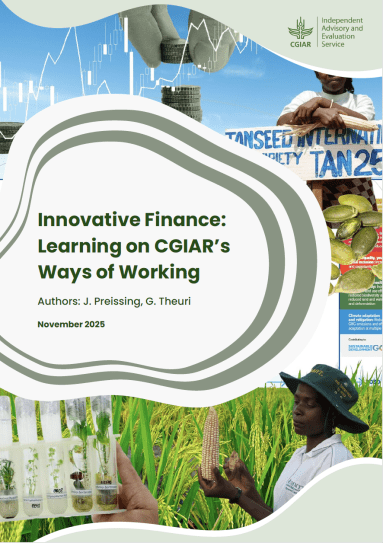
The summary examines CGIAR’s progress towards innovative finance and resource mobilization, drawing on IAES Evaluation Function evaluations, Independent Science for Development Council (ISDC) and CGIAR Standing Panel on Impact Assessment (SPIA) sources, 2025–30 Portfolio inception reports, external literature, field evidence from the Republic of Uganda, and a webinar with key stakeholders. The report presents findings, lessons learned, key evidence gaps, and provides strategic takeaways for CGIAR and partners to gain greater traction in innovative finance.
Overall, the summary found that CGIAR has strong scientific credibility, global networks, and technical expertise that can be used to attract and inform innovative finance instruments. Lasting progress will require building institutional capacities and strengthening strategic coherence across centers to translate finance innovation into scalable impact across agri-food systems.
Related:
Climate finance is a fundamental element of the global development agenda and has been increasingly considered in international fora such as the United Nations Framework Convention on Climate Change (UNFCCC) and the G20 Agenda. This publication aims to inform participants of the UNFCCC 30th Conference of the Parties (COP30), as well as UN agencies, international finance institutions, national governments of both donor and recipient countries, governmental and non-governmental stakeholders, and a wider group of partners interested in climate-related development finance to agrifood systems. The document was prepared as part of the work plan of the Food and Agriculture for Sustainable Transformation (FAST) Partnership.
No comments:
Post a Comment