
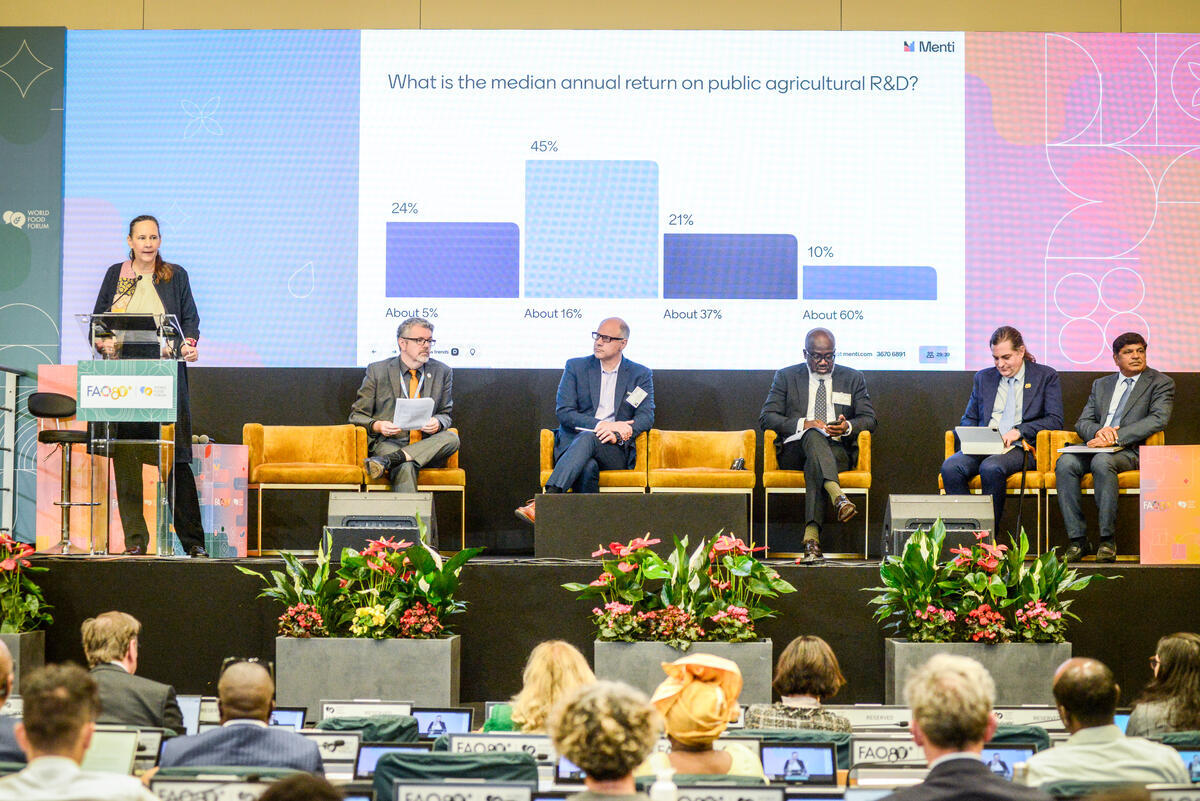
He challenged the panelists to consider four interconnected questions:
- How much should be invested? Why does agricultural R&D remain underfunded despite its demonstrated returns?
- Which financing instruments and partnerships work best? How can development finance, philanthropy, private investment and innovative funding models be mobilised?
- How should research funding be allocated and spent? Are short-term projects, competitive grants and conventional institutional arrangements delivering sufficient impact?
- Who decides what is researched? How can farmers, national research systems and underrepresented stakeholders gain greater influence over research priorities and investment decisions?
MAIN STATEMENT by Joanna Kane-Potaka:
Meeting agricultural R&D investment targets requires not only increased and better- tracked funding, but also equitable partnerships, stronger national research capacity, meaningful participation of farmers, women and young people, and greater transparency and accountability in decision-making to ensure local leadership and equitable research priorities.
Full transcript:
Many of us are aware of the pledges and calls for greater investment in agricultural research and innovation. The problem is that there is a long list of pledges and calls, stretching back decades. These include countries’ own investment targets and official development assistance (ODA) targets. To name a few, there have been the 2003 Maputo Declaration, the Malabo Declaration, African Union strategies, G20 calls, the 2021 UN Food Systems Summit, and the Kampala CAADP Declaration in 2025. The UN has also had longstanding targets. Most of these targets have not been met. Many are broken promises.
I am supposed to talk about money today, but I cannot help raising something that may be as important as the amount of money spent: the way we work. Reaching the targets will not have the desired impact if our approach is wrong. Are we delivering through equitable partnerships? Is innovation locally led? Are national systems and capacities being strengthened enough to deliver and lead? Have we moved from consulting stakeholders to forming genuine partnerships with them? Are all relevant stakeholders at the table? Are farmers at the centre? Are women and young people included? Ultimately, this is about power—and being prepared to shift it. Whoever controls the money has the opportunity to exert greater influence. They can determine even which research questions are answered. Are we measuring whether partnerships are equitable and leadership is local? Are we tracking who holds decision-making power?
At present, not adequately. There have been not only quantitative investment targets, but also commitments about how we work. These include the Africa Charter for Transformative Research Collaborations; the 2010 GCARD Road Map, which focused on equitable partnerships and locally led decision-making; the OECD’s 2011 Busan Partnership for Effective Development Co-operation, which emphasised country ownership, information-sharing and shared responsibilities; and the 2021 UN Food Systems Summit, which called for country-led transformation, inclusive national pathways, multi-stakeholder participation and better-coordinated investment in science and innovation. The Kampala declaration also emphasises strengthening national capacities.
We are not there yet. There are broken promises in these qualitative areas, too. So what should we do to support equitable partnerships and local leadership? We need to create an enabling environment in which these approaches can work in practice. We need better methodologies. Funders represented here today need to consider how their methods can support this shift. International organisations and governments also have a role. Do we have key performance indicators (KPIs) for this? Not adequately. We also need more evidence that these approaches lead to greater and more sustainable impact.
I will finish with two recommendations.
- First, track the money and the commitments more accurately and transparently. We should also track power and decision-making. Some financial tracking already exists, and some commitment tracking is under way, but tracking who holds power is largely missing. This would be a bold and necessary step.
- Second, connect quantitative targets with qualitative targets on equity and leadership. That would help us understand which types of financing genuinely shift power and support locally led research.


No comments:
Post a Comment