
4 September 2026. The GFAiR - The Global Forum on Agricultural Innovation and Research has officially launched four practical guides that provide frameworks, standards, and KPIs for measuring Equitable Partnerships across every stage of Research for Development (R4D) projects.
🌱 Who benefits? Researchers, project partners, and global agricultural initiatives at all levels.
The four guides include:
1️⃣ The Partnership Principles: Defines nine principles for building equitable, inclusive, transparent, and mutually beneficial partnerships in agrifood research and innovation. 3 p.
2️⃣ Guidelines for Application in Projects: Shows researchers how to apply the nine Partnership Principles at each stage of a project, from scoping and design through implementation, dissemination, and scaling. 6 p.
3️⃣ Assessment Tool (Manual): Provides a survey-based tool, available manually or digitally, for partners to assess how effectively a project is applying the nine principles and identify areas for improvement.
4️⃣ Partner-Inclusive Language Guide: Provides practical guidance on using language that recognises partners as equal contributors and avoids terminology that reinforces unequal power relationships in research partnerships. 13 p.
It was launched during a strategic dinner meeting on the sidelines of the AFS Forum 2026 in Kigali, Rwanda. These tools address a critical sector-wide gap.
As Joanna Kane-Potaka, GFAiR Executive Secretary, highlighted during the launch:
"There are no standards on measuring Equitable Partnerships, and a lot more work is needed. That is why GFAiR unveiled a series of guides for how to apply Equitable Partnerships in projects, as well as how to measure them at each stage of a Research for Development project."
🤝 Witnessed by Strategic Partners the launch was celebrated alongside key regional partners from the Forum for Agricultural Research in Africa - FARA, ASARECA, CORAF and CCARDESA, including:
- FARA: Dr. Aggrey Agumya (Executive Director)
- ASARECA: Sylvester Dickson Baguma (PhD) (Executive Director along with Dr. Joshua Okonya, Moses Odeke; Julian Barungi and Blaise Amony)
- CORAF: Dr. Emmanuel Njukwe (Director of Research and Innovation)
- CCARDESA: Dr. Majola L. Mabuza (Special Programme Coordinator, FSRP)
- GFAiR: Francois Stepman (Advisor), and Dr. Botir Dosov (GNC Consultant)
🌍 Supported by the European Commission, GFAiR works in close collaboration with six Regional Fora to drive agricultural innovation.
🫶 A massive thank you to all our partners for the continued support and collaboration in bringing this milestone to fruition!
 Related:
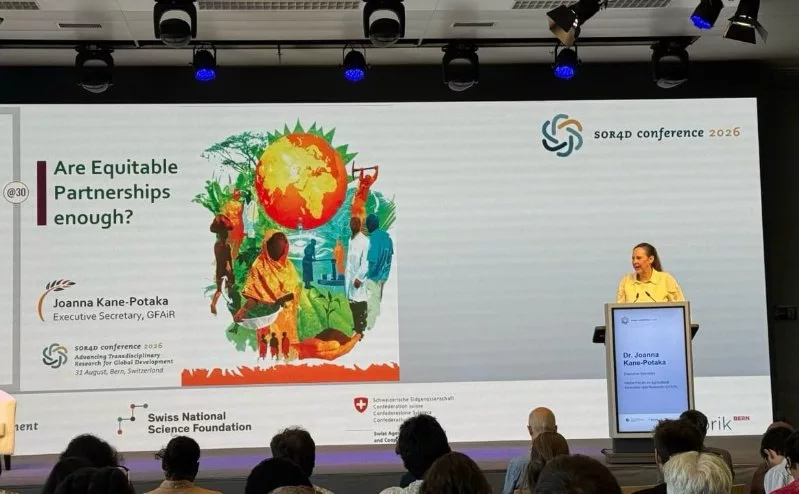
2 September 2026. Are Equitable Partnerships enough? The GFAiR time-tested approach
Equitable partnerships are necessary but not sufficient to transform agricultural research and development. Drawing on GFAiR Executive Secretary Joanna Kane-Potaka’s keynote at the SOR4D (Solutions Oriented Research for Development) conference in Switzerland under under the overarching theme “Advancing Transdisciplinary Research for Global Development: Crisis, Collaboration, and Change”, it makes the case for moving beyond shared decision-making and co-ownership toward genuine local leadership.
- Equity must lead to local leadership: Partnerships can be co-designed and co-implemented while power still remains with those controlling funding; genuine transformation requires external partners to relinquish some power and enable local actors to lead.
- External partners should build local capacity: Rather than protecting their own existing “comparative advantage,” international organisations should use their strengths to help national institutions develop the capabilities needed to eventually lead their own research and innovation.
- Funding can unintentionally reinforce inequity: Consolidating fragmented funding could reduce duplication and proposal-writing costs, but larger projects may exclude smaller or less-experienced organisations unless funding mechanisms are deliberately designed around equity and local leadership.
- National actors should set the agenda: Governments and national institutions need to have their priorities and voices amplified so that international partners support locally defined agendas rather than determining them.
- Partnerships need to be measured: There is currently no widely accepted standard for measuring equitable partnerships, which is why GFAiR is developing tools and guidance to assess partnerships throughout the research-for-development project cycle.
- The problem is often “how,” not “what”: The article suggests that many development challenges are not primarily limited by technical research capacity, but by how research is organised, who participates, who owns it, and whether solutions are taken up and scaled locally.
- The ultimate goal: GFAiR sees equitable partnerships as a step toward local leadership, greater ownership, uptake and scaling of solutions, and ultimately stronger development impact—with funders having a particularly important role in accelerating this shift.
Related:
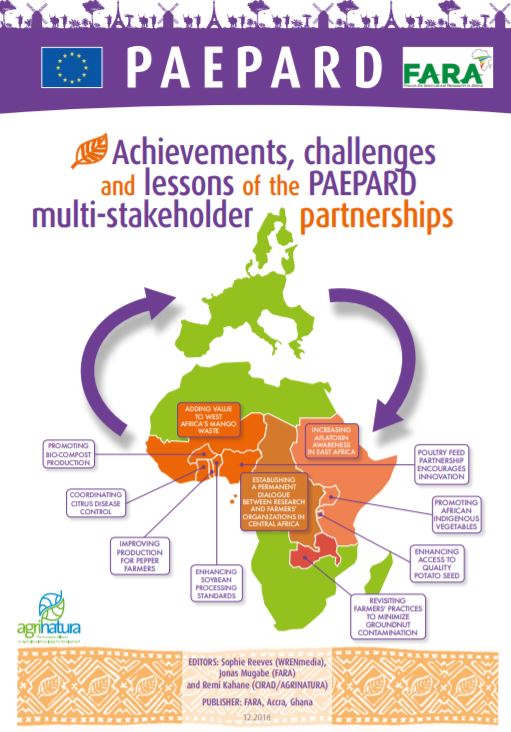
- ARD Partnerships – An Introduction: An introduction to agricultural research-for-development (ARD) partnerships and the PAEPARD approach.
- Systems Thinking and ARD Partnerships: Explores how systems thinking can help partners understand the wider context, relationships and dynamics affecting agricultural innovation.
- Adaptive Leadership in ARD: Examines leadership approaches for navigating complexity, uncertainty and change in multi-stakeholder agricultural partnerships.
- Managing Power Differences in ARD Partnerships: Focuses on recognising and managing differences in power, influence and resources among research and development partners.
- Gender and Youth Inclusion in ARD Processes: Looks at how agricultural research partnerships can meaningfully include women and young people rather than treating inclusion as an add-on.
- Reflection and Learning in ARD: Explores how partnerships can systematically reflect, learn from experience and adapt their approaches during implementation.
- Knowledge Co-creation and Management in ARD: Addresses how different stakeholders can jointly create, exchange, manage and use knowledge throughout the research and innovation process.
- Scaling in ARD Processes: Examines different pathways for taking successful agricultural innovations to greater scale, including scaling out, up and deep.


No comments:
Post a Comment