
From 1 to 6 September 2025, Africa hosted the second UNFCCC Climate Week, a solution-oriented global forum driving climate implementation and finance strategies. This was followed from 8 to 10 September by the Second Africa Climate Summit where African leaders and partners convened under the banner “Accelerating Global Climate Solutions” to showcase homegrown innovations, demand investment—not aid—and coordinate a unified continental front ahead of COP30.
Extracts of the programme
Below are the agriculture-focused sessions:
Enhancing Preparedness and Anticipatory Actions in Africa (8 Sept)
It spotlighted multi-hazard early-warning/early-action across agrifood value chains and showcased preparedness models relevant to farmers.
Speaker: Abebe Haile-Gabriel (FAO ADG/Regional Representative for Africa).
Enhancing Preparedness and Anticipatory Actions in Africa (8 Sept)
It spotlighted multi-hazard early-warning/early-action across agrifood value chains and showcased preparedness models relevant to farmers.
Speaker: Abebe Haile-Gabriel (FAO ADG/Regional Representative for Africa).
09/09 Enhancing Climate Change Adaptation and Resilience through South–South Technological Innovation
It examined how tools like climate-risk/vulnerability mapping and SSC technology transfer (e.g., drought-tolerant crops, low-cost irrigation) had been used to scale locally led adaptation in agriculture, water and energy, and it produced policy/finance recommendations for uptake.
Keynote: Prof. Celeste Saulo (WMO SG). Moderator: Dawit Solomon (AICCRA–ILRI). Panelists: Abebe Haile-Gabriel (FAO), Edith Ofwona Adera (AfDB/AAAP), Doris Mpoumou (UN Women to AU/UNECA), Matthias Naab (UNDP RSCA), Martin Krause (UNEP Climate Change Div.), Robert Ackatia-Armah (WFP Ethiopia).
Keynote: Prof. Celeste Saulo (WMO SG). Moderator: Dawit Solomon (AICCRA–ILRI). Panelists: Abebe Haile-Gabriel (FAO), Edith Ofwona Adera (AfDB/AAAP), Doris Mpoumou (UN Women to AU/UNECA), Matthias Naab (UNDP RSCA), Martin Krause (UNEP Climate Change Div.), Robert Ackatia-Armah (WFP Ethiopia).
09/09 Transforming Africa’s Food Systems for Climate Resilience & Agro-ecology
Organized by WRI, the session explored how agroecology and food-system innovations had advanced climate resilience, with examples on landscape approaches and farmer-centered practices.
Speaker : Edward Kilawe Senior Forestry Officer (FAO).
09/09 Locally Led, Forecast-Informed Climate Services for Resilient Smallholder Futures (9 Sept, evening)
Hosted by the NORCAP ARCS consortium, it highlighted how tailored, forecast-informed advisories had supported planting decisions and risk management for smallholders in Ethiopia and Malawi.Co-moderator: Joseph Kirule (FAO Ethiopia).
 09/09 Collaborative Solutions: Leveraging AI for Resilient Agriculture, Energy, and Risk Systems in Africa
This session showcased Earth Observation (EO)/Artificial Intelligence (AI) applications (from climate-smart agriculture and early warning to last-mile services), and it issued actions on financing, governance, and ethical/inclusive AI for farmer resilience.While locally driven, context-specific adaptation is vital, many African countries lack access to the technological tools and systems required to adapt effectively and at scale. Across the Global South, however, a wide array of cost-effective, proven technologies is emerging—from Earth Observation (EO) systems and open-source climate data platforms to Artificial Intelligence (AI) for early warning systems, precision agriculture, grid optimization, and resilient infrastructure planning. These innovations hold enormous promise for strengthening resilient agriculture, clean energy systems, and climate risk management, especially when tailored and scaled in African contexts.
Objectives: (see concept note)
- Identify promising AI, Earth Observation, and materials-based technologies emerging from the
Global South that can be localized and scaled to strengthen Africa’s agriculture, energy, and climate risk management systems. - Examine the financing, policy, and regulatory frameworks—including data governance, IP flexibility, and digital access—needed to accelerate the adoption and interoperability of climate technologies.
.png/122213bb-78ff-293a-2b59-736e866abc86?version=1.0&t=1757434463795&download=true)
- Assess strategies to ensure localized deployment reaches vulnerable communities, empowers youth and innovators, and integrates informal economies and citizen-driven solutions for last-mile resilience.
Moderator: Robert Lisinge (UNECA).
Keynote: Ousmane Ndiaye (DG, ACMAD).
AI can significantly improve people's understanding of climate patterns and forecasting capabilities.
He pointed out that traditional observation methods can be augmented by AI to predict outcomes based on historical data. However, he highlighted that high-quality data is essential for effective AI modeling, reinforcing the adage "garbage in, garbage out." The discussion also addressed the importance of technological access and modern computing resources, which are vital for AI training and application.
Panelists:

- Amjad Abbashar (UNDRR Africa)
He articulated the pressing need for effective leadership and governance as Africa prepares for urbanization, where the projected population of urban areas account 70 percent by 2050. Smart cities must integrate various services, including utilities like electricity and clean water, to ensure effective urban planning, he stressed. The director general also explored the potential of AI in optimizing energy usage from production to distribution, highlighting renewable energy techniques, recalling experiences from 2013 on Zero Net Energy Buildings. Manasseh envisioned a future where homes could generate electricity during sunny days, allowing owners to sell excess power back to the grid while drawing from it at night, potentially resulting in zero net payment due to energy production. As demand for energy continues to rise, particularly with the growing energy consumption associated with AI, he reiterated the necessity of incorporating renewable energy and green technologies, alongside effective policies and governance, to meet the growing demand. - Wilfred Ndifon (AIMS)
She emphasized AI's ability to accelerate learning; pointing out the critical issue of data governance, which raises concerns about data usage and potential misuse. Establishing clear guidelines for shared data is essential to build trust and maximize AI's effectiveness, she noted. She identified financing as a significant challenge, urging policymakers to prioritize investment in AI initiatives tailored to agriculture, calling for multilateral organizations to contribute to funding research and AI projects, citing the emergence of innovative solutions, such as a virtual agronomist platform that enables farmers to seek timely advice. - Namukolo Covic (ILRI/CGIAR, Ethiopia Rep.)
- Fatima Denton (UNU-INRA)
- Emmanuel Manasseh (ITU Africa).
SIDE EVENTS
08/09 Regreening Africa: Building climate-resilient food systems through land restoration
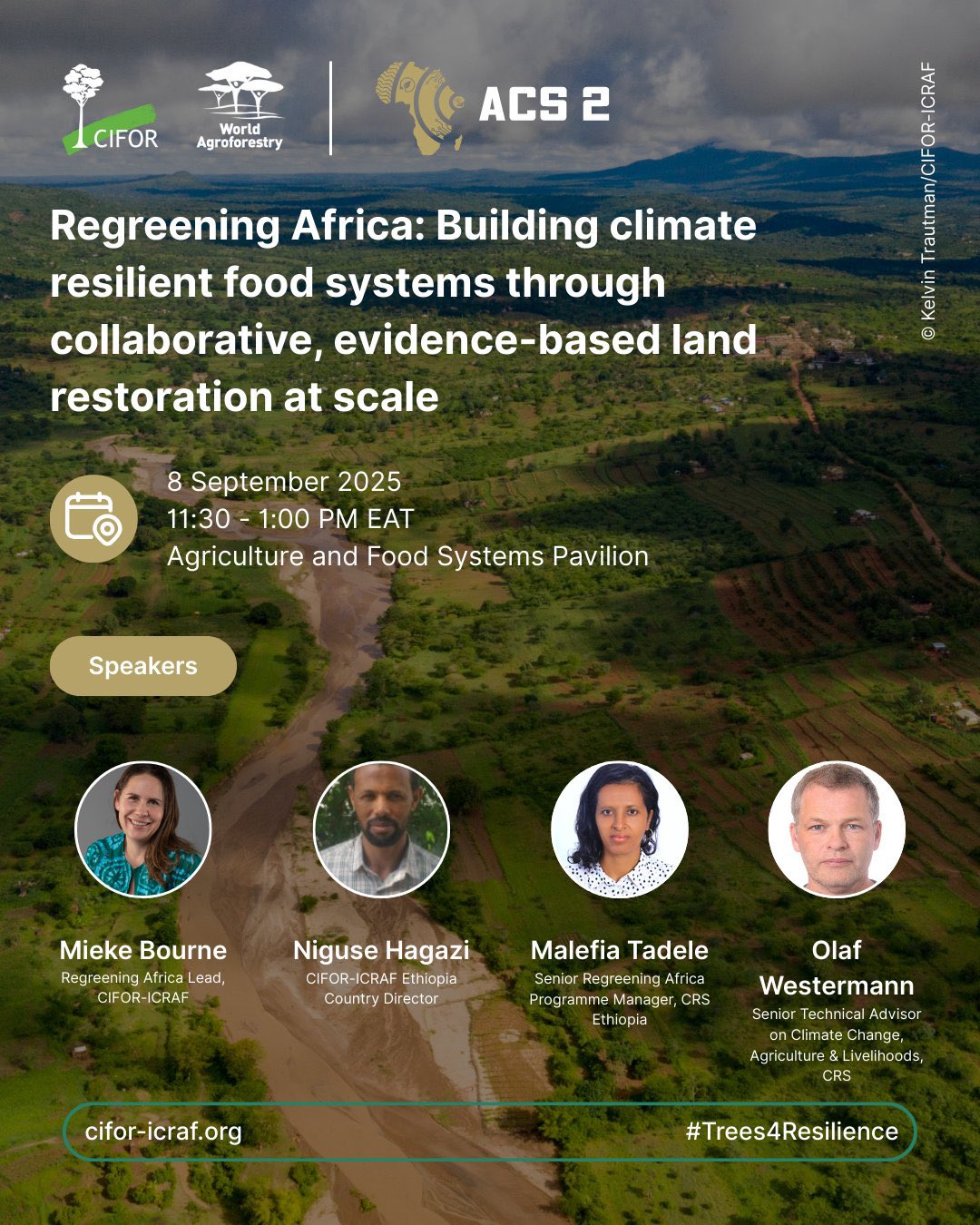
(CIFOR-ICRAF side event)
It presented evidence that large-scale restoration under the Great Green Wall vision had strengthened food security and adaptation; organizers promoted replication and investment pathways; specific speakers were not listed on the public agenda posts.
09/09 Rooted in resilience: Governance, financing and technical support for locally led, biodiversity-rich, climate-smart restoration
(CIFOR-ICRAF side event)It highlighted community-led restoration models that had improved farm productivity and ecosystem services, and it called for blended finance for locally led projects; individual speakers were promoted via social posts rather than a formal list.

(ECDPM side event)
It argued that investments (e.g., green ammonia for low-carbon fertilizer) had simultaneously advanced adaptation and ag-industry growth, and it proposed pipelines for Africa-Europe collaboration.


No comments:
Post a Comment