

The event focused on promoting “opportunity crops” — lesser known, nutrient-rich, resilient crops that are environmentally friendly and have potential to support food security. It was part of the BOLDER initiative, aiming to build momentum around those crops in Africa. The program included opening remarks, panel discussions, short talks, thematic sessions from seed to table, and conversations about preserving crop diversity. Learn more about BOLDER.

- Cody Gildart, Chief Communications Officer, Crop Trust
- Stefan Schmitz, Executive Director, Crop Trust Talk: “Within Diversity; Among Diversity”
- Céline Termote, Senior Scientist and Regional Team Leader for Food Environment and Consumer Behavior, Alliance of Bioversity International and the International Center for Tropical Agriculture (CIAT)

- Mercy Mwambi, Agricultural Economist, World Vegetable Center (WorldVeg)
- Matilda Ntowa Bissah, Scientist, Council for Scientific and Industrial Research - Plant Genetic Resources Research Institute (CSIR-PGRRI), Ghana

- Sarah Paule Dalle, Researcher, Department of International Environment and Development Studies (Noragric), Norwegian University of Life Sciences (NMBU)
- Peter Emmrich, John Innes Centre (JIC)
- John Adriko, Director of Research, National Forestry Resources Research Institute (NaFORRI),
National Agricultural Research Organisation (NARO), Uganda
What are researchers seeing in terms of production trends, markets, and shifts in consumer preferences?
- Mercy Mwambi, Agricultural Economist, World Vegetable Center (WorldVeg)

- Céline Termote, Senior Scientist, Alliance of Bioversity International and CIAT
- Nora Castañeda-Álvarez, BOLDER Project Coordinator, Crop Trust
- Nico Wilms-Posen, Project Coordinator, Power of Diversity Funding Facility, Crop Trust
How farmers are working with researchers to test, select and adopt diverse crops using the 'tricot'

- Kauê de Sousa, Scientist, Alliance of Bioversity International and CIAT
- Carlos Houdegbe, Faculty of Agronomic Sciences, University of Abomey-Calavi, Benin
- Sognigbe N’Danikou, Scientist, World Vegetable Center (WorldVeg)

- Mujuni Sospeter Kabululu, Senior Research Officer, Tanzania Plant Health and Pesticides Authority
- Dèdéou Apocalypse Tchokponhoue, Genebank Manager, University of Abomey-Calavi, Benin
A look at what’s next: how to build equitable, sustainable food systems with support from national governments and new initiatives.
- Nora Castañeda-Álvarez, Crop Trust
- Nico Wilms-Posen, Crop Trust
Video published 03/12/2025
Background:
Initially, the PDFF will focus on 14 high-potential opportunity crops in seven countries,: Colombia, Kenya, India, Nigeria, Tanzania, Uganda and Zambia. Additional funding can extend the project’s reach to more countries, driving a shift towards resilient and sustainable agrifood systems worldwide.
Backed by an initial investment of €10 million from Germany (the German Federal Ministry for Economic Cooperation and Development (BMZ) through KfW Development Bank) and €2 million from Ireland, the PDFF will empower farmers to diversify their agricultural systems with resilient and nutritious alternatives to mainstream crops. The German funding will come via KfW, the German Development Bank, and Ireland is providing funding through its Department of Foreign Affairs.
National Workshops

Kenya: 18–22 August 2025. Nairobi. Finger millet and amaranth were selected as Kenya’s priority “opportunity crops” during the two-day National Stakeholder Consultation under the Power of Diversity Funding Facility (PDFF). They were chosen from a longlist of 43 crops. The initiative will be implemented in collaboration with Alliance of Bioversity International and CIAT, and Kenya’s Agricultural and Livestock Research Organization (KALRO).
- Edwin Garzón-Horta — PDFF Project Specialist, Crop Trust
- Dr. Gloria Otieno — Genetic Resources & Food Security Policy Specialist, Alliance of Bioversity International & CIAT
- Peterson Wambugu — Genetic Resources Research Institute (GeRRI), Kenya

- Evelyne Okoth — Farmer representative from Kisumu
India: 19-20 August 2025. Chennai. Foundation National Stakeholder Consultation on Opportunity Crops in India, under the Power of Diversity Funding Facility (PDFF).
India’s agricultural landscape is rich with diversity, yet many traditional crops have quietly faded from mainstream attention. At the national dialogue hosted by the MS Swaminathan Research Foundation and Crop Trust called the ‘Power of Diversity Funding Facility – Identifying Priority Opportunity Crops’, scientists, farmers, and policymakers came together to spotlight these neglected and underutilised species (NUS)—and why they might hold the key to a healthier, more sustainable future.

process to choose opportunity crops brought together representatives from the national government, farmers, researchers, environmental organizations, international cooperation agencies, agricultural unions and the private sector. The group finally chose peach palm and chayote, opportunity crops that will now receive critical support from the Funding Facility to tap their full potential for Colombia’s communities and economy.

In Nigeria the consultation tackled a list of 37 possible crops. Fonio and pigeon pea came out on top.

The Crop Trust’s Power Of Diversity Funding Facility brought together partners from the Zambia Agricultural Research Institute (ZARI), the National Genebank of Zambia, local experts and farmers to identify Opportunity Crops that matter most for the country’s agricultural future. The top picks? Sorghum and cowpea – crops that can withstand harsh conditions while providing reliable nutrition.
Uganda: 1–2 August 2024. Kampala. Stakeholder Mapping and Crop Prioritization workshop for the BOLDER Project on Neglected and Underutilized Species (NUS) in Uganda 47 pp.
Organized by: The Alliance of Bioversity International & CIAT (CGIAR), which coordinated the Uganda and Tanzania workshops for BOLDER.
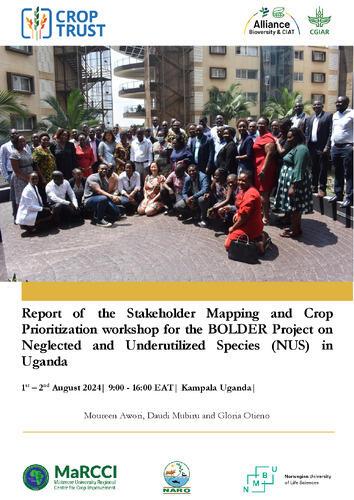
These species collectively offer immense potential for strengthening Uganda’s food systems, improving
dietary diversity, and fostering sustainable economic development. By focusing on their promotion and utilization, Uganda
can leverage their climate resilience, nutritional benefits, and cultural relevance to address malnutrition and support long-term growth.
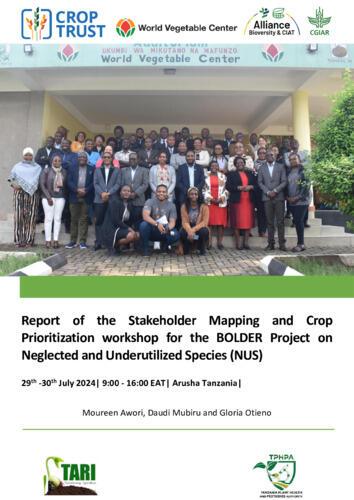
A stakeholder workshop in Tanzania convened 55 participants to identify priority Neglected and Underutilized Species (NUS) crops, develop comprehensive stakeholder lists, and define roles within NUS food systems. The workshop identified five key priority crops: sweet potatoes, finger millet, Moringa, Bambara groundnuts, and Jute mallow. Participants emphasized the importance of selecting crops with traits such as pest and disease resistance, drought tolerance, high nutritional value, and marketability. These traits are critical for enhancing food security, improving nutrition, and ensuring the resilience and sustainability of local food systems. The collaborative efforts of stakeholders aimed to strengthen NUS integration into Tanzania’s agricultural value chains and promote their broader adoption.


No comments:
Post a Comment