
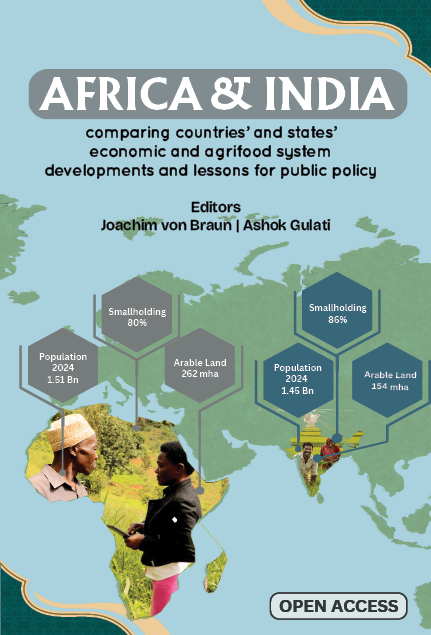
This book adopts a unique approach, using African countries and Indian states as units of analysis, matched based on various indicators, to draw actionable lessons for both regions. Interestingly, the quantitative assessments highlight that on some key indicators some Indian States are ahead, and on some indicators some African countries are ahead of Indian States.
By comparing the two regions in such disaggregated ways at state and national levels, it highlights critical lessons for boosting agricultural productivity, enhancing food security, and addressing malnutrition, fostering mutual South-South learning.
It provides new insights into the patterns of structural change in Africa and India, examining the drivers of agricultural growth, the nutrition outcomes of structural transformation, and the role of public spending in shaping these dynamics.
 (formerly Africa Agriculture Status Report)
This report highlights Africa’s gains in agricultural productivity, nutrition, and longevity while calling for transformative, systemic action to ensure inclusive systems amid persistent undernutrition and climate shocks.
By comparing the two regions in such disaggregated ways at state and national levels, it highlights critical lessons for boosting agricultural productivity, enhancing food security, and addressing malnutrition, fostering mutual South-South learning.
It provides new insights into the patterns of structural change in Africa and India, examining the drivers of agricultural growth, the nutrition outcomes of structural transformation, and the role of public spending in shaping these dynamics.
AGRA (2025) Africa Food Systems Report 2025, 154 pp.

This report highlights Africa’s gains in agricultural productivity, nutrition, and longevity while calling for transformative, systemic action to ensure inclusive systems amid persistent undernutrition and climate shocks.
This report introduces, for the first time, a selected set of food systems key indicators (Chapter 1 page 3), which measure Africa’s performance across five domains: food supply chains, diets, food environment, systemic drivers, and outcomes. These indicators are fertilizer use, irrigation, mechanization, dietary diversity, cost of diet, intra-African trade, access to finance, policy coherence, poverty, stunting, and greenhouse gas emissions. It provides a baseline which will enable Africa to monitor progress year-on-year and show progress towards the CAADP commitments.
See also IFPRI events
 This report presents policy insights aligned with the Kampala Declaration and new CAADP agenda, focusing on building resilient, inclusive agrifood systems that deliver equitable livelihoods for youth, women, and vulnerable populations.
Highlights how 20 priority crops (VACS) can significantly improve micronutrient intake across 41
African countries, backed by an interactive dashboard for selecting and scaling these crops.
Content:
- Governance and policies for agrifood systems transformation
- Drivers of sustainable farming and resilience in Africa
- Food baskets and corridors in africa: from production zones to engines for agri-food systems transformation
- Innovative finance and investments for agrifood systems transformation
- Transforming Africa’s agrifood systems through infrastructure
- Knowledge support for agrifood systems transformation
- A call to action on the implementation of the agrifood systems approach in Africa
IFPRI (2025) Global Food Policy Report 584 pp.
See also IFPRI events
Over the past 50 years, the world’s food systems have changed dramatically. Throughout, policy research has played a crucial role in providing evidence and analysis to inform decision-making that supports agricultural growth, better livelihoods, and improved food security and nutrition. The 2025 Global Food Policy Report examines the evolution and impact of food policy research and assesses how it can better equip policymakers to meet future challenges and opportunities.
This report provides a data-driven breakdown of development finance—grants, concessional loans, and other instruments—supporting African food systems, tracing changes before and after the 2021 UN Food Systems Summit.
The WHH Food System Toolkit contains practicable, current, state-of-the-art methods that are used to
assess, analyze, learn from, transform, and monitor influencing factors and dynamics of food systems and interrelated sub-systems (e.g., farming practices, markets, WASH, nutrition, etc.).
 IFAD, IFPRI, AKADEMIYA2063 (2025) Africa Report on External Development Financial Flows to Food Systems 44 pp.
This report provides a data-driven breakdown of development finance—grants, concessional loans, and other instruments—supporting African food systems, tracing changes before and after the 2021 UN Food Systems Summit.
Key Recommendations (from the 3FS framework):
- Strengthen country-owned financing strategies integrating domestic and external resources.
- Reduce overreliance on food assistance by directing more funding toward long-term transformation.
- Fill investment gaps in infrastructure, nutrition, natural resource management, and agri-value chains.
- Promote complementary roles among bilateral, multilateral, and philanthropic actors.
- Equip policymakers with financial intelligence to plan, track, and manage resources effectively.
Welthungerhilfe (2025) Food System Toolkit, 129 pp.
The WHH Food System Toolkit contains practicable, current, state-of-the-art methods that are used to
assess, analyze, learn from, transform, and monitor influencing factors and dynamics of food systems and interrelated sub-systems (e.g., farming practices, markets, WASH, nutrition, etc.).
The toolkit is based on the WHH Food System Framework, which provides practical guidance on navigating food system transformation processes systematically and effectively. It aims to equip practitioners with advanced methods and tools for designing and implementing effective food systems transformation programs.
Welthungerhilfe (2025) A Growing Opportunity for Better Nutrition: study & Opportunity Crops Dashboard, 83 pp.
Highlights how 20 priority crops (VACS) can significantly improve micronutrient intake across 41
African countries, backed by an interactive dashboard for selecting and scaling these crops.
Opportunity crops have emerged as a leverage point to combat hidden hunger as they can both improve diets and enhance climate resilience. Opportunity crops are traditional or indigenous, locally adapted crops that are rich in micronutrients, more tolerant of extreme growing conditions, and traditionally underutilized. 
Though opportunity crops have attracted growing attention, research on what they can do for nutrition is still scarce. A new, cutting-edge study commissioned and co-authored by Welthungerhilfe provides the first quantitative and policy-oriented analysis of how scaling up the production and consumption of opportunity crops could help to close micronutrient intake gaps.
The study covers 20 opportunity crops and 12 essential micronutrients in 41 countries with a high burden of hunger and undernutrition.
The study shows that opportunity crops offer a promising solution for addressing hidden hunger. They are particularly well suited to improve intakes of calcium, folate, riboflavin, vitamin C, vitamin E, among others. Some opportunity crops are rich in iron, zinc, and magnesium as well, even when considering that these nutrients are less bioavailable in plants than in animal-source foods. They can also help to address seasonal nutrition gaps as many can be harvested year-round or preserved through drying, fermentation, or long shelf life.
 Alliance of Bioversity International and CIAT; Chinese Academy of Agricultural Sciences (CAAS); Yunnan Agricultural University. (2025). 2025 Kunming Manifesto: Agrobiodiversity for People and Planet. Rome (Italy): Bioversity International / Cali (Colombia): International Center for Tropical Agriculture / Beijing (China): Chinese Academy of Agricultural Sciences. 37 pp.

3 September 2025. The Alliance of Bioversity International and CIAT launched the Kunming Manifesto on Agrobiodiversity at #AFSForum2025. This landmark report presents agrobiodiversity as a core driver of improved nutrition, healthier ecosystems, and resilient livelihoods, drawing on the insights of experts from the Third International Agrobiodiversity Congress. Case studies from around the world explore the potential to increase productivity, investment, and market demand, offering actionable recommendations to integrate agrobiodiverse practices into policy, contributing to resilient agrifood systems globally.


No comments:
Post a Comment