
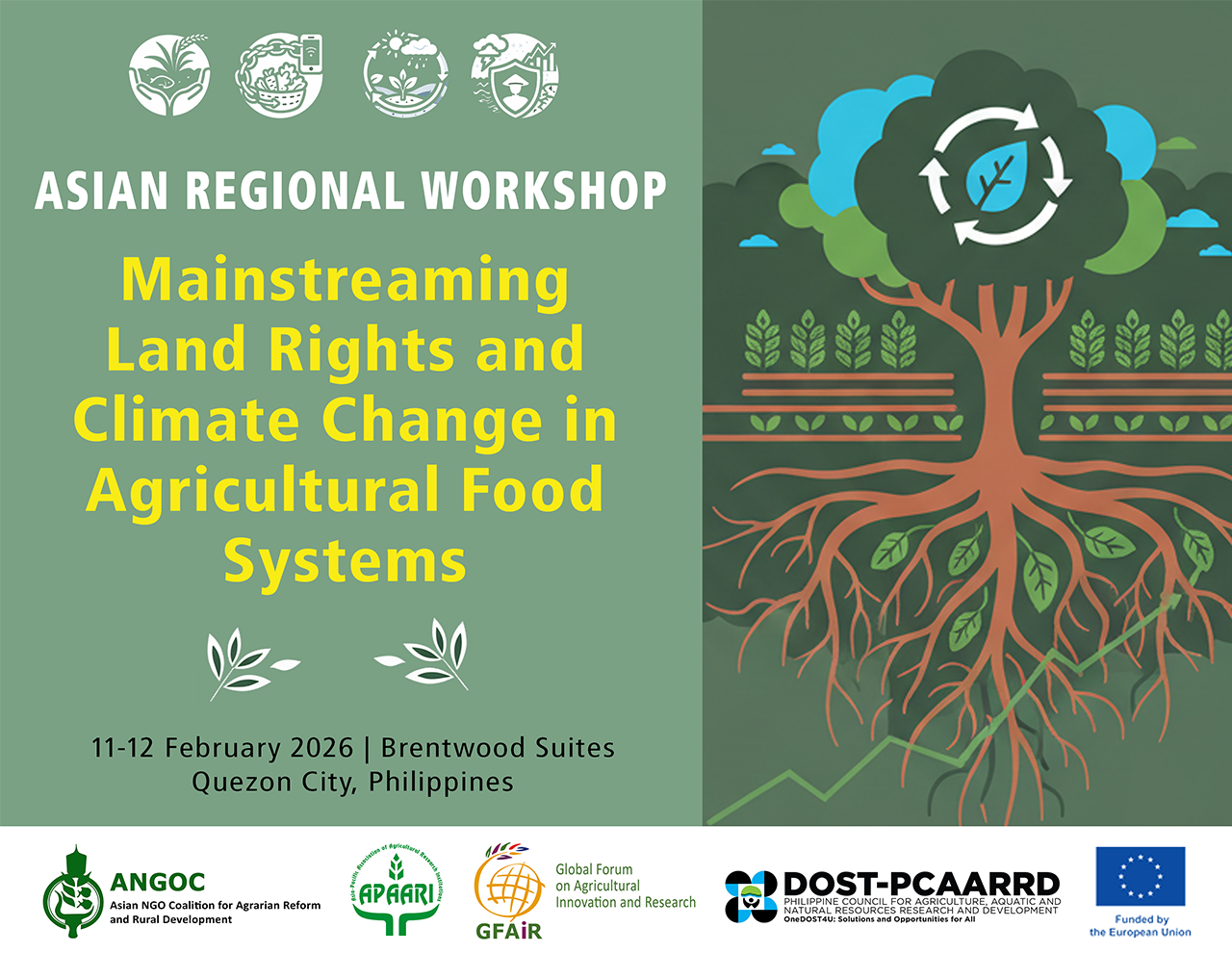
Day 1 (11 February 2026) - Please register here for Day 1
Day 2 (12 February 2026) - Please register here for Day 2
Research and development on food and agriculture in recent decades have focused on increasing productivity prompted by uncertainties of food supply. These undertakings have secured the food needs of the global population as affirmed by FAO in The State of Food and Agriculture of 2023 that “agrifood systems generate significant benefits to society, including the food that nourishes us, and jobs and livelihoods for over a billion people”.[1]
However, this development pathway opened opportunities to commercialize food and agriculture attracting multinational corporations to establish large scale plantations, congregating international value chains, and marketing taking on a global scale. Today, just a handful of powerful agri-corporations dominate each of 11 key industrial agrifood sectors – from seeds and fertilizers to grocery retail and food delivery.[2]
Moreover, advances in productivity have been negated by climate change – as rural livelihood and livelihood assets become more exposed and vulnerable to changes in rainfall and drought patterns. Many Asian countries also have large growing populations with a high proportion of poor people living with tenure insecurity which lessens their resiliency to the adverse effects of disasters and to cope with climate change.
Civil society organizations (CSOs) and farmer organizations[3] have been advocating the need for greater focus on community-led, farmer-based research and extension, sustainable farming systems, greater recognition of indigenous knowledge and gender equity, among others.[4] While thematic priorities vary among these groups, they are consistent in focusing on vulnerable smallholder producers with insecure land tenure, high vulnerability to environmental disasters and weak market linkages.
Given that the problems are complex and multifaceted, a wholistic approach of looking at the interplay of land tenure, climate change, and food security towards transforming the food systems is recommended. Recognising the social function of land increases the opportunities to emphasize the cultural, as well as the nutritional importance of food systems and provides an important reference point when designing land use, and particularly change of land use, regulations and policies.
The Asian Regional Workshop organized jointly by Asian NGO Coalition for Agrarian Reform and Rural Development (ANGOC) and the Asia-Pacific Association of Agriculture Research Institutes (APAARI), in partnership with the Global Forum on Agricultural Research and Innovation (GFAiR) and the Philippine Council for Agriculture, Aquatic and Natural Resources Research and Development (PCAARRD), will discuss the challenges and recommend policies towards building "productive, equitable, and resilient agricultural systems."
This regional workshop was undertaken as part of GFAiR Collective Action on Land Tenure and Climate Change, coordinated by ANGOC and funded by the European Commission (EC).


No comments:
Post a Comment