Platform for African – European Partnership in Agricultural Research for Development
Showing posts with label Pakistan. Show all posts

Monday, December 2, 2024

PlantwisePlus: Sustainable solutions for a food-secure future

25 November 2024. InfoPoint conference: Empowering smallholder farmers to safeguard crops, livelihoods and biodiversity

Recording available

PlantwisePlus supports countries to predict, prevent, and prepare for plant health threats, helping farmers to produce safer, higher-quality food through sustainable crop production. PlantwisePlus addresses three critical challenges for smallholder production: preparing for pest and invasive species outbreaks, reducing pesticide risks, and improving access to farmer advisory services. With a target to reach 75 million smallholder farmers in 27 countries around the world, the role of PlantwisePlus in supporting agricultural resilience, food security, and environmental sustainability will be key focus areas of this InfoPoint. 

The session featured speakers from CABI, who offered an overview of the programme’s achievements and vision, as well as two programme partners from Zambia and Pakistan who are involved in on-the-ground implementation. These partners shared how PlantwisePlus supports their national strategies for sustainable agricultural development, demonstrating the vital role of partnerships in achieving lasting impact. 

  • Leonard Mizzi – Head of Unit INTPA F3- Sustainable Agri-Food systems and Fisheries
  • Dr Daniel Elger – CEO, CABI
  • Dr Janny Vos – Partnerships Development Director, CABI
  • Zombe Sikazwe - Senior Seeds Officer, Seed Control and Certification Institute (SCCI), Zambia
  • Dr Imtiaz Hussain - Member Plant Sciences, Pakistan Agricultural Research Council (PARC), Pakistan

Thursday, August 22, 2024

The Role of Consumers in Agroecology

22 August 2024. The International People’s Agroecology Movements, IPAM, posed a central question as part of a webinar series “The Future is Now: Resilience and Sovereignty through People-led Agroecology”, namely: What’s the role of consumers in mainstreaming agroecology?

The International People’s Agroecology Movements, IPAM is a research-learning-action approach to agroecology that focuses on small-food producers and farming communities. 

  • IPAM promotes agroecology as a sustainable approach to agriculture and food production and development, in the framework of food sovereignty, ecological and social justice. 
  • It is an innovative approach developed by a network of farmers and women’s organisations, NGOs, researchers and academic institutions. 
  • IPAM is a network of Field Learning Sites (FLS) situated in different communities across regions. The FLSs are training centres or campuses of farmers’ fields, CSOs, institutions and universities that offers on-site learning on agroecological farming methods, innovations and techniques. The FLSs offer structured sessions, study tours, visits, immersions and exchanges among farmers, students.

The webinar highlighted the roles consumers play in the creation of a just, healthy, equitable and sustainable food system. With a focus on civic participation beyond consumption, transformation in food systems was explored through the lens of the consumer.


  • Charlene Tan Good Food Community, Philippines 
  • María Julia Jiménez Movimiento Agroecológico Boliviano Slow Food Bolivia 
  • Nasira Habib Organica Pakistan/ Khoj-Society for People's Education 
  • Thongdam Phongphichith Sustainable Agriculture and Environment Development Association,  Lao PDR
  • Rita Saavedra Consumidores Conscientes y el Observatorio Agroecológico

Resources


Tuesday, May 28, 2024

9th International Symposium on Soil Organic Matter (SOM2024)

26 - 31 May 2024. The 9th International Symposium on Soil Organic Matter (SOM2024) is currently underway at the Mohammed VI Polytechnic University (UM6P) in Benguerir, marking the first time the event has been held on the African continent.

See programme

Africa plays a critical role in global food security, with vast agricultural lands and a rapidly growing population. However, the continent also faces unique challenges when it comes to soil health. Decades of drought, overgrazing, and inadequate land management practices have contributed to soil degradation, a major threat to agricultural productivity.

According to a press release, SOM2024 aims to address these issues by showcasing the expertise of African researchers in agriculture, environmental science, and soil science. The symposium provides them with a platform to share their knowledge and findings with leading international experts, fostering cross-continental collaboration and accelerating progress in understanding soil organic matter.

But the significance of SOM2024 goes beyond knowledge sharing. It’s about highlighting Africa’s contributions to finding solutions for global problems like soil degradation and climate change.


Related:

Find below a curated selection of videos on enriching soil quality organically shared by International People's Agroecology Movements, IPAM. All the videos are recorded in Urdu with English subtitles.
  • Convert garden waste into rich resource


IPAM PakistanIPAM Pakistan is a research-learning-action approach to agroecology that focuses on small-food producers and farming communities. 
  • IPAM promotes agroecology as a sustainable approach to agriculture and food production and development, in the framework of food sovereignty, ecological and social justice. 
  • At the core of IPAM is a network of Field Learning Sites, which serve as training centres or campuses of farmers’ fields, civil society organizations, institutions and universities that offer on-site learning on agroecological farming methods, innovations and techniques and sharing of experiences of movement-building for agroecology. 

Thursday, November 25, 2021

Agricultural Innovation Systems and the science-policy interface

22-26 November 2021. 8TH TAP PARTNERS ASSEMBLY

The Tropical Agriculture Platform (TAP) is a G20 initiative, officially launched in 2012, with a mandate to work towards bridging the capacity gap for agricultural innovation in the tropics. 
Its objective is to increase the coherence and effectiveness of capacity development interventions for agricultural innovation systems, so they can lead to sustainable change and impact at scale. Since its launch, TAP and its 52 Partners have embraced the Agricultural Innovation Systems (AIS) perspective, acting as a multilateral dynamic facilitation mechanism that enables better
coherence and greater impact of Capacity development interventions in AIS. 

TAP major achievements include the development and piloting of a Common Framework on Capacity Development for AIS (2015-2019), as well as practical tools and capacity development manuals, the integration of the TAP concept and approaches in to Strategic Plans, programmes and projects of the Partners, and development of TAPipedia,

The seventh TAP Partners Assembly comprised: 2 virtual meetings/sessions and Side-events on specific topics organized by TAP Partners.

Extracts of programme on side events

22/11 Strengthening the policy innovation capacity of food systems: how to engage in the science-policy interface?

Side event organized by the European Alliance on Agricultural Knowledge for Development (Agrinatura), the DeSIRA-LIFT project, the Directorate-General for International Partnerships of the European Commission (DG INTPA) and the DeSIRA initiative.

The science-policy interface is a key component of the innovation capacity of a food system. In this side event, various stakeholders reflected on their experiences with various science policy interfaces and share their lessons learnt on questions such as:
  • What capacities are needed to address policy issues and engage with policy makers?
  • How to develop interactions between research and policy?
  • What is the right level of interaction with policy makers?
Speakers:
  • Ismahane Elouafi, FAO Chief Scientist
  • Helena Posthumus (Agrinatura / WUR, DeSIRA-LIFT)
  • Keynote presentation: Engaging successfully in the science-policy interface: the case of viticulture in France | Jean-Marc Touzard (INRAe)
  • Koffi Alinon (CIRAD)
  • Selvaraju Ramasamy (FAO)
  • Kwaku Antwi (FARA)
  • Guy Faure (DG INTPA)
  • Closing remarks | Christophe Larose (DG INTPA)

22/11 Regional insights and challenges in investment in innovation for sustainable agriculture intensification, 

Organized by the Commission on Sustainable Agriculture Intensification (CoSAI) in collaboration with the Asia- Pacific Association of Agricultural Research Institutions (APAARI), the Forum for Agricultural Research in Africa (FARA), and FONTAGRO. See programme

25/11 Strengthening the Capacity of African Agricultural Innovation Systems: towards a Joint Action Plan (JAP) for Capacity Development in Africa’s Agricultural Innovation Systems

The CAADP ex-Pillar IV institutions-CAADP XP4, namely FARA, AFAAS, CORAF/WECARD, ASARECA, CCARDESA facilitate the strengthening of capacity among professionals and communities of practice in African institutions. The objective of the side event was to galvanize assembly members in aligning collective capacity development efforts towards confronting the challenges Africa’s AIS and supporting actions around climate emergencies & food and nutrition security, to drive inclusive agricultural transformation and improve livelihoods.
  • Moderator: Delgermaa Chulunbaatar
  • Samson Eshetu,  AFAAS
  • Salim Nahdy, AFAAS
  • Abdulrazak Ibrahim, FARA
  • Karen Munoko, FARA, Youth and agribusiness

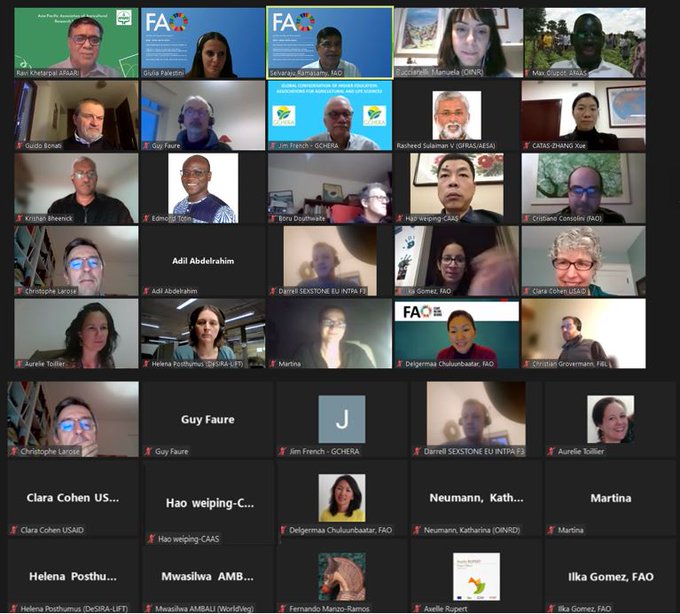
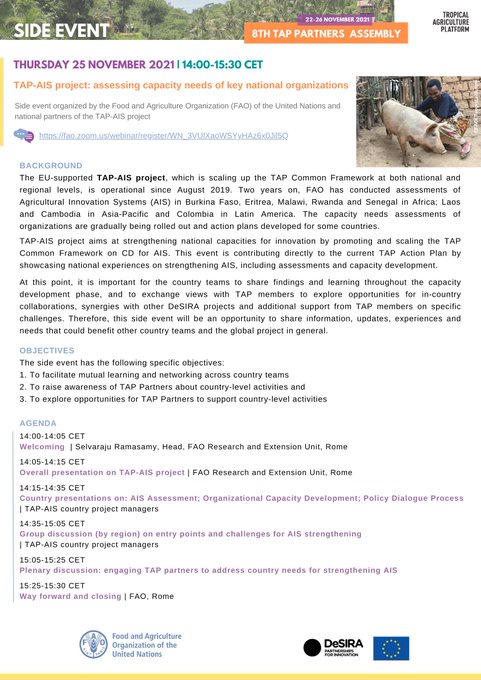
25/11 TAP-AIS project: assessing capacity needs of key national organizations

Two years on, FAO has conducted assessments of Agricultural Innovation Systems (AIS) in Burkina Faso, Eritrea, Malawi, Rwanda, Senegal; Laos, Cambodia and Colombia. The capacity needs assessments of organizations are gradually being rolled out and action plans developed for some countries. 

It's important for the country teams to share findings and learning throughout the capacity development phase, and to exchange views with TAP members to explore opportunities for in-country collaborations, synergies with other DeSIRA projects and additional support from TAP members on specific challenges. Therefore, this side event was an opportunity to share information, updates, experiences and needs that could benefit other country teams and the global project in general. 


Overall presentation on TAP-AIS project | FAO Research and Extension Unit, Rome 
  • Delgermaa Chuluunbaata, Agricultural extension officer at FAO
  • Manuela Bucciarelli,  Project Management, Monitoring and Evaluation Expert.
Country presentations on: AIS Assessment; Organizational Capacity Development; Policy Dialogue Process | TAP-AIS country project managers 
  • Moderator Anila Rahim - Pakistan
  • Aristide Sempore - Burkina Faso
  • Seyoum Teame - Eritrea
  • Bun Thol - Cambodia
  • Vornthalom Chanthavong - Lao DRC

26/11 Ways to Develop Agricultural Innovation Systems (AIS) via Integration of Industry-Education Research (IER)

The AIS is essential for sustainable agriculture development and innovation is one of the main driving forces. Industry, education, and research are basic factors that constitute to the AIS. Industrial demand fuels agricultural innovation and scientific research underpins agricultural development while education cultivates high-quality labor force. A virtuous cycle should be built to bolster the advancement of industry, education and research sectors. 

When industry raises a problem, solutions are found via research and cultivate talents to solve the issue, forming a “Three-in-One” mechanism. How to integrate the three factors to drive the agricultural innovation is a question needing further discussion. In order to map out specific ideas and measures for boosting AIS to spur the development of agriculture, Chinese Academy of Tropical Agricultural Sciences (CATAS) and Chinese Academy of Agricultural Sciences (CAAS) organised a webinar on Ways to Develop AIS via Integration of Industry-Education-Research.
  • Opening remarks |Dr. Selvaraju Ramasamy, Head of FAO-Research and Extension Unit, Rome
  • Welcome remarks |LIU Guodao, Vice President, CATAS, China.
  • Development of AIS through IER Collaboration of CATAS | LIU Kui, CATAS
  • Practices and Cases on International Cooperation for Agricultural Innovation Capacity of CAAS | HAO Weiping, CAAS
  • Contributions of CATIE to breeding, agroforestry and education in the coffee sector of the Americas | Rolando Hermes Cerda Bustillos, CATIE
  • AIS Development through IER Collaboration | John B. William, Alliance of Bioversity International and CIAT
  • AIS Development through Industry-Education Research (IER) Collaboration of CABI | Claire Curry, CABI
  • Practice and thought on AIS through Industry-Education Research (IER) Collaboration in Pakistan | Iqrar Ahmad Khan, University of Agriculture, Faisalabad, Pakistan @1:16:46 (video recording)

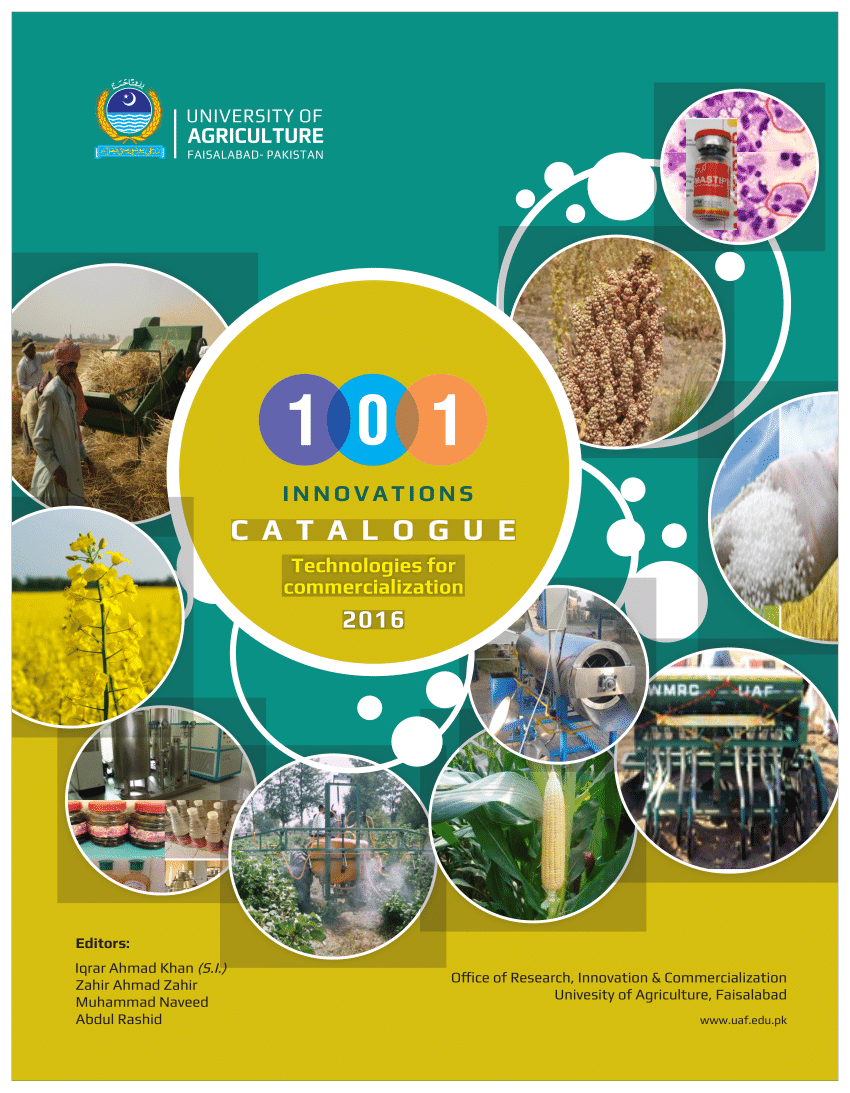
101 INNOVATIONS CATALOGUE Technologies for Commercialization 2016
This volume summarizes a 101 entries (products) which seems to have an immediate commercialization value. 
    • There are new varieties of cotton and mustard with competitive advantage of determinate growth and potential for mechanical harvesting. 
    • Three new hybrids of maize with high pro-vitamin A contents are ready for release in the public domain. Transgenic sugarcane is in the testing process. 
    • Ten new mango selections are being promoted. Two new breeds of backyard poultry have been developed. A large number of mechanical and agricultural engineering innovations have been made available for industrial manufacturing. 
    • There are several soil amendments and databases created to improve soils and enhance fertilizer use. The plant and animal pests and diseases are being addressed through environmentally safe interventions. Water and energy solutions have been developed for easy adoptions with a focus on renewable options. 
    • A special emphasis has been placed on reducing postharvest losses and value addition to capture markets within- and outside Pakistan. New our blending and fortification technologies are made available to address the malnutrition in children and women. The value addition also includes value chain interventions and development of novel products like vaccines, textile stripping technologies, guar gum control of aflatoxins and silymarin extraction from a weed. 
    • An important limitation to agriculture is delivery of information and services to the farmer. Innovative applications of ICT have been explored and offered for upscaling by the government and industry.

  • AIS Development through IER Collaboration of iShamba | Martin Aketch, iShamba, Kenya
    iShamba Farmer Insights (35 p.) 
    • Mercy Corps’ AgriFin is funded by the Mastercard Foundation and Bill and Melinda Gates Foundation to help organizations design, test and scale digitally-enabled services for Africa’s smallholder farmers. 
    • iShamba’s unique services are positively impacting farms and lives. It can improve farmer satisfaction by addressing their challenges and incorporating their suggestions for improvement. 
    • Over 90% of farmers reported improvements in their way of farming, farm production and revenue, and overall quality of life because of iShamba’s agricultural information service. They spoke about improved knowledge and ability to plan farm activities, increased yield and volume sold, and having more food for consumption.
  • Practices and thought on AIS through IER Collaboration of CGCOC Group | WANG Miao,
    CGCOC Group, China
    CGCOC is a mixed-ownership enterprise jointly funded by state-owned enterprises, management teams, local state-owned assets, overseas key employees and external natural persons. CGCOC has formed three regional centers in Africa, namely the eastern Africa, west-central Africa with English speaking regions and French speaking regions, covering 27 countries and accounting for 50% of the whole African countries, among which, CGCOC Nigeria Company has been established for 35 years.
  • Boost scientific and technological innovation: Construction of Big-data Platform for China Natural Rubber Industry Chain | LI Hantang, CATAS, China
  • Concluding remarks | LIU Kui, CATAS

26/11 Establishing and Operationalizing a Research, Technology and Innovation Platform for the Date Palm Integrated Production System in NENA Region 

Organized by the Association of Agricultural Research Institutions in the Near East and North Africa (AARINENA)

26/11 How to strenghthen agricultural innovation in Latin America

A session about the challenges and lessons learnt about the adoption of approaches and tools by regional research and extension organizations in Latin America and the Caribbean.