Platform for African – European Partnership in Agricultural Research for Development
Showing posts with label IFPRI;. Show all posts

Thursday, September 7, 2023

AGRF Summit Side events day 4: Journey towards COP28

5 - 8 September 2023. Africa's Food Systems Forum 2023 Summit’s theme, “Recover, Regenerate, Act: Africa’s Solutions to Food Systems Transformation

The AGRF Summit, which takes place from September 5th-8th, is an annual gathering that brings together heads of states and governments, agriculture ministers, members of the civil society, private sector leaders, scientists and farmers in discussions meant to define the future of Africa’s.


08/09 7:00-9:00 : Side event The CAADP Biennial Review Process: Promoting Data Use, Diversity, and Inclusion

The CAADP Biennial Review (BR) has highlighted the enormous demand for timely high-quality data to
guide performance monitoring and decision-making. It has also underscored challenges related to data availability and quality as well as the inadequate utilization of BR data and results
  • Dr. Godfrey Bahiigwa, Director, African Union Commission, Department of Agriculture, Rural Development, Blue Economy and Sustainable Environment (AUC- DARBE) 
  • Dr. Ousmane Badiane (see picture), Executive Chairperson, AKADEMIYA2063 
  • Ms. Constance Okeke, Project Manager, ActionAid International and CAADP Non State Actor Group (CNG) 
  • Prof. Joao Mutondo, Faculty of Agronomy and Forest Engineering, Eduardo Mondlane University, Mozambique 
  • Ms. Josephine Love, Principal Agriculture Officer, Ministry of Agriculture, Livestock, Fisheries and Cooperatives, Kenya 
  • Dr. Boaz Keizire, Head of Policy, Advocacy and Food Systems, AGRA
  • Dr. Samuel Benin, Deputy Director, Africa Office, IFPRI
  • Ms. Tsitsi Makombe, Director, External Relations, AKADEMIYA2063 
  • Dr. Augustin Wambo Yamdjeu, Director, Knowledge Systems, AKADEMIYA2063
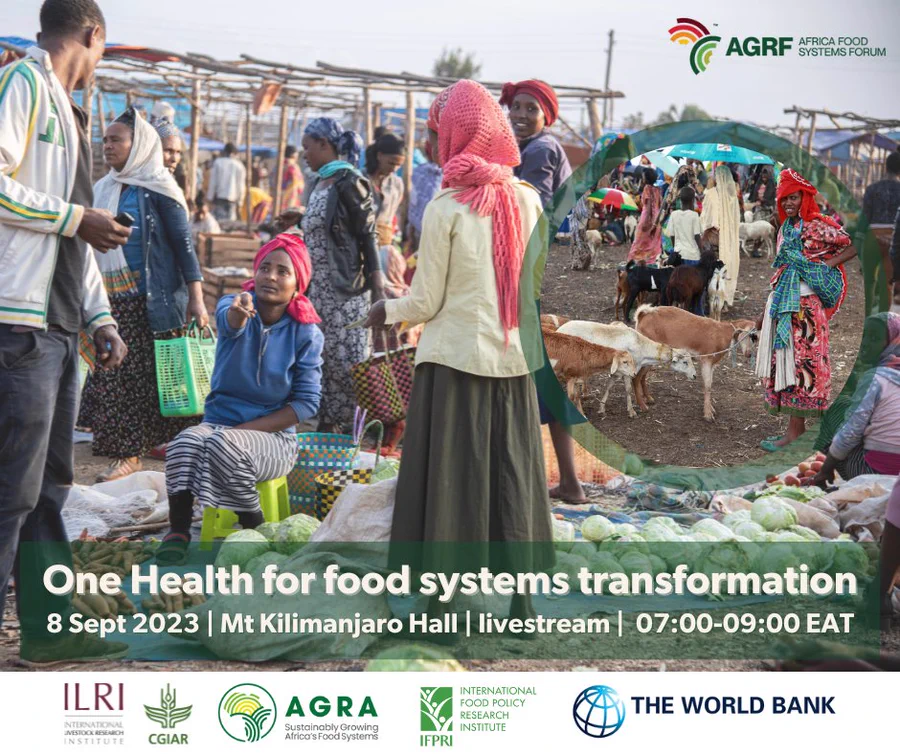
08/09 7:00-9:00 : Side event to discuss 'OneHealth for Food Systems Transformation

Food systems are often described as the single biggest contributor to complex global health challenges for people, animals, plants, and the environment through pollution, ecosystem degradation, greenhouse gas emissions, land and water use, chemical use, unhealthy and unsafe diets, animal welfare concerns, infectious disease risks, and biodiversity loss. 

The collaborative, multisectoral, transdisciplinary and systems focused nature of One Health allows it to make important contributions to the functioning of food systems and health through infectious disease prevention, surveillance and control, ensuring
food safety along food value chains in both formal and informal settings, and animal welfare in food production systems. 
  • Moderator – Dr. Namukolo Covic (see picture), Director General's Representative to Ethiopia, ILRI 
I. Keynote presentations on One Health for Food Systems Transformation
  • Dr. Johan Swinnen,  (see picture), DG, IFPRI/CGIAR [Food Systems] 
  • Mr. Martien Van Nieuwkoop, Global Director, Agriculture and Food Global Practice, World Bank [One Health]
  • Government of Tanzania [Tanzania’s One Health Platform] 
II. Panel Discussion 
  • Dr. Johan Swinnen, DG, IFPRI/CGIAR [Food Systems] 
  • Mr. Martien Van Nieuwkoop, Global Director, Agriculture and Food Global Practice, World Bank 
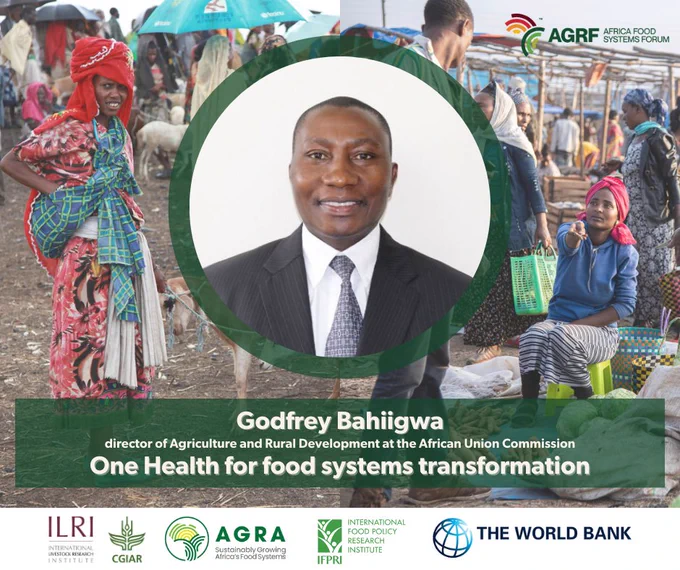
  • Dr. Godfrey Bahiigwa,  (see picture), Director of Agriculture and Rural Development,  (AUC- DARBE)
  • Mr. Vine Mutyasira, Program Officer, Policy Quantitative Modelling and Data Analytics, AGRA 
  • Dr. Iain Wright, Deputy Director General, ILRI 
Summary/conclusion: 
  • Dipti Thapa or Francisco Obreque, World Bank 
  • Michael Victor, ILRI

08/09 09:00 - 11:30 : Plenary Session title: Journey towards COP28: Adapting Africa’s Food System to Climate Change
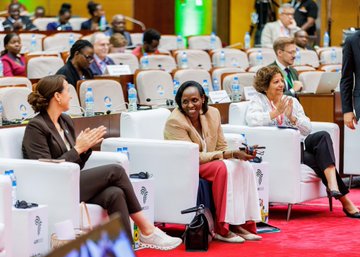
This plenary session explored the impact of climate change on food systems in Africa, the policy responses needed to ensure food security and action required for resilient food systems in the face of these challenges. 
This session builds on the Climate Action Summit and provides key recommendations as well as Africa’s position on food systems and climate nexus for COP 28.
  • Moderator Mr. Jeff Koinange, Anchor/Talk Show Host
  • Framing remarks Dr. Agnes Kalibata, President, AGRA and Special Envoy for the 2021 Food Systems Summit
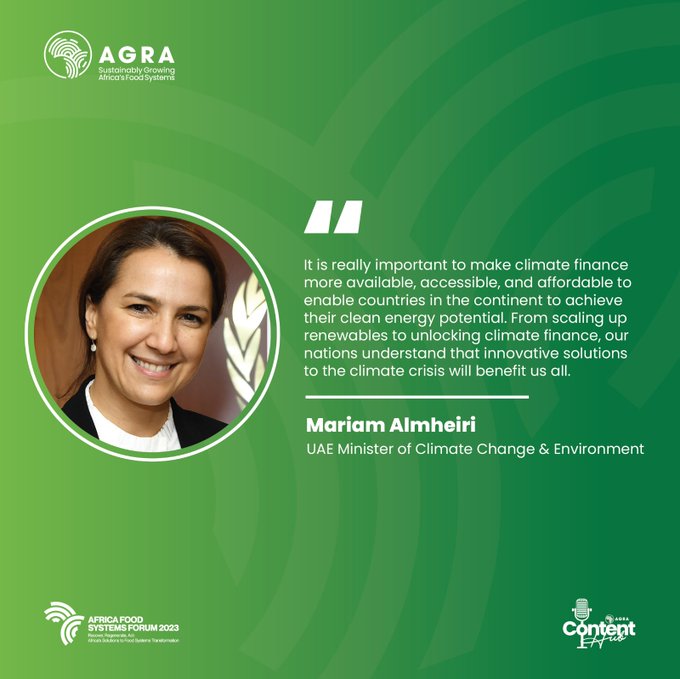
  • Keynote Speech H.E. Mariam Almheiri, Minister of Climate Change and Environment, UAE
Roundtable 1: Food Systems into National Plans and Implementation Mechanisms
The first roundtable discussed the importance of incorporating Food Systems into National Adaptation and mitigation plans, Nationally Determined Contributions (NDCs), and other national strategies. 
  • Dr. Johan Swinnen, Director General, Managing Director of Systems Transformation, CGIAR and Director General, International Food Policy Research Institute (IFPRI)
  • Hon. Lee White, Minister of Water, Forest, Sea and Environment, Gabon
  • Ms. Cristina Duarte, UN USG, Special Advisor on Africa
  • Hon. Selemani Saidi Jafo, Minister of State, Office of the Vice President Union and Environment, United Republic of Tanzania
  • Dr. Mithika Mwenda, Executive Director, Pan African Climate Justice Alliance
  • Moderator Mr. Daouda Sembene, CEO, AfriCatalyst (former Executive Director, IMF)
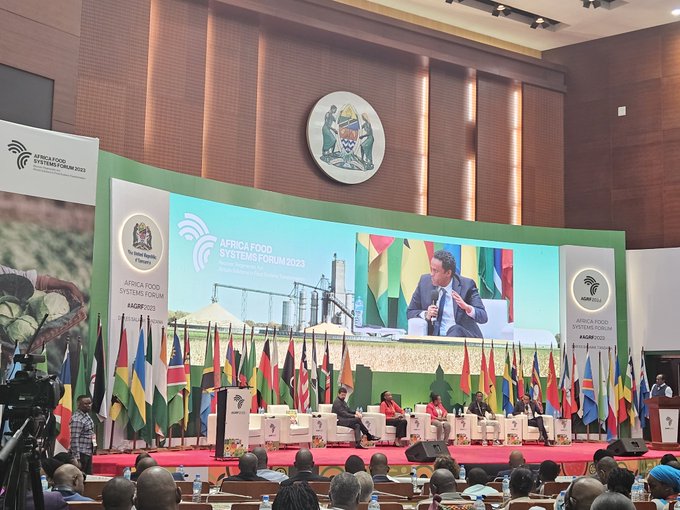
Roundtable 2: Future Proofing and Financing Food Systems
The  second roundtable focused on solutions to improve the resilience of food systems, including sustainable agriculture practices, innovative technologies, and improved supply chains.
  • Mr. Abdulmajid Musa Nsekela, CEO, Cooperative and Rural Development Bank (CRDB), Green Finance, Tanzania
  • Mr. Martien Van Nieuwkoop, Global Director for Agriculture and Food, World Bank
  • Ms. Ann Vaughan, Senior Advisor for Climate Change, Bureau for Resilience and Food Security, USAID
  • Mr. Tabi Joda, Lead, One Billion Trees for Africa Great Green Wall
  • Closing remarks Ms. Nadine Gbossa, Director, Food Systems Coordination, International Fund for Agricultural Development (IFAD)
Roundtable 3: Finance
Lastly, the third roundtable, explored the financing needed to support these solutions, including public and private sector investment, and access to climate finance. 

08/09 09:00 - 11:30 : Sustainable Livestock and Pastoralism Transformation


This session provided a forum for governments, producer organizations, research and academic institutions, development agencies, civil society organizations and private sector to engage in dialogues on innovations and food systems pathways to efficiently produce more nutritious, safe and accessible animal source foods with a reduced environmental footprint, and contribute to vibrant local and diversified livestock systems that are more resilient to shocks and disruptions in Africa.
  • Moderator Ms. Zuhura Yunus, Director of Presidential Communications, Tanzania State House
  • Hon. Abdallah Ulega, Minister of Livestock and Fisheries, United Republic of Tanzania
  • Dr. Shirley Tarawali, Chair, Global Agenda for Sustainable Livestock & DDG, ILRI
Roundtable 1 Sustainable Livestock Transformation
  • Dr. Babafemi Oyewole, Chief Executive Officer, PAFO
  • Hon. Fred Bwino Kyakulaga, Minister of State for Agriculture, Animal Industry & Fisheries, Republic of Uganda
  • Mr. Jean Baptiste HATEGEKIMANA, President of Continental Executive Committee, African Youth in Livestock, Fisheries and Aquaculture Incubation Network (AYL-FAIN)
  • Dr. Nyabenyi Tipo, Representative to Tanzania, Food and Agriculture Organization (FAO)
Roundtable 2 Supply and Demand of Animal Sourced Food
  • Dr. Anthony Whitbread, Director of the Sustainable Livestock System program, ILRI
  • Mrs. Margaret Munene, CEO, Palmhouse Dairy, Kenya
  • Dr. Juliana Kantengwa, Founder, Wood Valley Organics
  • Ms. Emmastella Gakuo, COO, Savannah Circuit, Kenya
  • Mr. Jay Waldvogel, Senior Vice President Strategy and International Development, Dairy Farmers of America, and Chair, Dairy Nourishes Africa for Global Dairy Platform
  • Ms. Prudence Masako, Country Director, CARE Tanzania

08/09 09:00 - 11:30 :Food Systems in a time of Crisis: Youth Refugees, Migrants and displaced people as part of the solutions


This session shared impactful stories on how the inclusion of young the refugees, migrants and displaced in Agri-Food Systems have helped to address urgent food demand and long-term recovery process and development in a humanitarian and post conflicts and climate crisis context.
  • Moderator Ms. Vanessa Adams, Vice President Strategic Partnership and CoP for Inclusive Agricultural Transformation in Africa, AGRA
Panel Discussion 1
  • Mr. Stanlake Samkange, Senior Director for Strategic Partnerships, WFP
  • Ms. Ada Osakwe, Managing Partner, Agrolay Ventures, AGRA Board Member, & Youth Ambassador Generation Africa
  • Ms. Alice Nzamukosha, Vice President of Zone 2, CODIGA Cooperative
  • Mr. Bernard Hien, Regional Director, West and Central Africa Division, IFAD
  • Mr. Ahmed Madobe Nunow, Minister of Agriculture and Irrigation of the Federal Republic of Somalia
  • Ms. Lian Biar Kuoirot Deng, NextGen Ag Impact Network, South Sudan (VIDEO)
Panel Discussion 2
  • Hon. Ms Josephine Joseph Lagu, Minister, Ministry of Agriculture and Food Security in South Sudan
  • Mr. Kayitare Shema, Vice President of the Cooperative, CODIGA Cooperative
  • Mr. Mahadi Hasan TUSHAR, NGIN Ambassador and Regional External Relations Coordinator, IAAS Asia Pacific
  • Mr Anthony Mhagama, Programme Manager, IUCNClosing RemarksMr. Zlatan Milisic, UN Resident Coordinator, Tanzania

08/09 09:00 - 11:30 : Green Financing Framework for Food Systems Transformation


In the wake of the Paris agreement, green financing mechanisms were heralded as a crucial pathway to support climate change mitigation and safeguard global food systems. To effectively protect food systems and build resilience, there is an urgent call for governments, international organizations, and private sectors to reinvigorate their commitments, channeling substantial resources into green financing initiatives that promote sustainable agriculture, biodiversity conservation, and equitable access to nutritious food.
  • Moderator Dr. Geeta Sethi, Advisor, Global Agriculture Practice, World Bank
Panel 1 Discussion
  • Mr. Ibrahima Cheikh Diong, United Nations Assistant Secretary General (UN-ASG) and Director General (GDG), African Risk Capacity Group
  • Hon. El Sayed el Quseir, Minister of Agriculture and Land Reclamation, Egypt
  • Hon. Mudrick Ramadani Soraga, Minister, Ministry of Labour, Economy and Investment Zanzibar, United Republic of Tanzania
  • H.E. Mohamed Beavogui, Former Prime Minister of Guinea and Special Envoy for the 13th Replenishment of IFAD
  • Mr. Bhupen Dubey, CEO, Advanta Seeds
  • Mr. Maurits Waardenburg, Co-Leader of McKinsey partnership with the Hydrogen Council, McKinsey & Company
  • Ms. Hope Murera, CEO, COMESA Insurance
Panel 2 Discussion: Green Banking
  • Mr. Kenneth Davis Kasigila, Head of Policy Advisory and Climate Finance, CRDB Bank
  • Dr. Peter Umunay, Senior Environmental Specialist, Global Environment Facility (GEF)
  • Mr. Juan Lucas Restrepo, Director General, Alliance of Biodiversity International and the International Centre for Tropical Agriculture (CIAT)
  • Dr. Conrad Rein, Director of Policy Outreach, Innovation Commission, Development Innovation Lab (DIL)
  • Hon. Emmanuel Mpawe Tutuba, Governor of the Bank of Tanzania
  • Mr. Boleslaw Stawicki, Country Director, Tanzania, IFAD, Tanzania

Monday, March 20, 2023

UN Water Conference Side Events

22 - 24 March 2023. UN Water Conference Water is a fundamental part of all aspects of life. Water is inextricably linked to the three pillars of sustainable development, and it integrates social, cultural, economic and political values. It is crosscutting and supports the achievement of many SDGs through close linkages with climate, energy, cities, the environment, food security, poverty, gender equality and health, amongst others.

With climate change profoundly affecting our economies, societies and environment, water is indeed the biggest deal breaker to achieve the internationally agreed water-related goals and targets, including those contained in the 2030 Agenda for Sustainable Development.Programme at a glance (105KB PDF)
The Side Event programmes are being updated on a rolling basis, to ensure you are viewing the latest version, access it through the website.

The Conference, co-hosted by the Governments of Tajikistan and the Netherlands, will feature an opening and closing ceremony, six plenary meetings and five multi-stakeholder interactive dialogues. It will also feature a number of high-level special events and side events organized by Member States, the UN system and other stakeholders.

20/03. Groundwater: Potential and Pitfalls for Africa 


by IFPRI, AMCOW; Water Research Institute Ghana; Federal Institute for Geosciences and Natural
Resources Germany; Ministry of Water and Sanitation Senegal; Ministry of Water and Environment
Uganda; IFPRI; African Union Commission; Gov. of Ethiopia; NEXUS Gains, ILSSI

The economy-wide benefits of accelerating groundwater development in Senegal and Uganda

Development of groundwater is key to accelerating agricultural and overall economic growth, fighting climate change, and generating employment in Africa. However, improvements in groundwater institutions are needed to increase equity and environmental sustainability in groundwater use. This session discusses the groundwater program of the African Ministers' Council on Water (AMCOW), including case studies on the benefits of groundwater development and institutional advances in several African countries.
  • Moderator Claudia Ringler, Deputy Director of Environment and Production Technology Division, IFPRI
  • The importance of groundwater development for water and food security in Africa H.E. Dr. Seleshi Bekele, Ambassador of Ethiopia to the US
  • Africa’s groundwater development program Moshood Tijani, African Ministers' Council on Water
  • Groundwater development potential in Africa Ramon Brentführer, Policy Advice Groundwater bei BGR, Federal Institute for Geosciences and Natural Resources
  • The economy-wide benefits of accelerating groundwater development in Senegal and Uganda Angga Pradesha, Senior Scientist, IFPRI
  • The groundwater governance toolbox: Elements to increase sustainability of groundwater use in Africa Hagar ElDidi, Senior Research Analyst, IFPRI
  • Niokhor Ndour, Director of Resource Management and Planning, Ministry of Water and Sanitation, Senegal
  • Julius Aheebwa, Water Officer, Ministry of Water and Environment, Uganda
  • Mure Agbonlahor, Agricultural Production and Marketing Officer, African Union Commission
  • Ruth Meinzen-Dick, Senior Research Fellow, IFPRI

20/03. Water & SDGs - Downscaling WATer relevant SDGs (DWAT-SDGs)


To support localizing SDGs, the International Water Resources Association is increasing support to SDG implementation through a task force committee (TFC) on Water & SDGs. The overall goal of the TFC is to downscale WATer-relevant SDGs (DWAT-SDGs) to the country/region, basin, and local scales to facilitate SDG realization and support sustainable management of water resources in a climate crisis.

This session will allow member countries to exchange existing tools and case studies linked to SDG 6 implementation and will develop suggestions and partnerships for expanding SDG 6 localization, making an important contribution to the Water Action Agenda.

  • Moderator Claudia Ringler, Deputy Director of Environment and Production Technology Division, IFPRI
  • Overview and introduction Ximing Cai, Ben Chie Yen Professor, University of Illinois, Urbana-Champaign
  • A SDG localisation framework for guiding sustainable development leadership in the Australian water sector Paul Satur, Research Fellow and Lecturer, Monash University Sustainable Development Institute
  • Localizing SDG6 in India: Where to start? Riddhi Singh, Associate Professor, Indian Institute for Technology Bombay
  • How to localize SDG 6 in Egypt and the MENA Region: The role of the private sector Dahlia Sabri, International development practitioner, KEO International Consultants, Egypt
  • Does SDG 6 matter in a water-abundant country like Brazil? Alcigeimes B. Celeste, Federal University of Sergipe, Brazil
  • Discussant Raya Stephan, Water law expert, International consultant; Deputy Editor in Chief, Water International, International Water Resources Association (IWRA)
  • Discussant Timothy Foster, Senior Lecturer in Water-Food Security, University of Manchester

21/03. Water for Sustainable Development: Innovative Solutions to the Water Crisis in Africa by International Centre for Leadership Development Nigeria

  • Keynote Address on Water Crisis Peter David Pedersen - Japan 
    Case studies from the 4Revs Innovation ecosystem
    4Revs (= 4 Revolutions) is a platform run by Nelis, a non-profit organization that supports sustainability innovation (see below) by connecting young social entrepreneurs, social innovators, and sustainability practitioners
  • Water as a great paradox for human survival Overview on Water Cases in Africa Nkechika Ibe- Nigeria 
  • Water crisis in Cameroon: Challenges and Innovative Solutions Tantoh Nforba - Cameroon 
  • Water challenges in Tunisia: Challenges and Innovative Solutions Radhia Essamin - Tunisia 
  • Water issues focusing on Water filters Tanzania: Challenges and Innovative solutions Henry Kazula - Tanzania

22/03 Water Management in Action for Productive, Climate Resilient Food Systems

  • USAID , German BMZ, EU, the Netherlands, Norad, and Sida
  • This webinar explores how to sustainably scale irrigation systems in Asia, Africa, and the Middle East and North Africa to achieve sustainable water and food security while facing climate change.
WE4F’s work, and this session, focus on bringing together the three communities/silos to achieve sustainable water and food security in the context of climate change.
  • For business and industry, this session shares how to integrate sustainable irrigation practices and water efficiency into their operations and the food value chain.
  • For the scientific and technological community, the session explores how research institutions and technology developers can contribute to better water management and security by researching basins and surface eater to help farmers and businesses improve monitoring and management while the technology community can help build better irrigation technologies that integrate different water management challenges.
  • And finally, for farmers, this session highlights how the first two communities’ work must be to the benefit of the vulnerable smallholder farmers whose water usage and ability to grow food will be the most affected by climate change.

23/03  “Resilient Rivers: Counting Fish from Forests” on integrated watershed monitoring and management.

  • FAO, Center for International Forestry Research (CIFOR) 
  • Presentations in this 90-minute side event describe collaborations across forestry and fisheries as a foundation for launching a new eLearning course, “Resilient Rivers: Counting Fish from Forests” on integrated watershed monitoring and management. Speakers include colleagues from Colombia, Zambia, Japan, and Sweden
Panel:
  • Mr. Davison Gumbo, Senior Scientist, CIFOR, Zambia. Social and ecological linkages across watersheds
  • Ms. Malin Ingemarsson, International Policy and Water for Resilient Landscapes, Swedish Water House, Sweden
  • Mr. Toru Nakamura, Deputy Director, Conservation Division, Forestry Agency, MAFF, Japan. Contribution of Forests to Fisheries’ environment - Model Analysis for Water, Soil, and Nutrient Runoff
  • Ms. Sandra Hernández, Fundación Humedales, Colombia, Fisheries and forests in the Magdalena and Atrato River Basins, Colombia, South America
  • Video – Resilient Rivers: Counting Fish from Forests
  • Launch of eLearning Ms. Ashley Steel, Livelihoods, Production & Trade Statistics Team (Forestry Division, FAO)

24/03 Small-scale irrigation in the Sahel: Climate action

  • World Bank, Minister of Agriculture, Animal and Fisheries - SIIP/Burkina Faso, Minister of Agriculture -SIIP/Niger, Ministry of Agriculture, Rural Equipment and Food Sovereignty - SIIP/Senegal  
  • The side event will consist of a panel with representatives from Burkina Faso, Niger, and Senegal, moderated by the World Bank. 

Tuesday, October 5, 2021

REPORT: Gender, diversity and power in the global food system

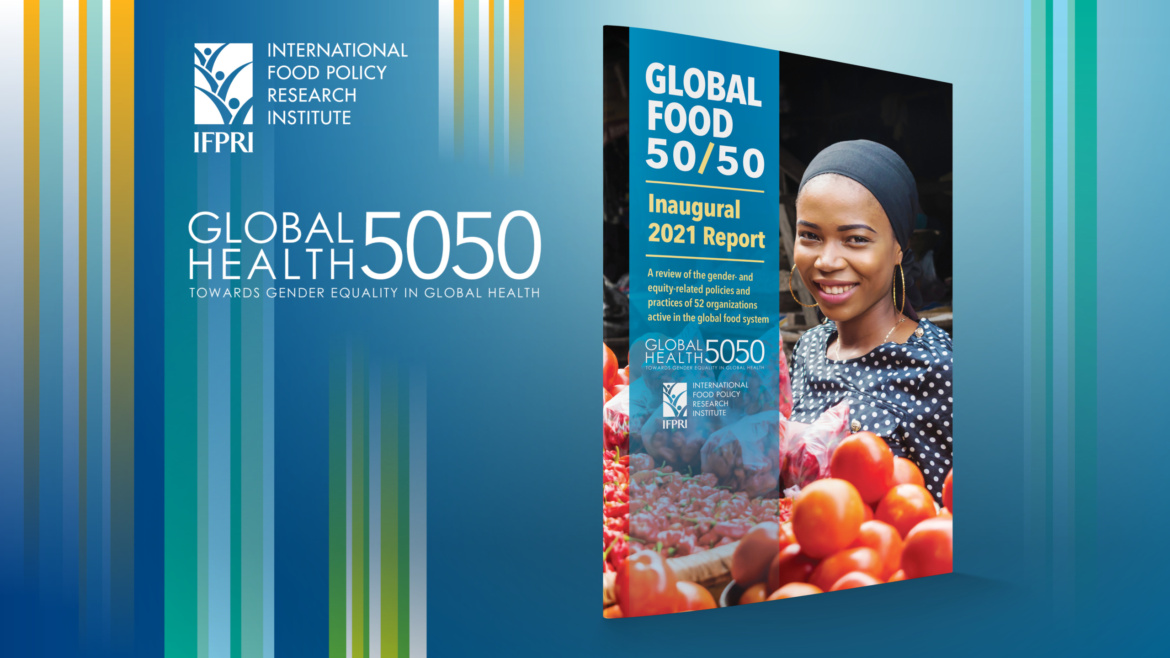
5 October 2021. The establishment of the Global Food 50/50 initiative is a response to broad stakeholder demands for a global food system that is accountable for progress towards gender equality. This event marks the launch of the inaugural Global Food 50/50 Report, which reviews the gender- and equity-related policies and practices of 52 global food system organizations as they relate to two interlinked dimensions of inequality: inequality of opportunity in careers inside organizations and inequality in who benefits from the global food system.

The Report shows that organizational commitment to gender equality is high, and that over half of organizations are transparent about their policies on shaping diverse, inclusive and equitable working environments for people. The latest data also suggest, however, that rhetoric may be used as a substitute for action. Leadership remains disproportionately male and dominated by nationals of Europe and North America. The report asserts that the skewed distribution of power and privilege is undermining global efforts to reach the Sustainable Development Goals.

This policy seminar will present the findings of the report and explore how this new accountability mechanism can power a broader movement to demand more equitable and inclusive organizations across the global food system.
  • Johan Swinnen, Director General, CGIAR-IFPRI
  • Kent Buse, Co-Founder and Co-Director, Global Health 50/50
  • Jemimah Njuki, Director for Africa, CGIAR-IFPRI (Presentation)Results of 2021 Global Food 50/50 Report
  • Sonja Tanaka, Coordinator, Global Health 50/50 (Presentation)
  • Keynote Address: Agnes Kalibata, UN Secretary-General’s Special Envoy to the 2021 Food Systems Summit
  • Jamille Bigio, Senior Coordinator for Gender Equality and Women's Empowerment, USAID
  • Lawrence Haddad, Executive Director, Global Alliance for Improved Nutrition (GAIN) (Presentation)
  • Rick White, Chair of the Private Sector Mechanism of the United Nations Committee on World Food Security (CFS)
  • Vicki Wilde, Senior Program Officer, Gender and Agriculture Development, Bill & Melinda Gates Foundation (BMGF)
  • Closing Remarks Sarah Hawkes, Co-Founder and Co-Director, Global Health 50/50
  • Moderator Katarlah Taylor, Events Manager, CGIAR-IFPRI

Resource:
Global Health 50/50 and IFPRI (2021),
The Global Food 50/50 Report 2021. 37 p.
  • The primary aim of the Global Food 50/50 Report is to catalyze faster progress towards this vision by enabling enhanced accountability driven by rigorous evidence. A second aim is to increase recognition of the role that gender plays in the food system for everybody — men and women, including transgender people, and people with nonbinary gender identities.
  • This Report presents measures of how well an initial sample of global food system organizations are acknowledging and addressing gender as a determinant of opportunity, access, and participation in the global food system. It shows that organizational commitment to gender equality is high. Over half of the organizations are transparent about their policies for shaping diverse, inclusive, and equitable working environments.
  • The data also suggest, however, that rhetoric may be used as a substitute for action. Organizational leadership — CEOs and board chairs — remains disproportionately male and dominated by European and North American nationals.

Friday, March 12, 2021

WEBINAR: UNFSS How to Incentivize Food Loss and Waste Reduction

12 March 2021. The 2021 United Nations Food Systems Summit: How to Incentivize Food Loss and Waste Reduction. By IFPRI

Absurd quantities of food are lost and wasted every year in a world where 700 million people go hungry each day and where planetary boundaries are being exceeded by unsustainable food production. Drastic reduction of food loss and waste is therefore imperative and will be an essential part of the UNFSS agenda.

This policy seminar will serve as a platform to discuss actionably, “game-changing” solutions to reduce food loss and waste on a global scale (SDG 12.3) and provide inputs to the UNFSS agenda. It is built around the Champions 12.3 Initiative and the Technical Platform for the Measurement and Reduction of Food Loss and Waste.
  • Welcome - Troels Vensild, Minister Counsellor of Food, Agriculture and Fisheries, Embassy of Denmark, USA
  • Opening Remarks - Johan Swinnen, Director General, IFPRI
  • Agnes Kalibata, UN Secretary General’s Special Envoy to the 2021 Food Systems Summit
  • Rasmus Prehn, Minister for Food, Agriculture and Fisheries, Denmark
Rapid Fire Presentations
  • Nnaemeka Ikegwuonu, CEO, Coldhubs Nigeria
  • Richard Swannell, Director, WRAP Global
  • Maximo Torero, Chief Economist, Food and Agriculture Organization of the United Nations (FAO)
  • Jessica Vieira, Director of Sustainability, Apeel Sciences
  • Closing Remarks - Craig Hanson, Vice President For Food, Forest, Water & The Ocean, World Resources Institute
  • Moderator - Rob Vos, Director, Markets, Trade and Institutions, IFPRI

Friday, April 3, 2015

The Agricultural Research Response to the Sustainable Development Goals

Published on 2 Apr 2015
Farming First TV spoke to CEO of CGIAR, the world largest agricultural research partnership, on how it will respond to the Sustainable Development Goals that are being finalised at the United Nations between now and September 2015.


 Related:
In the fourth instalment of the International Food Policy Research Institute’s annual reporton food policy, launched on 18th March 2015, authors report on the major developments that have happened at a global, regional and national level in 2014 but also, and for the first time, discuss the challenges to tackling food insecurity we face in the near future.

Looking to the past, the report highlights achievements as well as setbacks. For example, achieving the Millennium Development Goal of halving poverty by 2015, of 64 countries meeting the MDG of halving the number of hungry people since 1990, of global undernourishment having fallen from 19% to 11% in the past 2 decades, the commitments made at the Second International Conference on Nutrition in Rome to end malnutrition, the African Union committing to end hunger by 2025 and membership in the Scaling Up Nutrition (SUN) movement continuing to grow.