Platform for African – European Partnership in Agricultural Research for Development
Showing posts with label rice. Show all posts

Wednesday, December 16, 2020

Liberia: EU, AfricaRice Director General Tour Desira Project Site

14 December 2020. The Director-General of the Africa Rice Center (AfricaRice), Harold Roy-Macauley has completed a visit at the European Union's funded integrated rice and fish farming project under the Development of Smart Innovation through Research in Agriculture (DeSIRA) at the Central Agriculture Research Institute (CARI) in Suakoko, Bong County.

Mr. Roy-Macauley, who was recently on a four-day visit to Liberia from the Center's headquarters in Abidjan, Cote D'Ivoire, took stock of progress that is being made and lauded the technicians for the high level of work that has been done thus far.

The DG's visit was followed by a high profile delegation from the European Union office in Liberia that also toured the field to ascertain how their funds are being utilized.

Both delegations were led on their respective tours by AfricaRice Country Representative, Dr. Innousa Akintayo and experts who are working on the project. He toured the fields of the project, which seeks to develop integrated, climate-smart rice-fish production systems sustainably and balance interventions on participatory research on rice-fish farming, development of successful extension service delivery systems.

Dr. Roy-Macualey, the members of the EU delegation, was ferried to the "floating cage," an innovative technological fish pond that that has the capacity to host 40,000 fish in a safe, secure, and eco-friendly environment on a lake at the CARI center. A facially impressed Dr. Macaulay bombarded experts with questions as he tried to get a better understanding of the initiative and how it would impact the Liberian society, especially in the area of nutrition and food security.

Locally fabricated machines as well as locally made feeds for the fishes were also showcased during the tour.

Friday, November 30, 2018

Developing the rice value chain in East and West Africa

30 November 2018. Brussels. DevCo Infopoint. Rice is becoming one of the most important food crops on the African continent. Steep population growth coupled with rapid urbanization and changing consumer behaviour are the main drivers behind the increasing demand for the cereal.

You will find below the link to watch the video of the conference
https://ec.europa.eu/europeaid/news-and-events/developing-rice-value-chain-east-and-west-africa_en

Despite increased rice production output over the years, the average yields across Africa still remain very low and meet just a fraction of what is actually demanded Challenges along the value chain are still high, but also the potential for significant growth, employment creation and poverty reduction in Africa.
  • Introduction: Mr Regis Meritan, Head of Sector - Agricultural Growth DEVCO C1 - Rural Development, Food Security, Nutrition
  • Dr. Ulrich Sabel – Koschella, Head of Unit, Agricultural Value Chains, GIZ A4SD
  • Mr Jean – Bernard Lalanne, Head of Program, GIZ CARI (Competitive African Rice Initiative)

  • Mr Michel Baudouin, Agro- economist

Thursday, August 31, 2017

How farmer videos trigger social learning to enhance innovation

31 August 2017. Information and Communication Technology (ICT) tools such as videos promoted to enhance farmer access to information to influence change in farming practices need to be situated in social learning processes. Farmers learn and innovate through social learning characterized by exchanges amongst farmers to contextualize knowledge and adapt technologies for relevance.

This study assessed how a video-mediated extension approach (VMEA) triggers social learning to enhance innovation among rice farmers in Uganda using experiences of a Non-Government Organization, Sasakawa Global 2000 (SG 2000). A cross-sectional study was conducted among 100 farmers subjected to VMEA by SC 2000 in Kamwenge district. Semi-structured interviews, focus group discussions (FGDs), field observations and key informant interviews were used to collect the quantitative and qualitative data. Quantitative data were analyzed using Statistical Package for Social Sciences (SPSS) while thematic analysis was applied to the qualitative data.

Results indicate that inherently, videos trigger conversational exchange between farmers including those who do not watch the videos. These interactions enable collective reflection, evaluation and validation of knowledge, which in turn motivate experimentation. In this study, videos significantly enhanced awareness, knowledge acquisition, uptake of technologies and innovation among rice farmers. However, the potential of videos in influencing farmer knowledge and behavioral change can be further exploited if the users can produce contextualized videos of farmer practices and innovations for dissemination. Among other things, effective use of videos in extension requires excellent skills in facilitating social learning processes; and video documentation of farmer practices and innovations to aid scaling up and deepening learning.

For more details, please find the full publication at How farmer videos trigger social learning to enhance innovation among smallholder rice farmers in Uganda

You can find other publications that you may find of interest on the subject of using videos in agricultural extension at Publications.

Thursday, July 13, 2017

Why people believe the myth of 'plastic rice'

5 July 2017. BBC. Why people believe the myth of 'plastic rice'. 
A video which falsely claims to "prove"
the existence of fake plastic rice in the food supply

Despite little evidence that it's a widespread problem, rumours of "plastic" rice being sold in Africa and elsewhere persist on social media - driven in particular by viral videos which show bouncing rice balls.

The rumours spread over the last few weeks in Senegal, The Gambia and Ghana - and reached such a pitch that the Ghana Food and Drugs Authority decided to carry out an investigation.

They invited consumers and traders to submit samples of any rice brands they suspected of being made of plastic - and eventually concluded that there was no plastic rice being sold on the Ghanaian market.

Tuesday, May 30, 2017

Smart-valleys, developing inland valleys for rice production

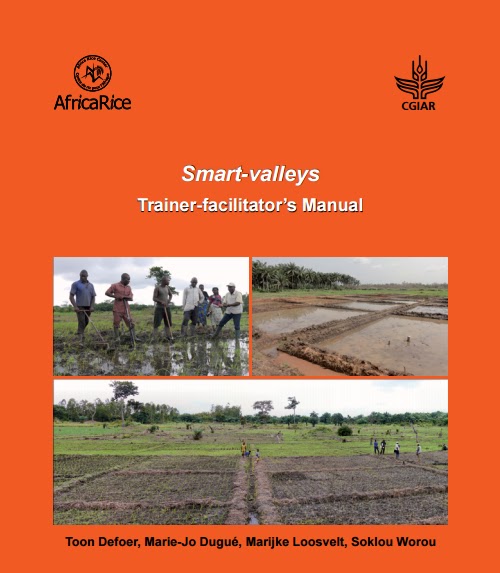
Smart-valleys: Trainer-facilitator’s manual.
Smart-valleysManuel du formateur-facilitateur
Defoer, T, Dugué, M-J, Loosvelt, M, and Worou, S. 2017.
Abidjan, Côte d’Ivoire: Africa Rice Center (AfricaRice). 130 pp

This manual is made up of modules, which are to be used by the trainer-facilitator during the training of the technician-facilitators who are in the position to facilitate the Smart-valleys development process on the ground. The manual is therefore, first of all, meant for the trainer-facilitators interacting with the technicians during the training workshop. These training workshops, and consequently the accompanying modules, are based on the principle of training by discovery and by action-training.

The AfricaRice Knowledge Management Unit is currently preparing distance learning courses for the approach that will allow AfricaRice to reach even more farmers in the end.

‘SMART-valleys’ is a low-cost, participatory and sustainable approach to develop inland valleys for rice-based systems. Major advantages mentioned by farmers are the increased water retention in their fields, less risk of fertilizer losses due to flooding and increased rice yields.
  • The SMART-valleys approach follows a step-wise procedure focusing on design, lay-out and construction of low-cost water control infrastructure after a careful selection procedure paying attention to both socio-economic and biophysical factors and making extensive use of farmer knowledge.
  • The SMART-valleys approach starts with the identification of inland valley sites with potential for rice cultivation. This is done by a technical team working with farmers and village chiefs in the field. The team should be comprised of members that are trained in the SMART-valleys approach, able to comprehend the social and hydrological setting of valleys with potential for rice cropping. Together they put together a dossier containing information about the valley/s to be developed, importance of rice in the surrounding community, potential to grow and market rice, suitability of the soil and water source for rice cropping, land tenure, etc. The dossier allows the technical team to discuss with the communities that want to exploit the valley and those that are downstream that might be affected by the development.
  • The plan and design of the development is based on this dossier, consultations with technical teams and farmers’ knowledge and experience of water flow and retention on the soil surface. Such a design outlines the water intake, drains and bunds to enable greatly improved water retention in the valley lowlands and drainage of excess water from the valley. It may also include simple structures to divert water from a natural source and provide irrigation to thirsty rice fields when needed.
Background:
Back in 2009 the SMART-IV project was started in Benin and Togo. Since that year it supported rice farmers with improvement land and water management approaches. Despite a slow start the SMART-IV project has become a great success. With hard work and good collaboration it achieved the goals that were set by the donor, the Ministry of Agriculture in Japan.

The SMART-valleys approach was rewarded a second phase then called the SMART-VALLEYS project and it expanded the project to Liberia and Sierra Leone. Ebola affected the timely implementation of the activities but since this year field technician and farmers are exposed to the Smart-valleys approach and it conducted agronomic research to improve the yields in terms of quantity and quality.

In the meanwhile new projects are introducing the Smart-valleys approach in GIZ funded projects in Burkina Faso and northern Benin. The approach was showcased as an example of adaptation of African farmers to climate change and variability at the COP22 Climate Change meeting in Marrakech last year. Both Radio France International and the German sister Deutsche Welle broadcasted the Smart-valleys approach.

The coordinator of the project, Dr. Roland Issaka (picture), is succeeding to Sander Zwart who coordinated the project from 2009 until 2017.

Videos:


Related: 

4-5 April 2017. Abidjan, Cote d’Ivoire. Technologies, Platforms and Partnerships in support of the African agricultural science agenda. A meeting was held co-hosted by IFPRI and AfricaRice, to strengthen linkages and forge stronger partnerships around new ideas, tools and technologies that contribute to developments in agricultural science, technology and innovation. The meeting was attended by over 60 participants from international development institutions (World Bank, Africa Development Bank, IFAD and USAID) and technical partners (CGIAR Centers, national partners including universities, sub-regional organizations, private sector and NGOs). It demonstrated how new technologies and their assessments, delivery mechanisms, shared platforms, and new tools will support agricultural transformation and economic development in Africa.

Funding support for the Scientific and Technical Partnerships in Africa program was provided by the International Fund for Agricultural Development (IFAD), with support from the CGIAR Research Program on Policies, Institutions, and Markets (PIM) led by the International Food Policy Research Institute (IFPRI).

The Meeting:
  • Reviewed and discussed initial highlights and results from IFPRI and partners three workstreams as proof of concept in technical support of the Science Agenda.
  • Explored examples of country level applications of technologies, technology platforms, and their delivery mechanisms.
  • Prepared for specific business cases for technologies and examined further the role private and public sector partnerships play in technology investment in Africa.
  • Explored opportunities to create synergies in agricultural R&D that could make a difference in brokering institutional and technical partnerships moving ahead.

Friday, May 27, 2016

ROPPA: regional meeting on rice sector interprofessional organisations

3 - 5 May 2016. ROPPA organised a regional meeting in Cotonou to discuss about the results and challenges faced by interprofessional organisations and define a joint strategy by UEMOA/CEDEAO/CRCOPR to support the set up of dynamic and strong rice interprofessional organizations in the rice.

In its action plan (34 pages), the Regional Dialogue Framework of the Rice Producers' Organisations (CRCOPR) of the ROPPA highlighted the need to capitalize the experience of existing interprofessional organizations in the rice sector. 

L’objectif pour cet atelier sera de contribuer à terme à la mise en place des OIP dynamiques qui participent à la définition des politiques sectorielles rizicoles tant au niveau national que régional et au développement de la chaîne de valeur riz.

Plus spécifiquement, il s’agira de définir les grandes lignes d’une stratégie conjointe UEMOA/CEDEAO/CRCOPR pour la mise en place des Organisations Interprofessionnelles rizicoles fonctionnelles et dynamiques. 

Il est attendu de cet atelier , des enseignements à partir des expériences vécues (forces, limites, stratégies, fonctionnement, évolution etc) par les Organisations Interprofessionnelles rizicoles existantes ;l’état des lieux du processus de construction des nouvelles Organisations Interprofessionnelles rizicoles (Mali, Bénin, Niger, Côte d’Ivoire) ;Des recommandations pour améliorer les textes juridiques sur les Organisations Interprofessionnelles rizicoles à partir de leur analyse comparée ;Des esquisses de plans d’action de chaque pays pour corriger les insuffisances dans la mise en place des Organisations Interprofessionnelles rizicoles et un plan d’appui soutenant la mise en place des Organisations Interprofessionnelles rizicoles, développé par le CRCOPR.


Documents:

Saturday, March 12, 2016

The Malanville Innovation Platform (IP) and rice parboiling technologies

9 February 2016. The SARD-SC project rice component in collaboration with AfricaRice and INRAB have installed energy efficient GEM rice parboiling technologies and innovations in the Malanville Innovation Platform (IP) in the irrigated rice ecology of northern Benin Republic.

The formal launch of the Malanvile IP, which attracted almost 1000 women from the nooks and cranny of the country, witnessed the presence of policy makers such as the mayors of Malanville and Gaya, Niger. It also provided additional policy incentive to the operationalization of the IP.

To efficiently use and manage the Grain quality Enhancer, Energy, efficient and durable material rice technologies(GEM) facility, 538 women rice parboilers including 10 from Gaya in Niger, were trained on processing and adding value to locally produced rice. Over a period of two months, these women households learned skills on rice parboiling and value addition as well as the management of the GEM parboiling facility.

The training alone resulted in 8 tonnes of quality parboiled rice which is already attracting consumers within and outside the Malanville community. As part of the IP process, 12 youths (10 male and 2 female) are being facilitated to learn various skills on rice processing and adding value and operation of equipment and farming tools.

The formal opening was attended by the IITA/SARD-SC Coordinator, Dr Chrys Akem. He remarked that in general, the SARD-SC project has challenges in effectively addressing gender equity – active involvement of women in project activities. The deployment of the GEM rice parboiler in the Malanville IP has fully demonstrated that pairing gender sensitive technological innovation with institutional change, can significantly bring about gender mainstreaming in agricultural productivity programs and projects.

The Malanville IP also received milling machine and other farming equipment from AfricaRice through the Japan Emergency. One of the youths of the Malanville IP who was trained on the use of farming equipment indicated that with appropriate machinery, he realized that rice farming can be enjoyable and not a burden. He is motivated to start his own rice farm in addition to the help given to the household farms. The Mayor of Malanville, Dandakoe Inoussa said that “The GEM parboiler and other technologies and innovations should be rolled out in northern parts of Nigeria close to Malanville, as well as Gaya in Niger, because we are the same people. We share the same values and culture, and can easily share and learn productivity enhancing technologies and innovations to improve livelihoods.”

To date, over 1000 women households have been reached through the GEM technology and innovations in two IPs in Benin. The GEM is being rolled out in combination with enhanced packaging and branding of locally produced rice to attract urban rice consuming households and contribute to raising incomes of women and employment opportunities for youth in the rural economy. Already, Nasarawa in Nigeria and Gaya in Niger in consultation with their respective research institutes, have requested for the GEM technology and innovation and these will be deployed in Nigeria and later in Niger.

Tuesday, February 16, 2016

Innovation platforms in rice value chains

1-5 February 2016. Cotonou, Benin. AfricaRice held its 2016 Science Week and Global Rice Science Partnership (GRiSP)-Africa Forum. The Science Week served as the annual review, reflection and planning event for the Center and its research and development partners from around the world. It is held under the framework of the Global Rice Science Partnership (GRiSP), a CGIAR Research Program on rice.

International and national rice research and development partners from the public and private sectors, including representatives of national research and extension programs of about 30 African countries participated in this event.

The main objectives of the 2016 AfricaRice Science Week and GRiSP-Africa Forum were to discuss results obtained in 2015 and carry out effective and efficient planning of rice research-for-development (R4D) activities in 2016.

In addition to updates on GRiSP-Africa R4D activities and meetings of the Africa-wide Rice Task Forces and the Rice Sector Development Hubs, the Science Week’s program included among others brainstorming sessions on improved seed delivery, long-term agronomic trials related to soil fertility management, knowledge sharing and innovation platforms in rice value chains.

Related:
Published on 22 Dec 2015. A video on the improved GEM parboiling rice system, which has started to make a difference in the lives of over 450 women rice parboilers in the Glazoué rice hub in Benin, has been produced.

AfricaRice has developed and established the GEM system in Glazoué using an innovation platform approach along the rice value chain thanks to the project "Support to Agricultural Research for strategic crops in Africa" (SARD-SC) with funding from the African Development Bank (AfDB).

Appropriate training has allowed women to explore the GEM method and its advantages that include the following:
  • Reduction of post-harvest losses; 
  • Parboiling a large quantity of rice in a limited period of time; and 
  • Improving the quality of rice that better meets consumer demands. 
The innovation platform approach has promoted the creation of good business relations between the various stakeholders in the rice value chain by bringing together all the stakeholders.

As a result, rice consumers are progressively being attracted to the locally produced parboiled rice in Glazoué, leading to increase in incomes of women parboilers. In addition to the beneficiaries from Glazoué rice hub, the training included women processors from Malanville in northern Benin and 10 young entrepreneurs.

Tuesday, February 2, 2016

AfricaRice 2016 Science Week and GRiSP-Africa Forum

2 - 4 February 2016. Cotonou, Benin. AfricaRice 2016 Science Week and GRiSP-Africa Forum. The Science Week serves as the annual review, reflection and planning event for the Center and its research and development partners from around the world. It is held under the framework of the Global Rice Science Partnership (GRiSP), aCGIAR Research Program on rice.

International and national rice research and development partners from the public and private sectors, including representatives of national research and extension programs of about 30 African countries are expected to participate in this event.

The main objectives of the 2016 AfricaRice Science Week and GRiSP-Africa Forum are to discuss results obtained in 2015 and carry out effective and efficient planning of rice research-for-development (R4D) activities in 2016.

In addition to updates on GRiSP-Africa R4D activities and meetings of the Africa-wide Rice Task Forces and the Rice Sector Development Hubs, the Science Week’s program will include among others brainstorming sessions on improved seed delivery, long-term agronomic trials related to soil fertility management, knowledge sharing and innovation platforms in rice value chains.

Related:
3 January 2016. A new research centre will help African countries promote innovation in the agricultural sector. The Green Innovation Center, which was inaugurated at AfricaRice in Benin this month (), aims to boost agricultural productivity, increase the incomes of smallholder farmers and create job opportunities, particularly for youth and women in Benin, Burkina Faso, Cameroon, Ethiopia, Ghana, Kenya, Malawi, Mali, Nigeria, Togo, Tunisia and Zambia.
“The main gap that the centre seeks to close is the low capacity of the present extension service.” Bernard Marc Winfried, AfricaRice
The Green Innovation Center is supported by the Federal German Ministry for Economic Cooperation and Development (BMZ), in partnership with other institutions such as Benin Ministry of Agriculture, Livestock and Fisheries, and AfricaRice.

BMZ has given 2.7 million euros (almost US$3 million) to AfricaRice to implement the centre’s activities in 2016 and 2017, according to Bernard Marc Winfried, a knowledge management specialist at AfricaRice.

Gerd Müller, minister for BMZ, said during the inauguration that agriculture does not only need water and fertiliser but also knowledge and innovation..

Monday, October 26, 2015

AfricaRice returns to M'be, Cote d'Ivoire


The 38th meeting of the Board of Trustees of the Africa Rice Center (AfricaRice) was held between September 7 and 10 at M’bé near Bouaké, its main research station in Côte d’Ivoire, for the first time in 12 years following the civil crisis that forced the Center to scale down its activities in that country. The Board meeting – an important signal marking the full return of the Center to Côte d’Ivoire – was warmly welcomed by both the government and traditional authorities. A colorful closing ceremony, attended by the local government administrator of Bouaké, Mr Konin Aka, and an array of community leaders from M’Bé, dressed in their full traditional regalia, expressed their joy on the return of AfricaRice to the community.

Monday, July 13, 2015

IFAD Wins 'Best Sustainable Development Practice' Award at Expo Milano 2015

6 July 2015. Milan. The International Fund for Agricultural Development (IFAD) won a 'best sustainable development practise in food security' award for its work promoting the System of Rice Intensification (SRI) in Madagascar. This unique approach allows smallholder farmers to maximise rice yields while reducing the amount of seeds, water and land used.

The awards ceremony took place at the EXPO Milano 2015 world fair and was hosted by the Feeding Knowledge Program - an international network for research and innovation in food security. The competition was implemented by the Mediterranean Agronomic Institute of Bari.

Together with Cornell University and the Ministry of Agriculture, Livestock and Fisheries, IFAD began applying the SRI method in the Upper Mandraré Basin Development Project in Madagascar in 1997. The success of the project, which ran in two phases until 2007, has lead to the adaptation of the SRI method in at least 50 countries around the world and by as many as five million smallholder farmers.

Monday, March 30, 2015

Rice Science in Africa gets a new Director General

15 March 2015. Cotonou, Benin. Dr. Harold Roy-Macauley, new Director General of AfricaRice, doesn't want to just improve rice science for Africa, he wants to make the continent a world leader in it.

The rice sector in Africa is going to be “evidenced-based and therefore very solid and powerful,” he said. At a time when the developed world agonizes over the value of science, Africa sees an opportunity to grab a lot of market share by using science to improve their food production and become a next exporter, and then the rest of the world can play catch up.

“Rice is global and it is big business,” said Macauley,a Sierra Leonean national, in his first speech to the AfricaRice staff in Cotonou, Benin. “It is the white gold of the future. We at AfricaRice should consider ourselves fortunate to be in big business already”.

Roy-Macauley outlined his first priorities as:
  • Rendering partnerships more efficient around rice science and sector development
  • Strengthening capacity for rice science and sector development
  • Improving access of small-holders rice producers to markets
  • Reintegrating rice science in the policy agenda of countries
  • Increasing investments in rice science and sector development

Tuesday, February 17, 2015

Introducing new rice technology in Sierra Leone

7 February 2015. The West Africa Agricultural Productivity Programme (WAAPP) is a five year programme aimed at improving agriculture by introducing new technology as well as improving on existing ones. WAAPP-Sierra Leone commenced in 2011 and is due to fold up in June 30, 2016.

The five year project in Sierra Leone targets the two staple foods - rice and cassava. By the end of the project in 2016, five improved agricultural technologies should have been adopted by an expected 120,000 beneficiaries. The improved technology should cover 150,000 hectares countrywide, with a total number of 200,000 beneficiaries.

Concord Times engaged the Project Coordinator, Sulaiman Sesay, on the progress made so far.
"So far the target goals are meant for the completion of the project. Since the adoption of improved technology is highly incumbent on research, we now providing support to research institutions with infrastructure and human capacity building," said Sulaiman Sesay. "We support both long and short term training for scientist both locally and internationally. We are supporting 41 scientists who are pursuing masters and doctorate courses in universities abroad and we are providing short term training for local farmers and extension workers."
In the area of human capacity building, he said the project is providing technical assistance to two big institutes, including the Africa Rice Research Centre in Benin and the International Institute for Tropical Agriculture, as well as provide support to the Rokupr Rice Research Centre in Sierra Leone.

Friday, February 13, 2015

The Competitive African Rice Initiative (CARI) project

11 February 2015. Nigeria, Burkina Faso, Ghana and Tanzania – are set to benefit from a $3.3 millionCompetitive African Rice Initiative (CARI) project.
grant provided by Bill and Melinda Gates (BMGF) and the German Development Cooperation (BMZ), under their

The initiative focuses on intervention areas to achieve the following objectives:
  • Improved productivity and quality of paddy rice based on sustainable and competitive rice production systems;
  • Increased sourcing capacity through structured producer-processor-linkages as well as improved storage capacity and processing efficiency;
  • Improved access to and adapted financial services for all value chain actors;
  • Shaping and strengthening the enabling environment at national and regional level including policy framework and market linkages between producers, processors and traders.
The implementing institutions of the grant are led by GIZ, Technoserve, the John A. Kufuor (JAK) and Kili Trust (KT).

Speaking on the establishment of the Nigeria/ECOWAS Rice Sector Policy and Regulation Advocacy Platform in Abuja, CARI’s project coordinator, Mr. Stefan Kachelriess-Matthess, said: “The projects are implemented at two levels of support, we support up to 40 percent of implementation cost and our Nigerian partners in the private sector have to provide 60 per cent of the implementation cost.”

ECOWAS Commissioner of Agriculture, Environment and Water Resources, Dr. Lapodini Marc Atouga, represented by a Director at the Commission, also spoke at the event, saying that rice consumption in the last two years in the sub-region had increased from 7 to 7.7 million tons.
“I will like to commend GIZ/CARI for this timely initiative. The need to have a permanent and functional platform to promote rice development cannot be overemphasized. With the current interventions on rice in the West Africa region we must all endeavor to build sustainable rice value chains with access to finance, technology and knowledge to move the region from a rice deficit to a rice surplus one,” he said.
The project, which will end in 2017 is targeting about 120,000 small scale rice producers, while secondary beneficiaries are the rural service providers and rice millers. The initiative is geared towards improving their sourcing capacity of quality supply.

Grow Africa is a partnership platform that exists to help catalyse sustainable investment and growth in African agriculture. Grow Africa was founded by the African Union Commission, the NEPAD Agency and the World Economic Forum.

Monday, January 26, 2015

Impacts of climate change on rice markets in Senegal

The Stockholm Environment Institute’s research project Adaptation without Borders is placing a spotlight on the country of Senegal in West Africa to illustrate how climate change can have unexpected and indirect impacts on food security and social stability. in this blogpost four short films explore these issues in relation to rice production, consumption and global trade.
Spotlight on Senegal

In the film below SEI Researcher Adam John discusses global rice markets and price volatility in the context of a changing climate. He describes what it is about rice markets that makes them so volatile and explains why this makes countries like Senegal, who import the vast majority of their rice, so vulnerable to climate change effects on rice production in other countries - and the policy response of governments in major rice exporting and importing countries abroad. Adam also reflects on the scope for Senegal to reduce this vulnerability by reducing its import dependence.


Rice is the main staple food in Senegal. It currently imports around 70% of what is consumed, but has high potential to increase domestic production and big plans to become self-sufficient by 2017. SEI Researchers Adam John and Magnus Benzie travel through Senegal in this film to explore how the country is planning to achieve food security in the face of climate change impacts both at home and abroad…


Experts from the Africa Rice Centre explain the potential for Senegal to become self sufficient in rice. Does the country have the resources required to achieve this ambition in spite of climate change? Watch the film below.


Djeneba - a resident of Dakar - describes in the next film why so many people in Senegal today prefer to eat rice as their staple food as opposed to more traditional cereals. She compares domestically produced rice with imported rice to demonstrate why there is such a strong preference for the imported variety.


Read Djeneba's story here to learn more about what connects rice harvests in Asia and global trade to a hard working nanny in Senegal. Why are rice prices so important? Follow the link to find out more.
Read Djeneba's story here
Related: 16/01/2015. Daily Times Nigeria Rice policy: Asian cartel and their disruptive agenda Foreign importers have even falsely argued that rice production in Nigeria is not economically feasible and un­controlled imports should be allowed in. But the reality is completely different. Nigerian farmers have shown an impres­sive performance in response to Government’s new rice policy that favours local rice produc­tion and milling.

Monday, September 1, 2014

Rice Innovations Fair of Scalable Technologies

1-2 September 2014. Cotonou, Benin. Rice Innovations Fair of Scalable Technologies

Objectives
1. Create visibility of research products of AfricaRice & partners for the development sector.
2. Explore with NGO’s, donors, private and public organizations scalable technologies and define
dissemination pathways.

The first day of the event focused on the presentation of a set of eleven technologies, followed by discussions to define dissemination pathways for each innovation.
  1. Scalable technologies developed by AfricaRice and partners (rapid presentation):
  2. Smart‐valleys – a participatory and low‐cost development approach
  3. Inland valley atlas – assessing the potential for development
  4. RiceAdvice – localized farmer advice for nutrient management
  5. Multi‐stakeholder platforms – improving farmers’ access to the value chain
  6. Powertillers – local adaptation to support multiple use
  7. Rice Varieties – ARICA, NERICA and others – new lines of rice varieties
  8. Mechanical weeders – reducing labour in rice production
  9. GEM Parboiler – energy efficient and improved quality
  10. ASI Thresher – high‐capacity thresher for clean rice
  11. PLAR/IRM – Participatory Learning & Action Research for improving farmer practice
The second day will include a visit to the Ouinhi district in Benin, to see inland valleys that have been developed using the Smart-valleys participatory approach. These achievements are the result of AfricaRice’s partnership with the Benin extension agency called Cellule Bas-Fonds, under the Rural Engineering Division of the Ministry of Agriculture, Animal Husbandry and Fisheries.

Related:
Title: Supporting the African rice value chain (Competitive African Rice Initiative, CARI)
Commissioned by: German Federal Ministry for Economic Cooperation and Development (BMZ)
Countries: Various countries in Africa; based in Nigeria
Lead executing agencies: Agricultural ministries in Nigeria, Ghana, Burkina Faso and Tanzania
Overall term: 2013 to 2017

Tuesday, August 12, 2014

Strategies to scale up investments in modern rice farming

6 - 7 August 2014. Kigali. Researchers from 11 African countries discussed strategies aimed at scaling up investments in modern rice farming and boost production.

The event was hosted by the Rwanda Agricultural Board (RAB) with facilitation from AfricaRice – a leading pan-African rice research organisation that operates in 25 African countries.

According to Diagne Aliou, AfricaRice’s economist in charge of impact assessment, the training was aimed
at introducing continental rice producers to automation of socio-economic surveys and improved methods and tools of the rapidly growing agricultural field.
“Rice growing is one of the budding agricultural fields in Africa and it requires day-to-day modern evaluation theories and practices with a particular focus on their applications that will assess the impact of agricultural research and projects,” he said.
The expert explained that the training in Kigali was in line with the target of leaders in Africa who want the continent’s rice to be able to feed its population and have surplus for international markets.

The Deputy Director General in charge of Research at RAB, Dr. Daphrose Gahakwa, said Rwanda became a member of AfricaRice in 2013 in a bid to learn from other continental producers how to boost rice production.
“It is our first time to host this training since joining the forum last year and it is very important in the way that it will improve our capacity in data collection. Our day-to-day objectives and work means that we need to correct information in order to improve our productivity,” Gahakwa said.

Thursday, July 31, 2014

AfDB’s NERICA dissemination project receives US Treasury Award

23 July 2014. Washington D.C. The African Development Bank’s New Rice for Africa (NERICA) project received Development Impact Honors from the US Treasury Department in an awards ceremony.

The NERICA Dissemination Project increased domestic production and food security in seven West African countries, namely Benin, Gambia, Ghana, Guinea, Nigeria, Mali and Sierra Leone. The project was selected from a pool of 29 submissions from various multilateral development banks (MDBs). It is the third consecutive year in which an African Development Bank project has won a US Treasury Award.

The US Treasury Department’s Development Impact Honors awards promote the highest standards in development by recognizing outstanding projects undertaken by multilateral development banks. The program seeks to reward excellence in project design and implementation and to showcase the vital work MDBs carry out in communities, countries and regions to support the world’s poorest people.


O.N.U. - NERICA The Seed of Hope (AfDB) from City VIDEO on Vimeo.

Monday, June 23, 2014

Agro-sylvo-pastoral systems to feed West and Central Africa


16 au 20 juin 2014. 
Niamey, Niger. Quatrième Semaine Scientifique agricole de l’Afrique de l’Ouest et du Centre et Onzième Assemblée Générale du CORAF/WECARD. Theme: Innovations in agro-sylvo-pastoral systems to feed West and Central Africa.

Programme in English

Extract:
Side event on: Contribution of Rice Research in Regional Initiative on Rice (Offensive Riz)

Dr Yamar MBodj, Director of Rural Hub and Dr Mandiaye Diagne of AfricaRice made presentations on the main side event theme.The side event aimed to demonstrate the contribution of research to the success of the Regional Initiative on rice. It examined the contribution of the different poles of rice development to the success of the Regional Initiative on rice and capacity building of stakeholders at national and regional levels. 

Dr Alain Sy Traoré, Director of Agriculture of ECOWAS has made introductory remarks marked by three key points: 
  1. the 15 countries of the ECOWAS region chose rice as a strategic sub-sector which is in line with the Regional Program on Agricultural Investment and ECOWAP. 
  2. He also stressed the need to build national reserves against food insecurity in the sub region to compensate for shortages and damage during critical periods with emphasis on rice. 
  3. Dr Traore noted that AfricaRice is a technical resource center on all aspects of rice production in the sub-region.
Side event on: The private sector and CORAF/WECARD for useful research
The commitment of CORAF / WECARD for this theme comes through: a workshop in November 2013 to raise the mobilization and involvement of the private sector in the implementation of the second operational and strategic plan of CORAF/WECARD; a gender policy involving the private sector in its activities to create favorable incubation conditions for youth and self-employment of women; the implementation of a "Knowledge for employment-based Internet" project on the one hand and on the other UNIBRAIN project to increase the use of the results of scientific research as a source of new jobs for educated youth. Note the need to develop public-private partnerships and strategies for the exploitation of the results of scientific research.

To motivate more private researchers, participants suggested developing market mechanisms of search results. To reverse the situation, the participants of this session invited the CORAF / WECARD fund youth activities in addition to the "knowledge for employment based on the Internet" program and develop public instruments to promote employment youth through the use of technologies and innovations. This is to make agriculture a business and a source of employment especially for young people. Private research is facing enormous challenges, both internally and externally. 

In addition, the potential for private innovation is often not taken into account by conventional
research
. Also, research driven by private is forced to develop its own strategy and make his own plea. It is in this context that fall activities Gisele Lopes Almeida who was able to make an ecological agriculture business profitable by finding biological solutions to input problems. Three types of organic products have been developed by her company: 
  1. the nematicides biodegradeur 
  2. the biocompost and 
  3. the activator nematicide growth. 
All these innovations have the advantage of preserving the health of plants and animals including promoting modern family farming.

Related:
Le Réseau pour la Gestion de l’Information, de la Communication et des Connaissances Agricoles 
Krishan Bheenick, Senior Programme Coordinator for
Knowledge Management, shared details of the
Knowledge Management work CTA and CORAF are
collaborating on, at the official launch of CORAF ReGICA
in a side event organised by the two organisations.
    (ReGICA) est initié par le Conseil ouest et centre africain pour la recherche et le développement agricoles (CORAF) pour répondre à un besoin de gestion des connaissances agricoles des pays membres. 

    En effet, plusieurs initiatives sont en cours ou ont été menées en Afrique de l’Ouest et du Centre dans le domaine agricole mais il manque un cadre accessible où les contenus générés par ces initiatives sont agrégés au moyen des outils web2.0 et rendus disponibles à tous les acteurs.

    Objectifs:
    • Faciliter la Collaboration entre les institutions et individus membres en mettant à leur disposition les outils et les capacités nécessaires à un meilleur travail collaboratif dans le domaine de la recherche et le développement agricoles au sein de la zone CORAF; 
    • Renforcer la Visibilité des activités de recherche et de développement agricoles menées par les institutions et individus membres; Faciliter le Renforcement des Capacités des institutions et individus membres dans l’utilisation des outils TIC et de gestion de connaissances dans le domaine de la recherche et du développement agricoles.
    Related:
    17th June 2014. The book ‘Unlocking the Potential for Integrated Agricultural Research for Development (IAR4D) in the Savannah of West Africa’was launched on  by the Chairman of the 4th CORAF/WECARD General Assembly, Dr Adama Traore, the acting Director General of AfricaRice. 

    This was the third launch of a book documenting the work undertaken to establish a proof the IAR4D approach. 
    1. The first launch was of the book documenting a synthesis of all the work carried out in the three sub-regions. This took place in Durban, South Africa during the 10th CAADP Partnership Platform meeting in March 2014. 
    2. The second launch was for the book summarsing the outcomes of the work carried out in the Southern Africa sub-region. This took place in May 2014, during the 1stCCARDESA General Assembly in Gaborone, Botswana. 
    This book documents the proof of the IAR4D approach. IAR4D was developed by FARA as a means to overcoming the low adoption of agricultural research outputs by end users leading to limited impact of agricultural research on the continent. The research coordinated by FARA under the Sub-Saharan Africa Challenge Programme (SSA CP) has established that IAR4D delivers more benefits (income and food security) than the conventional research-to-development approach. The superior performance of IAR4D is mainly attributed to stronger linkages and interactions among agricultural value-chain actors from commencement of the research onwards.

    Thursday, May 15, 2014

    Another green revolution is stirring in the world’s paddy fields

    10 May 2014. The Economist. Flood-resistant rice is now spreading as fast as the waters themselves. Five years after the first field trials, 5m farmers across the world are planting more than a dozen varieties of rice with flood-resistant genes, collectively called “Sub 1”.

    They are proliferating even faster than new rice varieties during the heady early days of the first green revolution in the 1960s. “And Sub 1 is the first of a new generation of seeds,” says Mr Zeigler. If all goes well, over the next few years plants that tolerate drought, salinity and extreme heat will revolutionise the cultivation of mankind’s most important source of calories.

    But that will depend on the technology working as promised and, in particular, on public policies that support a second green revolution. Neither is guaranteed.