Platform for African – European Partnership in Agricultural Research for Development
Showing posts with label Mali. Show all posts

Wednesday, October 23, 2024

Russia africa Agri-Business expo

23 - 25 October 2024. Russia Africa Agri-Business expo

The International Agricultural Exhibition brought together 19 industry areas and more than 350 exhibitors from various countries. It demonstrated technologies and products of the agro-industrial complex in an informal setting and presented by practitioners and experts of the agro-industrial complex of Russia and countries of Asia, Africa and the Middle East. This was an exchange of best practices and discussion of industry trends and challenges at the highest level and brought together a community of professionals in the agricultural sector, providing the exchange of experience, knowledge and the establishment of long-term business contacts.

Results of the business program 2023round tables10practical sessions38expert practitioners and government representatives290public agreement on partnership and interaction
JSC Moskovskoe, the largest producer and supplier of genetic material for farm animals in the Russian Federation, has for the first time agreed to export products to the Republic of Mali. 

Thursday, June 20, 2024

GIZ Knowledge Centre for Organic Agriculture and Agroecology in Africa Newsletter

Global project Knowledge Centre for Organic Agriculture and Agroecology in Africa
  • Commissioned by: German Federal Ministry for Economic Cooperation and Development (BMZ)​​​​​​​
  • Overall term: 2019 to 2026
KCOA is a collaborative country-led partnership that aims to scale up the adoption of organic and agroecological farming practices through a network of five Knowledge Hubs in Africa. Within KCOA, the implementing organisations have four main objectives: 
  1. to improve access to knowledge on organic agriculture and agroecology; 
  2. to strengthen the technical and professional capacity of multi-pliers; 
  3. to foster networking and to strengthen relationships in the sector; 
  4. and to strengthen actors in their advocacy activities.

Resources:

ISAN Magazine Issue 10 (May 2024) brings stories about the benefits of biodiversity in agricultural systems, stories from Zimbabwe about how to enhance agrobiodivesity for improved food security and community-based climate change adaptation approaches, as well as profiling knowledge products on enhancing soil fertility developed by farmers in the Southern African region.


On behalf of BMZ, GIZ implements projects related to agroecology, among others, as part of BMZ’s Special Initiative “Transformation of Agricultural and Food Systems“. The following examples of rural development projects illustrate how transformative pathways are shaped differently by different sets of agroecological principles.
  • India Agents of Change – Women Self-Help Groups in India To design a systemic approach for food systems transformation and to tailor a strategy which supports rural women to create community benefits. Women Self-Help Groups (WSHG) have become pivotal change agents in agroecology
  • Mali Uniting Multiple Stakeholders for Agroecological Transitions in Mali To support multi-stakeholder dialogue and foster change processes and politics. 
  • Global Integrating Aquaculture into Smallholder Farming Systems To harness synergies among different productions systems in rural areas and to design approaches to integrated aquaculture. 
  • Regional in Sub-Saharan Africa Agroecology – a Pathway for Rural Youth Employment To ensure that business models meet sustainability goals while promoting fair employment. 
  • Mexico Strengthening Rural Livelihoods in Mexico To design cross-sectoral approaches to integrate biodiversity
Related

Support to Agroecological Transformation Processes in India (SuATI)


Thursday, March 30, 2023

Conference Accelerating Impacts of CGIAR Climate Research for Africa

27 - 31 March  2023. South Africa. Accelerating Impacts of CGIAR Climate Research for Africa (AICCRA ) Spring School Climate Change and Agriculture Conference 

Media and communication delegates from Zambia, Mali, Senegal, Ghana, Kenya, and Ethiopia gathered in Cape Town

AICCRA strives to foster a climate-smart future for Africa, propelled by scientific research and innovation in agriculture.

The aim of the workshop is to expedite climate action by enhancing capacity and knowledge-sharing about the impact of climate change on African agriculture. It also aims to amplify key messages through partner and stakeholder networks to scale up climate-smart agriculture, creating a more resilient future for African smallholder farmers.

Objectives

  • Unpack the impact of climate change on African agriculture and food systems.
  • Explore how we can transform African agriculture and food systems for a more sustainable and climate-resilient future.
  • Discuss important national, regional, continental, and global initiatives to promote climate-smart agriculture.
  • Investigate key developments, so that audiences can be prioritised.
  • Horizon scan upcoming policy events (e.g., COP28).
  • Connect AICCRA partners, exploring how they can support national or regional programs.
  • Understand partners strategic priorities, and how communications can support these objectives, highlighting any challenges that must be overcome.
  • Strengthen the capacity of participants in understanding how to develop communications strategies, and develop messages.
  • Share skills so that participants know how to use digital tools to create compelling content for communications channels (e.g., social media).

Friday, August 17, 2018

Bottling Mali’s wild plants for nutritious drinks

In 2016, Aïssata Diakité launched Zabbaan Holding – a company that makes juices from plants grown locally in central Mali by over 5,000 farmers.

Zabbaan Holding was launched, with initial capital of €200,000 – built up from her own savings and funding from a Malian State investment fund (Fonds de garantie du secteur privé du Mali) – selling a limited selection of juices. Diakité then secured funding from a British investment fund, as well as support from Mali’s private sector guarantee fund, allowing her company to develop a new range of fruit, leaf, flower and stem-based juice products, including ‘The Prince’s Secret’ (kinkéliba, ginger, hibiscus and baobab),‘The Duke’s Secret’ (zaban and baobab) and ‘The Queen’s Secret’ (hibiscus, mango and baobab).

All of the juices are made from wild plants from the African savannah, most of which have been used in traditional medicine for centuries. “Zabbaan Holding operates throughout the agricultural value chain,” explains Diakité. 
“We have more than 5,000 farmers across Mali supplying us, and we currently employ 65 part-time staff, including 35 women, to bolster our workforce during the fruit-growing season.”
Upstream of the value chain, the company guarantees product traceability by working with Afnor, which ensures that farmers’ cooperatives and the company’s suppliers are compliant with EU standards. In 2018, Diakité set up Zabbaan Equity to help farmers become better organised to reduce loss, and to deliver training in fruit picking and storage. The organisation spans farmers’ cooperatives, federations and partner consortia within the company’s supplier network. Its ultimate purpose is to help farmers ensure their produce is not rejected due to issues of non-compliance with required quality requirements, for instance.

The company’s factory in Bamako produces between 10,000 and 20,000 bottles a day, selling its output across the Economic Community of West African States and Europe. “We work with delicatessens and restaurants in France,” adds Diakité.

The company’s success has not come easily. Other than the fruit, almost everything else – including bottles and labels – is imported from Europe. But it would take a lot more than that to discourage Diakité.
 “Difficulty is part and parcel of being an entrepreneur. Knowing how to grasp opportunities and surround yourself with the right people is vital.”

Friday, May 18, 2018

Increased consumption of nutritious fonio and Bambara groundnut

In March 2018, stakeholders identified along the fonio and Bambara groundnut value chains were invited to crop-specific meetings to share back results of the value chain studies and discuss ways forward to overcome challenges for production, marketing and consumption of these crops.
Weak value chain development is partly a result of the narrow focus of agricultural research and development, which has neglected many local crops important in traditional food systems. Overcoming weaknesses in marketing these crops requires attention to enhance their processing, trading, marketing and retailing, which can in turn help leverage their benefits for strengthening food security, alleviating poverty, and increasing the resilience and sustainability of farming systems in face of climate change.
Dr Yara Koreissi, Food and Nutrition Technologist at IER
(wearing a yellow headdress) describes dishes developed
with Bambara groundnut, Koutiala, Mali.
Credit: Bioversity International/G.Lochetti

Bioversity International and the Institute of Rural Economy (IER) have been working to promote value chain development of fonio and Bambara groundnut in Mali through 'Linking agrobiodiversity value chains, climate adaptation and nutrition: Empowering the poor to manage risk', a project funded by the International Fund for Agricultural Development (IFAD) and the European Commission  and theand the CGIAR Research Program on Climate Change, Agriculture and Food Security (CCAFS), and the CGIAR Research Program on Agriculture for Nutrition and Health (A4NH). that is currently in its fourth and final year of implementation. Detailed value chain assessments were carried out in 2017 by Charlie Mbosso, Market and Gender Specialist, Bioversity International.

Fonio (above) and Bambara groundnut harvested in Mali.
Credit: Bioversity International/G.Meldrum
More than a hundred stakeholders – such as farmers, traders, restaurateurs, journalists and representatives from NGOs, government bodies, farmer’s groups and cooperatives – took part in these meetings. They engaged in stimulating, and at times passionate, discussions on how to increase consumers’ demand and improve cultivation of fonio and Bambara groundnut in Mali. The groups were challenged to develop innovative solutions to the identified bottlenecks.

Each crop presents peculiar challenges and opportunities: a message that clearly emerged during the meetings. In the case of fonio, harvesting and especially processing are time-consuming and problematic. Cleaning and sand removal are complicated by the small dimensions of fonio grains, which need to undergo long processing. The cleaned and polished fonio – while more attractive to consumers – is however poorer in micronutrients and dietary fibre due to the removal of the outer part of the cereal. Small producers also face difficulties in linking to a disorganized market. The price farmers receive is too low to motivate them to produce and sell fonio, while the final price is too high for most consumers to access processed fonio.

Tuesday, January 16, 2018

Fast-growing durum wheat for hot climate receives innovation prize

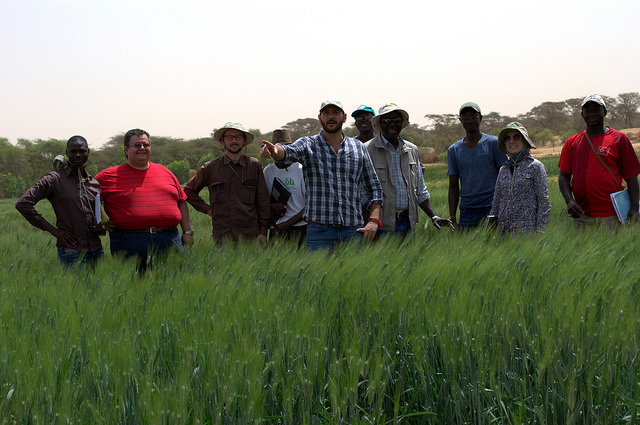
15 January 2018. "A 'crazy idea' has resulted in the ability to grow durum wheat in the extreme heat of famine-affected Senegal, Mauritania and Mali, potentially boosting the income for 1 million farming families." This is the statement that explains the choice of the winner of the 2017 Olam Prize for Innovation in Food Security.

In this region, farmers grow rice for 8 months a year, while the land remains unproductive for the other 4 months. The new durum varieties have been developed to grow very fast and to tolerate high temperatures, allowing farmers to grow durum wheat between rice seasons. In this way 600,000 tonnes of new food could be produced, corresponding to 175 servings of pasta per person per year, in the region, which would also generate significant extra incomes for the farmers. As the wheat contains 5 times more protein than rice, as well as vitamins and minerals, it will also help to improve diets.

The basic research that made these achievements possible was done within a project that was led by Professor Rodomiro Ortiz at SLU in Alnarp and financed by the Swedish Research Council.

The actual plant breeding work was led by Rodomiro Ortiz and Filippo Bassi (International Center for Agricultural Research in the Dry Areas), and conducted in cooperation with research institutes in Mauritania (CNARADA), Senegal (ISRA) and Morocco (Mohammed V University). The germplasm will be shared freely with developing countries, which means that the discovery also has wide adaptation potential for other areas hit by increasing temperatures.

See also: Interview with Dr Filippo Bassi of ICARDA and Olam Prize for Innovation in Food Security Winner

The 2017 Olam Prize Winner for Innovation in Food Security was featured on a panel at the 8th International BCFN Forum on Food and Nutrition on the 4th of December in Milan, Italy. The Prize is run in partnership with the international scientific organisation, Agropolis Fondation and the winner receives an unrestricted US$50,000 grant for the scaling up of research. Watch an animation explaining the 2017 winner’s research.


Thursday, November 16, 2017

Mobile phones in Mali with weather and climate information

16 November 2017. RIC4REC has innovated to benefit Malian producers regarding increasing mobile phone adoption to provide weather and climate information to farmers. Mobile phones are useful for disseminating weather and climate forecasts among producers and enable decision-making on the best dates for ploughing, sowing, applying fertilizer for agricultural activities, and laundry and drying for women. 

Regarding resilience to climate change, the use of mobile phone technology has improved the ability to anticipate and adapt to climate change based on the supply of information on future events in the short term (daily) and medium term (seasonal information), along with advice and recommendation on agricultural practices as per the specific needs of each producer.

Speakers:
Due to a technical problem which occurred during the Video recording the webinar is not available online. The case study in French: "Informations climatiques et conseils agricoles ay bout des doigts au Mali"  will soon be available in English as well, on the BRACED website: www.braced.org/discussions.

Friday, August 11, 2017

Choosing low cost and effective irrigation delivery systems

Choosing low cost and effective irrigation delivery systems and irrigation application technologies are the ways to improve agricultural productivity and farm incomes.

The purpose of this project (August, 2016 to July, 2020) of the International Center for Biosaline Agriculture is to expand low cost and water efficient irrigation technologies and addressing related constraints and limitations for large scale adoption by smallholder farmers in the Sub-Saharan Africa covering mainly four countries; Burkina Faso, Niger, Mali, and Senegal. The partners of the project are ICBA, NARIs, Universities, Farmer Associations, Media agencies, Private Sector

Burkina Faso, Niger, Mali, and Senegal.  have the largest potential for small scale irrigation investments. The major objective of this project is to scale up appropriate and tested small-scale irrigation technologies and introduce on-farm water management practices to smallholder farmers in SSA to increase agricultural productivity and food security. The project also focuses on employing solar systems as a sustainable source of energy for operating irrigation pumps. 

ICBA is an international, non-profit agricultural research center established in 1999 through the visionary leadership of the Islamic Development Bank (IDB), the Organization of the Petroleum Exporting Countries (OPEC) Fund, the Arab Fund for Economic and Social Development (AFESD), and the Government of the United Arab Emirates (UAE).


Saturday, January 14, 2017

Future of African Agriculture: Perspectives from the Next Generation of African Scientists

Asem-Hiablie
11 January 2017. Davis, USA. University of California, Plant and Environmental Science Bldg. Borlaug LEAP Fellows presented their perspectives from a book they are editing, The Future of African Agriculture: Perspectives from the Next Generation of African Scientists.

The book is showcasing the opportunities for Africa’s future in the midst of on-going challenges through current research and from the viewpoint of young African scientists. Seven former Fellows, now serving as editors on the book, presented current research in the context of the book. 

Dr. Dawd Gashu
Through presentation and panel discussion, the speakers covered the three main book topics:
  1. Africa Rising – small farmers feeding the continent
  2. Biotechnological advancement as a tool to enhance agricultural productivity in Africa and 
  3. Opportunities and challenges in Africa’s agriculture in 2050 and beyond 
The speakers represented both academic and government research institutes in seven different African countries (Togo, Nigeria, Ethiopia, Ghana, Kenya, Tanzania, Mali).

Dr. Waweru
Presenters and Panel:
  • Dr. Senorpe Asem-Hiablie, Ghana. Post-doctoral Researcher, USDA-ARS (Research:
    Investigations of Human Exposure Risk to Environmental Estrogens through Common Ingestion Pathways).
  • Dr. Dawd Gashu, Ethiopia. Assistant Professor of Nutrition, Addis Ababa University (Research: Effect of Micronutrient Status on Health and Metabolism of Children in Ethiopia)
    Dr. Assoumane
    Maiga
  • Mr. Kwevitoukoui Hounkpati, Togo. PhD Candidate, Entomology, University of Georgia (Research:  Systematic Studies of West African Ladybeetles (Coccinellidae)
  • Mr. Mustafa Jibrin, Nigeria. PhD Candidate, Plant Pathology, University of Florida-Gainesville (Research: Molecular Characterization and Race Classification of Bacteria Spot Pathogen of Tomato in Northwestern Nigeria).
  • Dr. Assoumane Maiga, Mali. Professor Advisor, Ministry of Education, Mali. (Research: Evaluating Communication Strategies and the Role of Mass Media in Disseminating Agriculture-related Information to Farmers in Post-conflict Nations)
  • Dr. Mariam Mtunguja, Tanzania. Senior Research Officer, Mikocheni Ag. Research Inst.
    Dr. Mtunguja
    (MARI) (Research: Genetic Diversity, Starch Physicochemical Properties and Cyanide Levels in Farmers' Preferred Cassava Landraces in the Eastern Zone of Tanzania)
  • Ms. Bernice Waweru, Kenya. Research Scientist, Kenya Agriculture and Livestock Research Org. (KALRO) (Research: An Implementation of Nested-Association Mapping for Stem Rust Resistance Genes in Bred Wheat)

Monday, September 15, 2014

BUILDING RESILIENCE TO FEED WEST AFRICA: PROPOSALS FROM FAMILY FARMERS

9 - 11 September. Bamako, Mali. POLICY DIALOGUE RELATED TO THE INTERNATIONAL YEAR OF FAMILY FARMING (IYFF) IN BAMAKO THEME : BUILDING RESILIENCE TO FEED WEST AFRICA: PROPOSALS FROM FAMILY FARMERS

Friday, February 14, 2014

Aid and trade for livestock development and food security in West Africa

Aid & trade for livestock development and food security in West Africa
Jan van der Lee, Hans Schiere, Roel Bosma, Evelien de Olde, Sifra Bol, Jessica Cornelissen
Wageningen UR Livestock Research 
This project was funded by the Dutch Ministry of Economic Affairs
December 2013 , 101 pages

The central issue in this study is the search for opportunities for livestock development to enhance food security in West Africa through aid and trade. The report discusses win-win and trade-offs between aid and trade, reflecting a rather traditional divide between development aid and economic development.

The study focuses on situations in five Sub-Saharan West African countries (Nigeria, Ghana, Benin, Burkina Faso and Mali) while extending those experiences to (other countries in) West Africa. It uses past experiences and experiences from elsewhere while envisaging future developments. The emphasis on livestock for food security is justified because of:
  • the central role of livestock and its products in West Africa, 
  • the increasing demand for animal products by growing cities and their populations, 
  • the need for good documentation on issues of aid and trade in a rapidly changing West Africa. 
Related:
9 April 2014. West-African Livestock Farming Offers Opportunities for Dutch Industry

Tuesday, February 11, 2014

The West African Agri-Business Resource Incubator


23 January 2014. Selingue province of Malthe, Mali. The West African Agri-Business Resource Incubator (WAARI) was officially inaugurated by Prof Moustapha Dicko, Minister of Higher Education and Scientific Research, Government of Mali, in the presence of Dr William Dar, ICRISAT director-general.

WAARI is one of the six agribusiness incubators being established under the Universities, Business and Research in Agricultural Innovation (UniBRAIN) project of FARA, with the Agri-Business Incubation (ABI) program of ICRISAT's Agribusiness and Innovation Platform (AIP) as the handholding and mentoring partner. 

The Danish International Development Agency (DANIDA) is financially supporting this initiative in Africa.FARA –UniBRAIN is supporting other incubators in Africa. Some of the incubators are located in the following countries: 
  1. Ghana, on Creating Competitive Livestock Entrepreneurs in Agribusiness Consortium (CCLEAr); 
  2. Kenya, on Sorghum Value-Chain Development Consortium (SVCDC); 
  3. in Uganda, on Afri Banana Product (ABP) Limited and on Consortium for Enhancing University Responsiveness to Agribusiness Development (CURAD); 
  4. and in Zambia, on Agribusiness Incubation Trust (AgBIT).

Friday, March 5, 2010

Millennium Seed Bank partnership (MSBP) in Burkina Faso and Mali

In the Sahelian regions of Burkina Faso and Mali, safeguarding wild species by increasing the ex situ conservation capacity of national partners and helping local communities sustainably use and propagate them, is one of the major objectives of the Millennium Seed Bank partnership (MSBP). 
  
Baobab trees help to improve soil quality and reduce erosion

After selecting particular wild species that they would like to cultivate, communities are trained in specific techniques needed to promote germination, such as breaking seed coats, and how to tend the seedlings. The seedlings are then planted on farms and in home gardens, protecting the species from over-exploitation in the wild.

At Sikasso, in Mali, scientists have been trained in seed processing (credit: Moctar Sacandé)

Tree species such as acacia, baobab, and nere (Parkia biglobosa) are amongst those selected by farmers to improve the quality of the soil and reduce erosion. Trees also provide non-timber forest products including fruits and fodder. "We don't need to demonstrate the benefits of planting trees," explains Moctar Sacandé, MSBP international coordinator. "The communities already know the benefits. We are just providing them with a sustainable supply of good quality seeds and planting materials. This means that farmers don't have to rely on natural regeneration." The seed collections are also being used to improve nutrition by encouraging cultivation of wild food and fruit trees.

In Burkina Faso, the MSBP has helped to support the Centre National de Semences Forestieres (CNSF) in its activities. By planting tall grasses, such as Andropogon gayanus, which reduce water runoff and prevent soil erosion, CNSF is helping farmers rehabilitate their soil and restore the Sahel. The grass can also be harvested for thatch and fodder. The initiative has been so successful that both the Burkina Ministries of Environment and Agriculture are now promoting and sponsoring CNSF to extend their work in this area.

Reference:
New Agriculturist, March 2010: Conserving wild plants in West Africa