12 - 14 June 2024. 8th edition of AFMASS Food Expo.
Since 2015, the trade show has grown to be the most important platform to source the latest new technologies and packaged food products; and where to discover the latest investment opportunities and market trends in Africa’s food and agriculture industry value chain.
The 2024 edition presented solutions across 8 special sections, including sections on packaging; ingredients and commodities; milling and baking technologies; dairy manufacturing; meat, poultry and fish; fresh produce; beverages.
AFMASS Food Expo Eastern Africa is targeted at investors, managers and professionals in the food and FMCG manufacturing, retail and hotels, restaurants and catering (HORECA) industry in the Eastern African Community but attendees to the event come from most major economies in the COMESA and SADC regions of Africa – with South Africa, Uganda, Tanzania, Ethiopia, Rwanda, Nigeria, Ghana, Zambia and Zimbabwe well represented at the trade show.
12/06 SESSION 1: State of
the Food Industry in Eastern Africa
Lewis Ngwenya – President, Simplifine
Tolga Celtekligil – Managing Director, Buhler Eastern Africa
Hiten Shah – Managing Director, Bakex Millers Ltd
Nitin Menon – Head of Sales, Dohler East Africa
12/06 SESSION 2: Opportunities & Trends in Funding & Financing the Food
& Agriculture Industry Value Chains in Africa
Absa Representative
12/06 SESSION 3 – Emerging Innovations & Trends in the Food & Beverages
Industry in Africa
Presentation: Taste Modulation in Foods & Beverage Industry – Mai
Osman, MEA Team Leader Product Manager, Dohler
12/06 SESSION 4 – Emerging Innovations & Trends in the Beverages &
Confectionery Industry in Africa
Presentation: Kevin Johnstone – Managing Director, Cranbrook Flavors
12/06 SESSION 5 – Investment & Trade Opportunities in the Grains (Milling,
Baking, Animal Feed & Snacks) Industry in Africa
Presentation: Transforming Grains - The Art of Food Processing – Ankit
Sharma – Regional Manager, Business Development (Food), Buhler
Panel discussion: Emerging Opportunities in Animal Feed Manufacturing
in Eastern Africa
Joe Karuri – CEO, Pioneer Feeds & Chairman, Association of Kenya
Feed Manufacturers (AKEFEMA)
Paul Kamau – CEO, Association of Kenya Feed Manufacturers
(AKEFEMA)
Khalfan Machera - Project and Process Engineer – Aquafeed, Buhler
Panel discussion: Innovating with Composite Flours in Africa – Critical
Success Factors & Opportunities
David Nolte – Head of Operations & R&D, Stern Ingredients East Africa
Sanjay Yenugwar – Head of Production & R&D, Capwell Industries Ltd
Peter Muni – Milling Industry Consultant
•
Prof. Catherine Kunyanga – Associate Prof. & Associate Dean,
University of Nairobi
13/06 SESSION 6 – Advances in Quality Assurance, Food Safety & Nutrition
Management in Africa
Peter Mutuku – Managing Director & Collins Tobito – Molecular
Biologist, Sorela Scientific Presentation on mycotoxins, aflatoxin contamination
James Mureithi – Managing Director, Control Union, Kenya
Stella Otaro – CEO, Top Quest Consultants
13/06 SESSION 7 – Advances in Supply Chains & Processing Technologies
Innovation in Africa
Amar Bahra – Sai Raj Ltd
Panel Discussion – Critical Success Factors in Transformation of the Food
Industry in Africa in the face of Supply Chain Disruptions, the Ukraine War
and the Middle East Conflicts
Esti Keren – Managing Director, SLO Ltd
Kevin Johnstone – Managing Director, Cranbrook Flavours
13/06 SESSION 8 – Advances in Food & Packaging Technologies & Innovations in Africa
Presentations – Speakers to be confirmed
14/06 SESSION 9 – Advances in Fresh Produce Industry in Africa
•
Okisegere Ojepat – CEO, Fresh Produce Consortium of Kenya
Presentation: Jane Ambuko, PhD, Professor of Horticulture and
Postharvest Specialist, UoN – Empowering Small-Holder Horticulture
Producers: Reducing Losses & Expanding Market Access
14/06 SESSION 10 – Making It in Entrepreneurship in Food Industry in Africa
– Focus on Women-Owned & Led Businesses
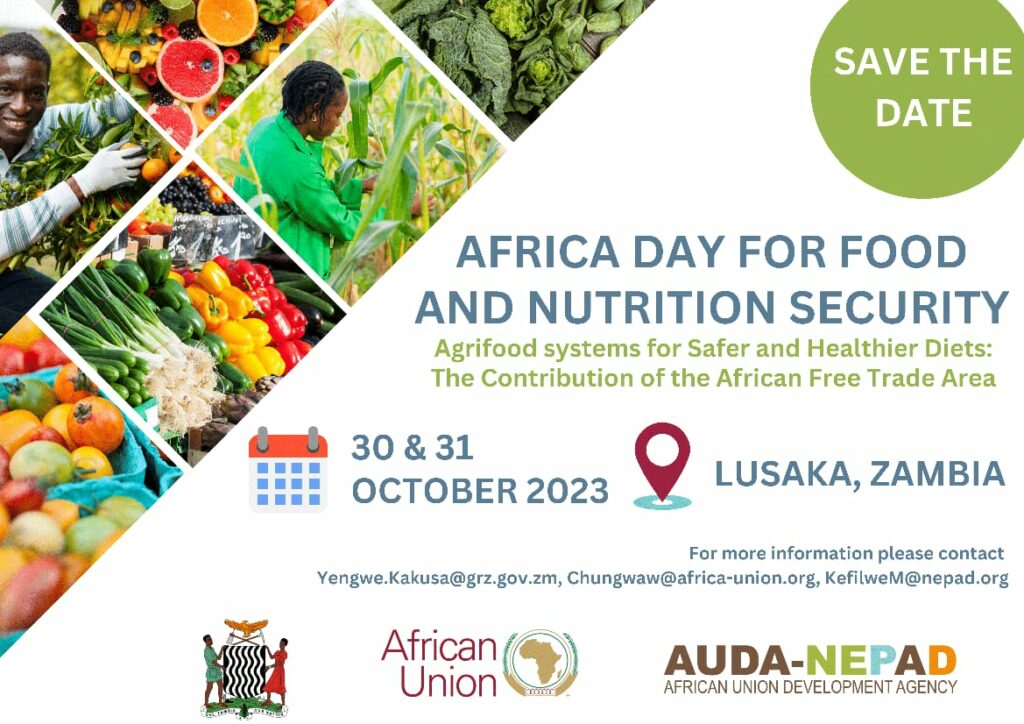
Theme: Accelerating the implementation of the African Continental Free Trade Area Agreement in the context of CAADP Commitments for Safer and Healthier Diets
The African Union Commission (AUC) through its Department of Agriculture, Rural Development, Blue Economy, and Sustainable Environment (DARBE), in partnership with the Department of Health, Humanitarian Affairs and Social Development (HHS) and the African Union Development Agency (AUDA-NEPAD), with support of technical institutions and other stakeholders organized the commemoration of the 14th Africa Day for Food and Nutrition Security (ADFNS), the 19th edition of the Comprehensive Africa Agriculture Development Programme (CAADP) Partnership Platform (PP), the associated Malabo Policy Learning Event (MAPLE), as well as the CAADP High-Level Ministerial Forum (HLMF)
30/10 MALABO POLICY LEARNING EVENT (MAPLE)
KEYNOTE ADDRESS: Reaping the Dividend of Two Decades of Policy Reforms for Food and Nutrition Security in Africa - Dr. Lawrence Haddad, Executive Director, GAIN
Panel Discussion: Showcasing Success Stories and Key Policy Lessons in Food and Nutrition Security
Setting the scene for the MAPLE by sharing and reviewing concrete examples of success stories in policy reforms and exploring conditions for scale-up.
Ms. Abimbola Adesanmi, Partnership for Child Development, Nigeria
Ms. Rosemary Mwaisaka, former Director for Nutrition and ECSA Food Fortification program
Mr. Jervis Zimba, President of the Zambia Farmers Union
Ms. Doris Utuka, Gaba National School Feeding Manager, Ghana.
Ms. Muntanga Lindunda, CEO, Zambia Association of Manufacturers.
Mrs. Ellah Chembe, CEO, Zambia National Farmers Union
BR Commitment: Boosting Intra-African Trade in Agricultural Commodities & Services
Assess progress toward the Malabo Declaration commitment to boost intra-African agricultural trade.
Raise awareness about the current state, challenges, and opportunities of intra-African trade in
agricultural commodities and services. Share findings, and success stories that can inspire and inform stakeholders.
Dr. Hermogene Nsengimana, Secretary General, ARSO - Keynote Presenter
Mr. Martin Bwalya, Independent Food Systems Expert
Mr. Daniel Njiwa, Director, Regional Food Trade & Markets AGRA
Ms. Anataria Rumba, Director of Business Competitiveness Trademark Africa
Mr. Dingiswayo Shawa, SPS Expert COMESA
Dr. Chris Muyanda, Vice Chairman, Muska Development Agency - Summary
BR Commitment: Ending hunger and halving poverty by 2025
Dr. Sukati Mphumuzi, Senior Regional Nutrition and Food Systems Officer FAO - Keynote presenter
Mr. Raymond Chikomba, Regional Nutrition Coordinator, SADC
Dr Rhoda Mofya, National Coordinator for Nutrition and Food Security, FAO Zambia
Dr. J Chris Toe, Senior Advisor WFP
Prof Lise Korsten, University of Pretoria / AAS
Mr. Ishmael Sunga, CEO, SACAU
Dr. Laila Omar Gad, UNICEF Representative to Liberia
Ms. Bibi Giyose, Senior Advisor to CEO AUDA NEPAD - Summary
31/10 THE 14TH AFRICA DAY FOR FOOD AND NUTRITION SECURITY (ADFNS) COMMEMORATION
OPENING REMARKS:
Mr. Stanlake Samkange, Out-going Chair of the CAADP DPCG
Dr. Abebe Haile, Assistant Director-General and Regional Representative for Africa, FAO
Dr. Ibrahim Assane Mayaki, AUC Special Envoy on Food Systems
H.E. Ms. Nardos Bekele-Thomas CEO, AUDA-NEPAD
H.E. Amb Minata Samaté Cessouma, AU Commissioner for Health, Humanitarian Affairs and Social Development
H.E. Ambassador Josefa Leonel Correia Sacko, AU-DARBE Commissioner for Agriculture, Rural Development, Blue Economy & Sustainable Environment.
Hon. Rueben Mtolo, MP, Minister of Agriculture, Gov. of Zambia
High-level Ministerial Panel
W. K. Mutale-Nalumango (MP) Vice President, Republic of Zambia
Hon. Sylvia T Masebo, MP, Minister of Health, Government of Zambia
Hon. Reuben Mtolo, MP, Minister of Agriculture, Government of Zambia
Hon. Makozo Chikote, MP, Minister of Livestock and Fisheries, Government of Zambia
Perspectives from Partners on the Status of Agri-Food Trade, Food and Nutrition Security: Big Picture Priorities
Mr. Odd Arnesen, Regional Food Security Envoy, NORWEGIAN AID
Julianna Drinan. Program Officer: Agricultural Development (Data and Evaluation focus) at Bill & Melinda Gates Foundation (BMGF). Seattle, Washington, United States
UNICEF representative
Kelley Cormier Food Safety Division Chief, Center for Nutrition, USAID’s Bureau for Resilience and Food Security USAID
Dr. Abebe Haile, Assistant Director-General and Regional Representative for Africa
Dr Nalishebo Meebelo, ReNAPRI Executive Director
Dr. John Ulimwengu, Senior Research Fellow, IFPRI
Mr. Mafa Chipeta, Former Director, Department of Technical Cooperation, FAO
Where do we stand and what could be the targets and pathways of the next CAADP cycle?
Dr. Ousmane Badiane, Executive Chairperson, AKADEMIYA2063 - keynote presentation 2
Mr. Stanlake Samkange, Out-going Chair CAADP DPCG
Dr. Holger Kray, Practice Manager, World Bank
Mr. Odd Arnesen, Regional Food Security Envoy, Norway
Prof. Jean-Jacques Mbonigaba Muhinda, Regional Manager, East & Southern Africa, AGRA
Mr. Derrick Sikombe, Chief Economist, Government of Zambia
Mr Kolyang Palebale, President, PAFO
01/11 SUB-THEME 2: Harnessing science, Innovation, and research to enhance food and nutrition security
Dr. Clement Adjorlolo, Ag. Head of Agriculture and Food Security
Dr. Fatunbi Oluwole, Acting Director, Research, and Innovation, FARA - Keynote Address
Dr. Muzi Sukati, Senior Regional Nutrition Officer, FAO-RAF - Current Status of Food and Nutrition Security
Prof. Lise Korsten, University of Pretoria / AAS - Roles of Science and Research in Food Security
AGRA - Innovation for Increased Productivity and Sustainable Agriculture
Dr. David Amudavi-Executive Director, Biovision Africa Trust - Role of Agroecology in nutrition and Food Security
Prof. Francis Zotor, IUNS Vice President - Closing Remarks
01/11 SUB-THEME 3: Financing agri-food and nutrition through private sector involvement
Mr. George Ouma, Coordinator, AfDB
Mrs. Lydie Kouame, Deputy Director, WFP Global Africa Office
Ms. Bibi Giyose, Senior Nutrition and Food Systems Officer, FAO
Ms. Providence Mavubi, Director Industry and Agriculture, COMESA - Keynote Address: The role of the private sector in agri-food and nutrition financing
Mr. Simon Ziba, CEO, Vision Fund in Zambia
Ms. Gladys Mugambi, SUN Movement Business Network, Multisectoral Coordinator for Food Security and Nutrition
Mr. Cheyo Mwenechanya- Head of Agriculture Banking, Zambia National Commercial Bank (ZANACO),
Dr. Frank Kayula, Executive, Director, National Smallholders Association, Zambia
Moderator: Mr. Ashford Ngugi, Senior Partnerships Advisor, AUDA-NEPAD
Case studies
Mr. Webster Sento, Executive Director, Setso Indigenous Foods (Agro-processing)
Ms. Jacqueline Kung’u – Regional Advisor, Research and Monitoring, Nutritional International Africa
Mrs. Lucy Muchoki, CEO Pan African Farmers Agribusiness Consortium/NSA - Closing Remarks
02/11 SUB-THEME 4: Harnessing the nexus between CAADP and AfCFTA towards tripling intra-African trade in agricultural commodities and nutrition improvement
Dr. Diana Akullo, Principal Officer-Sanitary and Phytosanitary, AfCFTA
Ms. Nadine Umutoni, Project Coordinator, ARSO
Dr. John Mukuka, CEO, COMESA, ACTESA
Dr. Hakim Mufumbiro, Coordinator, CCAFRICA,
Ms. Kefilwe Moalosi, Senior Nutrition and Research Officer, AUDA-NEPAD
The objectives of the Policy Dialogue are to: 1. Share empirical evidence on the importance of climate smart agriculture in transitioning to resilient farming communities in SSA. 2. Develop recommendations on how to build climate-smart and resilient farming systems in SSA at scale 3. Networking, and promoting partnerships and action.
Day 1 SESSION 2: AGRICULTURE AND WATER CHALLENGES IN SSA
RURAL COMMUNITIES
Facilitator: Dr Simphiwe Ngqaweni, CEO , National Agriculture
Marketing Council (NAMC)
Keynote Presentation Dr Inga Jacobs-Mata, Regional Representative – Southern
Africa, International Water Management Institute (IWMI)
Transforming irrigation in southern Africa in a changing
climate – Prof. Jamie Pittock, The Australian National
University (ANU) & Dr Henning Bjornlund, University of
South Australia (UniSA), Australia
Dr Matilda Azong Cho, Future Africa University of Pretoria
Dr Ikalafeng kgakatsi, Director for Climate Change and
Disaster Risk Reduction at the National Department of
Agriculture, Land Reform and Rural Development, South
Africa (DALRRD)
Dr Menghestab HAILE, Regional Director for Southern
Africa, United Nations World Food Programme (WFP)
Mr Vitumbiko Chinoko, African Agricultural Technology
Foundation (AATF)
Day 1 SESSION 3: Agricultural Technology for Resilience: Governance Framework and Practice
Facilitator: Chinoko Vitumbiko, Project Manager, Open Forum
on Agricultural Biotechnology in Africa (OFAB), AATF
Dr Makarius Mdemu, Ardhi University, Tanzania
Mr Wilson De Sousa, National Institute for Irrigation,
Mozambique
Mr Christo Spies, Chief Executive Officer, WineMS
Mr Lwembe Mwale, Climate Change Programme Officer,
Common Market for East and Southern Africa (COMESA)
Dr Richard Stirzaker, Principal Research Scientist, Virtue
Irrigation Academy (VIA)
Day 1 SESSION 4: CIRCULAR FOOD SYSTEMS / THE WATER-ENERGYFOOD (WEF) NEXUS
Facilitator: Dr Tafadzwa Mabhaudi, Research Group Leader -
Sustainable and Resilient Food Production Systems (SuRF),
IWMI, South Africa
Keynote Presentation: Complex systems and circular food systems – Dr Andre
van Rooyen, ICRISATEthiopia
Mr Phil Bowes, Enterprise Development Manager, Vinpro
Professor Rabi Mohtar, IWRA Vice President and Texas
Amu
Eng. William Ponela, Founder and CEO, Zonful Energy
Dr Gabriel Lekalakala, Specialist Scientist, Climate Change
Analysis, Department of Water and Sanitation, South
Africa
Day 2 SESSION 5: THE IMPORTANCE OF SOCIAL INCLUSION
(WOMEN AND YOUTH) IN TRANSFORMING
AGRICULTURAL SYSTEMS IN SSA
Facilitator: Mr Suwilanji Sinyangwe, FANRPAN
Dr Elizabeth Mkandawire and Dr Colleta
Gandidzanwa, Food Systems Research Networks
for Africa (FSNet-Africa), African Research
Universities Alliance (ARUA) Keynote Presentation
Dr Karen Parry, University of South Australia
(UniSA), Australia
Dr Jean-Marie Kileshye Onema, Executive
Manager, WaterNet
Dr. Mokhantso Makoae, Human Sciences Research
Council (HSRC)
Mr. Bonani Nyhodo, National Agriculture
Marketing Council (NAMC)
Day 2 SESSION 6: CAPACITY GAPS IN TRANSFORMING
SMALLHOLDER FARMING IN SSA
Facilitator: Prof Khathutshelo Nephawe, Chair South
African Council for Natural Scientific Professions
(SACNASP)
Keynote Presentation: "Capacity Gaps for Transforming Smallholder
Farming in Sub-Saharan Africa" - Mr. Mamadou
Biteye, Executive Secretary, Africa Capacity
Building Foundation (ACBF)
Dr Martin Moyo, Country Representative – Climate
Adaptation and Mitigation Senior Scientist, ICRISAT
Zimbabwe
Mrs Wendy Petersen, Executive Manager, SA Wine
Industry Transformation Unit (SAWITU)
Mr Mpho Tlape, Farmer Support and
Development, Gauteng Department of Agriculture
and Rural Development (GDARD)
Dr Lisa Rebelo, Michael Wellington - Lead Scientist
Digital Earth Africa
Dr Sandile Ngcaphalala, Farmer Development Lead,
GrainSA
Day 2 SESSION 7: IMPORTANCE OF PARTNERSHIPS TO
ENSURE INCREASED INVESTMENTS IN SUSTAINABLE
WATER MANAGEMENT IN SSA
Facilitator: Dr Marinda Visser, from University of
Pretoria
Dr Eric Wandra, CEO, Ocean Finance Company,
South Africa Keynote Presentation
Mr Gerard Martin, Executive Manager, Winetech
Dr Luitfred Kissoly, Ardhi University Tanzania
Dr Mario Chilundo, UEM/INIR Mozambique
Dr. Vuyo Mjimba, Human Sciences Research
Council (HSRC)
Dr Jackie Crafford, Managing Director, Prime Africa
Consult
Day 3 SESSION 9: POLICIES PRIORITIES FOR TRANSITIONING TO CLIMATE-RESILIENT FARMING SYSTEMS IN SSA
Facilitator: Eng. James Sauramba, Executive Director - SADC
Groundwater Management Institute (GMI)
Ms Sithembile Mwamakamba, Director of Policy
Research and Analysis, FANRPAN- Keynote Presentation
Mr Delfim Vilissa, Policy Advisor to the Minister of
Agriculture and Rural Development. Ministry of
Agriculture and Food Security of Mozambique
Representative from Mozambique
Eng Bezzel Chitsungo, Director-Department of Irrigation
- Ministry of Lands, Agriculture, Fisheries, Water and
Rural Development, Zimbabwe
Dr Thokozani Simelane – Human Sciences Research
Council (HSRC)
Dr Canisius K. Kanangire AATF- enabling environment for agricultural
biotechnology from its Africa wide experience.
Mr Kwame Ababio, Senior Programme Officer
Environment and climate change , African Union –
NEPAD
Day 3 INVESTMENT PRIORITIES FOR TRANSITIONING
TO CLIMATE-RESILIENT FARMING SYSTEMS IN SSA
Facilitator: Ms Sithembile Mwamakamba, Director of Policy
Research and Analysis FANRPAN
Keynote Presentation
Mr Ishmael Sunga, Southern Africa Confederation of
Agricultural Unions (SACAU)
Dr Leah Ndungu, Regional Manager, Eastern & Southern
Africa, Australian Centre for International Agricultural
Research (ACIAR)
Dr Oluyede Ajayi, Global Lead, Food Security and Rural
Well Being, Global Center on Adaptation
Dr Easther Chigumira, Senior Agriculture Specialist,
World Bank
Ibrahima Cheikh Diong, United Nations Assistant
Secretary General (ASG) and Director General of the
African Risk Capacity (ARC) Group
Dr Vine Mutyasira, Program Officer, Policy Quantitative
Modelling and Data Analytics at Alliance for a Green
Revolution in Africa (AGRA)
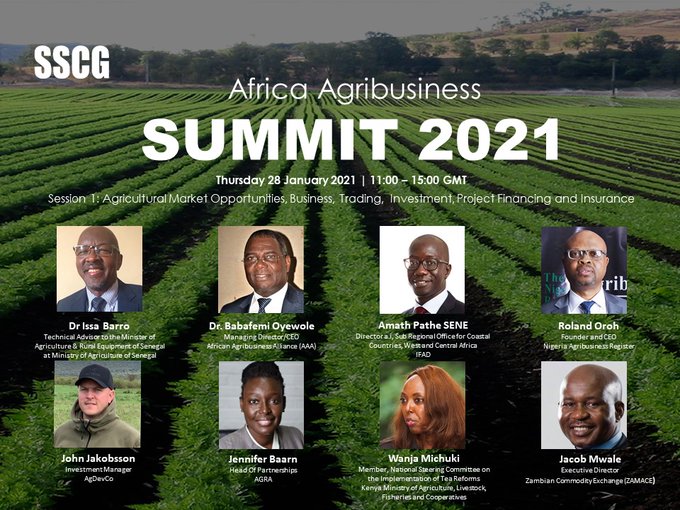
28 January 2021.Africa Agribusiness Summit 2021. The theme of this summit is Accelerating African agro industry growth, productivity and value chain development; Tackling food waste and security challenges.
The half day-long summit will bring together stakeholders from governments, investors, business, academia and multilateral institutions to take stock of the agriculture and agro sectors in Africa and identify opportunities to enhance growth, efficiency, productivity and sustainability across agricultural value chains in support of smallholder farmers, agricultural products processing and boost food security. The summit will feature panel discussions, transformation talks and presentations on a myriad of topics and opportunities. Its aim is threefold: to highlight innovative solutions for growth, discuss areas for further investment and qualifiers for investment, and create an avenue for collaboration between the UK and African private and public sectors.
Join us to connect with like minded business leaders, investors, industry experts and entrepreneurs, to gain latest update, insights, perspectives, strategies and practical best practices. Specific topics to be discussed include:
Africa’s agricultural market and agro-industry economic landscape
Sustainable and impact agricultural investment opportunities
Digital agriculture - Agrotechnology, agri-tech, innovation and farming systems
Building sustainable agri-Food systems - Reducing food losses, security and safety
Ethical and Sustainability Governance (ESG) and Social Responsibility
Tackling climate change risks, challenges and impact
Empowering and supporting smallholder farmers across the value chains and integration into global and local supply chains
Dr Issa Barro - Technical Advisor to the Minister of Agriculture & Rural Equipment of Senegal at Ministry of Agriculture of Senegal*
Dr. Babafemi Oyewole - Managing Director/CEO at The African Agribusiness Alliance (AAA)
Amath Pathe SENE - Director a.i, Sub Regional Office for Coastal Countries, West and Central Africa at International Fund for Agricultural Development (IFAD)
Jacob Mwale - Executive Director of Zambian Commodity Exchange (ZAMACE)
Ndidi Okonkwo Nwuneli - Managing Partner of Sahel Consulting Agriculture & Nutrition Limited and Co-Founder of AACE Food Processing & Distribution*
Providence Mavubi - Director of Industry and Agriculture at COMESA Secretariat*
Wanja Michuki - Member, National Steering Committee on the Implementation of Tea Reforms in Kenya at Kenya Ministry of Agriculture, Livestock, Fisheries and Cooperatives
Jennifer Baarn - Head Of Partnerships at Alliance for a Green Revolution in Africa (AGRA) and fmr Deputy CEO of the Southern Agriculture Growth Corridor (SAGCOT) Centre
Roland Oroh - Founder and CEO of Nigeria Agribusiness Register
Dr Essam Yassin Mohammed - Climate Change Program Leader at WorldFish (ICLARM)
Pamela Kuwali - Chief Executive Officer at Civil Society Agriculture Network
Ndagijimana Jean Paul - Country Manager - Rwanda at Alliance for a Green Revolution in Africa (AGRA)
Sheila Komen Keino - Regional Director, Partnerships and New Business / Malawi Fertilizer Systems Programmes Director at African Fertilizer and Agribusiness Partnership (AFAP)
Dr Helen Onyeaka - Programme director - Food Safety, Hygiene and Management Masters, Food Microbiology Lecturer - The University of Birmingham
Esayas Lemma Hayi - Director, Crop Development Directorate at Ministry of Agriculture, Ethiopia
Dr Dinesh Chauhan - Chief Operating Officer at the Indian Society of Agribusiness Professionals
Michael Mamo - Managing Director of Addis Exporter Ltd (PLC)
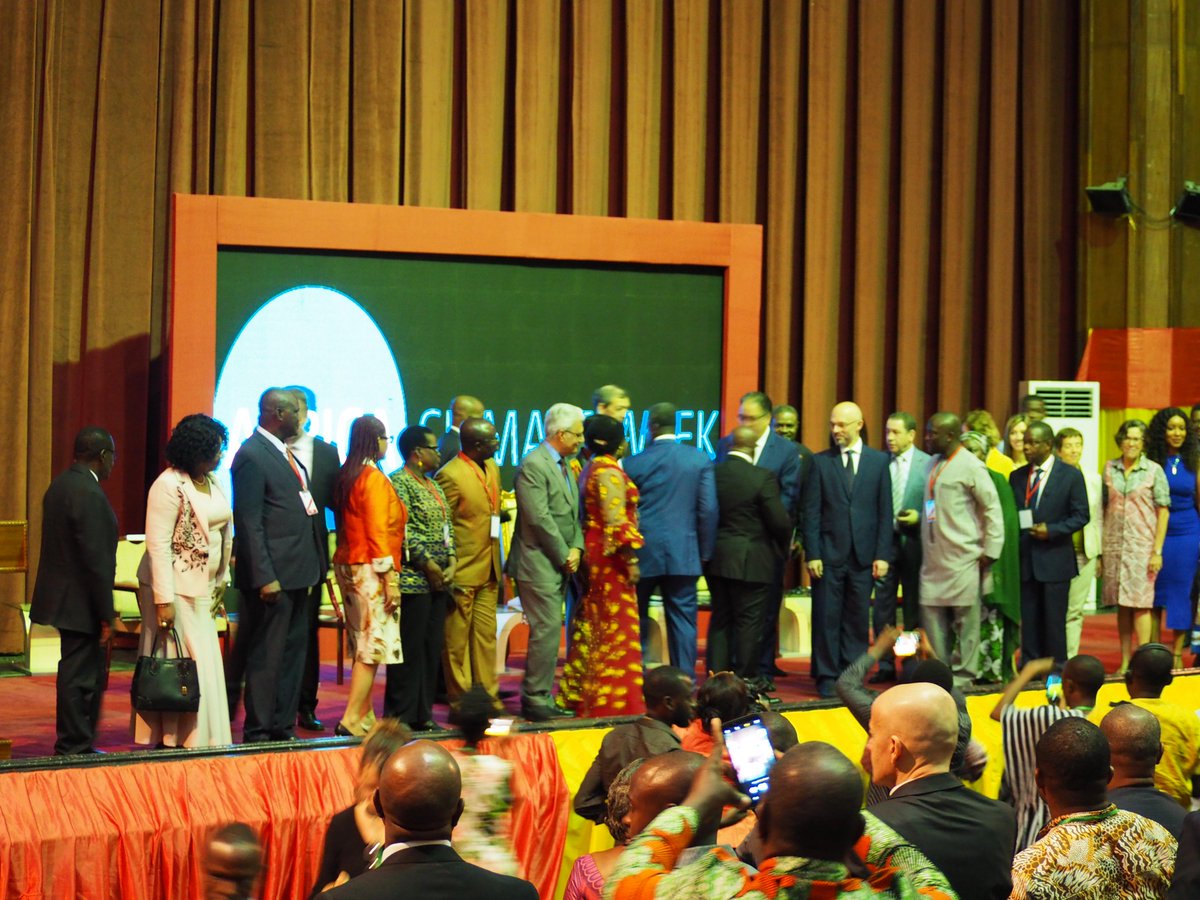
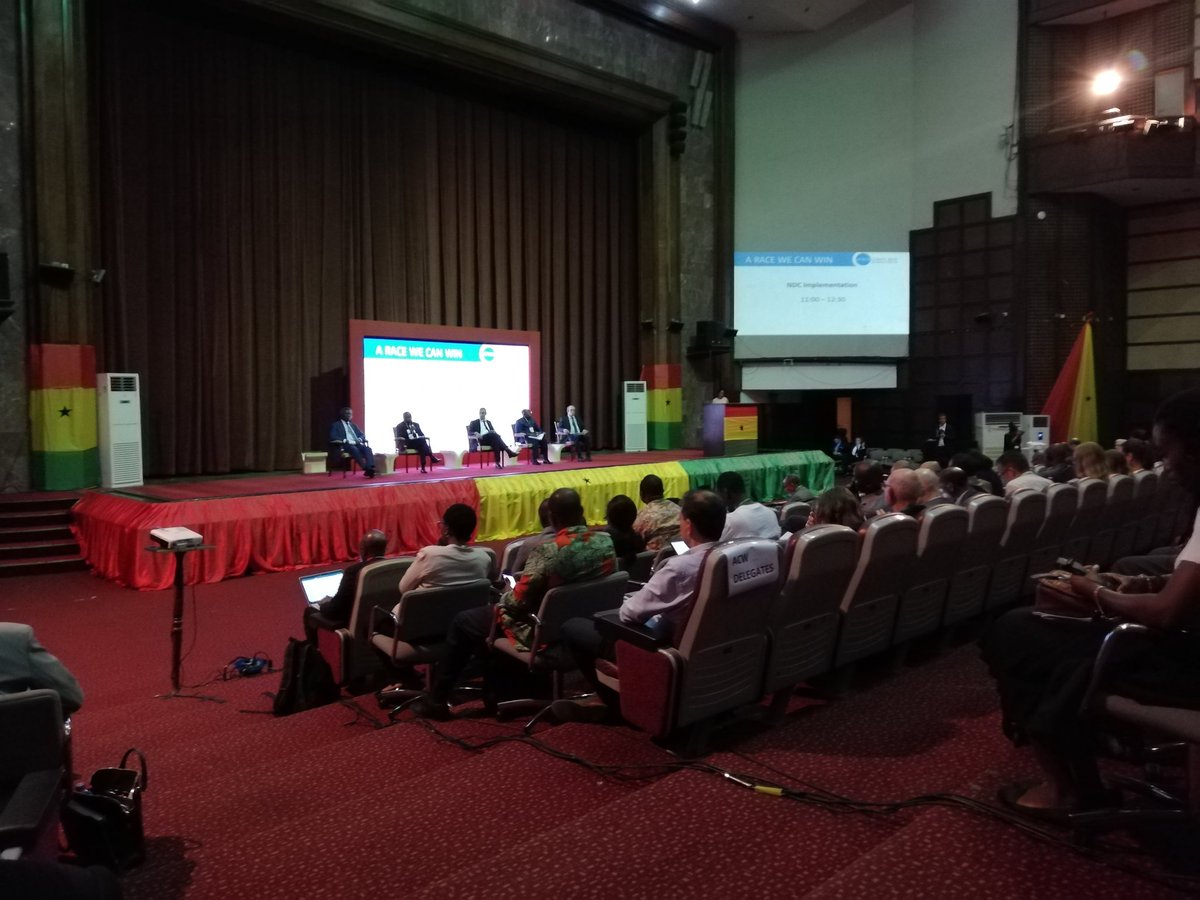
18-22 March 2019. Accra, Ghana. Africa Climate Week. the Africa Climate Week (ACW) 2019 was convene in the lead-up to the UN Secretary-General’s Climate Summit in September 2019, bringing together diverse actors from the public and private sectors.
Participants will focused on how engagement between Parties and non-Party stakeholders can be further strengthened in key sectors for Africa, including energy, agriculture and human settlements. The event showcased the role of future carbon markets to enhance climate action towards the goal of sustainable development, and seek to facilitate implementation of countries’ nationally determined contributions (NDCs) under the Paris Agreement on climate change and SDG 13 (climate action), among other Goals.
The event consisted of opening and closing plenaries with six parallel sessions:
Farmers’ Climate Resilient Practices: Taking action to reduce climate risks at farm and ecosystem
levels.
Climate Resilient Ambition Powered by Nature: Building the case for nature based solutions (NBS) in
Africa’s agriculture and food system
Colliding Climate and Conflict Risks in Fragile and Vulnerable Contexts: Building resilience from an
integrated approach in the most vulnerable places.
Scaling up Private Sector Investment to Build Resilience in Agriculture: Showcasing climate actions
from businesses, insurers and government on microcredit, risk transfer, food value chain for climate
resilient agriculture and food sectors
Large Scale Restoration and Agroforestry, Lessons from Africa: Learning from Ghana Cocoa and
Forest Initiative from, Great Green Wall Initiative and AFR100 - African Restoration Initiative.
Early Warning- Early Action and Forecast Based Financing: Implementing Early Warning-
early Action
and Forecast Based Financing approaches
This side event explored the technologies, practices, planning, policies and investment options available for transforming landscapes and food systems, focusing on synergies between adaptation and mitigation in COMESA member States.
Mclay Kanyangarara, COMESA Climate Advisor
Irene Annor-Frempong, Divisional Manager and Strategic Priority Leader, FARA
Abebe Haile-Gabriel, Assistant Director-General and Regional Representative for Africa, FAO
Stephen Muwaya, Program Coordinator, Ministry of Agriculture, Animal Industry and Fisheries, Uganda
Tammy Muzi Dlamini, Agri Business Manager at National Marketing Board (NAMBoard), Eswatini.
Background:
The Africa Climate Week is part of Regional Climate Weeks that are held annually in Africa, Latin America and the Caribbean (LAC) and Asia-Pacific. Regional Climate Weeks are organized by the Nairobi Framework Partnership (NFP), which supports developing countries in preparing and implementing their NDCs.
The events’ global partners are the UNFCCC, Word Bank, UN Development Programme (UNDP), UN Environment Programme (UNEP), UNEP Partnership with the Technical University of Denmark (UNEP-DTU Partnership), Climate Technology Centre and Network (CTCN) and International Emissions Trading Association (IETA). Regional partners include the African Development Bank (AfDB) in Africa, Inter-American Development Bank (IDB) in LAC and Asian Development Bank (ADB) and UN Economic and Social Commission for Asia and the Pacific (ESCAP) in Asia-Pacific.
22-24 October 2018. Kampala, Uganda. A high-level meeting brought together members of national research institutions, policy institutions and government within Uganda, including senior decision makers, to explore approaches to enable an equitable research system in the country.
The meeting tackled important questions such as: how national research systems can nurture a wider pool of research talent and how to foster an inclusive research and knowledge system that enables a diversity of voices and opinions to contribute to national development.
The event was hosted by and has been developed in partnership with Uganda National Council for Science and Technology (UNCST). Based in Kampala, UNCST develops and implements ways to incorporate science and technology in Uganda’s national development process and advises the government on relevant policy matters and coordinates research and development activities in the country.
The meeting defined a shared vision; articulate the key challenges and gaps that limit equitable access to, use of and full contribution by researchers and institutions to the national research and development agenda; and developed a plan for a holistic, equitable, collaborative and sustainable research system that is capable of contributing to national development priorities of response. It will include speakers from Uganda’s Ministry of Science and Technology, Resilient Africa Network, universities across the country, UNESCO and Sida, as well as from UNCST and INASP.
The six key areas for discussion were:
Uganda’s national research system and who is shaping the future
Research funding and its drivers
Gender inequity
The obstacles within the global economy that impede African knowledge transfer and application
The dynamics of North-South research collaborations
The global knowledge pool: is it restricted and who determines access and contribution?
( EASTEco) an East African Community institute told the researchers that working together as a group would help East Africa share the high costs associated with research.
“We are small economies. Infrastructure is expensive. It makes sense to work together and share results. It is easy to work together since the region faces the same challenges. Each country within the region would be given areas where they have comparative advantage so that they put their best talent there, citing Uganda taking coffee."
For instance the just ended World Bank programme, the East African Agricultural Productivity Programme (EAAPP) selected countries depending on their comparative advantages. Uganda was selected to host the Cassava Centre for Excellence, Ethiopia was selected to host wheat, Tanzania rice, while Kenya was given dairy.
The Consultative Group on International Agricultural Research (CGIAR) also host specific programmes in different countries. Nigeria hosts the international centre for Cassava, Philippines hosts one for rice, Kenya one for livestock and forests, Peru for potato.
Rob Smith, Senior Vice President and General Manager, Europe, Africa and Middle East; H. E. Joaquim Alberto Chissano, Former President, Republic of Mozambique; Christian Schmidt, Federal Minister of Food and Agriculture, Germany; H. E. Sir Quett Ketumile Joni Masire, Former President Republic of Botswana and Martin Richenhagen, AGCO Chairman, President & CEO at the AGCO Africa Summit 2015.
19 January 2015. Berlin, Germany. Agribusiness in Africa. AGCO Corporation organized the 4th AGCO Africa Summit. In cooperation with Bayer CropScience, DEG and Rabobank the aim was to capitalize on the successful events of the previous years and establish a regular dialogue on Africa’s agricultural future in the context of the problematic issue of global nutrition.
The theme of the 4th AGCO Africa Summit was “Agribusiness in Africa – Partnering for Growth” and the summit had a strong focus on private sector driven agricultural growth, promoting the idea of agriculture as a business and not just a development agenda. Speeches and panel sessions showcased implemented projects touching on successful approaches for engaging with large-scale commercial projects, how to catalyze successful mid-sized domestic agribusiness and also building scale with commercially minded smallholder farmers.
The following dignitaries attended this year’s H.E. Joaquim Alberto Chissano, former president of Mozambique; H.E. Sir Quett Ketumile Joni Masire, former president ofBotswana and Christian Schmidt, Germany’s federal minister of food and agriculture.
Joining AGCO in sponsoring the summit were Bayer CropScience, DEG — Deutsche Investitions - und Entwicklungsgesellschaft and Rabobank.
AGCO’s Future Farms are to give local farmers and AGCO dealers hands-on training experience with leading edge agricultural equipment and practices.
They are to have a new state-of-the mechanization center, a poultry learning center and a grain handling center, which the release says, are “each a first of its kind for Africa.
A grand opening is to take place in May for a Future Farm already fully operational in Zambia. Others are planned for key African markets, primarily in Francophone countries.
Rob Smith, AGCO senior vice president and general manager for Europe, Africa and the Middle East, said that “Africa represents an important future growth market for AGCO and we are putting sustainable mechanization at the core of our strategic investments.”
AGCO invested $350 million and committed some six years of research and development into its Massey Ferguson Global Series, a new product line of 60-130hp tractors which are to ultimately be assembled at multiple manufacturing sites and are to be sold in Africa and elsewhere.
“For AGCO, ‘sustainable mechanization’ means designing our products for the African market environment and building them locally,” Dr. Smith said. “it also means providing professional training for operating, maintaining and servicing our machines, and first class support through out extensive dealer network and parts supply in Africa.”
Related:
28 - 29 January 2015. Dar es Salaam. Agribusiness Congress East Africa Conference. Over 800 agricultural experts convened to debate on finance, best practices and sustainability in the region’s blossoming farming sector.
The conference represented the entire agribusiness spectrum from input suppliers, agro-processors, traders, exporters, retailers, commercial farmers, processors, policy makers and associations.
ECA-SA, in collaboration with the COMESA and SADC Secretariats will organize an Ad Hoc Experts Group on Agro-industry development for food and nutritional security in Southern Africato discuss and review the state of the agriculture sector in Southern Africa. The meeting with take place from .
The Expert Group Meeting will discuss emerging issues and challenges in strengthening agro-industry for food and nutritional security in the SADC region. An issues paper on Agro-industry development for food and nutritional security in Southern Africa will be the major discussion paper. The two day meeting is expected to provide concrete recommendations on how to strengthen the agro-industry sector through among others partnerships, best practices and lessons from other regions.
Participants will include agro-industry and agribusiness experts from government institutions, the private sector, SADC institutions, civil society, academia and others development partners.
8-10 September 2014. Lilongwe, Malawi. Delegates to the 6th African Consumer Protection Dialogue Conference in Lilongwe have adopted the African Dialogue Cross Border Cooperation Principles, initially launched in a Statement of Intent at the 5th African Consumer Protection Dialogue Conference held in Livingstone, Zambia last year September.
Jointly hosted by the COMESA Competition Commission, Competition and Fair Trading Commission-CFTC of Malawi and the U.S. Federal Trade Commission, the conference brought together 77 delegates from 20 countries, including the United States.
Malawian Minister for Industry and Trade,
Hon. Joseph Mwanamveka (MP), at the
6th Annual African Consumer Protection
Dialogue Meeting
According to a joint press release from the organisers, the Statement of Intent was formulated in recognition of the need for effective and enhanced cross border collaboration between and among the participating consumer protection and competition agencies as well as agencies dealing with criminal investigations such as Interpol, in dealing with the traditional and emerging consumer rights violation issues.
"The Livingstone Statement of Intent also outlined each provision of the African Dialogue Cross Border Cooperation Principles, including the mechanisms participating agencies intend to use to work towards effective collaboration and enforcement of cross border consumer protection violations," reads part of the statement.
And in order to effectively implement the African Dialogue Principles, delegates agreed on a Proposed Implementation Framework.
The statement from the organisers says delegates set up Working Committees to coordinate specific tasks and resolved to report on progress in March 2015 and at the 7th African Dialogue Annual Conference.
24 - 26 September 2014. Nairobi, Kenya. This conference hosted over 600 delegates (policy and decision makers) from over 50 countries within and outside Africa.
It had eight topical sessions from strategic information on the world and continental dairy industry outlook, trends, future projections, practices opportunities and challenges to policy issues impacting on dairy industry development, trade and competitiveness and sustainability to technical issues of interest to players along the value chain.
The event hosted workshops and seminars by the dairy sector partners and supporters with long-term commitment to the dairy industry in Africa. Workshops and seminars gave in-depth presentations on some of the cutting edge technologies and emerging knowledge to dairy industry actors attending the conference as well as pre-registered trade visitors. Details of the private workshops and registration are coming soon.
One workshop tackled the issue of aflatoxin contamination:
UN Food and Agriculture Organization (FAO) Livestock Development Officer Olaf Thiemetold the dairy forum in Nairobi that the sector is largely unexploited in the region due to a variety of constraints.
"We are urging governments to partner with the private sector in order to improve the productivity of the sector. This group should be assisted to commercialize their operations in order to improve the yields. The average per capita milk consumption for Africa stands at 50 kg compared to the global average of 100 kg."
Kenya's Deputy President William Ruto said Common Market for Eastern and Southern Africa trading bloc produces 12 million metric tonnes of milk annually against an annual demand of 14 million metric tonnes, adding the region relies on imports in order to plug the deficit.
Cabinet Secretary for agriculture Felix Koskei said the dairy industry contributes four percent of the country's Gross Domestic Product, up from 2.8 percent in 2003. He said the industry is most visible in the rural areas where it is a major source of livelihood.
Government data indicated there are 1.2 million dairy farmers in Kenya. Koskei said Kenya produced 5.2 billion litres of milk put, of which only 550 million litres was processed by the dairy industry in 2013.
15 - 16 September 2013.5th Joint COMESA Ministerial meeting of agriculture, environment and natural resources. The economic significance of agriculture in COMESA (Common Market for Eastern and Southern Africa) region is overshadowed by its low productivity due to less mechanized production, infrastructure challenges and dependency on rain-fed agriculture, COMESA said.
COMESA Assistant Secretary General, Ambassador Dr. Kipyego Cheluget said this has brought about food insecurity and slow development of agricultural industry in the region. Currently, the region is showing mixed food security developments with some countries registering increased crop and livestock production while others are showing deficits, he said. COMESA is working with partners to address food security and improvement of livestock production.
Intra-COMESA trade through micro, small and medium enterprises development will add value to development and promote regional integration. Agriculture represents more than 30 percent of the COMESA region’s GDP and provides livelihoods to about 80 percent of the total population. It accounts for 65 percent of foreign exchange earnings too. The two-day meeting was undertaken under the theme: “Enhancing Intra-COMESA Trade through Micro, Small and Medium Enterprise Development”. The meeting reviewed the implementation of agricultural, environmental and natural resources development in the region.


 12/06 SESSION 1: State of
the Food Industry in Eastern Africa
12/06 SESSION 1: State of
the Food Industry in Eastern Africa  12/06 SESSION 2: Opportunities & Trends in Funding & Financing the Food
& Agriculture
12/06 SESSION 2: Opportunities & Trends in Funding & Financing the Food
& Agriculture