Risk Assessment for Israel Agriculture and Adaptation to Climate
Yael Kachel, Senior Economist - Strategy DivisionSenior Economist - Strategy Division. Ministry of Agriculture and Rural Development, Israel - How to Transform Agriculture in The Era of Climate Change – The Role of Government
Marc Perel, Agriculture Meteorologist and co-cordinator of the Agricultural Preparation Committee on Climate Change, Soil Conservation & Drainage Unit Ministry of Agriculture and Rural Development - Risk Assessment for Israel Agriculture and Adaptation to Climate
The climate crisis is one of the biggest threats to the global economy and to human wellbeing, already taking its toll and severely affecting our ecosystems, livelihoods and food security. Considered a "desert threshold" country, Israel is expected to face impactful climate changes resulting in extensive consequences for its agricultural and water sectors, among others. In view of these facts, Israel is making important steps to assist its agricultural sector in adapting to climate change, including formulating a quantitative assessment for prioritizing and targeting preparedness policies.
Head of MATC/ Ministry of Agriculture Rep. Israel - A Country on the Frontline of Climate Innovation
Ambassador Gideon Behar, Special Envoy for Climate Change Ministry of Foreign Affairs of Israel Food Farming in Light of Changing Climate: Challenges and Solutions
Dr Gidon Toperoff, co-cordinator of the Agricultural Preparation Committee on Climate Change Ministry of Agriculture and Rural Development
Risk Assessment for Israel Agriculture and Adaptation to Climate
Yael Kachel, Senior Economist - Strategy DivisionSenior Economist - Strategy Division. Ministry of Agriculture and Rural Development, Israel - How to Transform Agriculture in The Era of Climate Change – The Role of Government
Marc Perel, Agriculture Meteorologist and co-cordinator of the Agricultural Preparation Committee on Climate Change, Soil Conservation & Drainage Unit Ministry of Agriculture and Rural Development - Risk Assessment for Israel Agriculture and Adaptation to Climate
The climate crisis is one of the biggest threats to the global economy and to human wellbeing, already taking its toll and severely affecting our ecosystems, livelihoods and food security. Considered a "desert threshold" country, Israel is expected to face impactful climate changes resulting in extensive consequences for its agricultural and water sectors, among others. In view of these facts, Israel is making important steps to assist its agricultural sector in adapting to climate change, including formulating a quantitative assessment for prioritizing and targeting preparedness policies.
Head of MATC/ Ministry of Agriculture Rep. Israel - A Country on the Frontline of Climate Innovation
Ambassador Gideon Behar, Special Envoy for Climate Change Ministry of Foreign Affairs of Israel Food Farming in Light of Changing Climate: Challenges and Solutions
Dr Gidon Toperoff, co-cordinator of the Agricultural Preparation Committee on Climate Change Ministry of Agriculture and Rural Development
The climate crisis is one of the biggest threats to the global economy and to human wellbeing, already taking its toll and severely affecting our ecosystems, livelihoods and food security.
Considered a "desert threshold" country, Israel is expected to face impactful climate changes resulting in extensive consequences for its agricultural and water sectors, among others.
In view of these facts, Israel is making important steps to assist its agricultural sector in adapting to climate change, including formulating a quantitative assessment for prioritizing and targeting preparedness policies.
MATC - MASHAV’s International Agricultural Training Center – specializes, since 1963, in human capacity building, transfer of knowledge and professional support in the fields of agriculture, water management, environment and rural development.
MATC designs and implements MASHAV's agricultural cooperation programs and professional training activities in Israel and abroad. Our cooperation programs are inspired by the Israeli development experience and combine both practical agricultural know-how and the Israeli spirit of innovation. Activities include international courses and tailor-made training activities in Israel and in stakeholders’ countries, as well as long- and short term advisory missions and agricultural projects. Trainings are held in English, French, Russian, Spanish and Arabic.
Please Click HERE for the Webinar Recording, Presentation, Transcripts, Questions and Chat.
Transforming our food systems requires technical and institutional innovations to go beyond ‘business as usual’. A range of innovative products, services, or business models based on new technologies can help solve many of the market failures. However, the Agriculture and Food innovation ecosystems are struggling to bring these innovations to use and at scale despite the obvious need to address local and global challenges.
This is why institutional innovations are also needed to address the systemic challenges in the value chain as the conduit from research to markets, preventing their successful implementation and growth. For this, it is essential to reinvent the way the public sector interacts with the private sector including through entrepreneurship and startup ecosystems. Stakeholders – innovators, entrepreneurs, farmers, governments, investors – are struggling to connect and collaborate and these ecosystems provide a physical or virtual location where they can interact to create and scale new innovative companies.
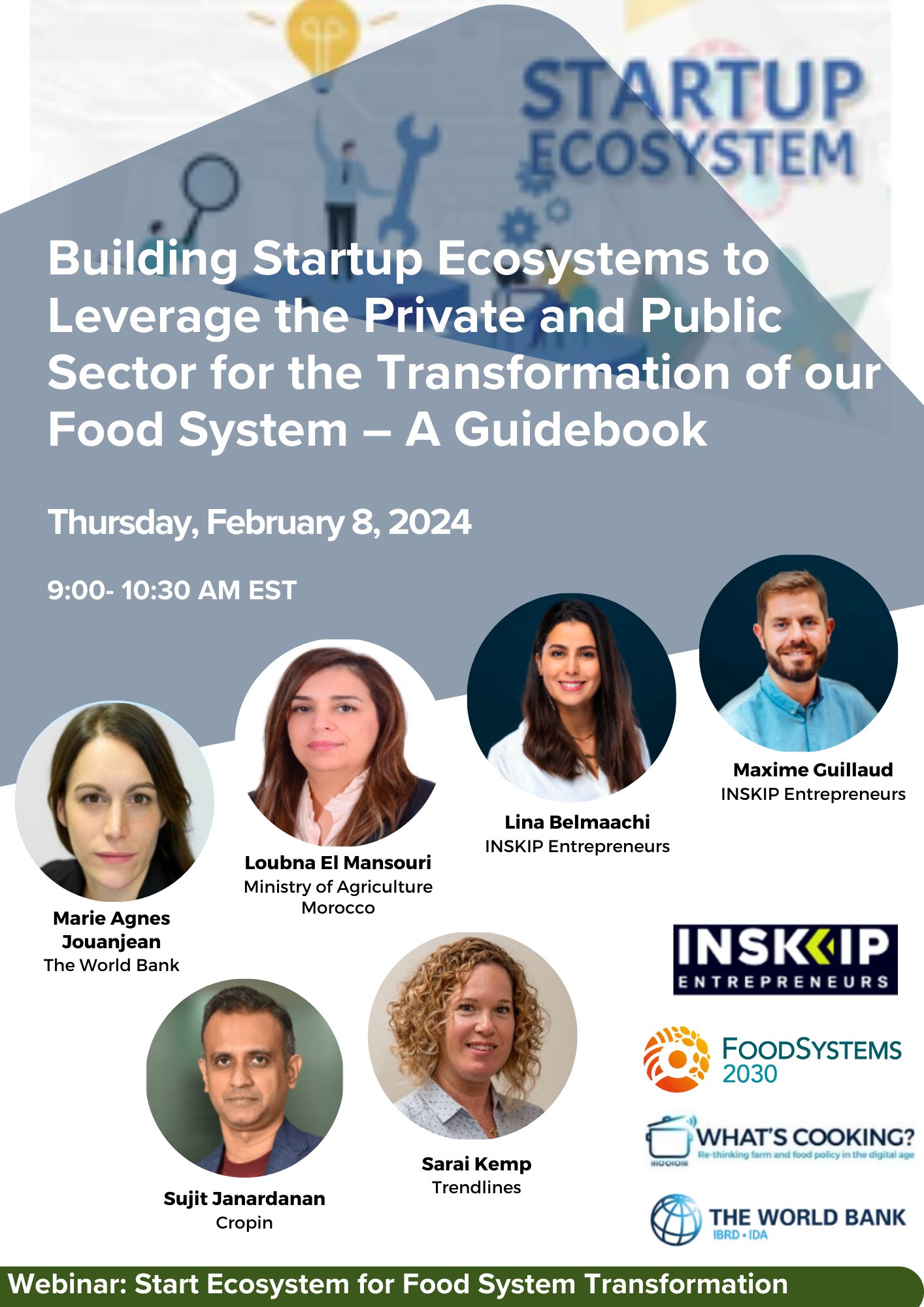
The World Bank commissioned aGuidebookbringing together insights and key features of these
to facilitate the development and growth of AgTech startup ecosystems for harnessing innovative technologies and boosting private and public sector capabilities to provide access to farmers to innovative services in World Bank client countries.
It also provides an assessment of the relevance of the various models developed around the world based on different levels of maturity of core features of the economy.
Drawing on instructive best practices and concrete enablers, this webinar will allow the World Bank operational teams and their client countries to understand the challenges and needs of the various stakeholders and build upon these observations to make informed decisions, create meaningful collaborations, and ultimately catalyze the growth of the agricultural sector around the world.
Moderator: Marie Agnes Jouanjean, Senior Agricultural Economist, Agriculture and Food Global Practice at The World Bank.
Maxime Guillaud, Entrepreneur and the Founder of INSKIP Entrepreneurs Maxime Guillaud is an entrepreneur and the Founder of INSKIP Entrepreneurs, a French company dedicated to nurturing entrepreneurial ecosystems. He has played a vital role in establishing multiple investment funds and acceleration programs, aiming to foster robust and integrated ecosystems in Africa and Europe. Specializing in startups, fintech, industry, health, and food sectors, Maxime also personally mentors startups, guiding them through their go-to-market strategies and financing issues.
Lina Belmaachi, Manager at INSKIP Entrepreneurs Lina Belmaachi is a Manager at INSKIP Entrepreneurs. She co-founded an AgTech project dedicated to drawing the future of agriculture through innovative solutions by identifying data-driven technologies that can solve pain points throughout the agricultural value chain. With experience in biotech as well as wellness startups, she is specialized in creating innovation vehicles such as startup programs or digital business units for corporates and public actors in Morocco and Africa.
Sujit Janardanan, Chief Marketing Officer at Cropin Sujit Janardanan is the Chief Marketing Officer at Cropin, a global B2B agtech company and digital transformation enabler for the agri-food ecosystem. With over 20 years of experience in tech such as Google Cloud and Amazon, he was recognized as one of the 50 Most Talented CMOs of India in 2013.
Sarai Kemp, VP Agrifood at Trendlines Sarai Kemp is the VP Agrifood at Trendlines, a leading Israel and Singapore-based investment group. She is an agrifood investment professional with over 15 years’ experience in the agrifood industry. At Trendlines, Sarai is responsible for sourcing start-ups, evaluating opportunities, negotiating, and closing investments and working with portfolio companies post-investment. She is also a board member on several agrifood tech portfolio companies internationally and a consultant for a CEA 6-year Agtech challenge, managed by the Weston Foundation in Canada. "The entrepreneurial spirit and risk-taking mentality is higher in less developed countries"
Discussant: Professor Loubna El Mansouri, Director of the Digital Pole of the Ministry of Agriculture in Morocco.
Simcha Shore of AgroScout: Simcha founded AgroScout Ltd, an agro-data company with a mission to create an impact on global food security and by working with processors and growers around the world to improve their crop yields through precision agriculture.
AgroScout helps processors & growers worldwide in reaching sustainable goals of production through support and direct partnership with processors, chemical companies.
With a presence in North America and Latin America, and an international team of agriculture and software developers, AgroScout is continuously developing innovative solutions for everyday crop monitoring and detection.
Guy Elitzur of EcoPhage EcoPhage is a leader in the development and commercialization of sustainable phage-based biopesticides for bacterial plant diseases. EcoPhage is an agribiotechnology company, providing sustainable and effective, phage-based crop protection solutions to manage bacterial plant diseases.
Phages are naturally occurring viruses (bacteriophages) that target bacteria and are safe and inert to humans, animals, and plants.
The platform technology consists of screening and characterization methodology of phage collections, resulting in the selection of the most promising phage candidates (“super phages”). These phages form a basis for highly effective and sustainable phage cocktails that meet multiple agricultural product attributes for antimicrobial crop protection.
Udi Peretz of SOLVEAT: SOLVEAT was founded to revolutionize everyday foods by integrating health-promoting ingredients that target specific medical conditions.
Utilizing a proprietary technological platform for the delicious integration of active herbal compositions into ordinary foods, SOLVEAT applies the highest scientific, clinical and quality standards.
Its first food ingredient were designed to maintain healthy blood sugar levels in prediabetics. Its next products are being developed to boost the immune system, improve women's health and other high-impact medical conditions.
Ilanit Kabessa & Eran Itzkovitch of AlgaHealth: AlgaHealth’s protocol overcomes current difficulties in producing microalgae by employing innovative microalgal physiological processes in order to maximize the quality and cost-efficiency of the production processes.
Fucoxanthin (few-co-zan-then) is a brown pigment that occurs in the chloroplasts of brown algae.
AlgaHealth is developing new microalgal sources for fucoxanthin and novel cultivation and processing protocols for microalgae that will produce large quantities of natural, high-quality fucoxanthin much more efficiently than in traditional ways.
Next, the company will develop and produce polysaccharides as a by-product, providing a second source of novel, high-value microalgal products.
Nissim Chen of AquiNovoAquiNovo develops innovative, non-GMO, non-hormonal, peptide based feed additives addressing the ever-growing demand for fish protein.
Company’s innovative additives improve both growth performance and feed utilization, thus enable growing more fish with less feed.
Feed additives developed by AquiNovo are targeted, synthetic, bioactive and biodegradable peptides leading to sustainable increase of farmed fish yields at reduced cost – significantly increasing farmers’ gross profit and margins
Ltd. Michael Isakov of Biofishency Ltd. BioFishency Ltd. develops, manufactures and markets disruptive electro-chemical and biological aquaculture water treatment solutions for Recirculated Aquaculture Systems (RAS).
BioFishency offers a full conceptual replacement for traditional RAS systems, to overcome the existing challenges of RAS, by delivering fully-controlled water treatment solutions.
Based on Big Data analysis and independent of water temperature, the company’s patented technologies enable the production of healthier seafood products, while lowering the carbon footprint, yielding cost and resource savings for its customers around the globe.
Dror Michael L. of Hargol™ FoodTech Nutrient rich protein ingredient containing 72% whole protein, omega-3, omega-6, omega-9, iron, zinc, folic acid, calcium,
chitin and vitamins.
Raviv Kula of FruitSpec FruitSpec's mission is to help the fresh produce supply chain maximize value and efficiency with data and innovation.
FruitSpec helps fruit growers and marketers to gain better prices. Our technology provides accurate measurements, predictions, and decision tools that facilitate yield to market demand optimization.
Adi Nir of Metomotion: AI Robotics and data analytics solutions for Greenhouses
Dotan Peleg of Projini Alon WallachAgwaEquinom LtdGil Shalev Equinom is using science and technology to develop superior ingredients naturally, at the source – in a fraction of the time typically required to breed new crops.
Equinom crops are bred naturally, without genetic editing or modification, and are optimized to make meat and dairy analogs more delicious, nutritious, cost-effective and sustainable.
The plant-based food market grew 27% in 2020 and is projected to reach $162B by 2030.
Michal B. of Celleste Bio Ltd. Celleste Bio is focused on producing high quality and high value cocoa ingredients using cell culture methods, eliminating the dependence on cultivation of cocoa trees.
The cultivation of cocoa worldwide has sustainability challenges, including risks of deforestation and biodiversity loss, threats of unreliable production due to climate change, child labor issues, and higher carbon emissions than other food sources.
New technologies that enable the production of cocoa ingredients without these risks can help ensure a more sustainable supply of cocoa ingredients while appealing to consumers’ increasing demand for more environmentally friendly food choices.
The company will make cocoa ingredients from naturally occurring cocoa cells without genetic modification or manipulation. Celleste was founded by four entrepreneurs bringing a wealth of interdisciplinary experience in the agrifood sector, specifically in the cellular biology field.
The Trendlines Group
The Trendlines Group invests in innovations in agrifood and healthcare, leveraging our experience, partnerships network, and resources to go from seed to market.
Capitalizing on oits partnerships with investors, strategic players, inventors, and governments gives its portfolio company entrepreneurs exposure and access to international players and is central to helping us achieve Trendlines Group mission of investing in companies to improve the human condition. See portfolio
With a growing consumer market and the African Continental Free Trade Agreement (AfCFTA), Africa presents strong potential for businesses. Join us as we explore the transformative potential of Smart Agriculture, HealthTech, and FinTech in Africa. A webinar presented the prospects
Mara Zhanet, CEO of Jacaranda Hub - With 16 years of professional experience, Mara is a social entrepreneur and business development professional. As the Founder & Country Director of Jacaranda Hub, she is dedicated to developing young people and aspiring MSMEs by providing them with collective services, infrastructure, finance, and specialized tools. Mara serves on various boards and committees, including the Smart Zambia Institute Tender Board and the United Blockchain Association, bringing a wealth of knowledge and expertise to the event.
Roy Gakuo, Founder of ImukaAccess. Roy has over 10 years of experience in business incubation, acceleration, and investment readiness. With a strong background in different business skill sets, Roy brings a unique blend of expertise to the discussion. He is passionate about enabling entrepreneurs in emerging markets to reach their full potential. Currently leading Imuka Access, Roy focuses on preparing and connecting businesses to financing, helping numerous Small and Growing Businesses secure funding.
Calvin Jodisi, President of the African Summit of Entrepreneurship and Innovation (ASENTI). Founder of Change Mind Change Future and the driving force behind ASENTI, Calvin is dedicated to offering training and support to entrepreneurs across Africa.
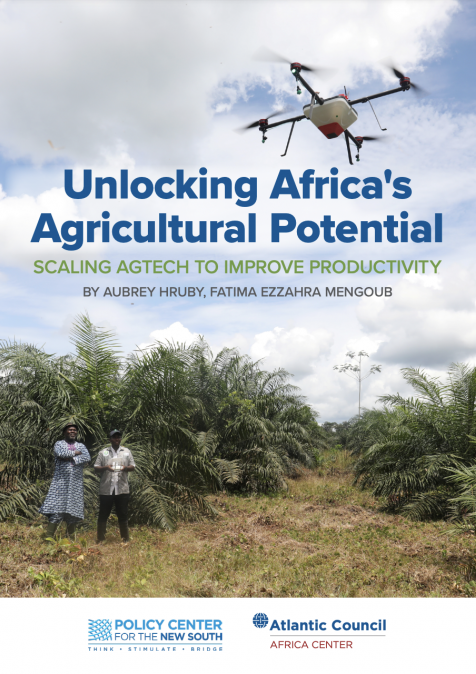
20 September 2023. This event, hosted by the Africa Center in partnership with the Policy Center of the New South, launched a report featuring new research and recommendations on agritech solutions.
VACS supports the African Union Common Position on Food Systems including focus on indigenous agriculture, the AU Green Recovery Action Plan, and the Soil Initiative for Africa. The Vision for Adapted Crops and Soils (VACS) aims to foster more resilient food systems, with an initial focus on the African continent. VACS seeks to boost agricultural productivity and nutrition by developing diverse, climate-resilient crop varieties and building healthy soils.
Ms. Aubrey Hruby, Senior Fellow, Africa Center, Atlantic Council
Ms. Fatima Ezzahra Mengoub, Senior Economist, Policy Center for the New South
Mr. Niraj Varia, Chief Executive Office, iProcure
Mr. Eli Pollak, Chief Executive Officer, Apollo Agriculture Cameron Alford, Vice President, Department of Compact Operations, Millennium Challenge Corporation
4 - 8 September 2023. Africa Climate Week (ACW 2023) + African Climate Action SummitThe Africa Climate Action Summit is being co-hosted by the Government of Kenya and the African Union Commission and is co-convened by the African Development Bank and GCA. The Summit will coalesce partners, including international financial institutions and the private sector, around accelerating adaptation financing and climate action leading into the United Nations Secretary-General’s Climate Action Summit and COP28.
ACW 2023 will be organized into four systems-based tracks, each focusing on specific themes:
04/09 Climate innovation in agriculture - practical solutions and lessons to be shared from Israel
This event explored innovative ways and technology how to maintain and increase agricultural production in the face of growing draught and water scarcity. It used the example of the TIPA project in Senegal to illustrate how to move to drip irrigated agriculture using solar power to pump water, growing up to 3 harvests per year.
TIPA is a small-scale horticultural production package based on low-pressure drip-irrigation, a mix of vegetables and tree crops, and modern crop management systems. TIPA is engineered towards small scale farmers and rural communities in Senegal. The TIPA project is a MASHAV initiative. (MASHAV – Israel’s Agency for International Development Cooperation).
Related: 03/09 Israel, NGOs Launch New Farming Innovation Center In Kenya.AITEC was jointly developed by the Israeli Embassy and several Israeli and international NGOs focusing on agricultural and technological development. Embu County Government and Don Bosco Tech Africa, which empowers African youth by providing them with technical training also contributed to the project.
04/09 AB Testing for Farming - Unlocking Transformation of Smallholder Livelihoods in Africa
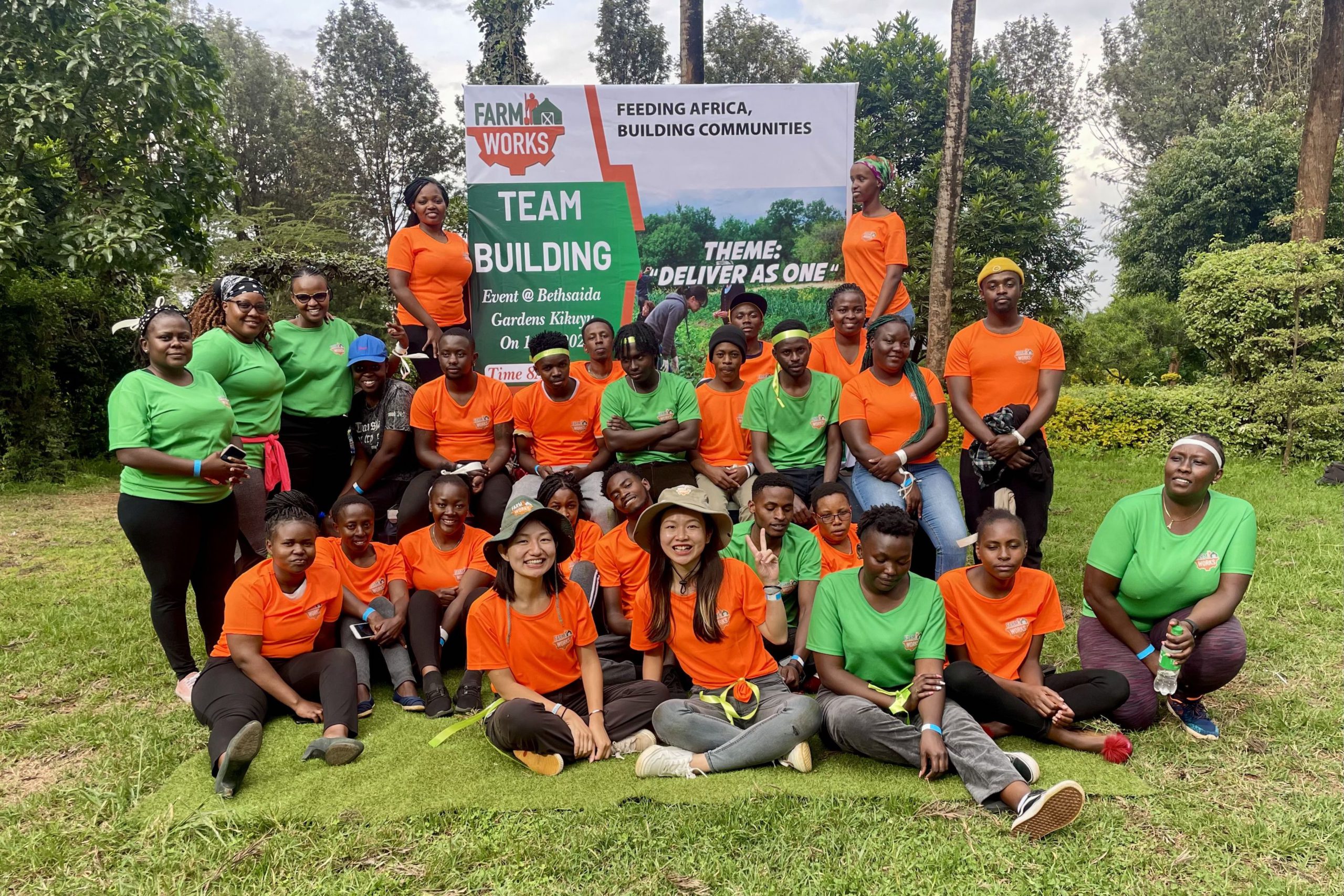
The event discussed the approach of FarmWorks Field School - an effective approach of applying tech-industry's A/B testing method to farming. in field schools, farmers divide their plots into 2, one using traditional techniques and the other using recommended techniques - a group of farmers meet at the school weekly to monitor crop growth and learn the impact of different techniques.
Using this method, we've significant changed farmer behavior, encourage them to use more climate-resilient farming methods, while improving their yield and income. We will share the case study and propose ideas to engage the broader community of stakeholders to build partnerships and replicate the good lessons learnt globally.
05/09 @10:00-11:30 CEST (11:00 to 12:30 EAT) Charting the pathway towards an inclusive green transition – The unique role of local digital innovations in driving climate action
A new report co-authored by a collective of independent experts coordinated by Power Shift Africa titled: Just Transition: A Climate, Energy and Development Vision for Africa(# 92 p.), shows how the continent can embark on an African Just Transition that strengthens food and energy infrastructure and sets out a more resilient and just development path.
06/09 @11:30 - 12:30 CEST (10:30 - 11:30 EAT) The Connections Between Food Security and Climate
To effectively address the resilience of landscapes to climate change, a comprehensive approach is necessary, transcending sector-based initiatives and embracing the nexus approach. This approach allows for the identification of landscape solutions that benefit multiple sectors like agriculture, energy, and water, and emphasizes their interconnectedness in enhancing conservation efforts. During the event, panelists will present emerging evidence, sharing examples and experiences from Africa, to develop a framework that unites key sectors based on the nexus approach.
06/09 @16:30 - 17:30 CEST (15:30 - 16:30 EAT) Learning to Build Better Food Systems through the Africa Sustainable Commodities Initiative – a regional multi-stakeholder platform in West & Central Africa
This event will share lessons from 8 years of partnership, culminating in the Africa Sustainable Commodity Initiative (ASCI), a multi-stakeholder platform, inclusive of government, communities, companies and NGOs. African owned and led, ASCI is a single set of principles for the responsible production of agricultural commodities: protecting forests, while ensuring social benefits for farmers (the majority of whom are women), communities, indigenous peoples and their human rights.
This event would highlight the progress being made across the ten countries in West and Central Africa (accounting for 75% of Africa’s forests), from policy (FPIC in Liberia) and legislation (Forest Law in Edo State, Nigeria), to capacity building (sustainable forest management) and institutionalization of responsible principles of production (Tree Crops Development Authority in Ghana). The event will also highlight the key role of women, the majority of smallholder farmers in Africa, and the importance of engaging their voice in such multistakeholder initiatives. Panelists will include representatives from Sesdev, a civil society organisation in Liberia, the ministry of Environment in Cameroon, and private sector in Ghana, moderated by Proforest, which has facilitated the platform for many years, working at a regional and national level.
07/09 @10:00 - 10:30 CEST (09:00 - 09:30 EAT) Safeguarding human and animal health in a changing environment
ILRI, VSF Germany, Zoonosis Disease Unit, Swiss Tropical and Pubic Health Institute, University of Greenwich, Natural Resource Institute, University of Liverpool, University of Copenhagen
This event will demonstrate tools and approaches that are being developed to support early detection and response to these diseases in order to minimise health and socio-economic impacts that they cause. Such interventions include data-driven disease forecasting and mapping systems, community-based participatory surveillance systems, and more efficient ways of bundling of health care services to enhance their coverage.
07/09 @ 12:30 - 13:00 CEST (11:30 - 12:00 EAT) Considering GST outcomes to drive nature-positive climate action in Africa
Nature-based solutions (NBS) for climate mitigation and adaptation are a huge win-win for African countries to meet their climate, sustainable development, food security, and biodiversity goals – and the GST outcomes can be a powerful signal to the international community to prioritize support for these solutions. Yet, the urgency of pre-2030 NBS action – especially transformations necessary within food systems – and the large NBS financing gap have often been buried in general calls for ambition.
07/09 @13:00 - 14:00 CEST (12:00 - 13:00 EAT) Unlocking Nature based solutions for transformative climate adaptation in Africa
Nature-based Solutions (NbS) seeks to address societal challenges while ensuring biodiversity and wellbeing co-benefits. The side event will provide evidence and share experiences from WWF and partners on how NbS initiatives have contributed to strengthening climate resilience in Africa and what action and finance is needed to unlock their full potential.
07/09 @14:30 - 15:30 CEST (13:30 - 14:30 EAT) Nature as the Backbone for Climate and Biodiversity Solution
MS Teams Link UNEP , WWF , IUCN, AU, NEPAD, AFDB, FAO
Solving climate change, biodiversity loss and development in Africa cannot be separated. They must be done in tandem, simultaneously and with equal urgency. Healthy terrestrial and marine ecosystems are the foundations for natural systems in regulating climate including mitigation and adaptation. Healthy ecosystems also build resilience of communities to withstand impacts of climate change. This side event seeks to build momentum and promote nature-based solutions as a means for co-implementing the Paris Agreement and the Kunming-Montreal Global Biodiversity Framework (GBF) to address the planetary crises of biodiversity loss and climate change.
07/09 Adapting Agrifood Systems and Ensuring Food Security in Africa Amidst Climate Change
FAO, Ban Ki-Moon Center for Global Citizens, and UNDP
Extreme weather events in sub-Saharan and North Africa caused a staggering USD30 billion in losses in 2020, leading to declines in crop and livestock production. This has had devastating effects on rural livelihoods, food supplies, and exacerbated hunger. The event aims to unveil essential finance, policy, innovation, and knowledge interventions that support the development of resilient agrifood systems in Africa. The aim is to contribute to the region's economic growth, improve the livelihoods of local farmers and food producers, and enhance food and nutrition security. By leveraging existing regional initiatives and engaging stakeholders from agribusinesses and financial institutions, this panel seeks to promote blended finance, private capital investments, lending opportunities, and risk insurance to strengthen adaptation and transform agriculture and food systems.
ECDPM, AKADEMIYA2063 & UNDP Rome Centre for Climate Action and Energy Transition
Drawing from the Malabo Montpellier Panel’s report ADAPT and ECDPM’s AgrInvest project, this event will pinpoint food systems financing gaps and showcase lessons learned and best practices, drawing from recent experiences in five countries: Benin, Mali, Rwanda, Zimbabwe, and Kenya.
Ms. Kerstin Opfer, Policy Advisor Energy Policy and Civil Society, Germanwatch
Presentation of the key findings from the Malabo Montpellier Panel report - Dr. Seraphin Niyonsenga, Senior Scientist, AKADEMIYA2063
Presentation of the key findings of ECDPM’s AgrInvest project - Ms. Cecilia D'Alessandro, Policy Officer, Sustainable Food Systems, ECDPM
Mr. Ayman Cherkaoui, Director, Hassan II International Center for Environmental Training
Ms. Beatrice Cyiza, Director General, Environment and Climate Change, Ministry of Environment, Rwanda
Mr. Sauli Hurri, Senior Regional Technical Specialist, IFAD
Ms. Laureen Njuguna, General Manager Starlight Farmers’ Cooperative Kenya
Ms. Enid Charana, CEO, Nyamira North Women Savings and Credit Society, Kenya
This Malabo Montpellier Panel report analyzes the experience of systematically selected four African countries: Benin, Mali, Rwanda, and Zimbabwe to apprehend what government actions – policy and institutional innovations and programmatic interventions – have contributed to building a conducive enabling environment for leveraging international climate finance for food systems transformation. The report brings to the fore what these four African countries are doing right and explores lessons for the continent for replication and scaling up.
07/09 @16:00 - 17:00 CEST (15:00 - 16:00 EAT) Agroecology as a Pathway for Climate change Adaptation and Mitigation
The side event, organized by the Alliance for Food Sovereignty in Africa (AFSA), aimed to promote and strengthen advocacy efforts for Agroecology as a sustainable approach to food systems and adaptation to the climate crisis in Africa. The event will provide a platform for knowledge exchange, dialogue, and collaboration among key stakeholders, including farmers, researchers, policymakers, civil society organizations, youth, and Agroecological entrepreneurs
07/09 @16:00 - 17:00 CEST (15:00 - 16:00 EAT) Supporting smallholder climate adaptation from seeds to basin
MS Teams Link IWMI, IHE Delft, World Bank, The Alliance Bioversity - CIAT
The event brings together different actors to discuss how climate adaptation for agricultural farmers requires a systems approach to climate hazard identification, adaptation solution priority setting and impact evaluation. The panelists will discuss the role of the latest advanced digital and remote sensing innovations in supporting user-oriented agronomic solution bundles and scaling efforts from seeds to basin scale to ensure sustainable climate adaptation with mitigation co-benefits.
07/09 @16:30 - 17:30 CEST (16:30 - 17:30 EAT) Walking the talk : Advancing smallholder farmers land rights for climate adaptation and resilience
International Land Coalition Africa (ILC Africa) and International Land Coalition Africa The Eastern Africa Farmers Federation (EAFF) Pastoralist Women Council (PWC) Kenya Livestock Producers Association
Small holder farmers rely mostly on land for their livelihoods for food and income to support their basic needs. Since most farmers are smallholder farmers contributing to food production, a healthy and safe environment remains crucial to enable them till their lands and secure the right to food. However, the sad reality remains: the impacts of climate change are more manifest for smallholder farmers (including pastoralists), bearing the brunt of the crisis through climate-induced droughts and other extreme weather patterns, while having minimal contribution to its causes. The situation is exacerbated by the fact that these same smallholder farmers, particularly women and youths, often lack secure rights to their land. Indeed, limited access to natural resources like water and land may further push smallholder farmers into poverty and lead to political tensions and land conflicts. This calls for recognition of the crucial role of land rights in climate adaptation and resilience. Without tenure security, women, men, and communities who mostly rely on adaptation strategies continue facing numerous hurdles. There is need for smallholder farmers to contextualise adaptation programs to suit different contexts. Climate adaptation policies should also address socioeconomic conditions, and climatic stresses that smallholder farmers face.
07/09 @16:30 - 17:30 CEST (16:30 - 17:30 EAT) Climate Change and Food Security: The contribution of pastoralism through sustainable management of rangelands across the Horn of Africa: How improved pastoralism can contribute to increased food security, climate adaptation and mitigation.
Welthungerhilfe and Welthungerhilfe University Hohenheim Germany Local partner(s)
Protection and well-managed animal movement is key for a recovery of the often badly degraded vegetation. Most rangelands could harbor two to four times biomass. Simple rotational grazing may easily double the stocking rates. But success in area protection attracts more animals and more destructive use of the range if territorial governance is weak or non-existent. Such governance requires a fine-tuned balance of private owners, communities, and local authorities.
08/09 @11:30 - 12:30 CEST (10:30 - 11:30 EAT) From Farm to Fork – what is required to pivot agriculture and food systems towards food secure, regenerative, climate resilient outcomes - Event of the Climate Champions
UNFCCC Led by the Climate Champions Team, this dialogue will explore the essential policy, finance and technical interventions which will deliver long term resilience via sustainable agriculture and improved food security outcomes in Africa and which contribute to the Sharm El Shaikh Adaptation Agenda on agriculture. An Africa-based study commissioned by IUCN for the Climate Champions in 2021 showed regenerative, sustainable agriculture model will add tens of billions to the economy, improve farmer livelihoods, food security and nutrition outcomes, and, when managed well, will reduce pressure on the land, sequester carbon, and support biodiversity and conservation.
08/09 @14:30 - 15:30 CEST (13:30 - 14:30 EAT) CompensACTION: Mobilizing carbon finance for food security and environmental benefits
CompensACTION Initiative, GIZ, Eastern Africa Alliance on Carbon Markets and Climate Finance Clim-EAT
Transforming agriculture and food systems requires a paradigm shift – away from a one-dimensional system that only produces food - to a system that provides multifunctional services. Smallholder farmers already make a significant contribution to nature- and climate positive agriculture but are not rewarded for it. The CompensACTION initiative has been launched under German G7 presidency in 2022. Its vision is that agricultural producers, especially smallholders in developing countries, receive adequate compensation for the multifunctional services they provide to ecosystems.
06/09 7:00 - 8:00 AM by Kenya Private Sector Alliance (KEPSA), P4G and Danish Embassy Accelerating green business models through public private partnership - P4G contributes to green and inclusive growth in developing countries by supporting businesses to become investment ready and supporting country climate transitions in food, water and energy systems. 07/09 10:00 - 11:00 AM by ILRI: P4G contributes to green and inclusive growth in developing countries by supporting businesses to become investment ready and supporting country climate
2 March 2022. The Israeli Trade and Economic Mission to Ghana has joined the Ministry of Food and Agriculture, Africa Fertilizer and Agribusiness Partnership (AFAP), and the Alliance for a Green Revolution in Africa (AGRA) held a stakeholder forum on Ghana’s soil health and management. This is to share learnings and highlight best practices to generate rapid responses to help develop better soil health practices to support the development and efficiency of the agricultural sector in Ghana.
Through this forum, the Israeli Trade and Economic Mission desires to partner with the government of Ghana and other relevant stakeholders to promote the use of innovative fertilizers, soil inoculants, best soil practices, and influence policy formulation in agriculture production by sharing the Israeli expertise and technological know-how.
Given the global rise in fertilizer prices, it is an opportune time to work together with various stakeholders, researchers, and leading experts to explore ways in increasing long-term efficiency and effectivity of soil inputs in Ghana, in order to raise yields and profits for Ghanaian farmers.
Recent years have seen an increased awareness in Israel, by both farmers and policymakers, of the importance of employing Conservation Agriculture (CA) practices to prevent further degradation of the country’s soil resources, and thus to secure local fresh food production and export. Common CA measures employed in Israeli-cultivated fields include minimum- or no-tillage to minimise soil disturbance; periodical addition of manure to enhance fertilisation and carbon stock; and use of service crops to maintain soil cover.
Through intensive Research and Development (R&D), several Israeli institutions have developed some of the world’s most innovative types of fertiliser and soil inoculants for all kinds of soil types and plants that increase yields and protects the soil. For the past 10 years, Deshen Hetzafon has developed a variety of smart fertiliser compounds – solid, soluble, granular or liquid fertilisers, bio-stimulants and micronutrients – all manufactured with adjustment to the way the minerals are absorbed by the plant from the root system or foliage. There is also Groundwork BioAg, which leverages on the natural power of mycorrhizal fungi to improve the productivity, sustainability and profitability of commercial agriculture and expand regenerative agriculture practices.
Recent years have seen an increased awareness in Israel, by both farmers and policymakers, to the importance of employing Conservation Agriculture (CA) practices to prevent further degradation of the country’s soil resources, and thus to secure local fresh food production and export. Common CA measures employed in Israeli cultivated fields include minimum- or no-tillage to minimize soil disturbance, periodical addition of manure to enhance fertilization and carbon stock and use of service crops to maintain soil cover.Ayelet Levin-Karp, Head of Trade and Economic Mission, Embassy of Israel, Accra.
Through intensive Research and Development (R&D), several Israeli institutions have developed some of the world’s most innovative types of fertilizers and soil inoculants for all kinds of soil types and plants that increase yields and protects the soil.
The project is called ASASE, stands for Accessible Soils and Sustainable Environments and also means "land" in the local Ghanaian language Twi.
At the end of last 2020, the public sector, private sector and civil society organization partners jointly began the inception phase of this project, working towards a climate-smart cocoa sector where forests and natural ecosystems can thrive alongside sustainable cocoa production.
Over the next four years, this 2.3 million Euro project funded by the Netherlands Enterprise Agency (RVO),Export Trading Group (ETG), and chocolate makers, will work with 5,000 farmers in Ghana's Ashanti and Eastern regions to tackle deforestation, rehabilitate aging cocoa farms, and restore natural forests.
Natural forests capture carbon dioxide, increase biodiversity, and improve soil quality, providing ecosystem services that entire communities benefit from. For Ghana's 800,000 cocoa-farming households however, the country's high risk of deforestation brings with it the threat of lower, less reliable rainfall and rising temperatures that could damage cocoa trees, reducing yields and household incomes.
Fertilizer Research and Responsible Implementation (FERARI)
FERARI is a public-private program in Ghana that integrates an on-the-ground implementation program to develop the fertilizer value chain with transdisciplinary research by Ph.D. and postdoctoral researchers, supervised by internationally renowned universities, and to build the research capacity at the involved institutions.
The overall objective of the program is to develop the evidence base for the need of a systematic approach to support widespread adoption of balanced fertilizers by farmers in the less developed markets of sub-Saharan African countries, specifically Ghana, as a means to improve their food and nutrition security.
FERARI activities run from 2019 to 2024 and are co-funded by OCP, Mohammed VI Polytechnic University (UM6P), IFDC, and other involved institutions.
Israeli companies
For the past 10 years, Deshen Hetzafon has developed a variety of smart fertilizer compounds – solid, soluble, granular, or liquid fertilizers, bio-stimulants, and micronutrients – all manufactured with adjustment to the way the minerals are absorbed by the plant – from the root system or the foliage.
Sheffa by Deshen Hatzafon was established in Israel in October, 2012 by 7 cooperative organizations representing 260 farming communities in Israel, that together own approximately 150,000 hectares of cultivated farmland.
Product: HomiGreen Barak enriches the soil with organic material, encourages essential root activity, and: Improves the absorption of mineral ions; Increases chlorophyll production; Assists the plant in coping with extreme weather conditions; Increases reproduction; Based on soft water; Based on Humic and Fulvic Acids; Our Guarantee
There is also Groundwork BioAg, which leverages on the natural power of mycorrhizal fungi to improve the productivity, sustainability and profitability of commercial agriculture and expand regenerative agriculture practices.
Groundwork BioAg produces highly-effective mycorrhizal inoculants for commercial agriculture. Containing concentrated and vigorous beneficial fungi, Rootella® inoculants significantly improve soil nutrient uptake in plants.
The Groundwork BioAg products increase crop yields, improve resistance to several types of stress, and reduce fertilizer requirements. Groundwork BioAg has demonstrated significant yield increases in numerous major crops, including corn, soybean, sorghum, sugarcane, potato, and strawberry.
Groundwork BioAg products are sold in major markets worldwide, including the USA, Brazil, Canada, India, Europe and Ukraine.
symbiotic relationship that dates back 450 million years, mycorrhizal associations have evolved into a critical component of successful restoration projects across several continents.
Mycorrhizal fungi make up over 90% of the living microbial biomass that is present in most soils.
Mycorrhizal fungi make up over 90% of the living microbial biomass that is present in most soils. The picture provided details mycorrhizal hyphae connecting the fine root hairs to vast regions of the soil, where the hyphae transport carbohydrates to other beneficial microbes, particularly plant growth promoting Rhizobacteria (PGPR). The mycorrhiza fungus obtains the carbohydrates that it requires from the roots, and in return provides plant nutrients including nitrogen and moisture through the hyphal network.
Mycorrhizal inoculant extend the grass roots deeper, improve the soil structure, and join plants together for easier maintenance and less watering. Healthy soil and soil biology can eventually eliminate weeds. Plants colonized with mycorrhizal fungi produce significantly larger root mass and are therefore more capable of handling stress from drought, pathogen attacks, and other forms of environmental stress. Mycorrhizal plants have access to more volume, and therefore more moisture compared to plants that are not colonized by mycorrhizal fungi.