Platform for African – European Partnership in Agricultural Research for Development
Showing posts with label Bangladesh. Show all posts

Wednesday, January 29, 2025

APAARI Community of Practice (CoP) Public-Private Partnerships

30 January 2025. APAARI Community of Practice (CoP) Public-Private Partnerships

This initiative is currently more foucsed to Bangladesh, where APAARI is implementing projects with the support of STDF and USDA. However, our vision is to expand this CoP to a regional platform in the near future, enabling broader collaboration and knowledge-sharing across the Asia-Pacific on public private partnership.


The CoP aims to:

  •  Engage directly with private sector representatives, trade associations, and other stakeholders.
  • Contribute to identifying key challenges in export-import processes and the agriculture trade.
  • Participate in co-creating actionable strategies to enhance trade efficiency and competitiveness.


Thursday, February 8, 2024

SHiFT: Catalyzing Food Systems Transformation

Published 22/01/2024. Sustainable Healthy Diets is the only CGIAR Initiative with the main goal of ensuring sustainable healthy diets for all through food systems transformation.


The International Food Policy Research Institute and the Alliance of Bioversity and CIAT lead SHiFT in close collaboration with Wageningen University and Research and with contributions from the International Potato Center. 

SHiFT combines high-quality nutritional and social science research capacity with development partnerships to generate innovative, robust solutions that contribute to healthier, more sustainable dietary choices and consumption of sustainable healthy diets. It builds on CGIAR’s track record of agricultural research for development, including ten years of work on food systems and nutrition under the CGIAR Research Program on Agriculture for Nutrition and Health (A4NH).

This Initiative will work in Bangladesh, Ethiopia and Vietnam in the first phase, followed by India, Benin, Senegal, Guatemala and Honduras.

Proposed 3-year outcomes include:
  1. Stakeholders initiate implementation of at least two solutions (innovations or policies) to increase the demand for sustainable healthy diets and/or improve the ability of MSMEs and the informal sector to deliver sustainable nutritious foods in three target countries.
  2. Stakeholders initiate implementation of at least two solutions (innovations or policies) to tackle gender and youth equality and social inclusion in food systems in three target countries.
  3. Stakeholders show a significant increase in their ability to engage in governance and political economy issues and/or to navigate trade-offs in food systems transformation in three target countries.Stakeholders improve the design and implementation of the national roadmap towards food systems transformation for sustainable healthy diets in three target countries.

Related:

November 28-29, 2023, the CGIAR Research Initiative on Sustainable Healthy Diets through Food Systems Transformation (SHiFT) held its first research partner meeting to share research findings, evaluate progress, and set goals for the future.
WP5 has three major objectives: 
  1. Engage in national multistakeholder consultative processes to develop and support food systems transformation; 
  2.  monitor and document food systems transformation in the target countries; and 
  3. develop capacity to engage in, support, and monitor food systems transformation toward sustainable healthy diets.
Representatives from six national partners from Ethiopia and Viet Nam provided an opportunity for SHiFT researchers to hear more about the countries’ food systems agendas and how their priorities are quickly evolving.

To advance their work on capacity building, WP5 researchers plan to tailor their capacity-strengthening approaches for their Strategic Partners, based on the capabilities prioritized by each partner. They will also provide one-on-one coaching to strengthen the Strategic Partners’ capabilities to support transformative change and extend their capacity assessment to relevant platforms.


Thursday, December 7, 2023

Taking Integrated Action on Climate and Nutrition

6 December 2023. InfoPoint conference: Taking Integrated Action on Climate and Nutrition

Can we find win-win solutions which tackle both climate change and improve food security and healthier diets?

The bidirectional relationship between nutrition and climate change means there are multiple opportunities for systems’ approaches that integrate action for climate and nutrition to address multiple national and global priorities simultaneously. Climate action positively impacting food, water and sanitation, social protection, and health systems can benefit nutrition. Good nutrition is, in turn, needed for healthy populations, healthy populations are needed for thriving economies.

Leonard Mizzi, Head of Unit INTPA F3 Agri-Food Systems and Fisheries

Lawrence Haddad, Executive Director, Global Alliance for Improved Nutrition (GAIN)
GAIN Executive Director and World Food Prize Laureate, Lawrence Haddad, presented the new report of the initiative on climate action and nutrition (I-CAN). 

The report analyses levels of climate-nutrition integration across policy, research and finance. The report was researched by GAIN and launched at the Committee for Food Security (CFS) in November 2023. It forms part of efforts at COP28 to focus more on how food systems and climate are interlinked. It aims to foster collaboration to accelerate transformative action to address the critical nexus of climate change and nutrition. I-CAN further aims to build a strong alliance across nutrition and climate communities, strengthen existing efforts and take action to address the gaps, and develop an evidence base of integrated nutrition and climate action.

Lawrence Haddad introduced the I-CAN vision and objectives and shared the reports main findings. For example, just 2% of NDCs have concrete plans to address nutrition and only 1% of climate-related ODA financing explicitly mentions nutrition. At the same time, 95% of Global Nutrition Report commitments do not consider climate or sustainability at all.

Rudaba Khondker, Country Director, GAIN Bangladesh
She presented a concrete example on the co-benefits of integrated action and collaboration across environment and nutrition. The case study from Bangladesh complemented the presentation with practical efforts to link climate and nutrition.

Recording:

Forthcoming here

Resource

FAO(2023) Climate action and nutrition. Pathways to impact. #44 p.

Climate change and malnutrition are two of the greatest challenges facing humanity today, both interconnected through agrifood, water, social protection, and health systems. Responding to both climate change and malnutrition with integrated actions provides one solution to two of our biggest barriers to sustainable development.

This paper, prepared as a contribution to the Initiative on Climate Change and Nutrition (I-CAN), explores options for integrated actions addressing jointly climate change and malnutrition across agrifood, water, social protection, and health systems by
  1. recapping each system’s importance to good nutrition, 
  2. compiling the evidence on the interaction of each system with climate change, and 
  3. documenting the response options for integrated actions that have the potential to benefit climate change and malnutrition.
The evidence compiled in this paper shows there is the potential for each of the systems to be nutrition-sensitive and climate-smart for healthy diets, safe food, efficiently managed clean water for all needs, enhanced coping strategies, and less illness from systems that significantly reduce overall greenhouse gas emissions, protect biodiversity, preserve natural resources and increase resilience resulting in a virtuous cycle of healthier people, and stronger communities that can drive sustainable development. 

Integrated actions can lead to positive outcomes on both climate and nutrition, with the support of key enablers identified in this paper. A comprehensive and strategic research agenda is also key in order to identify other key influencers and fill other priority gaps in our understanding of the trade-offs, enablers and pathways of integrated action to impact.

Thursday, February 17, 2022

Second GFRAS webinar of the series on Public-Private Partnerships

17 February 2022.
Public-Private Partnerships in Agricultural Extension. Second GFRAS webinar of the series on Public-Private Partnerships

This session presented the establishment of PPPs at the hand of three cases in Bangladesh, Thailand and East Africa, highlighting the form of PPP, its context and the support required.
Furthermore, experiences from within the GFRAS network were discussed to highlight best practices and issues and promote cross-region learning.
  • Joe Slaats GFRAS
  • Simon Winter (Syngenta Foundation)
  • Rouf Abdur Bangladesh - Delivering plant health advice through Farmers' Hubs. Example of partnership between Syngenta and CABI
  • Atthawit Watcharapongchai (GIZ) Public Private Partnership in the Sustainable Rice Initiative (SARA) Thailand - Value Chain in Sustainable Rice
Background Bangladesh:
Syngenta Foundation for Sustainable Agriculture (SFSA) has designed an inclusive business model called “Farmers’ Hub” which is a one-stop commercial service platform creating smallholders’ access to quality inputs, Agri machines, markets, finance, and knowledge. It helps increase farm productivity and ensures fair prices.

Different external and internal studies show that the Hubs are a good vehicle for technology transfer and service delivery to small and marginal farmers in remote regions. Organizing smallholders this way can greatly facilitate the production and collection of quality crops from disadvantaged areas. It also improves compliance with quality standards. 

This is not only true in Bangladesh. Building on the success there, the Syngenta Foundation  team in Senegal launched its own Farmers’ Hubs at the end of 2017. In the last 3 years, Syngenta Foundation is also conducting a pilot phase for the Farmers' Hub model in Indonesia, Kenya, Mali, and Nigeria. In March 2018, Syngenta Foundation  has also added a digital platform, the efarmers hub to support the offer of the program. Besides this, this model is scaling up in different countries in Franchise or Network Manager concepts.


Background Thailand
The Sustainable Rice Platform e.V. (SRP) is a global multi-stakeholder alliance established in 2011. Originally co‐convened by the International Rice Research Institute (IRRI), UNEP and GIZ, SRP is now an independent membership association. Together with its over 100 institutional members from public and private sector stakeholders, research, financial institutions, and NGOs, SRP aims to transform the global rice sector by:
  • Improving smallholder livelihoods
  • Reducing the social, environmental and climate footprint of rice production
  • Offering the global rice market an assured supply of sustainably produced rice to meet the growing global demand for rice.
Registered SRP Projects are SRP member-led projects on the ground that use SRP tools to incentivize
and document rice farmers’ shift to sustainable farming practices. Currently, Registered SRP Projects are implemented at varying scales in Asia, Africa, Europe and the Americas, reaching nearly 500,000 rice farmers. Projects report results to the SRP Secretariat annually to aggregate global reach and impacts.

The 10th Anniversary Report commemorates SRP’s first decade of advocacy, as well as its continuing progress in helping producers switch to sustainable rice farming practices. Since its establishment in 2011, SRP evolved into a global multi-stakeholder alliance with over 100 institutional members, and over 400,000 farmers participating in 22 active Registered SRP Projects around the globe today.

The report showcases some of our most significant developments, including the launch of our SRP Standard for Sustainable Rice Cultivation, the world’s first sustainability standard in rice, together with SRP Performance Indicators – currently the only recognized working definition and set of metrics for sustainable rice production.

Resource:
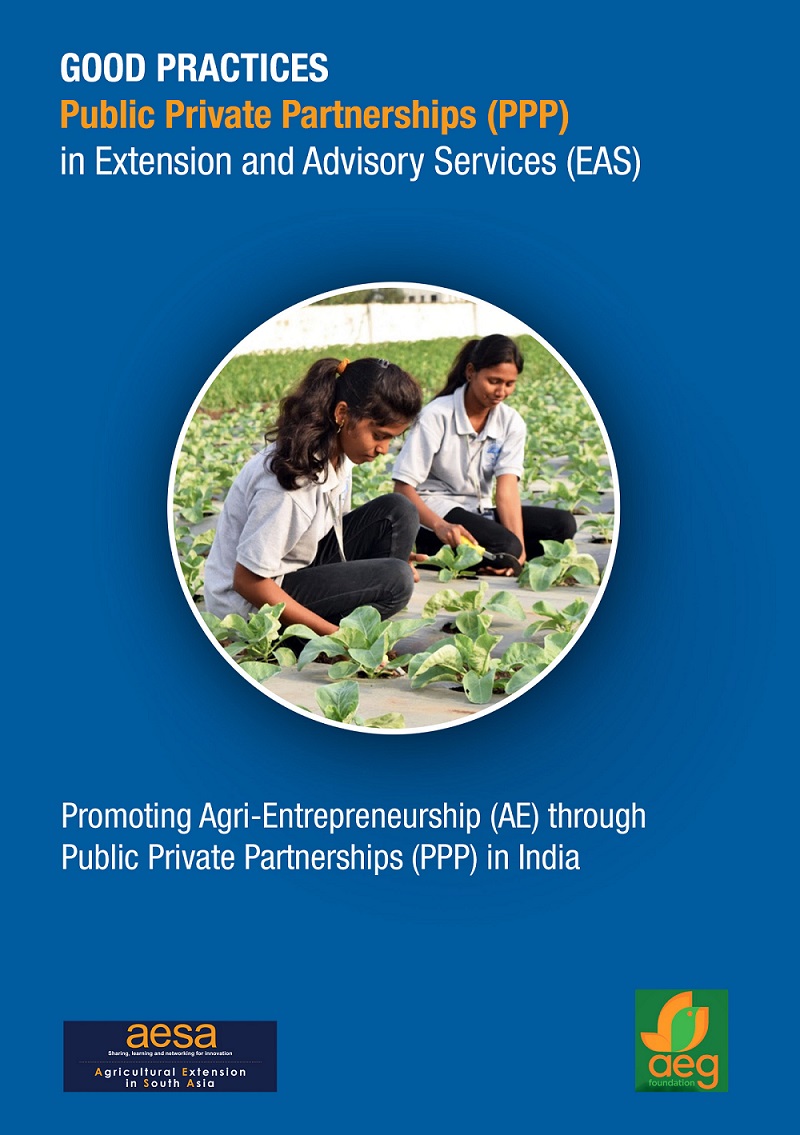
AESA (2020) GOOD PRACTICES: Public Private Partnerships in Extension and Advisory Services Agricultural Extension South Asia (AESA) Network, # 32 p.

Provision of advice and other services related to farming at the village level is critical for enhancing the incomes of small and marginal farmers. Creation of an eco-system that can support the emergence of agri-entrepreneurs through delivery of these services at the village level is the only way forward if we are keen to enhance farm incomes. In this Good Practices Note, S Baskar Reddy, Rajendra Jog, Parikrama Chowdhry and Aravind Thumbur reflect on their experiences with developing and scaling up a model of agri-entrepreneurship by forging partnerships with a number of agencies.


Tuesday, August 3, 2021

UNFSS 2021 Pre-Summit Affiliated Session - NUTRITION: Multistakeholder approach to transforming food systems and achieving global nutrition goals.

27 July 2021. UNFSS 2021 Pre-Summit Affiliated Session - Multistakeholder approach to transforming food systems and achieving global nutrition goals.


This event brought SUN countries and stakeholders together to explore the challenges and opportunities of a multistakeholder approach to transforming food systems and achieving global nutrition goals. 
  • Ms. Gerda Verburg, SUN Coordinator, United Nations Assistant Secretary-General (Moderator) 
  • Mr. Iean Russel, FAO-EU FIRST Senior Policy Officer, Cambodia 
  • Mr. Hou Kroeun, Deputy Country Director at Helen Keller International and Coordinator of the SUN Civil Society Alliance, Cambodia 
  • Mr. Sok Chea Hak, SUN Business Network Coordinator, Cambodia 
  • Ms. Inmaculada del Pino Alvarez, Food Security Program Lead at the International Development Law Organization and member of the Governance Action Area 
  • Ms. Ana Yanira Calderón, Directora Ejecutiva, Consejo Nacional de Seguridad Alimentaria y Nutricional (SUN Focal Point), CONASAN, El Salvador 
  • Dr. Shams, Coordinator of the coordination unit for the Afghanistan food security and nutrition agenda (SUN Focal Point) 
  • Mike Khunga, SUN Youth Leader for nutrition and co-chair of AT5 on resilience, Malawi 
  • Ms. Carla Montesi, Director of “Green Deal and Digital Agenda”, European Commission

27 July 2021. Access to nutrition through the workplace: leveraging the private sector

Co-founded by the CGF and the Global Alliance for Improved Nutrition (GAIN), the Workforce Nutrition Alliance supported the organisation of a UNFSS Pre-Summit Affiliated Session under the theme “Access to nutrition through the workplace: leveraging the private sector”. The event, hosted by the Government of Bangladesh Ministry of Labour and Employment and GAIN, brought together leaders from government, civil society, the private sector and non-governmental organisations, to explore the key role of workforce nutrition programmes in addressing global malnutrition. Find out more about the Workforce Nutrition Alliance: https://workforcenutrition.org/


26 July 2021. Towards a Zero Hunger, Nourish the Future Pledge For the Private Sector

The Zero Hunger, Nourish the Future Pledge is an opportunity for companies, investment funds, and philanthropies to align USD 5 billion of their resources with new evidence and complement their pledges with new commitments being made by global institutions and governments to end hunger and nourish the future by 2030.
  • Peter Bakker, President, World Business Council for Sustainable Development (WBCSD)
  • Dr. Lawrence Haddad, Executive Director, GAIN & Chair, Action Track 1, UN FSS
  • Ute Klamert, Assistant Executive Director, World Food Programme (WFP)
  • Ibrahim Gourouza, Grow Africa & AUDA-NEPAD
  • Sanne Helderman, Lead research, World Benchmarking Alliance
  • Takaaki Nishii, CEO, Ajinomoto
  • Caroline Keeling, CEO, Keelings
  • Hanneke Faber, President, Food & Refreshments, Unilever
  • Julia Friederike Harnal, Vice President Sustainability & Governmental Affairs Agricultural Solutions, BASF

26 July 2021. UN FSS Pre-Summit Parallel Session. Tackling Undernutrition Through Action and Accountability: 

A ‘reset’ for the prevention, early detection and treatment of wasting and costing information on the consequences of stunting.” Emergency Nutrition Network, the Power of Nutrition (PoN), Standing Together for Nutrition (ST4N) and the Micronutrient Forum (MNF). The webinar included a brief overview of the wasting reset, followed by a panel discussion. 
  • Moderator: Dr Patrick Webb – Professor, Tufts University 
  • Minister Colm Brophy – Ireland’s Minister of State for Overseas Development and Diaspora 
  • Aminata Shamit Koroma – Nutrition Director, Sierra Leone 
  • Shawn Baker – Chief Nutritionist, USAID 
  • Simon Bishop – Chief Executive, the Power of Nutrition 
  • Cecilia Fabrizio – Programme Lead, Standing Together for Nutrition

26 July 2021. UNFSS Pre-Summit Webinar: Economic Empowerment of Women to Combat Malnutrition

This webinar was hosted by IFDC (https://www.ifdc.org), Malnutrition Matters (https://www.malnutrition.org) and 2SCALE (https://www.2SCALE.org).

To alleviate malnutrition in a sustainable manner and to progress toward gender equity, local, nutritious food-centered micro-enterprise is pivotal. IFDC and Malnutrition Matters empower rural or village-based women and youth to use the low-cost SoyaKit to make affordable protein-rich soyfoods for their neighborhoods, while making a daily $4 profit. Increased income generation is foundational for gender equity. This micro-enterprise requires 2 days’ training in food-processing and business, is environmentally friendly (soyfoods require 10x less energy than animal protein), produces many tasty foods, is quickly profitable, and is a strong catalyst for gender equity initiatives with a policy/cultural/educational focus. 
  • Hart Jansson, President of Malnutrition Matters, 
  • Caroline Sage, Business Development Associate at IFDC

Wednesday, June 30, 2021

WEBINAR: How can digitization impact food fortification?

30 June 2021
. 2pm – 3:30PM CET. Scaling up innovation for a fortified future – part I - fortification quality digitization by GAIN

Fortified foods that meet government-issued standards can have a significant impact on improving nutritional intakes and overall health of a population. Unfortunately, many fortification programs fall short of this intended impact. Understanding and addressing challenges along the fortification supply chain is critical to ensuring the quality and safety of fortified products. This requires generating data that enables full traceability of fortification quality.

However, few countries are collecting and analysing data on fortification quality, and those that do may be lacking the critical step of transforming data into actionable information. Can digitization help improve QA/QC data systems, drive efficiencies, and increase the transparency and traceability of fortification quality? Can digitization address constraints faced by governments and strengthen government oversight while reducing their data collection burden? Can digitization be a win-win for the government and for industry?

This webinar:
  • Provided a high-level overview of quality/compliance challenges in fortification and explore how digitization can be part of the solution.
  • Presented examples and lessons learned from successful digitization efforts in sectors outside of nutrition.
  • Showcased collaborations with new/unconventional partners that can help government and industry to leverage digital data to accelerate progress.
  • Featured perspectives from millers on how data can improve their bottom line and help them stay compliant with fortification mandates and standards.
  • Discussed how IT/systems stakeholders, industry, government, and NGOs can come together to improve fortification quality and industry compliance.
Speakers:
  • moderator Andreas Bluethner, Director of Nutrition BMGF
  • Dipika Matthias, Deputy Director, Nutrition, BMGF, USA
  • Bernard Kowatsch, Head of WFP Innovation Accelerator, Italy
  • Ashish Pande, Managing Director & Senior Vice President, Crown & Dangote Mills, Olam, Nigeria
  • Anna Zhenchuk, Managing Director, BioAnalyt, Germany
  • Zameer Haider, National Program Manager for Oil Fortification, Nutrition International, Pakistan
  • Janice Zdankus, Vice President of Innovation for Social Impact, Hewlett Packard Enterprise, USA
  • Harun Rashid, Chairman, Shakti Edible Oil, Bangladesh
  • Imtiaz Masud, Head of QA & EMS, Bangladesh Edible Oil, Bangladesh

Wednesday, May 12, 2021

WEBINAR: Effectiveness of Multisectoral Programming to Improve Nutrition Sensitive Agriculture, Nutrition and Health: Experiences from Nepal, Bangladesh and Uganda

12 May 2021. In this webinar, speake
rs examined data on multi-sectoral programming from Feed the Future Innovation Lab for Nutrition focus countries including Nepal, Uganda, and Bangladesh. They also discussed approaches and best practices for developing evidence-based interventions across agriculture, nutrition, and health, and will explore implications and future directions for multi-sectoral strategies.

Leveraging multi-sectoral programming to improve health and nutrition has gained attention over recent years. Collaboration between sectors has the potential to address many of the root causes of malnutrition.  However, multi-sectoral interventions can be complex and difficult to evaluate, and outcomes can be challenging to measure. 

  • Moderator: Dale Davis is the Country Director of Helen Keller International in Nepal.
  • Nassul Kabunga is an Evaluation Research Economist affiliated with the Friedman School of Nutrition Science and Policy at Tufts University.
  • Dr. Laurie Miller is a Professor of Pediatrics in the School of Medicine, Adjunct Professor of Nutrition at the Friedman School for Nutrition Science and Policy, and Adjunct Professor of Child Development at the Eliot Pearson Department of Child Study and Human Development at Tufts University.
  • Neena Joshi serves as Director of Programs at Heifer Project International Nepal.
  • Katie Appel is an Assistant Researcher for the Feed the Future Innovation Lab for Nutrition.

Thursday, December 17, 2020

WEBINAR: Impacts of COVID-19 on Agricultural Value Chains in Bangladesh, Laos, Myanmar, India and Vietnam

17 December 2020
. VCB-N Webinar presenting the results of Country Assessments regarding the Impacts of COVID-19 on Agricultural Value Chains

The Value Chain Capacity Building Network (VCB-N) initiated by an IFAD-grant shared the results of country assessments on the impact of COVID-19 on agricultural value chains, implemented in a number of Asian countries in the APR as mandated by IFAD. 

In total, six assessments were conducted by VCB-N members in five countries including Bangladesh, Laos, Myanmar, India and Vietnam covering analysis of 16 different agricultural value chains.

Recommendations for designing more resilient and future proof value chains in the post-COVID era, were presented and discussed.

Thursday, June 11, 2020

WEBINAR: Social Safety Nets and COVID-19: Can we protect food security and nutrition?

11 June 2020. Social Safety Nets and COVID-19: Can we protect food security and nutrition? - Organised by IFPRI

COVID-19 has led to an unprecedented global response through expanded social safety nets, as countries struggle to mitigate the health and economic risks related to the virus and accompanying lockdowns. Gains made in the fight against poverty, food insecurity, and malnutrition in the last decade are threatened, requiring a vigorous policy response. 

Social safety nets hold promise to minimize further harm, particularly among vulnerable populations. But the expansion of safety nets during the pandemic faces significant challenges. 

This seminar presented evidence on how social safety nets have been used to respond to COVID-19, how well this response has addressed food security and nutrition, and opportunities and challenges going forward. Speakers provided a global overview, and profile the experience and research evidence from Bangladesh and Ethiopia. These two countries have welcomed IFPRI and partners to carry out research aimed at improving the effectiveness of their extensive social safety net systems.
  • Opening Remarks - Frank Place, Director, CGIAR Research Program on Policies, Institutions and Markets
  • Akhter Ahmed, Senior Research Fellow, IFPRI
  • Ugo Gentilini, Senior Economist, Social Protection and Jobs Global Practice, World Bank Group
  • Jessica Leight, Research Fellow, IFPRI
  • Tigist Mamo, SPIR Health and Nutrition Technical Lead, World Vision
  • Mamunur Rashid, Programme & Policy Officer, World Food Programme -Bangladesh
  • Moderator: Daniel Gilligan, Deputy Director, Poverty, Health, and Nutrition Division, IFPRI

Monday, January 2, 2017

Bangladeshi agro-based organization to fight food security in Liberia

25 December 2017. Monrovia - Brac-Liberia, a Bangladeshi agro-based organization operating in Liberia has received a 1.5 Million Euros project gear toward addressing food and nutrition security to help end hunger in Liberia.

The money was given to Brac by the European Union to fight or address food security including hunger and nutrition in Liberia.

The project, which is expected to commence early next year, will be implemented in six counties: Grand Cape Mount, Bomi, Grand Bassa, Montserrado, Margibi and Bong Counties.

Brac organised a workshop that seeked to sensitize farmers and stakeholders in the country’s agricultural sector on food and nutrition security across the six selected Counties. Before this project ends in 2018, 390 most vulnerable household groups will be engaged in cash for work,1625 poor households will receive training in poultry and livestock rearing, and the capacity of 5200 smallholder farmers will be built on climate smart agriculture technologies