

- The Food Systems Pavilion brings together over 15 international leaders in the food space spanning the public, private and not-for-profit sectors, from farmers and youth to policy makers and scientists. This diversity of expertise and perspectives sets it apart from other coalitions, with co-hosts and partners committing to work collaboratively to tackle trade-offs, showcase solutions and overcome barriers.
- Participating organisations include co-hosts Clim-Eat, Coalition of Action for Soil Health (CA4SH), EIT Food, Environmental Defense Fund, FOLU, Good Food Institute, Infarm, SNV and Yara International; session partners Aleph Farms, Food Tank, Just Rural Transition, One Acre Fund and Rabobank; and supporting partners World Farmers’ Organisation, World Food Forum, YPARD, IAAS World and YOUNGO.
This day explored the types of food system shocks the world should prepare for as well as specific characteristics of food systems that can withstand such shocks.
Partnerships for food system transformation


- Alvin Chandra - CFRS Alliance/UNEP
- Cristina Rumbaitis del Rio - Senior Adaptation and Resilience Advisor, World Resources Institute; International Engagement Associate, The Food and Land Use Coalition
- Patty Fong - Program Director, Climate Health and Well-being, Global Alliance for the Future of Food (GAFF)
- Mary Robinson - Board Member, World Farmers' Organization
- Jai Shroff - CEO, UPL Global
- Raphael Podselver - Head of UN Advocacy, ProVeg International
- Ani Dasgupta - President & CEO, The World Resources Institute
- Oluwatosin Ogunsola - Agriculture Working Group, YOUNGO Patrick Verkooijen - CEO, Global Centre on Adaptation
Special Address by Agnes Kalibata (AGRA)
Designing food systems resilience in a warming world for global security
How both global and regional solutions can lessen risks, increase supply chain stability, and improve livelihoods.- Dr. Dhanush Dinesh Clim-Eat
- Elizabeth Nsimadala WFO Board Member
- Sudhanshu Sarronwala Chief Impact Officer, infarm
- Gus Guadagnini The Good Food Institute Brazil
- Dr. Nguyen Do Anh Tuan Director General, International Cooperation Department, Ministry of Agriculture and Rural Development, Vietnam
- Oscar Ekdahl Regional Program Officer, Resilience & Climate, World Food Programme (WFP) and representative of the RLFSCAlliance
- Han-Maurits Schaapveld Ambassador of the Netherlands to Egyptian and Dutch Government Officials
Farmers and innovators at the center: Solutions for creating resilient food systems for tomorrow
- Padraic Flood Team Lead Crop Genetics, Infarm
- Nichola Dyer Senior Adviser, Safe Seaweed Coalition
- Nura Aman Farm Africa
- Patricia Pinho Brazilian rainforest organization IPAM
- Omar Farhate International Association of Students In Agricultural And Related Sciences (IAAS) Afrika
- Jennifer Chow Senior Director, Environmental Defense Fund (EDF)
- Theo De Jager Executive Director of Saai in South Africa
- José Luis Chicom Former Minister of Production in Peru
Food Systems Transformation and the future of the Koronivia Joint Work on Agriculture
- Martina Fleckenstein WWF International
- George Wamukoya African Group of Negotiators Experts Support (AGNES)
- Janie Rioux IFAD
- Luke Spajic Youth Representative
- Martial Bernoux FAO
- Bernadette Fischler Hooper WWF International
- Jennifer Chow Senior Director, Environmental Defense Fund (EDF)
Nov. 8. ENABLE a culture of sustainable, healthy and nutritious diets
This day tackled the why, what and how, moving from problem statements to sharing solutions and what needs to happen to scale these up and drive positive tipping points. It will discuss the role of climate policy; food loss and waste; indigenous, underutilized, neglected and aquatic foods; shifting dietary patterns; and climate finance.Panel 1: A global system to nourish a population of 10 billion by 2030 in a changing climate

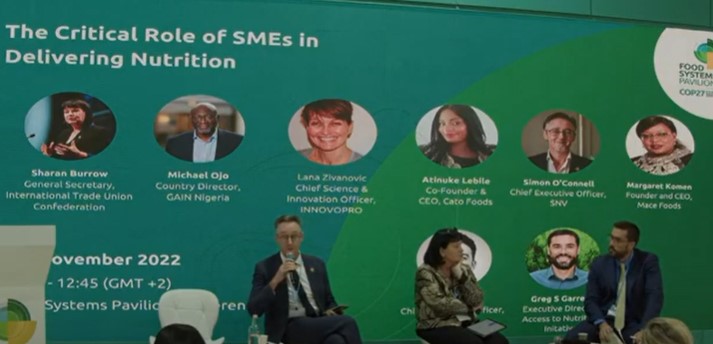
Panel 2 The critical role of SMEs in delivering nutrition
Panel 3: Climate and Nutrition: we can't have one without the other

Panel 4: Shifting diets to deliver climate goals and nutrition security

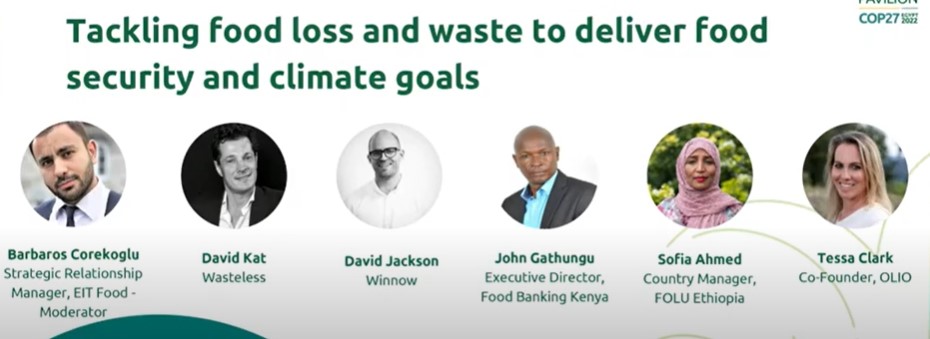
Panel 5: Tackling food loss and waste to deliver food security and climate goals
Panel 6: Solving the protein dilemma through smart policy and financing
Panel 7: Recipe for sustainable healthy food: changing our consumption
Panel 8: Diversification through indigenous, neglected and aquatic foods

Panel 8: A culture of sustainable healthy diets
Foodscapes: A Bridge to Building Regenerative Food Systems
- Saswati Bora, Global Director of Regenerative Food Systems The Nature Conservancy
- Muhtari Aminu Kano Muhtari Aminu Kano, Africa Director of Policy & Government Relations The Nature Conservancy
- Ruth Sitienei Ruth Sitienei, Africa Soil Scientist The Nature Conservancy
Nov. 9. INCREASE sustainable investment and financing to build food systems
This day showed that if we can increase sustainable investment and financing for climate resilient food systems, we can accelerate #ActionOnFood.The Challenges and Opportunities to Mobilize Finance Solutions for Food System Transformation
Vulnerable communities have been disastrously impacted by COVID, conflict, climate change and the cost of food and inputs. This session identified strategic actions to engage farmers and consumers and align mitigation & adaptation efforts for inclusive and resilient, nature-positive food systems.
- Berry J. Marttin Managing Board Member Wholesale & Rural, Rabobank
- Patty Fong Program Director for Climate and Health & Well-being, Global Alliance for the Future of Food GAFF
- Angela Churie Kallhauge Executive Vice President for Impact, Environmental Defense Fund
- Pieternel Boogaard Global Head Agribusiness, Food & Water, FMO
- Susan Chomba Director of Vital Landscapes, World Resources Institute WRI
- H.E. Hailemariam Dessalegn Former Prime Minister of the Federal Democratic Republic of Ethiopia; Chairperson, AGRA Board of Directors
- Bernhard Stormyr VP Sustainability Governance, Yara International
- Simon O'Connell Chief Executive Officer, SNV
- Marcel Beukeboom Permanent Representative of the Kingdom of the Netherlands to FAO
Financing a sustainable and just food system transition:
How leading financial institutions and value chain actors set concrete targets & take action.- Matt Jones Head of Nature Economy, UNEP-WCMC
- Berry J. Marttin Managing Board Member Wholesale & Rural, Rabobank
- Diane Holdorf Executive Vice-President, WBCSD
- Bernhard Stormyr VP Sustainability Governance, Yara International
- Hannah Young Head of ESG & Impact, Signature Agri Investments
- Matthew Brian Reddy Senior Private Sector Specialist, Global Environmental Facility GEF
- Eric Usher Head, UNEP Finance Initiative
The do’s and don’ts of blended finance: An interactive conversation
This session, hosted by Rabobank, laid out successful uses of blended finance so far and potential paths forward.
- Claire Shrewsbury Director Insights & Innovation, WRAP
- Berry J. Marttin Member of the Managing Board, Rabobank
- Daan Wensing CEO and Chair of the Executive Board, IDH
Digital Climate Finance Solutions:
This demo stage featured Dragon’s Den pitches showcasing new technologies that make climate financing more accessible and help close the funding gap.- Nick Hughes Founder & Managing Directing, 4RDigital
- Rose Goslinga Co-Founder and President, Pula
- Lieke Verhofstad Business Development Manager Global Food & Agri Networks, Rabobank
- Gareth Selby CTO & Co-Founder, Inclusive Energy
- Jeremy Doyle Global Technical Advisor on Climate Adaptation and Mitigation, SNV
Mobilizing Finance Solutions for Food System Transformation in Africa
The session will addressed 4 critical questions needing solutions in the financial system as whole to transform agriculture outcomes in Africa.- Ndidi Nwuneli Sahel Consulting, Executive Chair & Co-Founder Reshma Shah Equity Group Holdings, Group Director Sustainability
- Marcela Paranhos IDH, Global Carbon Finance
- Dr. German Velasquez Green Climate Fund, Director for Division of Mitigation and Adaptation
- Hannah Ratcliffe Director for Portfolio Value Creation, AgDevCo
- Wanjohi Ndagu Investment Director, Pearl Capital Partners Justine Bolton Carbon and Biodiversity Specialist, First Rand Bank
- Simon O'Connell SNV, Chief Executive Officer
- Fiona Napier Nature Lead in Africa, UN Climate Change High Level Champions
The Role of Insurance as a Key Climate Adaptation Mechanism to Protect Smallholder Farmers
Crop insurance in various forms is critical in adapting to climate change by protecting the food system and farmers livelihoods. New innovations by insurance companies and technology providers offers an opportunity to broaden coverage to address increasing risk, but as only 20% of smallholder farmers are covered by some level of insurance, larger structural reforms are required.- Scott Onder Mercy Corps, Chief Investment Officer
- Simon Young WTW, Senior Director
- John Mundy One Acre Fund, Head of Climate Finance
- Rose Goslinga Pula Advisors AG, President & Co-Founder
Building bridges between finance and development cooperation for the adaptation of food systems
This session provided recommendations on enhancing food system adaptation in country-level investment processes. The EU Practitioners Network (PN), FMO, ECDPM and DFCD facilitated a dialogue among key relevant stakeholders, based on recent research around public-private collaborations and blended finance, focusing on different examples of climate finance and food value chain investment processes. It features experiences emerging from Europe, Africa and international public-private cooperation on the cooperation of financial institutions to increase access to finance for current marginalized actors in least developed countries (small-scale farmers, women, SMEs, Youth, etc.). (eg. GCA-AfDB Africa Adaptation Acceleration Program; FAO-ECDPM AgrInvest project; EDFIs’ guarantee schemes, assessment of climate risks and partnerships with donors and private sector).- Francesco Rampa European Centre for Development Policy Management, Head of Sustainable Food Systems ECDPM
- Dr. Martin Fregene African Development Bank, Director of Agriculture & Agro-Industry AFDB
- Dr. Nalishebo Meebelo Regional Network of Agricultural Policy Research Institutes, Executive Director ReNAPRI
- Dr. Debisi Araba Imperial College London, Visiting Research Fellow at the Centre for Environmental Policy
- Simon O'Connell CEO, SNV; Chair, European Practitioner's Network
- Pieternel Boogaard Director Agribusiness, Food & Water, FMO
Resource: 

Investing in sustainable food systems: A methodology and lessons learned from Africa # 7 p.
Cecilia D’Alessandro, Francesco Rampa and Koen Dekeyser break down the methodology we developed with FAO for the AgrInvest project – to help agribusinesses and financial intermediaries make investment decisions that can increase the sustainability of food systems. They also highlight some of the lessons we learned by applying the methodology in Burkina Faso, Ethiopia, Kenya and Niger.| Read the brief |
Climate Finance for Sustainable Transformation of Agriculture and Food Systems
In this session, experts from NGOs, private sector, international organisations and government shared their experience in implementing successful models for climate financing and other initiatives towards climate mitigation and adaptation in the agriculture and food systems.- Helmy Abouleish SEKEM Development Foundation Egypt
- Godefroy Grosjean CGIAR/CIAT
- Ursula Flossmann-Kraus KliK Foundation for Climate Protection and Carbon Offset
- Maia Tskhvaradze Ministry of Environmental Protection and Agriculture of Georgia
- Martin Frick World Food Program WFP
Financing Research and Innovation for Adaptation in Africa’s Food Systems
This event, hosted by the Malabo Montpellier Panel and E3G, explored the critical need for good quality public finance for investment in research and innovation to drive food systems adaptation activities. While the focus of this session was be on the financing needs of African food systems and ongoing activities on adaptation, lessons learned were applicable beyond COP27 to broader action on building sustainable and resilient food and agriculture systems that deliver on health and nutrition targets in line with the SDGs, CAADP and the AU Agenda 2063.
- Claire McConnell - Moderator E3G Berlin
- Dr Yemi Akinbamijo Forum for Agricultural Research in Africa (FARA)
- Dr Ishmael Sunga Southern African Confederation of Agricultural Unions (SACAU) and member of the Malabo Montpellier Panel
- Nachilala Nkombo World Wildlife Fund (WWF), Zambia and member of the Malabo Montpellier Panel
- Dr Laouali Garba African Development Bank - Division of Agricultural Production, Sustainability and Research AFDB
- Dr. Leonard Mizzi European Commission, Head of Unit DG for International Partnerships, Sustainable Agri-Food Systems and Fisheries INTPA/EC
- Dr Debisi Araba Malabo Montpellier Panel
Financing Food Security through innovative financial Instruments
New and innovative climate finance mechanisms are needed for the continent especially for adaptation and in agriculture. Investors are gradually greening their portfolios with the introduction of ESG, Environment Social and Governance, more investors want their portfolios to create impact and be environmentally friendly. The event heard various stakeholders on Agricultural innovations and projects that attract climate financing using Nigeria as a case study.
- Ms. Titilope Ngozi Akosa Executive Director Centre for 21st Century Issues
- Ronoh Grace Programme Officer Alliance of Civil Society Organisations for Clean Energy Access
- Chinma George CEO Climate Finance Consulting
- Dr Olufunso Somorin Regional Principal Officer African Development Bank AFDB
Innovation driving food systems transformation
The importance of innovation and partnerships for accelerating impact and transformation of our food systems: discussion about why food systems require pre-competitive and collaborative approaches to identifying, scaling, demonstrating and transferring solutions.
- Wanjira Mathai Environmentalist and Activist
- Bertrand Piccard Initiator and Chairman of the Solar Impulse Foundation
- Dr. Pádraic Flood Team Lead Crop Genetics, Infarm
- Ndidi Okonkwo Nwuneli Executive Chair, Sahel Consulting
- Marcel Beukeboom Permanent Representative to the United Nations in Rome, Dutch Ministry of Agriculture, Nature and Food Quality
- Richard Zaltzman Interim COO, EIT Food
- Achim Hupperts VP Sustainability, DSM Adam Gerstenmier Executive Director, Food Action Alliance
Unleashing the power of innovation for regenerative and climate-smart food systems
Supporting farmers and consumers by building inclusive innovation ecosystems that foster fit-for purpose solutions, innovative models and at-scale strategies for climate outcomes, countries can re-energize investment back into the food system to fast-track gains on climate commitments now.
- Sean de Cleene World Economic Forum WEF
- Jaime Adams Senior Policy Adviser for Climate, USDA
- Jim Andrew Pepsi
- Barry Marttin Rabobank
- Arnold Puech D'Alissac World Farmers' Organisation WFO
Future food: from sideline to center stage
The agrifood tech companies, scientists, visionaries and impact investors are developing and delivering the needed innovation in the agriculture and food sectors to sustainably nourish people without consuming the planet.
- Sean de Cleene World Economic Forum WEF
- Sudhanshu Sarronwala Chief Impact Officer, Infarm
- Dr. Lee Recht Vice President Sustainability, Aleph Farms
- Dr. Dhanush Dinesh Founder, Clim-Eat
- Hanan Brand Vice President and Head of the Startup Division, Israel Innovation Authority
Investments into the food systems: an economy fit for the future
World’s leading agri-food tech investors discussed the role of early-stage investment to accelerate food systems transformation and its contribution to climate change adaptation and mitigation.
- Dr. Micol Chiesa Churchill Head of Climate Science, Planet Fund
- Sedef Köktentürk Managing Partner & COO Head of Impact, Blue Horizon
- Talia Rafaeli General Partner, Kompas
- Sharyn Murray Investor Engagement Manager, The Good Food Institute
- Purvi Mehta Asia Lead Agriculture, Bill & Melinda Gates Foundation BMGF
- Olivier Warnan Partner, BNP Paribas Solar Impulse Venture Fund
True Value of Food: A call to action to solve climate change and other global crises
Session participants will hear case studies on the tools, policies, and practices gaining traction around the world that enable governments to support this Call to Action.
- Sandor Gaastra Director General for Climate and Energy at the Netherlands Ministry of Economic Affairs and Climate Policy
- Kay Harrison New Zealand’s Climate Change Ambassador. Kay is also Divisional Manager of the Climate Change Division at the Ministry of Foreign Affairs and Trade
- Berry J. Marttin Member of the Managing Board, Rabobank
- Diane Holdorf Executive Vice President Pathways, World Business Council for Sustainable Development (WBCSD)
- Roy Steiner Senior Vice President for the Food Initiative, The Rockefeller Foundation
- Dr. Salman Hussain Head a.i. of The Economics of Nature Unit (TEN), UNEP
- Jessica Colston GAIN
- Máximo Torero Chief Economist, FAO
- Jenn Yates Director, True Cost Accounting Accelerator
- Michel Scholte Executive Director of True Price and Co-founder of Impact Institute
- Thoraya Seada Director of the Carbon Footprint Center, Heliopoilis University for Sustainable Development, Egypt
Visualising transformative adaptation for resilient food systems
This session revealed the science and thus specificity of transformative adaptation through showcasing 3 transformative adaptation visions in a ‘Pecha Kucha’ style presentation (storytelling through images).- Ana Maria Loboguerrero Alliance of Bioversity International and International Center for Tropical Agriculture (CIAT)
- Dhanush Dinesh Clim-Eat
- Veronica Doerr Australian Centre for International Agricultural Research (ACIAR)
- Rebecca Carter World Resources Institute WRI
The road to 1.5 degree: One burp at a time
ZELP (Zero Emissions Livestock Project) has developed a novel technology in the form of a wearable device for cattle.
Activating future generations for success
In this session, 10 students from Africa and Europe pitched their solutions that are curated through a cross-continental Foodathon. From Africa:
- Yakubu Abdul Mumin Gariba NutCare from Ghana
- Sarah Mirembe Wrap Eat from Uganda
- Noel Mutatiina Think Solutions from Uganda
11 Nov. BOOST nature positive production and soil health

Boots on the Ground: What should the private sector do to boost regenerative agriculture?
Regenerative agriculture and soil health are the new magic words. Yet, large producers could not feel a bigger distance to the topic.
Producer-Driven Regenerative Solutions Across Geographies and Ecosystems
Co-host Session: FOLU and EDF. Speakers demonstrated how collaborative, context-specific approaches can boost soil health, protect forests, enhance biodiversity and increase carbon sequestration at the farm, and discuss what data and evidence is needed to better understand context specific outcomes and to see how local outcomes can be scaled to tackle broader landscape and global challenges.Carbon farming: its value and potential
Co-host Session: Rabobank. Carbon farming holds the key to mitigating climate change while enhancing soil health and nutritional value, so that agriculture is sustainable and can feed future generations. Carbon farming can reduce GHG emission from agricultural land, sequester additional carbon, regenerate degraded soils, increase biodiversity and ensure food & nutrient security for a growing global population.Taste the soil: the silent Ally that feeds you - Demo stage
The session demonstrated how soil health influences our lives and food. With concrete examples focusing on coffee and wine, it also touched on the many innovations shaping African agriculture today, the essential role of farmers in preserving the link between soils and food and the policy measures that can support them. See Details
- Ana Mbiata, Senior Technical Manager Agriculture, Farm Africa

Soil Health Resolution - Coalition of Action 4 Soil Health (CA4SH)
This session brought together diverse stakeholders from science, policy, development, conservation, and the private sector to garner support for scaling investments in soil health. See Details- Alex Awiti CIFOR-ICRAF

- Adrian Leitoro Nature and People as One
Repurposing Public Support to Food and Agriculture to Enable a Just Rural Transition
The Just Rural Transition (JRT), Food System Economics Commission (FSEC), and the International Food Policy Research Institute (IFPRI) held a joint event highlighting opportunities for governments to take forward policy action to transition to more sustainable global food systems through the repurposing of public support to food and agriculture. This session communicated the latest academic analysis on the hidden costs of subsidies, including an upcoming report by the Food System Economics Commission and IFPRI. It will also highlight the perspectives of key stakeholders including farmers organisations on policy actions that deliver positive outcomes for people, nature and climate. See Details
- Elizabeth Nsimadala - President, Eastern African Farmers Federation EAFF
- Ishmael Sunga - Chief Executive Officer, Southern African Confederation of Agricultural Unions SACAU
Soils as an asset: Galvanizing public support to achieve our shared ambitions for NDCs.
Soil health continues to decline globally at an alarming rate despite our improved understanding of the interconnectedness of soil health, food production, climate, water and biodiversity. Recognizing the urgency for action and change, many actors are coming together to raise awareness about the central role of soils. See Details- Claudia Ringler Deputy Division Director, Environment and Production Technology Division, International Food Policy Research Institute (IFPRI)
Food Security Partnerships, Programs and Policy Solutions: The Ground We Need to Feed
This session focused on the partnerships that drive sustainable and productive agriculture programs with tangible outcomes for our current and future food security. See Details
- Yemi Akinbamijo Forum for Agricultural Research in Africa FARA
Creating win-wins on soil? Rewarding smallholder farmers for building soil organic carbon
Partner session: Ashoka Trust for Research in Ecology and the Environment (ATREE). The panelists discussed successful approaches by which smallholder farmers have been rewarded for boosting soil organic carbon. How can such efforts be scaled? What is the institutional architecture needed to overcome the transaction cost problem while protecting smallholders interests? See Details- Leigh Ann Winowiecki CIFOR-ICRAF
Sustainable Agriculture and Food Security: Climate proofing agricultural systems for better food security
Partner session: OCI. The need the clear: to ensure food security for the growing population, a sustainable food system is required. The question is how to scale it? This session explored some practical solutions addressing the more critical needs and discuss what it takes to scale. See Details12 Nov. SCALE climate resilient agriculture
This program highlighted key trends and challenges for food security and climate adaption & mitigation and bring forth the solutions we need to urgently implement at scale for food system resilience. Building truly sustainable and resilient agri-food systems is a major step for accelerating #ActionOnFood.Transforming Food Systems for a Climate-Resilient Future
A high-level panel will reflect on how climate change and recent crises have affected global food security, and the actions we must take to create a decarbonized, fair, and resilient food system. See DetailsDecarbonizing Food Production: Global solutions, local implementation
A diverse panel of food system players will discuss how to effectively implement food chain climate innovations and bring smallholder farmers on board, while ensuring resilience of farm economies. See DetailsFinancing Climate Resilient Agriculture
While smallholders are willing to adapt climate resilient mechanisms, most options come at a cost with high upfront investment. This session showed how SHFs can be sustainably supported through innovative finance models. See DetailsClimate Adaptation Services - Demo Stage
In this demo stage, three speakers gave their best Dragon’s Den pitches, showcasing their digital solutions to help climate change adaptation. These innovations could pave the way to a climate resilient future. See DetailsScaling Climate Resilient Agriculture and National Action Plans
This session addressed key constraints to scaling climate resilient agriculture in national action plans including coordination and governance, technical capacity, financing, as well as access to innovative resources. See DetailsFood and agriculture systems can achieve the NDCs while meeting the needs of eaters and policy
This session explored the status and prospects of scaling climate-resilient agriculture in national action plans. Nationally Determined Contributions (NDCs) need to be specific and urgent to make change now, not by 2050. What is happening on the ground to ensure that policymakers have the tools they need? See DetailsBuilding Nutrient-Dense Global Food Systems
Food and agriculture systems are responsible for roughly 30 percent of greenhouse gas emissions. Dietary shifts can help improve human health and protect biodiversity while achieving climate goals—shifting to healthy and sustainable diets has been identified as one of biggest way to reduce greenhouse gas emissions. See DetailsPastoralism and Rangelands Restoration: Promising solutions to benefit our planet and people
It’s important to take a local view of traditional livestock systems in rangelands. This session highlights their resilience to climate change and efficiency against food insecurity while exploring new paths for greater adaptation. See DetailsThe contribution of dairy to resilient food systems in East Africa
How can dairy contribute to a resilient food system? This question is faced by actors in the East African dairy sector, amidst other challenges such as food and nutrition security, rural economic development, and climate adaptation. NEADAP is developing a position paper on the role of dairy in food systems. The paper will be based on stakeholder discussions in six East African countries. In this session, a draft of the paper is introduced by Wageningen UR and discussed by experts from ILRI and the Rwanda National Dairy Platform. See DetailsPlanting the seeds for a climate-smart future: New business models and opportunities to scale solutions for a climate-smart future
Over the past decade, while significant progress has been made around the science on Climate-Smart Agriculture (CSA), the scale of implementation has been deterred by ‘lock-ins’ within food systems. With just 8 harvests left until the Sustainable Development Goals (SDGs) and the urgency to act if we want to stay within 1.5 degrees, it is important to scale up CSA now to achieve its potential in terms of food security, climate change mitigation and adaptation. See DetailsBreaking Down Barriers for an Agriculture Breakthrough:
Putting the Breakthrough Report recommendations into action. The session highlighted the Agriculture Breakthrough recommendations on R&D investment priorities, climate finance, policy action and other public sector-led interventions in the agriculture sector, and the metrics and indicators needed to track progress globally on the adoption of climate-resilient, sustainable forms of agriculture. It focused on the next steps for putting those recommendation into action towards COP28 under strong UK leadership. See Details14 Nov. EMBRACE sustainable water and aquatic blue food diversity for climate smart food systems
This day elevated the importance of water and aquatic foods for achieving global food and nutrition security through discussions of themes such as aquatic nutrition, water data, small-scale fishing communities, sustainable governance and management, and innovations to support sustainable and equitable aquatic food and water systems.Water and Aquatic Foods as Critical Components of the Food Systems Transformation
Both water and blue foods have been undervalued and overlooked in conversations about climate change and food security at both global and national levels. This plenary session will be setting the theme for the entire day by highlighting the importance of incorporating blue foods and water into food systems policy and decision making, with particular emphasis on their incorporation in Nationally Determined Contributions (NDCs) and National Action Plans (NAPs). See DetailsAquatic Foods as a Climate-Smart Source of Nutrition
This session aims to highlight the importance of blue foods for small-scale fishing communities and vulnerable populations, especially women and children. We will hear directly from small-scale fishers and aquaculturists about the current contributions of blue foods to their community’s food security and nutrition, and how they are adapting to climate change’s effects on essential sources of nutrition and livelihoods. We will also hear from a leading scientist in this field who will share a summary of the mounting evidence that aquatic foods could be key to meeting food and nutrition goals in the face of climate change in coastal countries around the world, as well as a summary of the challenges we must overcome to enable this. See DetailsSustainable governance and management interventions in aquatic food and water systems to ensure food and nutrition security in the face of climate change
Aquatic blue foods and water systems have enormous potential to contribute to achieving net-zero emissions from food systems and to support food security and livelihoods globally through provision of key micronutrients and protein to some of the most climate change vulnerable and food insecure communities in the world. Although climate change creates significant risks to the nutritional, economic, and cultural contributions of water and aquatic food systems, management reforms could mitigate many of the negative impacts of climate change. This session will bring several policy-makers and funders to discuss successful governance and management interventions for aquatic foods and water at the international, national, state, and local levels. See DetailsInnovation and Technology in Water and Aquatic Food Systems
There is no “one-size-fits-all” solution for resilient water and sustainable blue food systems, This panel will underscore the need for a multi-pronged approach to achieve goals for climate-resilient water and blue food systems. We will highlight a series of cutting-edge innovations and technologies from both sectors to improve the sustainability of water and blue foods while ensuring global food and nutrition security in the face of climate change. See DetailsFrom the Ground Up: Community-led approaches across blue foods, freshwater and agriculture
The Nature Conservancy. If we are to be successful in transitioning our food systems at the pace and scale required, it will be thanks---in large part---to the farmers and producers who made it happen. Community engagement, activation and leadership must be central to the myriad global transition approaches. Join us to discuss the centrality of community-led approaches, as well as some of the best practices – and even a few lessons learned – from panelists with experience the world over. See Details
Climate-Aggravated Water Scarcity as a Food Security Issue
Climate change is exacerbating water scarcity around the world posing greater risk to food security. In this session, voices from different countries (farmers, implementers) will share their challenges and approaches to adapt to limited water availability in terms of quantity but also quality for different needs. Participants will further discuss institutional fabric required at various levels of government (community, county and state) and need for a regulatory function to avoid adverse effects of productive uses on water availability. See Details
Water Data for Planning and Decision Making
This interactive session will explore multi-level water data needs and approaches for putting it to use. Date needs for decision making vary for functions and at different scales among users, from the farm to the river basin, from landowner to regulator. After spotlights on challenges and initiatives in different countries, the session will feature a participatory discussion to formulate water data related issues and takeaways. Topics covered will include democratization of data, institutional landscape, community engagement, and monitoring to create sustainable water and food systems. See DetailsClimate and Water Smart Agriculture: From the Netherlands and Egypt to the World
This session shared insights and lessons learned from Egypt-Netherlands cooperation on Climate and Water Smart Agriculture. Based on Dutch-diamond knowledge exchange, the session validated and explored options for future cooperation on food systems knowledge and innovation to inspire climate and water smart practices, technologies and business cases to contribute to the FAST Initiative. See Details
Global Salmon Initiative
Over the last year the Global Salmon Initiative has been working in partnership with the World Wildlife Fund and Sustainable Trade Initiative to establish a common GHG emission accounting framework for the whole aquaculture sector from pen to plate. Prioritizing stakeholder collaboration and shared learning, this project is focused on establishing aligned, credible accounting and motivating ambitious mitigation efforts. See DetailsAchieving Ambitious Food System Transformation in the Context of USAID's New Climate Strategy
How should the U.S. Agency for International Development (USAID) support the transformation of food systems in the face of climate change? USAID and experts are drafting a key report that will inform USAID’s agriculture, nutrition, and food security The study results will inform program and policy decision making by USAID. See Details
15 Nov. CHAMPION youth action in food systems
Young people and other marginalized stakeholders of the food system across the Global North and South have a meaningful say in policy and investment decisions that impact them, and the transition leads to equitable social, environmental and economic outcomes.Youth transforming food systems: From idea to action
This session showcased current youth-led initiatives that are resulting in policy changes within the food system - presenting how one idea can spark a system change. See DetailsCreating access: Options & Barriers for youth inclusion in food systems transformation.
Young people play an important role in addressing the climate crisis. However, barriers still exist for them to be included in the decision-making processes. In order to unlock the full potential of youth to contribute to food systems transformation, and contribute to a more sustainable future, this session will expose key barriers in the food and climate space that lead to incomplete youth inclusion in policy- and decision making processes, as well as promote options offered and made available by different stakeholders and organizations. See DetailsAdapting to transboundary climate risks in food trade
How can we better govern the global food system in a world where crises are the norm rather than the exception? This event will explore how climate change creates risks for the global food system that interact with other drivers of instability to create major threats to food security worldwide. In an interconnected world, the impacts of climate change can cascade through international trade from one country to another, creating risks for both producers and consumers. See DetailsMeat vs. Earth Either or both?
Aleph Farms and Orbillion Bio together showcase one of the world’s latest and greatest food innovations: cultivated meat! See DetailsAccountability of NDCs, NAPs, and food systems: From the youth lens
The message is clear – we must limit global warming to 1.5 °C for the future of our planet and human wellbeing. All parties have been called to take responsibility for assessing their Nationally Determined Contributions (NDCs) and communicating their ambitious National Adaptation Plans (NAPs) for adaptation strategies and mitigation of potential drivers of emissions at the national level.This plenary session has been put together to touch base on key limitations for youth engagement in policymaking and implementation while highlighting pathways to enhance meaningful youth participation in NDCs and NAPs with a firm stance on accountability demands from the national government. See Details
Borrowing the earth from our grandchildren: What does behavior change for intergenerational justice mean to you?
This event will focus on methods of behavior change for climate action in agriculture and food systems, especially within the context of institutions, which can maintain the status quo– or with thoughtful management, be agents of change. This event focuses on the interface between youth, climate change, and food systems in organizations through interviews with leaders of two organizations. See DetailsClimate Crisis: Next steps for Youth in agri-food systems
Young people, as actors of change, have the opportunity to shake up the food system as they will be the food producers of the future. To create a sustainable environment for youth to thrive in, it is relevant to already focus on youth inclusion in the agri-food system today. This session will focus on youth led innovations in the agri-food sector as well as on empowering young entrepreneurs creating Agri-tech start-ups. Building on the work of these youth entrepreneurs, this session will 1) amplify the voices of young people, especially young women and minorities, 2) showcase innovative activities by youth in the food sector, and 3) display innovative youth-led solutions in agriculture. See Details


