Platform for African – European Partnership in Agricultural Research for Development
Showing posts with label Thailand. Show all posts

Wednesday, July 17, 2024

Agroecology Economies webinar: Equitable Commercialization Networks

17 July 2024. 05:00 PM CEST. Agroecology Economies webinar: Equitable Commercialization Networks that Facilitate Access to Healthy Food 

  • Healthy food supplies to schools in Thailand, agroecological market networks in East Africa, Food Corridors in the Afro-Colombian territories, and Food Sovereign Corridors in Argentina. 
  • This webinar also featured the programs and policies implemented by the Brazilian government to encourage agroecological production and to expand the supply and distribution of healthy food.
Speakers: 
  • Marut Jatiket, The Field Alliance, Thailand
  • John Kariuki Mwangi, Slow Food Kenya, Kenya 
  • Anyela Lizeth León Gonzáles, Grupo Semillas, Colombia 
  • Josefina Galán and Agustín Mavar, Union de los Trabajadores de la Tierra, Argentina 
  • Silvio Porto, CONAB, Brazil

When it comes to agroecology, one of the main questions is: How can agroecology feed the world? For decades now, frontline organizations have been co-creating solutions in the four corners of the globe to recover soils and agrobiodiversity and advance the production of healthy food. 

Pioneering initiatives demonstrate that successful agroecological transitions also require thinking beyond production. It is critical to address food supply flows from the perspective of guaranteeing the human right to adequate food for all people.

Thursday, December 2, 2021

Jobs for rural youth: the role of local food economies

2 December 2021. Jobs for rural youth: the role of local food economies by INTPA Infopoint

Presentation of a study, co-financed by the EU, that looks in-depth at the current employment situation of youth in the food economy in 5 sub-Saharan African countries (Namibia, South Africa, Tanzania, Uganda and Zambia) and 2 Southeast Asian countries (Thailand and Viet Nam).

The study reviews local food production and distribution models commonly found in more advanced economies, which try to reconcile economic, social and environmental objectives. The event will be an opportunity to share the key findings from this study and discuss policy implications.
  • Willem Olthof - Deputy Head of Unit, Sustainable Agri-Food Systems and Fisheries, INTPA F3
  • Alexandre Kolev - Head of Social Cohesion Unit, OECD Development Centre
  • Ji-Yeun Rim - Senior Policy Analyst, Social Cohesion Unit, OECD Development Centre

Friday, November 30, 2018

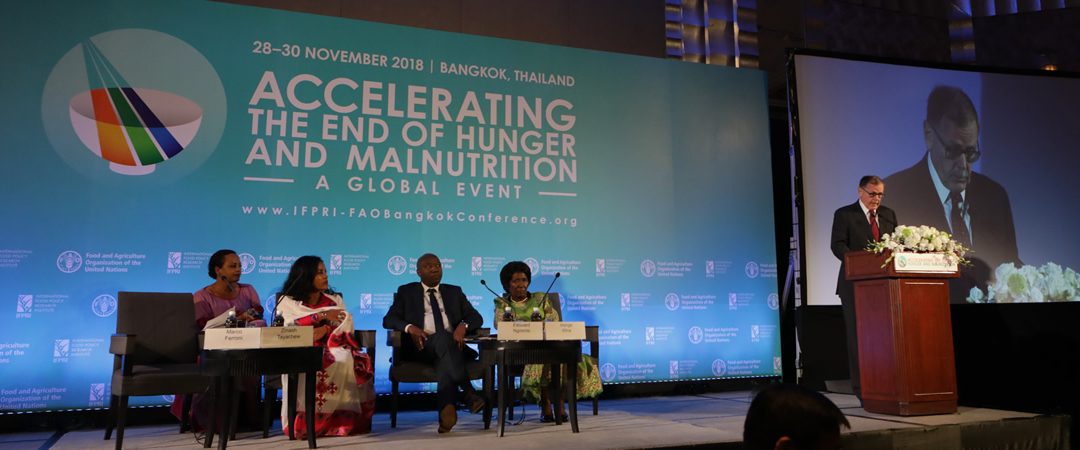
The IFPRI-FAO Global Event: Accelerating the end of hunger

28-30 November 2018. Bangkok, Thailand. The IFPRI-FAO Global Event: Accelerating the end of hunger.

How can we accelerate progress in transforming our agri-food systems to meet the needs of the hungry and malnourished and achieve the SDGs?


With rising levels of global hunger putting the goal of ending malnutrition in all its forms by 2030 in serious jeopardy, the Food and Agriculture Organization of the United Nations (FAO) and the International Food Policy Research Institute (IFPRI) organised a global conference aimed at urgently accelerating efforts to achieve Zero Hunger worldwide.


The conference highlighted how great strides have been made in many countries in reducing hunger and malnutrition, rapidly and sustainably, through improvements in public policies, focused investments and the harnessing of new technologies.
  • Bangladesh, for example, has achieved one of the fastest reductions in child underweight and stunting in history, largely by using innovative public policies to improve agriculture and nutrition. Policies supporting agricultural growth helped increase agricultural production, while other policies supported family planning, stronger health services, growing school attendance, greater access to drinking water and sanitation, and women’s empowerment. Together, these policies reinforced each other to create an environment of improved food security and nutrition for millions of Bangladeshis.
  • Economic growth in China lifted millions out of both hunger and poverty, while Brazil and
    Ethiopia
    transformed their food systems and diminished the threat of hunger through targeted investments in agricultural research and development (R and D) and social protection programmes. Starting in the mid-1980s and continuing over two decades, crop production in Brazil grew by 77 percent and that -- combined with the country’s Fome Zero programme, established in 2003 to provide beneficiaries a wide range of social services -- saw hunger and undernutrition nearly eradicated in just ten years.
  • Similarly, Ethiopia’s large-scale investments in agriculture have led to substantial growth in the production of cereals and the availability of food, while the creation of the Productive Safety Net Programme provides food and/or cash to needy households, which are direct for the most needy and conditional on a work requirement for others. These investments, combined with large public expenditures in health and education, have dramatically reduced hunger and undernutrition, shifting the international image of Ethiopia from victim of frequent famines to development success story.
By convening key figures from the worlds of research, policymaking, and development programme implementation to share knowledge of the policies, interventions, and technologies that have effectively accelerated the elimination of undernutrition, the conference has catalyzed the next era of rapid reductions in hunger and malnutrition.

Reports
LAUNCH OF THE GLOBAL NUTRITION REPORT 2018
29 November 2018. The 2018 Global Nutrition Report shares insights into the current state of global nutrition, highlighting the unacceptably high burden of malnutrition in the world.

LAUNCH OF THE REPORT: REDUCING STUNTING TROUGH MULTISECTORAL EFFORTS IN SSA
29 November 2018. The report “All Hands on Deck: Reducing Stunting through Multisectoral Efforts in Sub-Saharan Africa” lays the groundwork for more effective multisectoral action on reducing stunting by analyzing and generating empirical evidence useful for informing the joint targeting and, if necessary, the sequencing of sector-specific interventions in countries in SSA.

‘Future Smart Food’ to Tap Huge Potentials of Neglected and underutilized species
Li, X. and Siddique, K.H.M. 2018. Future Smart Food - Rediscovering hidden treasures of neglected and underutilized species for Zero Hunger in Asia, Bangkok, 242 pp.
Scoping and Prioritizing NUS through an interdisciplinary priority-setting exercise in December 2016, in collaboration with among others FAO, ICARDA, ICRISAT, ACIAR and national governments and research institutes of Bangladesh, Bhutan, Cambodia, Lao PDR, Myanmar, Nepal, Vietman and India,

HOW TO BUILD URBAN FOOD SYSTEMS FOR BETTER DIETS, AND HEALTH IN LOW AND MIDDLE-INCOME COUNTRIES
30 November 2018. This blogpost includes the presentations of the side event and a 4 pages document on the Urban Food Systems research program of IFPRI

Spotlights:

Monday, January 2, 2017

5th Global Forum of Leaders for Agricultural Science and Technology (GLAST-2016)

6 December 2016. Bangkok. A report described by the UN as “the first post-Millennium Development Goals report of its kind,” cautions that without significant increased investments in agricultural research, especially in Asia, “home to 60% of the world’s hungry people,” global efforts to achieve the zero hunger target by 2030 could fall short. 

The Food and Agriculture Organization of the UN (FAO) launched the report titled, ‘Asia and the Pacific Regional Overview of Food Insecurity: Investing in a Zero Hunger Generation,’ (64 pages) at the 5th Global Forum of Leaders for Agricultural Science and Technology (GLAST-2016).

The report’s key thematic approach examines the challenges of addressing persistent hunger and undernutrition in the context of limited natural resources. It also takes a closer look at other aspects of malnutrition arising from poor diets such as the rise in obesity and ‘hidden hunger.’

In a significant new development, the report introduces a new indicator for monitoring food
insecurity and presents analysis of some of the emerging issues in the region, such as dietary diversification and implications for food production systems, food safety, and policy.

The launch was followed by a panel discussion “Investing in a Zero Hunger Generation”. The panel examined past policy successes and failures in this context and raise new questions to encourage dialogue and shape a new public narrative towards eradicating hunger and malnutrition and creating transformative change for sustainable development.

The panelists were:
  • Biraj Patnaik: Principal adviser to the Supreme Court of India Commissioners on the Right to Food. 
  • Marco Bertacca: Managing Director at Friesland Campina Thailand. Friesland Campina is one of the world's largest dairy product producers and is promoting Thailand as its export hub for milk and dairy products to other ASEAN countries. 
  • Tsetsgee S (Retd.): Former Director of Food Production, Ministry of Food and Agriculture, Government of Mongolia. Currently, National Secretary of Mongolia to the International Dairy Federation.
  • Parvathy Ramaswami: Deputy Regional Director, Regional Bureau for Asia & the Pacific, World Food Programme, Bangkok, Thailand