Platform for African – European Partnership in Agricultural Research for Development

Saturday, June 9, 2012

Agricultural Research in Africa: Why CAADP should follow IAASTD


A new briefing paper from APRODEV and PELUM Association analyses the agricultural research policies of the Comprehensive African Agriculture Development Programme (CAADP) and the extent to which they address the needs of marginalised smallholder farmers. CAADP has a huge opportunity to promote good agricultural research by following the findings of the International Assessment of Agricultural Knowledge, Science and Technology for Development (IAASTD). However, CAADP is largely not following the IAASTD roadmap.
The paper highlights five key problems with CAADP’s policies and practices:
  1. African governments are ignoring their CAADP commitment, set in 2003, to double their annual spending on agricultural research within 10 years; rather, many have been reducing their spending. CAADP has not invested enough in examining why CAADP commitments are not met at member state level and therefore falls short of appropriate measures to meet the set targets of 6% agriculture growth.
 2. Despite the fact that women constitute most farmers in Africa, they are paid lip service in CAADP programmes. Women are largely ignored in countries’ CAADP and other agriculture strategies.
 3. CAADP is promoting a farming model, associated with the Green Revolution, that encourages heavy reliance on expensive external inputs, such as chemical fertilizers and pesticides, and improved and/or hybrid seeds bought from agribusiness companies; this comes at the expense of promoting sustainable agriculture approaches which are likely to benefit poor farmers much more.
 4. CAADP’s lead partner in agricultural research, the Forum for Agricultural Research in Africa, has taken a lopsided stance on GMOs and advocates strong IPR regimes that threaten farmers’ rights to retain and exchange their traditional seeds; ignoring the consensus on sustainable, agro-ecological farming models as a viable solution for African agriculture.
5. Smallholder farmers, especially women, are being insufficiently consulted in the design of agricultural research policies.

Friday, June 8, 2012

Eating Planet, Nutrition Today: A Challenge for Mankind and the Planet

BARILLA CENTER FOR FOOD & NUTRITION EATING PLANET 2012
Eating Planet, Nutrition Today: A Challenge for Mankind and the Planet, a new book released by the Barilla Center for Food & Nutrition (BCFN), hopes to educate the public about food production and the challenges it faces and the benefits that reform could bring. The book is available for download from here.

Everyday one billion people go to bed hungry while 30 per cent of food is wasted and another billion people suffer from health problems related to obesity. As society has become more urban, younger generations have no idea as to how food is produced. Finally, the global agricultural system is responsible for one third of greenhouse gas emissions. Most of it coming from livestock, which accounts for about 20 per cent of the total, according to a UN report from 2006.

"Access to food is one of the first and most fundamental of all human rights," says Guido Barilla, chairman of the Barilla Group. "Where food is lacking, it becomes impossible to live with dignity, and the rights to a healthy life and peaceful coexistence are undermined."

The book was organized in collaboration with the Worldwatch Institute's Nourishing the Planet project, which provides an evaluation of environmentally sustainable solutions to alleviate hunger and poverty.

"The study's conclusions represent a major step toward ensuring that agriculture contributes to health, environmental sustainability, income generation, and food security," said Nourishing the Planet project director, Danielle Nierenberg. "The ingredients will vary by country and region, but there are some key components that will lead to healthier food systems everywhere."

The report is divided into four sections: Food for All, Food for Sustainable Growth, Food for Health, and Food for Culture. Each of these sections ends with concrete recommendations, proposals, and actions that need to be taken to solve the global food crisis. It also features contributions from experts such as Nobel Peace Prize winner Shimon Peres, Italian economist and former Prime Minister Mario Monti, philosopher and environmental activist Vandana Shiva and Carlo Petrini, founder of the International "Slow Food" Movement.

One of the points made in the book is that people in developing countries should be educated about the advantages of healthy foods, such as fruits and vegetables, before bad eating habits develop into deep-rooted cultural practices, which is already happening in places like India, where meat and dairy consumption are on the rise. It is important to develop healthy eating habits during childhood to ensure overall health later in life. Besides, healthy eating is also lighter on the environment since it is animal-derived produce that has a higher carbon footprint.

On June 28, 2012, the Barilla Center for Food and Nutriton and the Worldwatch Institute's Nourishing the Planet project teamed up to launch their new book, Eating Planet--Nutrition Today: A Challenge for Mankind and for the Planet. The event featured notable speakers such as Nourishing the Planet Director Danielle Nierenberg, food waste activist and author of American Wasteland, Jonathan Bloom; founder of The 30 Project and new member of the BCFN Advisory Board, Ellen Gustafson; publisher of "Edible Manhattan" and author of Eat Here, Brian Halweil; Stephanie Hanson, Director of Policy and Outreach for the One Acre Fund; Kelly Hauser, Agriculture Policy Director for the One Campaign; and founder and director of Citizen Effect, Dan Morrison.

Thursday, June 7, 2012

Establishment of an African Food and Agricultural Policy Platform

30th – 31st May, 2012. Accra, Ghana. Workshop to Plan the Establishment of an African Food and Agricultural Policy Platform (AFAPP).

The workshop was organized by the Forum for Agricultural Research in Africa (FARA) in collaboration with the Center for International Food and Agricultural Policy (CIFAP) of the University of Minnesota, USA. Policy research institutions or think tanks support and influence public and private sector decisionmaking by conducting policy research, disseminating the results and engaging in advocacy for its use. They also act as catalysts for new thinking and new solutions to address current, emerging and potential future problems and offer a nursery of ideas on the direction policies should take. With its new role as a weaver of knowledge networks in Africa,

FARA will provide a continental forum for networking (catalyzing, connecting and communicating) among African policy research institutions. Affiliate members of AFAPP will be drawn from these and other institutions to constitute the research resources by which AFAPP can carry out its mandate. The platform will provide the opportunity for them to catalyze, connect and communicate thus complementing and adding value to the work of each other. The platform will also provide several venues (e.g. workshops, seminars, training, conferences) for “venting” or communicating research outputs to affiliates of AFAPP, policymakers, and the broader community of policy analysts. By providing a platform for promoting the production, dissemination and uptake of policy research outputs, FARA expects to enhance the contribution of policy research institutions to public policy in Africa.

A small group (15 – 20) of policy experts drawn from policy research and development institutions within and out of Africa with ample knowledge and experience in food, agriculture and natural resources participated in the 2-day workshop. The participants have developed an action plan that shows the objectives, outputs and activities to be implemented. It should also provide a structure and operational mechanism of AFAPP, potential sources of funding and a roadmap on the way forward with identified responsibilities.

Wednesday, June 6, 2012

Africa Human Development Report 2012 on Food security

Launch of the report at the UNON compound in Nairobi.
(Photo: UNDP)
15 May, Nairobi, Kenya. Sub-Saharan Africa cannot sustain its present economic resurgence unless it eliminates the hunger that affects nearly a quarter of its people, the United Nations Development Programme (UNDP) argues in the newly released Africa Human Development Report 2012: Towards a Food Secure Future.

“Impressive GDP growth rates in Africa have not translated into the elimination of hunger and malnutrition. Inclusive growth and people-centred approaches to food security are needed” said UNDP Administrator Helen Clark at the launch on 15/05, attended by Kenya’s President Mwai Kibaki. Arguing that action focused on agriculture alone will not end food insecurity either, the Report calls for new approaches covering multiple sectors; from rural infrastructure to health services, to new forms of social protection and empowering local communities.

Ensuring that the poor and vulnerable have greater voice through strengthened local government and civil society groups is also needed to ensure food security for all. The quickening pace of change and new economic vitality on the continent make this an opportune time for action, the Report says. “Building a food-secure future for all Africans will only be achieved if efforts span the entire development agenda” Helen Clark said. While acknowledging that there are no quick fixes, the report argues that food security can be achieved through immediate action in four critical areas: Increasing agricultural productivity; more effective nutrition; building resilience; empowerment and social justice.

Towards a Food Secure Future

Sub-Saharan Africa has the highest prevalence of hunger in the world. Until this situation improves, the human development prospects of millions of Africans will remain at risk. UNDP’s first Africa Human Development Report shows that food security and human development reinforce each other.

If African countries are to realize their long-term potential, the report says, they must boost agricultural productivity to both improve the availability of food and reduce poverty. Policies to enhance nutrition are central to ensuring that access to food translates into human development. The report argues further that local populations must have the resources and decision-making power to produce and consume nutritious food throughout the year, overcoming the risks represented by continuing conflict, climate change and variations in food prices.

These drivers of change, by ending the ravages of hunger and malnourishment, will nurture capabilities and conditions for human development. A well-nourished and empowered population, in turn, is more likely to seek education, participate in society and expand its productive and human potential. With the right policies and institutions Africa can sustain this virtuous cycle of higher human development and enhanced food security.


Watch the video of the report below, featuring Ethiopian Prime Minister Meles Zenawi, Liberian President Ellen Johnson-Sirleaf, Harvard Professor Calestous Juma, UNDP Administrator Helen Clark and the Director of UNDP Africa, Tegegnework Gettu. All interviews can be watched individually.
 
Africa Human Development Report 2012 from UNDP on Vimeo.

Connecting Farmers to the Agricultural Value Chains in southern Africa

On May 28-30, 2012, SACAU hosted its Annual Conference and AGM in Antananarivo, Madagascar.

The theme of the two-day conference was “Connecting Farmers to the Agricultural Value Chains in southern Africa” and aimed at fostering more structured relations between farmers and agribusinesses in southern Africa. 

CEOs and Presidents of national farmers’ unions from 16 countries in southern Africa attended. Key agribusinesses with a regional scope, such as SENWES, AFGRI, RUSELLSTONE, Massmart/Wal-mart, SAB Miller, Agribusiness Chamber and ABSA were invited to participate as well as regional institutions including SADC’s Trade, Investment, Finance and Industry (TIFI), COMESA and NEPAD. 

Presentations were made by some of the leading agricultural procurement agri-businesses and discussions focused on sharing some of key developments and issues related to value chains in Southern Africa Region.


The conference was aligned to SACAU’s aim to strengthen its relationship with agribusinesses and create an environment that allows farmers to be well informed about value chain issues with respect to trading/marketing, retailing, direct production, storage, financing, processing, input supply and others. Increased agribusiness activity can be a key driver towards the deepening and broadening of the commercialisation of primary production, and especially of the smallholder sector.


Core areas of agreement between farmers and agribusiness from the conference will be used by SACAU to develop its positions on the sustainability of agriculture, especially from the perspective of agriculture primary producers in the region.

New board … Vice - President Dr Theo de Jager (AgriSA), 
President Mr Felix Jumbe (Farmers Union of Malawi), 
SACAU CEO Mr Ishmael Sunga, Mr Salum Shamte (
Agricultural Council of Tanzania) and Mr Hajasoanirina 
Rakotomandimby (Coalition Paysanne de Madagascar) 
make up the team representing farmers in the region.


International Workshop on Investing in and Strengthening Agricultural Innovation Systems

May 30 - June 1, 2012. An international workshop held in Washington D.C brought together more than 100 AIS experts and interested participants for three days of exchange and discussions.


Agricultural Innovation Systems: An Investment Sourcebook
AIS CoverPast efforts to strengthen agricultural research extension and education systems have not increased innovation in agriculture at the pace or the scale required by the intensifying challenges confronting agriculture today.  Experience indicates that aside from a strong capacity in R&D, the ability to innovate is often related to collective action and coordination, exchange of knowledge among diverse actors, and incentives and resources available to form partnerships and develop business. The Agricultural Innovation Systems Sourcebook describes the additional and complementary interventions needed for an effective agricultural innovation system (AIS).

Workshop objectives:

This workshop highlighted the key findings from the recently developed AIS Investment Sourcebook. The workshop also served as a venue to feature and learn from operational and analytical cases and initiatives that are currently not covered by the Sourcebook
  • To launch, and disseminate and discuss findings from the recently published “Investment Sourcebook: Agricultural Innovation Systems”
  • To learn from other on-going operational and analytical initiatives on AIS
  • To identify key recommendations for and issues requiring further analysis, experimentation and implementation to promote operationalization of AIS approach
  • To consolidate the Community of Practice on AIS
Participants List

Conclusions/summary of the Conference will be added later.

Some presentations relevant for PAEPARD

Please click on the days below to view the presentations

PART 3: RURAL ADVISORY SERVICES & ITS ROLE IN PROMOTING INNOVATION
Chair: Magdalena Blum, FAO

Session Description 
Pluralism and Brokering as the Defining Factors for Rural Advisory Services in an AIS Context – Kristin Davis, Executive Secretary, GFRAS and Willem Heemskerk, KIT
Application of ICT for RAS – Carol Bothwell, VP and Chief Knowledge Office, Catholic Relief Services
Private Sector Driven RAS: Principles of and Evidence of Engagement – by Willem Heemskerk, KIT and
Village-based Agricultural Advisor: A New Model for Self-employed Extension Workers – by David Priest, FIPS-Africa Ltd.
What can Brokers Offer for RAS and Agricultural Innovation – by Laurens Klerkx, Wageningen University
What can Brokers Offer for RAS and Agricultural Innovation - Rasheed Sulaiman, CRISP-LINK


PART 4: ROLE OF RESEARCH AND TECHNOLOGY IN AIS
Chair: Jonathan Wadsworth, Executive Director of the Fund Office, CGIAR

Session Description 
Strengthening Research System to Function in AIS – John Lynam, International Research and Innovation Consultant
Building Effective Demand Articulation and Interface between Research System and Other Actors – by David Spielman, Senior Research Fellow, IFPRI 
Lessons on Consortia and R&D Partnerships with the Private Sector (Australia, Chile and India) – Francisco Obreque, Independent Consultant     
Change Management within Agricultural Research Systems– Doug Horton, Independent Consultant 
20 years of AIS Implementation in Uruguay – What Have We Learned from INIA? – Mario Pareja, Independent Consultant, IICA
Agricultural Innovations Using the Integrated Agricultural Research for Development (IAR4D) Aapproach – Sidi Sanyang, Program Manager, CORAF/WECARD


PART 6: IGNITE SESSION &; PARALLEL WORKING GROUPS
IGNITE Session: 13 Speed presentations on AIS approaches/initiatives/products
Farmer-managed Funds for Local Innovation Processes – Ann Waters-Bayer, ProLinnova 
INNOVAGRO Network - Leticia Deschamps, IICA 

E-mail conference on "Ensuring the full participation of family farmers in agricultural innovation systems

4 June to 1 July 2012. FAO hosted a moderated e-mail conference  on "Ensuring the full participation of family farmers in agricultural innovation systems: Key issues and case studies".

The UN General Assembly has declared 2014 to be the International Year of Family Farming and has invited FAO to facilitate implementation of the International Year, in collaboration with its partners. Among its initiatives for the International Year, FAO is planning to publish a major study on family farming and Agricultural innovation systems (AIS) in 2014 in the State of Food and Agriculture series, which is FAO’s major annual flagship publication.

Agricultural innovation systems are systems of individuals, organizations and enterprises that bring new products, processes and forms of organization into social and economic use to achieve food security, economic development and sustainable natural resource management. AIS include a multitude of potential actors, such as producer organizations, research organizations, extension and advisory services, universities and educational bodies, governments and civil society organizations, co-coordinating bodies, individual farmers and farm laborers, and the private sector (including traders, processors, supermarkets etc.).

The e-mail conference is open to everyone, is free and will be moderated.

The Background Document to this FAO e-mail conference is available here.

Meeting the needs of smallholder farming families also provides the central theme of the GCARD RoadMap, which sets out the systematic changes required to transform and strengthen innovation systems to better meet the needs of resource-poor smallholders around the world.  Results from the FAO e-mail consultation will help inform discussion in The Second Global Conference on Agricultural Research for Development (GCARD 2): “Foresight and partnership for innovation and impact on small-holder livelihoods” on practical actions underway and that are required to implement these systematic changes. The GCARD 2 will be organized in Punta del Este, Uruguay, 29 October – 1 November 2012, more information is available on the GFAR website.  The Pre-Registration for the GCARD 2012 Conference is now open.

Outcomes from the email consultation and the GCARD Conference will inform preparation of the major FAO study in 2014, as well as help to build cooperation around key forward-looking agendas and facilitate planning of joint actions among all AIS stakeholders to deliver large scale development outcomes.

PAEPARD contribution:
Moderated conference on agricultural innovation systems:  a selection of the most significant contributions, relevant for PAEPARD.


·         In order to identify a pool of brokers on the African continent we launched a call for agricultural innovation facilitators (AIF) 1 year ago. We were at that time not aware that ASARECA was in the process of the creation of a pool of well-skilled platform facilitators for innovation platforms under their Farmer Empowerment for Innovation in Smallholder Agriculture (FEISA) project.
o   203 applicants submitted their CV to PAEPARD.
o   The screening of the CVs was based on the geographical origin (country) and the profile of the applicant (research, farmer organisation (FO), private sector, nongovernmental organisation (NGO), ministry, consultant or other).
o   Not surprisingly 160 were male applicants and 43 female.
o   86 applicants had a [agricultural) research profile, 36 applicants worked for an ngo,  21 for a farmer organization, 17 consultants, 16 from a Ministry, 14 private, 6 extensionists, 4 other.
o   But the career path revealed that the  basic training of the majority of all profiles originated in agricultural research.
o   A past training (in Montpellier or in Wageningen) with the International Centre for development oriented Research in Agriculture (ICRA) was a strong reference for the selection.

We are currently performing an evaluation of the brokers' facilitation in 10 ARD consortia from the consortium's coordinator perspective and the AIFs' perspective. And we realize that a technically sound agronomist with facilitation training is a rare gem. In the agricultural research community, we only managed to identify few good experts in group dynamics, adult training, moderation, knowledge management, etc.

We also realized that because (so far) the dominant PAEPARD partnership model has been the AIF (broker) functioning in a project context, this had some important limitations in terms of innovation. The stress is too much on project innovation instead of system wide innovation by involving several societal actors, including farmers, supply and processing industry, civic advocacy organization, and policy makers. The reason why we opted first for the project partnership model is obvious: we wanted to link the brokering to something tangible: the submission of a research proposal to a funding opportunity, as a milestone of the consortium facilitation (a process of minimum one year).

The requirement for the facilitator to be able to play an independent role within the consortium was essential. Preferably, the facilitator should not be a member of the lead institution (the applicant), to ensure a balance of influence on the consortium. The AIF needed nevertheless to be a person [all] the consortium members felt comfortable with. We wanted the choice of an AIF to be done through a consultation between the consortium and the PAEPARD-trained AIF.  But in one case the AIF with an ngo profile found it difficult to impose her authority towards the researchers involved in the consortium, and in another case AIFs with a research profile failed in their facilitation - not having "the spirit and training for facilitation and brokerage".

Conclusion: testing theoretical concepts into practice, but also to translate practical dilemmas into systemic lessons is a major challenge. [Platform for African - European Partnership in ARD]


Tuesday, June 5, 2012

Announcement:: e-discussion: The potential of information and communication technologies (ICT) to improve data collection and M&E

Participate in the 3rd e-Forum: June 11-22
The potential of information and communication technologies (ICT) to improve data collection and M&E activities is striking. Mobile phones, new platforms and repositories, and even software for reporting have reduced costs and time, improved data validity, and increased the ease of implementation. Some studies are showing these benefits. 
When a team from Catholic Relief Services used iformbuilder to register and distribute vouchers to beneficiaries in a seed fair in Central African Republic, they saved over a one week prep time and reduced the personnel needed by half. CRS is now developing an entire M&E system using iformbuilder.
The ICT in Agriculture e-Sourcebook touches on these tools in a number of modules. Module 6 on Agriculture Innovation Systems, Module 3 on Mobile Phones, and Module 8 on Farmers Organizations describe how some of these tools have been used. The following videos are taken from only a few of the many digitized data collection and M&E service providers. 

EpiSurveyor, demo of SMS data entry--

FrontlineSMS, explanation of origins and basics--

iformbuilder, basic demo--

This forum will explore two main topics: 
1) Tools and issues in data collection and 
2) Post-data collection—repositories, analytics, and dissemination in monitoring and evaluation. The forum will open the discussion to challenges related to using these technologies and their solutions as well.

Monday, June 4, 2012

Updates on PAEPARD Activities in Mauritius, April - May 2012

Breadfruit Festival in Mauritius
PAEPARD Facilitators sharing information on 
the project activities in Mauritius
The Ministry of Agro-Industry and Food Security, in collaboration with the Agricultural Research and Extension Unit (AREU) organised a breadfruit festival ("La Fete du Fruit a pain") from 25-27 April 2012 at the Farmers' Training School, Wooton. On this occasion, several activities were proposed to the public, which included a culinary competition, demonstrations on breadfruit propagation techniques, breadfruit processing and value-addition, public lectures on several key topics on breadfruits, and there was also an exhibition on breadfruit by some of the organisations involved in the breadfruit sector in Mauritius. In-line with this event, breadfruit village was also inaugurated at Pamplemousses (a region in the north of Mauritius) on 24th April 2012.Among the different exhibitions, there was an exhibit by the Food and Agricultural Research Council (FARC) and PAEPARD, whereby information on the PAEPARD Project in Mauritius were given to the public.

More information on the Breadfruit Festival in Mauritius can be accessed on this link.

Work session - 10th May 2012
The objective of this work session was to prioritize research areas from the ones identified during the previous work session. 

The prioritization process was explained to the participants by the facilitators:

  • From the 10 identified Research areas, the consortium needed to prioritize at most 5 research areas, according to their importance and complexity with respect to the local context. 
  • A prioritization questionnaire was designed and participants were required to rate the research areas accordingly 
  • The prioritization questionnaire and the list of research areas were provided to each participant 
  • Starting from the first research area to the last on the list, each one of them was rated according to the different criteria.
By the end of the work session 5 Research areas were prioritised.Some pictures of the work session can be viewed in the following Slide Show:


Work Session - 16th May 2012

The picture is an example showing how the research questions
were generated formulated for each of the 5 research areas
The work session organized on 16th May 2012 was a follow-up to the work session held on 10th May 2012, whereby 5 research areas were prioritized.The objective of this work session was to formulate research questions that would be developed into concept notes.Participants were explained by the facilitators about how to formulate the research questions under each research area. For each of the research area, there was a central question, secondary questions, and tertiary questions. From all these questions that were generated, a research title was formulated for each research area. 


By the end of the work session 5 Research titles were formulated under each Prioritized Research areas.In the next workshop that would be organized in June 2012, concept notes would be developed for each Research title.

Presentation at the IAALD Africa Chapter Conference

Nawsheen Hosenally during the presentation
A paper on the wiki of the Mauritius Breadfruit Sector Consortium (supported by PAEPARD) was presented at the IAALD Africa Chapter Conference 

held in Johannesburg, South Africa from 21-23 May 2012.

Presentation: "The use of ICTs to facilitate collaboration in a Multi-Stakeholder Partnership: A case study of the Mauritius Breadfruit Sector Consortium" by N.Hosenally and K.Bheenick
Click here to read full paper

Thursday, May 24, 2012

e-Agriculture for Improved Livelihoods and Food Security in Africa

21st - 23rd May 2012. Johannesburg, South Africa. International Association of Agricultural Information Specialists. 3rd IAALD Africa Chapter Conference: e-Agriculture for Improved Livelihoods and Food Security in Africa.

The conference drew attendance from 90 professionals and experts involved in the application of information and communication technology (ICT) in the rural domain, with a primary focus on agriculture (e-Agriculture), from both inside and outside Africa.

Speakers included government policy makers, industry, international development community, rural development practitioners, as well as researchers and graduate students from the agricultural and rural development field, including ICT. They presented and discussed the latest topics in e-agriculture and shared their experiences and lessons learned in the implementation of e-agriculture initiatives.

The conference activities comprised an exhibition showcasing e-agriculture initiatives and activities; pre-conference workshops, seminars and training. Prior to the conference, an online global discussion was held on e-Agriculture in Africa.

Presentation related to PAEPARD 


22/05. The use of ICTs to Facilitate Collaboration in a Multi-stakeholder Partnership: A Case Study of the Mauritius Breadfruit Sector Consortium – Nawsheen Hosenally - Consultant and Facilitator on Agriculture and Youth Related Projects, Mauritius and Krishan J. Bheenick, Programme Manager (Production Systems incl. IT Systems), Food and Agricultural Research Council, Reduit, Mauritius.  http://paepardmauritius.pbworks.com/

The role of South-South Cooperation in Agricultural Development in Africa - opportunities and challenges


17 May 2012. Brasília. The Role of South-South Cooperation in Agricultural Development in Africa: Opportunities and Challenges 2012. 

Both China and Brazil are becoming increasingly important players in agricultural development in Africa, whether through technical assistance or trade and commercial investments in land and agriculture. In the longer term, these new players may reshape the way agricultural development is thought about, financed and implemented across Africa. 


The implications of these new patterns of South-South cooperation have been discussed at a meeting in Brasilia on 17/05 organised by the Future Agricultures Consortium in collaboration with the International Policy Centre for Inclusive Growth (IPC-IG) and the UK Department for International Development (DFID), with support from Articulação Sul, the International Cooperation Centre in Agronomic Research for Development (CIRAD), and the United Nations Entity for Gender Equality and the Empowerment of Women (UN Women).


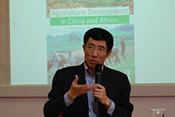
Professor Li Xiaoyun and Professor Qi Gubo of the Chinese Agricultural University in Beijing offered their perspectives based on the findings of their recently-published book, Agricultural Development in China: A Comparative Analysis. 
Focusing on China's experience of supporting agricultural development in Africa, they argued that China has made massive strides in achieving food security and poverty reduction, feeding 20 per cent of the world's population with only 8 per cent of the world's arable land. Lessons from this experience are potentially important for Africa, they said. China has experience of labour intensive agriculture supported by locally developed appropriate technologies. China's 'green revolution', they pointed out, was home-grown and based on long-term public investment in research, agricultural education and infrastructure, and was not reliant on market led development.
Panel 1: Brazilian cooperation for development: new paradigm for agricultural development in Africa? 

Setting Brazilian agricultural development cooperation in its geopolitical and policy context – what are the attributes of the Brazilian model and what challenges is it facing? Reflecting on lessons from different agricultural development models in Brazil and their implications for cooperation with Africa – how to get the blend right?

Panel 2: Agriculture, climate change and a green economy in Africa: what role for South-South?

Focusing on the opportunities and challenges for African agriculture [in the context of the Rio+20 and post-Durban agendas on sustainability], inclusive green growth and climate change mitigation – climate smart agriculture and the socioenvironmental lesson-learning process from Brazilian agricultural development. What lessons exist from including rural women for example? How can we do better rather than simply produce more?

Panel 3: Brazil and China in Africa: similarities and differences in South-South exchange 

Identifying contrasts and commonalities in Brazilian and Chinese approaches for agricultural development cooperation with Africa, and potential for future exchange – what might Brazil and China do together?

Related
guardian.co.uk, 10 May 2012. Chinese food security may be motivating investments in Africa Future need to import more food a possible influence in China's engagement with African agriculture, claims study.

Private Sector Perspectives for Strengthening Agribusiness Value Chains in Africa: Case Studies from Ethiopia, Ghana, Kenya and Mali

May 2012. Private Sector Perspectives for Strengthening Agribusiness Value Chains in Africa: Case Studies from Ethiopia, Ghana, Kenya and Mali. Partnership Report by Mima Nedelcovych and David Shiferaw.

Value chains have been accepted as an effective way of focusing on measures to improve the scale and impact of private sector investments, which include the investments made by smallholder farmers themselves as well as those made by larger-scale domestic or foreign agribusiness investors. Development partners have adopted value chain approaches when designing interventions and project implementation to coordinate their support to specific sectors and commodities. Particularly due to the emphasis on targeted value chains by the US Government’s Feed the Future Initiative, a better understanding of the linkages being made (or missed) along a value chain will be essential to realizing the returns that they promise.

This report is a summary of observations made in four country studies: Mali, Ghana, Kenya and Ethiopia. The findings suggest that African governments have significant opportunities to take actions that would directly stimulate private investments in agriculture. The private investors interviewed believed that, with greater government support in creating an enabling environment and less direct government intervention in value chains, critical barriers to their businesses would be reduced or eliminated. Observations specific to the four countries and four agricultural commodity value chains are summarized below and call for practical reforms that promote the growth of successful agribusinesses and more productive farming in Africa.

Rwanda's remarkable progress in almost all FARA’s priority areas

21-23 May. Kigali, Rwanda. The Executive Board of the Forum for Agricultural Research in Africa (FARA) was to review the programs and plans of FARA over the 18-month period from July 2012 to December 2013. The main reason for choosing Rwanda as venue for the Board meeting is the country’s remarkable progress in almost all FARA’s priority areas of intervention such as advocacy and policy, improved access to knowledge and technologies, strengthened capacities, and partnerships and strategic alliances. The total investment is USD 700,000 per annum for the past 3 years. FARA has also trained seven postgraduate students who have already complemented their courses of study and returned to their assignments with RAB.

In order to find out first-hand how Rwandan farmers are benefiting through the interventions introduced by FARA and supported by various donors, the Board members visited two key field locations of the Rwanda Agriculture Board (RAB) in Rulindo and Musanze districts.

In Rulindo, the Board visited the Kotemu Cooperative, where farmers have achieved new prosperity through cultivation of Orange-flesh Sweet Potato (OFSP), which was introduced by the FARA project Dissemination of New Agricultural Technologies in Africa (DONATA).
The members of the cooperative, most of whom are women, were dressed in bright orange shirts bearing the slogan Turye ibijumba bikungahaye kuri Vitamine A! (Let’s eat sweet potatoes rich in Vitamin A!). The women prepared an array of baked OFSP products. One, which they called ‘DONATA Doughnuts’, so impressed Dr Tiemoko Yo, Chairman of the FARA Board, that he exclaimed ‘This is the best cake I have ever eaten!’

At the Musanze site in the village of Gataraga, Irish potato farmers were similarly expressive about FARA’s work through the Sub-Saharan Africa Challenge Program (SSA CP). When Professor Monty Jones, Executive Director of FARA, asked the farmers what specific improvements in their lives had come about as a result of the FARA initiatives, he was overwhelmed by the immediate and varied responses of the farmers. One had been able to build a new house that he rents to a tenant. Another had been able to place her children in school, including one in university. Yet another had purchased a motor vehicle for transporting her crop to market. One after another, the farmers demonstrated their enthusiasm and satisfaction with the SSA CP project.


Related:

Wednesday, May 23, 2012

G-8/African Leaders Launch New Alliance for Food Security and Nutrition

President Jakaya Kikwete, Prime Minister Meles Zenawi of Ethiopia, 
Ghana's President John Atta Millls and President Yayi Boni of Benin, 
chairman of the African Union as the first African leaders 
to attend a G-8 summit at Camp David in Maryland, USA
18 May 2012. The G-8 and African leaders have committed to create a New Alliance for Food Security, with the goal of increasing responsible domestic and foreign private investments, making innovations to enhance productivity at scale, and supporting activities that eradicate hunger and poverty in Africa. 

The New Alliance represents a shared commitment to raise 50 million people out of poverty in the next decade by aligning commitments of Africa's leadership, the private sector, and the G-8. Central features of the New Alliance will be realizing the promise of L'Aquila, launching partnerships, mobilizing private capital, reducing and managing risk, improving nutritional outcomes and reducing child stunting, ensuring accountability for results, and taking innovations to scale. The initial countries participating in the New Alliance will be Ethiopia, Ghana and Tanzania.

Straight Talk Africa on May 23, 2012. Rhoda Peace Tumusiime, African Union Commissioner for Rural Economy and Agriculture shares her thoughts with Straight Talk Africa host Shaka Ssali on how leaders of the eight industrialized nations of the G8 and African nations gathered to address the acute food security agenda as the $20 billion pledge is about to expire from the 2009 L'Aquila, Italy meeting.

3rd ANNUAL SYMPOSIUM ON GLOBAL AGRICULTURE 
AND FOOD SECURITY
Advancing Food and Nutrition Security at the 2012 G8 SummitMay 18, 2012 | 7:30 a.m. - 5:15 p.m.
Ronald Reagan Building & International Trade Center
Washington, D.C.

On the eve of the 2012 G8 Summit, The Chicago Council on Global Affairs brought together senior global leaders to discuss new G8 efforts on food security and the opportunity and benefits of private sector investment in African agriculture and food sectors. Sessions identified ways business, civil society, and international organizations could complement and amplify G8 action on agricultural research and innovation, markets and trade, and nutrition.  President Barack Obama, Secretary Hillary Rodham Clinton, His Excellency Professor John Evans Atta Mills, His Excellency Jakaya Kikwete, His Excellency Dr. Boni Yayi, His Excellency Meles Zenawi, Bono, and other dignitaries addressed over 700 attendees.

Session on AGRICULTURAL INNOVATION: Getting to scale
Moderator:
Dr. Eleni Gabre-Madhin
, chief executive officer, Ethiopian Commodity Exchange
Discussants:
Mr. Dyborn Chibonga
, chief executive officer, National Smallholder Farmers’ Association of Malawi
Ms. Janet Chigabatia-Adama, Savanna Farmers Marketing Company
Mr. Hugh Grant, chairman, president, and chief executive officer, Monasanto Company
Mr. Jeff Simmons, senior vice president, Eli Lilly and Company; president, Elanco Animal Health
Mr. Jack Sinclair, executive vice president, Grocery Merchandise, Walmart
Mr. Sam Dryden, director, Agricultural Development, The Bill & Melinda Gates Foundation


Tuesday, May 22, 2012

Atelier de formulation de projet Développement participatif des technologies de la culture pomme de terre / Burundi

21 - 25 mai 2012. Bujumbura. Atelier de formulation de projet Développement participatif des technologies de la culture pomme de terre / Burundi, organisé  par la Confédération des Associations de Producteurs Agricoles pour le Développement (CAPAD).

L’objectif global du présent atelier est l’initiation et le développement d’un partenariat autour de la chaine de valeur semences pomme de terre.

Une étude conduite par l’ISABU (octobre 2010) montre que les variétés en diffusion ne sont pas toutes connues, seules deux variétés (Ndinamagara et Victoria) dominent dans la production alors qu’il existe 8 variétés en diffusion au Burundi. Plus de 50% des agriculteurs interrogés déclarent s’approvisionner en semences dans les marchés locaux et 37% conservent une partie de leur récolte. Cette situation montre que les semences de bonne qualité ne sont pas disponibles chez l’agriculteur. La même étude rapporte que les contraintes liées aux maladies viennent en premier lieu, suivi de contraintes liées à la fertilisation et aux semences.

La bactériose vasculaire de la pomme de terre est la contrainte phytosanitaire la plus redoutable déclarée par les agriculteurs. Plus de 75% affirment connaître cette maladie mais ignorent complètement les mécanismes de sa propagation ainsi que les moyens de lutte.

De façon spécifique cet atelier a pour objectif de :
  • Mobiliser les acteurs pertinents ; 
  • Développer une compréhension commune au sein des parties prenantes sur les enjeux et la vision du projet en partenariat ; 
  • Elaborer un plan de travail assorti d’un plan de répartition des rôles entre acteurs pour le développement de la proposition complète et la mobilisation du financement ; – Identifier les potentiels Partenaires Techniques et Financiers (PTF) ; 
  • Patrick Henri de la CTB presente le projet PAIOSA
  • Adopter d’une charte des valeurs pour le fonctionnement et la viabilité du partenariat 
La démarche méthodologique est participative pour faciliter la pleine participation et l’expression des points de vue de tous les participants. Divers outils participatifs sont utilisés à cet effet. Une alternance de travaux en plénière et de groupe permet d’échanger sur les principales préoccupations liées à la viabilité de la chaîne de valeur semences pomme de terre dans un processus multi acteurs.

A la fin de l’atelier un plan de travail et une répartition équitable des rôles sera mis au point pour les étapes suivantes jusqu’à l’atelier d’écriture.

Activite en rapport avec l'atelier: 


3ieme semaine de Pomme de Terre organisée au Burundi du 07 au 10 mai 2012 à Kayanza.

Déclaration des recommandations a l’issue de la célébration de la 3e semaine dédiée à la pomme de terre qui s’est tenue au Burundi, en province de Kayanza à l’Hôtel KAMHOTEL en collaboration avec le Ministère de l’Agriculture et de l’Elevage et avec l’appui technique et financier d’AGRITERRA, de la CTB à travers le PAOISA, de ZLTO, de CSA et IFDC, la Confédération des Associations des Producteurs Agricoles pour le Développement – CAPAD, l’Institut des Sciences Agronomiques du Burundi- ISABU, le Département de la Promotion des Semences et Plants – DPSP et la Faculté des Sciences Agronomiques du Burundi.