
Extracts of the main program
29/07 Unlocking Sustainable Investments for Home Grown School Meals
Lead: School Meals Coalition Concept note
The session served as a key milestone towards the School Meals Coalition Global Summit 18 - 19 September in Brazil.
29/07 Aligning Action, Investmentand Accountability
Lead: IFAD, WFP, and FAO 9:00-10:50 | Room CR1 Concept note
29/07 Increased and Targeted Investment through Public Private Partnerships
Lead: FAO
9:00 - 10:50 | Africa Hall
This dialogue explored the evolution of public-private partnerships (PPPs) in development finance, in particular the trends emerging from PPPs in the agrifood system since the UN Food Systems Summit 2021.
29/07 Indigenous Peoples-led Session
Lead: Indigenous Peoples’ Representatives in the SENA and Indigenous Peoples’ Food Systems Coalition
9:00 - 10:45 | Room CR5 Concept note
In this session, co-led by the Indigenous Peoples’ Food Systems Coalition and the SENA Indigenous Peoples representative, build on years of advocacy and collaboration. It spotlighted Indigenous-led practices, policies, and innovations that are shaping food system transformation from the ground up.
 Including:Juan Lucas Restrepo Director General of the Alliance of Bioversity International and CIAT
29/07 Food Sovereignty – Exploring National Approaches to Accelerating the Food Systems Transition
Lead: Italy and Africa Union Concept note
The session highlighted how countries are scaling up local solutions, strengthening small and medium-scale producers, and protecting traditional food systems through supportive public policies and financing tools like certification schemes and geographical indications. By contributing to create unique products whose value is reflected in the selling price, GIs can play a vital role in supporting rural economies by boosting demand for regional goods, creating jobs, and adding value to local activities.
This roundtable was moderated by H.E. Ibrahim Assane Mayaki, African Union Special Envoy for Food Systems. After his welcoming remarks, the Ministers of Agriculture of Ethiopia and Italy will delivered their opening remarks. The session featured interventions from the podium of Ministers, sharing their different national experiences and successful policy examples. A multistakeholder panel discussion followed, featuring representatives from International Organizations, agricultural producers’ organizations and other stakeholders, followed by an interactive exchange with the audience. The Minister for Foreign Affairs and East African Cooperation of Tanzania, Ambassador Mahmoud Thabit Kombo has reaffirmed Tanzania’s support for the concept of food sovereignty, stating that it is the right of communities to determine how they produce, distribute, and consume food in line with their needs, cultures, and priorities.
- In Tanzania, government buying is shifting toward smallholder farmers, particularly through school feeding programmes and farmer cooperatives. South Africa is working to preserve local crop varieties by identifying indigenous crops and scaling up community seed banks.
- In Mali, authorities aim to re-establish the country as the “breadbasket of West Africa,” revitalizing five key value chains and supporting over 800 local farmer groups.
- Niger aims to modernize agriculture with youth-led agro-tech and coal energy infrastructure to tackle migration by turning farming into a viable, dignified livelihoods.
- Meanwhile, Ethiopia is investing in domestic fertilizer production and seed research to reduce import dependence and strengthen seed sovereignty. And back in Gulele, those women making injera are connecting local production to global markets.
- Cameroon presented bankable agricultural projects to over 20 partners. The proposals focused on creating value, generating jobs, and driving climate-smart solutions.
Many countries are also building inclusive value chains (the process through which food moves from farmers to consumers), ensuring that smallholders, women, and youth can access markets, earn fair incomes and drive local economic growth.
Including:Juan Lucas Restrepo Director General of the Alliance of Bioversity International and CIAT
Including:Juan Lucas Restrepo Director General of the Alliance of Bioversity International and CIAT
29/07 Transformation in Complex Settings
Lead: WFP, UNICEF, and the HDP Nexus
Coalition Concept note
In the face of recurring crises—conflict, climate shocks, economic instability—many countries are charting a new path forward: linking emergency response to long-term food systems transformation.
29/07 Accelerating Public-Private Collaboration for Local Impact
Lead: WBCSD
Driving the transition to regenerative and sustainable agriculture requires collaboration across sectors. This session brought together public and private leaders to share knowledge and practical insights, showcasing how businesses are already implementing innovative solutions on the ground. It explored how successful, place-based approaches can be scaled and adapted through stronger public-private alignment on outcomes — setting the foundation for collective action through COP30 and beyond.
Lead: UNGC
11:00 - 12:50 | Room CR5 Concept note
More companies are taking measurable and ambitious action and promoting transparency by disclosing progress in their own operations and across their supply chains in areas such as environmental and climate action, social justice and equity, and finance & investment.
Moderator: Mr. Gerbrand Haverkamp, Executive Director, World Benchmarking Alliance
Opening Remarks
- Ms. Sanda Ojiambo, Executive Director and Assistant Secretary-General, United Nations Global Compact (UNGC) Fireside Chat
- Ambassador Ms. Ertharin Cousin, President and CEO, Food Systems for the Future and Board Member, Bayer AG Supervisory Board
- Mr. Gonzalo Munoz, Founder, Ambition Loop Corporate Accountability in Food Systems Policies and Processes
- H.E. Dr Faniran Sanjo, Director, Social Development Department Ministry of Finance, Budget and National Planning, Nigeria
- Ms. Inaya Ezzedine, MD, MP Chairperson Women and Children Parliamentary Committee SDG2030 AGENDA Parliamentary Commission Lebanese Parliament
- Mr. Jarot Indarto, Director of Food and Agriculture, The National Planning and Development Agency (Bappenas), Indonesia
- Ambassador Ms. Wampie Libon, Director of Inclusive Green Growth and Ambassador of Sustainable Development, Ministry of Foreign Affairs, The Netherlands
Panel Discussion
- Ms. Susanne Stormer, Partner, Sustainability Services Leader, PwC and Board Member Access to Nutrition Initiative

- Mr. Fabrice de Clerck (see picture), Chief Science Officer, EAT Foundation, Alliance of Bioversity and CIAT/CGIAR
- Ms. Francine Picard Mukuzi, Co-founder and Director of Partnerships, Shamba Centrefor Food and Climate, and Coordinator, Zero Hunger Coalition
- Ms. Christine Campeau, Global Policy Director, Food and Nutrition Systems, CARE
- Mr. Douglas Kativu, Director Africa, Global Reporting Initiative
- Ms. Laura Wellesley-Squires, Forest, Land and Agriculture (FLAG) Lead, ClimateArc
Closing Remarks
- Mr. James Lomax, Food Systems Coordination Unit, Ecosystems Division, UNEP
- Ms. Lara Blanco, Director Sustainable Development, Executive Office of the Secretary General, United Nations
29/07 The Implementation of the CAADP Strategy and Action Plan
13:15 - 14:45 | Africa Hall
Interactive
dialogue between African Youth
Agri-Food Entrepreneurs and African Leaders
Lead: Africa Union, AUDA NEPAD, IFAD, AFSF,
AGRA, and Akedemiya 2063
The CAADP Kampala Declaration 2026–2035, signed by African Heads of State in January 2025, sets a bold ambition to empower youth across agrifood value chains through a comprehensive set of youth-focused interventions. This high-energy session spotlighted Africa’s next-generation agri-entrepreneurs—giving them a platform to engage directly with African leaders, share their successes and challenges, and call for bold financial and policy solutions to scale their business and lead Africa’s food systems transformation.
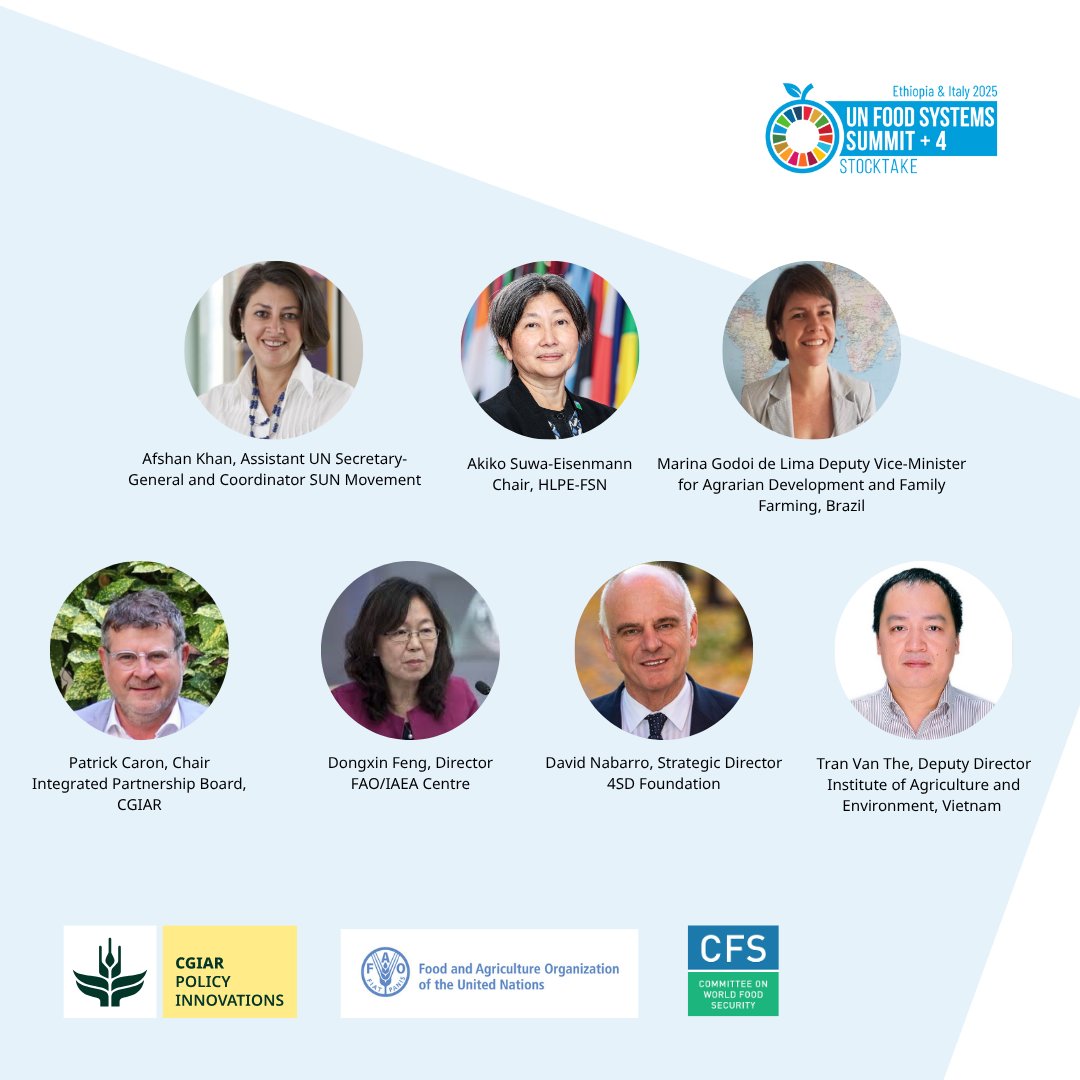
29/07 Anticipating the Future of Food: Science, Knowledge and Innovation for Just Transformations
Lead: FAO, CFS, SAC, and CGIAR
15:00 - 16:20 | Room CR1 Concept note

ministers share national experiences; civil society leaders provide rights-based perspectives on transformation pathways including through sustainable traditional food systems; country representatives engaged in successful initiatives, for instance, on school meals, agroecology and healthy diets, demonstrate evidence-based impact; and chairs of key institutional platforms including CFS High Level Panel of Experts (HLPE), FAO, CGIAR and the UNFSS Scientific Advisory Committee offer insights on the barriers and scaling effective arrangements.
Links/documents:
- CGIAR Policy Innovations Science Program
- Guidance on strengthening national science–policy interfaces for agrifood systems
- Montpellier Process: Pooling Collective Intelligence for Action
- Committee on World Food Security: https://www.fao.org/cfs/policy-products
- HLPE website
- HLPE. 2020. Food security and nutrition: Building a global narrative towards 2030. A report by the High Level Panel of Experts on Food Security and Nutrition of the Committee on World Food Security, Rome.
Lead: UNEP, UNDP, FAO, and Brazil
15:00 - 16:20 | Room CR2 Concept note
This session aimed to mobilize climate finance to transform agrifood systems, making them more sustainable and resilient amid climate change and resource degradation.
Lead: UNGC and UNIDO
15:00 - 16:20 | Africa Hall
This session, co-organized by UNIDO and the UN Global Compact, explored how integrated agro-food parks (IAFPs) and seaweed aquaculture can serve as transformative models to accelerate food systems transformation.
Resources
UNIDO Policy Brief: Potential of Integrated Agro-Food Parks for Rural Industrialization and Economic Transformation in Developing Countries
UNIDO Guidelines for Planning, Development and Management of Integrated Agro-Food Parks (IAFPs)
UNIDO Integrated Agro-food Parks for Rural Industrialization and Economic Transformation in Developing Countries
29/07 National Food Systems Transformation Convenor-led
Session
Lead: The Hub
15:00 - 16:20 | Room CR5 Concept note
Four years after the 2021 UN Food Systems Summit, National Convenors in 155 countries have been instrumental in advancing food systems transformation.


No comments:
Post a Comment