

Organised by the Centre for African Food Research and Innovation (CAFRI), the conference brought together food researchers, academics, policymakers, industry leaders, funders, investors, and emerging researchers to examine a critical question: How can Africa better fund and support the research needed to build resilient, nutritious, and sustainable food systems?
 From research to real-world impact
Africa has no shortage of food-system challenges—or ideas for addressing them. Climate variability is putting pressure on agricultural production. Post-harvest losses continue to undermine food availability and farmer incomes. Nutrition challenges coexist with rapidly changing diets, while food businesses and researchers often struggle to access the capital and infrastructure required to turn promising ideas into scalable solutions.
AFRIC 2026 placed research financing at the centre of this conversation.
Rather than treating research as an academic exercise separate from food-system development, the conference highlighted research as an essential investment in Africa’s economic and social future. Discussions explored the roles that industry, banks and investors, international and multilateral organisations, development-finance institutions, governments, and universities can play in creating a stronger funding ecosystem for African food research.
This shift in perspective is important. If research is expected to deliver solutions to Africa’s food challenges, researchers need more than recognition—they need sustainable funding, partnerships, mentorship, infrastructure, and pathways for moving discoveries from laboratories and universities into communities and markets.
A conversation spanning the food system
AFRIC 2026 addressed a broad range of issues shaping the continent’s food future.
Among its thematic areas were climate change and food production, indigenous food systems, food processing and value addition, public health and nutrition, and food policy and governance.
Together, these themes demonstrate why food research cannot be approached from a single discipline.
Climate-resilient agriculture, for example, requires collaboration among agricultural scientists, food technologists, economists, policymakers, businesses, and farmers. Likewise, improving nutrition requires an understanding not only of nutrients and diets but also of culture, affordability, food processing, consumer behaviour, and public policy.
The conference therefore offered a platform for connecting different parts of the food ecosystem—and, importantly, the people who finance, conduct, translate, and apply research.
Putting African researchers in the spotlight
One of AFRIC 2026’s notable features was its focus on the next generation of African food researchers.
Graduating researchers from CAFRI’s African Food Research Apprenticeship Programme (AFRAP) presented work addressing practical food-system challenges. Their projects covered subjects ranging from reducing fruit post-harvest losses and sustainable food preservation to plant-based proteins, insect-based protein, fermented foods, nutrition, and the use of artificial intelligence to reduce post-harvest losses.
These projects illustrate the breadth of innovation emerging from African researchers themselves.
They also reinforce a crucial point: Africa’s food challenges require African-led research that responds to local realities. Indigenous crops, traditional food systems, local markets, consumer preferences, infrastructure constraints, climate conditions, and cultural practices all matter when designing solutions that can work at scale.
Connecting researchers with capital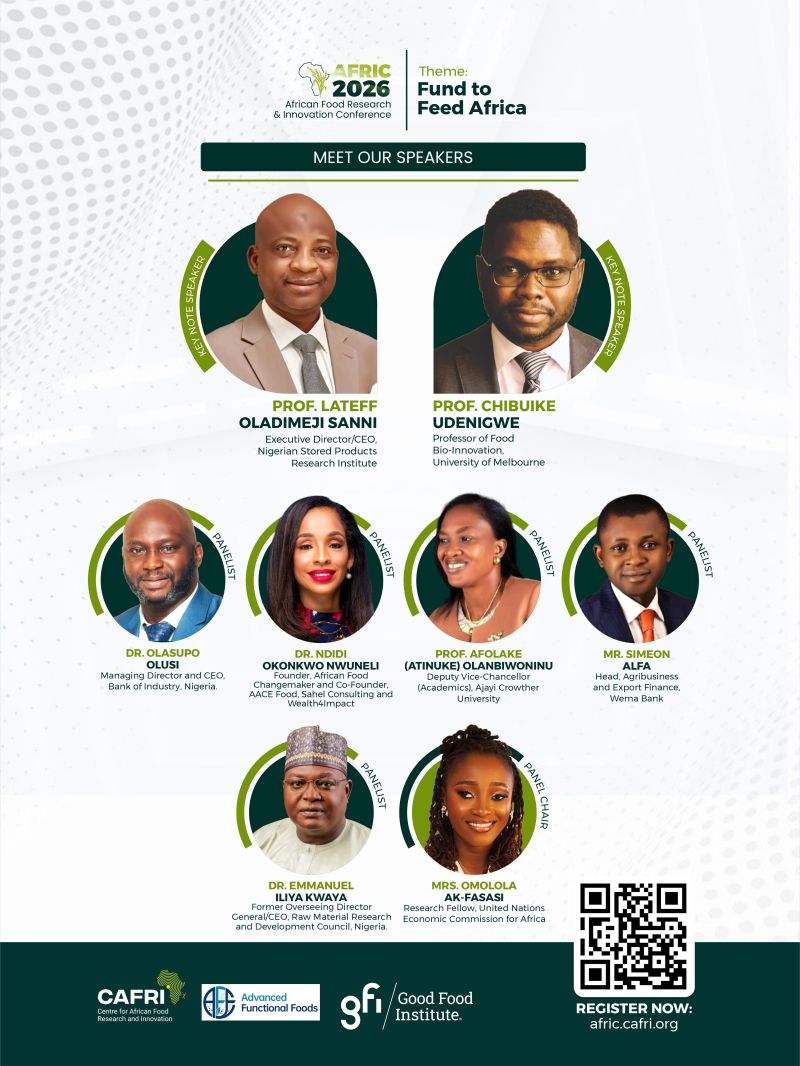
Perhaps the most consequential conversation at AFRIC 2026 was the connection between research and finance.
The conference programme included sessions examining research funding from multiple perspectives, including industry, banks and investors, international organisations, development-finance institutions, government-backed institutions, and academia. It also included a session dedicated to strategies for African researchers seeking research funding.
This multi-stakeholder approach matters because no single source of funding can solve Africa’s food-research financing gap.
Watch in the video the contribution of Dr Ndidi Okonkwo Nwuneli President and CEO, The ONE Campaign @ 1:30:34: The role of Industry in funding African Food Research.
African Food Changemakers is about highlighting and supporting the people transforming Africa’s food systems through innovation, entrepreneurship, and sustainable solutions.


No comments:
Post a Comment