28 May 2015. Feed the Future's Soybean Innovation Lab announced the availability of a new Tropical Soybean Information Portal (TSIP). The Tropical Soybean Information Portal (TSIP) is a one-stop data and information shop for the global community of researchers, extentionists, and private sector managers working in the soybean value chain.
The site is still small, but it is hoped it will grow to be an invaluable resource for soybean practitioners everywhere. The site is highly interactive so all materials are downloadable, and contributions are welcome. There is a Wiki page for tropical soybean terms and concepts, a video platform for webinars, and a curated database of research articles and reports.
TSIP contains a large online varietal trial information in sub-Saharan Africa. It is funded by USAID and Feed the Future.
Dr. Kristin Bilyeu is a Research Molecular Biologist with the USDA Agricultural Research Service and Adjunct Associate Professor in the Division of Plant Sciences at the University of Missouri. In...
Dr. Dan Reynolds is a Professor of Weed Science at Mississippi State University. In this video, he describes the “SMART” Farm (Soybean Management and Appropriate Research and Technology) concept...
Dr. Dennis Thompson is an Adjunct Assistant Professor in the Department of Crop Sciences at the University of Illinois. In this video, he discusses some of the challenges in delivering high...
Dr. Rita Mumm is an Associate Professor of Quantitative Genetics and Plant Breeding at the University of Illinois, and a former director of The Illinois Plant Breeding Center. In this video, she...
Kia Alexander is a Water Resources Engineer and a PhD candidate in Environmental Engineering at the University of Illinois. In this video, she provides an overview of the environmental impacts of...
Dr. Brian Diers is a Professor of Crop Sciences at the University of Illinois. In this video, he describes some of the key challenges that plant breeders in Africa currently face. Dr.
June 2015.Last November, to better assess the efficiency of these platforms and document stories of Innovation Platforms from various countries in the developing world, Humidtropics launched an Innovation Platforms Case Study Competition. In February, twelve candidates were selected to participate in a writeshop focused on writing stronger, more reflective and cohesive cases.
Case studies were assessed based on the following criteria announced in the competition notice: content strength, quality of writing, and usefulness of the case study.
Can an Innovation Platform Succeed as a Cooperative Society? The story of Bubaare Innovation Platform Multipurpose Cooperative Society Ltd., came out ahead as the winner of the competition. The editors found this to be an excellent case because of the legal precedent of creating a cooperative out of an Innovation Platform, which will be very useful for other country contexts with common law settings. Furthermore, it does a great job in illustrating a true multipurpose Innovation Platform, with the capacity to innovate and scale up its innovation to the benefit of members. This platform came up with technological, market and policy innovations, and tells a compelling story about sustainability and platform impact.
2 July 2015. This video produced for the ICRA/IFDC 2Scale programme demonstrates the coordination and coaching of cluster actors of the soy cluster in Zogbodomey, Benin.
Beginning 2000, farmers of Zogbodomey - a commune in the Zou Department of southern Benin -, who were looking for an alternative to cotton, have started growing soybean. The initiative was supported by the local producers’ organisation, the UCP (L’Union communale des producteurs de Zogbodomè au Bénin). The UCP not only supported the farmers technically, they also arranged for proper seed and engaged in finding market outlets for the produce.
The initial experience with Fludor, a national oil seed processing company, met with many problems. The UCP did not give up, however, and in its search for alternatives, the women of the commune, who are locally processing soybean at small scale, were considered a potential market to explore. Therefore, the UCP organised an initial training on soybean processing techniques to diversify soybean products and make milk, cheese, brochettes, and biscuits.
The UCP also supported the set-up of a women soybean processors association.
Together with the UCP and soybean processor village groups, GVPS, they now form the heart of the agribusiness cluster that is supported by 2SCALE.
The step-wise construction of a stable partnership, facilitated by a coach who is staff member of UCP, and supported by ICRA trainers, has resulted into several successes for both men and women: the men, soybean producers, have now secured access to quality seed and inoculum, and the women processors have extended their knowledge to others and have been able to buy simple processing equipment.
More women actors have joined the cluster, including wholesalers, so less soybeans leave the zone.
The partnership aims at win-win solutions for all actors involved,
for example, an inventory credit system was established that allows women processors and wholesalers to buy soybean from the UCP when market prices rise, without disfavouring the producers.
Cotton, once a men’s occupation, was turned into a profitable soybean business to the benefit of thousands of men and women. With support of the president of the federal farmer organisation FUPRO, the fire is spreading to other zones as well.
Published on 4 Aug 2015
Film of 2SCALE project (40 minutes) shot in Benin on local Soya business promoted through coaching and collaboration at various levels of the value chain.
The Agricultural Growth in West Africa (AGWA) study has been a joint undertaking of the African Development Bank (AfDB), the Food and Agriculture Organization of the United Nations (FAO) and the Economic Community of West African States (ECOWAS).
The report stresses that while increasing agricultural yields is essential, more attention needs to be placed on the downstream segment of the agrifood system: assembly, storage, processing, wholesaling and retail.
For example, domestic food processing companies often prefer to import raw materials such as fruit juice concentrate, wheat and vegetable oil rather than sourcing them domestically or developing substitutes based on local raw materials because local supply chains are too weak and fragmented to provide them reliably.
Appropriate policies will vary by country and market segment, but broad efforts to upgrade small and medium enterprises in food processing should be a policy priority, along with strengthening the linkages between market-oriented family farms and their organizations with agribusiness of all sizes to enhance access to markets, inputs and support services. Special attention should be placed in supporting women entrepreneurs, who play a key role in the agrifood system from farming through retail, and to youth.
As the post-harvest segments of the agrifood system grow ever-more important, addressing the varied demands on the system will require going beyond the traditional mandates of Ministries of Agriculture to focus on interconnections among issues as diverse as research, transport investments, trade policies, and nutrition education.
The report contains in-depth analysis highlighting these interconnections. For example, transport prices for farm produce in West Africa are much higher than in other developing regions, hampering intraregional trade and harming producers and consumers alike.
Addressing this situation requires a combination of measures ranging from investments in road infrastructure through improved road governance to reforming trucking regulations to instill greater competition.
Based on a detailed analysis of the drivers and trends shaping the development of West Africa's agrifood system and the system's response so far, the study identifies key implications for policies and agricultural investments.
These findings will help inform the deliberations on and new orientations of "ECOWAP-10", ECOWAS' forthcoming update to the current West African agriculture policy, ECOWAP/CAADP.
European Commissioner for International Cooperation and Development, Neven Mimica, co-signed new regional funding for cooperation with representatives of regional organisations from West Africa, covering the time until 2020. The so-called Regional Indicative Programme under the 11thEuropean Development Fund amounts to a total of €1.15 billion.
The West Africa Regional Indicative Programme was co-signed by President Kadré Désiré Ouedraogo of the Economic Community of West African States (ECOWAS) and President Cheikhe Hadjibou Soumaré of the West African Economic and Monetary Union (UEMOA).
The Programme focuses on three areas of cooperation:
Peace, security and regional Stability, including support to ECOWAS in its regional peace and security mandate and funding for peace and security initiatives, including migration.
Regional economic integration and trade, to strengthen trade, the private sector and regional integration and support infrastructure
Sustainable Development of natural resources and biodiversity, which covers support to resilience, food security and nutrition as well as environmental protection, biodiversity and climate change.
16 Countries benefit from the EU-West Africa Regional Indicative programme: Benin, Burkina Faso, Cape Verde, Côte d'Ivoire, The Gambia, Ghana, Guinea, Guinea-Bissau, Liberia, Mali, Mauritania, Niger, Nigeria, Senegal, Sierra Leone and Togo.
With support by the European Development Fund, the EC
announces grants under the Farm Income Diversification Programme Phase II (FIDP
II) - Scaling Up Nutrition (SUN). The goal of the program is to aid governments
and civil society to better understand and
manage nutritional issues related to agriculture, i.e., taking the six food
groups (Vegetables, Fruits, Legumes & Nuts, Animal Foods, Fats - incl
groundnuts, Staples) and providing training on how these six food groups
translate into cultivated crops and livestock. Eligibility for funding extends
to legally registered organizations in the EU and its candidate countries; the
European Economic Area; ACP countries (including Malawi); least-developed
countries; and qualified international organizations. Grants will range from
€1.5 million to €2.0 million, varying by regions and cost shares. Reference
EuropeAid/137113/ID/ACT/MW. The deadline for concept notes is 20 July 2015.
The EC will make grants
to strengthen agroforestry systems,
sustainable agriculture, and sustainable ecosystem management in the Dosso
and Zinder regions of Niger in the face of climate risks. Grants will range
from €500 thousand to €1.5 million, varying by cost shares. Eligibility for
funding extends to nonprofit organizations in the EU and Niger, and to
qualifying international organizations. Reference EuropeAid/137236/IH/ACT/NE.
The closing date for concept notes is 27 July 2015.
The EC will make grants
to increase the resilience of vulnerable populations in Senegal to food and
nutritional insecurity. Objectives are to diffuse innovative and sustainable agricultural practices; to diversify
agricultural production in order to improve nutritional outcomes; and to
strengthen social and policy measures in matters of food security. Grants will
range from €350 thousand to €550 thousand, varying with cost shares.
Eligibility extends to nonprofit NGOs in Senegal and the EU member states.
Reference EuropeAid/137163/DD/ACT/SN. The application deadline is 26 August 2015.
The International
Center for development-oriented Research in Agriculture (ICRA) – member of
PAEPARD - will sponsor a 3-week course for agricultural professionals on the
subject of "linking research to
inclusive development for food security," scheduled for June 2016 in
Wageningen, the Netherlands. Applicants can apply for fellowships through the
Netherlands Fellowship Programs (NFP and MSP) if their countries are eligible
for support in these programs. Fellowship applications can be submitted from 1 September 2015through ICRA’s
course web page after first completing an ICRA application form.
USAID's Bureau for Food
Security invites concept papers to revitalize
agriculture and livelihoods affected by the ebola outbreak in West Africa,
focusing preferentially on Guinea,
Liberia, and Sierra Leone. The Feed the Future Ebola Recovery Partnership
aims to mobilize the expertise, infrastructures, and resources of the private
sector, foundations, and other partners -- including in-country partners -- to
achieve a rapid and robust recovery from the ebola outbreak and to foster
broad-based food security. Funding is up to US$1 million. Funding Opportunity
RFA-OAA-15-000022. The deadline for applications is 06 November 2015.
The Research Council of Norway announces its first call
for proposals issued by the MILJØFORSK program (2016-2025) to generate new
knowledge about biodiversity, cultural
environments, ecosystem services, hazardous substances, and pollution. It
will also study pressures on the environment and the relationships between
social drivers/measures and natural drivers/responses. The MILJØFORSK program
will cooperate with the Norway – Global Partner program (NORGLOBAL) to
incorporate partners from the developing world into the grant proposals. The
priority partner countries for 2015 are Afghanistan; Ethiopia; Haiti; Malawi;
Mali; Mozambique; Myanmar; Nepal; Palestine; Somalia; South Sudan; and Tanzania
-- see the announcement for other developing countries which are also eligible.
The deadline for applications is 09 September 2015.
The Christensen Fund makes grants to indigenous-led and
community-based organizations for projects that combine biodiversity with cultural diversity. Pre-proposals are
accepted for consideration in the following programs: African Rift Valley; Central Asia; Northwest Mexico; Melanesia;
Global; and San Francisco Bay Area. Most grants are in the range of US$50
thousand to US$100 thousand for one or two years. The application period is 01 September
through 30 September.
Funding for Arboriculture
and Urban Forestry. The Jack Kimmel International Grant Program makes
grants to researchers in arboriculture and urban forestry worldwide. Projects
of one to three years are funded to a maximum of US$10 thousand. The
application deadline is 01 October 2015.
The Italian Cooperation will fund up to 16
participants for masters studies at the University of Florence in subjects of
natural resources management for tropical rural development. The fellowships
are for candidates interested in the Land and Water curriculum. Eligible
countries are Burkina Faso, Ethiopia,
Kenya, Mozambique, Niger, Senegal, Somalia, and Sudan. Women are strongly
encouraged to apply. The application deadline is 10 July 2015.
The French Institute for
Development Research (IRD) announces funding to support multidisciplinary
international teams (laboratoires mixtes internationaux, LMI) to undertake
research that corresponds to IRD's thematic priorities. These priorities
include societies and environment;
risks, climate, and environment; biodiversity, natural resources, and food
security; and several others. The maximum funding in the first year of an
LMI is €50 thousand. The deadline for preliminary proposals is 27 July 2015.
The Acumen East Africa Fellows Program is a one-year
leadership development program that gives 20 individuals from East Africa the
training they need to accelerate their social impact and leadership potential.
Eligible countries are Burundi,
Ethiopia, Kenya, Rwanda, South Sudan, Uganda, and Tanzania. Past fellows
have included several in smallholder
agriculture, renewable energy, waste management, fair trade, and other
areas. Acumen covers all program expenses related to travel and accommodations,
but it does not offer scholarships, stipends, or other funding. The application
deadline is 31
July 2015.
New Zealand's
government provides a variety of opportunities for training and university
study through the New Zealand Aid Program, Ministry of Foreign Affairs and
Trade. The priorities often include agriculture,
renewable energy, fisheries, disaster risk management, and other areas
related to natural resources and environment. Application deadlines are
specific to each country/regional program. The deadline for applicants from
Africa, Latin America, the Caribbean, and several Asian countries is 31 July 2015.
The Swedish International
Development Agency (Sida) funds short-term training in selected development
topics for participants from developing countries. Information about course
content and eligibility are included with the course description. Note:
Interested individuals should follow the website for additional courses that
may be announced, including at global and regional levels. The application
deadline for the course in strategic
environmental assessment is 30 September 2015.
The Australian Center
for International Agricultural Research (ACIAR) for university post-graduate
studies in Australia. Applicants are citizens of ACIAR's priority partner
countries, and engaged in an ACIAR
collaborative project at the time of application. Each awardee pursues
research at an Australian tertiary institution relevant to the project in which
the awardee is engaged prior to taking up the award. The deadline for
applications is 31
July 2015
The International Water Centre (IWC) in Australia is
currently offering several full scholarships for high calibre international
candidates* interested in studying the Master
of Integrated Water Management (MIWM) commencing in Semester 1, 2016 at The
University of Queensland. Deadline: 01 Aug 2015
The Swiss
Forum for International Agricultural Research annually awards a prize to
scientists working at or in association
with a Swiss institution in agricultural research for development. For
2015, the best research team project will be awarded CHF 10 thousand, and the
best masters project CHF 1 thousand. Deadline: 15 July 2015
This call is open to Canadians, permanent residents of
Canada, and citizens of developing countries pursuing a master’s or a doctoral degree at a recognized university
OR who have completed a master's or doctoral degree at a recognized university.
These research awards may be part of an academic requirement. Deadline: 06 Aug 2015
The Agropolis Foundation (France) promotes interdisciplinary and integrated plant biology,
ecology, and sustainable agriculture addressing development issues in the
global North and South. The call for Open Science "Training and Higher
Education" will fund projects that contribute to the diversity, quality,
and innovation of capacity building offered by the Labex Agro scientific community
and its partners. The deadline for applications(French, English)is 17 July 2015.
The United Nations
Framework Convention on Climate Change (UNFCCC) announces a global competition
for individuals aged 18-30 who submit video
examples of inspiring actions to combat climate change. The winners will be
funded to participate in COP 21 in Paris (November-December 2015) as youth
reporters. The deadline for submissions is 17 August 2015.
In Europe's
research program Horizon 2020, the Marie Skłodowska-Curie Individual
Fellowships provide opportunities to acquire and transfer new knowledge and to
work on research in a European context or outside Europe. The scheme
particularly supports the return and
re-integration of researchers from outside Europe who have previously
worked there. It also develops or helps to re-start the careers of individual
researchers that show great potential, considering their experience. Applicants
in the EU; their overseas territories; countries associated to Horizon 2020;
and most developing countries are eligible for consideration. The closing date
for applications is 10 September 2015
Within the framework of Danish development cooperation, the Danish Ministry of Foreign
Affairs hereby invites Phase 1 applications for The Call is applicable for both
North-driven (Denmark) and South-driven (Ghana,
Nepal, and Tanzania) development research grant applicants. Application
deadline: 04September 2015.
The OECD's
Cooperative Research Program invites applications for international conferences
(e.g., workshops, congresses, and symposia) and fellowships from research
scientists in agriculture and natural resources. The application deadline is 10 September 2015.
The Yves Rocher Foundation annually sponsors "Women
of the Earth" to honor women in France and selected other countries for
their achievements in environmental awareness, conservation, and solidarity.
Past awards include several for project work in the developing countries. Prizes
range from €3 thousand to €10 thousand. The closing date for applications in
France is 30
September 2015(candidates in other
countries should check their closing dates).
World Academy of Sciences (TWAS) helps support researchers from the developing world to travel
to other countries in order to pursue collaborative research for up to one
year. Costs are shared between TWAS and the host institutions. Among several
sub-programs are the "TWAS Fellowships for Research and Advanced Training"
(with an application deadline of 01 October 2015) and the "TWAS-UNESCO
Associate Scheme" (with a deadline of 01 December 2015). Researchers should review other
sub-programs for opportunities in Kenya, Malaysia, and Pakistan.
The World Academy of Sciences (TWAS) collaborates with institutions and research groups in
developing countries to enable distinguished visiting professors to teach and
build capacity at these institutions. The focus is least-developed countries
and institutions that are most separated from outside contacts. Requests are
made by host institutions in the developing countries. The host institutions
cover local expenses, while TWAS covers the international travel costs. The
application deadline for the Visiting Expert Program is 01 October 2015; the deadline for
Research Professors in Least-Developed Countries is 31 October 2015.
Leading up to the 2014 Fin4Ag – Revolutionising finance for agri-value chains international conference, the Technical Centre for Agricultural and Rural Cooperation (CTA) commissioned a study to explore the state of digital/mobile payments in agriculture.
The study was carried out using three case studies; SmartMoney from Uganda, NWK Agri-Services from Zambia, and Rice Mobile Finance (RiMFin) from Ghana.
The report introduces the concept of digital finance by providing an overview
of the new technologies and business models that began only seven years
ago. The report’s findings provide an insight that portrays the nascent usage of
digital payments by users ranging from large agricultural commodity buyers to
the small-scale farmers at the bottom of the pyramid.
This research revealed various dynamics that ultimately position smallholder
farmers as an economically viable target market for mobile financial service:
Large commodity buyers want to reduce the administrative, record
keeping, security and other costs involved in using obsolete cash payment
schemes while establishing a closer direct relationship with their farmers.
In order to reduce their costs, large buyers are willing to invest in the rollout
of mobile payments in rural areas where traditional mobile money –
and commercial finance – models are not economically viable.
In addition, MFSPs – who rely on a volume-based business model – can
register new subscribers and increase their transaction fee income while
farmers get the benefits of convenience, safety, security and their own
financial identity
Related:
2-3 October 2014. Kigali, Rwanda. Smart Rwanda Days 2014 - Digital Payments
SMART Rwanda Days is an annual event bringing together national and international stakeholders in the ICT sector – industry experts, policy makers, and development partners – to discuss how Rwanda can leverage Information Communication Technologies for economic transformation in line with Vision 2020.
Building on the successful SMART Rwanda Days 2013, and the Transform Africa Summit, last year’s SMART Rwanda Days provided a platform for stakeholders to discuss how ICT can contribute more significantly to Rwanda’s economic and social development. Download the programme.
In the last 3 years the Government of Rwanda in partnership with financial institutions have worked to build a strong foundation for electronic payments resulting in the country now being part of global interoperable payment systems. Mobile money services are growing financial inclusion and electronic payments swiftly as evidenced by the number of users and the total volumes in mobile transactions. As a result more Rwandans are financially included. Additionally, POSs have grown from 40 in 2012 to over 1,000 today adding to the increase in electronic payments steadily. There are over 4.5 millions mobile payments subscribers; over 13,000 mobile money agents; over 500 bank branches + over 1000 bank agents and over 350 ATMs that giving more Rwandans have more access to places to digitize and access their monies. In 2013, Rwanda became the first country in the world to achieve interoperable mobile payments with the launch of mVISA – the world’s first mobile interoperable mobile payments platform that allows banks to reach underserved and unbanked populations.
While the encouragement of content creation and the development of access infrastructure are necessary components, evidence suggests that in Africa no more than 5% of Internet content is sourced locally, with the rest sourced internationally — including African
developed content that is hosted overseas. This is true for global sites, such as Facebook, and for local sites such as online
media and radio stations. This data must be delivered to Rwanda over international transit links, which add significant cost and
latency to the download, which in turn limit usage.
This session presented steps taken by the Government of Rwanda towards adopting an Open Data Policy and examined the progress made by other African countries in developing their own policies. Regional and international experts in Open Data shared successes,
challenges and best practices from their country’s or organization’s perspectives.
It brought together representatives of the public and private sector from China and African countries. Regional institutions, development partners and think tanks also attended. Participants exchanged views on how African countries could attract greater investment, accelerate industrialization, create jobs and sustain development. The Chinese and African experiences were shared in order to provide information and lessons learned, and identify opportunities for enhanced partnerships, according to the World Bank.The Forum was an opportunity for pragmatic, candid and constructive discussions on practical steps to accelerate industrialization and manufacturing; Special Economic Zones and ideas for how to make them work better in Africa; accelerating improvements in infrastructure and trade logistics; creating conditions to attract development-oriented investment; skills development for private-sector led growth; and on scaled up agriculture and agribusiness investments that also benefit rural populations.
There was agreement that African countries could benefit from elements of China’s experience, although the situation in each country must determine the strategies to be followed. When it began its process of industrialization, conditions in China were very similar to those pertaining in many African countries today. Key priorities of China’s development strategy was pragmatic and long term. It included an emphasis on education and training, expansion of infrastructure, increased agricultural productivity, incomes of smallholder farmers and food security, and labor intensive light manufacturing as the basis for industrialization. It established Special Economic Zones as vehicles to pilot economic reforms before adopting them nationally, and to open the economy to foreign investment, technology and skills.
Current Chinese agricultural aid includes infrastructure construction, food production, livestock breeding, technology exchange, scholarships, and the storage and transport of agricultural products. Chinese banks also finance agricultural development projects. From 2010 to 2012, 52 percent of China’s global foreign assistance went to Africa, but only 2 percent was devoted to agricultural projects. It is impossible to measure the overall success of these aid projects, but China has improved its agricultural aid programs as it learns from its successes and failures.
Commenting on the theme of the conference, “The Role of Standards in Promoting Sustainable Agriculture and Food Security in Africa,” they stated that Africa was yet to meet its ever rising demand for food products due to poor conformity assessment which has made it lag behind in the agro-world stage even though it remains a primary producer of cash crops and raw materials.
The ARSO president and the director-general of the Standards Organisation of Nigeria (SON), Dr Joseph Odumodu, maintained that those at the receiving end of these lapses in standardisation remain small enterprises and producers.
To this end, he explained that the advantage of adopting good standardisation and conformity
He stressed that the use of standards, regulations and conformity assessment regimes for trade facilitation interventions would in no small way boost intra-inter-regional trade. Part of the take-away from the conference, he added, is that national standardisation bodies in the continent must begin to engage all the participants along the agriculture value chain.
assessment regimes is that they would lead to creation of new cost-efficient technologies in post-harvest processing and storage that improves products’ safety and avoid harvest glut and spoilage. Odumodu argued that a formal legal metrology system which complies with internationally accepted requirements promotes confidence and clarity of measurement and this reduces barriers to trade while also safeguarding fair competition, especially for small and medium-sized agricultural enterprises. This, he maintained, would improve products’ marketability while addressing demands for quality and safety attributes.
Related:
ARSO THC 02 (Agriculture and Food Products) Meeting in Nairobi, Kenya » 5th - 7th August 2015Draft Documents...
26 June 2015.Scidev. Accra Ghana. A large-scale project that seeks to help smallholders adapt to climate change by practising agricultural systems that integrate tree planting, rearing of livestock and crop production has begun in West Africa.
The Building Resilient Agro-forestry Pastoral Systems through Participatory Action Research (BRAS-PAR) project aims to improve the understanding of farmers’ perceptions and demands by addressing barriers to technology adoption while taking into consideration gender and social differentiation.
Robert B. Zougmoré, who leads CGIAR’s Research Program on Climate Change, Agriculture and Food Security (CCAFS) in West Africa, says the project’s work plans include assessment of needs to build the capacity of stakeholders in adaptation planning.
“The CGIAR system through the [Research Program on] CCAFS is willing through these kind of projects to generate the scientific knowledge and evidence about agricultural options that can work well in West Africa.”
According to Zougmoré, the objectives of the project include engaging rural communities and other stakeholders to test and validate scalable climate-smart models of integrated crop-livestock-tree systems, and the dominant farming systems in the region.
The BRAS-PAR projectis led by the World Agroforestry Centre (ICRAF), with US$2 million funding from CCAFS, Zougmoré adds.
The four-year project, launched last month (4 May) in Ouagadougou, Burkina Faso, is being implemented by
26 June 2015. Nairobi . Village Capital announced the first winners of its innovative program, East the DOEN Foundation, The MasterCard Foundation, and Duncan Goldie-Scot.
Africa: FinTech for Agriculture 2015. The program supports entrepreneurs in making financial services more affordable and accessible for smallholder farmers and other underbanked individuals in East Africa. The program is supported by
Village Capital East Africa: FinTech for Agriculture 2015 provided resources to 12 high-potential, early-stage entrepreneurs from across East Africa. The program also supported them through business development training, mentorship, and opportunities to meet potential customers and pitch to investors.
At the end of the 12-week program, the entrepreneur-participants ranked each other on six criteria, and chose two companies to each receive a 50,000 USD investment. The two top peer-ranked companies are:
Atikus Insurance (Rwanda) expands access to credit by increasing the capacity of MSME lenders via reimagined insurance and technology risk solutions.
Farmerline (Ghana, expanding to East Africa) provides accurate and timely agricultural information to farmers and also provides technology to stakeholders to work better
The other companies selected for the program were:
Chamasoft (Kenya) is a web and mobile app to automate record-keeping for investment groups.
FarmDrive (Kenya) is transforming how smallholder farmers access financial services.
M-Shamba (Kenya) is an interactive platform for smallholder farmers and traders.
Mobipay (Kenya) provides technology solutions to various economic sectors to drive commerce and trade.
nanoCredit Technologies (South Africa, expanding to Kenya) offers a series of lending and de-risking engines, providing structured digital finance for small farms.
Mifugo.Trade/Rangerland Solutions (Kenya) is an online livestock marketing platform that directly connects buyers and sellers, reducing marketing costs.
Redcore Interactive (Uganda) has developed remit.ug, which is a platform for online international money transfers to mobile money in Africa.
YieldUganda (Uganda) sources high quality, traceable food products for local and export markets.
18 January 2015. Village Capital, in partnership with MasterCard Foundation and Duncan Goldie-Scot, has announced the launch of its accelerator program, Village Capital FinTech for Agriculture: East Africa 2015.
The Village Capital flagship accelerator programme returns to East Africa for the third time; with over 125 applications received for the 2015 programme from nine African countries. Village Capital's investment committee ...
29 June - 3 July 2015. Denarau, Nadi, Fiji. The first Pacific Community Agritourism Week was attended by farmers, chefs, government officials, national, regional and private sector representatives.
The Pacific Community Agritourism Week is a joint collaborative effort of the European Union funded Pacific Agriculture Policy Project (PAPP) implemented by the Secretariat of the Pacific Community (SPC) and the European Union funded Pacific Regional Capacity Building Programme implemented by the South Pacific Tourism Organisation (SPTO) as well as the School of Tourism & Hospitality Management, University of the South Pacific (USP).
The week's objective was exploring an innovative way to reduce poverty through linking smallholder agriculture to the tourism industry. This goal is consistent with the European Union Year of Development theme "Sustainable growth, decent jobs and businesses" and the Small Island Developing States policies on improving economic growth and inclusive development.
CTA is also a partner to this event and organised side events/meetings, including an Agribusiness forum from 1-3 July 2015. A team of young social reporters, supported by CTA and SPC were covering the event live in Fiji. You can follow the updates on Twitter with the hashtag #PacAgriTo.
17 June 2015. This 200-page report, supported by CTA, has recently been made public. It can be of interest to all stakeholders interested in ICT4Ag generally, and in agricultural development in the Caribbean region in particular.
It offers a good detailed knowledge on ICT in agriculture issues and stakeholders in the Caribbean. Apart from the full report that you can download, a “Policy Pointers” highlighting key recommendations is also available from the page.
The report includes case studies and analyses of the use of ICT platforms and solutions such as:
Ministries of Agriculture and Marine Resources websites
Procurement management systems for the hospitality industry
Text messaging system for wholesale prices
National agricultural market information systems
National Agriculture Research and Extension Institute (NAREI) BBM usage
June 2015. Brussels. All signed Horizon 2020 projects have now been published. You can view all project details, such as total cost, who is the coordinator and who are the participants, on the CORDIS website. Select "Programmes" in the left navigation and then choose "Horizon 2020". You can filter by Horizon 2020 sections or by country.
Among the first Horizon 2020 projects funded, there are now 38 projects involving 80 participants from 20 African countries, including some international organisations based in Africa (AUC, ILRI, UN agencies, etc), who will receive a total EU contribution of €12.2m (i.e. € 153,000 per participant).
These projects include Research and Innovation actions, Coordination and Support Actions and other measures in a wide range of areas, including health, agriculture and food production, environment, energy, transport, space, peace and security, disaster resilience, and science and society issues.
EU-Africa Cooperation through Horizon 2020 – focusing on Agriculture and food production
PROIntensAfrica - Towards a long-term Africa-EU partnership to raise sustainable food and nutrition security in Africa
Ref.: 652671 Start date: 2015-04-01, End date: 2017-04-01 (African partners: Senegal, Botswana, Ghana, South Africa, Uganda, Burkina Faso)
PROIntensAfrica intends to develop a proposal for a long term research and innovation partnership between Europe and Africa, focusing on the improvement of the food and nutrition security and the livelihoods of African farmers
PROTEIN2FOOD - Development of high quality food protein through sustainable production and processing
Ref.: 635727 Start date: 2015-03-01, End date: 2020-03-01(African partner: Uganda)
PROTEIN2FOOD’s aim is to develop innovative, cost-effective and resource-efficient plant proteins –rich food sources with positive impact on human health, the environment and biodiversity.
Other relevant Horizon 2020 projects for Africa
MycoQuest - Rapid on-site detection of Mycotoxin in wheat
Ref.: 684135 Start date: 2015-07-01, End date: 2015-10-01
The business of our company is agricultural trading. We realized that our sector lacks a reliable, fast, on-site detection method of Mycotoxins, in particular of deoxynivalenol (DON) in wheat grains, which is one of the major threats to the food and feed sector.
TRICHO T-18 - Environmental friendly fungicide based on new endophytic Biological Control Agent Trichoderma asperellum strain T18
Ref.: 684567 Start date: 2015-07-01, End date: 2016-01-01
Biocontrol has been the fastest growing segment of the global plant protection business over the last few years. Its market is estimated at about 2,3 billion $, and within biologicals, the microbial products have been the fastest growing product type segment of biocontrol
OK-Net Arable - Organic Knowledge Network Arable
Ref.: 652654 Start date: 2015-03-01, End date: 2018-03-01
The overall aim of the thematic network ‘OK-Net Arable’ is to improve the exchange of innovative and traditional knowledge among farmers, farm advisers and scientists to increase productivity and quality in organic arable cropping all over Europe
Pathogens detection - Antibiotics reduction with early mastitis pathogens detection for @ point of animal care usages
Ref.: 663649 Start date: 2015-03-01, End date: 2015-09-01
Blue4Green will develop a portable sample handling/sensing system for DNA and/or RNA fragments. The input to such a system is a raw sample of milk, containing the bacteria to be analysed that causes mastitis.
Ref.: 652612 Start date: 2015-03-01, End date: 2020-03-01
The Joint Programming Initiative on Agriculture, Food Security and Climate Change (FACCE-JPI), launched in October 2010 by the European Council, brings together 21 countries committed to “building an integrated European Research Area addressing the challenges of agriculture
FACCE SURPLUS - SUstainable and Resilient agriculture for food and non-food systems
Ref.: 652615 Start date: 2015-03-01, End date: 2020-03-01
The objective of FACCE SURPLUS is to strengthen the European Research Area in support of different integrated food and non-food biomass production and transformation systems, especially by organising, implementing and cofunding with the EU a joint call for transnational research
Ref.: 652637 Start date: 2015-03-01, End date: 2019-03-01
The overall idea of the BioHorizon proposal is to establish innovative and mutually learning pan-European platform for transnational activities of NCPs involved in the SC2 and KET-B. The aim is also to create a network of NCPs.
EU-Africa Cooperation through Horizon 2020 – focusing on health research
EMI-TB – Eliciting Mucosal Immunity to Tuberculosis. Led by St George's Hospital Medical School (UK), with 14 partners, including 1 from Africa: Instituto Nacional de Saúde (Mozambique).
B3Africa – Bridging Biobanking and Biomedical Research across Europe and Africa. Led by Swedish University of Agricultural Sciences, with 11 partners, including 5 from Africa: ILRI (Kenya), Institute of Virology (Nigeria), Makerere University (Uganda), University of the Western Cape and Stellenbosch University (South Africa).
Related:
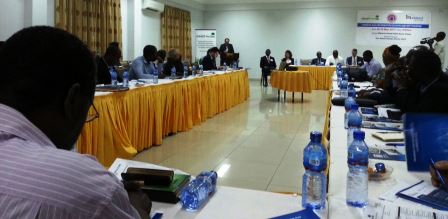
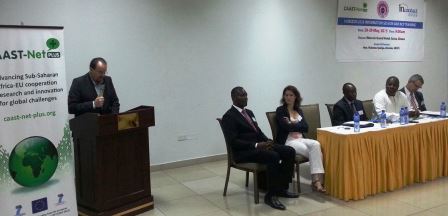
28-29 May 2015. Accra. Horizon 2020 Regional training workshop for African National Contact Points. A training workshop for National Contact Points (NCPs) from Central and West Africa brought together NCPs from a dozen countries to learn more about the EU's Horizon 2020 programme and the role of NCPs in facilitating participation of researchers from their countries, thereby boosting preparations for the second set of Horizon 2020 calls for proposals to be published later this year.
In a brief statement, the Head of Infrastructure and Sustainable Development at the EU in Ghana, Mr. Bart Missinne, said the EU research programmes, although intending to promote EU's competitiveness, strive to address global challenges.
Many African countries have no NCPs or only one person to cover the broad range of Horizon 2020 themes and opportunities, which puts their researchers at a relative disadvantage when trying to access EU funding. African researchers can identify NCPs for their countries on the Participant Portal. See the Participant Portal
Susan Bragdon, the Food and Sustainability Representative of the Quaker United Nations Office (QUNO) , was asked to talk about other international legal instruments that relate to genetic resources and intellectual property, in particular to discuss the story behind the treaties; how they came to be, what they say and the challenges presented by the regime complex.
Last year the Quaker United Nations Office (QUNO) called on negotiators at the World Intellectual Property Organization to include innovation by small-scale farmers and asked for complementarity of several international instruments dealing with this issue.
During two days, the 19 participants from 12 countries explored what drives local innovation, what supports it and what impedes it. QUNO is engaged in policy dialogue at international level and plans to develop an interactive web-based policy tool on small-scale farmer innovation. As a member of the advisory group for the meeting, Ann stayed on for a third day to strategise about follow-up to the consultation.
Through his participation in the consultation meeting as the sole Kenyan and the sole farmer, Joe was reinforced in his conviction that “if we really want sustainable food security, research and small-scale farmers should not work in their own cocoons but need to work together and complement one another”. He was also encouraged to devote even more efforts to promote farmer-led joint innovation together with researchers though the farmer innovators association in Kenya.
Related: May Policy brief (6 Pages) of Prolinnova: Creating a Space for Local Innovation in Agriculture
A project
called Strengthening Community Resilience
to Change: Combining LocalInnovative Capacity with ScientificResearch (CLIC-SR) has
provided an opportunity for a group of research and
development players in the country to
learn more about farmers’ innovative
responses to local changes, more in particular:
1. Homemade bio-pesticides
2. Sub surface drainage
3. Sex of chicken determined by shape of egg
4. Irrigation development —
This five-year project (2012-2017) aims to strengthen biocultural innovation for food security in the face of climate change, in China, India, Kenya and Peru.
This five-year project aims to strengthen biocultural innovation for food security in the face of climate change. It will improve the food security and resilience of small-scale farmers by supporting their innovation systems and traditional knowledge to thrive, and by linking farmers with scientists, in four focal countries.
Case studies and partners In each country, coordinating organisations are supporting participatory action-research led by indigenous farmers.
In India, Lok Chetna Manch is working with 10 Lepcha and Limbu villages in the central and eastern Himalayas, an area rich in rice and millets.
In Kenya, the Kenya Forestry Research Institute is working with 27 coastal Mijikenda villages, an area rich in indigenous vegetables and maize.
In Peru, Asociacion ANDES is working with five Quechua communities in the Potato Park, Cusco, which is home to 1,430 varieties of native potato.
Project advisory committee A European project advisory committee has been set up to provide strategic advice and to strengthen European developing country research partnerships. It brings together five leading experts:
29 June 2015. Milan, Italy. EXPO Milano. The Agri-Food Chain Coalition (AFCC) organised an event as part of the European Food and Drink Week at the EU Pavilion.
The keynote address was followed by a panel debate which which brought together experts from across the agri-food chain, namely
David Caffal (AIC Chief Executive),
Klaus Schumacher (BayWa Ag),
Ian Piggott (LEAF Demonstration Farmer) and
Wilberforce K. Tushemereirwe (Director of the National Agricultural Research Laboratories). Chair of the AFCC,
FEFAC Secretary General Alexander Döring, presented the “Food for Thought” vision which
looks at unlocking the potential of agriculture and the food industry in the EU.
The AFCC is a joint initiative representing 11 leading industry associations across the agri-food chain, united in their call for sustainable, solution-orientated and innovative EU policies that contribute to the "jobs & growth" and "innovation "objectives of the new EU Commission.
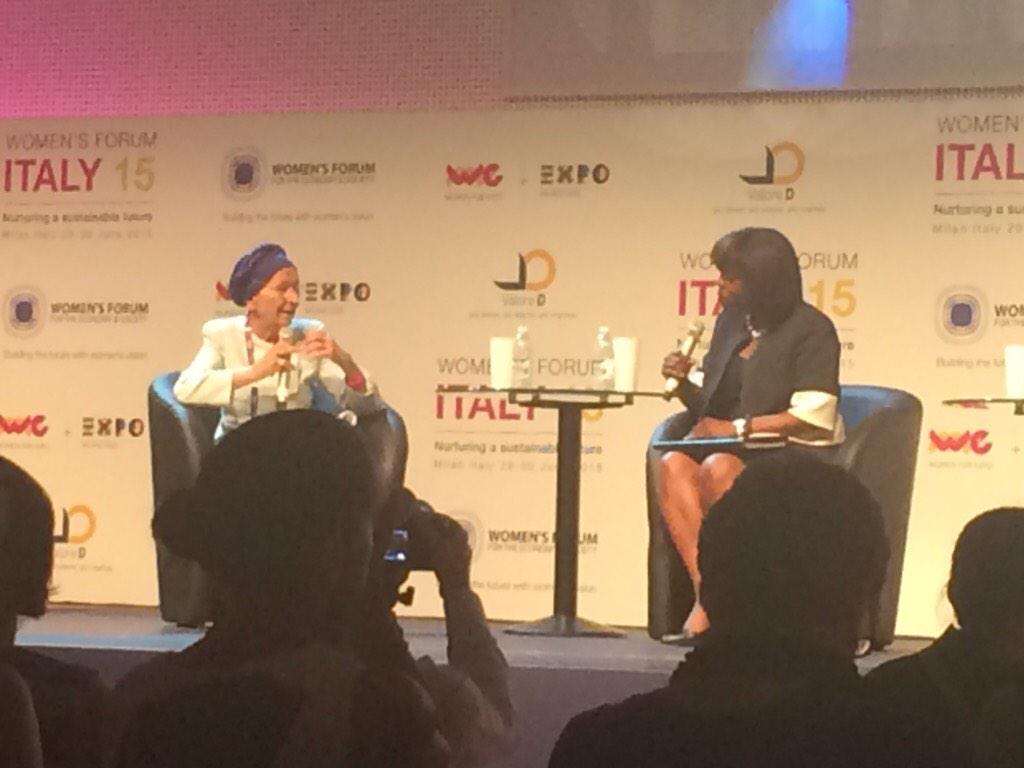
This one-and-a-half day event kick started the Women’s Weeks series of conferences which will last until 15 July. Under the theme Nurturing a sustainable future, Women’s Forum Italy examines issues surrounding food and nutrition from the perspective of gender.
Women farmers produce more than half of the all food worldwide, and women typically bear a greater responsibility for buying and preparing meals. Women and girls suffer more from food insecurity than do boys and men.They are also more vulnerable to obesity and far more exposed to eating disorders.
Women leaders from varying sectors and geographies spoke along with their male counterparts on topics relating to feeding the planet in a sustainable future. Extracts:
Women’s Equality and Empowerment – The first step to Zero Hunger Ertharin Cousin, Executive Director, WORLD FOOD PROGRAM Emma Bonino, Former Italian Minister of Foreign Affairs , PARTITO RADICALE Our visions for a better agricultural value chain







 [503 KB]