

The Borlaug Dialogue 2025 placed agricultural research firmly at the heart of food security strategy by focusing on soil not just as a substrate but as a living system essential for resilience, productivity and peace.
It underscored that innovation in soil health, digital mapping, regenerative practices and alternative protein systems are not peripheral—they are central to transforming agri-food systems under climate and conflict pressure. For someone working on agroecology and “forgotten foods”, the messaging is clear: research must span from the micro-level (soil microbiome, bioinputs) to the systems-level (food security, peace and trade), and must link to investment, policy and farmer-driven uptake.
 Extracts of the programme
21/10 Peace on the Plate: A Legacy of Security
This high-level session examined how food and agriculture, and by extension soil and land systems, underpin national and global stability — addressing links between climate change, migration, conflict and resilient food systems.
Panelists connected challenges such as climate change, migration and confl ict to the urgent need for resilient food systems. The discussion highlighted why addressing hunger is not only a humanitarian priority but also a strategic investment in a safer, more stable future.
- Facilitator: Cary Fowler, 2024 World Food Prize Laureate
- Ismahane Elouafi, Executive Managing Director, CGIAR

- Richard Roberts, 1993 Nobel Prize Laureate and Chief Science Officer, New England Biolabs
- Johan Swinnen, Director General, International Food Policy Research Institute
- Michael Werz, Senior Fellow, Council on Foreign Relations
21/10 Soil and Security: Leveraging Agricultural Transformation to Stabilize Nigeria’s Middle Belt

22/10 From Policy to Progress: A Diplomatic Legacy
- Facilitator: Gebisa Ejeta | Chair, World Food Prize Selection Committee, 2009 World Food Prize Laureate and Distinguished Professor of Agronomy, Purdue University
- Hon. Henry Musa Kpaka | Minister of Agriculture and Food Security, Government of Sierra Leone
- Hon. J. Alexander Nuetah | Minister of Agriculture, Republic of Liberia
- Hon. Eric Opoku | Minister of Food and Agriculture, Republic of Ghana
- Beth Dunford | International Development Sector Executive and Former Vice President, African Development Bank Group
22/10 Rewriting the Protein Narrative: Trust, Shared Vision, and Sustainable Solutions
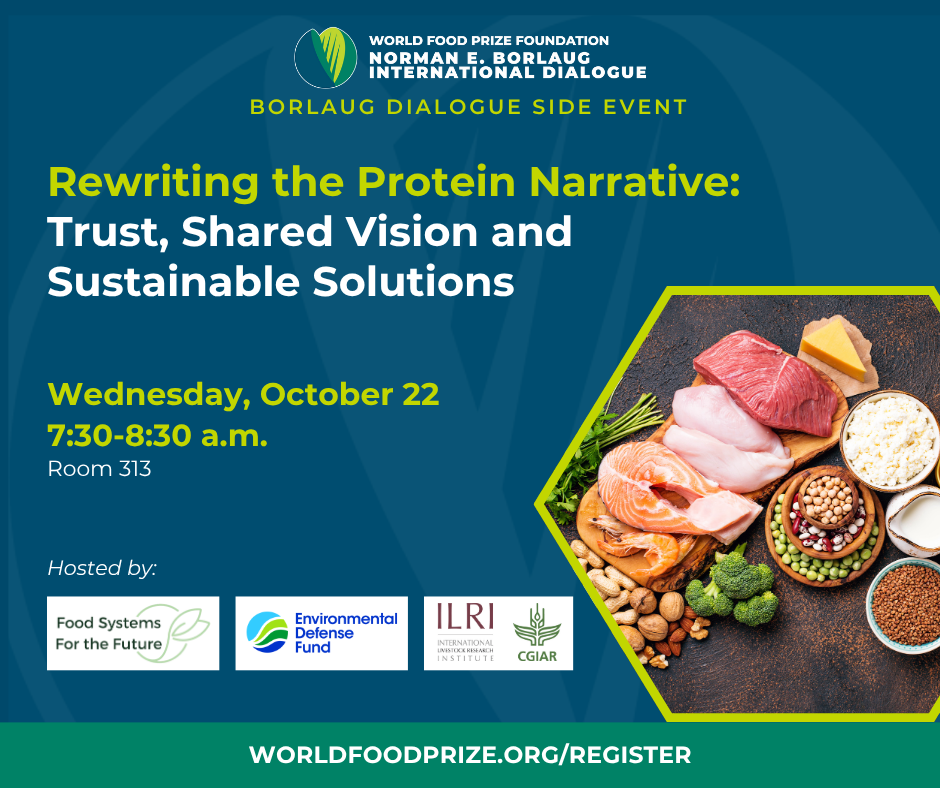
Hosted by Food Systems for the Future Institute (FSF), in collaboration with the Environmental Defense Fund (EDF) and International Livestock Research Institute (ILRI)
22/10 Research & Innovation Track: Soil Health & Digital Soil Mapping
The Soil Health & Digital Soil Mapping session explored how advances in soil science and digital technologies are reshaping our ability to assess, monitor and manage soils at scale — moving from soil as a static resource to soil as a dynamic, data-rich system. Presenters highlighted how digital soil mapping, remote sensing, machine learning, in-situ sensors and large soil-health datasets are enabling more precise, timely interventions in agricultural systems.
The key conclusion was that soil health must be measured and managed with the same rigour as other agricultural inputs: without adequate data-driven soil-management frameworks, innovations in inputs (e.g., microbials, neglected-crop systems) risk being applied on weak foundations.
Neglected crops and agroecology pathways benefit not just from biological innovation but from the soil-health diagnostics and mapping systems that support them — hence the research priority is dual: (1) biological/management innovation, and (2) digital soil systems for decision-support.
- Ismahane Elouafi — Executive Managing Director, CGIAR (also featured in soil-health research coverage)
- Johan Swinnen — Director General, International Food Policy Research Institute (IFPRI) — overarching dialogue participant with links to soil & ag systems research.
- Paul Temple — Chairman, Global Farmer Network — spoke to farmer experience and soil/regenerative agriculture.
- Additional experts from CGIAR and partner institutions working on soil health and mapping technologies.
22/10 Reimagining Partnerships to Transform the Agri-food Innovation Chain
The session focused on how evolving agri-food value chains demand new forms of collaboration and innovation — moving beyond traditional public research and extending through the full chain from discovery to delivery. It highlighted how public–private partnerships (PPPs), cross-sector alliances and institutional innovation can drive efficiency, scale and relevance in agri-food research and innovation.
Key conclusions included that:
- innovation chains must be co-designed with all actors (farmers, industry, R&D, policy) to be effective;
- the public sector must redefine its role—focusing on public goods, enabling environments and equity—while private actors bring speed, scale and market linkage;
- partnerships need to be structured so that benefits and risks are shared, especially for systems in low-income settings; and
- there is no one-size-fits-all: successful cases vary by crop, region and innovation stage, so context-adaptation is essential.
is less a novel technology and more the way it is integrated into value chains with inclusive, adaptive partnerships.
- Phil Pardey – Director, GEMS Informatics, University of Minnesota.
- Diana Horvath – Co-founder & Executive Director, 2Blades.
- Ian Puddephat – Executive (R&D), PepsiCo.
- Juan Lucas Restrepo – Director General, International Center for Tropical Agriculture (CIAT).
- Ty Vaughn – Lead, Innovation Partnerships, Bayer (Crop Science Division).
- Moderator: Appolinaire Djikeng – Director General, International Livestock Research Institute (ILRI).

22/10 School Meals as an Engine for Economic Growth and Trade
- Johan Swinnen (Director General, International Food Policy Research Institute)
- Additional panelists were drawn from host organisations: Bread for the World Institute, Alliance to End Hunger and Farm Journal Foundation
 23/10 Collaborative Partnerships and Innovation for Global Food Security, an 1890 Land-Grant
Perspective
The session emphasised that the network of 1890 Land‑Grant Universities (historically Black U.S. land-grant institutions) are uniquely positioned to drive inclusive agricultural innovation through collaborative partnerships—bridging academic research, extension services and underserved communities. Key take-aways included: the necessity of embedding research within real-world community contexts (not just labs), the importance of multi-stakeholder and cross-institutional alliances (public-private, NGO-university, global counterparts) to scale solutions, and the need for enhanced investment in capacity-building and infrastructure so that 1890 institutions can lead not only domestically but also in global food-security efforts.
The dialogue flagged persistent inequities in funding and infrastructure for 1890 institutions, and called for strategic partnerships that empower these universities as co-leaders in innovation ecosystems and knowledge exchange networks.
- Dr. Ruth Ray Jackson – Interim President, Langston University (one of the 1890 land-grant institutions)
- Dr. Solomon Haile – Program Officer, USDA National Institute of Food and Agriculture (NIFA) – overseeing 1890/evans-Allen research programmes
- Dr. Maria Marshall – Dean of Agriculture, Michigan State University (partnering with 1890 institutions)
- Ms. Kase Wheatley – Director, North Carolina A&T State University (1890 land-grant) Cooperative Extension / outreach lead
- Dr. Jeffrey Agnoli – Faculty, Ohio State University; moderator of the panel
23/10 Fields of Renewal: Innovation for Soil, Ecosystem and Security
The session highlighted how restoring soil health and ecosystem function is foundational to food security, climate resilience and global stability. Speakers emphasised the need for systemic innovation—combining biological, digital and landscape approaches—to regenerate degraded soils, rebuild ecosystem services and secure agricultural productivity for future generations. The main conclusion was that effective soil and ecosystem renewal requires not only technical innovation (e.g., sensors, bio-inputs, restoration practices) but integrated partnerships, long-term investment and alignment with policy, markets and local communities.
- Facilitator: Simon Heck | Director General, International Potato Institute
- Neil Bentley | Vice President, Market Management, Agricultural Solutions, North America, BASF
- Violet Grgich | President, Grgich Hills Estate Winery
- Rattan Lal | 2020 World Food Prize Laureate and Distinguished University Professor and Director of the Lal Carbon Center, The Ohio State University
- Paul Temple | Farmer, United Kingdom and Chair, Global Farmer Network


No comments:
Post a Comment