
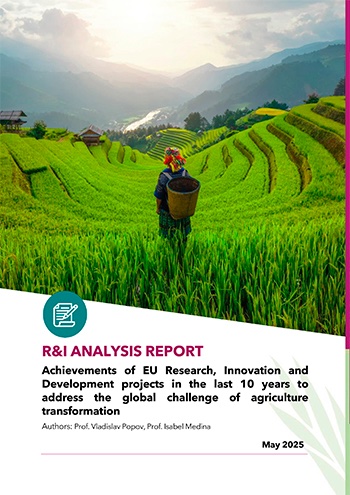
The SCAR Strategic Working Group on European Agricultural Research towards greater impact on Global Challenges (SWG ARCH) commissioned a Portfolio Analysis (PA) to evaluate the achievements of European Union (EU) funded research, innovation, and development projects aimed at transforming the agri-food systems towards sustainability in low- and middle-income countries (LMIC).
The analysis focused on projects funded by the European Commission through various funding instruments, such as Horizon 2020 or Horizon Europe (DG RTD, DG AGRI, DG ENV) , joint Funding Schemes between the European Commission and AU or EU Member States or Associated Countries, and DG INTPA, such as DeSIRA often in collaboration with international organisations such as the FAO and national research agencies. The evaluation criteria have included project scope, consortium structure, geographical intervention areas outside the EU, and the expected outcomes and impacts on local food security and nutrition.
Highlights:
InnoFoodAfrica - Locally-driven co-development of plant-based value chains towards more sustainable African food system with healthier diets and export potential
- InnoFoodAfrica focused on climate-resilient crops like sorghum and cowpeas.
- InnoFoodAfrica has improved seed varieties to enhanced yield and productivity, along with comprehensive training on best practices in farming and seed management.
- The African innovation platform (https://africainnovationplatform.com/) developed by InnoFoodAfrica addresses the promotion of innovative solutions in Africa by engaging local, national and international stakeholders for widespread technology and knowledge transfer has been developed.
- The platform aims to provide peer support for small farmers and SMEs, to enable compliance market and supply chain demands and maintenance of quality control parameters.
- The platform is a key exchange point to share best practices and innovative solutions among African stakeholders, contributing to the wider objective of the EU/Africa FNSSA partnership.
- A networking map with information on potential stakeholders is available to facilitate future collaborations. Viable solutions for the long-term operation of the innovation platform will help ensure the developed technologies and products reach markets in both Africa and Europe.
UnicARSSA - University-based Community Action Research for increasing viability of cereal-legume value chains towards improved nutrition and livelihoods in sub-Sahara Africa (UnicARSSA)
- EU Horizon 2020 ERA-Net Cofund LEAP-Agri / 1 September 2018 – 31 August 2022

- UniCARSSA links smallholders and rural entrepreneurs directly with universities in platforms for action to share currently available technologies, adapt them to local conditions and encourage new research for key constraints. It built on 2 established community action research platforms (CARPS) at two universities (University of Eldoret, Kenya and Makerere University, Uganda) to address constraints in improving productivity and consumption of under-researched cereals and legumes in Kenya and Uganda to increase food and security nutrition.
- UniCARSSA used an already established Community Action Research Platform - CARP (UoE, BUSSFFO, SMEs e.g EASTCOM Foods, County Governments, Input Suppliers such as MEA, ICRISAT) for participatory action and academic research.
- The Community Action Research Platform of Eldoret brought together researchers and farmers
with stakeholders along the value chain, such as input suppliers, wholesalers, market off-takers, agricultural insurance companies, and importantly, county governments. Over 500 smallholders trained in the project produced more, and some farmer groups started supplying cereals and legumes to small and medium-sized companies such as EASTCOM Foods. This company, which was a partner in the project, lacked a steady supply of raw materials for value added products made from sorghum and millet. - UniCARSSA has supported farmers and value chain actors in cereals and legumes to access appropriate technologies, specifically, access to information, access to markets of the four study crops (sorghum, millet, soybeans and groundnuts), linkages of farmers to relevant stakeholders e.g markets, microfinance, access to ICT for agriculture, i.e. the designed artificial intelligent-based approach to deter birds from infesting cereals in cereal crop fields.
- EU Horizon 2020 ERA-Net Cofund LEAP-Agri / 1 September 2018 – 29 November 2022

- NUTRIFOODS seeked solutions on how to increase the use of Climate Smart Food Crops (CSFC) in baked products to provide nutritionally-rich food that meets consumer needs while favouring local economies.
- Crops are considered to be climate resilient when they are better able to withstand the climate change affecting weather patterns, like higher temperatures and more frequent and severe droughts in Africa. CRCs with such properties can be classified as cereals (e.g. maize, sorghum, fonio, teff and finger millet), pseudocereals (amaranth), roots and tubers (cassava and sweet potato), pulses (phaseolus beans, cowpeas, chickpeas, pigeon peas and bambara groundnuts) and oilseed legumes (soya beans and peanuts).
- All these crops are widely grown across sub Saharan Africa. However, CRCs are underutilized and undervalued, primarily for technical reasons, but also lack attention in research, development and commercialization throughout their value chains.
- Download the report: Breads from African Climate-Resilient Crops for Improving Diets and Food Security


No comments:
Post a Comment