Platform for African – European Partnership in Agricultural Research for Development

Monday, July 10, 2017

G20 launches Africa Partnership with renewable energy, rural employment initiatives

7-9 July 2017. Hamburg. The G20 Summit in Hamburg, Germany, ended with a much-anticipated focus on Africa championed by German Chancellor Angela Merkel.

The G20 Leaders’ Declaration included the launch of the G20 Africa Partnership, listing rural employment and renewable energy initiatives as well as priorities for the first seven countries participating in the “Investment Compacts” with G20 nations.

The G20 Africa Partnership builds on existing regional and international strategies in order to ensure alignment, coherence and ownership, including the efforts of the G20 Initiative on Supporting Industrialisation in Africa and LDCs launched in 2016. 

As a core element of the G20 Africa Partnership, the G20 launches the initiative “Compact with Africa. in the finance track. The initiative aims at creating a favorable business envi- 3 ronment and supporting private investment, including in infrastructure, through investment Compacts with interested African countries. The country-specific investment Compacts combine individually agreed commitments by the bilateral and multilateral partners, forming a comprehensive and effective package to improve the framework for sustainable private investment.
  • Compact partners comprise individual African countries, the involved International Organisations (African Development Bank, International Monetary Fund, World Bank Group), as well as interested G20 members and other partner countries and institutions. The initiative is demand-driven and focuses on country-specific circumstances and priorities. Cote d’Ivoire, Ethiopia, Ghana, Morocco, Ruanda, Senegal and Tunisia have presented their commitments and visions for investment Compacts at recent G20 meetings. Further countries have already indicated their interest in joining the initiative.  
  • The Compacts aim at improving the macroeconomic, business and financing frameworks for private investment (both domestic and foreign) through national and concerted action of all stakeholders on the priorities of the African countries, including in the form of capacity building measures.
The G20 leaders needed to “walk the talk” on Africa, particularly in the areas of health, technology, and the financial commitments necessary to truly deliver on a “Compact with Africa.” India’s Narendra Modi 
Related:
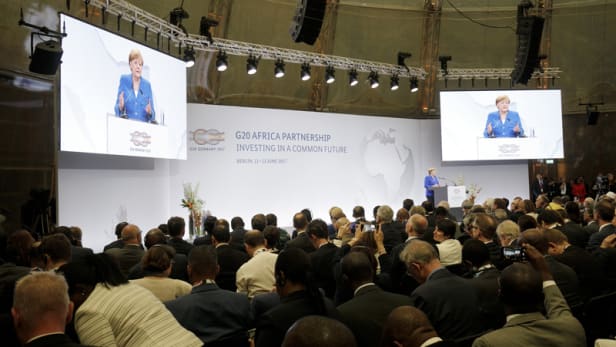
12-13 June 2017.  Berlin. The German Federal Ministry of Finance hosted the “G20 Africa Partnership – Investing in a Common Future” conference which provided backing for the G20 Africa Partnership and the Compact with Africa and presented Africa in all its modernity and variety to policy-makers and private investors.

A total of 800 guests, including 11 heads of state and government as well as more than 30 ministers, accompanied by 178 journalists present, were involved in the deliberations. At the center of the conference was the G20 “Compact with Africa" initiative aimed at improving the conditions for investment in Africa.
  • The G20 Africa Partnership Conference provided a platform for Government representatives as well as experts and private sector stakeholders to emphasize their commitment and exchange views on possible measures to support private investment. 
  • The conference brought together a wide variety of high-level stakeholders including the Heads of State and Government of Côte d'Ivoire, Egypt, Ghana, Guinea, Italy, Mali, Niger, Rwanda, Senegal and Tunisia. Participants emphasized that the G20 Africa Partnership and its related initiatives can be of importance in supporting African leadership and responsibility in national development efforts to achieve sustainable economic 5 development and inclusive growth. 
  • Much attention was given in particular to the “Compact with Africa” initiative as finance ministers from all Compact countries, Côte d’Ivoire, Ethiopia, Ghana, Morocco, Rwanda, Senegal and Tunisia attended the meeting. We welcome the announcement of additional bilateral contributions in support of the reform programs by several G20 countries and other partners, as well as strong interest shown by investors in particular countries and sectors. 
B20 Compact with Africa Recommendations
B20 Compact with Africa Factsheet EN

Video documentation:
G20 Compact with Africa
A key focus of the German G20 presidency in the financial sector is the deepening of global partnerships. A particular focus is on the African continent. Investment partnerships on the same level and better networked initiatives of the G20, international organizations and the African countries themselves should contribute to sustainable development and improved employment opportunities on the ground. to watch video

G20 Africa conference
On 12 and 13 June 2017, the Africa Conference of the German G20 Presidency took place in Berlin. A total of 800 guests, including 11 heads of state and government as well as more than 30 ministers, accompanied by 178 journalists present, were involved in the deliberations. At the center of the conference was the G20 " Compact with Africa " initiative aimed at improving the conditions for investment in Africa. to watch video

G20 African Conference - Day 1
The G20 African Conference " Investing in a Common Future " marks a reorientation of international development cooperation. The conference was opened by Federal Chancellor Dr. Angela Merkel, the President of the African Union Alpha Condé as well as Federal Minister of Finance Dr. German politician. to watch video

G20 African Conference - Day 2
The second day of the G20 African Conference is marked by parallel dialogues. The key issues focus on improved framework and financing conditions for investments and the promotion of energy investments, which contribute to more climate protection and sustainable development. The introductory symposium was opened by Bundesbank President Dr. Jens Weidmann. to watch video

G20 discussion forums
The second day of the G20 African Conference was marked by various discussions. In numerous formats the conference participants were able to discuss possible forms of cooperation. Within the scope of a structured dialogue, high-ranking experts met private investors at Roundtable. to watch video

Related:
Think Big for Small Small and Medium Enterprises as Pillar for Future-oriented, Sustainable Growth B20 CROSS-THEMATIC GROUPSMALL AND MEDIUM ENTERPRISES (SMEs)POLICY PAPER 2017

The paper is the outcome of eight months of intense discussions and hard work among 129 CTG members from 23 countries and diverse economic sectors. In five teleconferences and physical meetings in Berlin and Paris the SME CTG under the leadership of Chair Rudolf Staudigl, CEO Wacker Chemie AG, developed three highly relevant recommendations to the G20:
  1. Facilitating SME Participation in Cross-Border Trade – G20 members should facilitate SME access to cross-border trade and global value chains (GVCs) by systematically including their voice and needs in trade agreements, by capacity building, and by easing business travel.
  2. Building Digital Capacities and Capabilities – G20 members should facilitate SME access to the digital economy by strengthening digital infrastructure outside industrial centers, leveraging support for international multi-stakeholder initiatives on ecommerce, and enhancing the knowledge base on SME needs.
  3. Advancing Financial Inclusion – G20 members should ensure the implementation of the G20/OECD High Level Principles on SME Financing, the G20 Action Plan on SME Financing and the G20 High Level Principles on Digital Financial Inclusion, in particular by strengthening financial market infrastructure, enhancing access to diversified financial instruments, and advancing digital financial technologies.
You can download the full SME policy paper here.
You can access the SME Factsheet here.

Farmer innovations and climate change adaptation and mitigation

9 July 2017. Release of the publications related to the implementation of the project on ‘Strengthening Community Resilience to Change: Combining Local Innovative Capacity with Scientific Research (CLIC-SR).’

Drawing on its experiences in promoting farmer-led joint innovation that builds on the creativity of local people, the international Prolinnova network applied this approach in building local adaptive capacities and strengthening community resilience to various types of change, including climate change (CC).
  • Strengthen the resilience to change of smallholders and their communities, especially women, by enhancing their innovative capacity and thus their livelihood security through Participatory Innovation Development (PID)
  • Build the capacity of local organisations working in agriculture and natural resource management (NRM) to support smallholder communities in their efforts to adapt
  • Share and learn about farmer-led adaptation and about the relevance of PID in this process
  • Mainstream PID as an accepted approach in national and international policies and programmes related to agricultural development, NRM and climate-change adaptation.
The project was implemented in Uganda for four years (2012-2016) with financial support from the Rockefeller Foundation.
  1. Economic utilization of water in a tree nursery bed: the case of a farmer innovator in Nakasongola district. 
  2. The transitional beehive improves colonization by bees in Moyo district, Uganda; a case of climate change adaptation innovation by smallholder farmers. 
  3. A booklet of innovations on climate change adaptation and mitigation in Uganda.
  4. Innovations and climate change adaptation and mitigation; Policy and practice recommendations. 
Related:
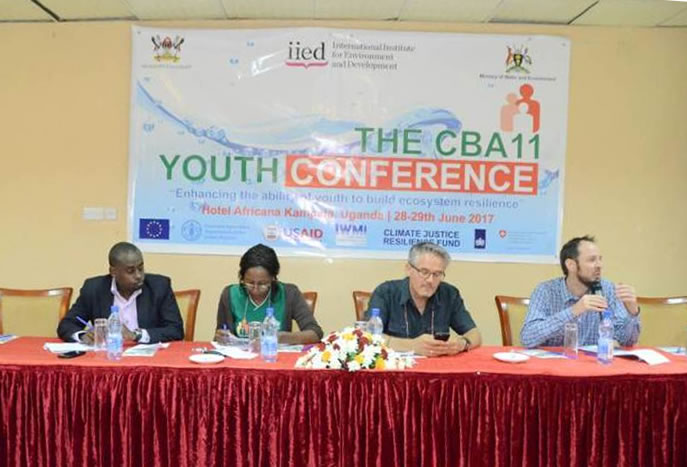
22-29 June 2017. Kampala. This year, Uganda was privileged to host The 11th International Conference on Community-Based Adaptation (CBA11) .

The 10th International Conference on Community-Based Adaptation(link is external) (CBA10) was held in Dhaka, Bangladesh. The conference theme was 'enhancing urban community resilience'. The International University of Bangladesh (IUB) campus hosted the event, and more than 300 participants from around the world took part.
Community-based adaptation to climate change (CBA) focuses on empowering communities to use their own knowledge and decision-making processes to take action on climate change ,therefore the CBA International conferences which usually take place in different countries provide opportunities to review the latest developments in CBA practice, policy and theory with participants from around the world.

It aims to strengthen the existing network of practitioners, policymakers, planners and donors working on all levels of community-based adaptation, and enhance the capacity and knowledge of practitioners, governments and donors to help improve the livelihoods of the most vulnerable to climate.change

The Conference was organized by International Institute for Environment and Development (IIED), International Centre for Climate Change and Development (ICCCAD, Makarere University Centre for Climate Change Research and Innovation (MUCCCRI) and the Ministry of Water and Environment (MWE) of the Government of Uganda,it was attended by over 300 participants from over fifty countries from all the main continents of whom nearly 100 went on the pre-conference field visit who all had a great time.

On 23rd up to 25th, one of the CBA11 field visit groups visited Kikandwa and see how the community is adapting to the impacts of climate change. The learning sites /projects visited show cased opportunities and at the same time showed actions used to address the several challenges due to climate. (see the full report of this field visit).

Kikandwa Environmental Association (KEA) is a developmental community-based organization founded in 1999 with the purpose of addressing rural development issues and natural resource management. KEA was born out of the need to address the alarming low levels of agriculture productivity, high level of food insecurity, and low income in the rural communities in addition to protection against rapid degradation of natural resources on which more than 95% of the people of Mubende and Mityana depend for their livelihood. The organization is registered at district level as a CBO.

1. Half + Half 1000 Acre ProjectHalf + Half 1000 Acre Community Forest Project, a Nature Based Conservation is an innovation initiated by Kikandwa local community by small holder farmers to conserve and restore small forest patches ranging from ½ acre to 5 acres per household or leaving a piece of land to regenerate naturally into a forest by its own depending on the land one has to enhance action for the realization of sustainable development goals (SDGs) hence promoting Community Based Adaptation on climate change. This initiative also aims at sensitizing smallholder farmers by themselves to value forests and its ecological functions in their livelihood.

It is anticipated that through campaigns and sensitization, these small forest patches or piece of land left to regenerate into forests can make thousands of acres of forest conserved in a given local communities. The initiative is driven by the fact that it is no longer feasible to conserve large tracts of forest only in the face of the rapidly growing human population and competing economic priorities especially in Africa where land is becoming so scarce. It is assumed that thisinitiative can contribute to sustainable agriculture and food security, reduced soil erosion, stable rainfall pattern, stable income and alternative use of forest hence contributing to CBA while reducing the biodiversity loss.

2. Community Road water Harvesting promote CBA.There are many opportunities for making connections between road construction, maintenance, climate change adaptation and water management. Kikandwa community is exploring the technology by integrating climate change adaptation and road water harvesting practices which make it possible to use roads as instruments for climate resilience in ever changing weather specifically in developing countries,35-80% damage to roads is caused by water according to research, if road water harvesting is done well, there is control of soil erosion, flooding, water logging and drainage congestion, road water harvesting contribute significantly to better water resources management for crop irrigation, domestic use and animal watering hence contributing to CBA.

EU investment plan want to mobilise €44 billion in private sector investment in Africa

6 July 2017. The EU scheme aiming to mobilise €44 billion in private sector investment in Africa and the EU neighbourhood was approved by the MEPs. As part of the European External Investment Plan, the new European Fund for Sustainable Development (EFSD) wants to encourage €44 billion in private investments in fragile states by offering a combination of grants, loans and financial guarantees worth €3.3 billion to boost jobs, growth and stability, thus addressing the root causes of migration.

In recent talks on the operating rules of the EFSD, MEPs persuaded EU ministers to focus on poverty, jobs, climate and small enterprises by creating decent jobs and offering particular support to young people, women and small businesses.
“This new innovative instrument is a clear signal that the EU is indeed serious about sustainable growth and addressing the root causes of migration. By improving the business climate and attracting private investments where they are needed most, we can help to create better living conditions in our partner countries”, said co-rapporteur Eduard Kukan (EPP, SK).
EFSD resources are made available thanks to the mid-term review of the 2014-2020 EU long-term budget plans and to the European Development Fund (EDF) reserve. The new fund will be composed of two regional platforms: one for Africa and the other for the EU Neighbourhood (south and east). It will function as a “one stop shop”, offering access to existing EU blending facilities (when EU grants are combined with loans or equity from public and private financiers), coupled with a new, additional guarantee for public and private investors. The EFSD Guarantee is expected to have a cash provision of €750 million including €350 million from the EU budget and €400 million from the EDF. The EFSD will also combine resources from two existing blending facilities – €2.6 billion from the Neighbourhood Investment Facility and Africa Investment Facility.

Resources:
Text of the amended EFSD Regulation (click on 05.07.2017)
Video recording of the debate (click on 05.07.2017)
Press release on informal agreement with EU ministers (28.06.2017)
EP Research Briefing: European Fund for Sustainable Development (February 2017)

Increase the scientific and technological capacities of African women

The scarcity of women in the field of science and technology is a situation that is found all over the world in both developed and developing countries. Women scientists’ networks are aware that this lack of representation has serious consequences on the global development.

It is in Africa where the scientific and technological gender gap is the widest. Furthermore, the continent is losing its best female scientists, who are emigrating to other regions. This is why the Women for Africa Foundation is a specific program to support and increase the scientific and technological capacities of African women so that they can acquire the necessary training and innovative spirit with which they will cope with the major challenges of the 21st century.

The Women for Africa Foundation is a Spanish private, non-profit entity created in February 2012 by María Teresa Fernández de la Vega, the former Vice President of the Government of Spain with the aim of promoting equal rights and opportunities for women, contributing to the progress of the continent.

The priority areas are : Health, Energy, Water and Climate change and Food Security.

The selected candidates are enrolled in a 6 months scholarship program of internship in following ‘Severo Ochoa’ Centres of Excellence, whose prestige is unanimously recognized throughout Spain and internationally, thereby ensuring excellence in scientific research in various fields. the associated research centres are:
  1. the Spanish National Cancer Research Centre (CNIO, www.cnio.es), 
  2. the Institute of Photonic Sciences (ICFO, www.icfo.eu), 
  3. the Spanish National Centre for Biotechnology (CNB, www.cnb.csic.es) and the Carlos III Health Institute (ISCIII, www.isciii.es), 
  4. the Institute of Mathematical Sciences (ICMAT, www.icmat.es ), 
  5. the Centre for Genomic Regulation (www.crg.es), 
  6. the Barcelona Graduate School of Economics (www.barcelonagse.eu).
Each of the seven centres will host 1 senior women researcher for a six-month fellowship. Applications will be subjected to a rigorous selection process, evaluating the academic merits and leadership of the applicants as well as the scientific quality and expected impact of their research projects. Selected candidates will receive training and integration in a dynamic, multidisciplinary and highly competitive working team, where they will be able to develop their research projects and acquire complementary skills, empowering them to transfer their research results into tangible economic and social benefits.

Dr. Liz Kizito, Senior Lecturer/ Head of the Department of Agricultural and Biological Sciences, Uganda Christian University, is one of the selected candidates.
Selected candidates:
Here is the overview of the Final Beneficiaries of Visiting Senior Research Fellowships of the 2ND EDITION OF SCIENCE BY WOMEN PROGRAM
  • Dr. IFEOMA ENWEANI, . She is presently attached to the Department of Medical Laboratory Science of the Nnamdi Azikiwe University in Nigeria
  • Dr. Yemisi Adesiji is a Nigerian senior lecturer in the Department of Medical Microbiology and Parasitology of the Ladoke Akintola University of Technology, Osogbo and acting as the head of department of Veterinary Microbiology at the University of Ilorin
  • Dr. Chiaka Anumudi is a Nigerian senior lecturer, who obtained her Ph D in Zoology (Cellular Parasitology) at the University of Ibadan
  • Dr. Sarra Arbaoui is a Tunisian reasearch assistant within the High Agronomic Institute of Chott Mariem, Tunisia
  • Dr. Elizabeth Kizito has a doctorate degree in Plant breeding obtained from the Swedish University of Agricultural Sciences, Uppsala and she is currently a senior lecturer and head of the Department of Agricultural and Biological Sciences at the Uganda Christian University, Mukono.
  • Dr. Nobanathi Maxacato, a young South African doctor, obtained her PhD in Chemistry from the University of Pretoria in 2012. She is currently a lecturer and research fellow in the University of Johannesburg where she teaches Chemistry for Somatology, for chemical engineering, for food and biotechnology and for environmental health
  • Dr. Atnuke Adebanji is a Nigerian senior lecturer who works at the Kwame Nkrumah University of Science and Technology of Kumasi, Ghana. Since 2012 she is a member of the West Africa Climate Change and Land Use (WASCAL) programme.
  • Dr Elizabeth Kaase-Bwanga holds a PhD in Economics - Rural Economy and Policy analysis, from the Makerere University of Kampala, Uganda where she is a senior lecturer specializing in Gender and Development Strategies, Feminist Economics and Gender Planning and Monitoring & Evaluaton in Local Development


Southern Africa Grain Network

6 July 2017. Lusaka Zambia. A new private sector driven regional body, the Southern Africa Grain Network (SAGNET) has been registered to unify the grain value chain in southern Africa. All interested parties are invited to follow SAGNET’s activities on the Facebook page and the website

Inter- and intra-Africa trade has become very important for all the countries on the continent. Improving the performance of the agricultural sector is seen by many stakeholders as critical in achieving accelerated economic growth and poverty reduction in Eastern and Southern Africa. The first focus area is the standardisation of processes and the harmonization of grading regulations. To allow participation of trade it is also important to develop a regional market information system that provides for reliable crop estimates as well as information regarding farmer deliveries, imports and exports in order to estimate each country’s supply and demand situation per commodity.

SAGNET membership will include private sector value chain actors from Southern Africa countries drawn from four sectors of the value chain, i.e. production, processing, trading and service providers.

SAGNET will eventually consist of 15 country private sector representatives who can invite organisations, individuals and private companies from their own countries. Participation by the various actors will be open, voluntary and based on agreement on a common agenda. The first SAGNET board will be headed by Jacob Mwale from Zambia, and he will be supported by Daniel Gerson (Mozambique), Mariana Purnell (South Africa), Grace Mhango (Malawi) and Julius Wambura (Tanzania).

SAGNET was registered as a not-for-profit organisation in January 2017 in Lusaka Zambia, also the current location of the head office. The organisation is supported by the UK government department responsible for aid in other countries, Department for International Development (DFID) through its programme FoodTrade ESA implemented by DAI. SAGNET’s private sector mobilization with a membership and stakeholder reach spans the greater Southern Africa region giving the organization a strong voice in advocacy to engage with governments and also with regional economic communities towards the improvement of the policy and trade environment.

SAGNET's role and mandate is aimed at achieving the following objectives:
  1. Regional Trade Promotion of Grains/Staple Foods 
  2. Regional Harmonization & Coordination
  3. Policy Advocacy – to reduce trade barriers
  4. Capacity Building & Stakeholder participation

Wednesday, July 5, 2017

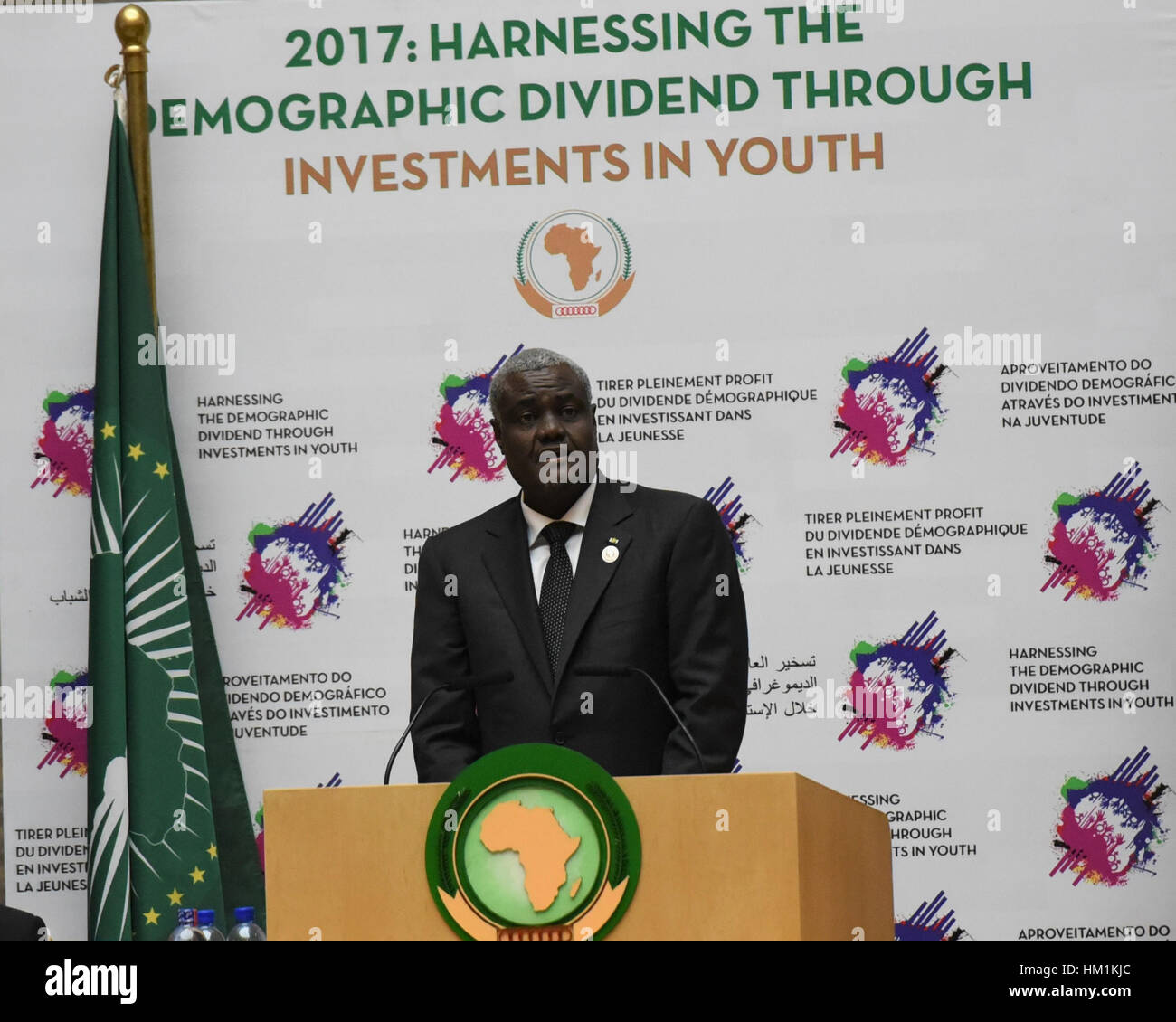
Harnessing the Dividend of Demographic through Investments in Youth

27 June - 4 July 2017. Harnessing the Dividend of Demographic through Investments in Youth. The summit has been conducted under the theme, “Harnessing the Demographic Dividend through Investment in the Youth”, and reviewed reports on AU reforms, current peace and security in the continent, implementation of Agenda 2063 and the 2018 commission’s budget, among others.

This year’s thematic focus on youth is a powerful reminder of the core principle at the heart of these agendas: creating a better world for the next generation. For the 226 million young people aged 15 to 24 living in Africa today, these agendas address challenges and opportunities that are integral to their futures.

The challenge of eradicating poverty and achieving inclusive and sustainable growth has spurred Africa’s steady pursuit of transformative sustainable development. These efforts have been marked by historic steps towards regional integration, industrialization and diversification, infrastructure development, private sector development, and strengthened agricultural productivity. All of these are vital for creating decent jobs and a better future for our young people.

The challenge of strengthening Africa’s human capital, starting with its young people, has galvanized commitments to promote their rights and invest in quality and relevant education at all levels, health, science and technology and innovation.
Related:
On May 25, 2017, The Wilson Center Africa Program hosted a panel discussion on “Harnessing the Demographic Dividend through Investments in Youth.” The event, hosted in partnership with the African Ambassadors’ Group, was a part of the celebration of Africa Day. Dr. Monde Muyangwa, Director of the Africa Program at the Wilson Center, moderated the discussion with H.E. Prof. Hassana Alidou, H.E. Ammon Machingambi Mutembwa, Ms. Mariama Kabia, Mr. Andy Rabens, and Mr. William S. Reese.


CIRAD policy brief: Impact of agricultural research in developing countries

4 July 2017. N° 42. Agricultural research in the Global South: steering research beyond impact promises - Etienne Hainzelin, Danielle Barret, Guy Faure, Marie-Hélène Dabat, Bernard Triomphe (PDF - 873.05 ko)
Agricultural research for development is increasingly being called upon to demonstrate its usefulness and its impacts, particularly among donors and policy makers. To meet this expectation, CIRAD has developed the approach ImpresS to document the contribution of research to changes within society and the mechanisms at work along the impact pathway. 

This policy brief presents the key lessons learned from the application of this innovative participatory approach to a set of 13 ex post case studies, sometimes many years after the intervention of research. It describes the implications of this process in terms of practices among not only researchers, but also donors.

To go beyond the promise of impact during the submission of research projects, which is often reduced to a purely rhetorical exercise, CIRAD aims to develop a "culture of impact" that permanently modifies its research practices in order to generate more consistent impacts on development.

Seasoning broth: adding value to soy

3 au 05 juillet 2017. Bohicon, Benin. Le Laboratoire des Sciences des Aliments (LSA) du Professeur D. Joseph HOUNHOUIGAN, Doyen de la Faculté des Sciences Agronomiques de l’Université d’Abomey-Calavi (FSA/UAC a réalisé à Saclo dans la commune de Bohicon la formation des femmes productrices d’Afitin sur la production d’un bouillon d’assaisonnement à base de soja dénommé « Dadonu ». Cette formation est déroulée sous la supervision du Professeur D. Joseph HOUNHOUIGAN et faciliter par Dr. Ir Yann MADODE, Assistant à la FSA/UAC

Il s’agit d’une activité du Projet Soja Afitin Milk (ProSAM) financé par l'Union Européenne (UE) à travers la Plateforme pour le Partenariat Africain et Européen de Développement de la Recherche Agricole (PAERPARD), un programme du Forum pour la Recherche Agricole en Afrique (FARA). Il est coordonné par SOJAGNON-ONG pour une durée de trois ans de 2014-2017 et connait actuellement une phase extensive d’un an (2018).

Le projet vise l’amélioration de la technologie de production des produits à base de soja (lait et afitin) qui constituent une importante source de revenus pour certaines populations pauvres.

Cette formation à mobiliser 27 participants dont 21 femmes provenant des institutions partenaires au Projet (FSA/UAC, INRAB, FUPRO, SOJAGNON-ONG) et les Transformatrices de Zogbodomey, de Lissazoumè et de Saclo.

L’amélioration de la qualité des produits dérivés du soja dans le cadre de ce projet de PAEPARD va impacter considérablement la vie socio-économique des ménages ruraux particulièrement des femmes-transformatrices.
"Le développement doit se faire à la base avec les petits producteurs et transformatrices. Dès lors que le processus est amorcé avec les acteurs à la base, les gouvernants n’ont plus grandes difficultés à conduire les actions publiques". Professeur D. Joseph HOUNHOUIGAN,
Nous continuons de faire le plaidoyer afin de mobiliser les ressources nécessaires pour appuyer les femmes à mettre en place les unités de production. Car pour assurer la durabilité des résultats de recherche, les femmes doivent se convertir en entrepreneur (agribusiness). Le Coordonnateur du Projet Monsieur Lagnon Patrice SEWADE
La production de cotylédons fermentés de soja offre aux producteurs et aux consommateurs de nombreux avantages nutritionnels, organoleptiques, économiques, et aussi un intérêt technologique.
  • La matière première (Soja graine) est disponible et accessible toute l’année contrairement au néré. 
  • De plus, le décorticage du soja est beaucoup moins fastidieux et long que celui du néré et il limite les risques de contamination microbienne et chimique. 
Malgré les atouts du soja, sa production est handicapée par beaucoup de contraintes:
  • les produits issus de sa transformation ne satisfont pas aux exigences des consommateurs. Au Bénin, la production d’afitin à base de soja reste clandestine et la terminologie « afitin de soja » inacceptée des consommateurs. 
  • Pour le consommateur béninois, Afitin c’est du néré, et vendre de l’« Afitin de soja » dans un milieu de connaisseurs reste un tabou. 
"Le Néré et le Soja ne peuvent pas porter la même appellation dans un marché de connaisseur « d’Afitin ».  Il faut lui attribuer un nom qui montre la particularité du produit compte tenu des ingrédients et innovation apportée par la recherche.  De plus, l’afitin à base du soja n’est pas stable pour une conservation sur le long terme car c’est un produit frais. Afin de valoriser les cotylédons fermentés de soja". Présidente du Groupement des femmes productrices d’Afitin de Saclo Madame GBAGBA Jeanne

Dans le cadre du ProSAM, la FSA/UAC et l’Université de Wageningen  ont développé et mis au point un bouillon d’assaisonnement intégrant l’utilisation des cotylédons fermentés de soja, plus stable, se conservant longtemps et permettant de relever le goût des préparations culinaires. Il s’appelle dadonu du Soja.

Dans le but de restituer les résultats des recherches aux producteurs d’afitin associés au maitrise des techniques de production des bouillons d’assaisonnement à base de cotylédons fermentés de sojaafin de réduire la pénibilité du travail et améliorer leurs revenus.

ProSAM, une session de formation des formateurs (trois productrices d’afitin) avait été organisée à la FSA en avril 2017. Dans la continuité de ce processus, une restitution de la formation des productrices par les premières productrices formées organisée. Cette formation vise la

De façon spécifique, il s’agit de :
  • Faire connaitre aux productrices d’afitin le bouillon d’assaisonnement Dadonu soja ;
  • Permettre aux productrices de maitriser la technologie de production du bouillon Dadonu soja 
  • Evaluer l’aptitude des productrices précédemment formées à transmettre les savoirs et savoir-faire liés à la production du Dadonu soja;
  • Evaluer la rentabilité financière du bouillon d’assaisonnement Dadonu soja ;
  • Echanger sur les stratégies de promotion du bouillon d’assaisonnement Dadonu soja par la mise en place d’unité pilote de production (agribusiness entrepreneur) ;
  • Faire maitriser par les productrices, les notions de bonnes pratiques d’hygiène et de fabrication répondant aux exigences de sécurité sanitaire.
  • Faire les tests de dégustation sensorielle du nouveau produit développé ;
  • Evaluer la formation des formateurs sur les technique de production du bouillon d’assaisonnement Dadonu soja

Tuesday, July 4, 2017

Nostalgic food an opportunity for agribusiness


1 July 2017, 5- 9 pm. Brussels. The Food Bridge vzw presented the new book, Diaspora , Food and Identity by Dr Maureen Duru.

Using the Nigerian migrants in Belgium as a case study in her research, Dr Maureen Duru (picture) presented a convincing argument about the importance of food to the identification modes of African diasporas.

She was not daunted by the fact that she was dealing with an area of study that had limited academic records and documentation, rather she went into her field of research to sought relevant
data for her study, thus collecting immense academic resource materials through interviews, participant observation, photographs and other qualitative methodologies.

In her book, Dr Duru also showed foods ability to expose wider issues; giving a historical account of food in Nigeria and in the diaspora by tracing the evolution of Nigerians migration to Belgium, the changes African migrants have brought to the country and also their experience in Belgium. Years living in Europe places her in a good position to analyse the similarities and differences between Europeans in Africa in pre-colonial and colonial eras and the present African migration to Europe. This further brings to the fore the question of how food is used to mark identity.

Monday, July 3, 2017

Side event: Copa-Cogeca and Agricord @ AU-EC Ministerial Conference

2 July 2017. Side event: Copa-Cogeca and Agricord (352.41 KB, PDF).

Opening by Copa-Cogeca
Mr Scanavino - President of CIA (Confederazione Italiana Agricultura of Italy) – member of COPA-COGECA and Associated member from AgriCord
Mr Scananivo is president of CIA since 2014. He is a producer and leader of the Vineyards and nursery entrepreneurs in Calamandrana. He is former vice president of CIA and president of CIA of Asti since 2002.

Farmers’ organisations: engaging by and with the agricultural private sector 
Theo de Jaeger - President of SACAU (Southern African Confederation of Agricultural Unions) – partner of We Effect (agri-agency of LRF, the Federation of Swedish Farmers) and partner of Agriterra (agri-agency of LTO, the Farmers’ Organisation from the Netherlands)
  • Which are important investment opportunities for agriculture and small holders that favour development and why? 
  • What are comparative advantages of farmers’ organisations , producer groups and their cooperatives for investors or to access finance together? 
  • Why do investments in agriculture remain a challenge and for what type of investments farmers’ organisations face concrete challenges? 
  • Which concrete measures could promote investments by and for farmers’ organisations and their cooperatives (based on concrete experience). How could the public sector favour this type of necessary investments? 
  • How could digitalisation play a role in improving access to investments and value chains for farmers’ organisations and smallholders ?
Integrating young farmers in agriculture 

  • Denis Kabiito - UNYFA (Uganda National Young Farmers’ Association) – partner of AHA (agri-agency of DBV, Deutscher Bauernverband, the German Farmers’ Organisation) Denis Kabiito is the national coordinator for the newly founded Uganda National Young Farmers Association. He is a biologist, a farmer, fisheries scientist and aqua culturist. He has served as an extensionist with a 10-year work experience in rural extension development work, advocacy, training and with agricultural producer associations and primary co-operatives in the central region of Uganda.
  • Simon Schlüter - DBV Germany Head of Brussels Office, International Affairs - Deutscher Bauernverband
  • Ibrahim Sidibé - Fédération Nationale des Jeunes Ruraux du Mali (FENAJER) and partner of AFDI (Agri-agency of les Jeunes Agriculteurs de France) Ibrahim Sibidé is the secretary general of the National Federation of Young rural people, a member of Coordination nationale des organisations paysannes du Mali (CNOP) and member of CNOP’s network of agro ecological farmers. Ibrahim Sidibé is a Malian farmer, managing a farm producing laying hen, cereals and vegetables.
  • Vincent Touzot - Jeunes Agriculteurs de France and member of AFDI. Vincent Touzot is a farmer, responsible for CAP and international affairs at Jeunes Agriculteurs (JA), and member of Afdi’s Board. Vincent works with his associate on a farm of 120 ha and has 50 milking cows. He produces milk that is then used to make butter ‘AOC Charentes Poitou’. Since his farm is situated in a vulnerable zone he practises sustainable farming methods.
  • Jackie Mkindi CEO - TAHA (Tanzanian Horticultural Association) – partner of FFD (agri-agency of MTK, the Finnish Farmers and Forest Producers’ Organisation) Jacqueline Mkindi is Executive Director/CEO in the Tanzania Horticultural Association (TAHA), an apex body that works to promote and develop the Tanzania horticulture. She is a development manager, specialized in Business and Trade. She is also an entrepreneur in the horticultural industry herself and she has risen from various positions in the Private Sector.
                                "Only the wearer knows where the shoe pinches"
  • Tiina Huvio, FFD/MTK Finland Mrs. Huvio is Progamme Director of the Finnish Agri-Agency for Food and Forest Development. Ms. Tiina Huvio has a carrier of twenty years in the development cooperation and she has worked in both multilateral and bilateral organizations, and since 2013 as coordinator with the Finnish Agri-Agency for Food and Forest Development (FFD). She has been involved in agri forestry and forestry via farmers’ organisations throughout her whole career.
Closing speech 
Jean François Isambert - President of AgriCord Mr. Isambert is president of AGRICORD, an international alliance of 12 agriagencies, mandated by farmers’ organisations to support their peers in developing countries. He is also General Secretary of AGPB (the Association of French Wheat producers)

Related:
“Final Report of the WFO and Copa-Cogeca Workshop: Connecting World Farmers to the Value Chain on 7th April 2017”.
This workshop provided a platform to discuss how policy, including trade and development policies, can help farmers, from developing and developed countries, to be integrated into the value chain, supporting the development of new technologies while fostering innovation. The discussion focused on the development of policy priorities that are relevant to all farmers and cooperatives around the world. Panellists were invited to reflect on how the introduction of digital technologies can help developing countries gain access to markets and, consequently, benefit from trade.

COMMUNICATION OUTPUTS:

  • Media – Press release can be found here 
  • Social media – Several original tweets (@CopaCogeca @worldfarmersorg @CEMAagri ) via #DynamicAgri and posts on Facebook and LinkedIn You can find us on: 
  • Online Photo album from this event is published here 

Highlight:
The Tanzania Horticultural Association (TAHA) is an apex private sector member based organization that advocates for the growth and competitiveness of the horticultural industry in Tanzania. Since its inception in 2004, TAHA has been an effective voicing platform for producers,traders,exporters and processors of the horticultural products mainly; flowers, fruits, vegetables, horticultural seeds,and spices. The Association safeguards the interest of the private sector and ensures the industry issues are well mainstreamed at the national and international agenda.

As a catalyst for the industry reformation and transformation, TAHA is engaged in a multitude of activities in a bid to achieve its overarching objectives.

Specifically, TAHA works to improve the business enabling environment in the industry through following key activities:
  • Maintaining positive dialogue with the Government of Tanzania, private sector and Development Partners to ensure that there are supportive policy and regulatory frameworks.
  • The above include advancing policy proposals that aim at enhancing trade
  • Mobilizing resources for the industry development programsProvides technical support services.
TAHA implements a range of technical services to enhance farmers’ capacity to produce safe, and quality products while ensuring consistency/reliable products supply to the markets. Such activities include:
  • Farmers' mobilization and institutional capacity building.
  • Driving innovative farming practices/technologies for improved production and productivity.
  • Facilitating access to innovative and affordable finances and other financial services.
  • Awareness creation and training on nutrition and gender aspects.Facilitate Markets linkages and Trade
This among other things involves:
  • Facilitating access to reliable, profitable, equitable and sustainable markets both national, regional and international
  • Provision of industry logistic services such as clearing and forwarding,trucking, cargo consolidation and handling, airfreight bookings and negotiations, etc through its vibrant logistic company TAHAFresh Handling limited.
  • Facilitating compliance to market standards, systems and procedures
  • Branding of TAHA and the industry through various promotion platforms at local, regional and international levels.
  • Ensuring optimal information/communication flow flow inside and outside the industry. TAHA manages an Information System (TIS) in which market prices and other products are delivered to the industry.
"TAHA’s role and responsibility is also to ensure that Tanzania horticulture is well profiled, opportunities are exploited and there is adequate information sharing to facilitate smooth business transaction amongst partners." Jacqueline Mkindi, CEO TAHA


About Fintrac
Fintrac, a woman-owned and US-based consulting company, develops agricultural solutions to end hunger and poverty. For 25 years, we have worked with local and international partners to increase production, improve postharvest handling, add value, and develop markets and competitive value chains for the world's most vulnerable farmers and communities. Click here to view an infographic of Fintrac's methodology.

By teaching farmers to view farming as a business, we increase yields to improve nutrition, generate income, and build industries. In just the last three years (2014-2016), Fintrac has:
  • Generated $1.3 billion in agricultural sales through private sector partnerships.
  • Leveraged $75 million in new investment.
  • Put more than 630,000 hectares of land under sustainable practices.
  • Worked directly with 1.5 million households, contributing the food security of 7.5 million people.


@ 7:22 "With the issue of climate change Research and Development is very important now (...) If we have researchers they are not facilitated to do their work. And when research is done there is no connection between the research and the demand of farmers at farm level. So what needs to be done is to translate and to simplify and come up with a simple language of the research that can be well understood by farmers"

Making Sustainable Agriculture a future for youth in Africa

2 July 2017. Rome, Italy. This conference was hosted by the AU Commission, the European Commission and the Estonian Presidency of the EU at the FAO premises.  The African Union – European Union Agriculture Ministerial Conference “Making agriculture a future for youth in Africa" aimed to build up political engagement ahead of the Africa-EU Summit in November 2017 on a common vision on how to generate sustainable, inclusive jobs for African youth in the agri-food sector and rural economy.

Parallel thematic sessions focused on:
Promoting Responsible Private Investment and Access to Markets in the Agri-Food Sector in Africa (67.12 KB, PDF)
The aim of this High Level Panel was to provide a short-list of possible concrete action-oriented proposals to be put forward and presented to the ministerial plenary. The High Level Panel focused on policy development in support of harnessing sustainable trade and responsible investments in Africa, and policy cooperation between the African Union and the European Union. It was also be an opportunity to build up political mobilisation and to advance discussions among key players for the EU's External Investment Plan (EIP) in the area of agri-food business. 
  • Mrs Agnes Kalibata, President AGRA
  • Mrs Mella Frewen, Director General FoodDrinkEurope
  • Dr Chiji Ojukwu, African Development Bank
  • Dr Martin Märkl, Bayer
  • Mr Jonathan Bee, Head of Regulatory and Scientific Affairs, Nestlé
  • Mr Daniel Gad, Omega Farms
Research and Innovation and the Role of Digitalisation in Agriculture (134.12 KB, PDF)
The keynote speakers discussed the current use of ICT in agriculture and its role and development as part of the research and innovation partnership on food nutrition and security and sustainable agriculture (FARA). The FAO presented its experiences with ICT in agriculture under the nearly 15 years’ running project of e-agriculture. The European Commission gave a general reflection on the research and innovation partnership, its current status and possible future developments. 
  • Dr Yemi Akinbamijo, Executive Director of FARA
  • Dr Philippe Petithuguenin, Deputy Director for Research and Strategy at CIRAD
  • Mr Cezar Santos Alvarez, FAO, e-Agriculture
  • Mrs Maria Cristina Russo, Director for International Cooperation of the Directorate-General for Research and Innovation, European Commission

Water Use and Management in Agriculture within a Climate-Resilient Environment (79.39 KB, PDF)
The session provided a vision on water use in agriculture in the EU and Africa, including a number of best practices and lessons learnt. It also involved presentations on the needs for innovation and implementation of sustainable management of water resources, focusing on the nexus of water, agriculture and food production. The brief vision presented should help to identify priorities of the EU-Africa cooperation on water and agriculture. 
  • Mr Daniel Calleja, Director General of the Directorate-General for the Environment of the European Commission
  • Mr Capoulas Santos, Portugal Minister of Agriculture
  • Dr Timothy O. Williams, Director Africa of International Water Management Institute (IWMI)
  • Dr Abdul Karim Seid, Head of the Water Resources Programme, Nile Basin Initiative (NBI)
  • Mr Jose Eugenio Naranjo Chicharro, Sub-Director General of Spain Ministry of Agriculture
  • Mrs Chantal Marijnissen, Head of Unit, DG DEVCO, European Commission
  • Dr Jochen Froebrich, Senior Researcher at Wageningen Environmental Research, European Water Platform
  • Mr Jan-Willem Vosmeer, Corporate Social Responsibility Manager, Global Affairs, Heineken
Climate-Smart Agriculture and Reducing Food Losses and Waste (66.95 KB, PDF)
The main objective was to provide an opportunity to share and learn from each other on good practices, technologies and indeed what is working and why in the efforts to building resilience to risks and scale up CSA in various agro-ecological systems and landscapes. The Session exposed some innovative and successful CSA practices, approaches and support policies which, with additional support, could be expanded and up-take accelerated, thereby getting a critical mass of communities and landscapes involved. The Session enlightened participants on envisaged measures for promoting investment, including the private sector, scaling up climate smart agriculture practices, reducing food loss and waste and mainstreaming CSA into national development planning process. 
  • Mr Andrew Doyle, Ireland Minister for Agriculture
  • Mrs Estherine Fotabong, Director NPCA (NEPAD)
  • Mrs Zenebu Tadesse, Ethiopia Ambassador to Rome-based UN Agencies
  • Mr Maria Helena Semedo, FAO Deputy Director-General
  • Mr Alan Jagoe, President of CEJA
  • Mr Ishmael Sunga, CEO SACAU
  • Mr Francesco Rampa (ECDPM)
Webstreaming 
Webstreaming of the opening session at www.fao.org/webcast/home/en/item/4402/icode

  • Mrs Josefa Leonel Correia Sacko, African Union Commissioner
  • Mr Graziano da Silva, FAO Director General
  • Mr Tarmo Tamm, Minister Estonian Presidency in EU Council
  • Mr Phil Hogan, European Union Commissioner
Webstreaming of the Closing Session at www.fao.org/webcast/home/en/item/4403/icode
  • Mr Giuseppe Castiglione, Italian Ministry of Agriculture Under-Secretary
  • Mr Li Yong, UNIDO Director General
  • Mr Mafuleka Gift Siphiwe, young farmer
  • Mrs Josefa Leonel Correia Sacko, AU Commissioner