Platform for African – European Partnership in Agricultural Research for Development

Thursday, July 4, 2013

Brussels Briefing on Fish-farming

3rd July 2013. Brussels Briefing on Fish-farming, organized by theTechnical Centre for Agriculture (CTA), together with the DG Development and Cooperation of the European Commission (EC/DEVCO), the ACPSecretariat and the European NGO confederation for Relief and Development, Concord .

Panel 1: Fish-farming: the pathway towards a blue revolution?
This panel provided an overview of the key concepts, existing systems and challenges and opportunities in aquaculture, especially for ACP countries. It addressed the main issues involved in the aquaculture sector in terms of food and nutrition security, health management and sustainability of the sector.
  • David Little, Professor of Aquatic Resources and Development, University of Stirling, UK: Overview of the significance of fish-farming sector: challenges and opportunities
  • Patrick Sorgeloos, Professor of Aquaculture, Ghent University, Belgium: Aquaculture nutrition: addressing the long-term sustainability of the sector
  • Rohana Subasinghe, Senior Aquaculture Officer, FAO: Risk analysis and health management in aquaculture 
  • Marc Prein, Advisor for the “Promotion of Sustainable Fisheries and Aquaculture”, GIZ : Organic aquaculture and sustainable fisheries – ecolabelling and aquaculture certification 
Panel 2: Proven successes in Fish-farming and lessons learned from the field
This panel presented proven actions in fish-farming in the various regions along with lessons learned and best practices which could be upscaled or replicated in areas related to regulatory frameworks, national and regional trade regimes and innovation systems.
  • Sloans Chimatiro, Senior Fisheries Advisor, NEPAD: Drivers of success in aquaculture across Africa
  • Milton Haughton, Executive Director, Caribbean Regional Fisheries Mechanism (CRFM): Opportunities for aquaculture development in the Caribbean
  • Tim Pickering, Inland Aquaculture Specialist, Secretariat of the Pacific Community (SPC): Aquaculture development: trends and successes in the Pacific

Tuesday, July 2, 2013

Announcement:Call for concept notes 2013: Innovation Incubator Fund, by 20 July 2013

This is a call for innovative ideas to incubate from MAEF’s Innovation Incubator Fund (IIF).

Maendeleo Agricultural Enterprise Fund (MAEF) is a grant-making fund that aims to sustainably improve the livelihoods of smallholder farmers in East Africa by investing in innovative agri-business enterprises that seek to either create or adapt technologies for improving agricultural productivity, increasing profitability and linking smallholder farmers to viable, profitable and sustainable markets.
  • The key focus is that it will lead to a proof of concept that has the potential to develop into successful, sustainable, scalable, replicable and viable commercial businesses that would profit and improve the livelihoods of smallholder farmers in the East Africa region.
  • The applications MUST be submitted by email to maef-info@farmafrica.org by 20 July 2013.
  • The Innovation Incubator Fund will invest in innovative ideas with recognised potential at an early stage. It will help grantees to refine and strengthen their ideas and, where appropriate test their modifications/adaptations at a limited scale (a few farmers groups with about 100 farmers). It will be a channel to promote and strengthen agricultural innovation and ‘Research and Development’ at the field level.
  • The Innovation Incubator Fund will further develop innovations that meet the priorities and needs of smallholder farmers.
  • It will fund project ideas for a period of 12 to 18 months. The funding grant level is GBP13,650.
  • Farm Africa’s MAEF team will guide and monitor the project development and build the capacity of grantees. At the end of the grant period, the grantees will have a fully developed proposal and will be in a stronger position to apply for further funding to implement their approach from MAEF’s Competitive Value Chain Fund and other grant-making organisations / financing institutions.
Country and geographical focus: This application is open to applicants operating within thespecified regions of East Africa that is Kenya (Central and Nairobi Counties), Uganda (Central and peri-urban Kampala regions) and Tanzania (Morogoro and Pwani Regions)
Applicants should have a track record in agricultural development and agri-business in those countries; have proven capacity to manage grant funds and fall under the categories as listed below

Category 1: Local non-governmental organisations (LNGOs), community-based organisations (CBOs), farmer associations

Category 2: Private companies (agri-business firms, small and medium enterprises -SMEs, cooperatives, farmer business agencies), academia, and research organisations and individuals

The investment of multinational food cie in agricultural research in Nigeria

28 June 2013. Interview with Emeka C. Orji - Deputy Director National Office Technology Acquisition and promotion NOTAP - Abuja, Nigeria, during the CAAST-Net Plus partners and stakeholders meeting (24-26 June 2013. Addis Ababa).

Emeka C. Orji answers following questions:
  • How did NESTLE appreciate the brokering role of the National Office for Technology Acquisition and promotion (NOTAP)?
  • Is the collaboration with PEAK milk (Friesland Campina) also a PPP success story?

Related:
FrieslandCampina in Nigeria
NOTAP and the Technology Story Board Initiative. The technology story board is a tool for promoting and popularizing science and technology in primary and post primary schools in Nigeria

Global alliance to boost local capacity to innovate in agriculture

Patrick Dugan opens up the Aquatic Agricultural Systems 
session during the Partnership and Stakeholder 
Engagement Meeting in Montpellier
24th and 25th June 2013. Montpellier, France. GIAR scientists, donors and partners met at the CGIAR Consortium headquarters to discuss progress on shared targets, development objectives and pathways of three “systems” CGIAR Research Programs or CRPs (Aquatic Agricultural Systems, Humid Tropics and Drylands Systems ) and Genebanks CRP. This is part of CGIAR’s new way to deliver, in partnership with the many development stakeholders, agricultural research for impact on poor smallholder farmers in developing countries.

Researchers, NGOs, donors and other development partners agreed that the adoption rate of agricultural innovations among poor farmers was often inadequate. Solutions nurtured by scientists are not always adapted to the local needs of farmers. Constraints from within or outside the agriculture sector, such as poor infrastructure or dysfunctional institutions, may also prevent scaling-up.

Development organizations may also be unaware of potentially valuable new technologies or farming practices, or institutional innovations that could improve rural household incomes, food security and nutrition in a sustainable manner.

Ann Waters-Bayer, representing Prolinnova, a network facilitating farmer-led innovations, highlighted that dissemination is not always linear from labs to fields. We need to better recognize the role of farmers themselves in developing agricultural innovations. Ann Waters-Bayer was pleased that the AAS is focusing on how research can maximize local innovation capacity. Approaches like local innovation platforms (e.g. goat innovation platform in Mozambique) gathering researchers and development organizations alongside farmers and value chain actors, could facilitate technology uptake.

The question of how to evaluate the research impact on local innovation capacity-building was of great interest among the participants. Wageningen University’s experience in this field was highlighted byKwesi Atta-Krah, director of the CGIAR Research Program for the Humid Tropics.

More information:
See CGIAR Research Program Engagement with Donors and External Stakeholders for more resources relating to the setting of targets and gauging impacts across the CGIAR Research Program portfolio.

Monday, July 1, 2013

Toward African Renaissance: Renewed Partnership for Unified Approach to End Hunger in Africa by 2025 within the CAADP Framework


30th June – 1st July 2013, Ethiopia, Addis Ababa. The African Union Commission, the Food and Agricultural Organisation of the United Nations and the Institute Lula have organized a meeting of African and international leaders to deliberate and endorse a radical approach to end Hunger in Africa by 2025 building on renewed partnerships within the CAADP Framework, lesson learning from Brazilian experience and other developing countries that have scored substantial gains in their ‘zero hunger’ programmes.

The Objectives Meeting are:
  1. Renewed Partnerships: Consolidate renewed partnerships toward a common goal and unified food and nutrition security priorities informed under a coordination platform within the context of CAADP framework
  2. Common, Innovative, Pro-poor Development Agenda: Arrive at innovative approaches and strategies for increasing food supply, economic growth opportunities, for all population groups, at all times incorporating successful experiences.
  3. Committed Leadership Drive for results: Stimulate and reinvigorate political leadership and commitment to commonly identified priorities toward a decisive national food and nutrition wellbeing guided by common policy and operational framework.

Thursday, June 27, 2013

Les filières semencières face au défi alimentaire en Afrique de l'Ouest


27 juin 2013, Paris. Pour répondre à la demande alimentaire, en pleine expansion, l'Afrique de l'Ouest doit accroître fortement, et de manière durable sur le plan social et environnemental, la production et la productivité de son agriculture.

Ce colloque organisé par FARM, avec le soutien du Groupement national de l’interprofession semencière (GNIS), a ouvert le débat avec les différents acteurs: agriculteurs, semenciers, chercheurs, Etats, bailleurs de fonds et autres parties prenantes sur:

  • De quelle manière la sélection et l'utilisation de semences améliorées peuvent-elles contribuer à relever ce défi ? 
  • Quelles devraient être les orientations de la recherche publique et de la recherche privée ? 
  • Comment favoriser l'émergence et le développement des filières semencières locales ? 

Agroecology for Sustainable Food Systems in Europe: A Transformative Agenda

26-27 June, 2013. Free University of Brussels (Belgium).  The conference  Agroecology for Sustainable Food Systems in Europe: A Transformative Agenda, included a half day policy dialogue with Members of the European Parliament in Brussels (EU).

The topic of AR4D - as a 'conforming' or 'transforming' praxis - was a central part of the conference discussions. The co-organisers are:  the Centre for Agroecology and Food Security of Coventry University (UK), the European Network of Scientists for Social and Environmental Responsibility
(ENSSER, Germany), Université Libre de Bruxelles, Belgium), Fondation Sciences Citoyennes, France), International Federation of Organic Agriculture Movements EU (IFOAM EU, Belgium), Technology Platform for Organic Food and Farming Research (TPOrganics, Belgium).

Download Program

Related:
From July 2 to 4 2013, the proponents of the IFOAM OSEA II Project in partnership with the Tanzania Organic Agriculture Movement (TOAM) are organizing in Dar es Salaam the third East African Organic Conference under the theme “Sharing achievements made and lessons learned”. The conference will bring together organic stakeholders to share experiences learned since the launch of the East African Organic Products Standards six years ago. 

African Livestock Conference and Exhibition (ALiCE)

26th – 28th  June 2013, Nairobi, Kenya. Jointly hosted by three membership organizations, Eastern and Southern Africa Dairy Association (ESADA), Kenya Livestock Producers Association (KLPA) and Eastern Africa Farmers Federation (EAFF) in collaboration with International Livestock Research Institute (ILRI), GALVmed, African Union - InterAfrican Bureau of Animal Resources (AU-IBAR), World Animal Health Organisation (OIE), ALiCE 2013 is a global event that brought together private and public sector players engaged in the livestock sector. World leaders, decisions and policies makers, businesses people, researchers insights on the livestock sector outlook, examined the trends, outline the opportunities and lead discussions on the policies and economics of livestock sector in Africa.

ALiCE is the largest convergence of stakeholders in the livestock sector in Africa. This is a platform specifically aimed at stimulating trade in livestock and livestock products in Africa and beyond and facilitating technology and knowledge transfer and sharing. The event brings together producers, processors and traders of livestock and livestock products and suppliers of technology, solutions and services in the entire value chain.

Livestock Africa Conference and Exhibition draw from around the world suppliers of genetics, animal health products, animal feeds and forage, farm equipments, animal products processors and processing equipments, livestock consultants, distributors and producers for trade and technology transfer.

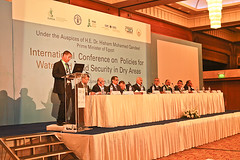
Policies for Water and Food Security in the Dry Areas


- See

24-26 June 2013. Cairo, Egypt. International Conference: Policies for Water and Food Security in the Dry Areas.  This conference brought together policy makers, development agencies, NGOs, donors and the private sector on the critical topic of identifying and adopting water management policies in the dryland areas that resonate with the development goals of food security, environment sustainability and better livelihoods.

In dryland areas, where water resources are already scarce and are further declining in the face of increasing population and climate change, water security is an immediate priority. The conference aimed to drive commitment and action toward quantifiable improvements to water usage, which can be closely monitored by all those involved in the land and water sector in the coming years.

Interviews:
Dr. Gryseels, Director General, Royal Museum for Cent. Africa: Are talks at the conference going to influence policymaking?
Dr. Lamraani – IDRC Representative: Policy to action – is there a missing link?

Wednesday, June 26, 2013

Joint African-European Research & Innovation Agenda on Waste Management


24 - 25 June 2013. Addis Abeba. Joint African-European Research & Innovation Agenda on Waste Management. The workshop on Waste as a Resource was organised by the EC (DG Research).

The objective of the Addis Ababa workshop was to generate three main outputs:
  1. Mapping the challenges related to solid waste management, recycling and recovery of raw materials in Africa and Europe 
  2. Identifying innovative research, technical, policy and business ideas that can help tackle these challenges. 
  3. Forming partnerships between researchers, policy-makers and waste operators around these innovations.
Final Report
Presentation by Frans Beckers
Presentation by Linda Godfrey
Presentation by Luisa Prista
Presentation by Marijk Huysman
Presentation by Michael Kabungo
Presentation by Vicky Onderi.


Related:  Theme-7-KBBE-Biowaste for sustainable production Building Scientific Capacity through Turning Bio-waste into Sustainable Products (Biowaste4SP): Development of appropriate Conversion Technologies applicable in Developing Countries


See also: Power Point Presentation of Andrew Gidamis - Biowaste4SP at the Global Science Collaboration: Science Capacity Building & the Implications for the Development Process. 27 June to 28 June. Location: Irish Embassy.


Related:

FP7-KBBE-2-2-3 Food Processing: Sustainable Production of Functional and Safe Feed from Food Waste
EC CONTRIBUTION: € 2,999,257.00
DURATION: 42 months
PROJECT START DATE: August 2012
LIST OF PARTNERS
  1. ACONDICIONAMIENTO TARRASENSE ASSOCIACION (ES)
  2. VLAAMSE INSTELLING VOOR TECHNOLOGISCH ONDERZOEK N.V. (BE)
  3. UNIVERSITA DEGLI STUDI DI PARMA (IT)
  4. NUTRITION SCIENCES NV (BE)
  5. IGV INSTITUT FUR GETREIDEVERARBEITUNG GMBH (DE)
  6. EKO DENGE CEVRESEL EKONOMIK SOSYAL ARASTIRMA DANISMANLIK MUHENDISLIK PROJE INSAAT TICARET VE MUMESSILLIK LIMITED SIRKETI (TR)
  7. KNOWLEDGE INNOVATION MARKET S.L. (ES)
  8. BAUERNKASEREI WOLTERS GMBH (DE)
  9. VERTECH GROUP SARL (FR)
  10. EIGEN VERMOGEN VAN HET INSTITUUT VOOR LANDBOUW EN VISSERIJONDERZOEK (BE)
  11. PROVALOR BV (NL)
  12. AQON WATER SOLUTIONS GMBH (DE)
The main focus of NOSHAN is to investigate the process and technologies needed to use food waste for feed production at low cost, low energy consumption and with maximal valorisation of starting wastes materials. Nutritional value and functionality according to animal needs as well as safety and quality issues will be investigated and address as main leading factors for the feed production using food derived (fruit/plant and dairy). According to this not only wastes will be characterized for their nutritional potential, but suitable technologies to stabilize them and convert them into suitable raw materials for bulk feed will be researched. 

Two different groups of activities will be thus addressed: 
  • From one side, replacement of bulk feed ingredients (constituting up to 90-95% of feed weight) will be studied from the starting waste materials. These bulk materials could cope part of the huge amounts of food waste generated in Europe. 
  • From the other side, the valorisation of active ingredients as well as the upgrade of waste into more valuable feed additives will be studied. The later constitute approximately the half of the feed cost.
The main expected result of NOSHAN project is the creation of a broad portfolio of valorised wastes for feed production. In this sense, a selection of wastes according to their potential nutritional properties, quantities produced, seasonality, possibility of stabilisation, safety and regulatory issues, cost and logisitics will be performed during the fi rst phase of the project.

In addition, a number of wastes will be studied in NOSHAN from the beginning of the project due to their great importance for European Agriculture production or to their nutritional composition. In order to improve nutritional content of feed and be able to fulfi l animal needs, waste will be treated alone or mixed with other waste looking for complementation and synergistic effects. The characterisation at molecular level of the diff erent waste streams will allow providing the best technology for the best raw material to obtain the desired nutritional/functional properties. 

See blogpost: Sub Sahara African involvement in FP7 projects: Theme 2 “Food, Agriculture and Fisheries, and Biotechnologies

Related:
Global Waste Management Outlook Initial Consultation
8-9 July 2013. Paris, France. The UN Environment Programme's (UNEP's) International Environmental Technology Centre (IETC), in collaboration with the International Solid Waste Association (ISWA), is leading the development of the Global Waste Management Outlook as a tool to provide an authoritative overview and analysis of policy instruments and resources for waste management, and recommendations for action. An initial consultation meeting will gather experts from governments, intergovernmental organizations, the private sector, academia and public interest groups, to discuss development of the Outlook.


read more: http://africasd.iisd.org/events/global-waste-management-outlook-initial-consultation/

CAAST-Net Plus partners and stakeholders meeting

24-26 June 2013. Addis Ababa. CAAST-Net Plus held its first partner and stakeholder meeting. CAAST-Net Plus objectives encourage more and better bi-regional STI cooperation for enhanced outcomes around topics of mutual interest, and particularly in relation to the global societal challenges of climate change, food security and health.

CAAST-Net Plus actions rely on bi-regional dialogue among stakeholders for gathering informed opinion and experience about the bi-regional cooperation process, formulating and disseminating it in such a way as to be admissible to the formal bi-regional STI policy dialogue process and to programme owners.

Through informing the bi-regional policy dialogue for mutual learning and awareness, through building support for coordinated and innovative approaches to bilateral funding of bi-regional cooperation around global challenges, brokering the public-private relationship to foster improved uptake and translation of bi-regional research partnership outputs into innovative technologies, good and services, and through dedicated mechanisms to encourage bi-regional research partnerships, CAAST-Net Plus makes contributions to the quality and scope of the Africa-Europe STI relationship for mutual benefit.

See the workshop report 12/07/2013: Africa-EU research collaboration on climate change, food security and 
water linkages. An overview of emerging issues and potential research priorities.

Overview of related meetings
  • CAAST-Net+ consortium meeting (CLOSED meeting)
    From Monday 24 June (lunchtime) to Tuesday 25 June (lunchtime). Location: AUC.
  • CAAST-Net+ workshop on EU-Africa bi-regional research cooperation on climate change with impacts on water and food security. (OPEN meeting)
    From Tuesday 25 June (lunchtime) to Wednesday 26 June (lunchtime). Location: AUC.
  • Joint African-European Research & Innovation Agenda on Waste Management "Waste as a Resource: Recycling & Recovery of Raw Materials" (OPEN)
    From Monday 24 June (lunchtime) to Tuesday 25 June (afternoon). Location: Hilton Hotel.
    CAAST-Net+ workshop on Research Infrastructures for EU-Africa Cooperation pdf - 43 KB [43 KB] (OPEN)
  • From Wednesday 26 June (lunchtime) to Thursday 27 June (mid-morning). Location: AUC.
    organised in close collaboration with European Commission and African Union Commission.
    http://eeas.europa.eu/delegations/african_union/press_corner/all_news/news/2013/20130610_en.htm 
  • Joint Expert Group (JEG8) meeting (OPEN to EU and AU government representatives only)
    Thursday 27 June (14:00) to Friday 28 June (lunchtime). Location: AUC.
  • Global Science Collaboration: science capacity building for development (OPEN)
    From Thursday 27 June (14:00) to Friday 28 June. Location: Irish Embassy.
    For more information: http://iscintelligence.com/event.php?id=88 

Monday, June 24, 2013

Energy SMEs in sub-Saharan Africa: Outcomes, barriers and prospects in Ghana, Senegal, Tanzania and Zambia

Energy SMEs in sub-Saharan Africa: Outcomes, barriers and prospects in Ghana, Senegal, Tanzania and Zambia.

James Haselip, Denis Desgain and Gordon Mackenzie
UNEP Risø Centre, Denmark, May 2013, 116 pages

This report presents the findings of research into the main outcomes of government and donor-backed efforts to promote small and medium-sized energy businesses (energy SMEs) in sub-Saharan Africa. The focus is on four countries: Ghana, Senegal, Tanzania and Zambia.

There is a predominant view among stakeholders, across the countries studied, that governments are ineffective in designing and implementing tangible support for energy SMEs, despite politicians often providing strong rhetorical support. As such the establishment and success of energy SMEs more often depends on support provided by donor agencies or NGOs that can provide technical assistance and/or subsidised loans.

The institutions and associations supporting SMEs are weak, fragmented and uncoordinated partly due to lack  of clear guidance and policy for the development of the sector.

Where numerous energy SMEs are in operation and thus where a valid demonstration effect can be identified, there is a perceived paradox that serves to undermine commercial interest in investing in energy SMEs. The paradox is that the donor-supported businesses that were issued with concessional and/or flexible loans serve to demonstrate that these businesses depend upon such concessional terms, i.e. that they could not survive in ‘the real world’. While this assumption is widely regarded as self-evident by private investors, there are in fact other, more concrete, factors that act to undermine the demonstration effect.

These include, inter alia, relatively high transaction costs of investing in SMEs; the inherently complicated nature of energy sector SMEs with longer supply chains and slower pay-back periods for capital-intensive technologies such as solar PV; rigid rules regarding the need to secure collateral.

Friday, June 21, 2013

Africa’s agribusiness industry attracts private equity interest

21 June 2013. How we made it in Africa. Two recent private equity deals in Africa’s agribusiness and food sectors show that investors continue to see opportunities in these industries.
A promotional image showing a vendor selling Fan Milk products.
The Abraaj Group, a private equity firm with operations across the world, will acquire a 100% stake in Fan Milk International, one of West Africa’s largest dairy companies.

Established in Ghana more than 50 years ago, Fan Milk is today one of West Africa’s top producers and distributors of frozen dairy products and juices. In addition to Ghana, the company also operates subsidiaries in Nigeria, Ivory Coast, Burkina Faso, Togo and Benin. It is estimated that Fan Milk currently sells more than 1.8 million products on a daily basis throughout West Africa.

Although it is unclear how much The Abraaj Group will pay for Fan Milk, a statement released by the firm called the deal “the largest ever Africa fast-moving consumer goods private equity transaction in sub-Saharan Africa, outside South Africa”.

Processing coconut into specialist oils
In another deal, South Africa-based private equity fund Agri-Vie recently announced an investment in Vida Oils International, a company involved in the processing of coconut into specialist oils and fats. Vida Oils has its head office in Mauritius and subsidiaries in South Africa and Mozambique.

Vida Oils supplies coconut oil to the food, pharmaceuticals, cosmetics and chemical sectors in South Africa, and the plan is to eventually also export internationally.

Emerging Economies and the Changing Dynamics in African Agriculture: What Role for CAADP?

This publication should be cited as: Lui, D., Rosengren, A., Roquefeuil, Q. de. 2013. Emerging economies and the changing dynamics in African agriculture: What role for CAADP? 
(ECDPM Discussion Paper 145).

21 June 2013. Emerging economies and the changing dynamics in African agriculture: What role for CAADP?

Abstract:
Emerging economies are increasingly active in the African agricultural sector, bringing forth new opportunities and challenges.To ensure a sustainable agricultural development, African stakeholders need to be in the driving seat, with clear policies on how partners’ support can provide the most benefits. 

By ensuring greater alignment with the Comprehensive Africa Agricultural Development Programme (CAADP), African governments could better direct support and investment in line with the respective comparative advantages of partners, while creating more certainty for investors from all countries. 

As more emphasis is being placed on the role of the private sector and investment, both from emerging and traditional players, agricultural development frameworks such as CAADP need to ensure that these investments promote agricultural growth that also benefits smallholders. Investments in land are a case in point.

Agri entrepreneurs as a new type of innovators and the role of agribusiness service providers

Smallholders need to work the logic of markets. For that they need skills – and they do not come spontaneously (Agricultural business development services) page 3) . To make farming a business, farmers need specific services to help them in doing so: business services. And these services need to cater to a wide range of types of farmers.

The same holds true for other value chain actors such as local traders, warehouse managers, input suppliers and local processors: they also need business services to be able to cope with the dynamic environment they find themselves in.

The workshop organised by the European Commission on 10th of April about the European Agribusiness in Africa has triggered PAEPARD to focus on Agricultural entrepreneurs in its social reporting on this blog over the past months.

Les petits exploitants ont besoin de travailler la logique des marchés. Pour cela, ils ont besoin de compétences - et ils ne viennent pas spontanément. Pour faire de l'agriculture une entreprise, les agriculteurs ont besoin de services spécifiques pour les aider à le faire: les services aux entreprises. Et ces services doivent répondre à un large éventail de types d'agriculteurs. La même chose vaut pour les autres acteurs de la chaîne de valeur tels que les commerçants locaux, les gestionnaires d'entrepôts, les fournisseurs d'intrants et les transformateurs locaux: ils ont aussi besoin de services d'affaires pour être en mesure de faire face à l'environnement dynamique ou ils se trouvent.

L'atelier organisé par la Commission européenne le 10 Avril sur l’agro-alimentaire européenne en Afrique a incité le PAEPARD à porter son attention ces derniers mois aux entrepreneurs agroalimentaires.


Here under is an overview of this harvest / Ci-dessous un aperçu de cette récolte:

PAEPARD video interviews
Interview with Andy Hall, Researcher in the area of Innovation Processes and agriculture. UNU-MERIT Maastricht. AISA workshop, Agricultural Innovation Systems in Africa, Nairobi, 29-31 May 2013. Andy answers following questions:
  • Are agri-entrepreneurs a new type of innovators? 
  • What is an example of an agri-business service provider?
  • Which role can entrepreneurs play to put research into use?
  • Can entrepreneurs link the value chain to financial actors?
  • Was Research into Use (RIU) over-designed?
  • Why is engaging agricultural Small and Medium Enterprises (agri-SMEs) so challenging?
  • Are equity funds an opportunity to engage them?
Patient capital to support African agribusiness
Interview with Paul Frix, the Director ad interim of the Centre for the Development of Enterprise (CDE).

The collaboration between GIZ and BMGF to support African agribusiness
Interview with Albert Engel, Deputy Director General, German Agency for International.

La collaboration du ROPPA avec le prive et la recherche
Interview with Khalilou Sylla. Le Secrétaire Exécutif du ROPPA donne ces commentaires sur le FORUM DES AFFAIRES du ROPPA. 29 – 31 OCTOBRE 2013 à ABIDJAN

Some Agribusiness support services

Towards Sustainable Clusters in Agribusiness through learning in entrepreneurship
IFDC, the International Centre for development oriented Research in Agriculture (ICRA) and Base of the Pyramid Innovation Center (BoP Inc.) are promoting sustainable agricultural production and commodity chain development across Africa through the five-year (2012-2016) Toward Sustainable Clusters in Agribusiness through Learning in Entrepreneurship (2SCALE) project. Funded by the Netherlands’ Directorate-General for International Cooperation (DGIS), the project focuses on the development of competitive rural agricultural systems, viable agro-enterprises and the use of public-private partnerships (PPPs). See also: Recent IFDC agribusiness support projects

Promotion of Private Sector Development in Agriculture
This is a bilateral technical assistance programme jointly implemented by the German Agency for International Development (GIZ) on behalf of the Government of Germany and the Ministry of Agriculture on behalf of the Government of Kenya. PSDA closely collaborates with other agricultural sector Ministries, mainly with the Ministry of Livestock Development, Ministry of Fisheries Development and Ministry of Cooperative Development and Marketing.

ASNAPP, an NGO with a head for business
Community farming projects in Africa have a much greater chance of making a real difference to the lives of rural farmers when there is a strong private sector company providing a ready market for the produce

Some best practices

Matooke Agribusiness Incubator
The Afri Banana Products Limited, formerly Incubation and Diversification of Banana Products for Agribusiness (IDBPA), aims to upscale innovations and improve entrepreneurial skills in banana production- to – marketing value chains with emphasis on capacity building for increased production, development of SME’s, training in entrepreneurship and agribusiness at B.Sc. and M.Sc. levels, linking of research innovations to agribusiness, and marketing of banana and its value added products including disease-free seedlongs, fresh peeled and vacuum sealed bananas, vinegar, banana wine, enriched animal feeds, biogas, charcoal briquettes, biodegradable bags and textile fiber materials.

Training Beninese youth in agribusiness
The Songhai Center in Porto-Novo works towards reducing youth unemployment and underemployment by training young people in organic agriculture, food processing, and natural resource management.

An indigenous agribusines success: Shito, a traditional pepper sauce
African entrepreneurs have incredible potential to make African agriculture a dynamic, growth-generating sector that fills a growing market niche and engages the youth.

Resources on Agribusiness

Agricultural business development services
This book describes the two dominant approaches to providing services: (a) supply-driven (where the funder decides what services should be offered), (b) and market-driven (where more emphasis is put on market forces). It looks at how 12 business service providers from across Africa run their businesses.It describes the seven different “business models” that they pursue, and examines the features of each one.

Innovation and Entrepreneurship to enhance graduate studies
ANAFE. Study on Challenges and Opportunities for Strengthening Tertiary Agricultural Education and Private Sector Collaboration in Africa.

Growing Africa: Unlocking the Potential of Agribusiness March 4, 2013. Africa’s farmers and agribusinesses could create a trillion-dollar food market by 2030 if they can expand their access to more capital, electricity, better technology and irrigated land to grow high-value nutritious foods.

A Guide to Inclusive Agribusiness
Report by the German Agency for International Cooperation (GIZ)

Agricultural Value Chain Finance
The purpose of this book is to provide an understanding of the emerging field of agricultural value chain finance.

Retrospective review of private and public sector agribusiness investments in Africa
World Bank Research Paper

Events

Announcement: East African regional agribusiness expos
14-15 June 2013. Arusha, Tanzania
28-29 June 2013. Marindi, Uganda
1-2 August 2013. Nakuru, Kenya

IFC Sustainable Agribusiness Conference 2013
4-6 June 2013. IFC organized a conference on Sustainable Agribusiness in Nairobi.

European Agribusiness in Africa: Opportunities and challenges
10 April 2013. Brussels. This workshop was organised by the European Commission's Directorate-General for Agriculture and Rural Development in collaboration with the Directorate-General Development and Cooperation – EuropeAid. Including a PAEPARDF video interview with Dr Ababacar Sadikh NDOYE, Directeur général Institut de Technologie Alimentaire – ITA.

SACAU policy conference Financing agriculture
13–15 May 2013. Dar el Salaam, Tanzania. This conference has attracted about 200 participants from 14 Southern Africa Development Cooperation (SADC) countries and some representatives from regional agriculture organisations from other parts of Africa.

Ghana: Agribusiness Entrepreneurship Programme
April 15-May 10, 2013. Four-week Agribusiness Entrepreneurship Programme

Building bridges between agribusiness and development
18 April 2013. The Guardian panel discussion: Aligning agribusiness and development means taking a holistic approach. The panel suggested 14 crucial factors to making it work

Funding

Setting-up an equity fund for SMEs agribusinesses in Uganda
The European Union and other partners are working with the Government to launch an equity fund for SMEs agribusinesses in Uganda.

Launch of two Dutch Funding instruments on food security
(a) Food and Business Global Challenges Programme (GCP). The closing date for submitting preliminary applications is9 July 2013. (b) Food and Business Applied Research Fund (ARF). Proposals can be submitted continuously during the course of this first Call for proposals.

The Technical Assistance Facility of the African Agriculture Fund.
This is a grant based facility, that supports capacity building for small and medium sized enterprises (SMEs) invested in by the African Agriculture Fund (AAF) and its SME Fund

Value chain based research funding
An innovative approach to funding ARD is the value chain based research funding.

US, Sweden create $25m fund to spur private agric investment
The governments of Sweden and the United States of America created a $25 million African agriculture fund for the six-member New Alliance for Food Security and Nutrition initiative.

Thursday, June 20, 2013

The Desert Land conference

17th and 18th June 2013. Ghent, Belgium. The Desert Land conference brought together research institutions, NGO's and corporations that help cope with the problems of Desertification and Land Degradation and find appropriate solutions.


The Conference on Desertification and Land Degradation 2013 (DesertLand) acts as a platform and a catwalk for showing actions that have been taken and projects undertaken since RIO 1992? (RIO+21) for combating desertification and land degradation.

Among the objectives of the DesertLand conference was taking stock of not only the current scientific knowledge but also of the current strategies of management of areas affected by drought (water scarcity) and by degradation of land (water erosion, wind erosion, physical and chemical degradation) and pastures, and this at a national, regional and community level. Downscaling is the issue!
Extract:
During the first day Fabèkourè Kambiré, Université catholique de Louvain, Belgium, presented "Effect of reduced tillage and manure on soil physicals properties and cotton yields in South-sudanian region of Burkina Faso".
During the second day Thomas Rabeil, Sahara Conservation Fund, France presented: Innovation, traditional knowledge and awareness lead to good practices to avoid biodiversity loss in the Sahara.
The mission of the Sahara Conservation Fund is to conserve the wildlife, habitats and other natural resources of the Sahara and its bordering Sahelian grasslands. To implement its mission, SCF forges partnerships between people, governments, the world zoo and scientific communities, international conventions, NGOs and donor agencies. People working together with a common goal: the conservation of deserts and their unique natural and cultural heritage.
Here under follows a video interview with Fabèkourè Kambiré. 

Securing Africa's Land for Shared Prosperity

May 2013
Author: Byamugisha, Frank F. K.
228 pages

This is the first book on land administration and reform in Sub-Saharan Africa, and is highly relevant to all developing countries around the world. It provides simple practical steps to turn the hugely controversial subject of "land grabs” into a development opportunity by improving land governance to reduce the risks of dispossessing poor landholders while ensuring mutually beneficial investors’ deals.

The book shows how Sub Saharan Africa can leverage its abundant and highly valuable natural resources to eradicate poverty by improving land governance through a ten point program to scale up policy reforms and investments at a cost of USD 4.5 billion. The book points out formidable challenges to implementation including high vulnerability to land grabbing and expropriation with poor compensation as about 90 percent of rural lands in Sub Saharan Africa are undocumented, but also timely opportunities since high commodity prices and investor interest in large scale agriculture have increased land values and returns to investing in land administration. 

It argues that success in implementation will require participation of many players including Pan-African organizations, Sub Saharan Africa governments, the private sector, civil society and development partners; but that ultimate success will depend on the political will of Sub Saharan Africa governments to move forward with comprehensive policy reforms and on concerted support by the international development community. 

Its rigorous analysis of land governance issues, yet down-to-earth solutions, are a reflection of Byamugisha's more than 20 years of global experience in land reform and administration especially in Asia and Africa. This volume will be of great interest to and relevant for a wide audience interested in African development, global studies in land, and natural resource management.

About the author:
Mr. Frank F. K. Byamugisha, a Ugandan national, is an Operations Adviser and Lead Land Specialist in the Africa Region of the World Bank where he has worked for about 30 years on land tenure and administration reforms especially in Asia and Africa. Before joining the World Bank, he was an Assistant Secretary at the Ministry of Finance in Papua New Guinea. He holds a Ph.D in Economics and a Master of Science in Land Surveying from the University of East London, a Masters Degree in Agricultural Development Economics from the Australian National University and a Bachelor of Science in Agriculture from Makerere University, Uganda.

Wednesday, June 19, 2013

Agri entrepreneurs as a new type of innovators

Interview with Andy Hall, Researcher in the area of Innovation Processes and agriculture. UNU-MERIT Maastricht
AISA workshop, Agricultural Innovation Systems in Africa, Nairobi, 29-31 May 2013.

Andy answers following questions:
  1. Are agri-entrepreneurs a new type of innovators? 
  2. What is an example of an agri-business service provider?
  3. Which role can entrepreneurs play to put research into use?
  4. Can entrepreneurs link the value chain to financial actors?
  5. Was Research into Use (RIU) over-designed?
  6. Why is engaging agricultural Small and Medium Enterprises (agri-SMEs) so challenging?
  7. Are equity funds an opportunity to engage them?


Transcript:

Are agri-entrepreneurs a new type of innovators?

Agri-entrepreneurs seem to be a new category of innovators which we start to see in the rural landscape in Sub Saharan Africa and in Asia. And what is interesting about them: they quite often are both interested in making money as entrepreneurs but they are also recognizing the market of poor people to which they sell products to or buy products from. One of the interesting things to me is that the entrepreneurs of this sort have started to martial a different sets of ideas to come up with innovations which seem to have this property to be relevant for development as well as for an entrepreneur to make money. Their resistance as a kind of pervasive force in the rural areas and the rural sector suggests that they may be a useful focus for capacity building into the future, looking at how research can be better linked to them, looking at how policy could better respond to their needs and how the institutional environment around markets could help the development of this sort of sector.

What is an example of an agri-business service provider?

Technoserve has a very long story in this in Africa but this bring us to the great question whether you are born an entrepreneur or can you train then? My sense is that they probably emerge automatically in a self organising way. Some of the agri-entrepreneurs that we have been seen are actually people who have taken a conventional career path. Maybe they have gone into IT and worked in the corporate sector and then come back and actually say "that's not for me and I want a business which is both socially responsible but also makes me a living.

Which role can entrepreneurs play to put research into use?

I think the most important role they have in bringing research into use is: what are entrepreneurs good at? They are good at  identifying opportunities -  opportunities that are often driven by the market. But entrepreneurs are also good in marshaling ideas and people. So they are in a sense performing - what is now called - the brokering role: putting ideas, resources and people together: to make that innovation actually happen.

Can entrepreneurs link the value chain to financial actors?

I don't know too much about that but I think that part of marshaling people and resources is there ability to tap into resources of financing to help them do the things they are doing . But as I said I don't know many details about this.

Was Research into Use (RIU) over-designed?

RIU is of course a very long story. But a number of things come out of that. One is that the distinction between research and into use - what we call innovation - is a false distinction. What is actually required is research funds being made available to development initiatives so they can trouble shoot and support the innovation process. the other thing that also came out - what kind of relate to the agri-enterprise issues we just talked about - is an increasing blur between development and an enterprise. Historically this has been seen as contradictory. But there is clearly a generation of entrepreneurs emerging which  who have developmental interest. And that's an opportunity for making a better use of agricultural research in development.

Why is engaging agricultural Small and Medium Enterprises (agri-SMEs) so challenging?

I think it continues to be a challenge often quite difficult to identify them. The usual channel to support them through funding mechanisms: they are not familiar with that sort of approach. those funds are often hogged by the usual suspects. Much more effort is needed to understand where they sit in the landscape, what sort of capacity support can be brought to bare to help them access funds, make partnership and this sort of connectivity work that is required around innovation.

Are equity funds an opportunity to engage them?

Equity funds may well be an opportunity to engage them but there is possibly further work required to understand what the investment opportunities are in the rural sector and investment opportunities associated with these sorts of entrepreneurs. But I don't see any reason why there should not be opportunities for equity funds.

Cadre permanent de concertation entre les op et la recherche (CROP) : perspective paysanne


18-20 juin 2013. Freetown, Liberia. L’objectif général de cet atelier est le renforcement du cadre de concertation entre les organisations de producteurs et la recherche en vue de la réalisation des objectifs assignés a la recherche dans le cadre de l’ECOWAP.

Les objectifs spécifiques de l’atelier sont de :
  • améliorer le dialogue entre les OP et la recherche; 
  • Mettre en place un processus permettant un mécanisme de coopération entre la recherche et les OP.
L’atelier est organisé autour de trois axes :
  1. la compréhension commune du rôle assigné par les Communautés régionales a la recherche dans le cadre des politiques agricoles: (a) bien comprendre le rôle que les acteurs de la politique agricole ont assigné a la recherche et (b) comment ils tentent s’organiser pour le mettre en œuvre 
  2. les cadres de concertation au niveau régional et national : (a) le rôle du producteurs, (b) revisiter les types de cadre de concertation existants dans la région, (c) le type de concertation entre les CGIAR, les CGIAR et les NARS ainsi qu’entre les NARS, (d) recenser les cadres de concertations innovants.
  3. la proposition d’une feuille de route cadre de concertation entre les OP et la recherche: une proposition de feuille de route pour le renforcement de la coopération entre les OP et la recherche.
Interview: 
Khalilou Sylla, Secrétaire Exécutif du ROPPA donne ces commentaires sur le CADRE PERMANENT entre les OP et la Recherche. 18-20 JUIN 2013 à FREETOWN (interviewé lors de la Table Ronde organise par la Commission Européenne à Bruxelles : Global Alliance for Resilience Initiative (AGIR) – Sahel – West Africa.


Extait: (a part de 3 min 27")
Cette réunion est très importante pour nous. C’est pour affirmer deux choses : La première chose est que nous n’avons pas de mécanisme clair qui nous permette de vraiment impliquer les producteurs dans le processus d’identification des priorités. La région de l’Afrique de l’Ouest et les structures qui impliquent les chercheurs ont cru qu’il suffisait d’impliquer les producteurs dans leurs conseils d’administration. Ce n’est pas cela qu’il faut.

Il faut un mécanisme qui permettent aux producteurs de dire : voilà mes besoins, que ces besoins peuvent être pris en charge et que le producteur puisse évaluer ce qu’on lui a donné ou que d’autres acteurs puissent évaluer où est l’efficacité de cette recherche ? Comme pour le secteur prive nous voulons dire au chercheurs : nous sommes dans un cadre ou nous devons travailler ensemble. L’idée de notre travail n’est pas compliquée.

Les choses clés qui nous intéressent sont de dire :
  1. voici les besoins des producteurs , 
  2. qu’est-ce que vous avez comme résultat de recherche pour pouvoir répondre à ces besoins, 
  3. pour les besoins pour lesquels vous n’avez pas de moyens ou résultats : c’est au producteurs d’aller chercher les ressources pour donner au chercheurs en demandant : faites cette recherche pour nous. 
Cela change tout. Ce mécanisme met le producteur au centre de la recherche. Ce n’est pas un producteur qui est dans un conseil d’administration et qui ne peut rien changer car il est au milieu de 50 chercheurs et on lui demande de les convaincre !

AfricaRice : Improving Food Security Information in Africa

12 June 2013. A new 3-year project has been launched with financial and technical support from Japan's Ministry of Agriculture, Forestry and Fisheries (MAFF) to improve the food security information system in Africa through the generation of quality rice data and information.

This will add value to the existing endeavors undertaken so far towards the goal of improving the availability and reliability of rice statistics in support of the objective of the CARD initiative.

The project will consist mainly of three main activities relating to: 1) the development of a survey methodology to be used to conduct rice surveys in the participating countries, 2) NARS capacity building to acquire the required skills to implement rice surveys using the method that will be introduced by the project, and 3) conduct surveys in selected countries.

For more information, visit www.AfricaRice.org

Speakers in the video (in order of appearance) :
  • Dr. Kenji Kamikura, Senior Statistician, Statistics Department, Ministry of Agriculture, Forestry and. Fisheries of Japan
  • Dr. Elisha Martine Mkandya, Economist, Tanzania Ilonga Agricultural Research Institute, Tanzania
  • Dr. Vivian E. Ojehomon, Head of Planning/Agric. Economist, National Cereals Research Institute (NCRI), Nigeria. 
  • Dr. Ali Touré, Coordinator, IFAD Project for WCA, AfricaRice, Benin