Platform for African – European Partnership in Agricultural Research for Development
Friday, September 12, 2025
Tropentag 2025
10 - 12 September 2025. Tropentag 2025 is an interdisciplinary international conference focused on tropical and subtropical agriculture, natural resource management and rural development.
This year the theme was “Reconciling land system changes with planetary health”, meaning the conference explored how agricultural systems, land use, food security, and environmental protection can be balanced in the face of climate change, urbanization, land-use change, and other pressures.
The event was organized by the University of Bonn/ZEF together with several partner European universities and research bodies, and it will include keynotes, oral and poster presentations, workshops, and hybrid/online sessions.
The key thematic areas were:
Resilient Crop & Livestock Systems: Enhancing crop and livestock productivity through optimized management, breeding, and climate-smart agriculture. Addressing biotic (pests, diseas-es) and abiotic (drought, salinity) stresses to improve resilience and resource efficiency.
Soil, Water & Biodiversity: Strengthening soil fertility, water management, and agricultural biodiversity. Applying nature-based so-lutions for soil conservation, water retention, and ecosystem services in agricultural landscapes.
Land Use, Forestry & Agroecology: Optimizing land management and farming systems through regenerative agriculture, sustainable forestry, and agroecological approaches. Balancing productivity, soil health, and ecosystem functions to enhance long-term agricultural and forest sustainability.
Food Systems & Nutrition: Improving food quality, safety, and biofortification while ensuring seed system sustainability. Strength-ening nutrition-sensitive agricultural value chains for healthier diets and resilient food systems.
Markets, Economics & Science Policy:Understanding farmer decision-making, risk management, and innovation adoption. Co-design of poli-cies and market mechanisms that support climate-resilient agriculture while ensuring economic viability.
Social Learning & Governance: Promoting knowledge transfer, participatory govern-ance, and institutional change. Addressing land ten-ure security, gender equity, and access to resources to support inclusive agricultural transitions.
Technology & Agricultural Innovation: Leveraging artificial intelligence, remote sensing, and smart farming for better decision-making and re-source efficiency. Advancing biotechnology and pre-cision agriculture to enhance productivity with mini-mal environmental impact.
Opening session Dr. Siméon Ehui — Director General of the International Institute of Tropical Agriculture (IITA) & CGIAR Regional Director for AfricaReconciling land systems changes with planetary health.
Dr. Lenis Saweda Liverpool-Tasie (Michigan State University, USA)Her research is about transforming food systems, rural livelihoods, MSMEs, policy-advisory in agriculture in low-/middle-income countries.
Dr. Chris Hoffmann (University of São Paulo, Brazil)Works on nutrition transition, gut microbiome, how socioeconomic & agricultural policies affect health outcomes.
Closing session Dr. Ousmane Badiane — Executive Chairperson of AKADEMIYA2063On remote sensing & AI applications in agriculture; broad reflections toward planetary health.
11/09 Sessions on Neglected & Underutilised Species
This session highlighted the crucial role of neglected and underutilised species (NUS) and broader biodiversity in tackling today’s food system challenges. Presentations spanned themes such as how NUS link biodiversity, climate, and nutrition; the nutritional potential of neglected African crops; and the integration of biodiversity into agricultural and rural development. Case studies also addressed ecological restoration in Brazil, mangrove protection in Vietnam, and citizen science approaches in the Dominican Republic. Together, the talks emphasized that biodiversity conservation and mainstreaming NUS are key strategies for building climate resilience, improving nutrition security, and supporting sustainable livelihoods.
Céline Termote
NUS at the nexus of biodiversity, climate and nutrition → Framed NUS as critical for dietary diversity and resilience to climate change.
Michael Frei, Hervé Mube K., Dominique van der Straeten, et al.
Micronutrient density of neglected and underutilised African crops → Showed how NUS could help combat hidden hunger through high micronutrient content.
Mariam Abbas
Mainstreaming biodiversity into agricultural and rural development: The case of Mozambique → Explored how policy and practice can embed biodiversity in rural development.
Milka Kiboi
Performance and yield stability of maize under a long-term experiment in the sub-humid tropics → Provided insights on biodiversity and stability of staple crops, linking to agro-biodiversity themes.
Emma Tamez Montero
Social-ecological restoration in the Brazilian Mata Atlântica: Implications on landscape connectivity dynamics → Examined restoration efforts to reconnect fragmented landscapes.
Uyen Tran
Does sustainable aquaculture certification protect mangroves? Evidence from Vietnam → Investigated whether certification schemes actually safeguard biodiversity.
Hugo-Enrique Reyes-Aldana
Citizen science for biodiversity monitoring and pathogen detection in coffee farms in the Dominican Republic → Highlighted farmer participation in biodiversity tracking and early warning systems.
Poster Session: Biodiversity and neglected species
A number of poster presentations under this theme: e.g. “Transforming Ethiopian botanical gardens into socio-ecological systems …”,“Wild and alien plant species as a source of food and livelihood support among low-income households …”,“Valorising neglected and underutilised crops: Role of bio-inoculants in improving productivity” etc.
11/09 Bridging Farmer Innovation and Digital Co-Design
The session focused on how farmers’ knowledge and innovation can be combined with digital tools through participatory and co-design approaches. Presentations highlighted how peer-to-peer learning, serious games, and participatory digital literacy can strengthen farmer capacities, encourage more sustainable practices, and improve rural livelihoods. Case studies spanned Kenya, Namibia, Cameroon, and Thailand, showing how farmers and researchers can co-create digital solutions tailored to local needs. The common thread was empowerment of rural communities by embedding innovation within their own social and ecological contexts, rather than top-down technology transfer.
Rufo Roba Halakhe, Maria Restrepo, Brigitte Kaufmann
Peer-assisted smartphone learning to support digital literacy and participatory design in northern Kenya → Farmers learned digital skills by supporting each other, enabling stronger participation in co-design of digital solutions.
Sean Yeo, Kingpai Koosakunilrund, Patrick Waeber
Breaking the failure cycle: Strategy game design to rethink mangrove restoration → A role-play/strategy game helped stakeholders rethink and improve approaches to mangrove restoration in Thailand.
Francis E Ndip, Perez L Kemeni Kambiet, Ernest L Molua
Agricultural commercialisation and children’s welfare: Impacts on diets and education → In Cameroon, commercialization of agriculture was linked to both opportunities and risks for children’s nutrition and schooling, underlining the need for inclusive policies.
Enhancing livestock husbandry and rural livelihoods through peer-to-peer information access: A transdisciplinary approach in communal areas of Namibia → Farmers co-designed peer-sharing platforms to improve livestock practices and strengthen communal resilience.
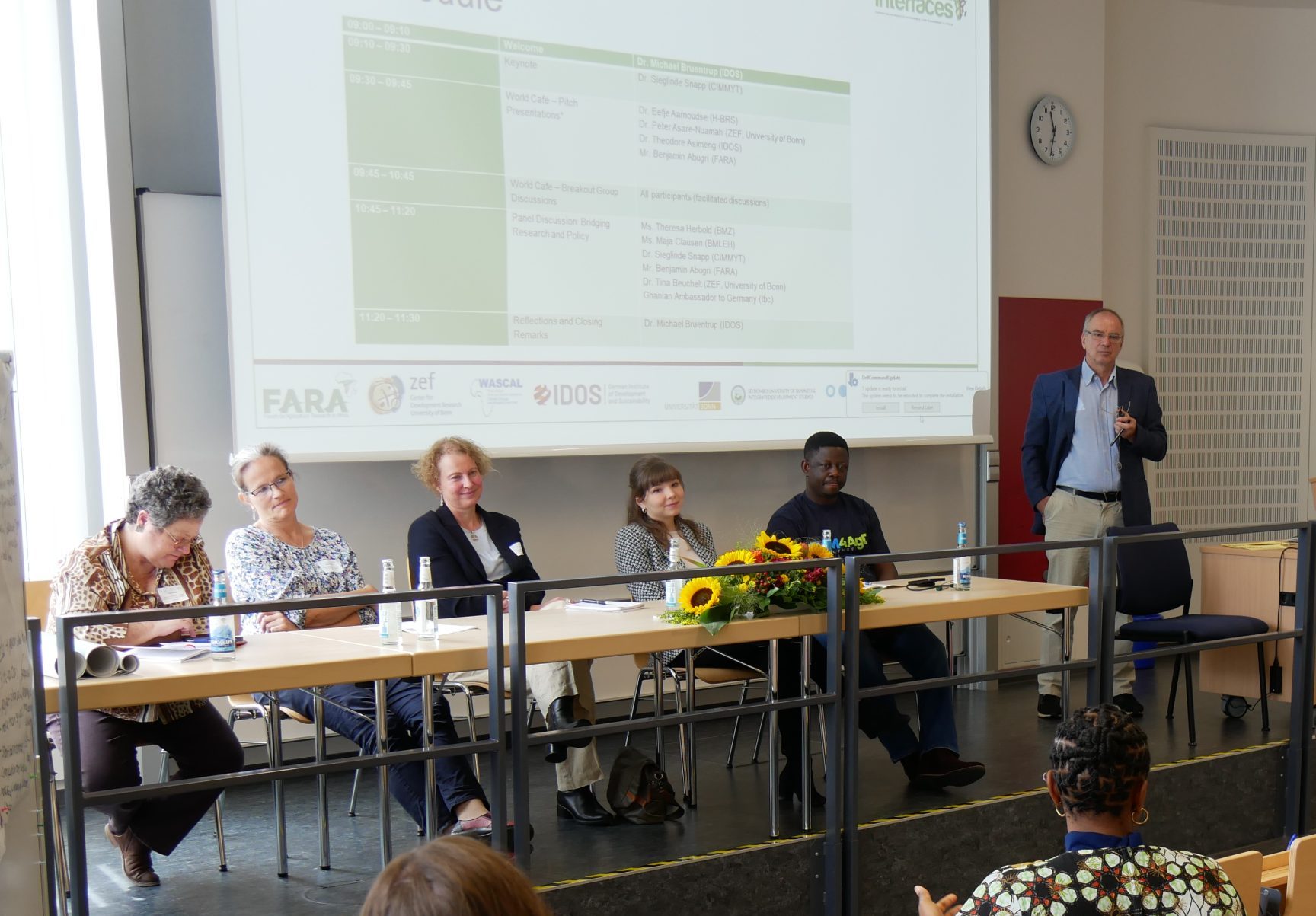
The event brought together researchers, policymakers, and development practitioners from Africa and Europe to reflect on how scientific knowledge can more effectively shape and inform policy processes.
The workshop built on previous Tropentag conversations on participatory research and agricultural knowledge management, and it offered a platform to deepen the dialogue around bridging research, policy, and practice.


 Extracts of the programme 80 pp.


No comments:
Post a Comment