Platform for African – European Partnership in Agricultural Research for Development
Showing posts with label soil. Show all posts

Friday, October 31, 2025

Borlaug dialogue

21 - 23 October 2025. Borlaug Dialogue 2025 under the theme “SOILutions for Security”.

The Borlaug Dialogue 2025 placed agricultural research firmly at the heart of food security strategy by focusing on soil not just as a substrate but as a living system essential for resilience, productivity and peace. 

It underscored that innovation in soil health, digital mapping, regenerative practices and alternative protein systems are not peripheral—they are central to transforming agri-food systems under climate and conflict pressure. For someone working on agroecology and “forgotten foods”, the messaging is clear: research must span from the micro-level (soil microbiome, bioinputs) to the systems-level (food security, peace and trade), and must link to investment, policy and farmer-driven uptake.

Extracts of the programme

21/10 Peace on the Plate: A Legacy of Security 

This high-level session examined how food and agriculture, and by extension soil and land systems, underpin national and global stability — addressing links between climate change, migration, conflict and resilient food systems. 

Panelists connected challenges such as climate change, migration and confl ict to the urgent need for resilient food systems. The discussion highlighted why addressing hunger is not only a humanitarian priority but also a strategic investment in a safer, more stable future.

21/10 Soil and Security: Leveraging Agricultural Transformation to Stabilize Nigeria’s Middle Belt


This session examined how agricultural transformation in Nigeria’s Middle Belt region can serve as a stabilising force in a context of land-use change, farmer-pastoralist conflict, environmental degradation and insecurity. Speakers highlighted how improving soil health, restoring degraded lands, establishing inclusive value-chains and strengthening local institutions offers a pathway from fragility to resilience. A key conclusion was that agricultural research and innovation — especially soil- and landscape-based interventions — must be embedded in peacebuilding and livelihood strategies, not treated purely as productivity tools. 

For regions such as the Middle Belt, where agro-ecological, socio‐economic and conflict dynamics intersect, this means that research on soil health and agricultural systems must be paired with local governance, inclusive partnerships (farmers + pastoralists + state) and long-term investment to deliver both agricultural and security outcomes.


22/10  From Policy to Progress: A Diplomatic Legacy


This session explored the complex pathway from global policy declarations to tangible progress on the ground, with a strong emphasis on the diplomatic legacy of food-security instruments and international partnerships. The discussion underlined that while high-level commitments – such as multilateral treaties, national food-security strategies and diplomatic engagements – set the stage, real progress demands sustained alignment between diplomacy, research, public-private collaboration and implementation in local contexts. 

Speakers emphasised that diplomatic frameworks can open doors and create legitimacy, but their value is realised only when matched with capacity, accountability, local-led processes and follow-through.
  • Facilitator: Gebisa Ejeta | Chair, World Food Prize Selection Committee, 2009 World Food Prize Laureate and Distinguished Professor of Agronomy, Purdue University
  • Hon. Henry Musa Kpaka | Minister of Agriculture and Food Security, Government of Sierra Leone
  • Hon. J. Alexander Nuetah | Minister of Agriculture, Republic of Liberia
  • Hon. Eric Opoku | Minister of Food and Agriculture, Republic of Ghana
  • Beth Dunford | International Development Sector Executive and Former Vice President, African Development Bank Group


22/10 Rewriting the Protein Narrative: Trust, Shared Vision, and Sustainable Solutions 
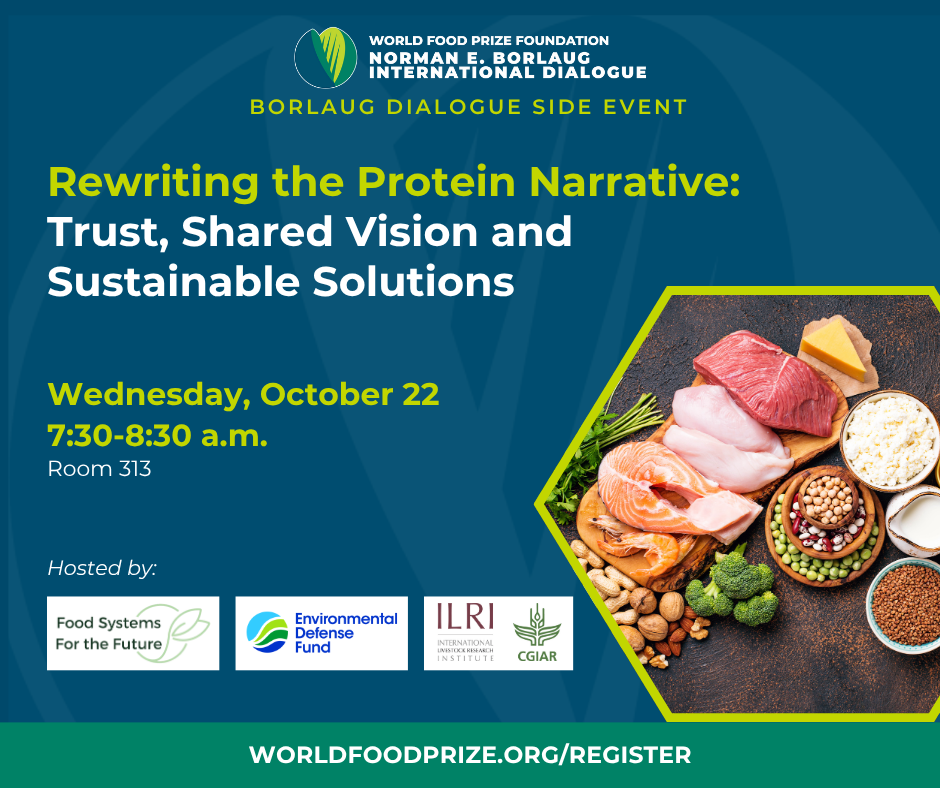

A research-oriented dialogue on how protein systems (plant, microbial, insect, cultivated) can be re-imagined for climate-smart agriculture, bringing in innovation, science and evidence of emerging systems. Feeding nearly 10 billion people while meeting global climate goals demands diverse, resilient protein systems. Animal-source foods remain central to nutrition, livelihoods, and culture, while complementary proteins, including plant-based, microbial, insect, blended, and cultivated options, bring innovation and resilience. Yet too often, these systems are pitted against each other.

Hosted by Food Systems for the Future Institute (FSF), in collaboration with the Environmental Defense Fund (EDF) and International Livestock Research Institute (ILRI)


22/10 Research & Innovation Track: Soil Health & Digital Soil Mapping 


The Soil Health & Digital Soil Mapping session explored how advances in soil science and digital technologies are reshaping our ability to assess, monitor and manage soils at scale — moving from soil as a static resource to soil as a dynamic, data-rich system. Presenters highlighted how digital soil mapping, remote sensing, machine learning, in-situ sensors and large soil-health datasets are enabling more precise, timely interventions in agricultural systems. 

The key conclusion was that soil health must be measured and managed with the same rigour as other agricultural inputs: without adequate data-driven soil-management frameworks, innovations in inputs (e.g., microbials, neglected-crop systems) risk being applied on weak foundations. 

Neglected crops and agroecology pathways benefit not just from biological innovation but from the soil-health diagnostics and mapping systems that support them — hence the research priority is dual: (1) biological/management innovation, and (2) digital soil systems for decision-support.

  • Ismahane Elouafi — Executive Managing Director, CGIAR (also featured in soil-health research coverage) 
  • Johan Swinnen — Director General, International Food Policy Research Institute (IFPRI) — overarching dialogue participant with links to soil & ag systems research. 
  • Paul Temple — Chairman, Global Farmer Network — spoke to farmer experience and soil/regenerative agriculture. 
  • Additional experts from CGIAR and partner institutions working on soil health and mapping technologies.

22/10 Reimagining Partnerships to Transform the Agri-food Innovation Chain

The session focused on how evolving agri-food value chains demand new forms of collaboration and innovation — moving beyond traditional public research and extending through the full chain from discovery to delivery. It highlighted how public–private partnerships (PPPs), cross-sector alliances and institutional innovation can drive efficiency, scale and relevance in agri-food research and innovation.

Key conclusions included that: 

  1. innovation chains must be co-designed with all actors (farmers, industry, R&D, policy) to be effective; 
  2. the public sector must redefine its role—focusing on public goods, enabling environments and equity—while private actors bring speed, scale and market linkage; 
  3. partnerships need to be structured so that benefits and risks are shared, especially for systems in low-income settings; and 
  4. there is no one-size-fits-all: successful cases vary by crop, region and innovation stage, so context-adaptation is essential. 
This session underscores that for agroecology, forgotten foods and neglected crops, the way forward
is less a novel technology and more the way it is integrated into value chains with inclusive, adaptive partnerships.

  • Phil Pardey – Director, GEMS Informatics, University of Minnesota. 
  • Diana Horvath – Co-founder & Executive Director, 2Blades. 
  • Ian Puddephat – Executive (R&D), PepsiCo. 
  • Juan Lucas Restrepo – Director General, International Center for Tropical Agriculture (CIAT). 
  • Ty Vaughn – Lead, Innovation Partnerships, Bayer (Crop Science Division). 
  • Moderator: Appolinaire Djikeng – Director General, International Livestock Research Institute (ILRI).

22/10 School Meals as an Engine for Economic Growth and Trade


The side event emphasised that school-meal programmes extend far beyond nutrition and education: by embedding procurement within local agriculture and supply chains, they serve as powerful levers for economic growth, market development and trade. With more than 400 million children reached globally and estimated procurement flows of around US $48 billion in 2022, the session underscored how well-designed school-feeding systems can generate stable demand from smallholder farmers, create jobs in food processing and logistics, and enhance trade opportunities for agricultural produce. 

The key conclusion was that integrating school-meal programmes into national and regional agrifood systems can multiply benefit: advancing nutrition, education, farmer livelihoods and trade. However, success depends on cross-sector policy alignment (education, agriculture, trade), reliable financing, and supply-chain capacities — especially in lower-income countries.
  • Johan Swinnen (Director General, International Food Policy Research Institute) 
  • Additional panelists were drawn from host organisations: Bread for the World Institute, Alliance to End Hunger and Farm Journal Foundation

23/10 Collaborative Partnerships and Innovation for Global Food Security, an 1890 Land-Grant
Perspective

The session emphasised that the network of 1890 Land‑Grant Universities (historically Black U.S. land-grant institutions) are uniquely positioned to drive inclusive agricultural innovation through collaborative partnerships—bridging academic research, extension services and underserved communities. Key take-aways included: the necessity of embedding research within real-world community contexts (not just labs), the importance of multi-stakeholder and cross-institutional alliances (public-private, NGO-university, global counterparts) to scale solutions, and the need for enhanced investment in capacity-building and infrastructure so that 1890 institutions can lead not only domestically but also in global food-security efforts. 

The dialogue flagged persistent inequities in funding and infrastructure for 1890 institutions, and called for strategic partnerships that empower these universities as co-leaders in innovation ecosystems and knowledge exchange networks.

  • Dr. Ruth Ray Jackson – Interim President, Langston University (one of the 1890 land-grant institutions)
  • Dr. Solomon Haile – Program Officer, USDA National Institute of Food and Agriculture (NIFA) – overseeing 1890/evans-Allen research programmes
  • Dr. Maria Marshall – Dean of Agriculture, Michigan State University (partnering with 1890 institutions)
  • Ms. Kase Wheatley – Director, North Carolina A&T State University (1890 land-grant) Cooperative Extension / outreach lead
  • Dr. Jeffrey Agnoli – Faculty, Ohio State University; moderator of the panel


23/10  Fields of Renewal: Innovation for Soil, Ecosystem and Security

The session highlighted how restoring soil health and ecosystem function is foundational to food security, climate resilience and global stability. Speakers emphasised the need for systemic innovation—combining biological, digital and landscape approaches—to regenerate degraded soils, rebuild ecosystem services and secure agricultural productivity for future generations. The main conclusion was that effective soil and ecosystem renewal requires not only technical innovation (e.g., sensors, bio-inputs, restoration practices) but integrated partnerships, long-term investment and alignment with policy, markets and local communities.

  • Facilitator: Simon Heck | Director General, International Potato Institute
  • Neil Bentley | Vice President, Market Management, Agricultural Solutions, North America, BASF
  • Violet Grgich | President, Grgich Hills Estate Winery
  • Rattan Lal | 2020 World Food Prize Laureate and Distinguished University Professor and  Director of the Lal Carbon Center,  The Ohio State University
  • Paul Temple | Farmer, United Kingdom and Chair, Global Farmer Network


25/10 Financing the Backbone of Africa's Ag Transformation: The Agri-SME


Monday, September 8, 2025

Recommendations human health and soil health connection research

28 August 2025. Listen in as Dr. James White from Rutgers University explains their research team's recent fascination: how microbiology enters the plant root cell nuclei to trigger genetic expression in traits that affect smell, taste, and nutrient density. 

Their team's been on the leading edge of research on rhizophagy, a process meaning "root" and "eating," where microbes work in symbiosis with the plan to gather needed available nutrients and deliver them into the root hairs.

Learn how this breakthrough applies to food is medicine programs and sourcing related to nutrition in health care settings. It includes recommendations on research that will support the work to prove human health and soil health connections. 

Recorded live on Aug. 26, 2025. Hosted by Think Regeneration's Denise Nicol and Ryan Slabaugh. Featuring Dr. James White, a microbiologist researcher at Rutgers University

Monday, June 2, 2025

The Africa Node of the International Research Consortium on Soil Carbon (IRC-SC)

26 - 28 May 2025.
The Africa Node of the International Research Consortium on Soil Carbon (IRC-SC) gathered soil science experts in Nairobi to exchange knowledge & technologies on soil carbon management, towards building resilient soils for a sustainable future (IRC-SC) gathered soil science experts in Nairobi to exchange knowledge & technologies on soil carbon management, towards building resilient soils for a sustainable future.

The key presentations and discussions are on the subject of:
  • Managing Green Carbon for Soil Health and Climate Change Mitigation in Africa.
  • Efforts to manage Soil Carbon in Africa: Imperative for SIA and AFSH-AP
  • Importance of agroforestry to Soil carbon management in Africa: Evidence from the field.
  • The Contributions of the Mineral Fertilizer to Soil Carbon Management in Africa: The Facts, Myths, and Fallacies
  • Making the case for Organic fertilizer manufacturing in Africa: Prospect, and benefits to carbon management
  • The role of capacity building on Soil organic carbon management in Africa: Imperative for Agroecology transition
  • Importance of Soil data to soil carbon management in Africa
The discussions pointed to the need to manage soil Carbon effectively as the key to halting soil degradation in Africa. Statistics show that Africa holds only 10% of the total carbon soil in the world due to the nature and properties of its soil. Despite this condition, the rate of loss of carbon soil is high due to agricultural practices and other land uses. This has a significant negative effect on agricultural productivity, ecosystem services, and climate change. The continental effort to manage African soil is the
development of the Soil Initiative for Africa (SIA) and the Africa Fertilizer and Soil Health Action Plan (AFSH-AP).

Various scientific studies have indicated that integrated soil fertility management remains the best approach to ensuring agricultural productivity in Africa. It is vital to combine the application of organic fertilizer to manage soil carbon and mineral fertilizer to supply plant nutrients. A sound soil information system is necessary to develop a robust advisory tool that combines Soil information with agronomic, climatic, and market data and uses the best ICT tool to inform site-specific mineral and organic fertilizer applications.

The Africa IRC-SC is established as part of global efforts to Raise Awareness on Soil carbon management, develop and disseminate scientific knowledge, and promote public-private synergies, implement thematic programming, contribute to a Strategic Research and Innovation Agenda (SRIA), and expand the scope of knowledge and action of Soil carbon management.

Wednesday, April 9, 2025

From soil science to policy

March 31, 2025. This SOILGUARD event, hosted by the Forum for the Future of Agriculture, provided a unique opportunity to spotlight the critical role of soil biodiversity in sustainable land management. Attendees will learn about the latest tools and methodologies for soil health evaluation, policy integration, and practical solutions. The event translated scientific findings into impactful policies through expert panels, innovative projects like SOILGUARD and others, and targeted sessions for diverse stakeholders. Focusing on a knowledge dialogue, actionable recommendations, and dynamic policy discussions, this conference aims to contribute to shaping the future of soil biodiversity strategies.

Session 1: SOILGUARD: Sustainable soil management to unleash soil biodiversity potential and increase environmental, economic, and social well-being

Soil is the foundation of our environment, economy, and food systems—but how well do we understand the biodiversity beneath our feet? A special highlight is the SoilGuardians App, a powerful tool designed to predict how climate change and land management affect social well-being.

Session 2: Measuring soil biodiversity

SOILGUARD identified four key indicators for measuring soil biodiversity, drawing on extensive research findings. 


Session 3: Practical recommendations and policy integration for sustainable soil management

Experts discussed the alignment of these recommendations with the Soil Monitoring and Resilience Directive and the Common Agricultural Policy (CAP), while also addressed challenges and opportunities in integrating practical solutions with policy.

Key research messages of SOILGUARD 


Regional/local context and soil management are highly relevant: 

There is a high variability in soil biodiversity depending on region’s climate, soil’s properties and geographical location.

  • Climate is the primary driver of cropland biodiversity with high temperatures in warm seasons and aridity potentially linked to biodiversity loss.
  • Soil biodiversity can go hand in hand with both soil multifunctionality and crop yields.
  • The perceptions of soil contributions to human well-being vary significantly across regions.
  • The SoilGuardians App is an innovative tool developed during the project. It serves as a decision-support platform to help farmers evaluate the impacts of their management practices on soil biodiversity and ecosystem functioning.

How do we link the knowledge on Soil monitoring and Climate change resilience to Policy?

  • Facilitate the collaboration and cooperation between the existing EU networks and different stakeholders to scale up the success of soil health initiatives.
  • Ensure a strong science-to-policy interface, where knowledge and insights are shared and transformed into actionable information for both farmers and policymakers.
  • There is a general undervaluation of long-term impacts in both farming and policymaking.

Thursday, February 20, 2025

International Research Consortium (IRC) for Soil Carbon


20 February 2025. Webinar titled "Strengthening Collaboration on Soil Carbon: Roles and Opportunities for the Africa Chapter of the International Research Consortium (IRC-SC)" 
  • Oluwole Fatunbi, highlighted the critical need for effective soil carbon management in Africa. 
  • Keynote speaker Aggrey Agumya emphasized the importance of building scientific capacity and collaboration to enhance climate resilience and food security. 
  • Mathieu Nogues introduced the Sol Carbon International Research Consortium, inviting participants to contribute on an international level. 
  • Dr. Joseph Kube addressed the current state of soil carbon research in Africa, discussing challenges and the potential for significant carbon storage. 
An interactive Q&A session followed, where participants explored various aspects of soil carbon management, including policy implications. The meeting then focused on organizing the African chapter of the IRC, stressing youth involvement and forming partnerships.
  • Current challenges in soil carbon research in Africa include limited long-term studies, fragmented data, and inconsistent monitoring methods that hinder effective carbon management strategies.
  • Opportunities lie in leveraging climate finance and carbon markets to support community-led projects focused on soil carbon enhancement and sustainable agricultural practices.
  • Collaboration among researchers, policymakers, and local communities is essential to develop innovative solutions and promote knowledge sharing for effective soil carbon management across the continent.
The potential for soil carbon storage in Africa despite land degradation.
  • Soil carbon storage in Africa has significant potential due to the following factors:
  • Africa possesses vast areas of degraded land that can be restored through improved land management practices, allowing for increased soil carbon sequestration.
  • Research indicates that Africa could potentially store 30-40% of the global soil carbon, highlighting the continent's crucial role in climate change mitigation.
  • Agroecological practices, such as agroforestry and conservation agriculture, can enhance soil health and organic carbon levels, providing a pathway to improve food security while combating land degradation.
  • Soil carbon storage in Africa has significant potential due to the following factors:
    • Africa possesses approximately 30-40% of the global potential for soil carbon storage, despite the challenges of land degradation.
    • Innovative agricultural practices, such as agroforestry and conservation agriculture, have demonstrated the ability to enhance soil carbon levels and improve soil health.
    • Restoration initiatives, like the Sahel regreening project, highlight the capacity for large-scale restoration efforts to boost carbon sequestration and combat climate change impacts.
Need for integrated approaches to enhance soil carbon and agricultural productivity.
  • Integrated approaches that combine organic and inorganic fertilizers can optimize nutrient availability and enhance soil health, leading to improved agricultural productivity.
  • Utilizing agroecological practices, such as agroforestry and conservation agriculture, can significantly increase soil carbon sequestration while maintaining or boosting crop yields.
  • Collaboration among researchers, farmers, and policymakers is essential to develop and implement effective strategies for soil carbon management that address local conditions and challenges.

Background:

The idea to create a Soil Carbon IRC emerged during the CIRCASA project (2017-2021) together with more than 100 stakeholders and 500 scientists from around the world. It was then reinforced by the launch of the ORCaSa project in September 2022. 

Taking things a step further, the Soil Carbon IRC expands its scope to cover all soils (including forests, pastures, wetlands, and urban areas…). Aided by Impact4Soil, an online platform for collecting and sharing knowledge on soil carbon, the IRC, and its partners and regional nodes aim to provide better access to research, methods and practices related to soil carbon.

Operationalising the International Research Cooperation on Soil Carbon


Launched in September 2022, ORCaSa is a Horizon Europe initiative that aims to bring together international stakeholders working on techniques for capturing and storing carbon in the soil.
  • Start date: 1 September 2022
  • End date: 31 August 2025

The project seeks to address the issue of increasing carbon emissions from human activities, which have led to a disruption in the balance of organic carbon absorbed and stored in the soil to support plant growth.

Over the next three years, ORCaSa expands the scope to include not only agricultural soil carbon but also soil carbon stored in forests, pastures, wetlands, and urban areas. Coordinated by the French National Research Institute for Agriculture, Food and the Environment (INRAE), the project is powered by Impact4Soil, a state-of-the-art platform that will collect knowledge on soil carbon and make it available to the public.

Related:

This workshop ( see the Agenda) gave an insight into what is happening in the United States and Australia, as well as an overview of the context in the Pacific region and Europe.

9-10 May 2024. East Africa Carbon Markets Forum, a premier event bringing together key stakeholders in the region's carbon markets.

4-6 June 2024. ORCaSa's partners organised a webinar to present Impact4Soil, the online soil carbon knowledge platform they have designed. Impact4Soil aimed at a range of professionals and experts from the research community, but also the private sector, NGOs, policy-makers, and anyone with an interest in the health of our soils.

Soil is a global subject of study, and Impact4Soil enables synergies and collaborations by bringing together researchers, farmers, foresters, spatial planners, land managers. Stated simply, the platform covers any type of soil category, from every possible angle.

For the research community, Impact4Soil offers seamless access to soil carbon-related data and meta-analysis, scientific publications, but also best practices and trends.

Thanks to its comprehensive and integrated design, Impact4Soil allows users to:
  • Compare results with the existing literature
  • Discover new insights to complement their work
  • Boost visibility of research partnerships, activities, and outputs

Thursday, September 26, 2024

Policy Workshop on International Carbon Certification Schemes

26 September 2024. Policy Workshop on International Carbon Certification Schemes


What proposals do other regions or countries have in terms of public and private schemes to promote the soil organic carbon (SOC) storage? How can they contribute to the ongoing discussions on the Carbon Removals Certification Framework (CRCF) from the European Commission?

This workshop ( see the Agenda) gave an insight into what is happening in the United States and Australia, as well as an overview of the context in the Pacific region and Europe.

Organised by the ORCaSa project in the framework of the Soil Carbon International Research Consortium (IRC), this event was an opportunity for experts and policymakers to meet, exchange ideas, and make progress in the field of soil carbon policy.

Moreover, the results of this workshop will be used to draw up a policy brief. Indeed, to achieve the objectives of the Paris Agreement on climate neutrality, to support the EU Green Deal and the objectives of the EU Soil Mission, Europe must coordinate its research and innovation efforts on soil carbon with international stakeholders and policymakers.
  • ORCaSa & the Soil Carbon International Research Consortium (IRC), an overview. Suzanne Reynders, INRAE, Coordinator 
  • European context: Certification Framework for Carbon Removals and Carbon Farming. Christian Holtzleitner, Head of Unit for Land Economy and Carbon Removals, Directorate-General for Climate Action, European Commission or other DG representative. 
  • Private schemes in USA. An overview of the agricultural carbon market in the USA: methods, regulations, and key players. Bruno Basso, Michigan State University, USA. • Public schemes in the USA. Amy Swan, Colorado State University, USA
  • National policy in Australia. How is it working for the last 10 years? How it is linked to research? Senani Karunaratne (Video @ 58:22:00), Commonwealth Scientific and Industrial Research Organisation, Australia
  • Pacific region context. Ben Mac Donald, (Video @ 1:18:00) Commonwealth Scientific and Industrial Research Organisation,
    Australia
  • Soil Mission Board. EU Soil Mission for healthy soils promoting soil carbon stocks. Liisa Pietola, Expert board member of the EU Mission: A Soil Deal for Europe, The Finnish Innovation Fund Sitra, Finland.
Discussion & debate Moderated by Jean-François Soussana, Vice-President International, INRAE & Edouard Lanckriet, Strategy Director and carbon farming expert, Agrosolutions.


Background:


Operationalising the International Research Cooperation on Soil Carbon

Launched in September 2022, ORCaSa is a Horizon Europe initiative that aims to bring together international stakeholders working on techniques for capturing and storing carbon in the soil.
  • Start date: 1 September 2022
  • End date: 31 August 2025
The project seeks to address the issue of increasing carbon emissions from human activities, which have led to a disruption in the balance of organic carbon absorbed and stored in the soil to support plant growth.

Over the next three years, ORCaSa expands the scope to include not only agricultural soil carbon but also soil carbon stored in forests, pastures, wetlands, and urban areas. Coordinated by the French National Research Institute for Agriculture, Food and the Environment (INRAE), the project is powered by Impact4Soil, a state-of-the-art platform that will collect knowledge on soil carbon and make it available to the public.

At the forefront of the Soil Carbon International Research Consortium (IRC) that will emerge from the ORCaSa project, stands the firm belief that a Soil Deal for Europe is needed if we want to meet our climate goals – healthy soils, healthy planet.

Related:


Shared resource:

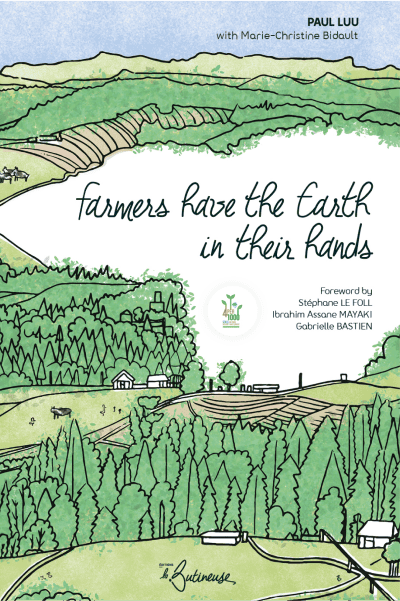
Paul Luu, with Marie-Christine Bidault Farmers have the Earth in Their Hands

How can we feed 10 billion people tomorrow? Can we avoid deforestation, the intensive use
of fertilisers and synthetic products, which aggravate climate change and the erosion of biodiversity? Should the debate be limited to a strict opposition between organic and conventional agriculture ? Can a better distribution of resources and changes in diet solve everything?

There is no single answer to all these questions, but agriculture has a magical side. It is not only part of the problem, it is also part of the solution, thanks to the superpowers of the soil. By being alive, preserved and regenerated, the soil can feed us, ensure the diversity of life on Earth and store carbon to help offset our greenhouse gas emissions.

Through a few scientific benchmarks, a brief historical review and the exploration of virtuous practices that can contribute to the life of the soil, this book opens up a bright future. Farmers have the Earth in their hands, but it is up to all of us to support them.

Tuesday, September 10, 2024

Agronomy and Policy Solutions for Effective Implementation of the African Fertilizer and Soil Health Action Plan

10 September 2024. Agronomy and Policy Solutions for Effective Implementation of the African Fertilizer and Soil Health Action Plan. Co-organized by IFPRI, CGIAR, Germany’s Federal Ministry for Economic Cooperation and Development (BMZ), and Africa Network of Agricultural Policy Research Institutes (ANAPRI)

Speakers from the research, policy, nongovernmental, and private sectors highlighted agronomy solutions and policy frameworks that can bolster stakeholder resilience. These experts will draw on the work of two CGIAR research initiatives, Excellence in Agronomy and National Policies and Strategies, to explore the potential of agronomy at scale solutions and present strategies for developing effective policy frameworks in support of soil health, balanced plant nutrition, and increased agricultural productivity and livelihoods. 

Opening Remarks
  • Charlotte Hebebrand, Director of Communications and Public Affairs, IFPRI
  • Antony Chapoto, Executive Director, Secretariat, Africa Network of Agricultural Policy Research Institutes (ANAPRI)
Outcome of the AFSH and Next Steps
  • Wole Fatunbi, Ag. Director of Research and Innovation, Forum for Agricultural Research in Africa (FARA)
  • Oumou Camara, Vice President of Programs, International Fertilizer Development Center (IFDC)
  • Bernard Vanlauwe, Deputy Director General, Research for Development, International Institute of Tropical Agriculture (IITA)
  • Felicitas Röhrig, Senior Policy Officer, Division “Agriculture, rural development”, German Federal Ministry for Economic Cooperation and Development (BMZ)
  • Habiba Mouttaki, Chief Commercial Officer, Office Chérifien des Phosphates (OCP) Africa
Supporting Agronomic Solutions at Scale and Enabling Policy Frameworks for Sustainable Fertilizer Management and Soil Health 
Discussion 
  • Richard Mkandawire, Africa Director, Alliance for African Partnership, Michigan State University (MSU); National Planning Commissioner, Malawi
  • Maria Wanzala, Vice President, Policy Services, African Fertilizer and Agribusiness Partnership (AFAP)
  • Nancy Laibuni, Advisor, Associate Member, Council of Economic Advisors- Executive Office of the President, Kenya

Tuesday, May 28, 2024

9th International Symposium on Soil Organic Matter (SOM2024)

26 - 31 May 2024. The 9th International Symposium on Soil Organic Matter (SOM2024) is currently underway at the Mohammed VI Polytechnic University (UM6P) in Benguerir, marking the first time the event has been held on the African continent.

See programme

Africa plays a critical role in global food security, with vast agricultural lands and a rapidly growing population. However, the continent also faces unique challenges when it comes to soil health. Decades of drought, overgrazing, and inadequate land management practices have contributed to soil degradation, a major threat to agricultural productivity.

According to a press release, SOM2024 aims to address these issues by showcasing the expertise of African researchers in agriculture, environmental science, and soil science. The symposium provides them with a platform to share their knowledge and findings with leading international experts, fostering cross-continental collaboration and accelerating progress in understanding soil organic matter.

But the significance of SOM2024 goes beyond knowledge sharing. It’s about highlighting Africa’s contributions to finding solutions for global problems like soil degradation and climate change.


Related:

Find below a curated selection of videos on enriching soil quality organically shared by International People's Agroecology Movements, IPAM. All the videos are recorded in Urdu with English subtitles.
  • Convert garden waste into rich resource


IPAM PakistanIPAM Pakistan is a research-learning-action approach to agroecology that focuses on small-food producers and farming communities. 
  • IPAM promotes agroecology as a sustainable approach to agriculture and food production and development, in the framework of food sovereignty, ecological and social justice. 
  • At the core of IPAM is a network of Field Learning Sites, which serve as training centres or campuses of farmers’ fields, civil society organizations, institutions and universities that offer on-site learning on agroecological farming methods, innovations and techniques and sharing of experiences of movement-building for agroecology. 

Tuesday, May 7, 2024

Africa Fertilizer and Soil Health Summit (AFSH24)


"Pre-events"


Extracts Side events AFSH24


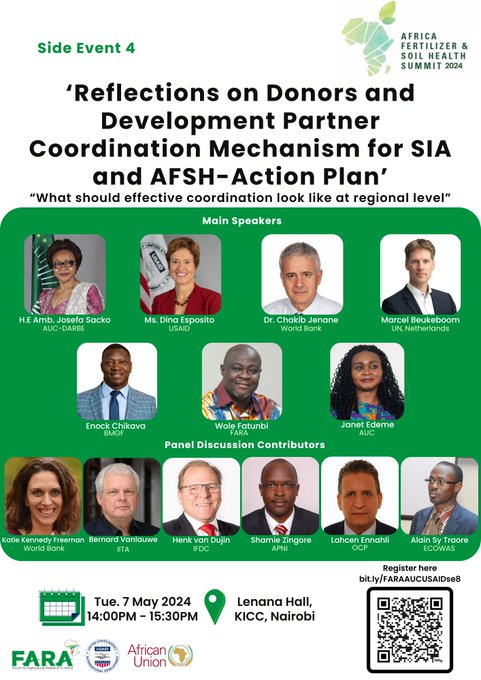
7  May. Side event 4. 14:00 – 15:30. (13:00 - 14:30 CET) Reflections on Donors and Development Webinar

  • Partner Coordination Mechanism for SIA and AFSH-Action Plan 

7  May. 14:00–15:30 (13:00 - 14:30 CET)  African Agroecological Fertilizers for Healthy Soils & Healthy Communities Webinar

  • AFSA Side event 
  • The event will highlight the benefits of agroecological practices and biofertilizer innovations happening across Africa will feature presentations from Kenyan agroecology centres and a government official
  • Anne Maina - Biodiversity and Biosafety Association of Kenya
  • Bridget Mugambe - Alliance for Food Sovereignty in Africa
  • Esther Bett - RODI Kenya, David Karanja - Organic Agriculture Centre of Kenya, 
  • Ferdinand Wafula - Bio Gardening Innovations
  • Daniel Gitahi - Director of Agriculture Strategy, Murang’a County Government

7  May. Side Event 7:  14:00 - 15:30 (13:00 - 14:30 CET) What Business and Industry can do to help Implement the 10-YearAction Plan Webinar 

by AFAP-IFA Side Event (see program in the link)

Panel 1. What do business and industry intend to do to support the implementation of the 10-Year Action Plan? 
  • Innocent Okuku, CEO, WAFA,
  • William Ngeno, Country Manager for Kenya & Uganda, Yara 
  • Mehdi Filali, SVP West Africa, OCP Africa
  • Ashish Lakhotia, CEO, Fertilizer and Agri-Inputs, ETG
Panel 2. What type of enabling environment would facilitate this increased private sector investment and engagement?
  • François Visagie, Managing Director, Manufacturing, Omnia 
  • Malolan Sampath, Chief Marketing Officer, Indorama 
  • Adriaan de Lange, CEO, Ma’aden Africa 
  • Lilian Mbuthia, CEO, Fertilizer Association of Kenya

  • by DeSIRA-Lift and IFAD
  • Fergus Sinclair (CIFOR-ICRAF)
  • James Wangu (WRI)
  • Annick Sezibera (CAPAD)
  • Talash Huijbers (Insecti Pro) 
  • Kishero Oliver (coffee farmer)

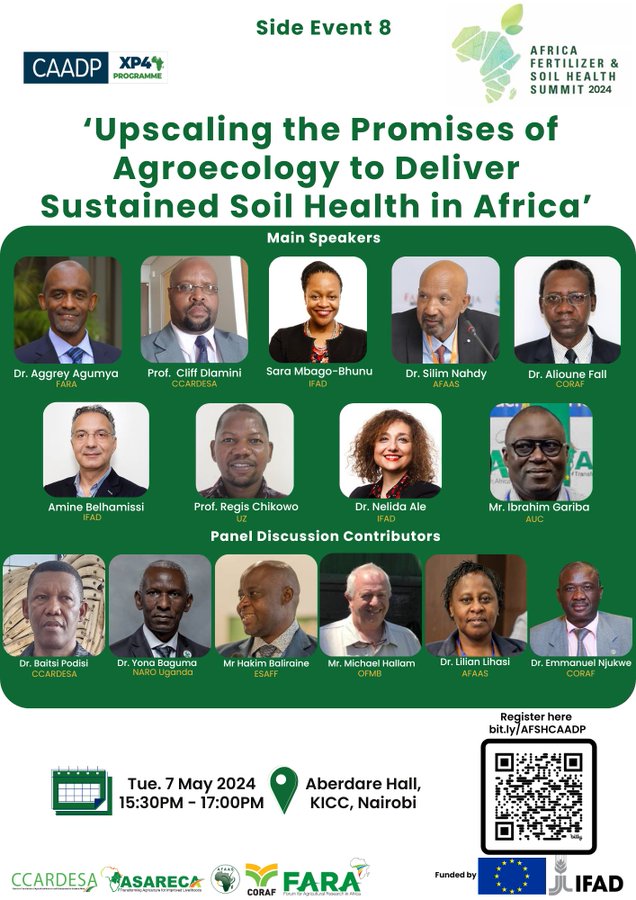
7  May. Side Event 8: 15:30 (14:30 CET) Upscaling the Promises of Agroecology to deliver Sustained Soil Health in Africa Webinar

  • Lead Organizer: CCARDESA Co-organizer: ASARECA, CORAF, AFAAS, FARA and IFAD (CAADP XP4 Institutions)

7  May. Side event 31: Importance and benefits of integrated landscape soil and water management to optimize fertilizer use and soil health across agricultural land uses. 

By: AFSA

7  May. Side event 34: 15:30 - 17:15 (14:30 CET)  Achieving Resilient Agri-Food Systems through Regenerative Agriculture in the Wake of Global Fertilizer Crises and Climate Change: Innovations and approaches for Improving Soil Health and Sustainable Intensification 

by: Sasakawa Africa Association. See zoom link 
  • Prof. Ruth Oniang’o (picture)/ Honorary Advisor, Sasakawa Africa Association (SAA), Editor in Chief, AJFAND Journal, and 2017 Africa Food Prize Recipient
  • The Soil Initiative for Africa - Reversing Decades of Decline in Soil Health in Africa - Dr. David Nielson, Senior Advisor to the North American Agricultural Advisory Network (NAAAN), Senior Advisor to the African Agricultural Research, Innovation, and Education Institutions (AARIEI); Former Lead Agriculture Economist at the World Bank Group.
  • Achieving Food Security through Regenerative Agriculture in the Wake of Global Fertilizer CrisesDr. Amit Roy (picture) / Board Chair, Sasakawa Africa Association (SAA) & former Chief Executive Officer, IFDC
  • Disseminating Regenerative Agriculture (RA) for Africa and Enhancing Livelihoods: SAA’s experience in promoting RA - Dr. Stella Kabiri / Lead Regenerative Agriculture, Sasakawa Africa Association (SAA)
  • Decreased dependency on imported fertilizer through utilization of locally produced substitutes for phosphate in Sahelian ecosystems - Dr. Andre Bationo, Chief of Party for SAPEP, 2020 Recipient of the Africa Food Prize
  • Dr. Martin Fregene, Director, Agriculture and Agro-Industry, African Development Bank
  • African Extension Framework for Improving and integrating Soil Health and Sustainable Intensification, - Dr. Silim Nahdy, Executive Director, AFAAS
Panel Discussion Translating the Vision of Regenerative Agriculture (RA) into Practical Innovations: Addressing Fertilizer Cost Challenges for African Smallholders

7  May. Side event 17.00-18.30 (16:00-17:30 CET) Soil Health and Water Management Innovations for Sustainable Agricultural Landscape in Africa

Maintaining healthy soil under climate change is a pressing concern, and this session offers a unique opportunity for sharing and learning. Organized by the International Water Management Institute (IWMI), the Alliance of Bioversity International and CIAT (ABC), and the CGIAR Initiatives on Nature Positive Solutions, Excellence in Agronomy, and West and Central African Food Systems Transformation, it will present integrated landscape soil and water management innovations for optimizing fertilizer use and enhancing soil health across various agricultural land uses.
  • Beyond Fertilizer: The water dimension of soil health. Dr. Noah Adamtey (IWMI)
  • Nature-positive solution for building soil health and strengthening smallholder farming systems in sub–Saharan Africa. Dr. Kaushal Manoj (ABC)
  • Maximizing landscape health: Integrated soil & water management solutions at scale. Dr. Birhanu Zemadim (IWMI)

8 May. Side event 37: 14:00 – 15:30 (13:00 - 14:30 CET) Monitoring soil health and soil health investments at different scales. 

By: EC (DG INTPA)

8 May. Side event 39: 14:00 – 15:30 (13:00 - 14:30 CET) Using mineral fertilizers in agroecological approaches in Africa 

Organization: CIRAD + Agrinatura partners. This side event is proposed as part of the SASi-SPi Science-Policy Interface project with the European Union.

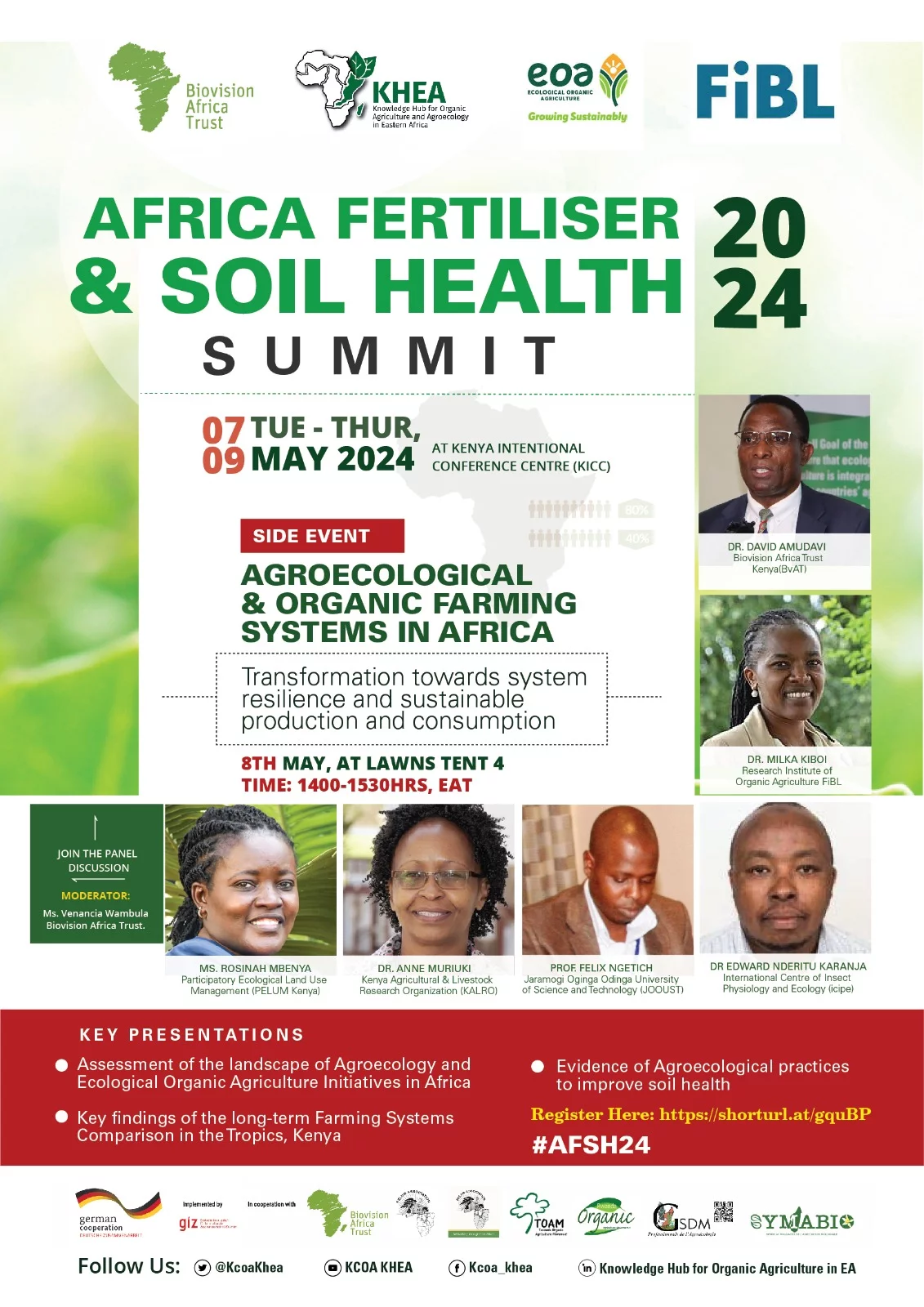
8 May. Side event 49. 14:00 – 15:30 (13:00 - 14:30 CET) Agroecological and Organic Farming Systems in Africa– transformation towards System Resilience and Sustainable Production and Consumption 

  • Biovision Africa Trust (BvAT) through The Knowledge Hub for Organic Agriculture and Agroecology in Eastern Africa (KHEA) and the Ecological Organic Agriculture Initiative (EOA-I), in partnership with the Research Institute of Organic Agriculture (FiBL) 
  • The Knowledge Hub for Organic Agriculture and Agroecology in Eastern Africa (KHEA) is one of the five Knowledge Hubs under the The Knowledge Centre for Organic Agriculture and Agroeocology in Africa (KCOA) Project. 
    • This KHEA Hub is being coordinated by Biovision Africa Trust (BvAT) in Kenya as the lead agency with a co-hosting arrangement with Participatory Ecological Land Use Management (PELUM) Uganda. 
    • KHEA is currently being implemented in five Eastern Africa countries with Country Implementing Partners (CIPs) as follows: Kenya; PELUM Kenya, Uganda; PELUM Uganda, Rwanda; ROAM, Tanzania; TOAM and Madagascar; GSDM and SYMABIO
    • The main goal of the KHEA Hub is to integrate Ecological Organic Agriculture (EOA) into the participating countries’ agricultural systems by generating, capturing, and sharing information know-how and integrating these into agricultural practices and decision-making for improved livelihood.
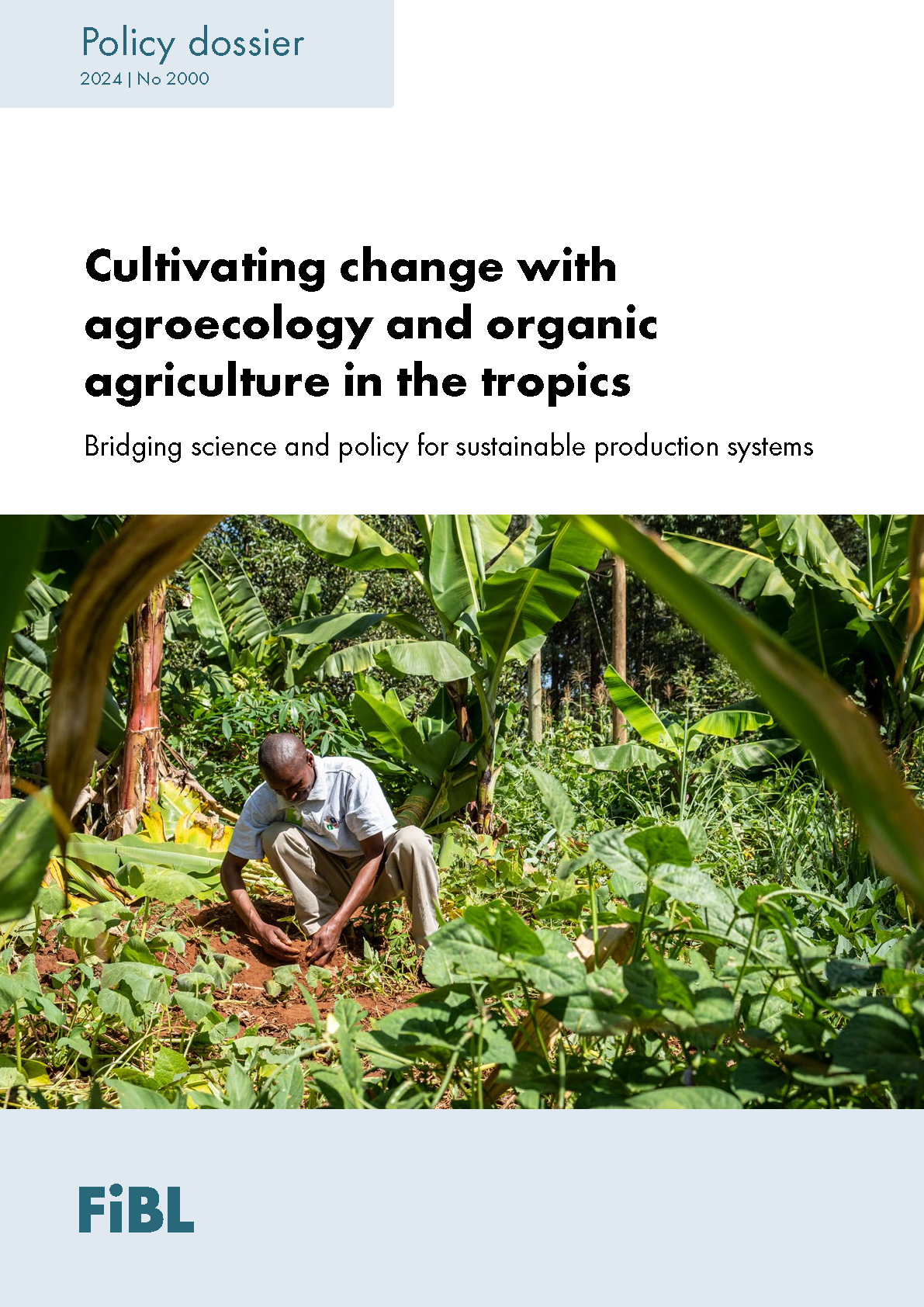
  • FiBL presented the report: FIBL (2024) Cultivating change with agroecology and organic agriculture in the tropics Bridging science and policy for sustainable production systems #48 pp.
    This policy dossier aims to present decision and policymakers and experts in the context of international cooperation with scientific evidence on how AE/O approaches can contribute to a beneficial transformation of production systems in the Tropics.

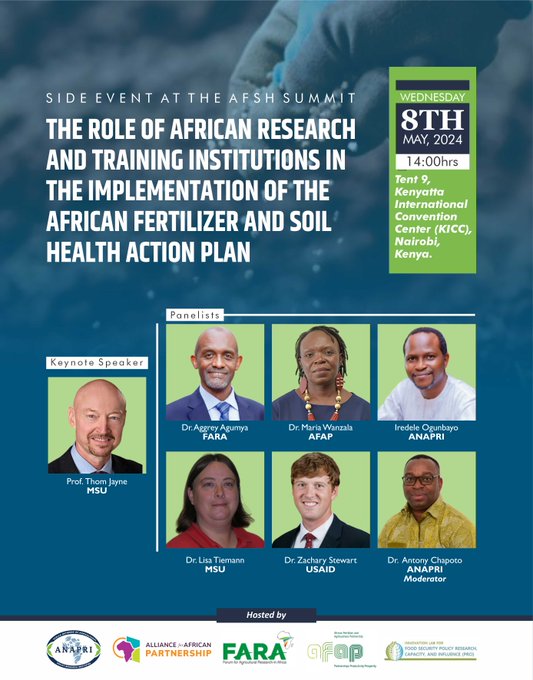
8 May. Side event 59: 14:00 – 15:30. Envisioning the Role of African Research and Training  Institutions in Shaping PolicyReforms for Fertilizer and Soil Health Programmes Across Africa 

This side was event organized by the Africa Network of Agricultural Policy Research Institutes (ANAPRI), in partnership with the Forum for Agricultural Research in Africa (FARA), the Alliance for African Partnership (AAP), African Fertilizer and Agribusiness Partnership (AFAP), and Michigan State University (MSU) through the Innovation Lab for Food Security, Policy Research, Capacity, and Influence (PRCI).

This panel identified opportunities for partnership and positioning African Research and Training Institutions to contribute more effectively in the domestication and implementation of the Fertilizer and Soil Health Action Plans across the African continent. 

This event brought together policy makers, development practitioners, local and international development partners, and research institutions and policy think tanks to identify how African-led institutions can take a lead in driving fertilizer use soil health in Africa.

The Feed the Future Innovation Lab for Food Security Policy Research, Capacity, and
Influence
 is a new innovation lab supported by USAID’s Bureau for Resilience and Food Security (RFS). It's a collaborative effort among consortium partners that seeks to enhance the ability of local policy research organizations to conduct high-quality food security policy research and influence food security policy more effectively while becoming increasingly self-reliant.
The Global Change Learning Lab in Sub-Saharan Africa is an integrative website that facilitates agroecology research and information sharing by MSU Global Change Science researchers and partners collaborating on action research in Sub-Saharan Africa. The majority of its research takes place in Malawi. Additional research is starting up in Tanzania, supported by SIIL, and is also on-going in Ghana, Mali, and Zambia. Use the arrow below to open the legend to view locations of Africa RISING Mother Trials, weather stations, and LUANAR (Lilongwe University of Agriculture & Natural Resources). See in particular its web pages on Soil Quality, Soil Fertility & Low Productivity
 
  • Dr. Bernard Vanlauwe (IITA) 
  • Dr. Anne Muriuki (KALRO/AfSP) 
  • Dr. Leigh Ann Winowiecki (ICRAF/CA4SH) 
  • Dr. Shamie Zingore African Plant Nutrition Institute (APNI) Benguérir, Morocco
  • Dr. Tilahun Amede (AGRA)
  • Rapporteur: Dr Liesl Wiese-Rozanov (FARA) 

8 May. 11:30. 1:00 pm CET. Parallel Session H: Emerging opportunities with organic and biofertilizers for soil health in Africa 

  • Facilitator: Dr. Nelida Ale (IFAD) 
  • Prof. Bernhard Freyer (Institute of Organic Farming, BOKU University of Natural Resources) 
  • Ms. Carla Montesi (EU DG/INTPA) 
  • Dr. Abdou Tenkouano (ICIPE)
  • IFAD Representative, ESA 
  • Dr. D. Amundavi (Biovision Africa Trust) Representative SME operator in organic/ biofertilizers – Real IPM Company Kenya 
  • Mr. Ibrahima Coulibaly (PAFO)