Platform for African – European Partnership in Agricultural Research for Development
Showing posts with label Agricultural Research. Show all posts

Monday, June 2, 2025

G20 Meeting of Agricultural Chief Scientists (MACS)

26-28 May 2025. Polokwane, Limpopo, South Africa. G20 Meeting of Agricultural Chief Scientists (MACS).

Transforming agriculture through research and innovation for providing adequate and nutritious food to all, minimising food waste and loss, boosting digital and precision technology and access to data to the farmers, combating the transboundary pests and diseases, encouraging investment in agricultural research & innovations for sustainably enhancing agricultural productivity while protecting the biodiversity and local food systems in the realm of climate change and diversification in agri-food value chain is essentially required. The challenges are much formidable than ever before. 

An innovative and collective effort is required to address such formidable challenges. Hence, in 2011 the G20 Member States decided to address the diverse global challenges in agriculture affecting the people and planet through join agricultural research and innovation strategies as well as implementation of initiatives under new cooperation formats.
  • Issue Note: Agriculture and food systems are central to global food and nutrition security, with
    over 700 million people experiencing hunger and Africa being particularly worst affected by food insecurity.
  • Programme
The 2025 G20 Meeting of Agricultural Chief Scientists (MACS) concluded with a strong emphasis on advancing climate-resilient agriculture, fostering equitable research collaboration, and supporting science-based policy for sustainable food systems. Key outcomes included a commitment to strengthening global cooperation on agricultural research and innovation, particularly with institutions in the Global South. Delegates agreed to prioritize the development of climate-smart technologies, promote open data sharing, and support inclusive innovation that integrates traditional knowledge with cutting-edge science.

The meeting also emphasized building resilient agri-food systems through enhanced public-private partnerships, investments in capacity development, and improved coordination between national research systems. Special attention was given to the importance of nutrition-sensitive agriculture, biodiversity conservation, and soil health. South Africa, as host, highlighted the role of African research institutions and the need for more equitable participation in global scientific dialogues. The MACS communiqué reflected a shared resolve among G20 members to align agricultural research with the goals of food security, sustainability, and resilience in the face of climate change and geopolitical disruptions.


Tuesday, June 4, 2024

EU-AFRICA Developing excellent research and talent together

4 June 2024
, 08:30-14:00 CET. EU-AFRICA Developing excellent research and talent together

The aim of this hybrid conference was to identify the most pressing needs, showcase ongoing collaborative initiatives, and create synergies within the research & innovation ecosystems of African and European countries.

EU-AFRICA COLLABORATION INITIATIVES IN THE FIELD OF RESEARCH AND INNOVATION

  • Ahmed Maalel, Regional Representative for EURAXESS Africa

DEVELOPING TALENT

  • Hicham El Habti, President, University Mohammed VI Polytechnic
  • Walter Timo de Vries, Professor Land Management and Academic Coordinator of TUM.Africa, Technical University of Munich
  • Claire Morel, Head of Unit – Marie Skłodowska-Curie Action, Directorate-General for Education, Youth, Sport and Culture, European Commission
  • Matteo Gatti, Senior Researcher, Irradiated Solids Lab, Institut Polytechnique de Paris, and Lead of the EuroTech Working Group on EU-Africa collaboration
  • Andreas Mortensen, Associate Vice President for Research, EPFL

THE GREEN TRANSITION

  • Maram Ali Ahmed (picture), Postdoctoral Fellow at École Polytechnique/National Ribat University/Al Neelain University, Khartoum, Sudan
  • Hélène Charton, Policy Officer, Directorate-General for International Partnerships, European Commission
  • Vanessa Miani, Policy Analyst Asia, Africa, MENA and External Relations, Directorate-General for Research and Innovation, European Commission
  • Emmanuel Nakouné, Scientific Director, Institut Pasteur de Bangui, Central African Republic 
  • Mariana Rufino, Chair of Livestock Systems, Technical University of Munich
  • Kirsten Thomsen, Head of Research Secretariat, DTU Aqua, Technical University of Denmark

Monday, May 8, 2023

8th Multi-stakeholder Forum on Science, Technology and Innovation for the Sustainable Development Goals


2-5 May 2023.
8th Multi-stakeholder Forum on Science, Technology and Innovation for the Sustainable Development Goals
In line with recent mandates and as in previous years, the STI Forum facilitated discussions on science, technology and innovation cooperation in support of the SDGs. In addition to providing the mandated inputs for the High-Level Political Forum on Sustainable Development to be held from 10 to 19 July 2023, the Forum took a broader look at the contribution of STI to the achievement of all the SDGs in recognition of the September mid-term review of SDG progress.

Accordingly, the theme for the STI Forum 2023 was: “Science, technology and innovation for accelerating the recovery from the coronavirus disease (COVID-19) and the full implementation of the 2030 Agenda for Sustainable Development at all levels”.

STI Forum Day 0

02/05 Science, Technology and Innovation in Africa Day 2023

  • Thematic Session 1: Mobilizing and Engaging Diaspora for STI in Africa
  • Thematic Session 2: STI for High Productivity and Economic diversification in Africa
  • Thematic Session 3: Role of Youth and the African Continental Free Trade Area (AfCFTA) in STI
See dedicated PAEPARD blogpost + recording
With the transcript of the presentations by 
  • Mr. Alessandro Rainoldi, Head of Territorial Development Unit, Joint Research Centre, European Commission
  • Ms. Shamika Sirimanne, Director, Division on Technology and Logistics, UNCTAD

STI Forum Day 1

03/05 Side Event - Enabling Agricultural Innovation Systems (AIS) for developing STI roadmaps for SDGs in the context of post COVID-19

See dedicated PAEPARD blogpost + recording

03/05 Session 1: Strengthening trust in science and technology

Scientific advisory commissions. One institutional tool for enhancing trust in science are the scientific advisory commissions, science academies, and committees. These commissions are often responsible for evaluating scientific evidence and providing recommendations on various issues related to science and technology. By providing independent and objective assessments of scientific evidence, scientific commissions help to ensure the accuracy and reliability of scientific findings. This helps to build trust in the scientific process and the validity of research findings.

Open science. Another tool for enhancing credibility of science and increasing science diplomacy is open science. When scientific research is conducted in a transparent and collaborative manner, it can enhance the credibility of scientific findings and promote greater confidence in scientific conclusions.

Citizen science. In addition to open science, direct public engagement with, and participation in, scientific processes and innovation, can potentially enable greater trust in science and technology. 

Highlighted speakers:
  • Willem Fourie et al., Using machine learning to improve the science-policy-society interface on the SDGs in South Africa, University of Pretoria, South Africa


STI Forum Day 2: Session 4 + 5

04/05 Presentation of the Global Sustainable Development Report 2023

The 2023 Global Sustainable Development Report (produced every 4 years) will be launched in September 2023.
  • The 2023 Report will build on the 2019 Report providing evidence that can help decision-makers to accelerate action and overcome impediments that stand in the way of progress on sustainable development.
  • The focus will be on accelerating transformation through important entry points and enabling science to support this acceleration.

04/05 Session 4: Breaking down barriers- closing the gender gap in science and technology

This session highlighted examples and lessons learned from gender and STI initiatives that are helping to move the needle towards making innovation ecosystems more inclusive and representative and explore what is needed to scale up and accelerate further progress

04/05 Session 5: Global research cooperation and funding- sharing knowledge through new partnerships

This session explored the status of global research cooperation and funding - especially in the Global South – for the achievement of the SDGs. It will bring together key public and private funders of research and development (R&D) and other key R&D actors.

Sources like UNESCO and WIPO offer important insights into overall R&D investments and priorities for both developed and developing countries. In general, SDGs related to health, climate change, and energy tend to receive more R&D investments. For example, investments in health research (SDG 3) are substantial, driven by both public and private sectors. 

The biggest R&D donors vary depending on the sector and the SDGs being considered. However, some of the largest R&D investors globally include the United States, China, Japan, and the European Union. They countries contribute a significant portion of global R&D funding across various sectors, including those related to the SDGs
  • Public R&D funding, typically provided by governments and international organizations, is essential for supporting basic research, capacity building, and projects with high social and environmental impact but lower financial returns.
  • Private R&D funding, predominantly driven by the business sector, is crucial for translating research findings into marketable products and services. The private sector accounts for approximately two-thirds of global R&D spending, with significant investments in fields such as information and communication technologies, biotechnology, and clean energy. However, private R&D funding is often concentrated in areas with higher commercial potential, potentially overlooking research areas with broader societal benefits
Panelists:
  • Ms. Katja Becker, President, Global Research Council; and President, Deutsche For schungsgemeinschaft, Germany
  • Ms. Ana Cristina Amoroso das Neves, Head, Internet Governance Office, FCCN, Unidade de Computação Científica da Fundação para a Ciência e a Tecnologia, Portugal; and Chair of the UN Commission on Science and Technology for Development
  • Mr. Kazuhito Hashimoto, President, Japan Science and Technology Agency
  • Mr. Fulufhello Nelwamondo, CEO, National Research Foundation of South Africa

Lead discussants:
  • Ms. Charlotte Watts, Professor, Chief Scientific Adviser and Director for Research and Evidence in the Foreign, Commonwealth and Development Offices, United Kingdom
  • Mr. Marco Antonio Zago, President, FAPESP – São Paulo Research Foundation, Brazil
  • Ms. Kendra Sharp, Head, Office of International Science and Engineering, National Science Foundation, USA

STI Forum Day 2: Session 6 + 7

This session explored a way forward for forging an equitable, digital future for all. Rapid digitalization is enhancing the way we live and work in a myriad of ways. It has the potential to open-up opportunities that we may not even have imagined yet. However, gaps in connectivity and access to digital infrastructure within and across countries remain a serious concern.
  • When data and AI are leveraged for good by ensuring they are safe and beneficial for all, and their value is shared among and within countries, they can rapidly accelerate progress towards all 17 SDGs. For example, machine-learning algorithms are able to sift through and interpret massive amounts of data from various sources to carry out a wide range of tasks. 
  • They can analyze high-resolution images from satellites, drones or medical scans to improve responses to humanitarian emergencies, help tackle climate change, increase agricultural productivity, enhance production efficiency in manufacturing, or help doctors identify and treat illness. 
  • The transformative power of AI and such intelligence technologies, however, also comes with challenges, ranging from issues of transparency, trust and security, privacy and biases, to concerns about displacing jobs and exacerbating inequalities and injustice. 
Panelists:
  • Ms.Hermina Johnny, Founder, Artemis Foundation
  • Ms. Alison Gillwald, Executive Director, Research ICT Africa, an African digital policy and regulatory think-tank based in South Africa
  • Mr. Chris Sharrock, Vice President of United Nations and International Organizations, Microsoft
  • Mr. Henrik Cox, Head of Product, Conservation X Labs
Lead discussants:
  • Ms. Mi Ock Mun, President of the Science and Technology Policy Institute (STEPI).
  • Mr. Robert Bertram, Chief Scientist, Bureau for Resilience and Food Security, USAID
  • Ms. Shamika Sirimanne, Director, Division on Technology and Logistics of United Nations Conference on Trade and Development (UNCTAD)
  • Mr. Amir Dossal, President and Chief Executive Officer, Global Partnerships Forum

STI Forum Day 2: Side events

04/05 Building Bridges with Technology: The Role of Enhanced Equitable Connectivity in Achieving the 2030 Agenda (STI Forum Side Event)

Real world experiences in bridging the digital divide in the Dominican Republic and in Niger, highlighting (i) connectivity as a form of aid, (ii) technology in increasing the efficacy of aid delivery, and (iii) access to information as a human right.
  • H.E. Ambassador Joan Cedano, Deputy Permanent Representative of the Dominican Republic 
  • Mr. Ibrahima Guimba Saidou, Director General of the National Agency for the Information Society in Niger (ANSI) 
  • Ms. Gabriela Alvarado, Representative and Country Director of the Dominican Republic, WFP
  • Pre-recorded videos of field operations from WFP and local partners in the Dominican Republic and Niger

04/05 Roundtable on Generative AI for the SDGs: Friend or Foe, Hope or Hype? (STI Forum Side Event)

Generative AI, a subfield of AI that can create novel content or ideas, can be a powerful tool for advancing the United Nations' SDGs. It has the potential to inform new and creative solutions to complex problems but is also raising many concerns. This roundtable will present a landscape overview of generative AI, including benefits and risks of its use and the current UN response to the rapidly evolving technology.
  • Ursula Wynhoven, ITU Representative to the UN 
  • Ambassador Cornel Feruţă, Permanent Representative of Romania to the United Nations
  • Guilherme Canela Godoi, UNESCO, Chief of Section, Freedom of Expression and Safety of Journalists 
  • Robert Opp, UNDP, Chief Digital Officer -
  • Amira Dhalla, Consumer Reports, Director of Impact Partnerships and Programs 
  • Rami Amin, World Bank, Project Lead, Technology Policy, Strategy, and Finance 
  • Dan Altman, Google, Lead, Technology and Society 
  • Cass Matthews, Microsoft, Office of Responsible AI


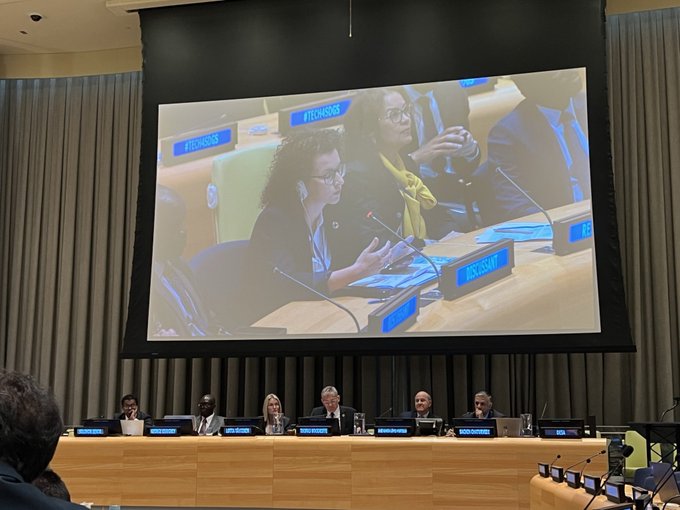
04/05 Implementing national STI4SDG roadmaps – capacity building and Partnership in Action (STI Forum 2023 Special Event)

This special event explored means and ways to support the implementation of national STI4SDGs roadmaps and highlight national pilot projects.

Panelists: 
  • Ms. Lotta Tähtinen, Interim Chief, Integrated Policy Analysis Branch, United Nations Department of Economic and Social Affairs (UNDESA) 
  • Mr. Sachin Chaturvedi, Director General, the Research and Information System 
  • Mr. George Essegbey, Chief Research Scientist, Science and Technology Policy Research Institute (STEPRI), Ghana 
  • Mr. Solomon Benor, CEO for Research and Community Engagement Affairs, Ministry of Education, Ethiopia 
High-level respondents: 
  • Mr. Robert Kayinamura, Minister Counsellor, Deputy Permanent Representative of the Republic of Rwanda to the United Nations 
  • Ms. Ismahane Elouafi, Chief Scientist FAO
Interactive discussion: 
  • Mr. Clapperton Chakanetsa Mavhunga, Professor of Science, Technology, and Society (STS) at MIT 
  • Mr. Alfred Watkins, Founder and CEO, Global Solutions Summit 
  • Ms. Angela Sarcina (see picture), Project leader for STI for SDGs, Territorial Development Unit, Joint Research Centre, European Commission 
  • Mr. Fernando Santiago, Industrial Policy Officer, UNIDO 

Transcript of the presentation by Ms. Angela Sarcina @53:00

At the Joint Research Center, we have been discussing and adjusting our own methodology to address key sustainability challenges and advance on the achievement of the SDGs and embed the SDGs into STI policies. In this reflection, we've been contributing a lot to the work of the Interagency Task Team, especially on the guidebook for the preparation of STI for SDG messages, roadmaps, but also the global pilot program supporting Serbia and Ukraine. 

We developed a reflection framework that includes questions for policymakers that need to take into account when they develop and adjust to their own their own STI policies. We developed this together with 30 policy makers practitioners and involving 12 regions in Europe and beyond. 

The experience we gained in the context of the collaboration with the Interagency Task Team, together with our internal experience was translated into a new project that we launched in collaboration with the Directorate General of the European Commission for International Partnerships (DG INTPA). This project is specifically focusing on STI for SDGs roadmaps in Sub Saharan Africa. 
  • We are now working with six countries: Rwanda, Gambia, Malawi, Mauritius, Namibia and Seychelles. The project will contribute to harness the STI potential and deploy the relevant frameworks and actions to address the specific place based sustainability challenges. We need to take into account the specificities of each country, region and at the sub national level. 
  • Over the past months we have been exchanging a lot with this six countries and we we have learned a lot. Some challenges are emerging, especially as regards to the future implementation of the STI for SDGs roadmaps. There is a need to strengthen the local capacities: not only for the design of the roadmaps, but also for the implementation phase. 
  • We recently did a training workshop in Kigali, Rwanda, 
We are collaborating a lot with the Interagency Task Team workstream 6 on capacity building. 
  • This working group has delivered training workshops in more than 75 countries involving more than 1200 participants. This is a successful experience that should be further strengthened and further deployed in more regions of the world. 
  • We find that the mobilization of resources, expertise and key stakeholders should be done at the very early stages of the development of the STI for SDGs roadmaps. 
  • For this reason we are collaborating very closely with the EU delegations in the six countries but also with the United Nations, the African Union and and other local and regional stakeholders. 
  • We are planning to involve the countries of the global talent program that already developed the STI for SDGs roadmaps. 
Initiatives like the partnership in action or the Coalition for Africa that was launched two days ago, have the potential to deliver on these objectives. The roadmaps are a true opportunity in terms of the mobilization of investments and for the advancement of more sustainable work. 


STI Forum Day 3: GSS 2023

05/05 Global Solutions Summit 2023

GSS2023 addressed following question: How can Africa achieve the SDGs by leveraging the diaspora, youth, and the Africa Continental Free Trade Area to:
  1. accelerate the development and deployment of sustainable, inclusive technology and 
  2. develop value-added activities in Africa’s manufacturing, agriculture, and service sectors? 
This focus was explicitly designed to complement the discussions at the Fifth African Science, Technology and Innovation Forum 2023 which convened in Niamey, Niger on February 26-27, 2023 and the 1st STI in Africa Day which will convene at the UN on May 2.


Thematic Session 1: Technology Transfer and Deployment for Value Addition in African Agriculture
  • Ms. Freda Korarome, Coordinator of Ecoforestry, Division of Natural Resources, Eastern Highlands, Provincial Administration, Papua New Guinea 
  • Prof Clapperton Chakanetsa Mavhunga, MIT 
  • Mr. Taffere Tesfachew, Acting Managing Director, UN Technology Bank for the Least Developed Countries or Ms. Federica Falomi, Economic Affairs Officer, UN Technology Bank 
  • Mutale Chilangwa, Director of Business Development, Heifer International 

Thematic Session 2: Technology Roadmaps and Needs Assessments For Technology Deployment and Sustainable Development
  • Professor Deepakraj Divan, Director of the Center for Distributed Energy at the Georgia Institute of Technology and Chair, IEEE Empower a Billion Lives Competition 
  • Mr. Surya Raghu, Founding Partner, ETCube International 
  • Prof Paul S. Chinowsky, Director, Resilient Analytics 
  • Mr. José Ramón López-Portillo Romano, Chairman, Q Element Ltd., Advisor to Mexico Government, member of the UN SG’s 10 Member Group for the TFM

  • Salome M. Guchu et al, Leveraging on Emerging Technologies Landscape to Bolster Kenya’s Innovation Ecosystem, Inter-University Council for East Africa
  • Crystal H. Brown, Sustainable Solutions for Climate Change Adaptation in Africa: Combining Indigenous Knowledge and Modern Technology, Worcester Polytechnic Institute, United States
  • Felipe de Andrade et al., Roadmap for a Role for Intellectual Property Offices in the Governance of Green Innovation, University of Antwerp/KU Leuven, Belgium

Wednesday, February 3, 2021

WEBINAR: Enhancing African Research Visibility Through Use of Repositories

3 February 2021. Enhancing African Research Visibility Through Use of Repositories

Sub-Saharan Africa accounts for 13·5% of the global population but less than 1% of global research output. Part of the problem is that there is low visibility of its research output. Open access repositories have created a paradigm shift in enhancing African research output.
  • Where are these repositories and how can we take advantage of them?
  • How should African researchers make use of these repositories to increase their visibility?
Panelists 

Wednesday, February 19, 2020

FARADataInformS _ Trending Issues: EU-Funded Agricultural Development Institution CTA Confirms Closure


The Technical Centre for Agricultural and Rural Cooperation (CTA) has provided information, capacity building and practical support to almost 80 countries over the past 35 years.

Monday, February 17, Wageningen, NETHERLANDS – An EU-funded institution established to support smallholder farmers in Africa, the Caribbean and Pacific will come to an end this year.

The Technical Centre for Agricultural and Rural Cooperation (CTA), based in Wageningen, Netherlands, has reached almost 80 developing countries to help improve productivity and resilience among some of the world’s most vulnerable rural communities.
The closure comes as the Cotonou Agreement between the EU and African, Caribbean and Pacific group of states, which provided the legal and financial framework for CTA, comes to an end in December 2020.

“CTA has a proud track record of bringing knowledge and innovation to smallholder farmers for more than 35 years,” said Michael Hailu, Director, CTA.
“CTA staff and management are incredibly proud to have worked for an organisation that has contributed to transforming agriculture across developing countries through access to technology, innovation and knowledge sharing. Our priority now is to ensure an orderly closure and provide as much support to our partners going forward as possible.”
In recent years, CTA has driven the agenda for digitalisation in agriculture, including launching a flagship report that identified a €2.3 billion untapped market for digital services in sub-Saharan Africa.

CTA also fostered and supported agricultural innovation through Pitch AgriHack, a competition for young entrepreneurs to incubate start-ups and new ideas to use technology to improve farming. Winners of Pitch AgriHack have included Illuminum Greenhouses, which provides affordable greenhouses to Kenyan farmers, and Develop Digitally, which helps Jamaican farmers access credit.
Other CTA initiatives have included the Climate, Livestock and Markets (CLIMARK) project, which used data to support pastoralists and livestock keepers in Kenya and Ethiopia, including satellite-based insurance policies that paid out whenever forage levels dropped too low to sustain herds.
CTA partnered with technology company Amfratech and Takaful Insurance of Africa to help provide cover to 10,000 pastoralists, improving their resilience to drought, an example of “climate-smart agriculture”.

The institution also supported women’s entrepreneurship, and worked with the African Women Agribusiness Network (AWAN) and Africa Women Innovation and Entrepreneurship Forum (AWIEF) to launch VALUE4HERConnect, a digital platform to support women in agribusiness.
And in the Caribbean and Pacific, CTA has supported projects to explore the potential of blockchain to improve transparency and unlock premiums for farmers, as well as promoting agritourism in the Pacific and Caribbean islands.

CTA also directly contributed to the EU’s Digital for Development policy, in particular relating to sustainable agriculture and entrepreneurship.
“We want the ideas that have been created by CTA to continue being utilised and support other programmes that we have,” said Harry Kimtai, principal secretary at Kenya’s ministry of agriculture.
Agnes Kalibata, president of the Alliance for a Green Revolution in Africa, added: “CTA has done a great job as a knowledge builder, in sharing that knowledge and advocating what needs to be done and what needs to change.”

Over the next months, CTA will explore opportunities with a range of international, national and regional partners that are interested in continuing the institute’s work and support smallholder farmers.
“CTA is proud to have driven the agenda on a number of topics related to rural and agricultural development and have facilitated exchange and learning,” Mr Hailu added.
“CTA may not exist as an institution but the momentum of our work will continue and we are proud of the legacy we leave behind.”


Source from: CTA


www.faradatainforms.faraafrica.org

Thursday, May 9, 2019

FARA Led S3A receives a boost as Uganda, 13 other countries to commit 1% of their budget for agricultural research

Uganda’s Minister of Agriculture, Animal Industry and Fisheries, Mr Vincent Bamulangaki Ssempijja, also the chairperson of the ASARECA Council of Patron Ministers signs the Communique in the presence of his counterparts from other countries. Together they committed to increase funding dedicated for agricultural research. 


In a move to address the glaring food insecurity several African countries are facing, Uganda and 13 other continental states have committed to increase funding for agricultural research in their respective countries.
In a communique, the ministers of agriculture from the 14 African countries, including Uganda, pledged on behalf of their respective nations to dedicate at least one percent (1%) of their total national resource envelop to agricultural research in line with the Forum for Agricultural Research in Africa's (FARA) Science Agenda for Agriculture in Africa (S3A) agenda. 

For Uganda whose next budget (2019/2020) is estimated at Shs39.5trillion, the fund allocation for conducting agricultural research shouldn’t be less than Shs395billion. Should this happen, then it will be a record budget allocation and a statement of intent from the government.
Despite the capabilities and availability of human resource in this area, agricultural research in African countries has for decades been relegated to the periphery.
Most agricultural research in Africa are donor funded which according to the executive director of Forum forAgricultural Research in Africa (FARA), Dr Yemi Akinbamijo, has robbed of the conscious of continental scientists and researchers, urging continental government to take up research funding responsibilities.
And for that, the ministers of agriculture from the 14 countries in the continent, mostly drawn from Eastern, Central and Southern African, now want the casual manner in which agricultural research is treated in the continent to stop forthwith.
“Aware that in Eastern, Central and Southern Africa, the challenge of feeding a growing population is projected to double by 2050 has to be met, that despite a degrading resource base coupled with global climatic and economic changes, where smallholder agriculture remains the centerpiece of our countries’ economies, that confronting this challenge while protecting the natural resource base involves finding innovative and sustainable ways to produce more food with less resources,” reads the communique signed by the Ministers responsible for Agricultural Research from 14 countries in Kampala, Uganda, on Friday last week.

Cognizant of the need to use the land resources in ways that will ensure its health and sustainable access to future generations, they committed to: “Conservation agriculture-based sustainable intensification (CASI) practices, including practicing minimum tillage, maintaining permanent soil cover and mulches.
“This is in addition to the implementation of crop diversification practices (such as cereal legume intercropping and rotations), as tested through the sustainable intensification of maize-legume cropping systems in eastern and southern Africa (SIMLESA) program and similar multidisciplinary research efforts show promise in boosting and stabilizing productivity and safeguarding the resource base in the face of climate change.”
Importantly perhaps, they committed to mainstreaming Conservation agriculture, institutionalisation efforts that support scaling and networking, integration into agricultural research and extension systems and fostering value chains development.
Part of the communiqué committed to reducing drudgery especially for women farmers and laborers; as well as attracting youth talent into agriculture. Supporting agribusinesses willing to invest in rural innovation and market development was also highlighted.
Promoting collective institutions to enable farmer integration into markets, supporting the development of smallholder machinery value chains through, local-level training for entrepreneurs and supporting market innovations that enable low-cost farmer learning and experimentation was conspicuous in the communique. 
Time to walk the talk
Uganda’s Minister of Agriculture, Animal Industry and Fisheries, Mr Vincent Bamulangaki Ssempijja who is also the chairperson of the ASARECA Council of Patron Ministers, after signing the communique said it is time research is promoted in Africa, saying their gesture (signing the joint communique) stress the call for research funding and promotion in all the continental states.
For scientists and researchers involved in the agricultural sector to fulfil their potential he said: “At least one percent of the total national budget of the country should be geared towards agricultural research because without that it will be difficult to overcome food insecurity threats that is already widespread across the continent,” said Mr Ssempijja.
As for Amb. Josefa Leonel Correia Sacko, the African Union commissioner for rural economy and agriculture, without research in agriculture, the continent should forget about agricultural transformation which helped propelled the economies of most European countries.
But before that the executive director of ASERECA, Prof Jean Jacques Mbonigaba Muhinda, said the role of research in agriculture has never been that crucial as it is today. He said the agricultural sector is evolving and without research it will be difficult to keep pace with the changes, most of which have far reaching effects on the livelihood.

And the head of Uganda’s delegation in the ASERECA Council of Patron Ministers Summit, the State Minister for Agriculture, Mr Christopher Kibanzanga, was of the view that African countries, including his own, Uganda, should invest where it reaps most and that is in agriculture. 
Governments that signed a joint communique in Kampala on May 03, 2019;
  1. The Republic of Burundi: Minister of Environment, Agriculture and Livestock
  2. Republic of the Congo: Minister of Scientific Research and Technological Innovations
  3. The Democratic Republic of the Congo: Minister of Scientific Research
  4. The State of Eritrea: Minister of Agriculture
  5. The Federal Democratic Republic of Ethiopia: Minister of Agriculture and Natural Resources
  6. The Republic of Kenya: Minister of Agriculture, Livestock, Fisheries and Irrigation
  7. The Republic of Madagascar: Minister of Agriculture, Livestock and Fisheries
  8. The Republic of Malawi: Minister of Agriculture, Water and Irrigation Development
  9. Republic of Mozambique: Minister of Agriculture
  10. The Republic of Rwanda: Minister of Agriculture and Animal Resources
  11. The Republic of South Sudan: Minister of Agriculture and Forestry
  12. The Republic of The Sudan: Minister of Science and Technology
  13. The United Republic of Tanzania: Minister of Agriculture
  14. The Republic Of Uganda: Minister Of Agriculture, Animal Industry and Fisheries
  15. For The African Union: Commissioner, Rural Economy and Agriculture, African Union Commission
  16. Observer: Dr. Martin Kropf, Director General, Cimmyt