Platform for African – European Partnership in Agricultural Research for Development
Showing posts with label PAEPARD Consortium. Show all posts

Tuesday, March 17, 2020

Pari gagné par Dossouhoui et son équipe


10 - 13 mars 2020. Cotonou, Benin. Foire de l'agro-alimentaire (JIF-MAEP 2020). 

La foire de l’agroalimentaire était une opportunité pour les producteurs et les transformateurs de produits agricoles de faire la promotion de leur unité de production et de leurs produits. L’Edition 2020 de cette foire a été agrémentée d’un concours de distinction des trois meilleurs produits présentés à la foire.

L’association SOJAGNON, qui a précédemment coordonnée le Projet Soja Afitin - Milk sur financement du PAEPARD de FARA à travers la Commission Européenne, a saisi cette opportunité pour mettre en compétition une innovation issue dudit projet: le Dadonu. 

Il s’agit d’un l’exhausteur de goût naturel développé par le Laboratoire de Sciences des Aliments de la Faculté des Sciences Agronomiques de l’Université d’Abomey-Calavi en collaboration avec les femmes transformatrices de soja du plateau d’Abomey et l’Université de Wageningen (Pays-bas) et l’Association SOJAGNON. 

Aujourd’hui, le Dadonu est produit et commercialisé au Bénin par les femmes de l’Association SOJAGNON à travers leur incubateur Bénin Agribusiness Incubation Hub (BAIH SARL). Grâce aux appuis complémentaires en équipements et en formations reçus sur financement du ProCAD/PPAAO-FA, EFTPA-GIZ /Projet Femme, et de ACMA2/ IFDC de l’Ambassade des Pays-Bas au Bénin pour renforcer le côté agribusiness du produit et prévulgariser la technologie, les femmes se sentent bien outiller pour amorcer leur autonomisation. Au terme des quatre jours de foire de ce pays et de la délibération, Le Dadonu, produit phare du Consortium Soja du Bénin, a été primé Deuxième prix de l’innovation agroalimentaire de l’année 2020.
« Cette reconnaissance du ministère de l'agriculture de l'élevage et de la pêche, vient confirmer la qualité de travail que font les milliers de femmes rurales membres de son association. Elles sont les principales partenaires de la recherche dans le développement de cette innovation. La foire de l'agro-alimentaire de la JIF-MAEP 2020 montre combien de fois le ministère s'emploie à valoriser la femme à travers ses activités dans l'agriculture et la transformation. ». Le Coordonnateur de l'Association SOJAGNON, Patrice Lagnon Sewadé, au nom de son équipe et de ses partenaires du ProSAM

Contexte
Il faut rappeler que le Dadonu a été exposé à la foire Internationale d’ Abidjan en Côte d'Ivoire du 22 novembre au 1er décembre 2019 au cours du Salon International de l’Agriculture et des Ressources Animales d’Abidjan (SARA 2019) et à la deuxième  édition de la Foire des Technologies Agricoles (FONATECA) au Bénin organisé par le ProCAD/PPAAO-FA du 28 novembre au 4 décembre 2019 sur l'esplanade extérieur du stade de l'amitié du Général Mathieu Kérékou.

A toutes ces occasions, le caractère innovant du produit et ses valeurs culinaires ont été révélés aux grands publics qui ont adopté le produit. Il a été raflé sur les différents stands et remplace progressivement le glutamate (communément appelé cube). Actuellement une représentation de l’entreprise est fixée en Côte d’Ivoire pour satisfaire à la demande de la population. D’importantes quantités sont aussi écoulées vers les pays de l’Afrique et même de l’Europe.

Thursday, January 31, 2019

Kick Off Meeting (KOM) and 1st General Assembly (GA) of the Long-term Europe-Africa Partnership for Food and Nutrition Security, and Sustainable Agriculture (LEAP4FNSSA)

30th January to 1st February 2019. FARA Secretariat, Accra, Ghana

The Long-term Europe-Africa Partnership for Food and Nutrition Security, and Sustainable Agriculture (LEAP4FNSSA) is a Coordination Support Action (CSA) funded by the Directorate General for Research and Innovation (DG RTD) of the European Commission (EC), under Horizon 2020. It brings together 35 institutions from Africa and Europe which are ready to engage in collaborative research and innovation on Food and Nutrition Security and Sustainable Agriculture (FNSSA) roadmap signed in 2016, between the African Union and the European Union.

From Left: Dr. Mawoko Philippe (Africa Union Commission), Agnieszka Romanowicz (European Commission), Madam Patricia Apiagyei (Hon. Deputy Minister of Environment, Science, Technology & Innovation of Ghana), Dr. Yemi Akinbamijo (Executive Director, FARA) and Philippe Petithuguenin (CIRAD)
A presentation to the 

Honourable Deputy Minister

The official Kick Off Meeting, which is taking place at the Secretariat of the Forum for Agricultural Research in Africa (FARA), Accra, Ghana, aims to provide visibility to the project while proving opportunity for engagement, reflection and discussions by officials, authorities and stakeholder representatives.

The meeting generated useful feedback and recommendations for the implementation of the Project. In addition, the GA provided an opportunity to build a shared vision of the project by clarifying contents of work package activities, the reporting line and work plan for year 1.

The event brought together over 75 participants from across Africa and Europe including the Minister of Environment, Science, Technology and Innovation (MESTI) of the Republic of Ghana and European and African Ambassadors representing countries involved in the project in Ghana for day one.
Participants representing the 35 partners of the LEAP4FNSSA Project at the Kick Off Meeting & General Assembly
Background
Leap4FNSSA is a Coordination and Support Action (CSA) whose main objective is to provide a tool for European and African institutions to engage in a Sustainable Partnership Platform for research and innovation on Food and Nutrition Security, and Sustainable Agriculture (FNSSA).

Under the aegis of the High Level Policy Dialogue (HLPD) and its Bureau, building upon former EU funded projects such as RINEA, CAAST-Net Plus, ProIntensAfrica and linking with the ongoing ERANet Cofund LEAP-Agri, Leap4FNSSA aims to achieve its main objective through:
  • Increased synergies and coherence between actors, research and innovation projects, initiatives and programmes, through the development of institutional alliances and clusters of projects. 
  • An enhanced learning environment and large knowledge base, including monitoring and evaluation activities, and established communication and links between different initiatives in order to improve European-African cooperation in Science, Technology and Innovation (STI). 
  • A well-established long term sustainable partnership and co-funding mechanism. 
The project will have a 4-years duration, from November 2018 to October 2022.

For more information on LEAP4FNSSA kindly refer to the below flyers (English and French).

Friday, November 2, 2018

Multi-Stakeholder Partnerships for enhancing agricultural research for development (ARD) to impact process


31 October 2018.  Multi-Stakeholder Partnerships for enhancing agricultural research for development (ARD) to impact process
African Journal of Rural Development
Vol 3 No 1 (2018)

Monday, October 22, 2018

Public-private partnership experienced by PAEPARD

22 October 2018.
Public-private partnership experienced by PAEPARD
AUTHORS: Alfred S., Muchiri S. and Kahane R. 9 pages

The Platform for Africa-Europe Partnership on Agricultural Research for Development (PAEPARD), designed a multi-stakeholder partnership approach to overcome existing shortcomings in agricultural research for development (ARD). Through a variety of brokerage mechanisms, PAEPARD has supported the formation of consortia made up of multi-stakeholder partners from the public and private sectors, which are intended to address priority research issues and respond to user needs.

PAEPARD played a key role in brokering the PPP that made up consortia, in particular, the Platform helped attract private sector small and mediumsized enterprises (SME) to partner with consortia, and trained a group of facilitators to strengthen partnership formation and management.

Initially, PAEPARD experienced challenges in involving the private sector in its multi-stakeholder consortia. A major constraint to the participation of SME stems from their reluctance to engage with NGO or government-driven research activities due to their limited experience and mistrust of working with such organizations. The challenges of working with smallholders in outgrower schemes also limits the private sector’s interest in submitting proposals for multi-stakeholder partnerships, which require significant time and resource commitments (human and financial).

To mobilize private sector partners PAEPARD sought to create better understanding of the winwin outcomes for all partners, the constraints that private sector partners operate under (e.g. time  and resources), and the required incentives for private sector participation (e.g. ownership of the research product).

During its second phase, PAEPARD increased the participation of private sector partners, including farmer organizations, in its multi-stakeholder consortia, through its users-led process (ULP), competitive research fund (CRF) and incentive fund (IF) mechanisms. Each of these mechanisms were funded by PAEPARD, providing the necessary financial incentive for private sector involvement in consortia.

Examples
Ghana citrus consortium
The Ghana citrus consortium brought together a range of stakeholders to address the high level of fruit losses due to the presence of the angular leaf spot disease (Pseudocercospora leaf and fruit spot) and fruit flies in the regions where citrus fruits are produced. One of the key partners in this consortium is the Citrus Growers and Marketing Association of Ghana (CIGMAG), which has over 3,000 members whose income depends on citrus fruit farming. Two private sector fruit processing companies were involved in the Ghana citrus consortium, which aimed to address citrus fruit damage as a result of pests and diseases. Pinora Ltd and Fruitland Ghana Ltd.

Nigeria cassava consortium
Two influential farmers’ groups (Unit Six Multipurpose Cooperative and Imo State Cassava Growers Association) joined the consortium to collaborate in the production and use of cassava as a raw material for poultry feed.

Burkina Faso Trichoderma consortium
With Téga Wendé on board, the consortium activities have seen a significant expansion in the production and use of organic matter by local farmers. In fact, the Téga Wendé group has almost doubled its compost production from 45 tons in 2014 to nearly 76 tons in the first half of 2017. The revenue generated by the sale of the compost has increased four-fold over this period to €2,763 in the first half of 2017. In addition, the study tours of Téga Wendé have made it possible to replicate the processing structure used by the group to establish 12 new rural composting units in Burkina Faso.

GIE BIOPROTECT, a (joint venture) private sector company based in Burkina Faso that specializes in the supply of organic farm inputs, as well as training and advice on organic farming and good agricultural practices, is a leading partner in the Burkina Faso consortium focused on promoting the use of Trichoderma enriched compost.

East Africa livestock feed consortium
EAFF established the Kenyan Aflatoxin Innovation Platform (KAIP). KAIP provided further support to elaborate and present several project proposals to create awareness among farmers of aflatoxin control mechanisms.

Malawi and Zambia groundnut consortium
Smallholder farmers, drawn from the National Smallholder Farmers’ Association of Malawi (NASFAM) and Eastern Province Farmers’ Cooperatives membership base, were at the heart of the project. Farmers participated at two levels, either as lead farmers who took part in the participatory research, or farmers who received targeted extension services for improved aflatoxin mitigation practices through publications, radio broadcasts and face-to-face demonstrations.

Burundi potato consortium
The consortium placed farmers at the center of activities, building strong relationships with producer cooperatives for the rapid dissemination and adoption of the locally adapted seeds.


Benin soybean consortium
Engagement with the women processors in the consortium has enabled researchers to demystify and simplify scientific information so that it is user friendly and meets the women’s needs. In 2016, the consortium also partnered with the African Agribusiness Incubation Network to set up a private sector organization, the Benin Agribusiness Incubation Hub (BAIH), to help turn research outputs into viable agribusinesses.

Tuesday, September 4, 2018

Atelier de clôture consortium BIOPROTECT

12-13 juillet 2018. Ouagadougou. Burkina Faso. Dans l’optique de présenter les résultats obtenus au cours de ces 4 ans d’activité, un atelier de clôture a été organisé au centre Notre-Dame de Lorette.

Le consortium BIOPROTECT est né de plusieurs constats, notamment l’accélération de la dégradation des sols sous l’effet de l’homme (désertification, utilisation maladroite des pesticides chimiques, pression démographique croissante) et du changement climatique. 
De la gauche vers la droite :
Dr. Jonas MUGABE coordonnateur de PAEPARD,
M. Claude Arsène SAVADOGO Coordinateur du consortium,
M. Ousmane ZONGO, Directeur du développement
de l’entreprenariat agricole, représentant M. le Ministre de
l’Agriculture et des Aménagements Hydrauliques,
M. Marc CASTRAN représentant la Délégation de
 l’Union Européenne,
Dr. Rémi KAHANE représentant du CIRAD/AGRINATURA
et coordinateur Europe de PAEPARD

Constitué de plusieurs acteurs issus d’organisations paysannes, du secteur privé (BIOPHYTECH, BIOPROTECT-B), d’Organisations Non Gouvernementales (ARFA) et de la recherche (INERA, IRD), le consortium s’est donné pour tâche d’améliorer la qualité de la matière organique par l’adjonction du champignon bénéfique Trichoderma sp. 

C’est dans ce cadre que le consortium BIOPROTECT a bénéficié d’une subvention de 250 000 € du Forum pour la Recherche Agricole en Afrique (FARA) au titre de la subvention SUB-GRANT-BIOPROTECT-B-BURKINA FASO/FARA-PAEPARDII-CRF-CONSORTIUM AGREEMENT/DCI FOOD/2013/308-657 pour la mise en œuvre de son projet « effets des amendements organiques enrichis au Trichoderma sp. appliqués aux productions maraîchères dans la zone subsaharienne ». 

Ayant duré quatre (4) ans, le projet avait pour objectif d’améliorer le potentiel agronomique des amendements organiques, développer/diffuser des techniques innovantes basées sur l’utilisation de souches locales de Trichoderma, former/conseiller les producteurs dans la production et l’utilisation de la matière organique enrichie au Trichoderma sp. 

Cet atelier se voulait un cadre d’échange et de partage des résultats obtenus, et aussi de réflexion sur les stratégies d’approfondissement de certaines questions et de dissémination des acquis. Il a vu la participation active de décideurs politiques, de chercheurs, de cadres du ministère de l’agriculture, d’organismes de financement, de représentants d’ONG, d’organisations paysannes, des bénéficiaires et parties prenantes directes du projet.

Outre la présentation des résultats, l’atelier comprenait deux panels de discussion : le premier était animé par les producteurs et les membres du consortium pour discuter des enjeux autour des amendements organiques ; le second était animé par les représentants d’organismes de financement et des politiques publiques pour discuter de l’appui à l’innovation en
agriculture.

References:

Wednesday, August 22, 2018

Food Safety training of the Food Safety Preventive Controls Alliance


16-25 August 2018. Accra, Ghana. Lead Instructor training (LI) on Food Safety.
AUGUST 2018
  • SPS harmonization discussion, 16-17 August 2018
  • Training sessions, PCQI and LI (PREVENTIVE CONTROLS QUALIFIED INDIVIDUAL AND LEAD INSTRUCTORS), 20-25 August 2018

The Food Safety Preventive Controls Alliance (FSPCA) is a broad-based public private alliance consisting of key industry, academic and government stakeholders whose mission is to support safe foodproduction by developing a nationwide core curriculum, training and outreach programs.

The Current Good Manufacturing Practice, Hazard Analysis, and Risk-based Preventive Controls for Human Foodregulation (referred to as the Preventive Controls for Human Food regulation) is intended to ensure safe manufacturing/processing, packing and holding of food products for human consumption.
  • The regulation requires that certain activities must be completed by a “preventive controls qualified individual” who has “successfully completed training in the development and application of risk-based preventive controls”. 
  • This course developed by the FSPCA is the “standardized curriculum” recognized by FDA; successfully completing this course is one way to meet the requirements for a “preventive controls qualified individual.”
  • These courses are taught by Lead Instructors trained by the FSPCA, who have been instructed in how to teach the FDA-recognized standardized curriculum.
The PAEPARD consortium PROJET SOJA AFITIN MILK (ProSAM) of Benin participated in this meeting represented by Patrice SEWADE (Réseau National des ONG actives dans l'Agriculture durable, Benin)


Options for moving forward
  • The situation analysis of the national SPS committees (NSPSC) as well as the case study has brought the participants to discuss what will be the solution to improve the functioning of the SPS committees on the region. 
  • The proposal is a strategy/action plan of three years which is described below. The annual workplan will follow the calendar of the SPS events as set for each of the three international standards setting organizations (OIE, IPPC, CODEX), the WTO SPS Committee and the regional and continental events on SPS work. 
  • The funding of the activities will comefrom national budgets, AU, ECOWAS and development partners.
Presentations:


Monday, August 6, 2018

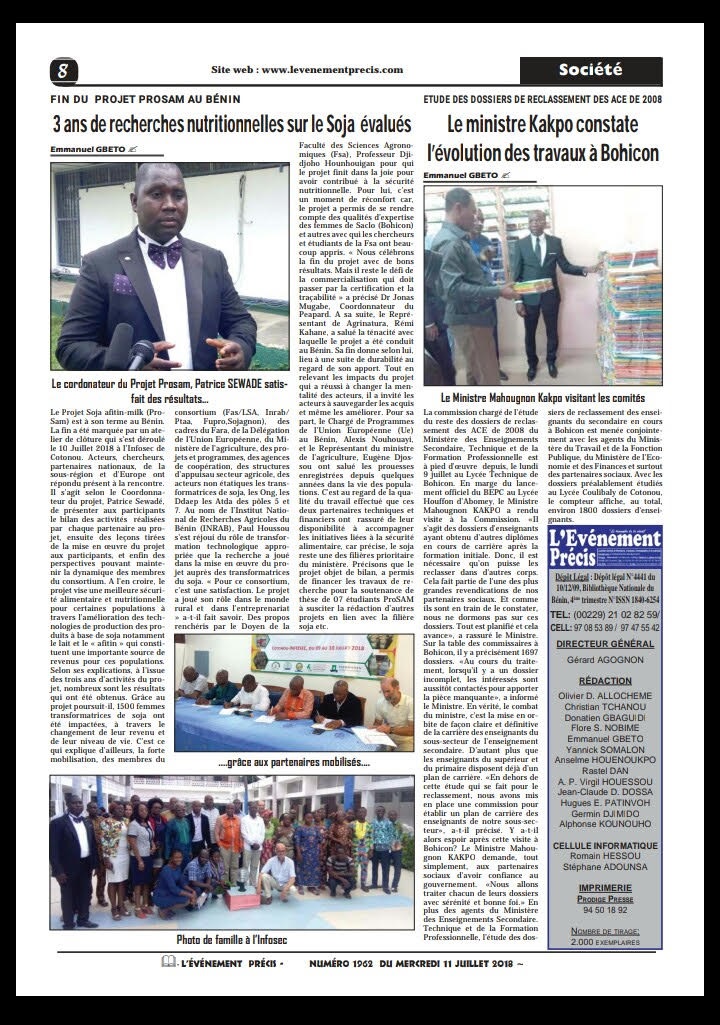
Clôture du Projet Soja aftitin-milk (ProSam)

9 - 10 Juillet 2018. Bohicon, Benin. Une variété de produits du Soja aux valeurs nutritionnelleslors d’une visite de terrain effectuée au Centre de stockage de graines de néré de Saclo, dans le cadre la clôture du Projet Soja aftitin-milk (ProSam) mis en exécution au Bénin, depuis le 29 Octobre 2014.
exceptionnelles est mise à la disposition des populations béninoises. Ceci grâce à une pratique d’utilisation des technologies apprises aux femmes transformatrices du produit. Le constat des dérivés a été fait avec les femmes transformatrices de Saclo dans la commune de Bohicon. C’était, ce lundi 09 Juillet 2018,

Projet s’inscrivant dans le cadre des 4 composantes de la Plateforme pour un partenariat Afrique-Europe pour la recherche agricole pour le développement (PAEPARD) financé par l’Union européenne (UE) et conduit par le Forum pour la recherche agricole en Afrique (FARA). Il a émerveillé par les conseils adressés aux femmes.
« Chaque fois qu’on vient, on trouve qu’il y a toujours de changement dans les pratiques. C’est un grand défi que vous avez relevé dans la mise en œuvre du projet   la clôture du projet ne doit pas signifier la fin des activités. Vous avez pu développer des technologies que vous avez mises sur le marché et nous souhaitons que vous vous développer davantage. Ne vous découragez pas parce qu’il n’y a plus d’appui » Je souhaite revenir voir un groupe de transformatrices plus fort et plus complétive sur le marché national et international. » Dr Jonas Mugabé, coordonnateur du projet PAEPARD
« Nous sommes venus témoigner de votre disponibilité et le dialogue que vous avez eu avec la recherche pour obtenir cette amélioration des conditions de vie et de travail. (...) Une bonne documentation qui capitalise l’exécution du projet est nécessaire. Ce processus devra être facilité par les deux étudiants de l’ISTOM mobilisés par le CIRAD dans le cadre de PAEPARD pour la capitalisation du ProSAM avec le avec une méthodologie appelée « ImpresS » pour l’analyse d’impacts des projets Ex-post. » Remi Kahané du CIRAD
Ressources:

Thursday, July 5, 2018

Better Vegetables, Better Lives: Improving African Indigenous Vegetables


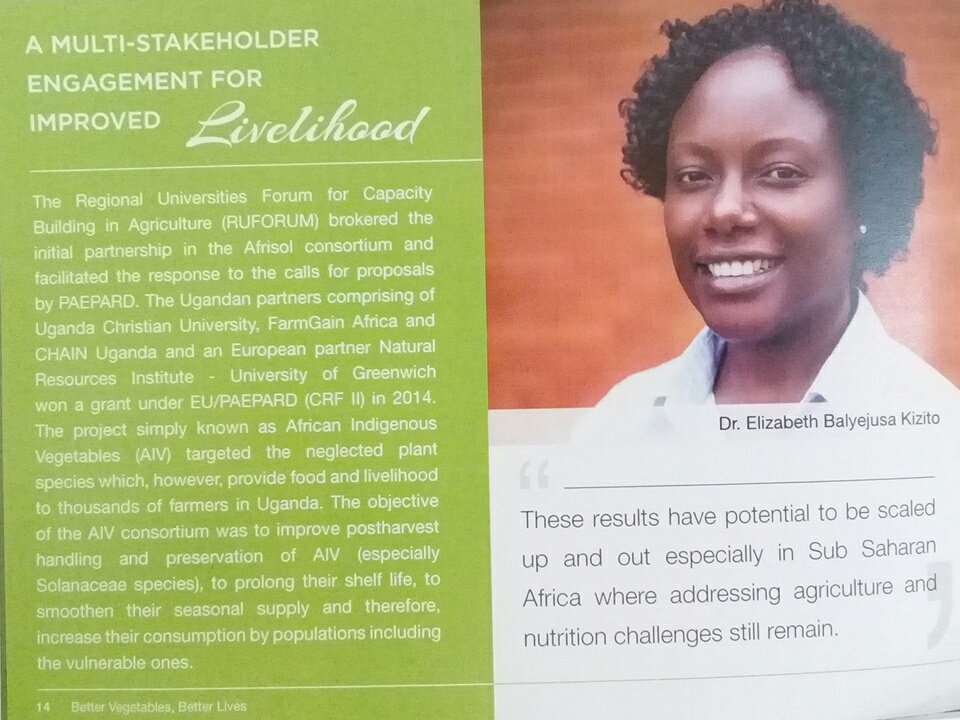
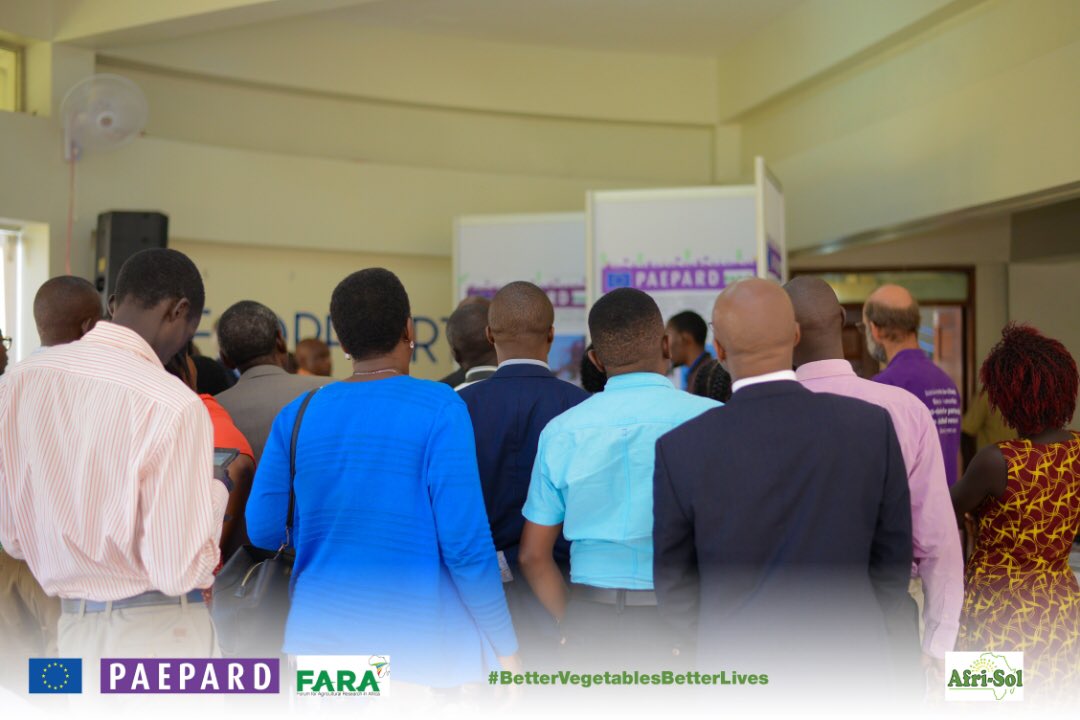
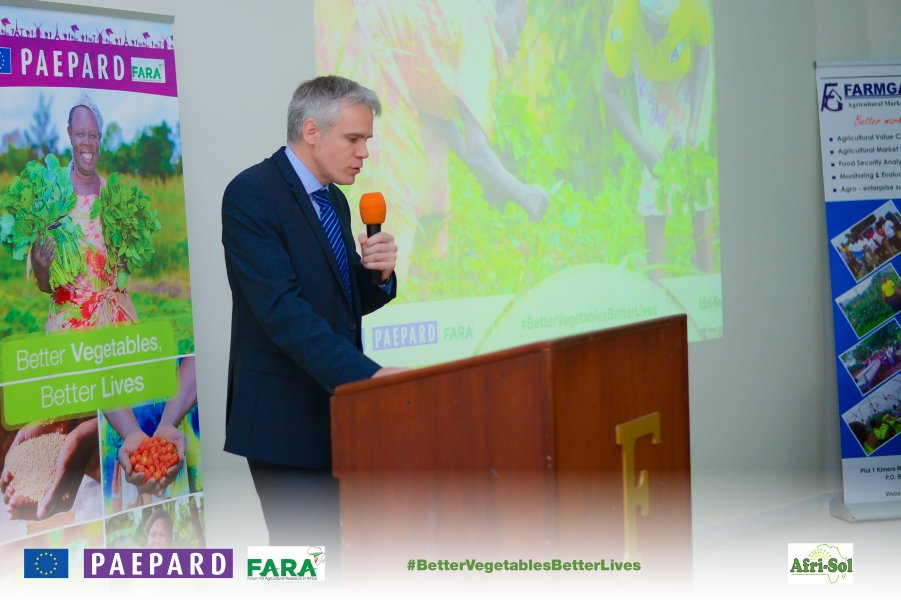
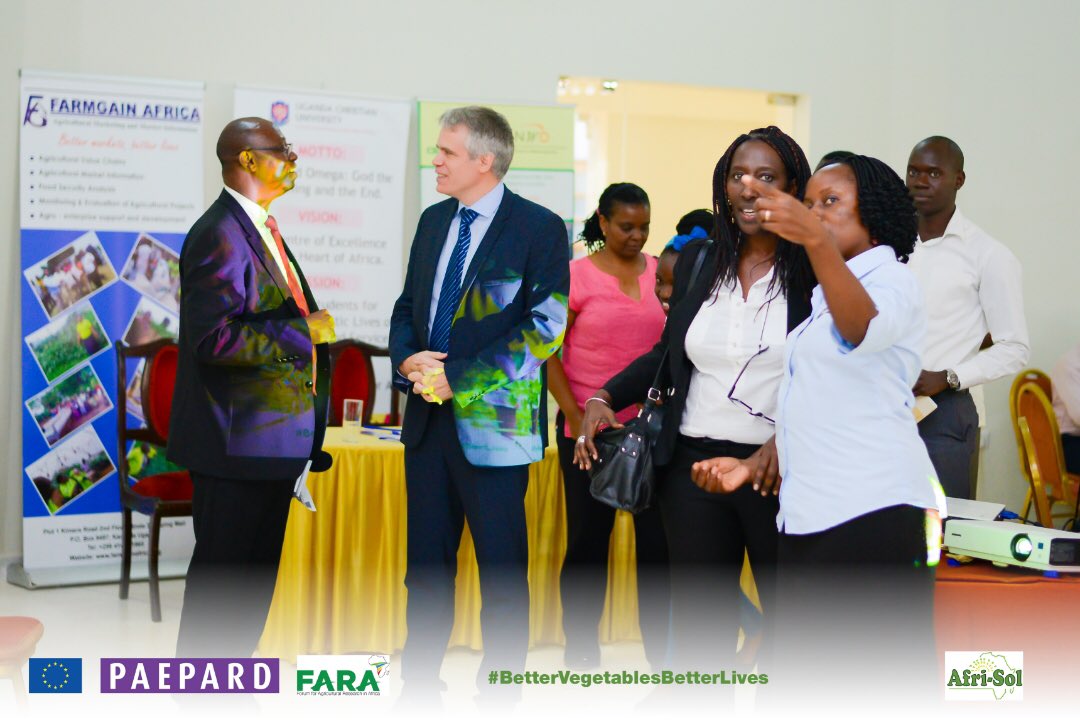
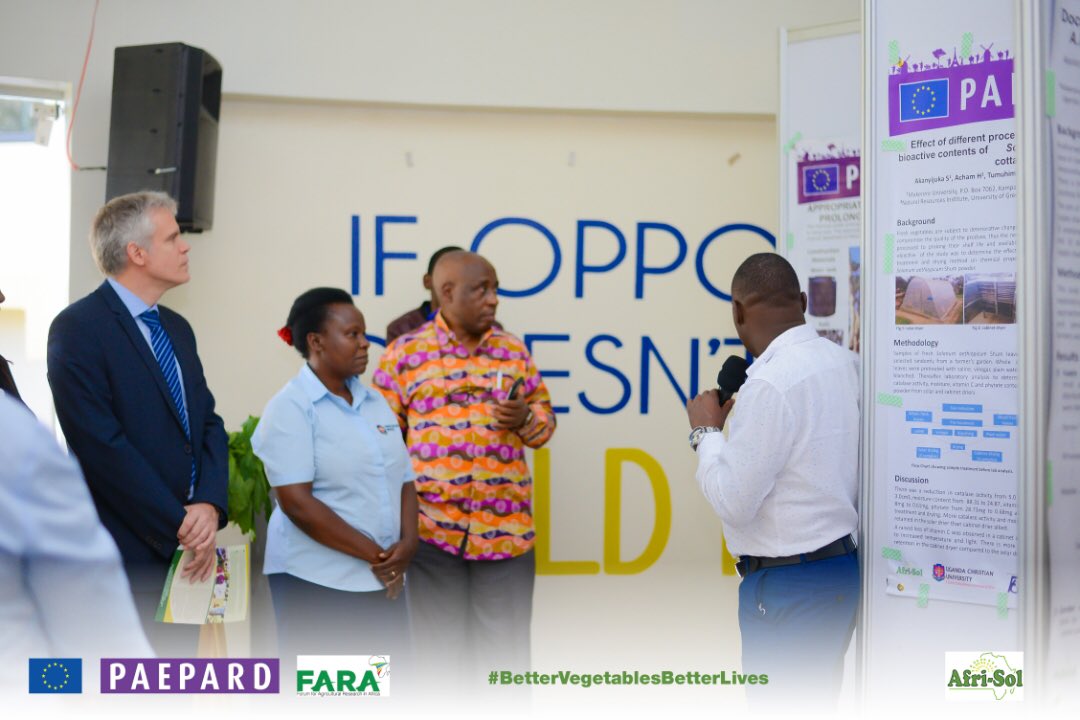
5 July 2018. Uganda. End of project dissemination workshop for the PAEPARD project “Enhancing nutrition security and incomes through adding value to indigenous vegetables in East and Central Uganda”.

The project communication has created awareness about the African Indigenous Vegetables (AIV). It has published stories that demonstrate othe project impact on their website at http://afri-sol.org/.

It encourages everybody to be part of the voice advocating for improved nutrition and income through investing in African Indigenous Vegetables by following and connecting via social media through FacebookTwitterInstagram using @afrisolug and the hashtag #BetterVegetablesBetterLives.

Download the Dissemination Note:
PAEPARD, 2018. Better Vegetables, Better Lives Improving African Indigenous Vegetables for greater nutrition and income African Solanacease Network (Afri-Sol): Mukono, Ganda 32 pages

Working with FarmGain Africa, Chain Uganda, University of Greenwich, FARA, and the European Union; farmers in Central and Eastern Uganda have benefited from engaging in Indigenous vegetables. 
250 farmers, 11 undergraduates, 7 Masters, 1 PhD trained through the #BettervegetablesBetterLives project
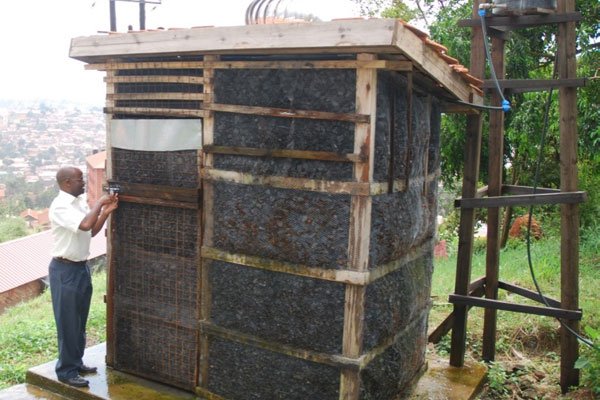
The charcoal cooler was designed working jointly with the farmers in Jinja and Wakiso to preserve the vegetables. The Charcoal Cooler is an appropriate technology that extends shelf life of vegetables from one to three days.

Eriya Matovu, a youth vegetable farmer vends vegetables during the open market and collects approximately US$800 in sales revenue. On average, Eriya’s weekly sales amount to about US$3,200.
"We noticed an increase in the farmer market access and a greater awareness on the importance of indigenous vegetables"  Dr. John Jagwe from Farmgain Africa (see picture right)
Merel CEDRIC 
(Head of Coperation @EUinUg)
IMPROVED INDIGENOUS VEGETABLE SEED PROCESSING
During the project life span, farmers participated and developed on-farm seed varieties lines. In the selected farming communities, the trainings on seed processing and value of vegetable nutrients have increased awareness on the nutritional value and consumption of vegetables in the communities. Farmers can now select the vegetable seed variety and determine the vegetable quality of their harvest. This has improved and sustained the pure seed quality and increase their income resulting from bumper harvests. The participating farmers from Jinja, Mbale and Wakiso are known for their pure seed quality making them reference points for pure seed business.

BUILDING APPROPRIATE TECHNOLOGIES TO REDUCE POST-HARVEST LOSSES
Two charcoal coolers were constructed in Jinja and Wakiso to reduce on the post-harvest losses. Previously, farmers would harvest and keep their vegetables in their houses and some under the tree shade. This has changed with the building of affordable and sustainable charcoal coolers. 


The vegetable shelve life has increased from 1-3 days allowing the farmers to store any extra vegetables that may have not been sold on that day. Identifying packing materials that address appearance, texture, flavor, nutrition value and safety for the vegetables has enabled better handling and reduced loss of vegetable quality during their transportation to the markets. 

"Working with farmers, we have been able to identify technologies that are appropriate for farmers to reduce post-harvest losses and maximise profits such as the charcoal cooler and packaging materials" Dr. Apolo from CHAIN Uganda (picture left).


Pemela Kabod (Makere University)
and Liz Kizito 

(Uganda Chrisian University)
“Quality is very important for our business to thrive. The improved packaging materials have greatly helped us during transportation of our vegetables to the market.” Mr. Odongo, farmer from Jinja.

MOBILIZING RESOURCES
From left ro right:
1. Mr Joseph Okee from the Ministry 
of Agriculture, Animal Industry 
and Fisheries (MAAF)
2. Jonas Mugabe (FARA)
3. Rev. Dr John Musisi Senyonyi, 
Vice-Chancellor UCU
4. Remi Kahane (CIRAD) and
African Indigenous Vegetables research team through this project honed proposal writing, resource mobilization, management and governance skills. The team submitted eight proposals for different calls and won three for funding. One of the proposals approved focuses on the functional vegetable seed system, a result from the prioritization exercise while working with the framers and other stakeholders. Other proposals included: 
  • UCU lead project with funding from Third World Academy of Sciences (TWAS): Phenotyping water use efficiency in Solanum aethiopicum, shum group. 
  • UCU and CHAIN partnership with funding from (ARF/ WOTRO): Developing a gender responsive commercial seed system for African Indigenous vegetables in Uganda 
  • Global Challenges Research Fund (GCRF - SASSA - Sustainable Agriculture for Sub-Saharan Africa): Improving production efficiency of African egg plant, (Solanum aethiopicum) for small holder farmers in Sub-Sharan Africa 
  • Chain Uganda also received funding from the Dutch, a result of the efforts from the Indigenous Vegetable project. 


Friday, April 27, 2018

Stratégies marketing pour les espèces alimentaires négligées et sous-utilisées

25-27 avril 2018.  Université de Parakou, Benin. Première édition des journées Scientifiques des Sciences Economiques et de Gestion de l’Université de Parakou

Dans le cadre de la mise en œuvre du projet Doyiwé sous financement de ARF/NWO-Wotro, le partenaire européen a envoyé pour séjourner, enquêter et interviewer les acteurs et partenaires du projet pour clôturer sa thèse de Master à l’université de Wageningen au Pays-Bas. Après deux mois de séjour à SOJAGNON et auprès des partenaires du projet, une bonne dose d’informations et de meilleurs compréhensions ont été obtenu sur le produit et le fonctionnement du marché de Doyiwé au Bénin.

Au total près de 80 pages ont été transcrites après les enregistrements ; 29 acteurs et partenaires ont été interviewé, questionné ; une dizaine de différentes régions agro-écologique du Bénin ont été parcouru et les acteurs interrogés, plus 3500 km de distances parcourues (Cotonou-Ouidah-Bohicon-Aplahoué- Zogbodomey-Djidja--Glazoué-Savè-Bantè-Bassila-Parakou-Natitingou-Kalalé) ; au moins 5 acteurs de chaque chaînes de valeurs a été écouté.

Monsieur Philip Barth a présente une partie de ses travaux de recherche. Le titre de sa communication etait: « Création de marchés dans les économies émergentes : Stratégies marketing pour les espèces alimentaires négligées et sous-utilisées »


Friday, April 20, 2018

Atelier de pilotage du projet ProSeSS: semences du soja au Benin

30 March 2018. Cotonou, Benin. Dans le cadre la mise en œuvre du projet ProSeSS (Alignement des attributs de qualité des semences du soja aux différents produits dérivés au Benin) il a été organisé au siège de l’ONG Sojagnon la réunion du comité de pilotage et technique du dit projet.

Cette réunion a connu la présence de tous les partenaires du consortium à savoir : Sojagnon, l’IITA, la FSA, et le REDAD.

See: report of the meeting (13 pages)

Les différentes activités exécutées par la coordination au titre de l’année 2017 sont les suivantes :
  • La formation des semenciers du Benin ; 
  • La participation de la coordination à l’atelier national de l’élaboration du Programme National de Développement de la Filière (PNDF) soja organisé par la Giz ; Ce qui a participé à rendre plus visible le projet; 
  • La participation de la coordination à l’atelier de validation de l’état des lieux de la filière soja et l’identification des CVA porteuse au Benin, organisé par la Giz ; à l’issu duquel les CVA soja grain (semence y compris), fromage de soja, farine infantile et lait de soja ont été retenues ; 
  • L’élaboration d’un document de politique (Policy brief) ; 
  • L’enclenchement du processus d’enregistrement à la bibliothèque nationale; 
  • L’élaboration du guide d’identification des producteurs semenciers ; 
  • L’identification des producteurs semenciers 
Policy Brief Approvisionnement en semences de soja au Bénin : Quelle stratégie faut-il mettre en place ? Mathieu A.T. Ayenan ; Patrice L. Sèwadé; Martin S. Agboton
L’accès aux semences de soja de qualité reste un défi majeur pour les producteurs ; ce qui ne leur permet pas d’obtenir des rendements optimaux. Les solutions durables à cet état de choses reposent sur (i) l’investissement dans la recherche et la production des semences, (ii) le renforcement de capacités technique, managériale et commerciale des producteurs désireux de se spécialiser en production de semence de soja et (iii) l’instauration d’un système de certification flexible mais qui garantit la qualité des semences. La mise en œuvre de ces mesures devrait permettre la production et la distribution de semences de soja de qualité pour l’amélioration de la productivité du soja au Bénin.

RECOMMANDATIONS 
  1. Créer les conditions favorables pour que le secteur privé investisse dans le secteur semencier ;
  2. Renforcer les institutions de recherche en sélectionneurs et spécialistes en production de semences et en moyens financiers pour la création variétale et la production des semences de base ; 
  3. Renforcer les entreprises semencières en technique de production et traitement des semences en stratégies de commercialisation des semences ; 
  4. Adopter le principe de semences de qualité déclarée. 
La mise en œuvre de l’ensemble de ces recommandations adressées au Ministère de l’agriculture, de l’élevage et de la pêche et aux différents acteurs de la filière soja doit permettre d’améliorer la productivité du soja au Bénin.

Related:
Working visit to Portugal: Tropical Research Institute [Instituto de Investigação Científica Tropical].
  • IICT has managed many projects, both with national or national plus European funding (e.g. from Foundation for Science and Technology (FCT), or from the Ministry of Agriculture (ProDeR programme)), and with funding from international institutes, such as CGIAR centers. Highlighted is the fact that IICT leads the BRAGMA project under the GMES & Africa initiative.
  •  IICT has a history of collaborative research and knowledge transfer with mainly with African Portuguese Speaking Countries (Guinea-Bissau, Cape Verde, São Tomé and Príncipe, Angola and Mozambique), with emphasis on i) food transformation and processing using culturally adapted and low input technologies, ii) food quality lab analyses, including for local products and iii) population surveys on food security and gender issues. 
  • Although some research has been done on several food products in Guinea-Bissau and Mozambique, jointly with local NGOs and research institutions, soybean is a novel crop to explore. This collaboration with Benin stands for a challenge and an opportunity to for networking in new partnerships, framed by PAEPARD
IICT contributes in the Soy/Benin consortium to:
  • Design and data analysis of the questionnaire for participative survey,; 
  • Nutritional and quality analyses of the processed products in IICT’s labs. Emphasis will ge given to vitamins, sugars/carbohydrates, antioxidant capacity and nutraceutic compounds. Training of researchers, students or technitians in specific lab analyses in IICTs labs will be offered to the consortium 
  • Linking the developed products with respect of the market needs, 
  • Participation in data analyses and divulgation activities. 
A team of 2 PhD researchers with complementary expertise relevant to the project objectives were allocated to the project tasks. 
  • The team has expertise in leading surveys, including those concerning agricultural practices and their impact on food security in African countries. 
  • It is also skilled in food technology using culturally and locally adapted methodologies/appropriate technologies, and offers with well-equipped labs for sample analyses.  
  • Expanding the capacity for lab determinations allowed expanding the type of analyses foreseen and evaluating the nutritional value of the products resulting also from the improved technologies. 
  • It involved in critical discussion in all tasks of the project, contibuting to remove bottlenecks and improve procedures. 
  • In kind contribution was given to the project, by means of supporting part of the researchers ‘ salaries and making avaliable lab materials, reagents and equipment use.