
Platform for African – European Partnership in Agricultural Research for Development
Showing posts with label Gabon. Show all posts

Monday, March 27, 2023

INCiTiS-FOOD Practitioner and Expert Virtual Round Table Discussion

27 March 2023. INCiTiS-FOOD Practitioner and Expert Virtual Round Table 

INtegrated and Circular Technologies for Sustainable city region FOOD systems in Africa (INCiTiS-FOOD)

Supporting innovative food systems and innovators:
Living Labs for Africa’s food systems
  • The INCITIS-FOOD Project (www.incitis-food.eu) is working on improving innovative circular food system in 6 countries across 3 African regions: East (Kenya), West (Ghana, Nigeria and Sierra Leone) and Central (Cameroun and Gabon). These countries also host living labs that act as innovation accelerators.
  • Living labs are innovation networks in which the participant’s roles and rules are freely defined by themselves. They essentially exchange information according to a defined research strategy and a digital infrastructure in order to transform this information into new knowledge; comparable to a lean innovation approach in which the end users define the contents of the project.
  • What are the benefits of participating as a food system actor? 
The objective of the eight living labs in six African countries is to map the landscape of food
providers, manufacturers, marketers, and consumers and to help identify bottlenecks and challenges that can be addressed by the living labs.

This consortium exceptionally involves a financial partner (AFRACA) to upscale innovation.
  • The African Rural and Agricultural Credit Association (AFRACA) is a leading pan-african network of financial and non-financial institutions involved in promoting access to rural and agricultural finance in Africa. AFRACA was established in 1977 as a lead advocate and coordinator on rural and agricultural finance in Africa. AFRACA members include: Central Banks, Commercial Banks, Agricultural & Development Banks, Microfinance Institutions, Universities and Training Institutions.
  • AFRACA is the banking expert in the consortium and will contribute to the Business Model Development and Financial Capacity Building for Circular Agri-food Entrepreneurship, INCiTiS-FOOD Roadshow Events and investment financing.

The project will also empower communities through the Open Calls funding, led by the Foodscale Hub, organization experienced in running large-scale international acceleration programs. One million euros will be given to 8 external Local Innovation Hubs (both from countries that participate in the INCiTiS-FOOD project and beyond) and 24 Independent Innovators from 6 countries from 3 African regions (East: Kenya; West: Ghana, Nigeria, Sierra Leone; Central: Cameroon, Gabon) as financial support from the InCiTiS-FOOD project. 

Beneficiaries of the Cascade Fund will be surveyed to generate empirical evidence on the co-benefits of the INCiTiS-FOOD project technologies and business models, which will guide urban food policy roadmaps.

The INCiTiS-FOOD project is co-funded by the European Union’s Horizon Europe research and innovation programme and all the information is available on project’s website, as well as Facebook, Linkedin, Twitter, Instagram and Youtube.
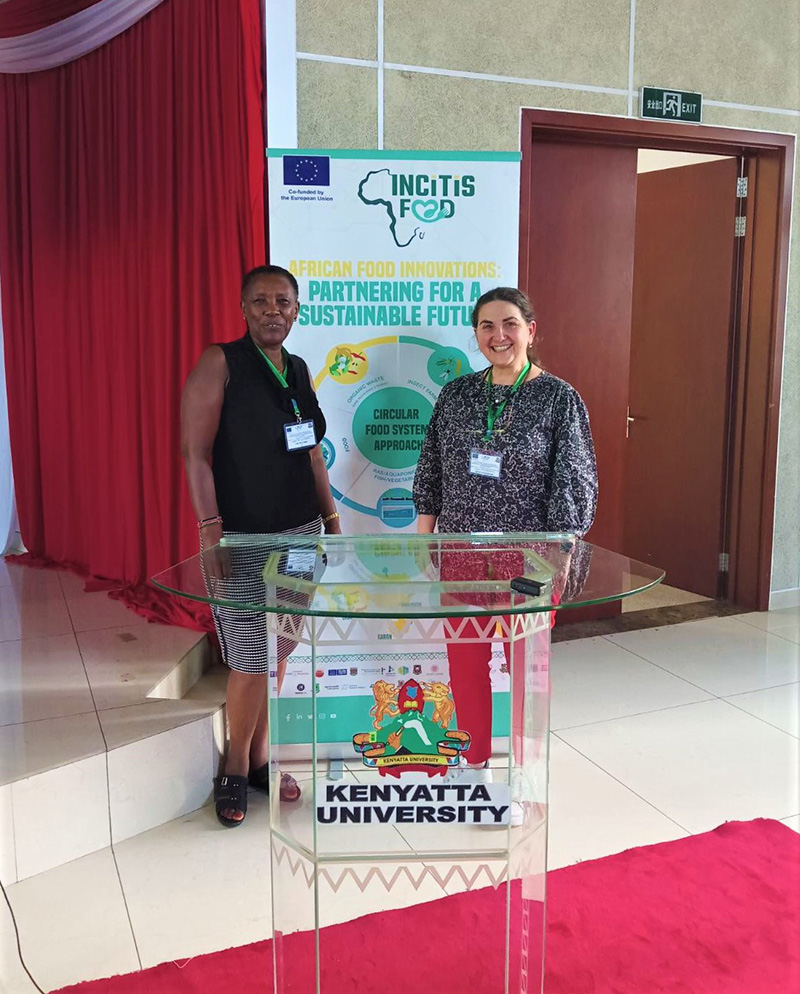
“We will set up 8 Living Labs in 6 African countries. Living labs will be turned into incubators of innovation and their mission will be to improve food and nutrition security in African city regions. Since current African food systems are experiencing severe challenges in delivering desired outcomes and a quarter of those who inhabit African cities remain food insecure and malnourished, we need to redefine and modernize the production. There are different methods to prevent food instability: availability of nutritious and safe food through local production, food access – affordability, food utilization, reduction of food waste, and food stability at all times.” Prof. Dr Gertrud Buchenrieder, Universität der Bundeswehr München – project coordinator (see pictures, right)

Wednesday, May 28, 2014

Agriculture at the The New York Forum AFRICA 2014

23-25 May 2014. Libreville, Gabon. The New York Forum AFRICA 2014 focused on transformation: unlocking the competitiveness of the African economy through building value chains around the transformation of the continent’s natural resources, including its human capital. In knowledge economies, such as those in the western world, education is the foundation of economic competitiveness and global prosperity – and is inseparable from the development of human capital.

The New York Forum AFRICA was organized around a number of major debates that examine the key economic and business issues for Africa today. One panel discussed agriculture around the theme: DYNAMIC AGRICULTURE MARKETS: A PIPE DREAM OR A GRAIN OF TRUTH? 
TRANSFORMING THE LAND FOR AGRICULTURE: 

The African vision for agriculture has been laid out as follows: dynamic markets within regions and countries, and farmers active in the market economy, while the continent becomes a net exporter of agricultural projects. Following from this would be a fairer distribution of wealth for rural populations, and environmentally sound agricultural production and sustainable land management. 

Is this an agricultural pipe dream – or is Africa close to achieving this? Are government, the private sector and the farmers delivering – and are they accountable?
  • How do we build value-added sectors to keep more revenues at home?
  • How do we integrate and support small farmers?
  • What can be done to protect from price hikes, and against environmental disasters?
  • How do we increase capacity and storage of water?
  • What needs to be done to improve access to market (financial and infrastructure/transport)?
  • Can we ensure food security?


Panelists
Moussa SECK
Chairman
Pan African Agribusiness and Agro-Industry Consortium
Kenya

Moussa is a renowned expert in the field of agricultural science and planning. He is the architect for Senegal’s national policy on agriculture, known as “Senegal Agricole” a Comprehensive Multisectorial Rural Development Program. In the late 1990s he created Agraria Africa, a concept for developing agriculture on a Pan African scale, based on the geophysical and climatic specificities of the African continent. Moussa is also President of Agrina Senegal, an organic, highly mechanised irrigated agribusiness farm that he founded in 1996. He is the Chairman of PanAAC, the Pan-African Agriculture and Agribusiness Consortium, a platform intended to mobilize and engage the private sector involved in the African Agribusiness and Agro-industry value chain. Moussa was recently appointed as the Chairman of Lead Africa, a leadership-training program for Anglophone and Francophone Africa. He has acted as a consultant on agricultural policy to FAO, UNDP, World Bank, and the Swiss Government. Moussa managed the SYSPRO think-tank of ENDA, the international environmental and development organisation for 20 years since its formation in 1986. He built SYSPRO into one of Africa’s most highly respected think-tanks. Moussa graduated from the University of Minnesota Borlaug Hall, USA and the Institut Agronomique et Vétérinaire Hassan II in Morocco.

Frank BRAEKEN
Chief Investment Officer
Amatheon Agri Holding N.V.
Germany

Frank Braeken is the Chief Investment Officer of Amatheon Agri Holding, a Berlin-based company committed to building a leading Agro Foods company operating across Africa. He has an FMCG background - a true global operator. After an early stint with P and G, Frank spent 26 years with Unilever, living and working in nine countries on four continents. His last role up to 2013 was Executive Vice President for the Africa region, with overall responsibility for its €2.5bln operations. Prior roles include Business Group President for the China Region, Managing Director of Unilever Foods France, and Chairman of Unilever Andina. After obtaining a law and MBA degree, his early career began in finance. His industries expertise lies in FMCG and African agriculture. His specific operational expertise is in developing markets sales and distribution strategies and systems, FMCG value chain analysis, multi-tier brand strategies for straddling the income pyramid, and talent and organisational strategies that cater to fast growing, developing organisations.