London, UK
May 18, 2026 – A groundbreaking new study has uncovered the significant scale and strategic importance of the African diaspora food market in the United Kingdom.
The research commissioned by the Global Forum on Agricultural Research and Innovation (GFAiR) and conducted by The Food Bridge vzw and funded by the European Commission, surveyed 1,507 African diaspora consumers across the UK and found that 97% include African food in their regular diet, with 35% consuming African food daily and 39% at least once a week.
According to the study titled “A Research on the African Diaspora Food Market in the United Kingdom: Understanding Market Dynamics, Opportunities and Indigenous Food Systems” the estimated annual
market value is £1.5 billion in the UK alone, with a projected €11.5 billion market across Europe.
The research – conducted between January and April 2026 – highlights that African food is not a niche or occasional choice, but a core component of daily diets – comparable to staple foods in national consumption patterns. This positions the African diaspora food market as a mature, stable, and scalable agro food sector.
Market Opportunities
The study maps a dynamic ecosystem of importers, wholesalers, retailers, restaurants, and online platforms, with
major hubs in London, Birmingham, Manchester, and Leeds. While demand is strong, the research also identified key challenges including high prices, inconsistent quality, limited availability outside major cities, and regulatory barriers affecting imports.
The report redefines African diaspora food markets not as niche ethnic enclaves but as a strategic trade corridor—one that directly links smallholder producers across Africa with discerning consumers in European cities.
These markets, it argues, function as living pipelines for Neglected and Underutilised Species (NUS), resurrecting indigenous and forgotten crops that have been marginalised by industrial agriculture. In doing so, they become powerful engines for diaspora entrepreneurship and SME development, offering low-barrier entry points for women and youth-led ventures into formal food systems.
Crucially, the report aligns this dynamism with core European Commission priorities: biodiversity conservation through crop diversification, supply chain sustainability by shortening distances and reducing waste, and inclusive growth that channels value back to migrant communities and their countries of origin.
Call to Action
In response to the report’s findings, the research issues a clear call to action for policymakers across Europe and beyond. First, it urges them to formally recognise
diaspora food markets not as peripheral or informal trading spaces, but as
strategic agri-food subsectors in their own right—deserving of the same policy attention, data collection, and infrastructure investment afforded to conventional supply chains. Second, it asks for concrete support for indigenous and forgotten crops, framing their rehabilitation not as heritage preservation alone but as a vital lever in the transition toward sustainable, climate-resilient food systems.
Third, the research advocates for
targeted, systemic support for diaspora agri-food entrepreneurs—opening pathways to affordable finance, technical incubation, and streamlined certification processes that reward rather than penalise small-scale, cross-border actors. Finally, it calls for the full integration of diaspora stakeholders into European development cooperation with Africa, shifting from a donor-recipient model to one of genuine partnership, where diaspora networks become co-designers of trade, agricultural development, and food security policy.
Together, these measures, the research argues, would unlock a more inclusive, biodiverse, and economically dynamic Europe-Africa relationship.
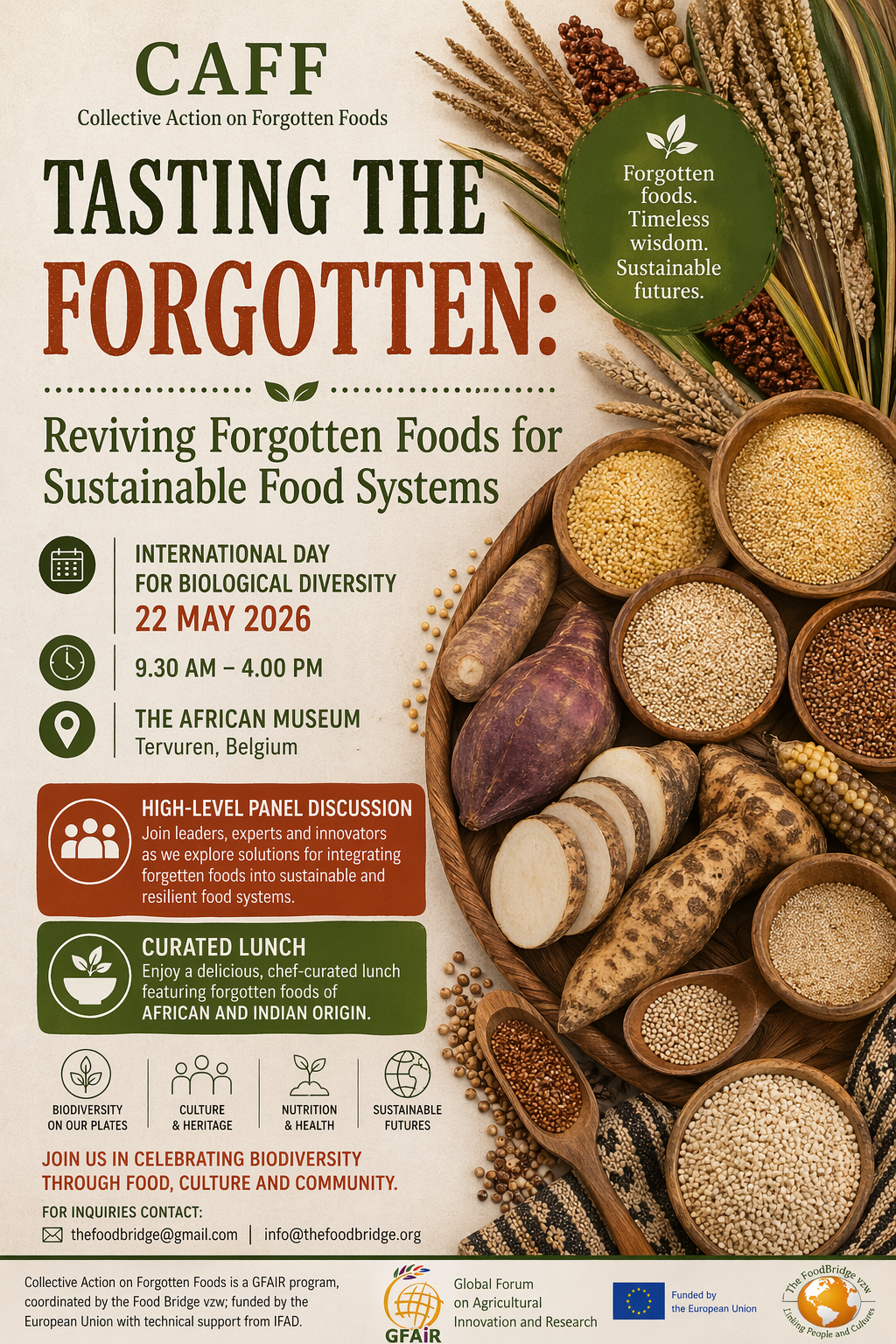
"This research confirms what we have long observed – the African diaspora food market is not a niche sector. It is a multi billion pound ecosystem with the power to transform Europe Africa trade, promote indigenous crops, and support sustainable food systems," said Dr. Maureen Duru, founder The Food Bridge vzw, ahead of the report launch on the 22 May, during the Tasting the Forgotten event in Brussels, Belgium.
18 May Greenwich. The report was presented at the Research Culture Week of the Greenwich University, more specifically at the Natural Resources Institute.
PPT forthcoming
Presentation by:
- Dr. Maureen Duru
- Mr. Ndubuisi Adinnu
The study was conducted by The Food Bridge vzw under the GFAiR Collective Action on Forgotten Foods, with technical support from IFAD and funding from the European Commission. The survey collected 1,507 valid responses from African diaspora households across the UK, with additional fieldwork support from GFAiR.
Related:
11 June 2026. 14:00 to 15:30 CET. Webinar “Food Safety vs. Sustainability – two sides of the same coin?”
- The webinar will explore the relationship between food safety and sustainability in food manufacturing, highlighting both the challenges and opportunities associated with current industrial practices. While food safety remains the highest priority across the sector, many processes used to ensure safe production, such as pasteurization, sterilization, cleaning in place, and sterilization in place, require significant amounts of energy, water, and chemical inputs.
- The session will examine how these practices can create sustainability trade-offs, while also addressing how climate change is introducing new microbial hazards that need to be controlled throughout the food system.
- Participants will gain an overview of the current landscape of food safety and sustainability, including opportunities to improve resource efficiency while maintaining high safety standards. Topics will include innovative hygienic design approaches, modernisation of traditional preservation methods, strategies to reduce spoilage and waste, and solutions to address emerging microbial risks linked to climate change.
- If you are interested in joining this webinar, please register through this link: https://bokuvienna.zoom.us/webinar/register/WN_5iai5_fwSzO1WN_p-Hqsxg#/registration
Horizon Europe — thematic priorities, funding opportunities and call analysis, An overview of Horizon Europe themes and how to read calls strategically.
Online (no booking required)
50 mins
Tuesday 19th May 10:00–11:30 GMT
Barbara De Angelis, Lucia Collischonn (Greenwich Research & Innovation)
- This session provides an overview of Horizon Europe, focusing on its thematic priorities and forthcoming funding opportunities across the remainder of the current year and into 2027. Designed to support strategic understanding rather than detailed proposal writing, the
- session explores how Horizon Europe is structured and what current calls reveal about evolving priorities.
- A central part of the session will be a guided, hands-on exercise analysing a specific Horizon Europe call topic. Through this practical activity, participants will work through how to read and interpret call texts, identify key expectations and understand how impacts are framed.
- The session offers space to build confidence in navigating Horizon Europe calls and to reflect on how researchers might engage with them strategically within their wider research planning.
What do funders really care about – and how does impact fit in?
Thursday 21th May
Online, 15:00 – 15:50: No booking needed - join directly via Teams
James Rannard-Lambert and Hanlu Zhang, Greenwich Research & Innovation
- Impact is now central to many funding decisions yet understanding what different funders actually value can feel unclear or inconsistent.
- This conversational session opens up discussion about how researchers make sense of funder priorities, how impact expectations shape bids, and how impact thinking can be woven into project design from the outset. Using practical examples, we’ll explore where
- researchers find information, how tools like Grant Nav, the Charity Commission and AI are being used, and what helps build impact narratives that feel credible rather than performative.
African Futures Conversations: reimagining entrepreneurship and innovation, Reimagines entrepreneurship and innovation from African perspectives.
Thursday 22nd May 14:00 GMT
Sterling Rauseo- Entrepreneurship and innovation are often framed through dominant global models — but what happens when we shift perspective to focus on African contexts, realities and ways of creating value?
- This panel explores how entrepreneurs, researchers and practitioners are creating value across diverse African ecosystems. Speakers reflect on what is already happening but not always recognised, what is actively being developed, where greater focus, support and
- resources are still needed, and what it means to decolonise entrepreneurship in African contexts.
Knowledge Exchange Community of Practice: What makes a partnership truly equal?
Friday 22 May
Online, 11:00 – 12:30: No booking needed -
join directly via Teams- Partnerships are central to knowledge exchange but creating relationships that feel genuinely equal can be challenging in practice. How do expectations get set? What helps build trust from the outset? And where do imbalances tend to creep in?
- In this CoP session, Sophie Cloutterbuck (Director of London Engagement and the London Met Lab) draws on extensive experience working with civic and community partners to reflect on what makes partnerships work well — and what can undermine them. The
- conversation then turns inward, with colleagues from GRI sharing emerging thinking behind the University of Greenwich’s Equitable Partnerships Toolkit and opening up discussion about how we support fair, respectful and transparent collaboration in our own work.