Platform for African – European Partnership in Agricultural Research for Development
Showing posts with label Sudan. Show all posts

Tuesday, June 16, 2026

Advancing Biological Control in Asia, the Middle East and Africa: Knowledge, Practice and Partnership

11 June 2026. Promoting the awareness and use of biological control in Asia, the Middle East and Africa

As concerns grow over pesticide resistance, biodiversity loss, environmental degradation, and food safety, experts from more than 75 countries gathered for a regional webinar organized by CABI and the International Tropical Fruits Network (TFNET). The event highlighted the growing recognition of biological control as a key component of sustainable agriculture and resilient food systems. Participants explored how biological control approaches, when integrated within broader Integrated Pest Management (IPM) strategies, can reduce dependence on synthetic pesticides while improving environmental outcomes, farmer livelihoods, and market access.

A major focus of the webinar was the role of innovation, science, and digital tools in accelerating the adoption of biological control. 

  • CABI showcased its PlantWise Plus programme and demonstrated the CABI BioProtection Portal, an open-access platform operating in 54 countries and 18 languages that provides information on more than 7,000 registered bioprotection products. 
  • Participants also learned from a successful case study in Malaysia, where classical biological control of diamondback moth significantly reduced pesticide use in brassica production while strengthening export opportunities through lower pesticide residues: Diamondback Moth Management in Malaysia
  • Country perspectives from Egypt, Sudan, and Saudi Arabia further illustrated how biological control is increasingly being incorporated into climate-smart agriculture programmes, extension services, and national sustainable agriculture strategies.

Throughout the discussions, participants emphasized that biological control is not a stand-alone solution but rather part of a broader systems approach to sustainable crop protection. Successful adoption depends on strong regulatory frameworks, quality assurance systems, effective extension services, farmer engagement, institutional support, and access to affordable biocontrol products. Digital advisory tools were identified as particularly important for helping farmers and advisers make informed decisions, while capacity development and policy harmonization were seen as critical for scaling adoption across regions. The webinar also underscored the importance of placing farmers at the centre of innovation and ensuring that solutions are adapted to local ecological and socio-economic contexts.

Looking ahead, participants identified significant opportunities for regional collaboration through joint research initiatives, regulatory harmonization, public-private partnerships, digital agriculture platforms, and South-South cooperation. There was broad agreement that scaling biological control will require coordinated action across research institutions, governments, extension systems, private companies, and farmer organizations. By fostering partnerships and sharing practical experiences, the webinar demonstrated how biological control can contribute to healthier ecosystems, safer food production, improved market access, and more resilient agricultural systems across Asia, the Middle East, and Africa.

Thursday, May 2, 2024

Sudan at a Crossroads: Food Systems, Hunger, and Humanitarian Aid During Civil Conflict

2 May 2024. Hybrid Policy Seminar, Sudan at a Crossroads: Food Systems, Hunger, and Humanitarian Aid During Civil Conflict

In April 2023, Sudan descended into a violent civil war that has displaced more than 8 million people, destroyed critical infrastructure, and left half the country’s population in need of humanitarian assistance. More than one year later, the unresolved conflict threatens agricultural production, agroprocessing, and trade, exacerbating Sudan’s status as a failed state. Sudan’s trajectory is therefore relevant for the broader community of scholars and practitioners working to enhance food systems and food security in fragile states facing complex humanitarian emergencies.

This IFPRI policy seminar will reflect on urgent data, analytical, and policy needs to mitigate food insecurity and revitalize food systems in Sudan. Several interrelated issues will be addressed, including options for policy engagement in the absence of a legitimate government, the viability of balancing immediate humanitarian needs with longer-term investments in agricultural development, and possible post-conflict scenarios that might affect priority-setting for the food system. The event will bring together researchers from IFPRI’s Sudan country program, conflict analysts, humanitarian donors, and country experts in a hybrid format.

Danielle Resnick, Senior Research Fellow, Development Strategies and Governance Unit (DSG), IFPRI
  • Overview Remarks from USAID Tyler Beckelman, Deputy Assistant Administrator, United States Agency for International Development (USAID) Africa Bureau
  • Sudan’s Conflict and Complex Emergencies Alex de Waal, Professor and Executive Director, World Peace Foundation, Fletcher School of Law and Diplomacy at Tufts University
  • Food Security Before and During the War: Evidence from National Rural Household Survey Khalid Siddig, Senior Research Fellow, Development Strategies and Governance (DSG) Unit and Sudan Country Strategy Support Program Leader, IFPRI
  • Shocks, Coping, and Livelihood Strategies due to the War Oliver Kiptoo Kirui, Research Fellow, Development Strategies and Governance (DSG) Unit, Sudan Country Strategy Support Program, IFPRI
  • Economic Costs of the War and Recovery Options Karl Pauw, Senior Research Fellow, Foresight, Policy, and Modeling (FPM) Unit, IFPRI
  • Local and External Competencies for Peacebuilding in Sudan Ibrahim Elbadawi, Managing Director of the Economic Research Forum and former Sudan Minister of Finance
  • Closing Remarks Johan Swinnen, Director General, IFPRI; Managing Director, Systems Transformation, CGIAR

Wednesday, January 31, 2024

Pathways to food security for Sudan

  • The Foreign and Commonwealth Development Office (FCDO) Sudan and FSD Africa commissioned Wellspring to undertake a rapid assessment of the agri-food and enabling payment systems in Sudan, to inform a coordinated emergency response that promotes food security. 
  • This webinar provided insights on the current situation, critical challenges and proposed interventions that can be deployed.

Recording forthcoming

Resources:

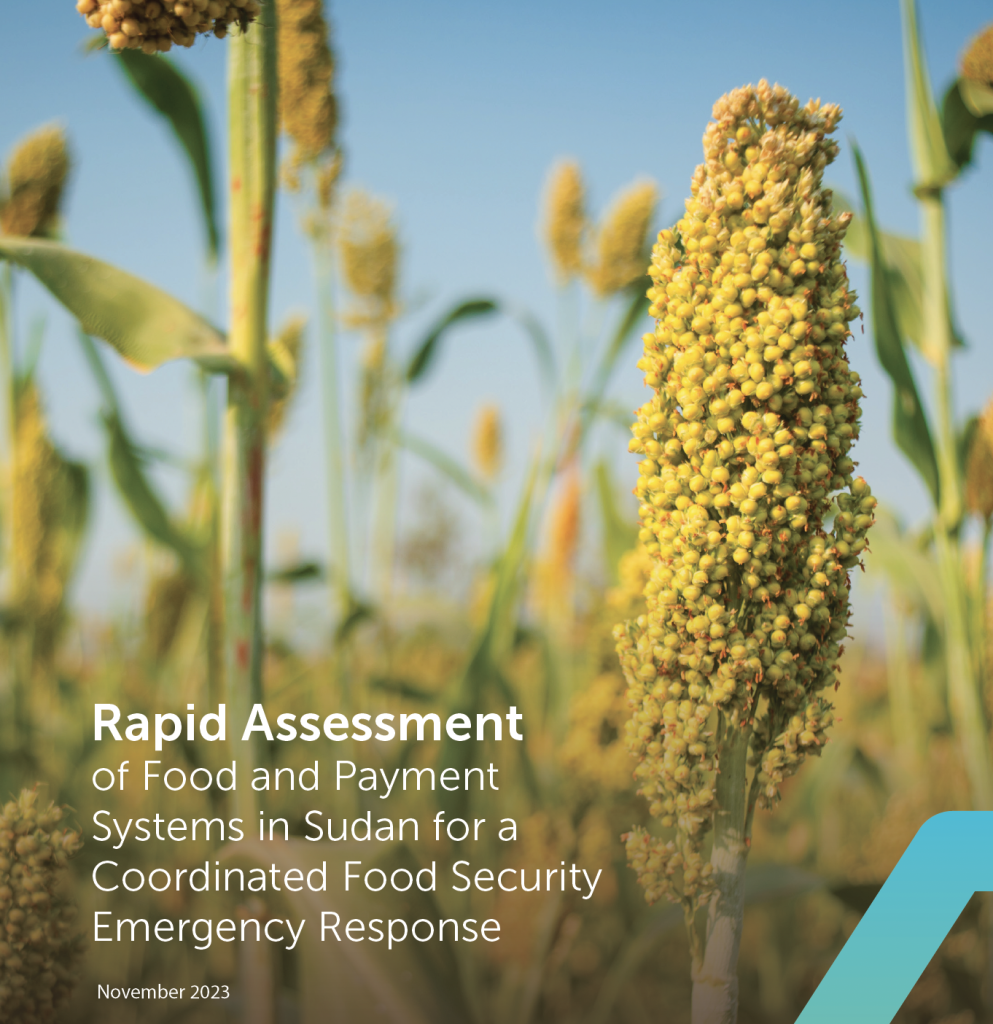
FSD, Wellspring (2023) Rapid Assessment of Food and Payment Systems in Sudan for a Coordinated Food Security Emergency Response November 2023 #24 p.

Sudan is facing worsening conflict that is contributing to a food insecurity crisis. The most recent Integrated Food Security Phase Classification (IPC) report identified over 20 million Sudanese who are currently experiencing acute food insecurity – 42% of the population and the highest number ever recorded in the country.1 Consequently, the Foreign and Commonwealth Development Office (FCDO) Sudan and Financial Sector Deepening (FSD) Africa commissioned a rapid assessment of the agri-food and enabling payment systems in Sudan, to inform a coordinated emergency response that promotes food security.
  • Sorghum, millet, and wheat are three key staple crops consumed in Sudan
  • In addition to the three main cereal value chains, there are others that may be regionally important for food security, including horticulture, legumes and pulses, and oilseeds.
Analysis of value chain segments
  • Access to inputs has decreased dramatically as a result of the ongoing conflict, mainly due to lack of access to inputs financing.
  • Farmers have abandoned mechanization due to high fuel prices. 
  • Planting during the recent summer season has significantly decreased compared to past years
  • A large proportion of Sudan’s processing capacity was concentrated in Khartoum and has been destroyed.
  • There are, however, small and medium agriprocessors still operating in other states, and some larger conglomerates have also relocated processing operations to cities such as Port Sudan since the conflict.
  • The current conflict has disrupted traditional pathways to market. 
  • Financial service providers (FSPs) have been very directly impacted by the conflict as well, with the vast majority of financial institutions still non-operational.
  • The current conflict, and its impact on traditional financial institutions, has prompted a surge in demand for digital financial services
  • The use of informal payments systems, known as hawala, has also risen to fill the gap left by non-operational formal financial institutions

There is an ongoing debate around the importance of wheat for food security in Sudan, as it is mainly consumed in urban areas and may not be suitable for domestic production. On the one hand, Sudan’s domestic wheat production is not cost-competitive against imports, and the type and quality of domestic wheat is often  not suitable for flour milling (...) Wheat flour and bread have been heavily subsidized for end consumers, and protests around previous withdrawals of subsidies and rising wheat prices have toppled governments. (page 7)


Thursday, May 9, 2019

Uncertainties of Climate Change Impacts in Agriculture

8 May 2019. ICARDA Workshop on Novel Research Dimensions in Modeling Climate Change Impacts in Agriculture.

The participants brainstormed on issues associated with modelling of crop growth process (in particular wheat) under various limiting factors such as weather, soil, management and water in a climate change scenario to strengthen the in-house modelling capacities and also to develop future projects.

The workshop was chaired by Prof. Senthold Asseng a renowned crop modeller from University of Florida and co-leader of the Agricultural Model Intercomparison and Improvement Project (AgMIP) network. He is the Director of the Florida Climate Institute and elected Chair of the Expert Working Group (now a program) Plant and Crop Modeling of the international Wheat Initiative.
"Africa imports every year 40 million tons of wheat. The main import is from Russia" 
"Our models predict that there will be a 6% decline in global wheat production for each degree in global warming"
"In 2010 Egypt lost 1,5 tons of wheat production out of the 10 million tons produced or a 16% drop due to a warmer season." 
"In 2016 France - as the 5th world producer of wheat - had a 32 % drop with a production of 12 million tons of wheat." 
"The combination of a warmer early winter and intensive rainfall during key crop growing stages leads to increased disease pressure, water logging, nutrient leaching and lower solar radiation." 
"Seasonal forecast research is very promising in dry areas where there is a great weather variability. Simulating the weather for the coming 6 to 9 months is like making money on a roulette game where 80% are red numbers. Seasonal forecasts need to be 80% reliable to be useful"
"If you have more dry seasons you better get the few wet seasons right" 
The  workshop identified the research gaps, challenges, pitfalls and opportunities within the MENA (Middle East and North Africa) context and in collaboration with AgMIP. The participants discussed various modelling options and identify funding opportunities within the region and globally and identify prospective partners and modelling platforms.
  • Introducing ICARDA and the DryArc Initiative, Jacques Wery ICARDA Deputy Director General - Research

  • Climate change impact and adaptation on the production of wheat. Senthold Asseng Professor at the Agricultural and Biological Engineering Department of the University of Florida. (see presentation and video interview below)
  • Modeling wheat yield, water productivity and nutrition using new high yielding cultivars and irrigation management strategies in Egypt. Ahmed Kheir Agricultural Research Center (ARC, Egypt), Soil, Water and Environment Research Institute
  • Improving and Upscaling WUE in agriculture the Nile Delta: Raised Bed Technology and ET-based Irrigation Scheduling, A.Swalem ICARDA Senior Scientist - Irrigation and Water Management
  • Bio-economic modelling at ICARDA, Y. A. Yigezu ICARDA Senior Agricultural Economist
  • Digital Augmentation for Accelerating Sustainable Intensification, C.Biradar ICARDA Geoinformatics and Research Data Management
  • Climate change in the DryArc and its implications on Agroecosystems A.Govind ICARDA Climatologist
Climate change impact and adaptation in wheat. Presentation by by Dr. Senthold Asseng


ICARDA video interview
Dr. Senthold Asseng, answers following questions: (partial transcription)
  • What is the Agricultural Model Intercomparison and Improvement project (AgMIP)?
    AgMIP - brings together thousand researchers, modelers and experimentalists around the globe  
  • How could barley and lentil crop modeling be integrated in the AgMIP research community?
    Some of the crops like barley and lentils have no teams yet. It would be very important to find a leader together with AgMIT who could motivate the community of whoever has barley and lentil crop models to collaborate. I would encourage ICARDA to take up such role.
  • Can climate change be used for farmers' decisions in rainfed dryland systems?
    If we get longer period of drought we better get prepared for that. We can help farmers to prepare for taking decisions and the changes which will come with climate change: for example to change crops or alter the management of fertilizers
  • How can we convince donors to support research on seasonal forecasting in dry land areas?
    Seasonal forecast research is very promising fo dry areas where there is great weather variability. We have to give the farmer the tools to recognize the good seasons to get most out of them. And we need to be prepared for the poor seasons and not waste limited resources. Seasonal forecast will help the farmer in the future to cope with  even increased seasonal variability.

Background DryArc
       ICARDA is currently elaborating a new large-scale initiative – the DryArc – in collaboration with five other CGIAR centers which is founded on the DryArc Interface;
  • Two of the CGIAR Centers were created specifically to work on the agriculture of the dry areas, ICARDA with a focus on the West Africa, North Africa region (WANA) and ICRISAT on the semi-arid tropics of South Asia and Sub-Saharan Africa;
  • The participating CGIAR Centers, ICARDA, ICRISAT, IFPRI, IWMI and World Fish have developed a proposal for a Proof of Concept for the New CGIAR Interface to support research and development investments in the global dry and based on current technologies for scaling;
  • A prototype of the DryArc Interface will be implemented as proof of concept phase (2019-2021), during which it will be tested through its application to key thematic areas of particular relevance for the DryArc region stretching from Middle East, North Africa, Central Asia and Sub-Saharan Africa. By the end of 2021, the Initiative will serve as a means to support, informing research and development investments in the DryArc region as a part of the subsequent 2022-2030 CGIAR Business Plan.
Related:
Talk at the 2014 ASP Summer Colloquium at NCAR.
Dr. Senthold Asseng works on systems analysis to understand compare and improve the productivity and sustainability of atmosphere - crop - soil systems changing over time, space and scales. He is interested in the impact and adaptation of climate variability and climate change on cropping systems and food security. 


Related:

Farmers and other players in Sudan's agricultural sectorare celebrating the success of new heat-resistant wheatvarieties which could transform the food landscape in Sudan. The country has been hard hit by a severe bread shortage and sharp price increases last year.

Thanks to the new cultivars such as Imam, Zakia and Bohain, Sudan's wheat-growing areas saw a rise in production to around 303,000 ha, up from 230,000 ha in 2017. The high productivity and wheat area expansion witnessed during this season would lead to a record high production expectation of around 0.85 million tons of wheat, covering up to 45% of the national demand, the nation's Minister of Agriculture and Forestry, Nahar Osman Nahar, announced.

Saturday, April 6, 2019

Sudan could be one of the world’s great breadbaskets

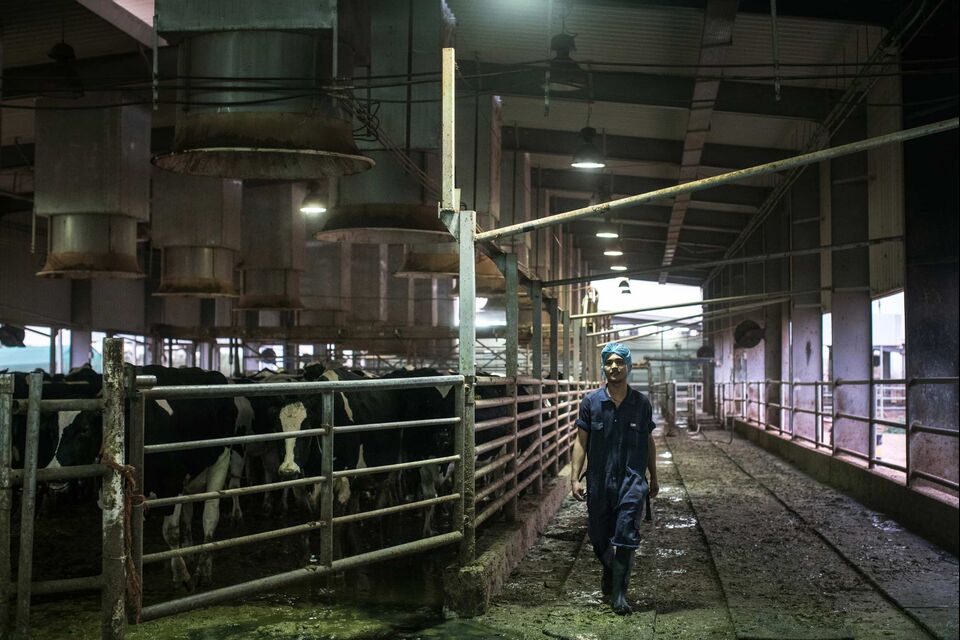
Ailafoun Dairy Farm, owned by
Sudan’s Dal Group
and the country’s largest such facility,
has in the past brought in
foreign cows to increase production.
2 April 2019. Bloomberg Businessweek.

Arab policymakers have been touting Sudan’s ability to feed the populous and water-scarce Middle East since the 1970s.

The country features as much as 200 million acres of arable land, a strategic location less than a day’s sail across the Red Sea to the Saudi port of Jeddah, and a roughly 25 percent share of the Nile’s waters under regional agreements, much of it unused.

In the Middle East and North Africa, by contrast, World Bank and United Nations statistics show that the number of chronically undernourished people has doubled, to 33 million, since 1990, and that water availability has tumbled on average to a sixth of the global mean.
Abdellatif, chairman of Dal Group,
beside a statue of Taharqa, a Nubian king,
in the lobby of his office in Khartoum
.

The benefits for both parties would seem obvious. And yet little of the 5 million acres the agriculture ministry estimates are in foreign hands—perhaps less than 1 in 20 acres—has been cultivated. “Nothing’s happened! Really almost nothing’s happened,” says Osama Daoud Abdellatif, chairman of the Dal Group, the country’s largest conglomerate. “Someone got this land, and someone got that land. But few have done much.”

Operating in Sudan has never been easy. Coordination between local and federal officials is often negligible. Rules and regulations are subject to sudden change—recently, one state government doubled tolls on its section of the road to Port Sudan overnight, throwing corporate budgets into disarray. Key portfolios such as pastureland, desertification, and forestry are frequently tossed from one ministry to another and back again.
“There is no stability in agricultural policy. Experts come and go. Not even the minister knows what budget he’s getting,” Abdellatif Ujeimi, the third of at least six agriculture ministers since 2014. (His tenure lasted about a year, until May 2018.)

Tuesday, September 25, 2018

First Inter-Regional Smart Agriculture Forum

24-26 September 2018. Khartoum Sudan. 1 Inter-Regional Smart Agriculture Forum (ISAF)

Within the scope of the initiative of HE/Omar Al-Bashir - President of Sudan to the Arab leaders about the "Arab Food Security" and being part of the global efforts towards achieving the Sustainable Development Goals (SDGs-2030), AICTO and the Arab Organization for Agricultural Development (AOAD) launched the initiative: "Smart Agriculture Forum" (ISAF) to be a platform gathering all potential stakeholders within the Arab and African regions and the rest of the world for an open and constructive debate.

Objectives
The 1st Inter-Regional Smart Agriculture Forum initiated an Inter-Regional dialogue about the IoT and new technology trends by gathering high level personalities from the Arab, African regions and Internationally to :
  • Emphasizing the role of the ICT, mostly IoT technologies in agricultural development within the Arab and African regions
  • Appraising the "Smart Agriculture" role in bridging the digital divide within the two regions
  • Empowering Arab and African farmers and workers through ICT use, to improve their practices
  • Promoting joint "Arab action" towards building a common strategy to achieve "regional food security" including ICT as a key factor for sustainable agricultural development.
  • Sharing knowledge and ideas about this IoT technology: specifically opportunities, challenges and threats…
  • Increasing the awareness of Arab and African governments about the need of developing a strong capacity building plans.
  • Contributing to the process of formulating appropriate policies and frameworks at the Arab and African levels to organize and facilitate the ownership of these technologies
  • Boosting the inter-regional and international cooperation in the field of Smart farming in an endeavor to coordinate efforts and come up with sustainable solutions for the future of the agricultural sector.
Extract of the programme
  • Climate-Smart Agriculture in the Near East North Africa Region - Dr. Babagana Ahmadu, FAO Representative 
  • Use of Information and Communication Technology (ICT) by Arab researchers and Extensionists in dissemination of Agricultural technologies - Mohamed Abdullah, Head of Agricultural Extension Department , ACSAD 
  • The value of Unmanned Aerial Systems for a Data Powered Agriculture - Dr. Ali Elbattay, Senior Scientist – Remote Sensing and Drones Technology, ICBA 
  • Precision Farming - Ms. Wang Li, director of International Cooperation Center, China Satellite Navigation 
  • Efforts of AAAID in Smart Agriculture (Challenges and Opportunities) - Dr. Halim Ben Haj Salah, Senior Agricultural Expert, AAAID
  • ACSAD experiences in the modern technological applications for sustainable agriculture and natural resources management in the Arab region - Dr. Ahmed Khirishi, Expert of Forest and Rangeland Management, ACSAD 
  • Connected Fields for Africa - Mitigate farmers risk - Ahmad A Rashwan, Executive Manager SAW For Trade/ Egypt Representative Of Pessl Instruments (Austria) In Egypt 
  • ITU-T-SG5 Environment, Climate Change & Circular Economy - Eiman Farouk, Head of Environmental Effects Division, TRPA 1
  • Integretad Management of olive Trees - Dr. Ahmed Awny Ahmed Farag, Director of Central Laboratory for Agricultural Climate Agriculture Research Center, Egypt