Platform for African – European Partnership in Agricultural Research for Development
Showing posts with label Sri Lanka. Show all posts

Monday, June 30, 2025

Biopesticide research in Sri Lanka and Russia

30 June 2025. APAARI Asia Pacific Biopesticides

The Asia‑Pacific Biopesticide Community of Practice (ABCoP), launched by APAARI in May 2024, is a vibrant cross‑sectoral platform that unites researchers, industry stakeholders, policymakers, regulators, NGOs and government agencies across the Asia‑Pacific region. Its primary mission is to promote knowledge exchange, foster collaboration, and accelerate the development, regulation, and trade of biopesticides—a sustainable alternative to conventional chemical pest control. 
  • Mr. Igor Rylkov, International Affairs Manager, All-Russian Plant Quarantine Center, under the authority of Rosselkhoznadzor (Ministry of Agriculture of the Russian Federation), Moscow Oblast, “Biological Crop Protection – Key Facts on the Current Situation in Russia.” rilkov.igor@vniikr.ru

    The All-Russian Plant Quarantine Center (ФГБУ «ВНИИКР»), under Rosselkhoznadzor in Moscow Oblast, actively promotes biological crop protection across Russia through several integrated approaches. As a core scientific institution within the Federal Service, it leads the development and deployment of biological control methods—such as introducing entomophagous insects, pheromone-based traps, and biovaccines—to combat quarantine and invasive pests in both field and greenhouse crops. 
    It also hosts forums and round‑table discussions with agricultural stakeholders, regulatory authorities, and research centers to refine regulatory frameworks and disseminate best practices in bio‑protection. In addition, VNIIKR serves as an educational hub: through its licensed Training and Methodology Department, it offers certification courses, practical seminars, and internships to Rosselkhoznadzor personnel and regional phytosanitary specialists in biological plant protection techniques and quarantine monitoring. By combining R&D, regulatory input, capacity-building, and stakeholder engagement, the Center fosters widespread adoption of safer, more sustainable biocontrol solutions throughout Russia’s agricultural sectors.

    The Union of Biological Producers in Russia (Союз биологических производителей России) is an industry association that represents the interests of companies and organizations involved in the development, production, and promotion of biological products in Russia.
  • Dr. A.D.N.T. Kumara, Senior Lecturer, Department of Biosystems Technology, Faculty of Technology, Southeastern University of Sri Lanka, “Advancements and Prospects of Biopesticides for Sustainable Agriculture: Global Trends and Insights from Sri Lanka.”

    Under integrated pest management frameworks, bio-agents can effectively suppress pests without harming non-target species, thus aiding in biodiversity conservation and food safety. Nonetheless, challenges such as inconsistent product quality, lack of farmer awareness, regulatory limitations, and higher initial costs are noted as barriers to large-scale adoption. Overall, the analysis calls for strengthened local research (often dependent on short term external research funding without follow up), improved regulatory pathways, targeted extension services, and public–private partnerships to fully realize the potential of biopesticides in Sri Lanka’s transition to a more sustainable agricultural future.

Background

Building on foundational work from a 2020–2023 STDF‑supported initiative led in partnership with AgAligned Global, ABCoP aims to harmonize regulatory frameworks (especially around Maximum Residue Limits), strengthen technical capacities in residue analysis, biopesticide production, and data validation, and thereby enhance safe trade opportunities. With monthly sessions open to all interested experts and newcomers, ABCoP ensures continuous regional engagement. The community supports APAARI’s broader vision of sustainable agriculture by bridging national decision‑makers and the private sector to advance biopesticides as a cornerstone of integrated pest management in the Asia‑Pacific

Wednesday, May 29, 2024

How to Finance an Agroecology Transition

30 May 20240.  2nd webinar in our Agroecology Economies Series How to Finance an Agroecology Transition: Innovations in Accessible and Affordable Credit Systems

This is the second webinar of the Agroecology Fund’s series on "Agroecology Economies". 

Credit is essential for any economic activity. It's no different for agroecological food production – farming, fishing, livestock rearing, and forest product collection. Without working capital, it is difficult to run a business at any scale. And we want agroecology to succeed at a large scale!

According to FAO data, in 2022, credit to agriculture reached USD 1,099 billion globally. Sadly, most credit feeds the dysfunctional way food is produced, processed, and marketed – causing large greenhouse gas emissions, destruction of biodiversity, and inequalities. To transform food systems towards agroecology, we must orient funding flows to reward sustainability and equity, especially for social sectors that have historically been denied access to affordable credit.

This webinar brought together changemakers tackling the dysfunctions of food systems and innovating to make credit available to food producers and agroecology businesses. These innovations address what and who credit is for and how to design it to be accessible, including a gender-based approach to address women’s access to credit.

  • Northern Cooperative Development Bank (NCDB), Sri Lanka: Cooperative credit schemes
  • Concertation Nationale des Organisations Paysannes au Cameroun (CNOP-CAM), Cameroon: Revolving funds mechanisms
  • FINAPOP, Brazil: A platform for connecting investors and farmers cooperatives
  • Associação de Cooperação Agrícola e Reforma Agrária do Paraná (ACAP/PR), Brazil: Leveraging public funds for agroecology
  • Dr. Rajeswari Raina, Shiv Nadar University, India: Financing the agroecological transition in India

    She referred to the Revitalising Rainfed Agriculture Network (RRAN). This is a pan-Indian network of academics, civil society organizations, development bankers, and others, working to enhance public investments in support of rainfed agriculture. It works towards prosperous, productive and secure rainfed agriculture.

See further: See: Public Development Banks’ potential in Agricultural and Food systems to tackle food and nutrition insecurity from an agroecological perspective Rajeswari S. Raina (professor, Shiv Nadar University) and Tara Nair (professor, Gujarat Institute of Development Research).
  • Despite the constitution of the nationwide network, the National Coalition on Natural Farming (NCNF), there is limited government funding for agroecology. The latest budget announced for 2023-24 has provided meager public investment for local, sustainable infrastructure through allocations to establish 15,000 Bio Input Resource Centres.
Building capacities to finance agroecological transformations:
  • Focus on sub-national actors: State Governments, mainly Andhra Pradesh, Sikkim, Karnataka, and Himachal Pradesh, and Civil Society Organizations (CSOs) like the Timbaktu Collective and Centre for Sustainable Agriculture, and the Revitalization of Rainfed Agriculture Network have tried out innovative approaches to mobilize financial resources for redesigning agri-food systems. These include innovations that combine the funds available under central assistance, and state plans to forge creative financing arrangements and mobilize grants from Public Development Banks (PDBs) and philanthropic organizations.
  • Expand and deepen the blended finance model: The unique blended financing partnership built on the philosophy to 'leverage private finance for the public good,' the Sustainable India Finance Facility (SIFF), under the leadership of the United Nations Environment Programme (UNEP), with participation from BNP Paribas and the World Agroforestry Centre, offers key lessons. Similar experiments with Farmer Field Schools, BioFarms, Integrated Farming Systems, and watershed development that facilitate bio-based landscape changes (with donors (like BMZ - through GIZ-India) also offer capacity-building lessons.
  • Reform Public Development Banks (PDBs). There is an urgent need for institutional reform of PDBs in India along agroecological principles, with a decentralized database, indicators of sustainability transitions, and healthy regard for local food cultures and agroecological knowledge vested with communities.

11 April 2024. First webinar Agroecology Economies Series: Participatory Guarantee Systems for Accessible Agroecology Markets: Learnings for a Way Forward

How does a consumer know if their food is agroecological? How can food producers be recognized and fairly compensated for their agroecological produce? Answering these questions lies at the heart of Participatory Guarantee Systems (PGS). Shared knowledge and social control are critical principles of PGS and differentiate it from conventional third-party audit systems, which tend to be expensive, exclusive, and focused on export crops. PGS can facilitate access to agroecology markets and promote trust-based relationships between producers and consumers. It can be an engine for sovereign, fair, and localized agroecological food systems. 

This webinar, brought together Participatory Guarantee Systems (PGS) practitioners from Asia, Africa, and Latin America to share the lessons learned so far about the operationalization and management of PGS, regulatory frameworks to incorporate PGS in national legislation, PGS methodologies and certification criteria, as well as the challenges and innovations in designing PGS in diverse territories and contexts.

Meirelles, Karla da Silva, and six Agroecology Fund grantee partners gathered to discuss their approaches to PGS on an Agroecology Fund webinar moderated by Agroecology Fund Advisor Georgina Catacora-Vargas, that was attended by nearly 600 people from 88 countries, and was translated in English, French, Spanish, and Portuguese. The webinar was the first in the Agroecological Economies webinar series that will continue throughout the year. The conversation focused on grassroots experiences with PGS as a way to strengthen access to markets and trust between consumers and producers. Participants described PGS with differing structures and norms depending on the needs and circumstances of local communities.
  • Jayakumar Chelaton (Thank Trust, India) 
  • Rashida Kabanda (ESAFF Uganda) 
  • Alberto Cárdenas Castillo (Agrecol ANDES, Bolivia) 
  • Aida Jamangulova (Agency of Development Initiatives, Kyrgyzstan) Carol Rojas Vargas (Semilla Nativa, Colombia) 
  • Alessandra Karla da Silva (CEDAC, Brazil) 
  • Roberto Gortaire Amézcua (Colectivo Agroecológico del Ecuador) 
  • Laércio Meirelles (Latin American PGS Forum)

Monday, May 6, 2024

Essential Competencies of Frontline Agricultural Extension Professionals

Suvedi, M., and Sasidhar, P.V.K. (Eds.). (2024). Essential Competencies of Frontline Agricultural Extension Professionals. East Lansing, Michigan, USA: Alliance for African Partnership, Michigan State University. #461 pp.

This training manual was funded by Michigan State University through the Alliance for African Partnership (AAP) for a 2021 Partnerships for Innovative Research in Africa (PIRA) grant award titled ‘Strengthening Agricultural Extension Training in the MSU Alliance for African Partnership (AAP) Consortium Partners in Africa’. 

All the papers are available at https://www.canr.msu.edu/people/murari_suvedi

To serve farmers and agribusiness operators better, we need to prepare new generations of agriculture development professionals, change our extension curriculum and pedagogy and prepare competent extension professionals. 

To improve training of extension professionals, the editors of this manual conducted three comprehensive studies on essential competencies of extension professionals in South Asia and sub-Saharan Africa: 

  1. Assessment of Core Competencies of Livestock Extension Professionals in India (2016): USAID – MEAS Funded Project. 
  2. Strengthening Agricultural Extension Training in South Asia (India, Sri Lanka and Nepal) - Process Skills and Competency Gaps in Undergraduate Agricultural Extension Curriculum (2020): Funded by US Department of State under Fulbright programme. 
  3. Strengthening Agricultural Extension Training in Nigeria, Malawi, South Africa, Uganda, and Kenya (2023): Funded by AAP-PIRA (Alliance for African Partnership - Partnerships for Innovative Research in Africa), Michigan State University. 
These studies identified essential job competencies of extension professionals, assessed whether these key competencies were covered in current UG extension curriculum, determined the gaps in essential job competencies of extension professionals and recommended competency-based curriculum with 11 process skills and core competencies and 97 subcompetencies for their inclusion in the UG agricultural extension curriculum. 

Extracts

The extension system is challenged to serve as the connecting actor in complex agricultural innovation systems, to go beyond technology transfer to facilitation, beyond training to learning,  assisting farmers to form groups, dealing with marketing issues, addressing public interest issues in rural areas such as resource conservation, health, monitoring of food security and agricultural production, food safety, nutrition, family education, and youth development, and partnering with a broad range of service providers and other agencies.  This calls for new skills and competencies for extension professionals, apart from those they  traditionally possessed. (page 277)

In general, innovators and earlier adopters have more formal education, higher social status (larger farms, higher income), greater exposure to mass media, greater exposure to interpersonal channels of communication, greater extension agent contact, greater social participation (e.g., community leader, farmer association leader) and more contact with persons outside their community than later adopters. However, it should be noted that individuals do not occupy permanent positions in the characterization of the adopter categories for all innovations. For instance, an individual who 
falls into the category of laggard in innovation A may become an innovator for innovation B. (page 102)

The multitude of ICT initiatives in agricultural extension plays an important role in revitalizing the interaction between extension services and farmers by making services more demand-driven, up-to-date, and inclusive. However, ICT is but one element in the wider transformation toward pluralistic extension services. Francis and Addom (2014) argue that extension alone cannot lift people out of poverty without the right combination of policies, technologies, and market opportunities. Context specificity is critical. To be effective, it is essential to choose the ICT tool that is the most appropriate in a specific situation and context, such as in affordability (McNamara et al., 2011). This depends both on the type of information to be transferred as well as on the characteristics of the target group. ICTs should not be seen as the sole solution to the challenges associated with agriculture because broad access to more sophisticated and integrated ICTs requires organizational capacity that public sector agricultural extension systems at present lack. (page 155)

Management generally values improvement-oriented studies. Donors and policymakers seek
knowledge-oriented evaluations and studies that answer accountability questions. (...) The extension program or project manager should establish the desired level of outcomes at the 
outset of a program, project, or policy. The higher up the hierarchy they are, the more time and resources it generally takes to gather data about outcomes, but the more convincing the evidence will be. As a manager, you must decide the trade-off between strong evidence of worth and the cost/time required to gather evidence. The top rung of the ladder shows results related to the long-term benefits or impacts that drive the program or project – for example, “environmentally friendly agricultural production.” Managers typically cannot evaluate at the top level because they cannot isolate other factors that may have led to the long-term result, but it is nevertheless helpful to know what the ultimate expected outcome or impact is. (page 169)

Because of several limitations -- such as availability of baseline data, budget, and absence of a
suitable comparison group -- experimental or quasi-experimental designs may not be feasible
in many contexts. In such situations, extension program evaluators have frequently used non-
experimental evaluation designs to conduct program/project evaluations. Two commonly designs
used evaluation designs are: Pre- vs. Post-program Evaluation 
page 173)

Wednesday, May 10, 2023

Standards and the Sustainable Development Goals: Leveraging sustainability standards for reporting on SDG progress

9 May 2023. This event shared the findings of a new IISD SSI Review: Standards and the Sustainable Development Goals: Leveraging sustainability standards for reporting on SDG progress. 

It explored how governments can work with voluntary sustainability standards (VSSs) to advance the SDGs and better track and report progress toward achieving them.

The report includes three case studies from India, Tanzania, and Uganda to demonstrate how VSSs can help governments prepare voluntary national reviews for the High-Level Political Forum on Sustainable Development, which outline their progress on advancing the SDGs in their jurisdictions.


From these 3 reporting examples, the authors distill a series of practical guidelines to help governments work together with VSSs to advance the SDGs and fill the data gaps that many face when tracking their progress.
VSSs exist in many sectors—notably agriculture, forestry, textiles, and mining and extractives—and their requirements can cover a broad range of activities along the supply chain (e.g., production, processing, manufacturing, and consumption). As such, many organizations have expressed interest in drawing attention to “alignment,” or how the formal requirements of VSSs address issues similar to those found in the SDGs and can potentially support their implementation. (page 2)
VSS requirements for organic agriculture, for example, might contribute directly to SDG target 2.4 on the implementation of sustainable food production systems and resilient agricultural practices.  (page 3)
Governments face many challenges when it comes to national SDG reporting, including data availability. These challenges can make reporting a daunting task for many governments, particularly in the Global South. 

Governments could enhance their SDG reporting by using relevant data from voluntary sustainability standards (VSSs) monitoring and evaluation or sustainability impact measurement documents.  
Arguments have been made for the use of GMOs in agriculture to help achieve zero hunger by 2030 and to aid in food security and sustainability. However, GMO crops can disrupt ecosystems, contaminate water and food supplies, and harm soil microbiomes. (...) While the role of VSSs—especially those active in the agriculture sector—in biodiversity conservation has been broadly discussed in  extant literature mixed results have been reported on their impacts.  (page 33)
Fairtrade International has been delivering business and leadership skills training and support to the Gumutindo Coffee Cooperative in Uganda. (...) This is an example of how VSS-supported educational efforts can promote gender equality (SDG 5) in accessing land titles and income improvements under SDG 2, among other benefits. (page 7 Summary)

The main agricultural commodities certified by VSSs in Tanzania are export crops, such as coffee, tea, cotton, cocoa, bananas, and some forest products. Tanzania also engages with the regional ARSO sustainability and eco-labelling scheme for agriculture. (page 78)

Fairtrade certification often means that women and men working on those farms get the same rights, regulated work hours, improved safety regulations, and better and equal wages through the introduction of a minimum base wage, as in Mount Meru in Tanzania. Following these changes, employees' incomes at the Mount Meru Flowers rose plantation increased by 30%, in addition to supplemental payments for different roles taken at the plantation. The Fairtrade Premium at Mount Meru—about 10% of each flower stalk sold—is reinvested in health care or education projects selected by workers at the plantation. Higher incomes also helped pay school fees for workers’ children, as well as members of their families and themselves. (page 82)

  • Moderator: Cristina Larrea, Lead II, Sustainability Standards, IISD
  • Keynote speaker: Sakiko Fukuda-Parr, Chair, UN Committee for Development Policy
  • Elena Kosolapova, Senior Policy Advisor, SDG Knowledge Hub Content Editor, IISD
  • Alex Lwakuba, Commissioner for Crop Production, Ministry of Agriculture, Animal Industry, and Fisheries of Uganda
  • Chariton Namuwoza, Chief Executive Officer, National Organic Agricultural Movement of Uganda
  • Vidya Rangan, Senior Manager, Impacts and Innovations, ISEAL Alliance
  • Rijit Sengupta, Chief Executive Officer, Center for Responsible Business, India
  • Lynn Wagner, Senior Director, Tracking Progress Program, IISD
  • Uchita de Zoysa, Chairman, Global Sustainability Solutions, Former Chief Negotiator for the UN SDGs and Advisor to the Minister of Sustainable Development and Wildlife, Sri Lanka
Resource:
Elena, K., Rupal, V., Laura, T., & Ann, W. (2023). IISD's State of Sustainability Initiatives Review: Standards and the Sustainable Development Goals: Leveraging sustainability standards for reporting on SDG progress. International Institute for Sustainable Development. # 150 p.


Thursday, October 6, 2022

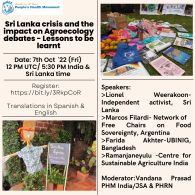
Sri Lanka crisis and the impact on Agroecology debates - Lessons to be learnt

7 October 2022
. 12 PM UTC Sri Lanka crisis and the impact on Agroecology debates - Lessons to be learnt

The Sri Lanka crisis has made movements and activists discuss and reflect on the best ways to transition to agroecology.

After the economic crisis in Sri Lanka this year and the preceding ban on chemical fertilisers, the debate around agro-ecology has come to the fore once again. The Sri Lanka crisis has made movements and activists discuss and reflect on the best ways to transition to agroecology. There have also been observations from some countries on how the crisis and the links with the fertiliser ban is being used by agro-businesses to create an adverse discourse around agro-ecology, possibly weakening the agro-ecology movement.

The Food and Nutrition thematic group of People’s Health Movement consulted with colleagues from PHM Sri Lanka who agreed on the need to ‘clear the air’ in terms of the exact turn of events in the country, on what led to the national crisis and in what way (if any) is it linked to the fertiliser ban. This is an important opportunity for PHM as well as movements working on agroecology and food security to learn from friends in Sri Lanka and listen to voices from different countries on how the debate around organics and agroecology is being played out in their respective countries after the Sri Lanka crisis. In this context we are organising a webinar discussion with the following objectives-
  • To understand from friends from Sri Lanka as to what happened during the Sri Lankan crisis and in what ways (if any) it links with the fertilizer ban in the country
  • Sharing from friends in different countries (Argentina, Bangladesh, India) on the impact of the Sri Lankan crisis on the debates on agroecology in their respective countries.
  • To promote dialogue and learn from Sri Lanka in order to better create roadmaps for the transition to ecologically sustainable agriculture.
Speakers:
  • Moderator: Dr. Vandana Prasad (PHM India/JSA and Public Health Resource Network)
  • Dr. Lionel Weerakoon- Independent Activist, Sri Lanka
  • Marcos Ezequiel Filardi (lawyer), Member of the Network of Free Chairs on Food Sovereignty (Red Calisas), Argentina
  • Farida Akhter, Unnayan Bikalper Nitinirdharoni Gobeshona (UBINIG), the Policy Research for Development Alternatives, Bangladesh
  • Dr. Ramanjaneyulu (Ramoo), Centre for Sustainable Agriculture, India

Related Resource

Politico published an article that looks at organic farming as a possible culprit for the dramatic implosion of Sri Lanka's economy.  While Rajapaksa's abrupt ban on chemical fertilizers did jolt farmers, senior research fellow David Laborde says yields didn't fall so precipitously that it would have dented exports that much. The bigger issue is that COVID-19 sent droves of overseas workers home to Sri Lanka. Money sent home by Sri Lankans working abroad normally totals about $6 billion per year, well above the $1.2 billion that comes from tea, the country's largest cash crop. "The remittances shock is several orders of magnitude bigger than the worst scenario we can imagine about tea," Laborde said. Without the remittances and tourism dollars, Sri Lanka had to spend more of its own currency on imports and interest on debt, which combined with inflation sent it into the spiral that led to its economic collapse.  

"The thing that is pretty evident is that there was macroeconomic mismanagement in Sri Lanka for months, if not years. They didn't want to spend their foreign currency on fertilizer," he said. "That was already a kind of reverse causality." Laborde ended by saying, "We should not draw any generalities or conclusions out of the Sri Lanka situation, except that bad macroeconomic policy can destroy your country and destroy your farm system. That's the only lesson I really want to draw about Sri Lanka."