Platform for African – European Partnership in Agricultural Research for Development
Showing posts with label AFSA. Show all posts

Friday, August 14, 2026

The West African Caravan: Defending Food Sovereignty through Land, Water and Peasant Seeds


The West African Caravan for Land, Water and Peasant Seeds has become one of the region's most visible grassroots mobilizations for food sovereignty, agroecology and communities' rights over natural resources. Initiated by the Global Convergence of Land and Water Struggles – West Africa (CGLTE-OA), the Caravan brings together farmers' organizations, pastoralists, fishers, women's and youth movements, civil-society organizations and agroecology networks. Since its first edition in 2016, it has sought to make the voices of rural communities heard in debates over land, water, seeds and agricultural policy. 

The movement itself brings together more than 300 organizations and has involved major regional networks including the Network of Peasant
Organizations and Agricultural Producers in West Africa (ROPPA), COPAGEN, the West African Committee for Peasant Seeds (COASP), La Via Campesina Africa, the Alliance for Food Sovereignty in Africa (AFSA) and We Are the Solution.


From a regional caravan to a movement for food sovereignty


At the heart of the Caravan is a simple principle: food sovereignty is difficult to achieve when
farming communities do not control the resources required to produce food
. Access to land and water is therefore inseparable from farmers' ability to save, reproduce, exchange and improve their own seeds. From its first edition, the Caravan explicitly connected these rights with family farming, peasant agroecology and food sovereignty, while challenging land, water and seed grabbing. Its vision emphasizes locally rooted food systems, biodiversity, farmers' control over seeds and respectful relationships between producers and consumers.

The Caravan is particularly significant because it takes these debates out of conference rooms and into farming communities. Rather than organizing a single regional meeting, delegations travel between countries and stop in communities where farmers, traditional authorities, women's groups, young people and policymakers can exchange experiences. Local struggles consequently become part of a regional political agenda. Research on the movement has highlighted precisely this ability of the Caravan to connect localized struggles over natural resources with broader West African and international movements for food sovereignty and climate justice.


Peasant and indigenous seeds at the centre


Peasant, traditional and indigenous seed systems are fundamental to this struggle. Generations of farmers have selected crops and varieties according to local soils, rainfall patterns, food cultures, nutritional preferences and farming systems. These systems maintain agricultural biodiversity while continuously adapting crops to changing environments. Seed sovereignty therefore goes beyond having physical access to seed: it concerns farmers' ability to save, select, multiply, exchange and transmit planting material and associated knowledge from one generation to another.

This is especially important for Africa's neglected and underutilized species (NUS), traditional crops and indigenous foods. Many such crops survive not because they have been prioritized by commercial seed companies, but because farming communities—often women—have continued cultivating, selecting, cooking and exchanging them. The erosion of farmer-managed seed systems can therefore mean more than the disappearance of varieties. It can also lead to the loss of traditional knowledge, food cultures, dietary diversity and locally adapted genetic resources.

The Caravan consequently raises a fundamental question about the future of African agriculture: who controls the seed? A food system increasingly dependent on a narrow range of commercial varieties risks marginalizing the diversity maintained in farmers' fields. By contrast, strengthening farmer-managed seed systems can complement formal breeding and genebank conservation by keeping crop diversity alive and evolving under real farming conditions. Previous Caravan activities have explicitly promoted common farmer seed banks alongside agroecological practices.


Women as custodians of seed diversity


The Caravan also brings attention to the often insufficiently recognized role of women in conserving agricultural biodiversity. In many West African farming and food systems, women are involved not only in production but also in selecting seed, storing planting material, processing crops and maintaining knowledge about preparation, nutrition and cultural uses. During earlier editions of the Caravan, organizers explicitly highlighted women's land rights and described women as important guardians of seeds.

Protecting indigenous and farmer-managed seeds must therefore go hand in hand with strengthening women's access to land, resources, decision-making and markets. A seed may be conserved in a genebank, but maintaining it as part of a living food culture requires farmers who continue to grow it and consumers who continue to value it.


The 2026 Caravan: converging on Cotonou


The fifth West African Caravan, held from 19 July to 9 August 2026, significantly expanded this regional mobilization. Two routes crossed West Africa: a Sahelian route from Senegal through Mali and Burkina Faso to Togo, and a coastal route from Guinea through Côte d'Ivoire and Ghana to Togo. They subsequently converged in Benin, where participants also met a Central African Caravan travelling from Cameroon through Nigeria ahead of the 17th World Social Forum in Cotonou. Organizers projected more than 500 participants, 18 stopovers and mobilization involving more than 20,000 people, particularly rural communities, women and youth.

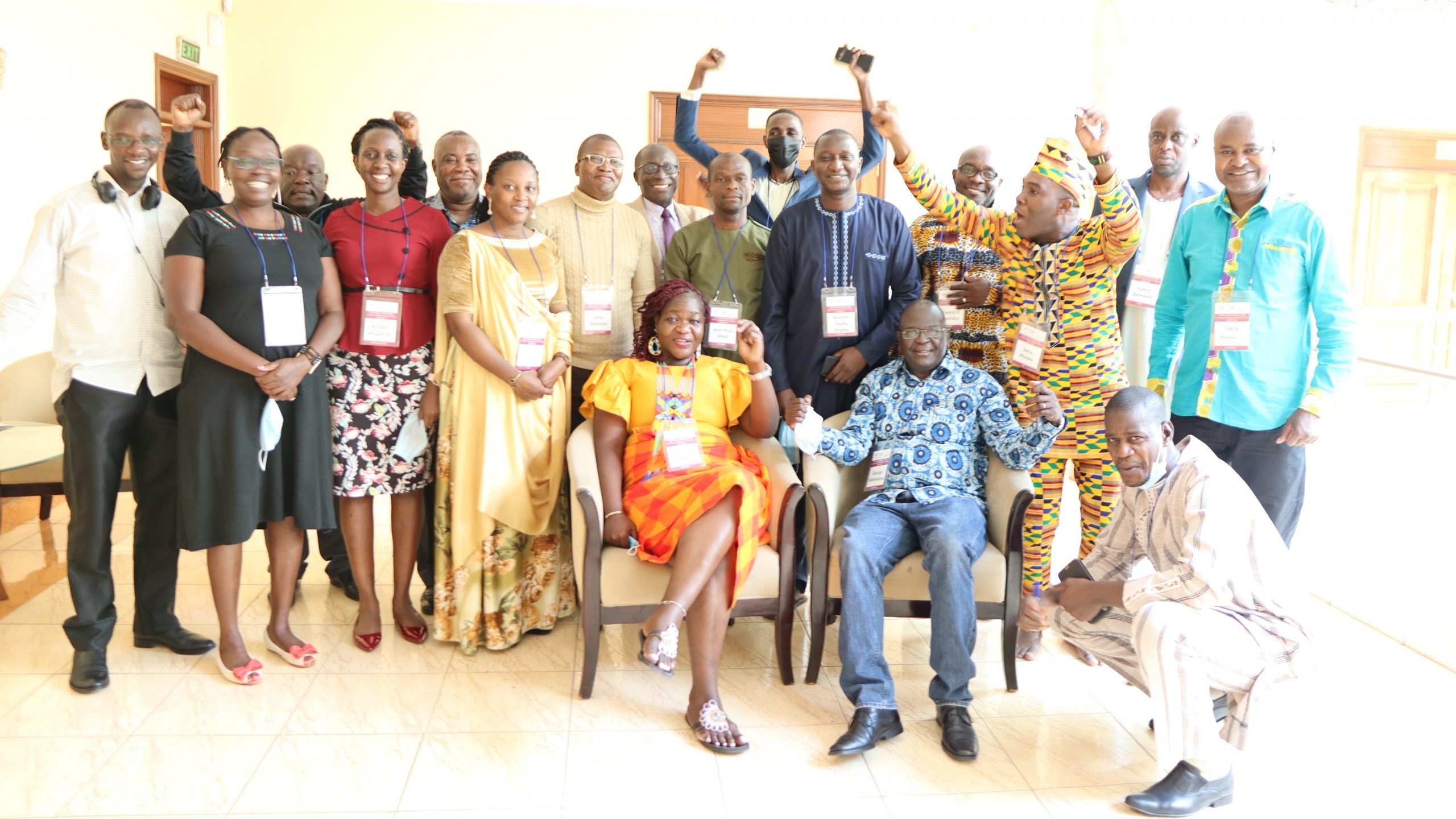
The launch in Tambacounda, Senegal, already demonstrated the broad coalition behind the initiative. Participants included representatives from Senegal, Mauritania, The Gambia and Guinea-Bissau, alongside farmers' organizations, social movements, community leaders and local authorities. The launch was supported by the Dynamic for an Agroecological Transition in Senegal (DyTAES) and Enda Pronat.

(see: CGIAR Trust Fund (2024) Dynamic for the agroecological transition (Dytael) in Fatick - Senegal. Relocalization of the millet value chain for the territorialization of agroecology

The West African Caravan was initially stopped by Beninese police and sent back toward the border on 3 August 2026, reportedly amid problems concerning authorization and cross-border entry procedures for the large convoy of more than 400 participants from multiple West African countries.

The arrival in Cotonou was therefore more than the conclusion of a journey. It brought a decade of grassroots experience—from the Caravan editions of 2016, 2018, 2021, 2023 and 2026—into a global civil-society forum. Land governance, access to water, peasant seeds, agroecology, food sovereignty, climate change, social cohesion and peace could consequently be discussed not as separate issues, but as components of the same transformation.


From seed conservation to transformation of food systems


The importance of the West African Caravan ultimately lies in its insistence that seeds are simultaneously biological resources, cultural heritage, sources of livelihoods and instruments of food sovereignty. Conserving indigenous crops without strengthening the communities that cultivate them is insufficient. Likewise, promoting agroecology without addressing farmers' access to land, water and diverse seed can only achieve limited transformation.

For neglected and underutilized species, this message is particularly powerful. Their revival requires a chain connecting farmers and seed custodians → community seed systems → research and characterization → agroecological production → processing and entrepreneurship → markets and consumers → supportive policies. The Caravan helps ensure that the first actors in this chain—the farmers and communities who have maintained this diversity—remain central to decisions about its future.

After ten years of mobilization, the West African Caravan demonstrates that the struggle for food sovereignty is also a struggle for agricultural biodiversity and control over the foundations of food production. Its recurring message—rights to land, water and peasant seeds are a common struggle—has particular resonance at a time of climate change, biodiversity loss and increasing concentration within agricultural input systems. Protecting Africa's indigenous and farmer-managed seeds is therefore not about returning to the past. It is about ensuring that the extraordinary diversity created and maintained by generations of African farmers remains available for future breeding, resilient farming, diversified diets and locally determined food systems.


Related:

10 August 2026. Niger Restored 900,000 Hectares of Dead Desert With Shovels — Half a Million People Now Eat. Niger Restored 900,000 Hectares of Dead Desert With Shovels, Half a Million People Now Eat, proving that sometimes the best technology to save the future is actually centuries old. In the southern Maradi region of Niger, a stretch of barren land that the United Nations once wrote off as "finished" is now thriving. This isn't the result of billions of dollars in foreign aid or heavy machinery; it's the result of an ancient, forgotten farming method called the "half-moon" and "zaï pits," pioneered by a man everyone once called insane.

This video explores how 528 sites in the Sahel are holding three million cubic meters of water, recharging aquifers, and creating life-saving microclimates. We also look at the reality behind the African Union's Great Green Wall project, and how grassroots, shovel-in-hand resilience is successfully pushing back the Sahara Desert.

Wednesday, June 3, 2026

Book Launch: My Food is African: Volume 2

26 May 2026. Webinar Book Launch: My Food is African: Volume 2
  • This powerful new guide goes beyond what we eat. It looks at the systems shaping African food choices, including culture, policy, markets, corporate power, advertising, gender dynamics, and citizen action.

Through live story readings, reflections, dialogue, and audience participation, the launch brought the guide to life as a tool for organising, advocacy, public education, and movement-building across Africa.

Published in 2026 with support from SIDA under the Transforming African Food Systems to Sustainability (TAFS) Project, this Barefoot Guide is a landmark publication — collective in authorship, continental in scope, and uncompromising in its argument.

Written by over 35 individuals — farmers, journalists, researchers, market traders, chefs, activists, and civil society advocates from across 50 African countries — Volume 2 picks up where Volume 1 left off. While the first guide helped individuals and families understand how to eat more healthily, emphasising traditional foods, dishes, and diets, this second volume asks the harder, structural questions: Who controls what Africans eat? Who benefits? And what happens when ordinary people decide to change that?


What the Book Takes On


Across seven chapters, the guide maps the real forces shaping African food — and the real people fighting back.

  1. The ultra-processed food crisis. Ultra-processed foods are flooding African communities, driving rising rates of diabetes, high blood pressure, and obesity, backed by corporate marketing budgets that dwarf anything civil society can match. The book examines this crisis honestly — including the difficult conversations with policymakers who are not villains but are, as one Ugandan permanent secretary put it, “trapped in a system they didn’t create.”
  2. From practice to policy. In Nigeria, sustained advocacy brought corporate seed legislation under public scrutiny. In Senegal, an agroecological farmers’ network secured land for organic farming through local government engagement. In Kenya, Zambia, DR Congo, Cameroon, and Zimbabwe, the book follows an AFSA team across ten countries documenting where the campaign is producing real, measurable change — in schools, parliaments, markets, and kitchens.
  3. From consumers to food citizens. In the DRC, twenty trained journalists produced hundreds of radio programmes reaching an estimated two million people, challenging corporate food narratives and reshaping media coverage. In Zambia, community radio turned ten free weekly slots into farmer networks and peer learning groups. In Cameroon, the Je Mange Camerounais movement made traditional food culturally trendy through restaurants, social media, and celebration.
  4. African markets are our markets. From Mbare in Harare to Thiaroye in Dakar to Jedaida in Tunisia, the book makes a powerful case for Africa’s territorial markets — the informal, community-rooted spaces that feed the majority of African people — as the backbone of food sovereignty, not problems to be modernised away. These markets maintain food diversity, sustain women’s economic power, and underpin agroecological food systems. They deserve protection and investment, not criminalisation.
  5. Advocacy in global spaces. The guide examines how African civil society is building capacity to engage the African Union, COP climate conferences, and the UN Committee on World Food Security — on African terms.
  6. A Vision for 2045 — and Beyond. The book closes with a grounded, honest imagining of what African food systems could look like by 2045, structured around eleven pillars of food sovereignty in practice. It celebrates real victories and names real defeats. Its conclusion is neither triumphant nor defeated: “The question now isn’t whether food sovereignty is possible. We’ve demonstrated it is. The question is how fast we can scale.”

My Food is African: Volume 2 is available in English and French (Je Mange Africain: Volume 2). It is a guide for organising, advocacy, public education, and movement-building — for citizens, researchers, policymakers, educators, journalists, chefs, and everyone committed to African food sovereignty.

“When we say My Food is African, we’re reclaiming power over our bodies, our communities, and our future. This is about who we choose to be as a continent.”

📥 Download the guide:
My Food is African: Volume 2 — How Citizens Are Reclaiming African Food Systems

Tuesday, July 29, 2025

African Food and Culture Tourism (AFCT)

29 July 2025. AFCT online session with Azeb Girmai, Country Coordinator, ENDA-Ethiopia(Ethiopia), sharing her research on how cultural tourism empowers South Omo communities. Discover how traditions boost livelihoods and resilience—despite policy gaps.

Azeb Girmai is climate change advocacy and campaign advisor with LDC Watch International. Before joining LDC Watch International, she was the Executive Director of ENDA Ethiopia, an Africa-based non-governmental organization working with marginalized communities. Ms. Girmai has more than 12 years of experience in the non-governmental sector, in areas such as international and national level advocacy and policy dialogue on environmental issues and sustainable development. She believes that tackling environmental challenges will mean tackling the main hurdles for women in Africa.

Time: 1600 EAT (1500 Southern Africa / 1400 Central & parts of West Africa / 1300 rest of West Africa/UTC). 

Join Zoom Meeting

  • https://afsafrica-org.zoom.us/j/88368006715?pwd=9G8blvaectveVCE28LulnLJ3juGMdf.1
  • Meeting ID: 883 6800 6715
  • Passcode: 363249

Monday, August 12, 2024

Field tour to agroecology centres of excellence

 12 August 2024.  Field tour to agroecology centres of excellence

  • by AFSA
  • This virtual event provided an immersive experience into best agroecological practices at the RUCID, the Ugandan HSHF/agroecology Centre.
The Rural Community in Development (RUCID), is a HSHF (Healthy Soils Healthy Food) centre in Mityana district and the RUCID ORGANIC AGICULTURE TRAINING COLLEGE is found 4 km from Mityana town along Namutamba road, in Kigogozi cell/ village, Kireku ward/ parish, Busimbi division/ subcounty, Mityana municipality, Mityana District. 

The college is an autonomous subsidiary of RURAL COMMUNITY IN DEVELOPMENT (RUCID), a limited company by guarantee.


The RUCID Centre in Mityana district, Uganda

Common agroecology practices alongside Ugandan farmers include; crop diversification, intercropping, contouring, and the preservation of indigenous seeds and making biofertilizers and bio-stimulants. These practices not only enhance food variety and nutritional value but also build resilience against climate change impacts. For example, the indigenous seeds are adapted to local conditions and offer higher resilience to pests and diseases, and require less inputs than commercial varieties. This not only reduces costs for farmers but also safeguards agro-ecosystem biodiversity.

Friday, February 25, 2022

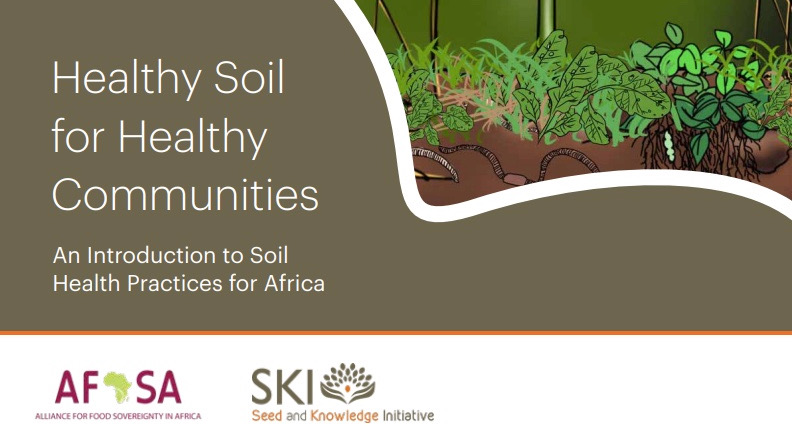
Healthy Soil for Healthy Communities – An Introduction to Soil Health Practices for Africa

17 February 2022.
 AFSA & SKI are delighted to announce the publication of a new book on agroecological practices: AFSA and SKI (2021) Healthy Soil for Healthy Communities – An Introduction to Soil Health Practices for Africa. #33 p.

There is a growing awareness across Africa that we need to improve the health of soils dramatically if we are to produce nutritious food and use water sustainably. The first step in beginning a soil regeneration process is to shift mindsets—to unlearn the ways we think about soil—or indeed—fail to think about soil.

With this in mind, the Healthy Soil Healthy Food (HSHF) initiative was jointly established by AFSA and SKI, bringing together 15 soil regeneration organisations that are working closely with smallholder farmers across the continent.

The HSHF initiative held 12 online learning and sharing sessions from September to December 2020, and it was from these sessions that the content was predominantly drawn for the HSHF publication we wish to proudly announce: Healthy Soil for Healthy Communities – An Introduction to Soil Health Practices for Africa.

This publication is not a technical book. Rather, it aims to help people move towards this mindset shift around soil. Within its pages, it presents the kind of understanding of soil needed if we are to have any chance of successfully regenerating soils, as well as covering recent practices that can help farmers transition to agriculture that prioritises soil health and is in greater harmony with nature.

Related:

20 - 21 February 2022. As part of the World Social Justice Day commemoration, AFSA organised a two-day social media campaign promoting Agroecology as a viable option for ensuring social justice for African smallholder food producers. The campaign will take place on Twitter, Facebook, and Instagram  with the official hashtag #Agroecology4SocialJustice.

Related:

This session during the Africa-Europe Week (14-18 February 2022) set out the challenges facing African communities - from the corporate capture of African lands and natural resources to the industrialisation of African food systems and the climate crisis. Key speakers outlined the struggles - for African civil society voices to be heard, for land justice, for women’s land rights, for corporate accountability, and for the transition to agroecology – a people-centred system of sustainable agriculture, combining indigenous knowledge with cutting edge science, working with nature to nourish healthy and resilient communities.

Related:

6 - 9 December 2021. The Alliance for Food Sovereignty in Africa (AFSA) organized a three-day strategy meeting in Nairobi, Kenya, to discuss and reflect on emerging themes and issues concerning the African movement for food sovereignty and food system transformation that facilitates Africa's transition to agroecology. 

The primary goal of the 2021 AFSA meetings was to evaluate progress since 2018 and develop a clear strategy for a future engagement at the continental, regional, and national levels. More than seventy people from 32 African countries attended the conference. 

The first two days were devoted to four separate working group meetings; each focused on a detailed review of activities carried out in the previous two years and planning for the coming year. Working groups:

  1. Land and Agroecology
  2. Resilient Seed Systems and Agroecology
  3. Citizens for Sustainable Food Systems
  4. Climate Change and Agroecology

    The Climate Change and Agroecology meeting was a side session in which the members reflected on the work that the group had done in 2021 but also proposed what they would do in 2022 regarding the transition to Agroecology for Climate Action. Over the period of last year 2021, the AFSA Climate Change working group members carried out various activities.

    The links hereafter refer to some of the vast engagements that were carried out by the members in campaigning for the transition to Agroecology for Climate Action. 
    COP26 Key Climate Action Demands – These were generated immediately after the Africa Climate Week 2021 and endorsed by various organisations; Zimbabwe – Nigeria – Zambia – Rwanda – Kenya – Ghana – Cameroon 


Thursday, February 24, 2022

Advancing agroecology practice/natural farming: Healthy Soil Healthy Food

24 February 2022. Advancing agroecology practice/natural farming: Healthy Soil Healthy Food

AFSA is organizing 4 sessions in which organizations who are part of AFSA members share how their work with farmers to advance agroecology practice/natural farming is going. 27 January, 10 February, 24 February, 10 March. This is the link to the recording of the session on February 10th in which RUCID, OACK and Scope-Malawi shared some of their experiences of putting agroecology into practice through the lenses of the natural farming principles.

This webinar presented the work of:
  1. Groundswell who work with partners across West Africa, 
  2. Kasisi Agricultural Training Centre in Zambia, 
  3. Chinyika in a drier part of Zimbabwe.

Tuesday, February 15, 2022

Africa-Europe Week and agriculture

14-18 February 2022
. Africa-Europe Week 


In the run-up to the summit, the first edition of the Africa-Europe week brought together young people, civil society and the private sector from Africa and Europe to discuss the aspects of the Africa-EU Partnership that matter to them the most: Youth Track + Civil Society and Local Authorities Forums

European Union leaders and African Union member states met in Brussels for the 6th European Union - African Union summit on 17 and 18 February 2022. 

15/02 CSO Session 3: From local to global: African EU cooperation to tackle the interlinked climate, health and biodiversity crises

This session explored how the EU Africa partnership should support African countries to implement ambitious and just climate and biodiversity actions and lead to stronger alliances for success at the international negotiations on climate, health, and biodiversity. It covered COP15 in China, COP27 in Africa, financing, and addressing climate and biodiversity loss impacts on health. It also highlighted the role of CSOs, Indigenous Peoples and local communities for stakeholder participation and governance.

15/02 CSO Session 6: Supporting family farmers and the right to food for all

Speakers noted that food and agriculture receive very little attention in the outputs of the AU-EU Summit despite their importance for the economic, social and cultural fabric of the continent. The session will suggest key points that the AU-EU investment packages should respect to ensure they respond to the interests and rights of small-scale family farmers, rural communities and food insecure urban dwellers.

15/02 How can the FNSSA and the CCSE Partnerships contribute to building stronger value chains for sustainable growth and jobs in Africa and in the EU

 - organised by two corresponding projects LEAP4FNSSA and LEAP-RE 

The role of Science, Technology and Innovation (STI) in the transformation the FNSSA and the Energy landscapes in Africa remains in the centre of the agenda in the AU-EU R&I Partnership. Structural transformation is required in Africa’s agricultural sector to reallocate economic activities from the lower-end of the FNSSA land and its energy sector, to the higher-end where more value is added which result in better economic returns and improved livelihoods. STI is seen as a conduit to stimulating this required paradigm shift.
  • Monica Ebele Idinoba from the African Union commission. She is the principal scientific officer at the African Union commission
  • Dr. Hans-Joerg Lutzeyer, Senior policy officer at the director in general for research and innovation of the European commission
    "The big heading this year will be developing the concept of the International Research Consortium, so that there will be meetings year-long, consultations to establish and International Research consortium which brings efforts together". 
  • Irene Annor-Frempong, FARA - lead coordinator Leap4FNSSA
    "By September 2022, we will have a final result on launching the international consortium for the FNSSA under the EU-AU partnership"
  • Dr. Erick Tambo, head of the pan-African educational program at the United Nations University vice directorate
  • Professor Luis Mira da Silva, associate professor at the University of Lisbon and Portugal, PhD in agricultural systems, from University of Reading.
  • Professor Babalola vice president of the organization for women in science and development
  • Dr. François Moisan, a scientific officer for the LEAP for renewable energy.
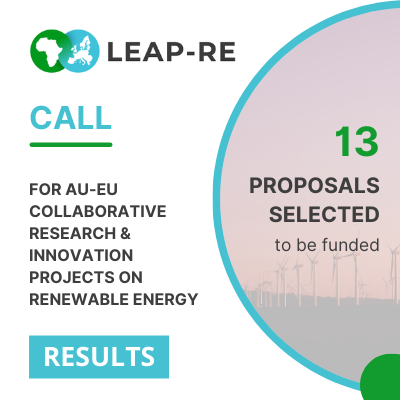
    "13 project proposals were selected for funding via LEAP-RE Call for proposals"
  • Dr. Giacomo Falchetta, International Institute for applied systems and energy, and environmental program.
  • Mr. Maranga, quality engineer with a particular focus on electrical engineering systems
In January 2021, LEAP-RE launched a ‘Call for AU-EU Collaborative Research and Innovation projects on Renewable Energy’. The Call resulted in 124 applications being received from candidates including compagnies, non-profit associations, research labs, foundations and more from 38 African and European countries. 36 pre-proposals were pre-selected, 32 were submitted, and 13 proposals were finally selected for funding.

13 proposals selected for funding were chosen along 6 thematic lines

(The projects listed below are recommended for funding to the national/regional research funding organisations of LEAP-RE by the Pillar 1 Call 2021 Steering Committee. IMPORTANT: The actual funding of the projects depends on the successful completion of the contract negotiations at the national/regional level.)

1. Renewable energy resources, mapping and modelling

  • OASES: Development and Demonstration of a Sustainable Open Access AU-EU Ecosystem for Energy System Modelling. Coordination: Fraunhofer Institute for Energy Economics and Energy System Technology, Germany.

2. End‐of‐life and second‐life management of RE components

  • RESTART: REcycling of spent Li-ion batteries and end-life photovoltaic panels: From the development of metal recovery processes to the implementation of a START-up. Coordination: University UCA of Morocco, Morocco.
  • SIREVIVAL: Si-based devices for renewable energy: From end of life recycling to revival of photovoltaic modules. Coordination: Université catholique de Louvain, Belgium.

3. Clean cooking and biomass transformation

  • SoCoNexGen: Solar Indoor Cooking Systems of the Next Generation. Coordination: Aachen University of Applied Sciences, Germany.
  • SOLAR INDUCE: SOLAR INDUCEed domestic clean efficient cooking and refrigeration for off-grid applications in Africa. Coordination: COPRECI S Coop, Spain.
  • PyroBioFuel: Sustainable biomass conversion into bioenergy through pyrolysis. Coordination: Cairo University, Egypt.
  • SunGari: A modern solar cooking solution for African staples. Coordination: University of Greenwich, UK.

4. New renewable energy resources for Africa

  • HyAfrica: Towards a next generation renewable energy source – a natural hydrogen solution for power supply in Africa. Coordination: CONVERGE, Lda, Portugal.

5. New, more efficient PV cells and components

  • QDSOC: Environmentally friendly colloidal quantum dots for high performance solar cells. Coordination: Université de Lorraine, France.
  • NANOSOLARCELL: Integration of photonic conversion layers based on photoemissive nanostructured materials for improving sunlight harvesting ability of solar cells. Coordination: CNRS-CEMHTI, France.

6. Productive uses and new applications of solar energy

  • MG-FARM: Smart stand-alone micro-grids as a solution for agriculture farms electrification. Coordination: Université de Lorraine, France.
  • LEDSOL: Enabling clean and sustainable water through smart UV/LED disinfection and SOLar energy utilization. Coordination: Centrul IT pentru Stiinta si Tehnologie, Romania.
  • SolChargE: Decentralized Solar Charging System for Sustainable Mobility in rural Africa. Coordination: Technical University of Munich, Germany.

15/02 CSO Session 10: Food Sovereignty and Rural Transformation through Agroecology and Land Justice

This session set out the challenges facing African communities - from the corporate capture of African lands and natural resources to the industrialisation of African food systems and the climate crisis. Key speakers outlined the struggles - for African civil society voices to be heard, for land justice, for women’s land rights, for corporate accountability, and for the transition to agroecology – a people-centred system of sustainable agriculture, combining indigenous knowledge with cutting edge science, working with nature to nourish healthy and resilient communities.

16/02. AfCFTA, A Game Changer

This high level panel looked at how to ensure an effective implementation of the AfCFTA at continental, regional and country level in order to make it a reality for the private sector.

17/02. Reflections on a common research and innovation agenda for agroecological transitions of agri-food systems under AU/EU policy frameworks

This session focused on the implications of new EU policy frameworks for Africa-Europe partnerships on the research and innovation (R&I) priorities for agroecological transitions of agri-food systems based on reflections of African stakeholders. The specific objectives of the side event are: - To discuss the implications of the EU Green Deal including the Farm-to-Fork strategy and INTPA priorities for the AU/EU agenda on research and innovation (R&I) for agri-food systems. - To provide input on R&I priorities and actions in African-European partnerships to support agroecological transitions under the sustainability / green agenda for agri-food systems in Africa.
  • Opening – Carla Montesi (DG INTPA) 
  • Keynote I: Implications of the EU Policy Frameworks for R&I priorities for agri-food systems in Africa – Tadas Briedis (DG Health) 
  • Keynote II: Reflections on R&I priorities for agroecological transitions under the AU/EU Policy Frameworks – Simplice Nouala Fonkou (African Union) 
  • Brief intermezzo on agroecological transitions – Helena Posthumus (DeSIRA-LIFT)
Panel discussion: reflections on R&I priority areas, actions and partnerships to support agroecological transitions in Africa 
  • Aggry Agumya (FARA) 
  • Abdou Tenkouano (CORAF) 
  • Marcela Quintero (One CGIAR)
    She presented the One CGIAR Initiative: Transformational Agroecology Across Food, Land, and Water Systems. This Initiative aims to develop and scale agroecological innovations for small-scale farmers, and other agricultural and food-system actors across different socio-ecological contexts in seven low- and middle-income countries in the Global South. For more details, view the full preliminary outline
  • Mouftao Salami-Odjo (YPARD - President REJEPPAT) - cancelled due to poor connection
  • Commentary R&I priorities for FNSSA – Hans-Jörg Lutzeyer (DG RTD) 
  • Closing – Simplice Nouala Fonkou (African Union)