Platform for African – European Partnership in Agricultural Research for Development
Showing posts with label INSARD. Show all posts

Friday, June 5, 2015

What African smallholders want from research

4 June 2015. Most of the food produced in Africa is supplied by small-scale farmers, many of whom are struggling. New knowledge could help to boost these micro-operations and their contribution to food security, but smallholders are rarely consulted when research agendas are set. An EU-funded project focused on stimulating the necessary dialogue.

The aim of the INSARD project was to get smallholders, scientists and policymakers to talk to each other. “A lot of the agricultural research and development being done is coming up with solutions that aren’t very well suited to smallholder farmers,” says Ann Waters-Bayer of ETC, the Dutch non-governmental organisation (NGO) that led the project consortium.

INSARD involved a number of African farmer organisations and NGOs as well as partners in the EU. It encouraged smallholder farmers and researchers in Senegal, Tanzania and Zambia to explore research needs, capacities and opportunities together. Farmers in all three countries seized this opportunity to identify research activities addressing their priority topics.

The prevailing disconnect between agricultural research and smallholder farming means that the scientists and farmers involved aren’t necessarily aware of their complementary skills and expertise, says Waters-Bayer. INSARD, which ended in December 2013, helped these groups become more aware of the ways in which they can help each other, she reports.

The “research outlines(43 pages) that the participating farmers and scientists jointly developed in Senegal, Tanzania and Zambia reflect this willingness to engage with each other. They focus on challenges specific to the individual countries and highlight aspects that could be addressed through research. Priority topics notably include optimising local seed systems, improving low-input methods to boost soil fertility and shedding new light on various issues regarding land tenure.
  • Identification, evaluation and characterization of local/indigenous maize seeds in the Southern Highlands of Tanzania
  • Soil fertility improvement through processed animal manure application in Zambia
  • Involving small scale farmers in marketing models that can effectively guarantee improved incomes for their produce in Zambia
  • Securing family farms in the context of increasing private investments (agriculture, mining, tourism and real estate) in Senegal
  • Land, pastoralism and pastoral mobility in Senegal: securing pastoral areas and resources.
  • Land Governance in Senegal: promoting a participatory approach, building local sustainable alternative land tenure security of family farms and vulnerable groups
Implementing these research outlines was, however, not part of the project’s remit. The INSARD partners have submitted proposals for new projects building on these outlines to a number of national and international institutions funding this type of research.

Tuesday, January 7, 2014

Zambia: Platform linking farmers, researchers formed to enhance agro production

31/12/2013. Lusaka, Zambia. A meeting was organised by PELUM to disseminate information on including smallholders in agriculture research. It was attended by researchers, farmers and representatives of civil society organisations.

The meeting was convened by PELUM Association to discuss a project called Including Small holders in Agriculture Research for Development (INSARD), whose objective is to facilitate the participation of a broader range of European and African civil society organisations in the formulation and implementation of Agriculture Research Development (ARD).
“When including Small holders in Agriculture Research for Development (INSARD), project which has been coordinated by PELUM Association in collaboration with Agriculture Consultative Forum and the University of Zambia, we were sensitised to be part of research to make it possible for research to work for us and that the research findings are used effectively by we the farmers. We have since identified our agriculture challenges, prioritised them and jointly developed research outcomes,” Mr Shonga, 66, a former headmaster, said.
He added:”let me take this opportunity to inform you that we know what challenges we meet. Sometimes, researchers spend time working on crop varieties while our major challenge is on markets.”
Mr Shonga, who has been growing maize, rice, soya beans and velvet beans but is diversifying to fish farming commended PELUM Association, the implementing agency for INSARD for creating a platform where small scale farmers meet researchers and policy makers to discuss the challenges in agriculture and to decide on appropriate research demands.

PELUM Association is a regional network of civil society organisations operating in Eastern, Central and Southern Africa involved in promoting ecological land use management practices, including seed and food security and providing support to small scale farmers in the region.

Faustin Vuningoma, the PELUM Association secretary general, said INSARD, a European Union project – a symbol of North-South partnership, is being piloted in three countries in Africa.
INSARD is working towards making it easier for civil society organisations, both non-governmental and farmer organisations, to be actively involved in influencing agricultural research systems in Africa.
Apart from Zambia, it is also being piloted in Tanzania and Senegal.

INSARD is a partnership between the Eastern and Southern Africa Small-Scale Farmers’ Association Forum, ETC Foundation, GRET, PELUM Association, Practical Action (2011/2012) and REPAOC).

Tuesday, November 6, 2012

Innovations for Better Livelihoods


30/10/2012. Breakout session GCARD II, P3.1 Innovations for Better Livelihoods

Unlocking innovation represents a major challenge. |A diversity of approaches grounded on participatory action research have been developed including notably the concept of Integrated Agricultural Research for Development (IAR4D).

Despite the conceptual agreement around these approaches and the promise they hold, there are also concerns, not only regarding how these approaches can have impact, but also how they can they do so at scale. Participatory approaches to agricultural research have often been judged to be slow and costly “boutique solutions” confined to the sites where they work directly. As a result their impact on poverty
is considered by some to be marginal when compared with commodity research targeting many millions of people.

This Session explored these issues by considering how investment in agricultural research can be
strengthened to increase its contribution to poverty reduction and improve the lives of those that more conventional approaches have failed to reach. In doing so the panelists considered the specific issues of partnerships and the role that they play in strengthening the quality of our work and the ultimate scale of the impacts.
What is needed for implementing innovation partnerships and producing the evidence and understanding required for impact in global, regional and national programs?
Stakeholders’ approach to AR4D
Putting the approach into practice: Establishing effective livelihood research partnerships for impact at scale
Working with national innovation pilot learning sites and inter-regional innovation platforms
3 p. Download document of the Breakout session GCARD II, P3.1

Thursday, November 1, 2012

INSARD @ GCARD: The Voices of smallholders in shaping priorities’

Involving smallholders in Agricultural Research for Development (ARD): Mind the gaps!

Hilary Warburton and Nicoliene Oudwater (ETC Foundation), on behalf of the INSARD (INcluding Smallholders in Agricultural Research for Development) consortium

The GCARD-2 Foresight paper (F3), “The voice of smallholders in shaping priorities”, raises a number of questions about why the inclusion of farmers, particularly resource-poor farmers, in foresight (and in ARD processes generally) has so far been limited. 

This prompted INSARD to think about how “the problem” of lack of inclusion is perceived, and how this affects the solutions proposed. We identified three differing sets of assumptions about the major cause(s) of the lack of inclusion of farmers in ARD. Each leads to an emphasis on a different, sometimes conflicting type of solution. Further, we see that focusing on national level processes would address one of the missing gaps in scaling up.

Gaps in perceptions of why smallholders have little engagement in ARD Some established players in ARD see the problem as essentially one of lack of capacity (skills and resources) within CSOs (Farmer Organisations (FOs) and NGOs). The CSOs do not organise themselves sufficiently to convey common messages from farmers; they are not sufficiently representative of a wide enough number of farmers; they are not able to articulate farmers’ problems as researchable questions, and therefore struggle to design projects; their monitoring and evaluation is often lacking; they have little involvement in recognisable foresight studies etc. The kinds of solutions proposed are therefore concerned with building capacity of CSOs to engage more effectively with formal researchers and other ARD stakeholders. This may include additional resources, stronger partnerships and shared projects – but overall, this approach retains the current form and processes of ARD, and tries to enable smallholder farmers and CSOs to fit better into the ARD mould. It fits with a project-driven research agenda where researchers and CSOs work together and need resources and skills to access funds and deliver acceptable results for donors.

Another view, often held by policy-oriented CSOs, is that the problem is primarily one of lack of democracy. Smallholder farmers are a diverse group with differing concerns; they also overlap with wider communities of rural populations and poor consumers (urban and rural) – all of which have legitimate interests in the future of agriculture and therefore of ARD. Current representation in ARD processes by a handful of CSOs or farmers is simply not sufficient to allow for real influence and equitable engagement. There are also concerns that some FOs represent only a narrow constituency of larger-scale farmers. The corresponding solution therefore focuses less on capacity building and more on widening the numbers of different voices within the ARD processes. An example is the Civil Society Mechanism (CSM) of the Committee on World Food Security (CFS) where the numbers of representatives has been widened to include different constituencies (for example, women farmers, pastoralists) and regions. It may change the balance of power between the ARD stakeholders, and deliberately seeks to bring the unheard voices of the more marginalised smallholder farmers and others into the discussion. This approach is less tied to individual field-level projects and more towards support for networks and research agenda setting.

More fundamentally, a third, alternative world view starts with food producers at the core, and the recognition that smallholder producers provide food to about 70% of the global population. Therefore the key question is not: “What role could smallholder farmers pay in meeting future needs in food & nutrition security…” but rather “What role can research play in supporting and enabling smallholder farmers/producers to continue to provide nutritious food to a growing population into the future?” The problem is perceived as a lack of accountability and awareness of researchers towards farmers, rural people and poor consumers. Rather than farmers and CSOs building their capacity to speak the language of researchers, the research organisations have a responsibility to consult and account for their work in ways that make sense for farmers. This means recognising that CSOs have legitimate interests in long term prioritisation of ARD as well as specific field-based projects. This means more openness to communicating, fostering innovative mechanisms for discussions with farmers (for example farmers’ juries), and recognising that formal research forms part of much wider agricultural innovation systems. It also requires recognition that farmers do not tend to separate ARD out from other livelihood and development issues. Few African CSOs focus only on ARD; they tend to cover wider agricultural development and environmental issues. If researchers want to support farmers and CSOs, they need to be prepared to try new processes and to look for entry points on issues of concern to farmers.

Two way process

Of course, there can be overlaps between these views and the Foresight report refers to issues with capacity, democracy/representation and the need to see problems through multiple lenses. Many researchers are actively searching for new ways to partner with farmers, but we sense that there is still a tendency to expect farmers/CSOs to engage within the existing ARD context, rather than for researchers and other private/public stakeholders to engage within farmers’ contexts. It does have to be a 2-way process with more flexibility and willingness on all sides to allow room for farmers to influence how ARD agenda-setting processes are constructed.

Gaps in scaling up There are examples of good practice and productive partnerships between farmers and researchers at local field levels. At the regional and global levels, there are well-established ARD structures where the multiplicity of farmers’ voices struggle to be heard. But we see a huge gap between the local and the international levels. In order to scale up local successes and address the lack of democracy and accountability at the higher levels, we need to fill this gap. National level processes are some of the key missing elements. The Foresight study noted that national level processes are generally more inclusive, multi-stakeholder oriented than the regional or global ones. However, studies for the INSARD project identified a lack of coordination between researchers, CSOs and other stakeholders at the national level. Both studies noted that farmers/CSOs are mainly involved at validation stage and in consultations rather than farmer organisations/CSO co-leading the process. This is where more emphasis is needed, and where the INSARD project is focusing. By brokering processes that bring farmers/CSOs, researchers, public/private stakeholders together around tangible and priority concerns of farmers, there is potential to create spaces where a greater diversity of farmers’ voices can be included, research questions relevant to farmers’ concerns can be identified and stronger, more equitable partnerships forged for the future.

Monday, May 7, 2012

INSARD Advisory Group meeting

1 May 2012. Brussels, CSA office. INSARD Advisory Group meeting, back-to-back with PAEPARD meetings: the CSO consultation meeting of 2 May and the PAEPARD multi-stakeholder meeting of 3-4 May 2012.

One of the main deliverables for INSARD (INcluding Smallholders in Agricultural Research for Development) is to come up with a CSO coordination and consultation mechanism that allows CSOs (both NGOs and Farmer Organisations) to participate effectively in regional and international discussions on ARD.

Following the mapping study by Mutizwa Mukute and the international consultation meeting in Nairobi (19 Nov 2011), a summary outlining the overall strategic direction has been developed and shared widely (i.e. through the PAEPARD website and EFARD, and also the INSARD webpage (www.repaoc.org/insard). The INSARD consortium is working on a more elaborated strategy, which was shared and discussed with the Advisory Group. WP 1: CSO coordination and communication mechanism WP 2: Producing joint research outlines (in framework of pilot national ARD platforms) WP 3: Policy-influencing strategy

Friday, December 23, 2011

Inventory of African and European CSOs involved in agricultural research for development (ARD) in sub-Saharan Africa.

19 November 2011. Nairobi. An international consultation meeting was held to discuss the findings of the inventory of African and European CSOs involved in agricultural research for development (ARD) in sub-Saharan Africa. The meeting was attended by about 30 people from research institutions, NGOs and FOs.

The study identified the formal and informal linkages between CSOs and other stakeholders involved in ARD, as well as potentials and blockages in the ARD system to realising a greater participation of CSOs in prioritising, formulating and carrying out ARD. The study also looked into resource allocation for ARD in sub-Saharan Africa, and how and where and by whom the decisions for such allocation are made.

This study was planned to contribute to:
  • Designing and implementing a consultative mechanism that allows various CSO representatives to participate meaningfully in African, European and international deliberations on ARD;
  • Triggering the necessary change in direction of the ARD system toward a more demand-led, grounded and smallholder-focused research and innovation system; and
  •  Stimulating greater resource flows to research involving small-scale farmers.
Next steps: 
  • INSARD will finalise the “CSO-in-ARD” mapping study report and make it widely available. INSARD will develop a short strategy paper on possible CSO consultation and coordination mechanisms. 
  • INSARD will develop a policy paper to provide a basis for engaging with the GCARD (Global Conference on Agricultural Research for Development) roadmap, including issues of governance reforms and alternative approaches to ARD.
  • INSARD will contribute to the regional consultations for GCARD in Africa and Europe in early 2012 by informing NGOs and FOs in these regions about the international ARD process, so that they understand how they can engage in ARD decision-making, in a similar way as was done during the time of the NGO Committee (NGOC) of the CGIAR (Consultative Group on International Agricultural Research).
Resources:
Mapping EU-SSA Agricultural Research for Development, CSO Engagement and Resource-Allocation Processes, Mutizwa Mukute and Tafadzwa Marange, 7 December 2011, 77 pages.

Wednesday, March 30, 2011

How local innovation, coupled with scientific insights and principles, can help improve yields without harming the land, water and the rest of the environment


Documentary film series: the ingenuity and grassroots expertise of small farmers in developing countries

Organisation: Prolinnova and TVEAP

A new documentary film series highlights one way forward: tap the ingenuity and grassroots expertise of small farmers in the developing countries. They have long mastered the art of resilience and survival against formidable odds.
The 4-part series, produced by TVE Asia Pacific (TVEAP), shows how local innovation, coupled with scientific insights and principles, can help improve yields without harming the land, water and the rest of the environment.

TVEAP, a non-profit media foundation, produced the series in partnership with Prolinnova, a global learning network that promotes local innovation led by small-scale farmers in sustainable agriculture and management of natural resources.

The film series were premiered at the 2011 Prolinnova International Partners Workshop, on 21 March 2011 in Dar es Salaam, Tanzania. (see related blog spot:
 International Forum on the Mainstreaming Participatory Approaches into Agricultural Research and Development

Filmed during 2010 in four countries on three continents, the short film series begins with an overview of the global agricultural research and development challenges tackled by Prolinnova partners. It shows how this work improves farmers’ ability to feed a world that’s both crowded and warming.

It also showcases the processes and products of participatory innovation development in three countries: Cambodia, Niger and South Africa. 

The examples featured in the series cover both technological and social innovation. Among them: an improved fish smoking oven and the use of millet glumes as cassava fertiliser in Niger; how goat rearing strengthens the economics of poor families in South Africa; and more efficient rice farming that uses considerably less water in Cambodia.

All four films illustrate how Prolinnova operates: bringing government, academic and civil society groups together with small farmers to work as equals.

Prolinnova partners are pleased with how the film series has turned out.

“The whole project -- which involved making three short films in Cambodia, Niger and South Africa, and an overview film covering the global programme -- was done within the span of a year. It was most challenging and exciting,” says Chesha Wettasinha, Coordinator of the film project of on behalf of Prolinnova at the ETC Foundation in The Netherlands.

She adds: “It was no small feat to capture in film concepts and approaches espoused by Prolinnova, but TVEAP did remarkably well in showing in a nutshell what we had written in reams of publications. Hats off to TVEAP for a job well done!”

The series was researched and scripted by TVEAP Director Nalaka Gunawardene, a science writer with wide experience in covering development issues in the print, television and online media.

“Many researchers and development professionals talk among themselves, usually in their own technical language,” says Gunawardene. “They don’t reach out enough to the policy makers, business leaders and the public. Films like these can bridge this gap, and make a difference.”

The series was conceptualised and produced by TVEAP under commission from the Prolinnova Network. It comes in two languages: English (original) and French (version). Interviews have been conducted in several local languages.

Says TVEAP’s Series Producer Manori Wijesekera: “Our challenge was to distil the essence of nearly a decade of field work by dozens of Prolinnova partners. We had to tell their story in an engaging and authentic manner – and in a nutshell.”

The series was filmed with local video crews in Cambodia, Niger and South Africa – as well as at the 2010 international partner meeting held in Wageningen, The Netherlands. Prolinnova partners at each location provided technical guidance and logistical support. The series was edited and post-produced in Colombo, Sri Lanka, where TVEAP is anchored. 

Both Prolinnova and TVEAP are firmly committed to the principles of open content. Thus, the video film series is being released and distributed without any copyright restrictions. The films may be used, adapted, versioned or copied without license fees or royalty payments, as long as the original sources are acknowledged.

The films can also be viewed online, in their entirety, at the TVEAP website:
http://www.tveap.org/?q=node/545


PROLINNOVA Niger: Arid Land, Fertile Minds


Thursday, March 24, 2011

International Forum on the Mainstreaming Participatory Approaches into Agricultural Research and Development

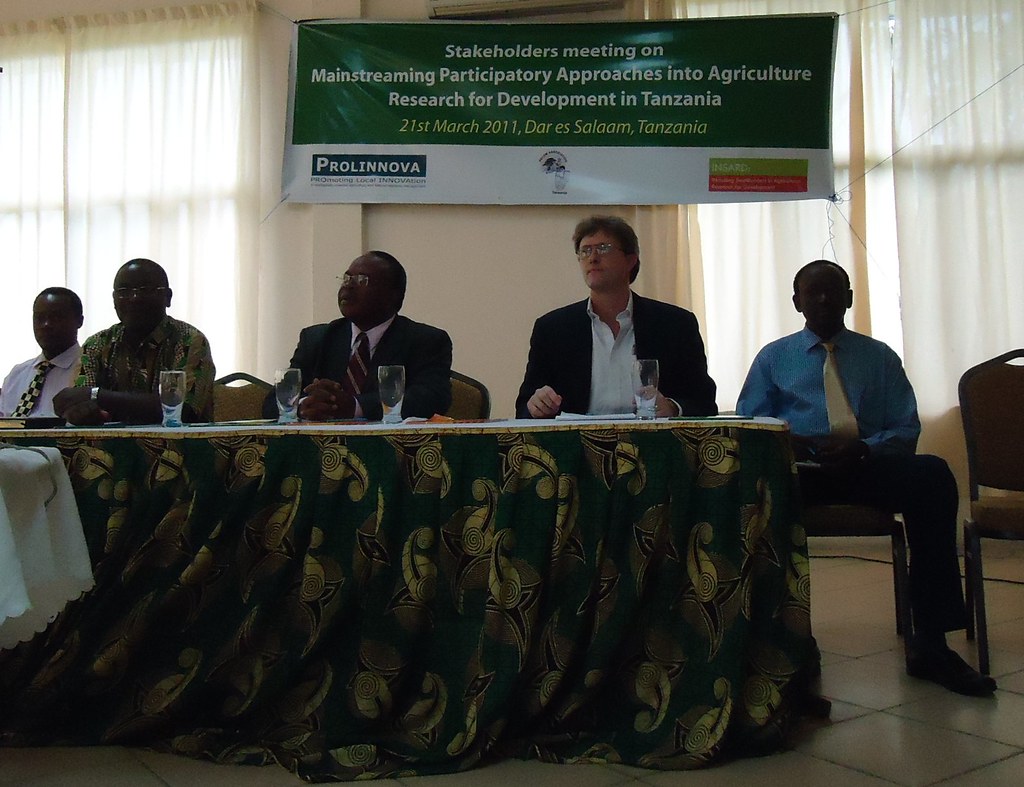
21st March 2011. Dar es Salaam. PROLINNOVA International Partners Workshop (IPW) 2011 including a one day. "International Forum on the Mainstreaming Participatory Approaches into Agricultural Research and Development".

PROLINNOVA organised its International Partners Workshop and the PROLINNOVA Oversight Group meeting / FAIR meeting from 19 – 25 March 2011 in Tanzania. During the International Forum the INSARD project was presented (Including Smallholders in Agricultural Research for Development) This initiative is a 3-year project financed by the European Commission. It comes under FP7 KBBE "Networking of NGOs involved in ARD".

The main aim of INSARD is to ensure the informed participation of a broad range of European and African CSOs in formulating and implementing ARD. It will do so by: 
1) Designing a structure for coordination and communication between European and African CSOs involved in ARD and in influencing ARD policy and practice 
2) Identifying CSOs' research priorities and a strategy to communicate these to other actors in ARD 
3) Facilitating joint definition of specific research examples by CSOs and researchers, based on the smallholders' priorities 
4) Engaging in policy dialogue with key African and European research organisations and donors. 

The project will build up a more transparent system for CSOs to provide well-founded inputs and positions in the ARD agenda and its implementation, so that smallholders are central to publicly funded ARD. It will help make research more relevant for small-scale family farmers, including livestock-keepers. It will seek to achieve its aim by building on existing initiatives and networks in Europe and Africa that involve CSOs promoting smallholder-centred ARD.


PROLINNOVA is an NGO-initiated programme to build a global learning and advocacy network on promoting local innovation in ecologically-oriented agriculture and NRM. This international meeting provided an excellent platform to share views and experiences and to reflect on mechanisms to strengthen the mutual learning process between the different partners involved.

The 2011 partners’ meeting was also be a good opportunity to continue to further strengthen the partnerships within the PROLINNOVA family – partners who have been around longer with those who have joined more recently such as the francophone sister-programme PROFEIS (Promoting farmer experimentation and innovation in the Sahel) and partners from the Andean region, Mozambique and Kenya.

Related blog post: INSARD @ the PAEPARD European Multi Stakeholder consultation