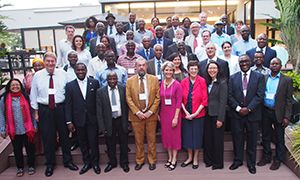
24-26 April 2019. Lome, Togo. West Africa Fertilizer Forum, organised by the Africa Fertilizer initiative in partnership with the Regional Fertilizer Professionals Association.
More than 200 participants from 38 countries gathered: producers, developers and investors. In Togo, firms like CECO Group, CIAT Sarl, and ETG Togo SA (Export Trading Group) operate in the fertilizer industry.
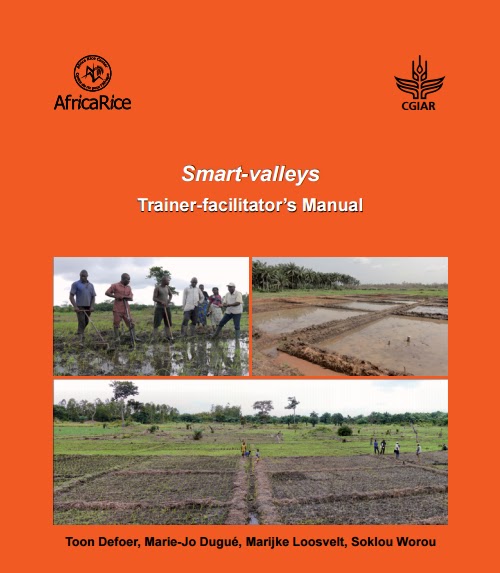
This manual is made up of modules, which are to be used by the trainer-facilitator during the training of the technician-facilitators who are in the position to facilitate the Smart-valleys development process on the ground. The manual is therefore, first of all, meant for the trainer-facilitators interacting with the technicians during the training workshop. These training workshops, and consequently the accompanying modules, are based on the principle of training by discovery and by action-training.
The AfricaRice Knowledge Management Unit is currently preparing distance learning courses for the approach that will allow AfricaRice to reach even more farmers in the end.
‘SMART-valleys’ is a low-cost, participatory and sustainable approach to develop inland valleys for rice-based systems. Major advantages mentioned by farmers are the increased water retention in their fields, less risk of fertilizer losses due to flooding and increased rice yields.
The SMART-valleys approach follows a step-wise procedure focusing on design, lay-out and construction of low-cost water control infrastructure after a careful selection procedure paying attention to both socio-economic and biophysical factors and making extensive use of farmer knowledge.
The SMART-valleys approach starts with the identification of inland valley sites with potential for rice cultivation. This is done by a technical team working with farmers and village chiefs in the field. The team should be comprised of members that are trained in the SMART-valleys approach, able to comprehend the social and hydrological setting of valleys with potential for rice cropping. Together they put together a dossier containing information about the valley/s to be developed, importance of rice in the surrounding community, potential to grow and market rice, suitability of the soil and water source for rice cropping, land tenure, etc. The dossier allows the technical team to discuss with the communities that want to exploit the valley and those that are downstream that might be affected by the development.
The plan and design of the development is based on this dossier, consultations with technical teams and farmers’ knowledge and experience of water flow and retention on the soil surface. Such a design outlines the water intake, drains and bunds to enable greatly improved water retention in the valley lowlands and drainage of excess water from the valley. It may also include simple structures to divert water from a natural source and provide irrigation to thirsty rice fields when needed.
Background:
Back in 2009 the SMART-IV project was started in Benin and Togo. Since that year it supported rice farmers with improvement land and water management approaches. Despite a slow start the SMART-IV project has become a great success. With hard work and good collaboration it achieved the goals that were set by the donor, the Ministry of Agriculture in Japan.
The SMART-valleys approach was rewarded a second phase then called the SMART-VALLEYS project and it expanded the project to Liberia and Sierra Leone. Ebola affected the timely implementation of the activities but since this year field technician and farmers are exposed to the Smart-valleys approach and it conducted agronomic research to improve the yields in terms of quantity and quality.
In the meanwhile new projects are introducing the Smart-valleys approach in GIZ funded projects in Burkina Faso and northern Benin. The approach was showcased as an example of adaptation of African farmers to climate change and variability at the COP22 Climate Change meeting in Marrakech last year. Both Radio France International and the German sister Deutsche Welle broadcasted the Smart-valleys approach.
The coordinator of the project, Dr. Roland Issaka (picture), is succeeding to Sander Zwart who coordinated the project from 2009 until 2017.
Videos:
Related:
4-5 April 2017. Abidjan, Cote d’Ivoire. Technologies, Platforms and Partnerships in support of the African agricultural science agenda. A meeting was held co-hosted by IFPRI and AfricaRice, to strengthen linkages and forge stronger partnerships around new ideas, tools and technologies that contribute to developments in agricultural science, technology and innovation. The meeting was attended by over 60 participants from international development institutions (World Bank, Africa Development Bank, IFAD and USAID) and technical partners (CGIAR Centers, national partners including universities, sub-regional organizations, private sector and NGOs). It demonstrated how new technologies and their assessments, delivery mechanisms, shared platforms, and new tools will support agricultural transformation and economic development in Africa.
Funding support for the Scientific and Technical Partnerships in Africa program was provided by the International Fund for Agricultural Development (IFAD), with support from the CGIAR Research Program on Policies, Institutions, and Markets (PIM) led by the International Food Policy Research Institute (IFPRI).
The Meeting:
Reviewed and discussed initial highlights and results from IFPRI and partners three workstreams as proof of concept in technical support of the Science Agenda.
Explored examples of country level applications of technologies, technology platforms, and their delivery mechanisms.
Prepared for specific business cases for technologies and examined further the role private and public sector partnerships play in technology investment in Africa.
Explored opportunities to create synergies in agricultural R&D that could make a difference in brokering institutional and technical partnerships moving ahead.
11 January 2017. Davis, USA. University of California, Plant and Environmental Science Bldg. Borlaug LEAP Fellows presented their perspectives from a book they are editing, The Future of African Agriculture: Perspectives from the Next Generation of African Scientists.
The book is showcasing the opportunities for Africa’s future in the midst of on-going challenges through current research and from the viewpoint of young African scientists. Seven former Fellows, now serving as editors on the book, presented current research in the context of the book.
Dr. Dawd Gashu
Through presentation and panel discussion, the speakers covered the three main book topics:
Africa Rising – small farmers feeding the continent
Biotechnological advancement as a tool to enhance agricultural productivity in Africa and
Opportunities and challenges in Africa’s agriculture in 2050 and beyond
The speakers represented both academic and government research institutes in seven different African countries (Togo, Nigeria, Ethiopia, Ghana, Kenya, Tanzania, Mali).
Dr. Waweru
Presenters and Panel:
Dr. Senorpe Asem-Hiablie, Ghana.Post-doctoral Researcher, USDA-ARS (Research: Investigations of Human Exposure Risk to Environmental Estrogens through Common Ingestion Pathways).
Dr. Dawd Gashu, Ethiopia. Assistant Professor of Nutrition, Addis Ababa University (Research: Effect of Micronutrient Status on Health and Metabolism of Children in Ethiopia)
Dr. Assoumane Maiga
Mr. Kwevitoukoui Hounkpati, Togo. PhD Candidate, Entomology, University of Georgia (Research: Systematic Studies of West African Ladybeetles (Coccinellidae)
Mr. Mustafa Jibrin, Nigeria. PhD Candidate, Plant Pathology, University of Florida-Gainesville (Research: Molecular Characterization and Race Classification of Bacteria Spot Pathogen of Tomato in Northwestern Nigeria).
Dr. Assoumane Maiga, Mali. Professor Advisor, Ministry of Education, Mali. (Research: Evaluating Communication Strategies and the Role of Mass Media in Disseminating Agriculture-related Information to Farmers in Post-conflict Nations)
Dr. Mariam Mtunguja,Tanzania. Senior Research Officer, Mikocheni Ag. Research Inst.
Dr. Mtunguja
(MARI) (Research: Genetic Diversity, Starch Physicochemical Properties and Cyanide Levels in Farmers' Preferred Cassava Landraces in the Eastern Zone of Tanzania)
Ms. Bernice Waweru, Kenya. Research Scientist, Kenya Agriculture and Livestock Research Org. (KALRO) (Research: An Implementation of Nested-Association Mapping for Stem Rust Resistance Genes in Bred Wheat)
27/11/2016 to 03/12/2016. Tchamba. Togo. Three researchers from Embrapa hortaliças (Brazil): visited the "Local seeds value chain promotion: farmers led breeding and distribution of green pepper and red pepper varieties” of which they are the technical partner: Carlos Francisco Ragassi, Dr Marçal Henrique Amici Jorge, Dr Claudia Silva da Costa Ribeiro
At the beginning of the second year of the project achieved results are:
Workshops were organized in Togo for planning activities, characterization and identification of problems referent to the production system, involving different actors of pepper value chain;
175 farmers were interviewed for assessing information about pepper production in the 5
regions of Togo and it was identified as major problems the lack of seeds in the local market, the occurrence of diseases and pests of plants and the difficulty of access to the market;
Introduction of germplasm from Brazil: 18 Brazilian cultivars and 17 Togo local varieties were evaluated (agromorphological characterization) by local farmers in three village of central region (Nimah, Alibi 1, Bago and Kaboli) and at the station of ESA in Lomé;
Mass selection: Capsicum spp. varieties from Togo e Brazil were tested at the station of ESA in Lomé. Seeds were collected of each local variety tested.
The seeds obtained from the first cycle of mass selection will help to perform the second cycle (mass selection 2) in year 2;
Five local varieties (Alibi1, Bago, Sokode (PV), Anie2, Lome) and five cultivars from Brazil (Jalapeno M, Jalapeno+, BRS Mari, BRS Moema, Maximus) were selected.
During the stay, the Brasilian and Togolese teams visited pepper trials farms. The group participated in the pepper farmers leaders training and discussions:
the project activities implementation and provisional results - AGOSSOU Affo Binde
Pepper breeding - Dr. Claudia Ribeiro
Production of seeds and seedlings - Dr. Marçal Amici
5 May 2014. Abuja, Nigeria. As global leaders gathered for the 2014 World Economic Forum on Africa to
discuss approaches to inclusive growth and job creation, the Innovation Prize for Africa (IPA 2014) innovators demonstrated that the best way to achieve equitable economic growth
for all Africans is to invest in local innovation and entrepreneurship.
Selected from about 700 applications from 42 countries the IPA has awarded its 2014 prize to Dr Nicolaas Duneas and Nuno Peres, from South Africa for their an innovative product for the treatment of bone injuries. The IPA 2014 also recognized two runners up for their contributions to African innovation.
In the business potential category, Logou Minsob (Togo) received USD 25,000 for his Foufou Mix, a food processor designed to replace the mortar and pestles used to prepare Foufou, a popular dish in West Africa.
In the social impact category, Melesse Temesgen (Ethiopia) received USD 25 000 for developing the Aybar Broad Based Furrow Maker (BBM), a low-cost farming device that is used to easily drain excess water from waterlogged fields.
From South Africa to Niger,
the IPA 2014 finalists - in the field of agriculture - were:
Daniel Gitau Thairu (Kenya)
Domestic Waste Biogas System
The Domestic Waste Biogas
System is a new type of biogas digester which utilizes any material capable of
decomposing instead of relying on animal dung to generate gas. Materials that
can be used include dirty water, leftover food, spoiled grain, and vegetable
and fruit peelings. This makes biogas usable even by households that cannot
afford animals.
Elise Rasel Cloete (South Africa) - GMP Traceability Management
Software CC
This software is programmed
to capture, store and trace data about livestock and enables data to be
captured in real-time. The data is then stored in an ear tag placed on
livestock and backed up on a remote server.
Logou Minsob (Togo) - Foufoumix
This is a device designed to
replace the mortar and pestles used in preparing the popular West African dish,
foufou. The “FOUFOUMIX " is a small electrical food processor that allows
generates discreet, quick and hygienic foufou in 8 minutes, substantially
reducing the amount of time needed to prepare the dish, while also enhancing
the hygienic conditions during production.
Maman Abdou Kane (Niger) - Horticultural tele
irrigation
The "Horticultural
Tele-Irrigation system is a technological process that allows growers to
remotely control their market garden irrigation system through a mobile or
landline regardless of geographic location.
Melesse Temesgen (Ethiopia) - Aybar BBM
The Aybar BBM is a low-cost
farming device that can be used by farmers to plough fields that are usually
waterlogged and helps them easily drain the water. This turns soils or fields
that were otherwise unavailable for farming into high yielding fields.
Sulaiman Bolarinde Famro (Nigeria) - Farmking Mobile Multi-crop
Processor
The innovation uses
centrifugal forces to process cassava, sweet potatoes, soy, she-nuts, grains
and cereals. It helps to separate the tubers from liquid, particles and
impurities/toxic elements. The extractor is designed to replace the present
crude fermentation and pressing technology which is extremely slow and wasteful
and offers limited output and profitability. The extractor reduces a process
that normally takes 3 - 4 days into a 5 minute process offering higher quality
product outputs.

 24-26 April 2019. Lome, Togo. West Africa Fertilizer Forum, organised by the Africa Fertilizer initiative in partnership with the Regional Fertilizer Professionals Association.