Platform for African – European Partnership in Agricultural Research for Development
Showing posts with label Brazil. Show all posts

Friday, November 14, 2025

Food & Agriculture Pavilion @COP30

10 - 21 November 2025
. Belém, Brazil. UN Climate Change Conference (UNFCCC COP 30) - Food & Agriculture Pavilion @COP30 

With Brazil holding the presidency as both an agricultural powerhouse as well as home to the Amazon rainforest and other critical ecosystems such as the Cerrado, the stage is set to show how coherent land-use policies can deliver for climate, nature, and people alike. For the first time, we may see food systems take center stage in a way that meaningfully links the Rio Conventions, the Sustainable Development Goals (SDGs), and the Paris Agreement. 

COP30 is the turning point to mainstream food systems into climate action. CGIAR scientists and FAO with and their global partners are seizing the moment to provide the science, partnerships, and innovations that make global adaptation and mitigation targets achievable, inclusive, and ready for finance.


Extracts of the programme


11 Nov. The full stack: From AI models to ethical policy and farmer impact (IWMI / CGIAR)


This event explored how advanced AI, Earth observation, and digital agronomy can translate into practical benefits for farmers. It focuses on data governance, responsible AI in agriculture, and real-world examples from CGIAR’s work in South Asia and Africa to scale decision-support tools for climate-smart farming.
  • Giriraj Amarnath Research Group Leader – Water Data for Climate Resilience IWMI 
  • Elliot Jones-Garcia Senior Research Analyst IFPRI 
  • Andrew Howe Ai2 Tek Sapkota Principal Scientist CIMMYT 
  • Imara Salas Secretariat Director AIM for Scale 
  • Marcelo Morandi Head of the Office of International Relations Embrapa


12 Nov. Sustainable nitrogen management for climate, food security and livelihoods


A discussion of science-based strategies for cutting nitrogen losses while maintaining yields. CGIAR and FAO researchers shared insights on fertilizer efficiency, circular nutrients, and opportunities for national climate commitments to integrate nitrogen mitigation.

  • Valerie Fajardo, Research Fellow International Nitrogen Network 
  • Martina Otto Head of Secretariat Climate and Clean Air Coalition, UNEP 
  • Tek Sapkota Principal Scientist CIMMYT Mark Sutton Director of the International Nitrogen Management System (INMS) and GCRF South Asian Nitrogen Hub (SANH), co-chair of the UNECE Task Force on Reactive Nitrogen (TFRN) and co-chair of the UNEP Global Partnership on Nutrient Management (GPNM) 
  • David Kanter Chair, International Nitrogen Initiative and Professor of Environmental Studies at New York University (NYU) 
  • Tariq Aziz Regional Director for South Asia at the International Nitrogen Initiative (INI) and Professor of Soil Science at the University of Agriculture, Faisalabad (UAF) 
  • Andrea Perez Senior International Affairs Manager Compassion in World Farming Martial Bernoux Team leader and Senior Natural Resources Officer FAO 
  • Osamu Kubota Deputy Assistant Minister, Export and International Affairs Bureau, Ministry of Agriculture Forestry and Fisheries (MAFF), Japan 
  • Saskia Sanders Swiss Federal Department of Economic Affairs and negotiator of Sharm El-Sheik Joint Work in Agriculture


13 Nov. Pulses in school meals — Untapped climate potential


This session highlights the mitigation and nutrition gains achievable by bringing climate-resilient pulses into national school meal programmes. CGIAR crop scientists share evidence from India, East Africa, and Latin America.
  • Sid Mehta Founder & CEO Greenworks Inc.
  • Lara Gilmour Director of Policy & Sustainability Global Pulse Confederation (GPC)
  • Marcela Quintero Associate Director General  Alliance of Bioversity International and CIAT
  • Lyana Latorre Vice President, Latin America and the Caribbean The Rockefeller Foundation


14 Nov. Demystifying low-emission food systems and landscapes


A science-based unpacking of what “low-emission food systems’’ actually entail. Presenters discussed how mitigation targets can be realistic for countries with diverse farming systems, and the role of CGIAR in quantifying emission reductions.
  • Eliza Villarino Research Specialist Alliance of Bioversity International and CIAT 
  • Marcela Quintero Associate Director General Alliance of Bioversity International and CIAT 
  • Tek Sapkota Principal Scientist, Agricultural System/Climate Change CIMMYT 
  • Claudia Ringler Unit Director, Natural Resources and Resilience IFPRI


14 Nov. Introducing AgriLLM: An AI-Powered Agricultural Advisory Service for the Global South


AgriLLM is a collaborative AI initiative leveraging advanced language models to expand equitable access to agricultural knowledge worldwide. It is developing a domain-specific large language model (LLM) for agriculture, benchmarked against leading systems and to be released open-source as a public good - bridging research, policy, and field-level impact. 
 
Established by the International Affairs Office at the Presidential Court of the UAE, with AI71 as the technology partner, AgriLLM is co-led by over 15 global partners including CGIAR, EMBRAPA, the Gates Foundation, FAO, IFAD, the World Bank, and ECHO, alongside universities and research centers.  
 
This COP30 session offered an early look at the initiative’s journey so far - what AgriLLM is, how it was designed, and its grounding in scientific knowledge and local realities - as well as a preview of what’s next ahead of its global launch in December 2025.
  • Silvia Massruhá President / Head of Digital Agriculture Embrapa
  • Lina Yassin CGIAR AI hub Product Lead CGIAR
  • Kate Kamarchuk Director, Client solutions & Strategic Partnerships AI71
  • Marcelo Behar Special Envoy for Bioeconomy and Senior Advisor Ambition Loop
  • Mamoun Alaoui, AI71 Product Manager/ Technical Lead AI71
  • Eliot Jones-Garcia Senior Research Analyst IFPRI


15 Nov. Climate technology progress report 2025


CGIAR scientists and partners assessed advances in climate tech—bioeconomy solutions, emissions monitoring, digital agriculture, and drought-tolerant crops—evaluating which innovations are ready for scaling.
  • Alex Godoy-Faúndez Associate Professor & Director Universidad del Desarrollo 
  • Debora Ley Coordinator, Climate Change National Actional Plan, NDC3.0 Ministry of Environment and Natural Resources, Guatemala 
  • Elisabeth Gilmore Associate Professor in Environmental Engineering Carleton University 
  • Martial Bernoux Team leader and Senior Natural Resources Officer FAO 
  • Monica Trujillo Research Fellow SEI Latin America 
  • Sara Lærke Meltofte Trærup Head of Section on Technology Transitions and System Innovation UNEP-CCC 
  • Stephen Minas Chair of the Climate Technology Centre and Network Advisory Board

The 2025 Climate Technology Progress Report (CTPR): ‘Advancing biobased technologies in the bioeconomy’ examines how advancing the climate and nature agenda through the integration of technology and sustainable biobased solutions can offer a comprehensive and cost-effective pathway to achieving both objectives simultaneously.

The report is intended as a resource for policymakers, practitioners, and stakeholders seeking to advance integrated, effective, and equitable climate and nature action in the lead-up to COP 30 and beyond.


15 Nov. Turning innovation into impact: Scaling climate-smart solutions for farmers (IWMI / AICCRA / CGIAR)


This AICCRA-led session presented success cases—index insurance, digital advisories, climate-smart cropping systems—reaching millions across Africa. Emphasis is on partnerships that turn pilots into national programmes.

Accelerating Impacts of CGIAR Climate Research for Africa (AICCRA) has six country teams and regional initiatives that work with national and regional partners to transform climate services and scale climate-smart agriculture, increasing access to and use of CGIAR innovations for the benefit of millions of small-scale farmers in Africa.
  • Martial Bernaux Team leader and Senior Natural Resources Officer OCB-FAO
  • Paula Packer Head of Embrapa Environment Embrapa Environment
  • Marina Piatto  Executive Director IMAFLORA
  • Paul Winters Executive Director AIM for Scale
  • Giriraj Amarnath Research Group Leader - Water Data for Climate Resilience (WDCR) IWMI
  • Todd Rosenstock Director - Climate Action Science Program CGIAR
  • John Mundy Director of Global Partnerships One Acre Fund
  • Vincent Martin Director - Office of Innovation FAO


15 Nov. Circular food systems: International solutions for climate action


Showcased evidence from CGIAR research on waste valorisation, nutrient recycling, climate-smart processing, and circular agriculture business models from Latin America, Africa, and Asia.
  • João Paulo Pucciariello Perez Executive Secretary of Food and Nutrition Security Osasco City Hall, Brazil 
  • José Ogawa Mayor of Barcarena, Brazil
  • Anna Salminen Chief Specialist Ministry of Agriculture and Forestry of Finland
  • Sieglinde Snapp SAS Program Director CIMMYT
  • Tilahun Amede Director Climate Adaptation Sustainable Agriculture and Resilience AGRA
  • Niina Aagaard Director of Communications Nordic Council of Ministers

x


17 Nov. Unlocking Finance at Scale for Land Restoration, Climate Adaptation & Food Security

The Resilient Agriculture Implementation for Net-Zero Land Degradation (RAIZ) initiative showcased how restoring degraded agricultural lands is vital for climate resilience, food security, and environmental gains.

By exploring innovative financing mechanisms that blend public, private, and multilateral capital, and sharing best practices across UNFCCC, CBD, and UNCCD frameworks, RAIZ accelerates pathways to achieve land degradation neutrality by 2030. 
  • James Stapleton Senior Advisor, Advocacy Alliance of Bioversity International & CIAT (CGIAR)
  • Wendy Franceconi Senior Environmental Scientist Alliance of Bioversity International & CIAT (CGIAR)

17 Nov. Agriculture and food security in the Caribbean (IWMI / CGIAR)


This session focused on water-smart agriculture, climate advisories, and innovation ecosystems that support Caribbean states in integrating adaptation into food security strategies.
  • Donneil Cain Moderator; Climate Change Coordinator Caribbean Development Bank 
  • Daniel Best President Caribbean Development Bank
  • Todd Rosenstock Director, CGIAR Cliimate Action CGIAR
  • Martial Bernoux Team Leader and Senior Natural Resources Officer FAO
  • Kristin Lang  Director, Department of the Latin America and the Caribbean Region Green Climate Fund (GCF) Secretariat


18 Nov. Strengthening Rural Extension and Advisory Services for a Just Agrifood Transition


This session highlighted the importance of strengthening Rural Extension and Advisory Services to promote a just agrifood transition. It emphasized the role of university outreach, civil society, international organizations, governments, and farmers in addressing climate change. Drawing on evidence and case studies, it showcased collaborative models that advance climate-smart, low-carbon, regenerative, and agroecological practices, linking knowledge, policy, and local action to foster fair, resilient, and sustainable agrifood systems for family farmers and traditional communities.
  • Marco Teixeira  Researcher and Consultant Instituto Escolhas
  • Jaqueline Ferreira Research Director Instituto Escolhas
  • Graciella Corcioli Professor and General Coordinator School of Agronomy at the Federal University of Goiás
  • Paulo Teixeira Minister Ministry of Agrarian Development and Family Farming of Brazil  
  • Gustavo Chianca Assistant Representative – Programme Officer FAO Brazil
  • Rodrigo Castro  Brazil Country Director Solidaridad


19 Nov. Restoring Soils, Renewing Futures: South-South Cooperation for Climate-Resilient Landscapes


This session explored innovative soil restoration models for climate resilience. It showcased policy, finance, and science partnerships that regenerate degraded lands, promote inclusive south-south learning, and scale soil health solutions for resilience, green jobs, and climate action.
  • Leigh Winowiecki Global Research Leader: Soil and Land Health CIFOR-ICRAF
  • Aliou Fala Director of Agricultural research
  • Sieglinde Snapp SAS Program Director CIMMYT


20 Nov. Finance and Evidence for Soil Health to Advance Climate and Sustainable Development Goals


This session spotlighted soil health as a cross-cutting solution for climate mitigation and adaptation, biodiversity conservation, land restoration, food and nutrition security, farmers’ income and livelihoods. It explored how to build and use credible evidence and scale up successful farmer-led initiatives through fit-for-purpose data, partnerships, and investment. Grounded in cases from Africa and Brazil, as well as youth-led initiatives, the discussion linked scientific and financial innovation to national pathways under the Rio Conventions and the Sustainable Development Goals.
  • Hicham El Azami Director of Evaluation & Learning OCP Nutricrops
  • Luis Rangel Senior Expert for Sustainable Agriculture Brazilian Ministry of Agriculture and Livestock (MAPA)
  • Leigh Winowiecki  Co-Lead, CA4SH and Soil and Land Health Research Lead CIFOR-ICRAF
  • Nick Blong First Assistant Secretary, Sustainability, Climate and Strategy Division Australian Government Department of Agriculture, Fisheries and Forestry
  • Lily Tanui Project Officer and Climate Action Leader Kenya National Farmers’ Federation (KENAFF)
  • Helena Van Tichelen UN Events Coordinator International Association of Students in Agricultural and Related Sciences (IAAS)

20 Nov. Enabling holistic NDCs: Tools for integrated climate, biodiversity & food systems action (Alliance CIAT–Bioversity, IWMI, partners)


A major CGIAR-supported event presented integrated modelling tools and cross-sector planning approaches to help countries upgrade their NDCs to include biodiversity, water, and food system linkages.
  • Roberta Makoko NDC Coordinator Malawi
  • Sophika Kostyniuk Managing Director Aquatic Life Institute
  • Charlotte Pavageau  Senior Programme Manager Biovision Foundation
  • Greenwell Matchaya Deputy Representative and Senior Economist IWMI/CGIAR, Pretoria
  • Moderator: Silvia Mantilla Global Policy & Communications Manager WFA


20 Nov. Scaling solutions for resilient animal & aquatic food systems (CGIAR involvement)


This session highlighted innovations from livestock, aquaculture, and aquatic food research communities—including genetics, climate-resilient breeds, water-efficient aquaculture, and antimicrobial-smart systems.
  • Michelle Tigchelar Senior Scientist WorldFish
  • Todd Rosenstock Program Director CGIAR
  • Anthony Whitbread Program Leader, Livestock, Climate, Environment (LCE) ILRI
  • Bernard Kimoro Head climate change and livestock sustainability State Department for Livestock, Ministry of Agriculture and Livestock Development, Kenya
  • Angela Churie Kallhauge Executive Vice President Impact at Environmental Defense Fund
  • Maya Rajasekharan Managing Director, Americas Alliance of Bioversity International and CIAT
  • Lucy Njuguna Postdoctoral Fellow Alliance of Bioversity International and CIAT
  • Ana Maria Loboguerrero Director, Adaptive and Equitable Food Systems Gates Foundation


20 Nov. Sustainable and regenerative livestock of the Americas


A multi-country dialogue on grazing management, silvopastoral systems, and regenerative livestock approaches. CGIAR contributes metrics for monitoring ecosystem benefits and emission reductions.
  • Mariana Aração Heaf of beef program EMBRAPA
  • Cristina Tófoli Executive Coordinator Instituto de Pesquisas Ecológicas (IPE)
  • Allison Thomas COO U.S. Dairy Export Council
  • Amanda Soares Roza  Technical Advisor for Sustainability and Market Intelligence CNA (Brazil)


20 Nov. Scaling regenerative agriculture from Riyadh to Belém (Alliance Bioversity–CIAT / CA4SH)


Building on the UNCCD COP16 momentum, this session connects regenerative agriculture leaders from Latin America, Africa, and the Middle East. It highlights CGIAR evidence on soil health, farmer incentives, and resilience outcomes.
  • Pedro de Figueiredo Co-founder and CEO NetZero in Brazil
  • Maya Rajasekharan Managing Director Alliance of Bioversity International and CIAT
  • Natalia Bottan Vasconcelos Sustaintability Manager Sygenta
  • Isabela Malpighi Chief Sustainability Officer Pepsico Latam
  • Osama Faqeeha Deputy Minister for Environment, Ministry of Environment, Water and Agriculture, Saudi Arabia
  • Gabriel Lambert Advisor to the Executive Secretary of the United Nations Convention to Combat Desertification (UNCCD)
  • Leigh Winowiecki Global Research lead for Soil and Land Health CIFOR-ICRAF


20 Nov. Family farming and agroecology: Pathways to inclusive & climate-resilient food systems


Explores how agroecology and family farming can drive just transitions. CGIAR’s contributions include metrics, farmer-centred extension models, and evidence on productivity co-benefits.
  • Kamyla Borges Senior expert on Agriculture Institute for Climate and Society
  • Caroline Rocha Executive Director LACLIMA

Wednesday, November 12, 2025

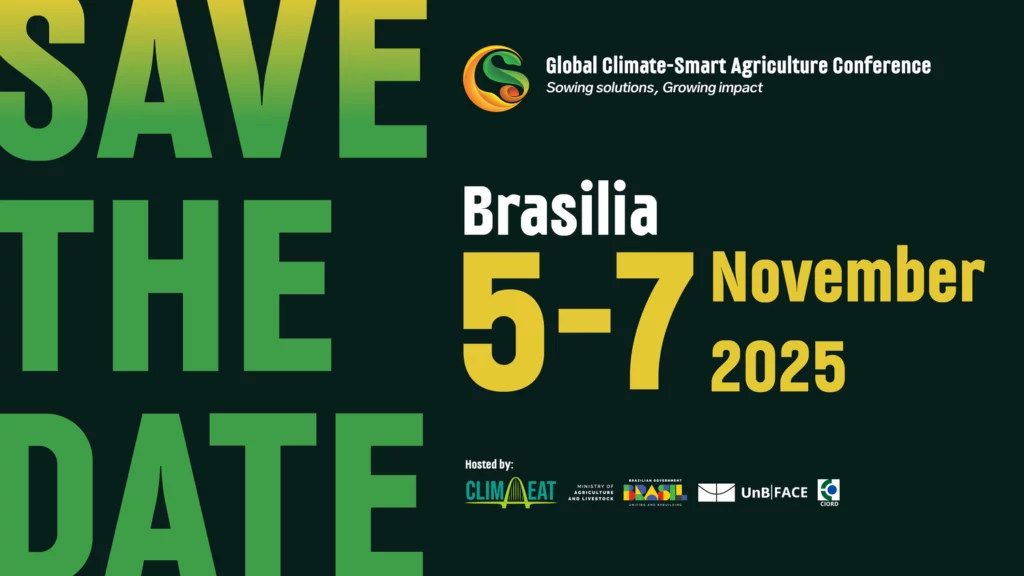
Global Climate-Smart Agriculture (CSA) Conference 2025

5–7 November 2025
, Brasília, Brazil. Global Climate-Smart Agriculture (CSA) Conference 2025

Over the three days the conference underscored that while the promise of climate-smart agriculture is strong, its success hinges on integrated, systemic approaches—not simply isolated innovations. Soil health and plant nutrition emerged as foundational; next-generation crops and sustainable livestock systems were flagged as necessary but not sufficient without enabling policies, inclusive institutions and innovative finance. The “synergies with planetary boundaries” track reinforced that CSA must be embedded in broader land-use, biodiversity and ecosystem resilience agendas. Several speakers emphasised that public and private investment must shift toward verifiable climate-smart outcomes (rather than vague “greenwashing” promises), and that farmer-centred design, gender and social inclusion, and digital tools will be critical enablers.

Thematic sessions

Extracts of the main programme

05/11 Opening Panel: Shifting power, scaling solutions: Aligning global food, climate and development agendas

In this session, panellists emphasised that transformative change in agriculture and food systems must go beyond incremental innovation; it requires a recalibration of power dynamics, meaningfully engaging farmers (especially small-holders and women), local institutions and communities in co-design and decision-making, rather than remaining passive recipients. They discussed how scaling solutions for climate-smart agriculture (CSA) demands alignment across global food, climate and development agendas — bridging trade-offs between mitigation/adaptation, food security, livelihoods, ecosystem health and equity. In particular, the panel highlighted three interlinked imperatives: (1) governance — creating inclusive institutions and enabling policies that shift power towards those most impacted; (2) finance and business models — unlocking investments that reward climate-smart outcomes (not just rhetoric) and channel resources into places and actors often marginalised; and (3) systems thinking — recognizing that food systems, climate action and development goals are deeply interconnected, so scaling solutions must work across value chains, landscapes and supply networks.
  • Rachel Waterhouse, Resilient Ocean-Coasts, Water and Land Use Systems Lead, FCDO
  • Grace Tanno, Minister, Head of the Agricultural Policy Division (DPAGRO), Brazil Ministry of Foreign Affairs (Itamaraty)
  • Chris Chilcott, Deputy Director Environment, CSIRO
  • Ishmael Sunga, CEO, Southern African Confederation of Agricultural Unions (SACAU)

05/11 From Pilot to Scale – Unlocking Payments for Ecosystem Services (PES) in Agriculture

Exploring how different financial and policy instruments can work together to mobilize climate finance in agriculture.

The discussion highlighted four major levers: (i) Measurement and verification — robust monitoring of ecosystem outcomes (e.g., carbon, water, biodiversity) is vital to make payments credible; (ii) Institutional & market design — clear governance, transparent rules, risk allocation (e.g., between buyers, aggregators, farmers) and credible demand (carbon markets, biodiversity credits) are essential; (iii) Inclusive business models — farmers (especially smallholders, women) must be integrated as active partners, not just recipients, with fair benefit sharing and capacity-building; (iv) Scaling pathways and policy enablers — public-sector policies, subsidy reform, enabling regulatory environment and blended finance can unlock up-scaling.
  • Moderated by: Rachael Kretsis, Climate and Agriculture Advisor, FCDO
  • Gertrude Kambauwa - Director of Land Resources Conservation, Malawi Ministry of Agriculture
  • Michael Kwame Nkonu - Head of Portfolio for Agricultural Livelihoods, IKEA Foundation
  • Lieven Claessens - Senior Scientist – Carbon Modelling, Olam Agri


06/11 Fact or Fiction? Debunking Myths in Sustainable Agriculture & Food Systems

In this interactive panel, participants explored how often-repeated claims in sustainable agriculture and food systems mask complex realities, and sought to distinguish legitimate innovation from oversold hype. The discussion addressed recurring themes such as “climate-smart agriculture can solve everything,” “zero-emission livestock is just around the corner,” or “nature-positive food systems are fully scalable today.” The speakers challenged each myth by contrasting them with empirical evidence and farmer-centred realities—for example, they emphasized that while soil health improvements are critical, the institutional and market barriers often prevent scaling; that livestock systems can reduce emissions but require major shifts in feed, land-use and behaviour; and that “nature-positive” approaches can deliver only if metrics, governance, and inclusive business models are robust. The session concluded that credibility in sustainable agriculture will depend on transparency about trade-offs, robust measurement of outcomes, stronger alignment with smallholder realities, and honest communication about what can — and cannot — be scaled rapidly.
  • Facilitator: Luis Rangel, Federal Inspector for Agriculture and Senior Expert for Sustainable Agriculture, MAPA
  • Muhammad Ibrahim, Scientist, Climate-Smart Agriculture
  • Ana Carolina Zimmerman, Farmer & Youth
  • Katja Vuori, CEO, AgriCord
  • Omar Farhate, Policy Officer, EmergingAg


07/11 The Private Sector/Business Panel- Innovative financial and business models

This panel explored how private finance can unlock climate-smart agriculture at scale—moving from pilots to bankable, replicable models. Speakers compared instruments such as blended finance, green bonds, sustainability-linked loans, carbon and ecosystem-service credits, and outcome-based contracts. They stressed the nuts-and-bolts: de-risking for early adopters, standardizing MRV to pay for results (not promises), aggregating smallholders so capital can flow efficiently, and aligning incentives across buyers, banks, and farmers. A recurring theme was inclusion—designing models that are investable and workable for farmers (especially SMEs and women), with policy predictability to crowd-in private capital rather than replace it.
  • Facilitator: Manuela Maluf Santos, Country Director, Brazil · IDH
  • Laurence Jassogne, Head of Nature and Climate Solutions, Olam Agri
  • Rodrigo Miguel, CEO of Agrifirm LATAM and member of the Strategic Committee of the Royal Agrifirm Group
  • Francila Calica, Head of Agricultural Affairs and Sustainability Latin America, Bayer
  • Franck Saint-Martin, Global Public Affairs, Nestle


Monday, June 2, 2025

One Planet Network’s Sustainable Food Systems Conference


27-29 May 2025. 
Brasilia, Brazil. With its 5th global conference, the One Planet Network’s Sustainable Food Systems Programme intended to make a substantial contribution to inspire and encourage policymakers to take bold decisions in the key policy fora in 2025, such as the UNFSS+4 Stocktaking Moment and UNFCCC COP30.

The main theme was: "Overcoming the Barriers to Food Systems Transformation - Coherent Policies and Equity-sensitive Solutions to Simultaneously Fight Hunger and Malnutrition, Biodiversity Loss and the Climate Crisis".

This conference showcased concrete solutions, policies and actions to address political economy barriers at the intersection of food systems, nutrition, climate, biodiversity, livelihoods, equality and other related policy agendas, that can be adapted and replicated in different contexts.

Day 1

Plenary Session 2: Systems-based and equity-driven strategies to address political economy dynamics

  • H.E. José Wellington Barroso de Araújo Dias, Minister for Social Development and Assistance, Family and Fight Against Hunger, Brazil
  • H.E. Christian Hofer, State Secretary for Agriculture, Switzerland
  • H.E. Henry Musa Kpaka, Minister of Agriculture and Food Security, Sierra Leone
  • H.E. Paul Gulleik Larsen, Ambassador-at-large & Special Envoy, Ministry of Foreign Affairs, Norway
  • H.E. Ambassador Nosipho Nausca-Jean Jezile, Chairperson, UN Committee on World Food Security
  • Joao Campari, Global Leader, Food & Agriculture Practice, WWF International
  • Myrna Cunningham, President, Center for Autonomy and Development of Indigenous Peoples
  • Arilson Favareto, Full Professor of the Josué de Castro Chair of Healthy and Sustainable Food Systems, University of São Paulo
  • Adriana Lobo Castellón, Head of the International Cooperation Office of the Ministry of Agriculture and Livestock, Costa Rica
  • Elisabetta Recine, Former President, National Food and Nutrition Security Council (CONSEA) of Brazil, member of IPES-Food
  • Máximo Torero Cullen, Chief Economist, Food and Agriculture Organization of the United Nations (FAO)
  • Walter Belik, Professor, University of Campinas in São Paulo
  • Chris Béné, Senior Policy Advisor and Principal Scientist, Alliance of Bioversity International and the International Centre for Tropical Agriculture (CIAT)
  • Diva Dessai, Influencing Manager & Senior Policy Advisor (Nutrition and Food Systems), GAIN Mozambique Samuel Jose Hino, Thematic Focal Point of Green Economy and Resources, Children and Youth Major Group to UNEP
  • Yessika Hoyos, Member of CAJAR, José Alvear Restrepo Lawyers’ Collective (CAJAR)
  • James Leslie, Global Programme Manager, Food Systems, United Nations Development Programme (UNDP)
  • Rodrigo Orair, Director, Extraordinary Secretary for Tax Reform, Ministry of Finance, Brazil

Solutions Workshop 1: Addressing trade-offs and maximizing co-benefits

  • José Graziano da Silva, Director, Instituto Fome Zero (IFZ)
  • Lee Ann Jackson, Head of the Agro-Food Trade and Markets Division, Organisation for Economic Co-operation and Development (OECD)
  • Allison Loconto, Research Professor, INRAE
  • Bakari Mongo, CEO, Tanzanian Organic Agriculture Movement (TOAM)
  • Tebila Nakelse, Research Professor, Virginia Tech
  • Balance Phala, Sustainable Food Systems Officer, ICLEI
  • Juliana Tangari, Director, Comida do Amanhã Institute

Solutions Workshop 2: Leveraging the power of social protection, food procurement and school
meals for improved farmer livelihoods, healthy diets, climate and biodiversity

  • Betina Bergmann Madsen, Chief Procurement Officer, Municipality of Copenhagen
  • Marcos Vinicius Dias Nunes, Vice President and Secretary of International Relations, National Confederation of Rural Family Farmers – CONTAG
  • Amos Laar, Professor of Public Health Nutrition, University of Ghana
  • Renata Mainenti Gomes, Coordinator, National Fund for Educational Development, Brazil
  • Nguyen Thi Ngoc Huyen, Youth sustainability advocate and social entrepreneur, Children and Youth Major Group to UNEP
  • Angie Katherine Roncancio Sánchez, Environmental Administrator, Ministry of Environment and Sustainable Development, Colombia
  • Luana Swensson, Policy specialist for sustainable public procurement, Food and Agriculture Organization of the United Nations (FAO)
  • Ana Terra Reis, Secretary of Supply, Cooperativism and Food Sovereignty, Ministry of Agrarian Development and Family Farming, Brazil
  • Najla Veloso, Executive Secretary, Latin American Sustainable School Feeding Network (RAES), Food and Agriculture Organization of the United Nations (FAO)
  • Anthony Wenndt, Technical Officer, Global Alliance for Improved Nutrition (GAIN)

Day 2


Plenary Session 3: Convergence and coherence: aligning policies and actions on climate, biodiversity, inequalities and nutrition through the food systems nexus

  • Karima Ahmed Al-Hada’a, Planning & Liaison Specialist, Ministry of Planning & International Cooperation, Yemen
  • Cherrie Atilano, Founder and CEO, AGREA Agricultural Systems International
  • Patrick Caron, Researcher, CIRAD
  • Agnes Kirabo, Executive Director, Food Rights Alliance & Chairperson, Scaling Up Nutrition Civil Society Network in Uganda
  • Alwin Kopše, National Convenor, Head of International Affairs, Federal Office for Agriculture, Switzerland
  • David Nabarro, Strategic Director, 4SD Foundation
  • Lilian Rahal, Secretary of Food and Nutrition Security at the Ministry of Development and Social Assistance, Family, and the Fight Against Hunger, Brazil
  • Jose Valls Bedeau, Policy Officer, Food and Agriculture Organization of the United Nations (FAO)

Solutions Workshop 3: Scaling Finance for NBSAPs and NDCS towards Food Systems Transformation: Exploring Solutions from the Global North & South

  • H.E. Christian Hofer, State Secretary for Agriculture, Switzerland
  • H.E. Henry Musa Kpaka, Minister of Agriculture and Food Security, Sierra Leone
  • Haseeb Bakhtary, Lead Scientist, Climate Focus
  • Oliver Camp, Environment and Food Systems Advocacy Advisor, Global Alliance for Improved Nutrition (GAIN)
  • Joao Campari, Global Leader, Food & Agriculture Practice, WWF International
  • Tereza Campello, Socio-environmental Director, Banco Nacional de Desenvolvimento Econômico e Social (BNDES)
  • Wendy Francesconi, Senior Scientist, Alliance of Bioversity International and the International Centre for Tropical Agriculture (CIAT)
  • Adriana Lobo Castellón, Head of the International Cooperation Office of the Ministry of Agriculture and Livestock, Costa Rica
  • Liban Mahad Abdullahi, Green Economy and Resources Working Group, Thematic Facilitator, Children and Youth Major Group to UNEP
  • Gonzalo Muñoz, High-level Champion, Ambition Loop • Orsayla Nyarai, International Union for Conservation of Nature (IUCN)
  • Maya Rajasekharan, Managing Director for the Americas, Alliance of Bioversity International and CIAT and Director General CIAT

Solutions Workshop 4: Multi-stakeholder Mechanisms for Food Systems Transformation

  • Tulsi Giri, Co-creator of Food Networks and Social Entrepreneur, Food Networks
  • Ceres Hadich, National Coordinator, Movimento dos Trabalhadores Rurais sem Terra (MST)
  • Agnes Kirabo, Executive Director, Food Rights Alliance & Chairperson, Scaling Up Nutrition Civil Society Network in Uganda
  • Alwin Kopše, National Convenor, Head of International Affairs, Federal Office for Agriculture, Switzerland
  • Beatriz Martins Carneiro, Food Systems Coordinator, Regional Office LAC, United Nations Environment Programme (UNEP)
  • Elisabetta Recine, former President, National Food and Nutrition Security Council (CONSEA) of Brazil, member of IPES-Food
  • Ana Maria Suarez Franco, Secretary General, FIAN International
  • Jose Valls Bedeau, Policy Officer, Food and Agriculture Organization of the United Nations (FAO)
  • Anthony Wenndt, Social Protection Lead, Global Alliance for Improved Nutrition (GAIN)


Day 3


Plenary Session 4: Measuring progress and promoting accountability mechanisms for food systems transformation Solutions Workshop 5: Linking food systems policies with biodiversity, nutrition and climate

  • Abdoulaye Falla, Director of Statistics of the Ministry of Agriculture, Niger • Alejandro Guarin, Food Systems Transformation Lead, World Benchmarking Alliance 
  • Thin Lei Win, Journalist, Lead Reporter for the Food Systems Newsroom of Lighthouse Reports & Thin Ink 
  • Hugo Melgar-Quiñonez, Associate Professor, McGill University 
  • Stella Nordhagen, Research Lead, Global Alliance for Improved Nutrition (GAIN) 
  • Sergio Schneider, Full Professor of Sociology of Rural Development and Food Studies, Federal University of Rio Grande do Sul 
  • Maria Siqueira, Director, Pact Against Hunger 

Solutions Workshop 5: Linking food systems policies with biodiversity, nutrition and climate


  • Bambot Grace Annih, National Convenor, Secretary General, Ministry of Agriculture and Rural Development
  • Oliver Camp, Environment and Food Systems Advocacy Advisor, GAIN
  • Maria Verônica de Santana, Northeastern Rural Worker’s Movement (MMTR-NE), Brazil
  • Patricia Gentil, Director of Ministry of Social Development, Family, and the Fight Against Hunger (MDS)
  • Karla Vanessa González Moreno, Farmer and active member of the Chamber of Livestock Producers of Nandayure, Costa Rica
  • Alwin Kopše, National Convenor, Head of International Affairs, Federal Office for Agriculture, Switzerland
  • David Nabarro, Strategic Director, 4SD Foundation 
  • Elisabetta Recine, former President, National Food and Nutrition Security Council (CONSEA) of Brazil, member of IPES-Food
  • Fredrick Edward Walugembe, Chairperson, National Food Systems Coordination Committee, Uganda
  • Truong Tuyet Mai, Food Systems National Convenor for Viet Nam & Vice- Director of the National Institute of Nutrition, Ministry of Health, Viet Nam
  • Eduardo Sfoglia, Head of International Advisory Ministry of Fisheries and Aquaculture, Brazil
  • João Paulo Pucciariello Perez, Executive Secretary for Food Security and Sustainability, Municipality of Osasco, State of Sao Paulo

Key Themes and Outcomes

  1. Addressing Political Economy Barriers. Participants examined how entrenched power structures, policy lock-ins, and geopolitical tensions hinder the implementation of sustainable food systems. The conference emphasized the need for equity-sensitive solutions that address these challenges, including adopting a Right to Food approach and promoting coherent implementation of nutrition, climate, biodiversity, and other relevant commitments. 
  2. Promoting Policy Coherence and IntegrationThe conference highlighted the importance of aligning policies across sectors to simultaneously address hunger, malnutrition, biodiversity loss, and the climate crisis. It showcased concrete solutions, policies, and actions that can be adapted and replicated in different contexts to achieve this integration. 
  3. Strengthening Multi-Stakeholder CollaborationRecognizing that food systems transformation is a whole-of-society task, the conference called for meaningful, inclusive, and cross-sectoral collaboration at all levels. It provided a platform for diverse stakeholders to share experiences and deepen their collective efforts towards more equitable and sustainable food systems pathways. 
  4. Informing Global Policy ProcessesOutcomes from the conference are intended to inform global food systems efforts in upcoming policy forums, including the UNFSS+4 Stocktaking Moment and UNFCCC COP30. The conference aimed to inspire and encourage policymakers to take bold decisions in these key policy fora in 2025.


One Planet Network’s Sustainable Food Systems Programme


The SFS Programme is a multi-actor partnership focused on catalyzing urgent transformation towards sustainable food systems, as a critical strategy to achieve the SDGs. Through a shared vision of inclusive, diverse, resilient, healthy and sustainable food systems, our partners collaborate on joint on-the-ground activities, research initiatives and advocacy efforts in support of more coherent and holistic policies to address complex food systems challenges. To do this, the SFS Programme promotes a ‘systems-based’ approach. The SFS Programme currently has over 200 members worldwide, bringing together leading organizations from government, the UN system, civil society, farmers and fisherfolk, the scientific community, and private sector.


2nd Brazil–Africa Dialogue on Food Security


20 - 22 May 2025.
Brasília, Brazil. 2nd Brazil–Africa Dialogue on Food Security: the Fight Against Hunger, and Rural Development – Ministerial Dialogue

The event convened 43 African Ministers of Agriculture, alongside senior policymakers, technical experts, and development partners from both continents. Following the success of the first edition held in 2010, this meeting promoted the exchange of knowledge and successful experiences, contributing to the strengthening of local food production. Through dialogue, whether in panels or in conversations during field visits, the event provided opportunities to contribute to the strengthening of resilient, inclusive and healthy food systems in African countries. At the same time, the interaction offered a privileged opportunity to reflect on Brazilian experiences considering the observations of the African delegations.

Extract of the programme


Panel 1: Sustainable and Climate-Resilient Agri-Food Systems and the Importance of Family Farming – National Experiences


  • Executive Director of COP30, Ana Toni
  • Minister of Agriculture and Forests of Angola, Isaac dos Anjos
  • Minister of Agrarian Development and Family Farming of Brazil, Paulo Teixeira
  • Minister of Agriculture and Animal Resources of Rwanda, Cyubahiro Marc Bagabe
  • Minister of Agriculture and Livestock of Brazil, Carlos Fávaro

Panel 2 – Research, Development, and Innovation for Terrestrial and Aquatic Agri-Food Systems


  • Moderator: Secretary for Trade Promotion, Science, Technology, Innovation and Culture of the Ministry of Foreign Affairs of Brazil, Ambassador Laudemar Gonçalves de Aguiar Neto
  • Minister of Agriculture of Eswatini, Mandla Tshawuka
  • Minister of Fisheries and Aquaculture of Brazil, André de Paula
  • Minister of Agriculture and Food Security of Nigeria, Abubakar Kyari
  • President of the Brazilian Agricultural Research Corporation (EMBRAPA), Silvia Massruhá

Panel 3: The Global Alliance Against Hunger and Poverty and the Role of Public Policies for Food and Nutritional Security


  • Moderator: Deputy Chief Advisor to the Presidency and Brazil’s Representative to the Global Alliance Council of Champions, Ambassador Audo Faleiro
  • Vice President of Tanzania, Philip Isdor Mpango
  • Minister of Social Development, Family and the Fight Against Hunger of Brazil, Wellington Dias
  • Deputy Prime Minister of Ethiopia, Temesgen Tiruneh Dinku
  • Assistant to the General Director of Itaipu Binacional, Silvana Vitorassi

Panel 4: Financing for Agri-Food Systems and Rural Development and the Role of Multilateral Development Banks


  • Moderator: Secretary for Climate, Energy and Environment of the Ministry of Foreign Affairs and Brazil’s BRICS Sherpa, Ambassador Mauricio Lyrio
  • Vice President of the International Fund for Agricultural Development (IFAD), Geraldine Mukeshimana
  • Secretary for International Affairs at the Ministry of Finance of Brazil, Ambassador Tatiana Rosito
  • Minister of Animal and Fisheries Resources of Côte d'Ivoire, Sidi Tiémoko Touré
  • Socio-Environmental Director of the Brazilian National Development Bank (BNDES), Tereza Campello
  • Director of Agriculture at the African Development Bank (AfDB), Martin Fregene

Strengthening South–South cooperation

FARA's team actively engaged in high-level discussions focused on strengthening South–South cooperation and advancing agricultural transformation across Africa. Key engagements included strategic dialogues with:
  • Nigeria’s Ministers of Agriculture and Livestock, and the Presidential Adviser on Food Security,to explore Nigeria’s potential hosting of the next Africa Agribusiness Science (AASW).
  • Partners from Embrapa to deepen collaboration under the ARIFA fellowship program, supporting African researchers in Brazil.
  • Brazil’s National Cotton Producers Association Abrapa - Associação Brasileira dos Produtores de Algodão to explore linkages with NICOTAN and scale innovations across cotton value chains.
Delegation visited Embrapa units, cooperatives and production enterprises, with the aim of presenting, in a practical way, technologies and methods applied in Brazil to strengthen sustainable agriculture. (see picture with Abdulrazak Ibrahim, Cluster Leader @ FARA | TAAT Capacity Development.

FARA also held  consultations with AGRA, the African Union Commission, AUDA NEPAD, the African Development Bank Group, and the Gates Foundation, reaffirming its shared commitment to inclusive, science-based agricultural development.

The Dialogue concluded with a Joint Declaration and the signing of six Memoranda of Understanding (MoUs) and three sanitary protocols between Brazil and African countries-including Nigeria, Ethiopia, Benin, Kenya, and Côte d’Ivoire. In a major breakthrough, nine African markets were officially opened to Brazilian agricultural products, creating new avenues for trade, innovation, and technology exchange.


Thursday, May 15, 2025

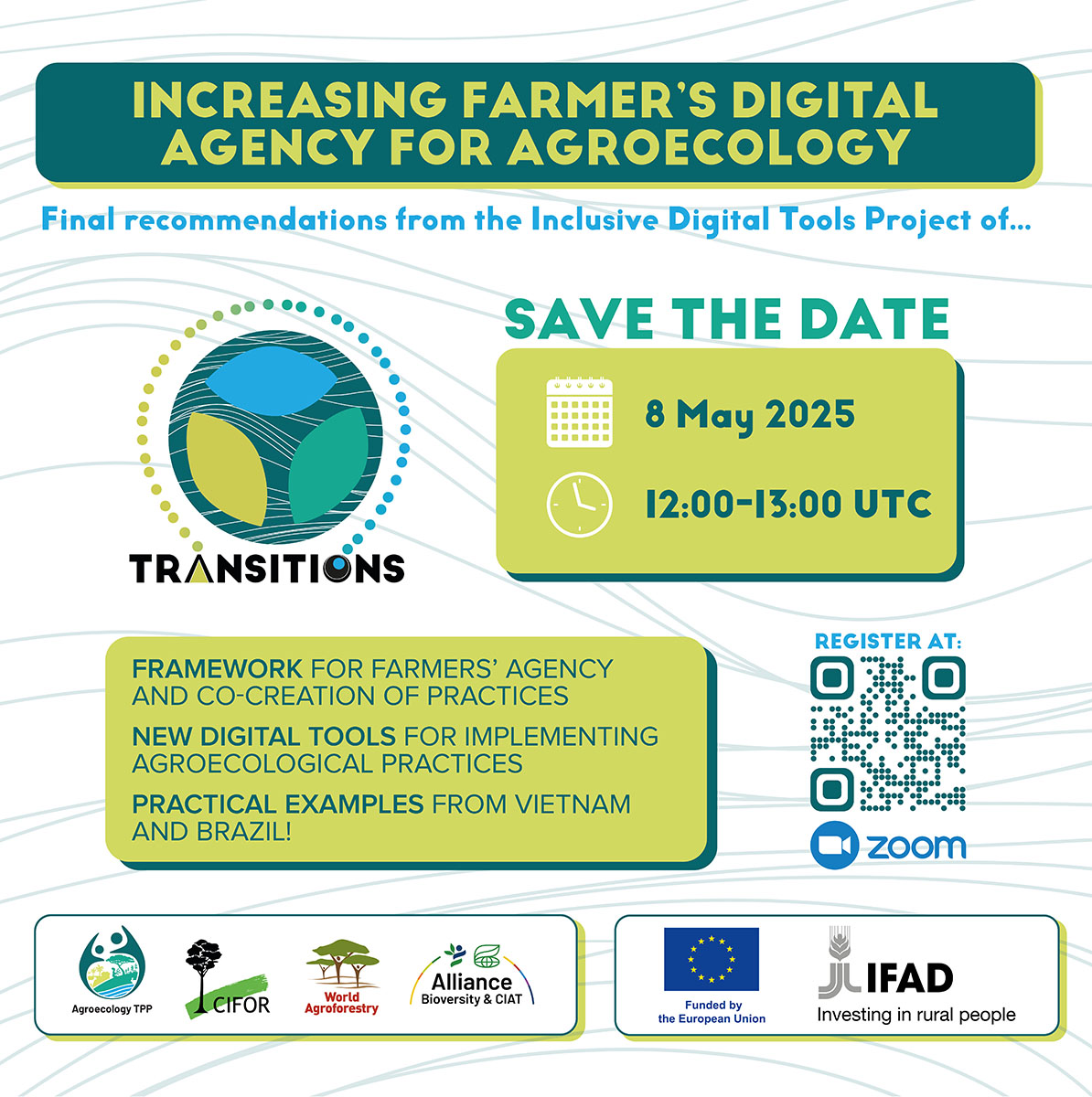
Increasing farmer’s digital agency for agroecology

8 May 2025.
  Increasing farmer’s digital agency for agroecology. An event of the Transformative Partnership Platform (TPP) for Agroecology and Agroecological TRANSITIONS Project (ATDT)

The purpose of this webinar was to share final recommendations and a framework for enhancing farmer agency in the use of digital tools and to promote inclusivity in farmers’ role in the co-creation of agricultural practices.  

The three-year, EU-IFAD funded Agroecological TRANSITIONS: Inclusive Digital Tools project shared its conclusions in this webinar with a presentation about farmer agency and co-creation of practices, followed by presentations of examples in Vietnam and Brazil, where the project developed new digital tools for implementing agroecological practices at scale and facilitated their implementation.
Speakers

Viviane Filippi

Program Officer, IFAD

Lini Wollenberg

Policy and Institutions lead Climate Action, The Alliance of Bioversity and CIAT

Mariette McCampbell

Inclusive Digital Tools Project, Agroecological TRANSITIONS

Violaine Laurens

Regional Manager – Digital Solutions, Solidaridad Latinoamérica

Trang Vu

Research Scientist, International Rice Research Institute (IRRI)

Wednesday, February 12, 2025

UK to establish agritech hub in Oyo, Nigeria

10 February 2025
UK to establish agritech hub in Oyo.  The Oyo State Government is set to benefit from a partnership with the United Kingdom Agritech Centre to enhance agriculture and livestock production through science and other technology-based solutions.

The Centre is also set to establish an Agritech Hub within one of the state’s Agribusiness Industrial Hubs, which will help revolutionise agriculture and provide practitioners with resources and opportunities for technological innovations in farming practices.

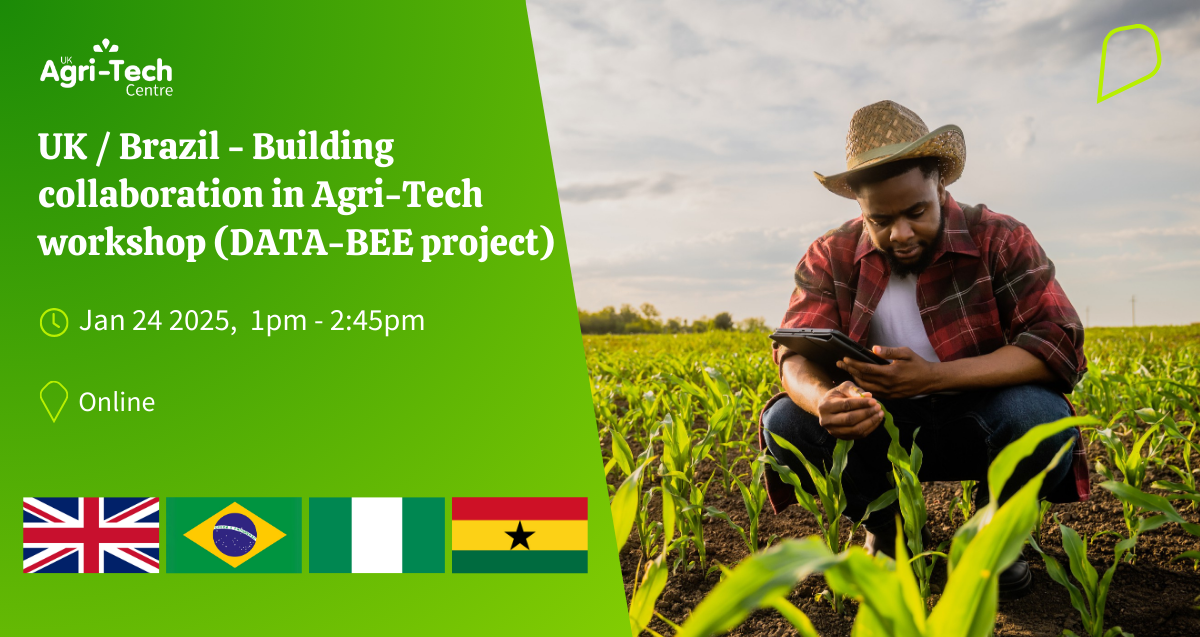
The UK has a new major project that is a tripartite relationship between Brazil, the UK, and Nigeria. It is called the Agritech. The UK Agritech Centre, as an organisation, comprises 300 members from the private sector and academia, and they bring to Nigeria science and technology-based solutions. https://ukagritechcentre.com/event/uk-brazil-building-collaboration-in-agri-tech-workshop/ 

Tuesday, October 29, 2024

Biodiversity for nutrition and health through Agroecology

30 October 2024. 4pm - 5:30pm Biodiversity for nutrition and health through Agroecology

Agrobiodiversity is a crucial component of biodiversity. While producing 80% of the food, family farmers and Indigenous Peoples applying agroecology and traditional knowledge, are also the safeguards of 80% of the world’s biodiversity and forests, and the custodians of indigenous and traditional crops. Fostering the traditional knowledge held by family farmers, Indigenous Peoples and Local Communities ensure a transformation towards more just, fair and resilient food systems. 

Agroecology Principles and Elements constitute a holistic approach with multiple co-benefits on biodiversity, climate adaptation and mitigation, and soil health, while providing nutritious food for all. This side event will tackle how, through agroecology, agrobiodiversity can be sustainably managed and used while promoting nutrition and health

At the country-level, it will showcase how agroecology is as a crucial pathway for countries like Colombia and Brazil which are striving to meet their National Biodiversity Strategies and Action Plans (NBSAPs), and how it achieves the multiples targets set by the Global Biodiversity Framework (GBF), 

At the local level, it will feature grassroots initiatives demonstrating how agroecology provides a pathway to protect nature, conserve the richness of biodiversity and restore degraded land and ecosystems, while producing healthy, diversified nutritious and culturally appropriate food.

The right to adequate food in urban and peri-urban areas

29 October 2024The right to adequate food in urban and peri-urban areas

  • This event aimed to emphasize the integration of the right to food and the right to the city in all measures addressing food insecurity in urban and peri-urban contexts, advocating for equitable, sustainable, and resilient food systems through multilevel governance and human rights-based approaches.
  • Policymakers, researchers, and stakeholders explored the role of local governments, power structures, and inclusive policies to ensure access to adequate food and urban services amidst challenges like climate change, food insecurity, increasing urban populations, conflicts and raising inequalities.

Speakers:


Opening remarks
  • Juan Echanove, Team Leader of the Right to Food, Rural Transformation and Gender Equality Division (ESP), FAO
  • Corinna Hawkes, Director, Agrifood Systems and Food Safety Division (ESF), FAO
  • Keynote speech: Jane Battersby, Lead author of HLPE-FSN Report “Strengthening urban and peri-urban food systems to achieve food and nutrition”
Panel discussion
  • Emily Mattheisen, FIAN International is a global human rights organization that advocates for the right to adequate food and nutrition.
  • Iromi Perera, Colombo Urban Lab
  • Elisabetta Recine, National Council for Food and Nutrition Security (CONSEA), Brazil and HLPE-FSN 
  • Ximena Moreno, Civil Society and Indigenous People’s Mechanism (CSIPM), Committee on World Food Security (CFS)
  • Arthur G. Kawamura, Private Sector Mechanism (PSM), CFS
  • Afantchawo Koudasse, Network of Farmers' and Producers' Organisations in West Africa (ROPPA)

Resource:

  • The 19th report by the HLPE-FSN "Strengthening urban and peri-urban food systems to achieve food security and nutrition in the context of urbanization and rural transformation" highlights the critical need to address food insecurity in urban and peri-urban areas, where over 75% of the world's food-insecure population resides.
  • Policymakers, researchers, and stakeholders explored the role of local governments, power structures, and inclusive policies to ensure access to adequate food and urban services amidst challenges like climate change, food insecurity, increasing urban populations, conflicts and raising inequalities.

Wednesday, September 11, 2024

Using digital tools to support climate & agroecological transitions at scale

10 September 2024. Using digital tools to support climate & agroecological transitions at scale.

The workshop was held as part of the closing of the Inclusive Digital Tools (ATDT) Project, which looks at how digital resources can boost inclusivity and empower farmers to co-create sustainable practices. 

The ATDT Project is part of the EU-supported Agroecological Transitions Program for Building Resilient & Inclusive Agricultural & Food Systems (TRANSITIONS), which advocates for climate and agroecological transitions by investigating holistic metrics; exploring public-private incentives and innovative pathways for sustainable practices, and developing digital tool innovations.

The Agroecological TRANSITIONS program, supported by the EU, advocates for climate and agroecological transitions by addressing several challenges. 

  • The program has three projects: investigating holistic metrics to assess food and agricultural systems and guide policy and investment decisions; exploring public-private incentives and innovative pathways for sustainable practices; and developing digital tool innovations to support farmers and extension practitioners assess performance.
  • TRANSITIONS’ Inclusive Digital Tools (ATDT) Project looks at how digital resources can boost inclusivity and empower farmers in co-creating sustainable practices. ATDT has evaluated digital resources for technical advice and performance assessment to understand how they support agroecological transition. Regional partners and teams have developed and tested digital tools to support agroecology in Vietnam for rice and in Brazil for livestock. 
  • As the ATDT project comes to a close this year, the panel exchanged ideas with a wider group of organizations and stakeholders actively working with digital resources. Through this work and the parallel projects on metrics and public-private incentives, the TRANSITIONS projects aim to improve food security, minimize negative ecological impacts, and foster climate-informed agroecological transitions in LMICs.

The interactive workshop, discussed opportunities and challenges to scale climate and agroecological transitions using digital resources. The objective was to share knowledge and exchange ideas among leaders and experts in this area on the following topics:
  • Climate and agroecology indicators in digital tools
  • Principles for digital inclusion of smallholder farmers
  • Digital tool design for co-creation
  • Incentives and pathways to scale digital tools for climate & agroecological transitions

Presentations:

  • Facilitator: Sandhya Kumar Agroecology TPP Scientific Coordinator 
  • Lini Wollenberg University of Vermont & The Alliance of Bioversity and CIAT - Digital tools for an agroecological transition? 
  • Violaine Laurens Regional Manager – Digital Solutions, Solidaridad Latinoamérica - Co-creating agroecology practices for livestock in Brazil: Solis 
  • Trang Vu/Katie Nelson, IRRI - Vertically integrated digital performance assessment for the 1 Must Do 5 Reductions in Vietnam 
  • Fancisco Hidalgo Socio-environmental researcher, Alliance of Bioversity & CIAT - Leveraging digital traceability tools for agroecology transitions  
  • Mary Crossland Livelihood systems associate scientist, CIFOR-ICRAF - Metrics for holistic assessment in digital tools 
  • Kyle Dittmer Research Analyst, Alliance of Bioversity & CIAT Principles for socially inclusive digital tools for smallholder farmers
Panel: Will this work? What will it take? 
  • Facilitator: Sandhya Kumar Agroecology TPP Scientific Coordinator
  • Oliver Oliveros Coordinator, Agroecology Coalition 
  • Alesha Miller Chief Strategy Officer, Digital Green  
  • Christophe Larose European Commission - Concluding statements @1:27:56 video recording

    Christophe referred to the final report
    EC (2024) “Strategic Dialogue on the Future of EU Agriculture. Ashared prospect for farming and food in Europe” September 2024 (# 110 pp.)

    This dialogue brought together 29 major stakeholders from the European agri-food sectors, civil society, rural communities and academia to reach a common understanding and vision for the future of EU's farming and food systems. These suggestions will guide the work of the European Commission when shaping its Vision for Agriculture and Food, to be delivered in the first 100 days of President von der Leyen's second mandate.
Members call for launching an EU-wide benchmarking system in agriculture and food systems aiming to harmonize methodologies of on-farm sustainability assessments. (page 10) ... An agricultural benchmarking system can be used to better leverage the potential of sustainability certification schemes.(page 39) ... The current lack of a standardized and harmonized methodology has led to a multitude of methods for assessing sustainability of farms and the agri-food sector. That causes inconsistencies and variations making it sometimes impossible to follow a clear way of improvement. (page 41) 
Regarding the uptake of innovation and technology, the need for de risking investments in innovation is emphasised, including through risk-sharing mechanisms and financial incentives. (page 104)
The speakers highlighted:
  • how digital tools can support farmer agency and negotiate top-down and corporate influence in digital tool design
  • how digital tools can best serve farmer needs through co-creation of knowledge and avoiding the pitfalls of current digital tool business models driven by non-farmer interests 
  • how aligning metrics, policy, incentives, and digital tools can help integrate climate change adaptation and mitigation into agroecological practices and technical advice.

Resources

A summary blog – covering key highlights from the event
A video recording, so you can relive the best moments from the event, in case you missed it


Presentation slides on:

Wednesday, July 17, 2024

Agroecology Economies webinar: Equitable Commercialization Networks

17 July 2024. 05:00 PM CEST. Agroecology Economies webinar: Equitable Commercialization Networks that Facilitate Access to Healthy Food 

  • Healthy food supplies to schools in Thailand, agroecological market networks in East Africa, Food Corridors in the Afro-Colombian territories, and Food Sovereign Corridors in Argentina. 
  • This webinar also featured the programs and policies implemented by the Brazilian government to encourage agroecological production and to expand the supply and distribution of healthy food.
Speakers
  • Marut Jatiket, The Field Alliance, Thailand
  • John Kariuki Mwangi, Slow Food Kenya, Kenya 
  • Anyela Lizeth León Gonzáles, Grupo Semillas, Colombia 
  • Josefina Galán and Agustín Mavar, Union de los Trabajadores de la Tierra, Argentina 
  • Silvio Porto, CONAB, Brazil

When it comes to agroecology, one of the main questions is: How can agroecology feed the world? For decades now, frontline organizations have been co-creating solutions in the four corners of the globe to recover soils and agrobiodiversity and advance the production of healthy food. 

Pioneering initiatives demonstrate that successful agroecological transitions also require thinking beyond production. It is critical to address food supply flows from the perspective of guaranteeing the human right to adequate food for all people.

Monday, July 1, 2024

Agroecological transition - the role of research in co-design and support of innovations

1 July 2024
. InfoPoint Hybrid Conference: "Agroecological Transition: The Role of Research in Co-Design and Support of Innovations

The DeSIRA initiative aims to support research and innovation projects in Africa, Asia and Latin America, while strengthening research capacities and governance by involving key actors at national, regional, continental and global levels. This initiative represents a major commitment to promoting agroecological innovation worldwide.

This InfoPoint shared research approaches and positions, as well as the changes they enable, through the testimony of three DeSIRA projects: 

Dinaamicc
  • Co-construction with local actors: Dinaamicc emphasizes co-construction with local actors to ensure the response to the real needs of communities.
  • Open innovation: the project integrates open innovation, accelerating the process of innovation and adoption (scaling). The DeSIRA program has enabled a scaling-up in the appropriation of solutions identified a few years ago.
  • Scaling process: by focusing on accelerating and expanding innovations, Dinaamicc aims to maximize the impact of agroecological practices within local communities.
Sustenta & Inova Brazil
  • Project setup and impact path: these projects emphasize the design and implementation of projects with deep reflection on the impact path. They allow the definition of clear objectives in line with the needs of local actors.
  • Rural Forums: the establishment of rural forums facilitates the appropriation of new agroecological practices among local communities. Research support allows innovators to gain scientific legitimacy, promoting the dissemination of solutions.
  • Training of leaders: the project includes training programs for local leaders, thereby strengthening their capacities to adopt and promote innovative practices.
  • Articulation with local policies: they work closely with local decision-makers to integrate innovations into municipal strategies, ensuring effective adoption, implementation and relay.
Asset
  • Technical innovation and policy dialogue: this project introduces technical innovations and facilitates their approval at the local policy level by integrating them into territorial strategies.
  • Role of scientific "broker": acting as a neutral mediator, Asset ensures scientific legitimacy and facilitates informed decision-making. Farmers, relying on scientific bases, strengthen their legitimacy with decision-makers.
  • Multi-scale collaboration: from local policies, the work extends to international bodies, including the UN, to foster a legal framework conducive to scaling up. In this context, Asset participates in the development of ASEAN guidelines on agroecology.
These experiences illustrate the importance of the research-development continuum, the continuity of research, and its central role in the co-design of agroecological innovations. They also highlight the importance of key mechanisms (participatory approaches, capacity building, science-policy interface) that foster the use and impact of these innovations.

Speakers
  • Leonard Mizzi, Head of Unit, INTPA F3- Sustainable Agri-Food systems and Fisheries
  • Philippe Petithuguenin, Director General for Research and Strategy, CIRAD France
  • Andry Rasamimanana, Head of Ceffel Center – Madagascar, Partner in Dinaamicc project (presentation in French)
  • Emilie Coudel, Researcher, CIRAD France, Sustenta & Inova project (Brazil)
  • Sayvisene Boulom, Head of Food Lab at National University of Laos, Partner in Asset project