Platform for African – European Partnership in Agricultural Research for Development
Showing posts with label COVID-19. Show all posts

Monday, March 7, 2022

COVID-19 and global food security: Two years later.


This e-book builds upon the lessons presented in the earlier volume, COVID-19 & Global Food Security (2020) that documented the impacts of the COVID-19 pandemic as of mid-2020, particularly the disruptions to livelihoods and the food and nutrition security of billions of people. Early in the pandemic, many hoped that COVID-19 could be controlled and even eliminated through a short-term response phase and that attention could subsequently be shifted to recovery and resilience building. Instead, COVID-19 and its disruptions have persisted and evolved, with new waves of infections and deaths and ongoing impacts, particularly among poor and vulnerable populations.

It is organized in four sections: food security and poverty; agricultural production and value chains; nutrition, health, and social programs; and policy responses and implications. Each section includes two types of contributions. The first are new syntheses of lessons on key topics such as country impacts, food price changes, value chain fractures, social protection case studies, and fiscal and monetary responses and policy recommendations. The second are new or updated blogs from the IFPRI COVID-19 series.

This e-book was launched and presented with lessons learned and key issues.
  • Opening Remarks - Johan Swinnen, Global Director, CGIAR Systems Transformation Science Group & Director General, IFPRI
  • Book Overview - John McDermott, Former Director, CGIAR Research Program on Agriculture for Nutrition and Health (A4NH), IFPRI
Rapid Fires
  • Neha Kumar, Senior Research Fellow, IFPRI
  • Thomas Reardon, University Distinguished Professor, Michigan State University & Non-Resident Senior Research Fellow, IFPRI
  • James Thurlow, Senior Research Fellow, IFPRI
Discussants
  • Sudha Narayanan, Research Fellow, IFPRI
  • Jemimah Njuki, Chief, Women’s Economic Empowerment, UN Women
  • Valeria Piñeiro, Senior Research Coordinator, IFPRI
  • Donor Reflections - Chris Hillbruner, Division Chief, Analysis and Learning Office of Policy, Analysis, and Engagement Bureau for Resilience and Food Security, United States Agency for International Development (USAID)
  • Closing Remarks - Johan Swinnen, Global Director, CGIAR Systems Transformation Science Group & Director General, IFPRI
  • Moderator - Charlotte Hebebrand, Director of Communications and Public Affairs, IFPRI

Thursday, February 10, 2022

COVID-19 and its Impacts on Local Food Systems and Rural Livelihoods

9 February 2022. Across the world, the COVID-19 pandemic has caused severe disruptions to agri-food systems. With border closures and movement restrictions imposed by governments to curb the spread of the virus, access to markets and trading were interrupted, thereby affecting the livelihoods, health, and well-being of hundreds of millions of people in sub-Saharan Africa who rely on these activities to survive.

During 2020-21, with support of the UK Foreign, Development and Commonwealth Officer (FCDO)/UKAid, APRA researchers conducted a series of studies to examine how responses to the crisis were affecting local food systems, value chains, and rural livelihoods across the region. 

The central research question was: 
How has the COVID-19 pandemic disrupted farming and domestic activities, health and human welfare, and agricultural markets and value chains, and what can we learn from this crisis to respond to major shocks and stresses in future?

Thursday, December 23, 2021

The CGIAR effort to support countries responding to COVID19

13 December 2021. The CGIAR effort to support countries responding to COVID19: how we did it and lessons learned. 

This event provided an overview of what has been achieved in the five focus countries of the CGIAR COVID-19 Hub (Bangladesh, Myanmar, Ethiopia, Malawi and Nigeria) and at program level, and what have been important lessons drawn from this innovative experience for future OneCGIAR endeavours. CGIAR's COVID-19 work will be incorporated into the larger the One CGIAR transition, beginning in 2022.

Launched 23 June 2020, the Hub focuses on the four research pillars making up the core of CGIAR’s response to COVID-19: Food Systems ; One Health ; Inclusive Public Programs ; Policies and Investments.

The webinar consisted of:
  • A series of ‘rapid fire’ presentations about country results
  • A brief talk show with country partners, to review the experience, results and lessons, inviting questions from the audience
The webinar featured the following CGIAR-19 COVID Hub speakers:
  • Dr. Kumwenda Wells (Project Coordinator) and Charles Chinkuntha – Chief economist. Department of Agriculture Planning Services, Malawi.
  • Dr. Zubairu Abdullahi (Director, Planning and Policy Coordination-Federal Ministry of Agriculture and Rural Development, Nigeria.
  • Dr. Amjath Babu (Agricultural Economist (Modelling and Targeting), Bangladesh.
  • Dr. Karta Kalsa (Ethiopian Institute of Agricultural Research - EIAR), Ethiopia.
  • Dr. Khin Maung Soe, Myanmar
Recording of the webinar is also available on https://a4nh.cgiar.org/covidhub/

Wednesday, November 17, 2021

8th Annual ReNAPRI Stakeholder Conference

17 - 19 November 20218th Annual ReNAPRI Stakeholder ConferenceTransform: Toward sustainable and resilient food systems in Africa.

The Regional Network of Agricultural Policy Research Institutes (ReNAPRI) is an entirely African-owned and African-led network of agricultural policy research centers that generate high-quality evidence and provide policy guidance in support of agricultural development, food and nutrition security, and livelihoods resilience.

The 2021 conference sponsors are: Feed the Future Innovation Lab for Policy Research Capacity and Influence; and the European Union’s Joint Research Center (JRC).  

The purpose of the conference was to promote strategic dialogue and evidence-based guidance to African governments as they grapple with how to build sustainable and resilient food systems. An evidence-based guidance can assist African governments, private firms and civil society groups to anticipate and respond proactively to tipping points in the ever-changing landscape of the Continent. The obejctives were:

  • Reflect on the outcomes of the UNFSS in the context of sustainable and resilient food systems in Africa 
  • Contextualize the conversation of a transformed African Agrifood system 
  • Identify public and private sector actions that will facilitate the transition from resource-dependent to productivity-led growth; and 
  • Promote practical ways by which African governments and Pan-African organizations can focus high-impact public investments that embed resilience and sustainability in downstream levels of the agrifood system. 

Extract of the programme

17/11 HIGH LEVEL PANEL ON SUSTAINABLE AND RESILIENT FOOD SYSTEMS IN AFRICA

The objective of this high-level panel discussion was to interrogate the perceptions of eminent persons/experts/leaders from Africa and beyond, concerning: 1. The role of governments and other key stakeholders in ensuring that we achieve strong food systems and resilient livelihoods in Africa. 2. The role of data-driven evidence-based policies in the quest to attain the aspirations of AU’s Agenda 2063 through African and global frameworks such as SDGs, CAADP, Malabo Declaration, AfCFTA, NDCs and NAPs 3. Their thoughts on actions required to develop fertilizer use, while managing soil health in Africa
  • Chance Kabaghe Executive Director, IAPRI and Board Member ReNAPRI 
  • Prof. Thom Jayne University Foundation Professor, Michigan State University and Board Member, ReNAPRI 
  • Prof. Pedro Sanchez Research Professor of Tropical Soils, University of Florida 
  • Dr. Ousmane Badiane Executive Chairman, AKADEMIYA2063 
  • Nana Ekua Edugyanmaa I Nyifahenmaa Gomoa Akyempim Traditional Council 
  • Dr. Charles Okyere Lecturer , Department of Agricultural Economics and Agribusiness, University of Ghana
  • Dr. Yemi Akinbamijo Executive Director, Forum for Agricultural Research in Africa (FARA) 

18/11  OPPORTUNITIES FOR BUILDING RESILIENCE OF AFRICAN FARMING SYSTEMS

Drawing on the work from AGRA’s Africa Agricultural Status Report (AASR 2021) the objectives of this webinar were to: 1) provide a platform for discussions and exchange of ideas about practical actions for building the resilience of African farming systems, and 2) engage stakeholders for ideas towards the Africa Fertilizer Summit II preparation and development of the Africa Fertilizer and Soil Health Action Plan.
  • Dr. Sampson Agyin-Birikorang Senior Scientist, International Fertilizer Development Center(IFDC) 
  • Prof. Richard Mkandawire Dr. Maria Wanzala Director of Policy, AFAP 
  • Eugene Rurangwa Land and Water Officer, Food and Agriculture Organization of the United Nations Sub Regional Office for West Africa 
  • Dr. Shamie Zingore Director of Research and Development, African Plant Nutrition Institute (APNI) 
  • Dr. Fred Dzanku Open Floor Discussion Africa Director of the Alliance for African Partnership (AAP), and Chairperson, Malawi Planning Commission Senior Research Fellow, Institute of Statistical Social and Economic Research (ISSER)

18/11 GOING BEYOND THE FARM: ACHIEVING RESILIENCE IN DOWNSTREAM AGRIFOOD SYSTEMS

There is growing concern about diminishing farmland holdings, widespread land degradation, and unhealthy soils due to rising population pressure. Added to these concerns is climate change, which exacerbates already fragile farming systems on the continent.  What will constitute a practical strategy for a resilient African farming systems? A discussion on ways to consolidate efforts across various stakeholders (governments, donors, and private sector) towards the Africa Fertilizer Summit II and preparation of the Africa Fertilizer and Soil Health Action Plan.
  • Setting the Scene: Lulama Ndibongo Traub Research Director, BFAP, South Africa (ReNAPRI) 
  • Dr. Edward Mabaya Research Professor, Department of Global Development, Cornell University 
  • Wandile Sihlobo Chief Economist, Agribusiness Chamber of South Africa 
  • Louise de Klerk CEO, Timbali Technology Incubator 
  • Ify Umunna Co-CEO, Nourishing Africa 
  • Gerald Masila CEO, East African Grain Council (EAGC) 
  • Betty Kibaara Director, Food Initiative Africa, Rockefeller Foundation 
  • Dr. Daniel Adu Ankrah Lecturer, Department of Extension, University of Ghana

18/11 TOWARDS RESILIENT, SUSTAINABLE AND TRANSFORMED AFRICAN FOOD SYSTEMS - 14h30 – 16h00

Through an exchange of ideas, panelists identifiedy practical ways through which African governments and Pan-African organizations can focus on high impact public investments that embed resilience and sustainability in downstream levels of the agrifood system.
  • Setting the Scene: Prof. Thom Jayne University Foundation Professor, Michigan State University 
  • Dr. Louise Fox Non-resident Senior Fellow, Africa Growth Initiative Brookings Institution 
  • Prof. Soji Adelaja John A. Hannah Distinguished Professor in Land Policy, Department of Agricultural, Food, and Resource Economics Michigan State University 
  • Boaz Keizire Head Policy and Advocacy Alliance for a Green Revolution in Africa (AGRA) 
  • Dr. Nick Sitko Senior Economist Food and Agriculture Organization of the United Nations 
  • Dr.Richard Ayisi Lecturer, Department of Economics, University of Ghana

18/11 SIDE EVENT 1: APRA – INCLUSIVE AGRICULTURAL COMMERCIALIZATION: LESSONS FROM GHANA AND NIGERIA

Moderator: Dr John Thompson is a Senior Research Fellow at the Institute of Development Studies (IDS), UK, Director of the Future Agricultures Consortium (FAC), and CEO of the Agricultural Policy Research in Africa (APRA) Programme, a network of over 100 researchers analysing pathways to more inclusive agricultural commercialisation in SubSaharan Africa.

19/11 SIDE EVENT 2: FANRPAN – BUILDING INTEGRATED AND INCLUSIVE CLIMATE-SMART, NUTRITION-SECURE PATHWAYS IN SUB-SAHARAN AFRICA

GCRF-Agricultural and Food systems Resilience: Increasing Capacity and Advising Policy (AFRICAP) is a major programme to make agriculture and food production in sub-Saharan Africa more productive, sustainable and resilient to climate change. A £9.2 million programme funded by the UK Research and Innovation through the Global Challenges Research Fund (GCRF), it involves UK and African research and policy organisations working together. GCRF-AFRICAP has developed an integrated assessment framework - the integrated Future Estimator for Emissions and Diets (iFEED). This is a new tool that brings together state-of-the-art crop and climate modelling with trade and nutrition analyses, expert knowledge, and stakeholder-driven research agendas in order to map pathways to desirable futures. iFEED crop modelling is used to project the impacts of climate change on a range of agricultural commodities and examine possible future land use patterns to explore implications for future nutrition security and climate smart agriculture. Focusing on four case study countries – Malawi, South Africa, Tanzania and Zambia – iFEED has gone through three stages, linked through a series of workshops and intermediate outputs.

19/11 SIDE EVENT 3: FOOD TRADE COALITION FOR AFRICA (FTCA) – REGIONAL TRADE AS A DRIVER FOR SUSTAINABLE FOOD SYSTEMS TRANSFORMATION IN AFRICA

The Food Trade Coalition for Africa (FTCA) championed by AGRA aims to increase intra-African food trade by working with key stakeholders in the public sector, the private sector, the Regional Economic Communities, among others, to coordinate food trade interventions and investments across the continent.

19/11 SIDE EVENT 6: RESEARCH TO POLICY – PEER LEARNING PANEL ON EFFECTIVE POLICY OUTREACH STRATEGIES

The purpose of this side event was to share successes and lessons learned on policy outreach by the Feed the Future Innovation Lab for Food Security Policy Research, Capacity, and Influence (PRCI). P

Virtual 2021 ReSAKSS Annual Conference

15-17 November 2021. AKADEMIYA2063, in partnership with AUC, convened a virtual 2021 ReSAKSS Annual Conference to promote review and dialogue on the impacts of the COVID-19 pandemic on African food systems and policy options to ensure recovery and strengthen resilience to future shocks.

Featuring five plenaries and five panel sessions, with over 23 organizations in attendance, the conference provided a forum to discuss research evidence and recommendations presented in the 2021 ATOR. 

The report assesses the impacts of COVID-19 on Africa’s food systems, examines the responses of African governments to the crisis, in particular their expansion of social protection programs to mitigate negative impacts on households, and equally discusses tools, methodologies and approaches to measure the impacts of COVID-19 and similar crises and to assess the resilience of individuals, communities, and countries. 

“The COVID-19 pandemic has posed unprecedented challenges to health, economic and agrifood systems around the globe, causing severe disruptions to African economies and food systems; it has interrupted the longest period of sustained economic growth in the continent’s history. Building resilient African food systems is one of the seven commitments of the 2014 Malabo Declaration. It calls for a broad perspective on food systems resilience that takes into account implications for and actions by all food systems actors. The 2021 Annual Trends and Outlook Report (ATOR) presents a body of research-based evidence to facilitate understanding of the pandemic’s effects and support the design of post-COVID-19 recovery measures that strengthen the resilience of African food systems,” Dr. Ousmane Badiane, AKADEMIYA2063 Executive Chair.

The 2021 ReSAKSS Conference shared required policies and actions to accelerate Africa’s recovery from the effects of the COVID-19 pandemic, preparedness for future shocks and potential solutions to challenges related to measuring the impacts of and resilience to complex shocks. The event was attended by high-level policy leaders (https://bit.ly/3cfuFFe), including H.E. Josefa Leonel Correia Sacko, AU Commissioner, Department of Agriculture, Rural Development, Blue Economy and Sustainable Development (AUC-DARBE).

  • 15/10: The conference was officially opened on Day 1 and featured an overview presentation of the 2021 ATOR, a keynote presentation on impacts of and responses to COVID-19 in African countries, presentations of key chapters, and panel and plenary discussions on the conference theme
  • 16/10: Day 2 focused on presentations and panel and plenary discussions of the different chapters of the 2021 ATOR.
  • 17/10: Day 3 concluded the conference with presentations and panel and plenary discussions on progress in achieving CAADP goals and targets and progress and next steps in the 2021 CAADP Biennial Review process.

Plenary Session I– Opening Session of the 2021 ReSAKSS Conference

Overview of the 2021 Annual Trends and Outlook Report (ATOR) - Dr. Éliane Ubalijoro, Executive Director, Sustainability in The Digital Age, Global Hub Director, Canada, Future Earth, and Co-editor of the 2021 Annual Trends and Outlook Report (ATOR) 

The 2021 Annual Trends and Outlook Report (ATOR) focuses on building resilient African food systems after COVID-19. It examines emerging data on the impacts of COVID-19 on African economies and food systems, reviews the responses of African countries to the pandemic, and advances the discussion on methodologies to measure the impacts of and resilience to shocks. Although the report is centered around COVID-19, its lessons are applicable beyond the currentcrisis. The pandemic, a uniquely wide-ranging challenge that combined features of previous health, economic and food price shocks, reminds us of the breadth ofrisks and challenges that food systems must continue to withstand into the future.The report argues for a broader conceptualization of resilience that encompasses climate risks as well as the wider range of shocks that threaten progress toward transformed food systems and economies.


Panel Discussion 
  • Moderator: Professor Sheryl Hendriks, Department Head, Agricultural Economics, Extension and Rural Development, University of Pretoria P
  • Dr. Ismahane Elouafi, Chief Scientist, Food and Agriculture Organization of the United Nations (FAO) Dr. Godfrey Bahiigwa, Director, Department of Agriculture, Rural Development, the Blue Economy and Sustainable Environment, African Union Commission (AUC) 
  • Dr. Martin Fregene, Director, Agriculture and Agro-Industry, African Development Bank (AfDB)

Tuesday, September 14, 2021

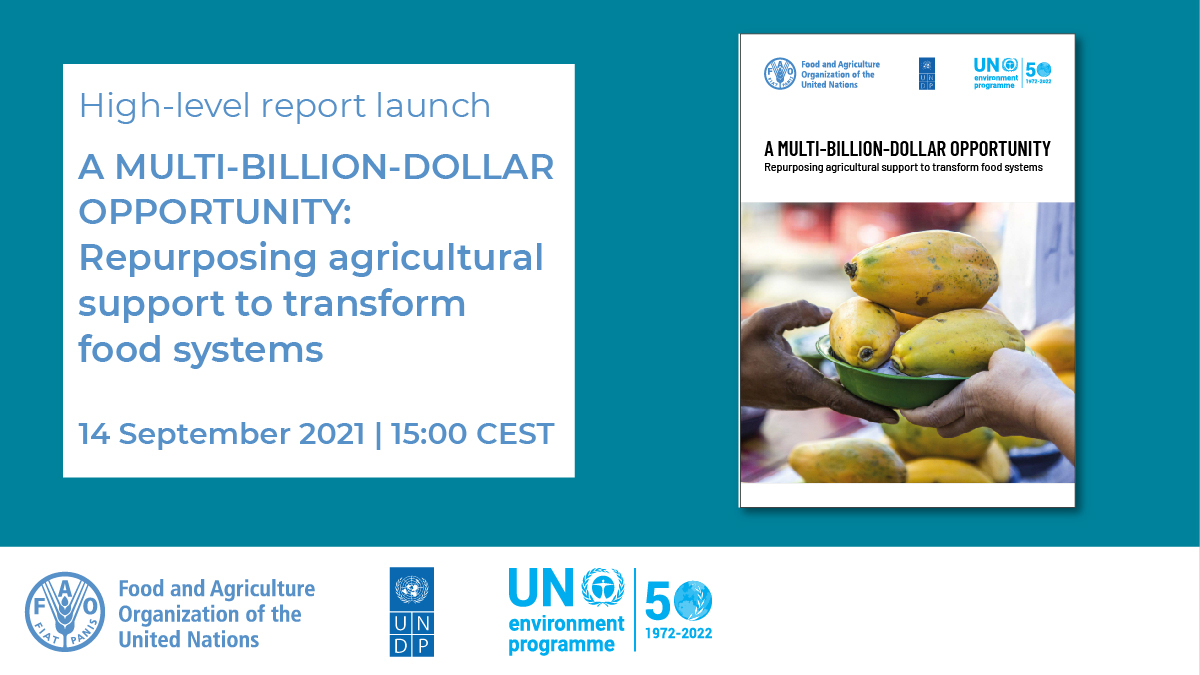
REPORT: Repurposing Agricultural Support to Transform Food Systems

FAO, UNDP and UNEP. 2021. A multi-billion-dollar opportunity – Repurposing agricultural support to transform food systems. Rome, FAO. 180 p.

Public support mechanisms for agriculture in many cases hinder the transformation towards healthier, more sustainable, equitable, and efficient food systems, thus actively steering us away from meeting the Sustainable Development Goals and targets of the Paris Agreement.

This report sets out the compelling case for repurposing harmful agricultural producer support to reverse this situation, by optimizing the use of scarce public resources, strengthening economic recovery from the COVID-19 pandemic, and ultimately driving a food systems transformation that can support global sustainable development commitments.

The report provides policymakers with an updated estimate of past and current agricultural producer support for 88 countries, projected up until 2030. The trends emerging from the analysis are a clear call for action at country, regional and global levels to phase out the most distortive, environmentally and socially harmful support, such as price incentives and coupled subsidies, and redirecting it towards investments in public goods and services for agriculture, such as research and development and infrastructure, as well as decoupled fiscal subsidies.

Overall, the analysis highlights that, while removing and/or reducing harmful agricultural support is necessary, repurposing initiatives that include measures to minimize policy trade-offs will be needed to ensure a beneficial outcome overall. The report confirms that, while a few countries have started repurposing and reforming agricultural support, broader, deeper, and faster reforms are needed for food systems transformation. Thus, it provides guidance (in six steps) on how governments can repurpose agricultural producer support – and the reforms this will take.

Read the Summary A multi-billion-dollar opportunity – Repurposing agricultural support to transform food systems: In brief 28 pages


14 September 2021
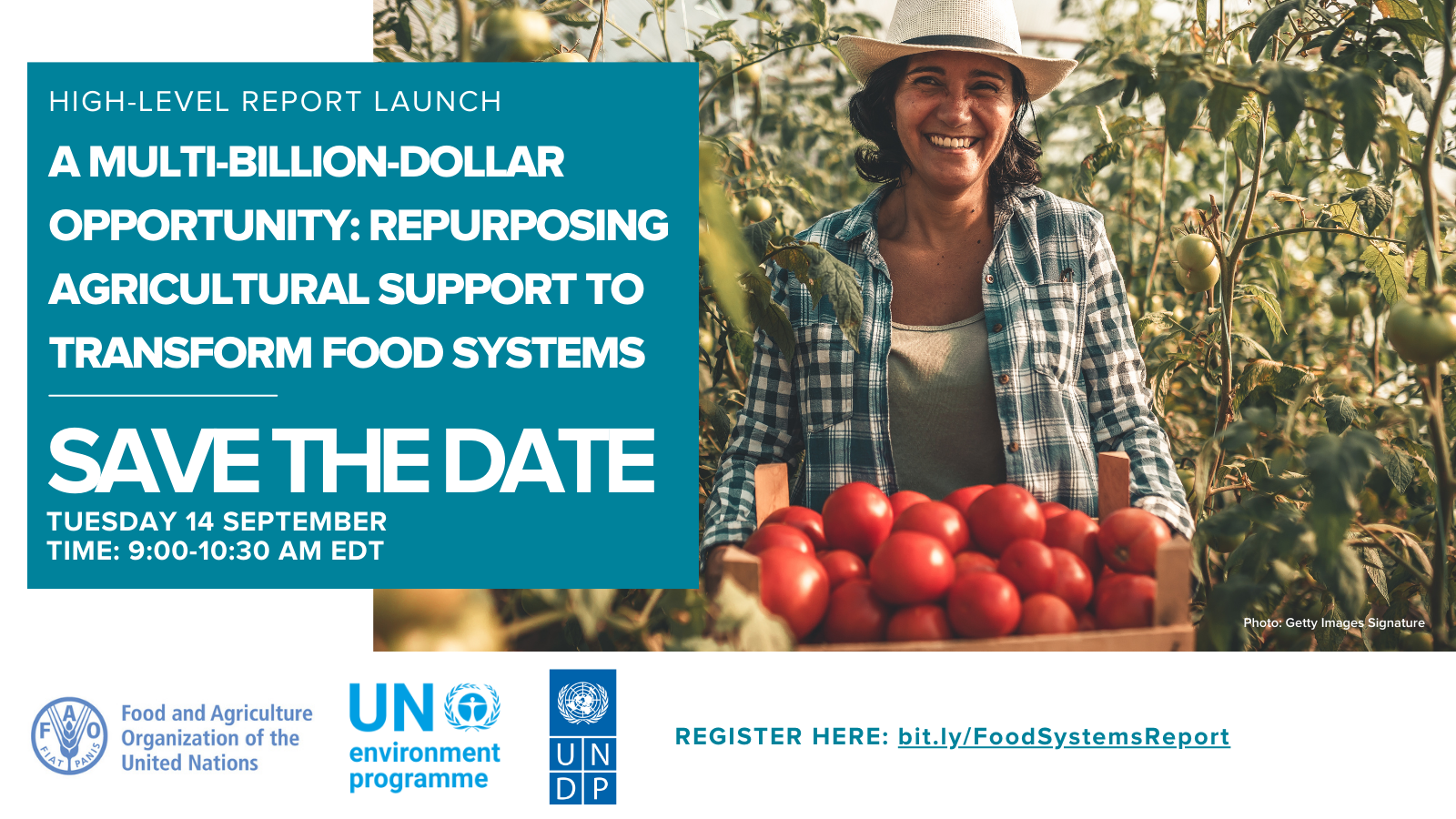
. A Multi-billion-dollar Opportunity: Repurposing Agricultural Support to Transform Food Systems - launch of this report, co-produced by FAO, UNEP, and UNDP.

Global support to agricultural producers totals half a trillion dollars and is set to soar even higher in the coming years. But the current way this support is provided has led to farming practices that are harmful to nature and health, thus working against sustainable, equitable, and efficient food systems.

We need to rethink, repurpose and reform this support, increasing its efficiency and the way it can support our path towards healthier people and planet and achieving Zero Hunger.

As a global call-to-action to repurpose agricultural support, join us for the launch of the report A Multi-billion-dollar Opportunity: Repurposing Agricultural Support to Transform Food Systems, co-produced
by FAO, UNEP, and UNDP.

This event brought together a round of influential speakers who share learning, insights, best practices to inspire and inform fundamental shifts in how we can accelerate and scale repurposing our support to food systems globally.

The key analysis of the report includes:
  • An updated estimate of agricultural support, covering 88 countries, over time and considering different country groups
  • The impacts of agricultural support on nature, climate change, health, nutrition, and equity and the implications of reforming them
  • Opportunities for repurposing and benefits
  • 6-step guide on how to repurpose agricultural support
  • Overcoming challenges in the short to longer-term, based on country
Speakers:
  • Moderator Nozipho Tshabalala, CEO, The Conversation Strategists.
  • Statement QU Dongyu, Director-General, FAO
  • Statement Inger Andersen, Executive Director, UNEP
  • Statement Achim Steiner, Administrator, UNDP
  • Opening remarks Hon. Minister Dr. Gérardine Mukeshimana, Minister of Agriculture and Animal Resources, Rwanda 
  • Opening remarks Hon. Minister Victoria Prentis, Parliamentary Under Secretary of State, Department for Environment, Food and Rural Affairs, United Kingdom of Great Britain and Northern Ireland
Presentation of the report + Technical panel discussion:
  • Marco V. Sanchez, Deputy-Director and OiC day-to-day matters for Agrifood Economics at FAO, and Lead Technical Author
  • Vijay Kumar Thallam, Executive Vice Chairman, Rythu Sadhikara Samstha
  • Johan Swinnen, Director General of IFPRI
  • Nicoletta Batini, Scholar of Innovative Monetary and Fiscal Policy, IMF
  • Francesco Branca, Director of Nutrition and Food Safety, WHO
  • Closing Hon. Minister James Shaw, Minister for Climate Change and Associate Minister for the Environment, New Zealand

Tuesday, June 8, 2021

WEBINAR: Agri-food market innovations in the Near East and North Africa

3 June 2020WEBINAR: Agri-food market innovations in the Near East and North Africa

Countries in the Near East and North Africa (NENA) region have ensured that food systems continue to function amidst the COVID-19 pandemic, and by many measures they have been resilient; food production, global and local food availability, and prices have remained relatively stable though rising of late. 

Market disruptions have nonetheless taken their toll with immediate and likely lasting effects on value chains actors’ incomes and business operations - from production, to intermediary and food retail and consumer levels – and some have turned to ICT-based solutions, such us advertising via social media, online customer service and e-commerce to keep their businesses and livelihoods alive.

The untapped potential of innovation and digital solutions in the NENA agri-food sector became increasingly clear during the pandemic, particularly for agri-food market tools ranging from data and information, to e-commerce, digital payments, and marketing platforms. Now over a year into the crisis, we wish to reflect on how COVID-19 disrupted agri-food markets in the region, did a transition to digital agri-food market tools accelerate, and what lessons and implications for women and men smallholders, SMEs and innovators? 

This zoominar drew from insights across NENA countries and globally, it looked at the innovation space for digital, and hear how the private sector can most effectively be supported. Debate around:

  1. How did COVID-19 disrupt agri-food markets in the region?
  2. Has digital agri-food marketing accelerated?
  3. What lessons and implications for women and men smallholders, SMEs and innovators?
Speakers

  • Opening remarks by Maximo Torero, Chief Economist – Food and Agriculture Organization of the United Nations (FAO).
  • What role can digital technologies play in agri-food markets and what has the evidence shown? by Marie-Agnès Jouanjean, Economist, Agriculture and Food Global Practice – World Bank.
  • Has COVID-19 accelerated the use of Digital Agriculture? by Daniele Tricarico, Insights Director – GSMA AgriTech programme.
  • Insights from the innovators: by Mohamed Ghareeb, GM of e-Commerce Business – eAswaaqMisr (a subsidiary of eFinance Company) (Egypt).
  • Innovators and the Ecosystem for agri-food market innovations by Soha Nasser, Agri-Food Specialist – Agrytech Lebanon.
  • Moderator, Jozimo Santos Rocha, Economist, Investment Centre – Food and Agriculture Organization of the United Nations (FAO).


Thursday, May 6, 2021

WEBINAR: How agricultural data can help Africa plan for food security after the pandemic?

6 May 2021
. How agricultural data can help Africa plan for food security after the pandemic? The tenth webinar in an eleven-part series focused on various aspects of sustainable development in Africa. Co-sponsors: MIT Center for International Studies (CIS), TRUE Africa University (TAU) Also watch it on YouTube.

Speaker: Sara Menker, an Entrepreneur and the CEO of Gro Intelligence.

Motto:  “What on Earth is going on?

Gro Intelligence was named by Time magazine as among the 100 most influential companies in 2021!!
  • She is a trustee of the Mandela Institute for Development Studies and was elected one of the World Economic Forum Young Global Leaders.
  • Menker was born and raised in Ethiopia. She studied Economics and African Studies at Mount Holyoke College. She moved to the London School of Economics for her graduate studies, and eventually earned an Master of Business Administration at Columbia University.
  • Menker is a former commodities group Vice President at Morgan Stanley. During her time at Morgan Stanley, Menker became interested in farmland investments. She left her job in Wall Street to use her skills in data analytics for social good. She became concerned by threat of a global food crisis, and started to investigate how Africa could mitigate the Earth's growing demands for food.
  • In 2014 Menker established Gro Intelligence, a data-driven platform which connects food market around the world. Gro Intelligence includes information such as the cost of avocado exports from Mexico and popular coffee beans, and uses artificial intelligence to make predictions about trends in food prices. 
  • Gro Intelligence offer software that makes agricultural, weather and climate data easy to understand. The data is combined with satellite imagery and creates over 1,000 models a day. She has used Gro Intelligence to investigate the impact of natural disasters, including droughts, on food supply. The reports inform companies on what and where to sell products, as well as supporting policy makers and insurance companies.
  • In 2018 Menker was named the Henry C. Gardiner Global Food Systems Lecturer. She has presented at the Rockefeller Foundation, X and The New York Times.
  • Menker is a trustee of the International Center for Tropical Agriculture and the Mandela Institute for Development Studies. She was selected by the World Economic Forum as a Young Global Leader in 2014. She is also a member of The Aspen Institute African Leadership Initiative. Menker is involved with Cognition X, the artificial intelligence information platform.
About the MIT X TAU webinar series:

The Center for International Studies (CIS) has partnered with the newly launched TRUE Africa University (TAU) to host a webinar series focused on various aspects of sustainable development in Africa. Thursdays at noon EST, starting on March 4, TAU founder, MIT alumnus, and CIS research affiliate Claude Grunitzky, will interview the thinkers, shapers and doers who he sees as the inventors of the future of Africa. Each of the eleven webinars promises to be a genre-defining look into the opportunities and challenges facing the African continent and its people over the coming century. The CIS-TAU webinar series will be an opportunity for the MIT community and beyond to engage with luminaries such as Taiye Selasi, the Ghanaian-Nigerian author; Jeffrey Sachs, the American economist; and Iyinoluwa Aboyeji, the Nigerian serial entrepreneur behind some of Africa’s most valuable startups.

MIT-TAU Webinar Series | TRUE Africa University | View All Events

Monday, April 12, 2021

REPORT: 2021 Global Food Policy Report: Transforming Food Systems after COVID-19

COVID-19 has upended local, national, and global food systems, and put the Sustainable Development Goals further out of reach. But lessons and momentum from the world’s response to the pandemic can contribute to food system change. In the 2021 Global Food Policy Report, IFPRI researchers and experts explore the impacts of the pandemic and government policy responses to date, particularly for the poor and disadvantaged, and consider what it all means for transforming our food systems to be healthy, resilient, efficient, sustainable, and inclusive.

The chapters in this flagship report explore key requisites for such a transformation in light of the current shock — balancing health and economic policies, promoting healthy diets and nutrition, strengthening social protection policies and inclusion, integrating natural resource protection into food sector policies, and enhancing the contribution of the private sector — and how best to achieve them. Regional sections examine the diverse experiences of the pandemic worldwide, and the impact of varied response measures.

At the launch event 13/04, speakers will share evidence on the impact of COVID-19, and discuss the way forward for food systems transformation.

Remarks
Report Overview
  • Johan Swinnen, Director General, IFPRI
  • John McDermott, Director, CGIAR Research Program on Agriculture for Nutrition and Health (A4NH), IFPRI
Rapid Fire Presentations

Resource
IFPRI (2021). 2021 Global Food Policy Report: Transforming Food Systems after COVID-19.
Washington, DC: International Food Policy Research Institute. 124 pp. https://doi.org/10.2499/9780896293991
  
This year’s Global Food Policy Report examines what we have learned about the deficiencies in current food systems, the changes that are needed for system transformation, and what COVID-19 has taught us. 

It offers lessons that can help put the world on the path to food system transformation for greater resilience, inclusion, efficiency, sustainability, and nutrition. IFPRI’s analytical work during the pandemic — conducted through both new initiatives and reconfigured ongoing research — illuminates the impacts of the crisis in numerous countries and considers how policy can best address such shocks while also helping to transform food systems for the future
  1. Chapter 1 Beyond the Pandemic: Transforming Food Systems after COVID-19
    Financing the Transformation to Healthy, Sustainable, and Equitable Food Systems 
  2. Chapter 2 Resilience: From Policy Responses to Resilient Policy Systems 
  3. Chapter 3 Nutrition: Transforming Food Systems to Achieve Healthy Diets for All 
  4. Chapter 4 Natural Resources and Environment: Governance for Nature-Positive Food Systems 
  5. Chapter 5 Toward Inclusive Food Systems: Pandemics, Vulnerable Groups, and the Role of Social Protection 
  6. Chapter 6 Food Supply Chains: Business Resilience, Innovation, and Adaptation 
Related:
Netherlands Discussion of IFPRI’s 2021 Global Food Policy Report: Transforming Food Systems After COVID-19

Opening Remarks
  • Paul van de Logt, Head, Food and Nutrition Security, Ministry of Foreign Affairs, Government of the Netherlands
Speakers
Discussants
  • Frank van Tongeren, Head of the SMART data and modelling unit, Trade and Agriculture directorate, Organisation for Economic Development and Co-operation (OECD)
  • Gerda Verburg, United Nations Assistant Secretary-General & Coordinator of the SUN Movement
  • Paul van de Logt, Head, Food and Nutrition Security, Ministry of Foreign Affairs, Government of the Netherlands
  • Katarlah Taylor, Events Manager, IFPRI

Wednesday, March 24, 2021

WEBINAR: Confronting the Gendered Impacts of COVID-19

23 March 2021. Towards Resilient Livelihoods, Food Security, and Nutrition for All: Confronting the Gendered Impacts of COVID-19 by IFPRI

The COVID-19 pandemic and associated lockdowns continue to have devastating effects around the globe, including in rural areas of developing countries, where people have been affected by livelihood and supply disruptions, income shocks, and food and nutrition insecurity. While the overall impacts are becoming clear, less attention has been paid to the differential impacts on men and women and their ability to cope with the multiple shocks associated with the pandemic. For example, women tend to experience more lingering income shocks and have greater difficulty accessing food than men. Understanding these gender differences can offer important insights to decision-makers designing and implementing policies and programs aimed at providing much-needed relief to the most vulnerable communities.

At this seminar, researchers from IFPRI, the World Bank, and the Center for Global Development shared insights from phone surveys in 7 countries (report forthcoming) on the gendered impacts of COVID-19, discuss operational entry points to mitigate negative gendered impacts, and highlight the extent to which policies and programs addressing COVID-19 incorporate a gender lens. Panelists also discussed the challenges of learning about the impacts in real-time, given difficulties in reaching rural women.
  • Moderator - Greg Collins, Deputy Assistant Administrator and USAID Resilience Coordinator, Bureau for Resilience and Food Security, USAID
  • Elizabeth Bryan, Senior Scientist, Environment and Production Technology Division, IFPRI
  • Megan O’Donnell, Assistant Director, Gender & Senior Policy Analyst, Center for Global Development
  • Patricia Van de Velde, Gender Focal Point for the Food and Agriculture Practice, The World Bank

Wednesday, March 17, 2021

WEBINAR: Evidence generation in challenging times: Lessons from agricultural innovations


‘Promoting evidence use’, ‘from evidence to policy impact’ – these have been the trending topics during countless webinars in 2020. The focus has tended to be on ensuring evidence-informed decisions by southern policy-makers and program implementers. What has been relatively less discussed is the practice and the decisions taken by international development institutions. To what extent are data and research used to diagnose the developmental problems that development institutions decide or agree to address in their country programming? To what extent does the institution incentivize and train people in using research and evidence to design the best possible interventions to address the diagnosed problem? To what extent is there continuous monitoring, evaluation, learning and adaptations in place to ensure that the chances of good outcomes are improved? To what extent is rigorous evaluation financed and built into development programs to ensure that next time around we know more about the effectiveness of the interventions and who it benefits and not?
  • Alison Evans, Vice-president and Director General of IEG, WBG
  • Kumar Iyer, Director of Delivery, FCDO
  • Mark Sundberg, Chief Economist, MCC
  • Håvard Mokleiv Nygård, Director of Knowledge and Evaluation, Norad
  • Stacey Young, Agency Knowledge Management and Organizational Learning Officer, USAID
  • Chair: Marie Gaarder, Executive Director 3ie

Related:
10 December 2021. The COVID-19 pandemic forced course corrections for midstream impact evaluations across the globe. Successfully conducting the research to learn findings can require a great deal of flexibility among researchers, in order to handle the unexpected turns that arise with everything from program changes to the weather.

This Evidence Dialogues webinar discussed lessons learned using examples from impact evaluations of agricultural innovations. The panel brought together the lead researchers from three 3ie-supported impact evaluations on agricultural innovations. They discussed the findings from their research and all of the mid-evaluation course corrections they had to make to the successfully complete the evaluations.

Panellists:

Annemie Maertens, Senior Lecturer, University of Sussex;
Fred Dzanku, Senior Research Fellow, Institute of Statistical, Social, and Economic Research (ISSER);
Alan de Brauw, Senior Research Fellow, IFPRI
Mark Engelbert, Evaluation Specialist, 3ie

Chair:
Sebastian Martinez, Director of Evaluation, 3ie

Thursday, February 25, 2021

WEBINAR: Food As A Commons

24 February 2021. Food As A Commons. Key findings from the study "COVID-19 lockdown and the impact on food security and local food systems - A food justice perspective from the Cape Flats and St. Helena Bay“ (August 2020, 39 pages) were presented. Further, results were contextualized and the concept and policy implications of 'Food As A Commons' was explored.

Food security in South Africa has long been on the priority list of many civil society organisations. Initiated by the call of two communities in South Africa, the SLE responded due to the high relevance of the issue. For this reason, this bottom-up study was designed as one of the post-graduate programme studies for this year. The demand came from two areas in the Western Cape which SLE have already been closely engaged with in the past, i.e. a community in the Cape Flats (CF) and in Saint Helena Bay (St. HB). 
  • Jose Luis Vivero Pol (Key Note Speaker)
  • Jane Battersby (Speaker)
  • Vuyani Qamata (Speaker)
  • Siphokazi Ndudane (Participation requested)
  • Sonia Mountford (Commentator)
  • Darina Döbler (Moderator

Monday, February 22, 2021

BOOK: African Coronavirus Stories: Perspectives on COVID-19 Challenges to Livelihoods and Food Systems

AFSA (2021) “African Coronavirus Stories: Perspectives on COVID-19 Challenges to Livelihoods and Food Systems.” Alliance for Food Sovereignty in Africa 128 p.

17 February 2021. AFSA launched a new book on the impact of COVID 19 on food security in Africa. 

Most of the reports were alarming. The headlines put Africa on the brink of an unprecedented humanitarian crisis. Indeed, the pandemic hit Africa when the continent was already under extreme vulnerabilities caused by climate-induced natural disasters, including floods and locust outbreaks.

Despite the suffering of millions of poor and marginalized families, real stories from the ground were rare to find. That is why AFSA ventured to produce human touch stories from the ground, reflecting the devastating hardships of smallholder food producers and workers in Africa.

Accordingly, AFSA collaborated with 21 freelance journalists and writers from18 African countries. This book is the result of their work. They captured interesting stories about the adverse impact of COVID-19 on smallholder food producers, marginalized sections of the community and citizens in the local food web.

This compilation of stories offers broader contextual insight into the breadth and depth of the pandemic on the lives of rural and urban small-scale food producers in Africa. It provides a glimpse of governments’ responses to contain the spread of the virus and how it disrupted the overall food system.

In a nutshell, these stories exemplify how the crisis has disrupted local food systems and economies, putting thousands of jobs and livelihoods at risk. The lesson was clear, bold and scary. The pandemic has harmed the poor and vulnerable the most and it is pushing millions more into abject poverty. The diet of smallholder food producers and the urban poor have been significantly reduced and hunger has become rampant.

The book inspires and serves as an enduring reminder that the surest path to food security depends on how best we support smallholder food producers. They are the backbone of African food systems and a resilient future.

Thursday, January 21, 2021

REPORT: Rapid Assessment of the Impact of Covid-19 on Food Systems and Rural Livelihoods in Sub-Saharan Africa

14 January 2021.
 APRA (2020) Rapid Assessment of the Impact of Covid-19 on Food Systems and Rural Livelihoods in Sub-Saharan Africa – Synthesis Report 2 32 pages


This report presents a summary of findings emerging from the second round of a three-wave rapid assessment led by the Agricultural Policy Research in Africa (APRA) Programme of the Future Agricultures Consortium (FAC) in October-November 2020 to examine how COVID-19 is affecting food systems and rural livelihoods in eight countriesEthiopia, Ghana, Kenya, Malawi, Nigeria, Tanzania, Zambia and Zimbabwe
  • It builds on a set of phone-based household surveys and key informant interviews conducted in those countries in June-July 2020, which served as the baseline for this research.
  • APRA will continue to monitor the situation as the response to the pandemic unfolds through the third round of data collection and analysis planned for the first quarter of 2021.
Two page summaries are also available for each of the following countries:
Related:
Carreras, M.; Saha, A. and Thompson, J. (2020) Rapid Assessment of the Impact of COVID-19 on Food Systems and Rural Livelihoods in Sub-Saharan Africa. APRA COVID-19 Synthesis Report 1, Brighton: Future Agricultures Consortium © APRA 2020, 26 pages

Wednesday, January 13, 2021

WEBINAR: Local vs Global? The role of trade in building food system resilience

13 January 2021. Virtual Event - Local vs Global? The role of trade in building food system resilience. IFPRI

As the COVID-19 pandemic continues to wreak havoc on the global economy and put pressure on food supply chains, debate has resurged about the role of trade in protecting food security. Though food supply chains have proved fairly resilient during the outbreak, many countries have faced both severe disruptions in supply and shifts in food demand. A few have responded with protectionist measures—namely export bans on key staple foods—with the intent of protecting domestic consumers, but depriving those abroad. These measures raise the question: Are food systems strongly connected with global value chains more vulnerable to disruptions or more resilient than more localized food systems?

This seminar brings together food system experts from the research community, policymaking organizations, and the private sector to discuss whether localized food systems with shorter supply chains are more resilient and sustainable than those with longer supply chains and greater integration in global markets.
  • Guido Landheer, Deputy Vice-Minister of Agriculture, The Netherlands
  • Robbert de Vreede, Executive Vice-President Global Foods, Unilever
  • Jeroen Elfers, Corporate Director Dairy Development & Milk Stream, FrieslandCampina
  • Marion Jansen, Director Trade and Agriculture Directorate, OECD
  • Maximo Torero, Chief Economist, Food and Agriculture Organization of the United Nations (FAO)
  • Closing remarks: Johan Swinnen, Director General, International Food Policy Research Institute (IFPRI)
  • ​​​​​​​Moderator: Rob Vos, Director, Markets, Trade and Institutions Division, IFPRI

WEBINAR: CGIAR COVID-19 Hub: Supporting National Responses to a Global Pandemic

12 January 2021. Virtual Event - CGIAR COVID-19 Hub: Supporting National Responses to a Global Pandemic. Co-Organized by IFPRI and CGIAR COVID-19 Hub

PODCAST

As the global leader in agricultural research, CGIAR took action in the earliest days of the pandemic to counter the potentially devastating impact on food security and nutrition worldwide. The CGIAR COVID-19 Hub mobilizes multidisciplinary research and innovation in support of national response efforts.

This seminar brought together researchers and national partners from Bangladesh and Ethiopia, the Hub’s pilot countries, to reflect on progress made and lessons learned. Looking ahead, national partners from Malawi, Nigeria, and other countries joining the Hub will also consider key priorities for future COVID-19 research and response, including mitigating threats to food systems that could arise from similar shocks moving ahead.

Thursday, December 17, 2020

WEBINAR: Impacts of COVID-19 on Agricultural Value Chains in Bangladesh, Laos, Myanmar, India and Vietnam

17 December 2020
. VCB-N Webinar presenting the results of Country Assessments regarding the Impacts of COVID-19 on Agricultural Value Chains

The Value Chain Capacity Building Network (VCB-N) initiated by an IFAD-grant shared the results of country assessments on the impact of COVID-19 on agricultural value chains, implemented in a number of Asian countries in the APR as mandated by IFAD. 

In total, six assessments were conducted by VCB-N members in five countries including Bangladesh, Laos, Myanmar, India and Vietnam covering analysis of 16 different agricultural value chains.

Recommendations for designing more resilient and future proof value chains in the post-COVID era, were presented and discussed.

REPORT: Facing Two Pandemics How Big Food Undermined Public Health in the Era of COVID-19

17 November 2020. (
Release date) This report  (36 pages) details how food and beverage corporations seized the coronavirus pandemic as a unique opportunity to promote their ultra-processed foods to especially vulnerable populations around the world.

“Facing Two Pandemics: How Big Food Undermined Public Health in the Era of COVID-19” reveals how the lack of healthy food regulations worldwide enabled “Big Food” to use the global COVID-19 crisis, publicly portraying themselves as do-gooders while directly and indirectly influencing policy and putting disadvantaged people at even greater risk.

These same corporations – whose ultra-processed food and sugary drinks were already contributing to rising rates of obesity, malnutrition, and diet-related diseases – used the pandemic to position themselves and their unhealthy products as essential and safe, putting those compromised populations at even higher risk of coronavirus complications and mortality. The Global Health Advocacy Incubator collected more than 280 examples from 18 countries between March and July 2020.
The Facing Two Pandemics report finds that food and beverage industry giants directly and indirectly blocked healthy food policies while putting vulnerable consumers at even greater risk.
Download the Report:
Press Release:
Big Food Used Global Pandemic to Aggressively Promote Unhealthy, Ultra-Processed Food & Sugary Drinks


Monday, December 14, 2020

WEBINAR. COVID-19 Risk and Food Value Chains.

11 December 2020.  COVID-19 Risk and Food Value Chains.

The short- and long-term impacts of the COVID-19 pandemic on food systems remain uncertain, raising concerns about food security. The pandemic’s public health impacts, as well as the economic and logistical impacts of pandemic response measures such as lockdowns and travel restrictions, have the potential to disrupt food value chains around the globe. Such disruptions could result in labor shortages, decreased production, volatile food prices, and reduced food availability and access. 

Understanding how COVID-19 is affecting local and global food value chains is key in establishing effective policy responses to mitigate the harmful impacts of the ongoing public health crisis. This webinar will examine results of several recent studies on how various food value chains are responding to COVID-19.

This webinar organized by the CGIAR Research Program on Policies, Institutions, and Markets (PIM) and Food Security Portal on December 11, 2020 shared results of recent studies in Ethiopia, Nigeria, and India on how food value chains are responding to COVID-19. 
  • Kalle Hirvonen (IFPRI) presented findings from a study on food consumption and food security in Ethiopia, using a unique panel survey of a representative distribution of households in Addis Ababa. 
  • Sudha Narayanan (Indira Gandhi Institute of Development Research) discussed bottlenecks in food and agriculture supply chains in India following closures of several Agricultural Produce Market Committee mandis and presented policy recommendations to ease the flow of goods. 
  • Ben Belton (WorldFish / Michigan State University) presented findings on the impact of COVID-19 on Nigeria’s fish value chains, which are crucial to the country’s food security and employment opportunities.

Wednesday, December 2, 2020

WTO Virtual Agriculture Symposium: Agricultural Trade and Food System Transformation

2-3 December 2020. WTO Virtual Agriculture Symposium, entitled Agricultural Trade and Food System Transformation

The transformation of food systems will require an unprecedented degree of international cooperation given the globalized nature of our food system. The recently announced UN Food Systems Summit in 2021 will raise food system transformation to the highest level of political attention.

The 2020 edition of the WTO Agricultural Symposium will explore the role of international agricultural trade in achieving this transformation. It will also assess and draw on the lessons learned from the impact of the COVID-19 pandemic on agricultural trade.

Sending a message to the upcoming UN Food Systems Summit on the centrality of international agricultural trade to the future of food systems, the Symposium will take a critical look at the role of the multilateral trading system in achieving global food security, nutrition, and addressing the twin challenges of climate change and environmental sustainability.

WTO (2020) TRENDS IN WORLD AGRICULTURAL TRADE - 25 YEARS OF THE AGREEMENT ON AGRICULTURE (AoA) BACKGROUND PAPER FOR WTO AGRICULTURAL SYMPOSIUM, 2-3 DECEMBER 2020.  (42 pages)

First Day

  • Opening Remarks - Alan Wolff, WTO Deputy Director-General
  • "Food Systems of the Future"- Qu Dongyu, FAO Director-General
  • "The Role of International Trade in Food Security" - Michael Fakhri, UN Special Rapporteur on the Right to Food
  • "The Role of International Trade in World Food Systems Transformation" - Agnes Kalibata, Special Envoy of the UN Secretary-General for the 2021 UN Food Systems Summit "WTO Agreement on Agriculture @ 25"
  • Edwini Kessie, Director, WTO Agriculture and Commodities Division
AGRICULTURAL TRADE, A VITAL PILLAR FOR FOOD SECURITY
International trade in agricultural commodities and processed foods has always been vital to global food security, and its importance is only likely to rise in future in view of natural disasters and climate change. Each year, the world's transport system moves enough maize, wheat, rice and soybean to feed approximately 2.8 billion people. Meanwhile, 190 million tons of fertilizers applied to farmland annually play a critical role in helping us grow enough food to sustain our expanding populations, with much of that fertilizer traded on the international stage. This session explores the interlinkage between international agricultural trade and food security.
  • Maximo Torero, Chief Economist, FAO
  • Anabel Gonzalez, Non-resident Senior Fellow, Peterson Institute for International Economics (former Trade Minister, Costa Rica)
  • Ertharin Cousin, CEO and President, Food Systems for the Future (former Executive Director of WFP)
  • Deep Ford, Former Chair of WTO Agriculture Negotiations
  • Clemens Boonekamp, Former Director of WTO Agriculture and Commodities Division
  • Moderator: Majda Petschen, Senior Counsellor, WTO Agriculture and Commodities Division

AGRICULTURAL TRADE, LESSONS LEARNED FROM COVID-19
The world is continuing to experience a health crisis – a global pandemic – that is unprecedented in modern times, one that has shutdown of large parts of the global economy. We have seen measures taken by governments to quarantine their citizens, impose travel restrictions, suspend non-essential economic activity, and seal-off national borders. At the outset of the crisis, airports and seaports were operating at a fraction of their total capacity with a dramatic impact on world trade and global production chains, including the production of food. This session explores the impact of the COVID-19 pandemic on agricultural trade and food security, and the lessons learned.
  • Claire Citeau, Executive Director, Canadian Agri-Food Trade Alliance (CAFTA)
  • Lee Ann Jackson, Head of Division, Agro-food Trade and Markets, TAD, OECD
  • Josef Schmidhuber, Deputy Director, Markets and Trade Division, FAO
  • Cheryl Spencer, Ambassador of Jamaica to the WTO, coordinator of the ACP Group in Geneva
  • Moderator: Ulla Kask, Counsellor, WTO Agriculture and Commodities Division
AGRICULTURAL TRADE, NUTRITIONAL DIVERSITY
Sustainable Development Goal (SDG) 2 recognizes the need for better nutrition, specifically aiming to "end all forms of malnutrition". It is generally argued that there are four main pathways through which international trade can improve nutrition: it can contribute to the stability of food supply and food prices acting as a buffer against fluctuations in the domestic market; it can contribute to the diversity of food supply thereby improving national diets; it can lower food prices making a healthier diet more accessible to consumers; and it can increase incomes thereby enhancing consumer purchasing power. This session explores the interlinkage between international agricultural trade and nutritional diversity.
  • Francesco Branca, Director, Department of Nutrition and Food Safety, WHO
  • Namukolo Covic, Senior Research Coordinator, Agriculture for Nutrition and Health (A4NH), International Food Policy Research Institute (IFPRI)
  • Chris Hegadorn, Secretary, Committee on World Food Security (CFS)
  • Dirk Jacobs, Deputy Director General / Director Consumer Information, Nutrition and Health, FoodDrinkEurope
  • Anne Marie Thow, Associate Professor, Public Policy and Health, The University of Sydney
  • Moderator: Erik Wijkstrom, Counsellor, WTO Trade and Environment Division

Second Day


AGRICULTURAL TRADE, PATHWAYS TO ENVIRONMENTAL SUSTAINABILITY
International trade leads to a more efficient allocation of resources, including natural resources such as land and water. The declining availability of renewable natural resources poses a serious threat to agricultural production and food systems. Amid increasing water scarcity in many parts of the world, for instance, virtual water trade as both a policy instrument and practical means to balance the local, national and global water budget is being carefully studied. This session explores the interlinkage between international agricultural trade and environmental sustainability, and the trade policy reforms that can improve environmental outcomes.
  • Ann Tutwiler, Coordinator, Policy Action Coalition of the Just Rural Transition & Senior Fellow, Meridian Institute
  • Carin Smaller, Director, Agriculture, Trade and Investment, International Institute for Sustainable Development (IISD)
  • Shenggen Fan, Senior Professor at the College of Economics and Management in China Agriculture University, and former Director General of the International Food Policy Research Institute (IFPRI)
  • Wanjira Mathai, Vice President and Regional Director for Africa, World Resources Institute (WRI)
  • John Clarke, Director in charge of International Affairs. Directorate General Agriculture – European Commission
  • Moderator: Doaa Abdel-Motaal, Senior Counsellor, WTO Agriculture and Commodities Division
AGRICULTURAL TRADE, FOOD SAFETY
Food safety regulations and the perception of risk are different among countries and consumers, with the COVID-19 pandemic leading to host of new food safety regulations. Although no major disruption to international trade has occurred for food safety reasons, serious trade frictions do and can occur. Risk reduction measures and quality certification programs can not only pre-empt food safety crises but can better position exporters in overseas markets. This session explores the important role of the WTO Agreement on Sanitary and Phytosanitary Measures and the Standards and Trade Development Facility in addressing these concerns.
  • Markus Lipp, Senior Food Safety Officer, Food Systems and Food Safety Division, FAO
  • Steve Wearne, Director, Global Affairs, UK Food Standards Agency
  • Kateryna Onul, Regulatory and Policy Lead, International Finance Corporation (IFC). Food Safety Advisory. Kateryna referred to the 2020 edition of :
    2020. Food Safety Handbook : A Practical Guide for Building a Robust Food Safety Management System Washington, DC: World Bank. © International Finance Corporation.
    and announced the webinar: 9/12. 3:00 - 4:00 pm Nairobi. Food Safety Regulations: Know Your Way Organised by IFC (the International Finance Cooperation) Food Safety team
  • Tesfalidet Hagos, Founder and General Manager of Luna Exports, Ethiopia
  • Godfrey Bahiigwa, Director, Department of Rural Economy and Agriculture, African Union Commission
  • Moderator: Melvin Spreij, Counsellor and Head of the Standards and Trade Development Facility (STDF), WTO Agriculture and Commodities Division

AGRICULTURAL TRADE IN 2050, TOWARDS FORWARD-LOOKING DISCIPLINES
Two brainstorming sessions in this Symposium are dedicated to imaging the role of agricultural trade in the world of 2050. Looking across the different pillars of the AoA, this session will solicit the views of trade experts on how best to reform agricultural trade policy and the design of forward-looking disciplines.
  • Gerda Van Dijk, Former Director International Trade at Department of Agriculture and South Africa's Agricultural Counsellor to the WTO
  • Carmel Cahill, Former Deputy Director Trade and Agriculture Directorate, OECD
  • Sophia Murphy, Executive Director, Institute for Agriculture and Trade Policy (IATP)
  • Darci Vetter, Former Chief Agricultural Negotiator, Office of the United States Trade Representative (USTR)
  • Janvier Nkurunziza Chief, Commodity Research and Analysis Section, UNCTAD
  • Moderator: Cédric Pene, Counsellor, WTO Agriculture and Commodities Division
AGRICULTURAL TRADE IN 2050, LET'S HEAR IT FROM THE FARMERS
Two brainstorming sessions in this Symposium are dedicated to imaging the role of agricultural trade in 2050. Looking across the different pillars of the AoA, this session will solicit the views of farmers organizations on the types of agricultural trade policy reforms that would strengthen the multilateral trading system and boost farm income.
  • Theo de Jagger, President of the World Farmers Organization (WFO)
  • Shawna Morris, Vice President, Trade Policy, National Milk Producers Federation and Dairy Export Council
  • Alexis Hougni, Researcher, Agronomy – Economics, National Institute of Agricultural Research of Benin
  • Raul Montemayor, President of Free Farmers Association
  • Moderator: Fabrizio Meliadò​, Economic Affairs Officer, WTO Agriculture and Commodities Division.