Platform for African – European Partnership in Agricultural Research for Development
Showing posts with label ElectriFI. Show all posts

Wednesday, November 9, 2022

World Bank Group at COP27

8 - 16 November 2022.
World Bank Group at COP27

Extracts of the programme

Nov. 8: Climate Finance: Let’s Get To Scale: Climate Finance for People and Planet

World Bank Group President Malpass introduced SCALE – Scaling Climate Action by Lowering Emissions – the new partnership to catalyze transformative climate action. The panel showcased the benefits of emissions reductions programs that utilize results-based climate finance as an innovative tool to support development goals, help countries to achieve their national climate goals, and generate high-quality, high-integrity emission reductions, ensuring benefits are shared fairly among people and communities.

SCALE, is a new umbrella trust fund for the Bank’s results-based climate finance. SCALE will provide grants for verifiable emissions reductions and aim to expand the funding sources for these activities, including from the private sector and philanthropies. It will help countries build a track record of projects and unlock private sector funding from international carbon markets. This fits squarely within our goals to provide efficient ways to pool funding from the global community for scalable projects with impact.

Nov. 9: Renewable Energy in Africa: Accelerating Sub-Saharan Africa Energy Access with Distributed Renewable Energy

The World Bank, IFC, and MIGA are launching a joint program to triple the electrification pace in Sub-Saharan Africa. The program will work with governments and the private sector to scale up private financing and deliver clean energy services through decentralized renewable energy solutions, such as mini-grids, off-grid solar markets, and systems for schools and health facilities, solar irrigation and cold chain for farmers, and innovative business models to displace diesel generation and improve access reliability.

The panel will discuss the importance of accelerating investment in distributed energy solutions and how innovative risk mitigation solutions can unlock barriers to investment. Insights will be provided by project developers, investors, and governments, who will highlight how political risk solutions could help mitigate some of the key risks while improving the viability of projects and accelerating scale.
  • Hiroshi Matano Executive Vice President, MIGA
  • Riccardo Puliti Vice President of Infrastructure, World Bank 
  • Emmanuel Nyirinkindi, Vice President, Cross-Cutting Solutions, IFC 
  • Ruth Nankabirwa Ssentamu Minister of Energy and Mineral Development, Uganda

Nov. 9: Greening of the African Financial Sector

This interactive, high-level panel shared successful climate finance investment instruments in Africa’s private sector banks, while highlighting the important role regulators play in greening the financial sector.
  • Dr. Sherif Samy, Chairman, Commercial International Bank (CIB)
  • Sherif Lokman, Sub-Governor, Central Bank of Egypt (CBE)
  • Todd Wilcox, CEO, HSBC (Egypt)
  • Reshma Shah, Group Director, Sustainability, Equity Group Holdings Plc
  • Moderator  Rhian-Mari Thomas, CEO, Green Finance Institute

Nov. 9: CCDR: Country Diagnostics: Country Climate and Development Reports

In 2022, the World Bank successfully launched our transformative new core diagnostic tool, the Country Climate and Development Reports, or CCDRs. It has already published more than 20 CCDRs, covering more than a third of the global population and GHG emissions. CCDRs are shifting the discussion from distant impacts into immediate and actionable recommendations for decision makers today.

This new report synthesizes the key findings from around 25 countries and reveal their most interesting recommendations about how countries can reduce emissions while growing their economies. Learn also from developing countries about their experience with CCDRs and how they plan to use them.
  • Axel van Trotsenburg - Managing Director of Operations, World Bank 
  • Stéphane Hallegatte, Lead Economist, Climate Change Group, World Bank Group 
  • Auguste Kouamé - World Bank Country Director for India 
  • Leila Benali - Minister of Energy Transition and Sustainable Development, Morocco 
  • Eisenhower Mkaka - Minister of Natural Resources and Climate Change, The Republic of Malawi 
  • Crispian Olver - Executive Director, Presidential Climate Commission, South Africa 
  • Merli Baroudi - Director, MIGA
Eastern and Southern Africa
Western and Central Africa
The G7 Presidency and the World Bank developed a publicly accessible dashboard to share information on acute food security and responses.
  • Mari Pangestu, Managing Director, Development Policy and Partnerships, World Bank 
  • Svenja Schulze - Federal Minister for Economic Cooperation and Development, Germany 
  • Juergen Voegele - Vice President, Sustainable Development, World Bank
The goal of the panel is to get insights from leading decision makers regarding policy, financing, and real sector innovations. 
  • Patrick Walsh, CEO & Co-founder, SunKing
  • Frannie Léautier, CEO, SouthBridge Investment
  • Emmanuel Nyirinkindi, VP, Cross-cutting Solutions, IFC
  • Moderator: Dr. Gökçe Mete, Senior Manager, Hydrogen for Net Zero Initiative, South Pole

Nov. 10 Global Food Security Program (GFSP)

Increasing commodity prices and greater climate volatility are putting additional strains on food supply chains and increasing pressure on food producers to optimize their practices. IFC’s new $6 billion financing facility, the Global Food Security Platform, will provide financing to support immediate needs and build more climate- and shock-resilient food systems for the future. The panelists will discuss private sector solutions to strengthen food security and innovations for climate-friendly production.
  • Kateryna Rybachenko, Deputy Chair of Ukrainian Agri-Business Club, the largest Ukrainian farming association with 5 million hectare of cultivated lands; Board member and former CEO of Agro-Region
  • Abanti Sankaranarayanan, Chief Group Public Affairs Officer, member of the Group Executive Board, Mahindra Group
  • Feike Sijbesma, Former CEO of Royal DSM and current honorary chairman
  • Bernhard Mauritz Stormyr, Vice President, Sustainability Governance at Yara International
  • Moderator: Vivek Pathak, Director and Global Head for Climate Business, IFC

Nov. 10: Achieving Universal Energy Access and Climate Goals in Africa

IFC and IRENA will host an Energy Access event which aims to bring together Ministers from across the region and the heads of international organizations to share experiences and discuss the Energy Access agenda and propose a way forward to reach SG7 by 2030 through clean energy solutions. Participants will explore some of the main emerging themes around universal access to clean and affordable energy in the continent, focusing on the opportunities, strategic, operational and technical challenges of incorporating energy access both on the demand and supply side including a renewed understanding of its complexity and the key role played by the private sector.
  • Riccardo Puliti Vice President of Infrastructure, World Bank 
  • Emmanuel Nyirinkindi, Vice President, Cross-Cutting Solutions, IFC 
  • Matthew Opoku Prempeh Minister of Education of Ghana 
  • Ruth Nankabirwa Ssentamu Minister of Energy and Mineral Development, Uganda

Nov. 11: Powering Africa and Promoting a Just Energy Transition

Achieving universal energy access and a just energy transition in Sub-Saharan Africa are closely intertwined. Energy transition cannot be complete in the region without ensuring access to modern and affordable energy services to those who lack access to energy. Half of SSA population still live without access to electricity, and two-thirds use polluting cooking fuels with negative consequences for their health, well-being, gender equality, as well as the climate. A fundamental shift in accelerating energy access is critical. Both public and private sector funding needs to step up, requiring strong policies and regulatory frameworks, well-functioning and financially viable utilities and innovative business models leveraging decentralized renewable energy technologies. This session comprises representatives from the World Bank, African governments and development partners to discuss how public and private sector can work together to fast-track energy access in the region leveraging both on- and off-grid renewable energy.
  • Axel van Trotsenburg Managing Director of Operations, World Bank
  • Riccardo Puliti Vice President of Infrastructure, World Bank 
  • Ruth Nankabirwa Ssentamu Minister of Energy and Mineral Development, Uganda 
  • Ibrahim Matola, Ministry of Natural Resources, Energy and Mining, Malawi 
  • Goddy Jedy Agba Minister of State for Power, Nigeria 
  • René van Hell Director of Inclusive Growth, Ministry of Foreign Affair, Netherlands

Nov. 12: Investing in Agriculture to Boost Climate Resilience

Overview of IFCs approach to Agriculture and Adaptation including services offered by the MAS Advisory team. The discussion  introduced the recently published IFC/IFAD Handbook for Scaling Irrigation Systems and focus on the way smart irrigation systems and practices can provide a pathway out of poverty for millions and increase farmers’ climate resilience, with a particular focus on Sub-Saharan Africa and South Asia.

Nov. 12: Food Security and Climate: Delivering Climate Action While We Feed the World


Developing countries have the opportunity to simultaneously reduce emissions from agriculture, while supporting adaptation priorities. The World Bank is committed to helping client countries achieve this goal, having already increased financing for climate-smart agriculture by 7 times since the Paris Agreement. This event will discuss key initiatives and operations, in a synthesized way, for delivering climate mitigation action to sub-sectors such as livestock and rice and will showcase relevant Bank projects, while engaging the voices of client countries around key mitigation themes.
  • Muhammad Abdur Razzaque - Minister of Agriculture, Bangladesh 
  • Moisés Santiago Bertoni - Minister of Agriculture and Livestock, Paraguay 
  • Mustapha Baba Shehuri - Minister of State for Agriculture and Rural Development, Nigeria 
  • Maria Helena Semedo - Deputy Director General, FAO Emma van de Ven - Strategy & Research Lead, Acorn, Rabobank 
  • Julian Lampietti - Manager for Global Engagement, Agriculture and Food, World Bank

Tuesday, June 21, 2022

European Development Days (EDD 2022)

21-22 June 2022 European Development Days (EDD 2022) – taking place in Brussels and online. The 15th edition will focus on “Global Gateway: building sustainable partnerships for a connected world.”. Below are some sessions related to FNSSA and research in general

21 June The AU-EU Innovation Agenda Science, Technology, Innovation and Research - High-Level Panels European Commission - DG for Research and Innovation

The AU-EU Innovation Agenda The 17-18 February EU-Africa Joint Summit acknowledged the African Union-European Union Innovation Agenda as part of the Global Gateway Strategy; thus launching its implementation.

The AU-EU Innovation Agenda is included in the final declaration of the joint summit as the Africa regional part of the Global Gateway Strategy. This underlines the role of R&I being part of a joint vision for a renewed Partnership for sustainable development.

Participants underlined the need for the Innovation Agenda to be based on equitable, inclusive partnerships and mutual respect. Emphasis was given to the importance of building bridges through increased partnerships, especially across the private sector, in part to stimulate market access for innovation. There was a plea for more capacity building, knowledge transfers and exchanges, in addition to a call for better leveraging of scientific knowledge. 

A call was also heard to increase the role of digital technology in the Innovation Agenda, as an enabler of innovation. The importance of fully including youth from the outset of this process was highlighted, as was the need to avoid a ‘brain drain’ to harness economic growth.
  • Irina Reyes Spokesperson for Commissions for Research , Innovation, Education, Culture & Youth - European Commission
  • Elisha Caleb Chief Executive Officer, Agrotech Plus
  • Prof Aggrey Ambali AU Development Agency - NEPAD
This session presented the concrete contribution of green hydrogen to the energy transition. One presentation showcased how green hydrogen could be produced/used in North Africa. Speakers discussed long-term green hydrogen strategies that were developed in a project financed by the African Development Bank then executed by GOPA - International Energy Consultants and Hamburg University of Technology. The project is based on a rigorous evidence-based approach.

Africa has huge opportunities regarding green hydrogen in areas such as transport and industry, as well as in hard to decarbonise sectors like steel. It could enable African countries to become low carbon and net providers of energy. The panel outlined the key factors needed for this to become a reality: increased solar and wind energy, political stability, coastal access, land, water, infrastructure and expertise. In Chile, green hydrogen is considered key to reaching carbon neutrality. It launched a green hydrogen strategy in 2020 and has global partnerships in place, including with Europe.


- Lab Debate CIRAD. Quality and relevant agricultural research calls for data sharing and knowledge exchanges across regions. Research and training platforms in partnership (“dispositifs de recherche et de formation en partenariat” dP) are structured around priority thematic areas jointly defined by the partner research organisations involved and guiding the work of multidisciplinary teams, under a common governance.

21 June Regreening Africa and the Great Green Wall 

- Project/ Report Presentation World Agroforestry Centre. Panellists summarised the successes of the Great Green Wall initiative and lessons learnt to date. Key lessons included the importance of empowering and incentivising local communities to ‘own’ restoration projects. The importance of building diverse strategic partnerships and strengthening private sector investment was also underlined.
  • Mieke Bourne - Regreening Africa Programme Manager, World Agroforestry Centre
  • Bernard Crabbé - Team Leader of the Environment and Circular Economy sector at the European Commission, Directorate-General for International Partnerships
  • Birguy LAMIZANA DIALLO - Sr Programme Officer United Nations Convention to Combat Desertification

21 June Digitalization the key to sustainable coffee?

 - Agora Fairtrade International

Digitalisation in the coffee sector offers both challenges and benefits to coffee producers and exporters, the panel heard. The endless possibilities include improved traceability and training; however, old fashioned capacity building skills are still needed to help small family coffee growers who will need to spend most of their time growing coffee. The panel concluded that it was important to use digitalisation to share information upstream with producers as well as downstream with exporters.
  • Cristina Reni Anzola - Alliances for Action. Market Development Coordinator International Trade Centre
  • Rafael FONSECA - Exports Manager COOPERATIVA MISTA AGROPECUÁRIA DE PARAGUAÇU LTDA
  • Rafaël Van den Bruel - Manager/Founder Coffeelab Independent

21 June The Global Gateway in Africa 

- Special Event European Commission - Directorate-General for International Partnerships

The panel discussed key challenges facing Africa, including ensuring ample electricity and food supplies, and how to empower young people as future entrepreneurs. The need to balance investment in infrastructure with investment in people and regulation was also stressed. Panellists pointed out that for investors to have confidence in Africa, they need to be sure of a stable long-term policy environment. The audience heard that the EU-Africa Investment Package now needs to be put into action, and that success would include the implementation of projects, increased foreign direct investment and improvements in healthcare, education, skills and entrepreneurship.
  • Saara KUUGONGELWA-AMADHILA Prime Minister of the Republic of Namibia
  • Mohapi MOHAPINYANE Minister of Energy and Meteorology of the Kingdom of Lesotho
  • Kandeh YUMKELLA Founder and CEO TENN | Co-chair Africa Europe Strategy Group on Energy AFRICA EUROPE FOUNDATION
  • Ousmane KANE Minister of Economic Affairs and Promotion of Production Sectors of the Islamic Republic of Mauritania
  • Amadou HOTT Minister in charge of Economy, Planning and International Cooperation of the Republic of Senegal
  • Jutta URPILAINEN European Commissioner for International Partnerships
Special Event French Ministry for Europe and Foreign Affairs. Panellists outlined what they are doing within their own practices to address the sustainability of the food system during times of crisis. Consensus was shown on the need to build a more resilient, greener and global food system and to increase funding, in addition to the necessity of implementing a framework designed to develop more localised agricultural production systems and supply chains. The French Development Minister presented the three pillars of the FARM initiative: trade, solidarity and sustainable production. She then called on the G20 to play their part in terms of ensuring a clear vision of market flows and stocks to preserve the fluidity of world trade in agricultural products.
  • Moderator : Dr Suzanne Ngo-Eyok, Alliance of Bioversity International and CIAT Managing Director for Africa - CGIAR
  • Ms Chrysoula Zacharopoulou, Minister of State for Development, Francophonie and International Partnerships - France
  • Mr Kako Nubukpo, Commissioner for Agriculture, Water Resource and Environment, West African Monetary and Economic Union - UEMOA (online)
  • Mr Jean-François Riffaud, Director-general - Action Against Hunger (Action Contre la Faim / ACF) (online)
  • Dr Jo Puri, Associate Vice-President, Strategy and Knowledge Department - IFAD (online)
  • Mr Koen Doens, Director-general for International Partnerships - European Commission

22 June Inclusive Growth -Digital Transformation of African smallholder farmers

 - AgoraBayer AG The digital transformation can bring many benefits to smallholder farmers in Africa, including access to training, access to markets and possibilities for mobile banking and financing.
  • Khadi CAMARA Deputy Head Countries & Markets German African Business Association
  • Adegboyega David SODADE Project Manager The Europe-Africa-Caribbean-Pacific Liaison Committee
  • Jeroen KROEZEN Partnership Manager Solidaridad Network
  • Everlyn MUSYOKA Smallholder Strategy and Partnerships Lead Africa Bayer CropScience

22 June AgriFi and ElectriFI - the Agriculture and Electrification Financing Initiatives 

EDFI Management Company With regard to investments in agriculture, the speakers noted that many farmers lack access to training, technology and finance. The Sistema.bio’s biodigester solution, which transforms organic waste into organic fertilisers, was also presented. It is estimated that it can allow for small farmers to reduce their respective Co2 emissions by 6 to 15 tonnes per year.
  • Dominiek DECONINCK Chief Investment Officer EDFI Management Company
  • Stefano SIGNORE Head of Unit, F.1 European Commission - Directorate-General for International Partnerships
  • Esther ALTORFER Managing Director East Africa Sistema.bio

Thursday, April 21, 2022

16 Climate Adaptation Startups from Asia and Africa Selected

18 April 2022
. Village Capital and The Lightsmith Group (“Lightsmith”) announced today that 16 startups were selected to participate in a new environmental accelerator called “ASAP”, or the Adaptation SME Accelerator Project, focused on innovative climate adaptation ventures in Asia and Africa. 

The 16 startups were selected from more than 300 applicants and have developed technologies in water, agriculture, risk analytics, supply chain, infrastructure, and insurance that can support adaptation and resilience to climate change.

During the ASAP accelerator program, the 16 companies will work with industry experts, investors, and ecosystem partners to develop the networks and tools they need to attract investment, grow their businesses, and increase their climate adaptation impacts. More information can be found here.
“Through the ASAP Accelerator, we aim to help these entrepreneurs to scale their impact and connect to a global network working to develop solutions that address the impacts of climate change
," Brian Parham, ASAP Program Director at Lightsmith.
ASAP is a grant-funded initiative led by The Lightsmith Group, in partnership with Village Capital, and with the support of the Global Environment Facility’s Special Climate Change Fund. Additional support is provided by Conservation International and the Inter-American Development Bank.

The cohort is composed of:

Asia

Absolute Water (India) increases the availability and quality of water in areas projected to experience water stress by organically treating and converting raw sewage wastewater into potable water through a system that naturally degrades pollutants and converts it into nutrients. Builds resilience to: increased drought and water scarcity that affect residential and commercial water use. (Water Management)


Agtuall (India) provides affordable crop price risk management solutions for smallholder farmers across the world. Their end-to-end data analytics platform increases the resilience of smallholder farmers by assessing the frequency and intensity of natural calamities and their impacts on crop yields and price. Builds resilience to: extreme weather events and weather volatility that affect crop yields, crop prices, and farmer incomes. (Agriculture, Risk Analytics/ Management, Insurance)

Aumsat Technologies LLP (India) provides satellite-based, AI-enabled hydrological analysis for locating, predicting, and forecasting groundwater resources. Their services help detect groundwater zones remotely, without fieldwork, helping farmers identify the optimum location for digging a well with high precision, less effort, and at lower cost. Builds resilience to: increased drought and water scarcity that affect crop irrigation. (Water)

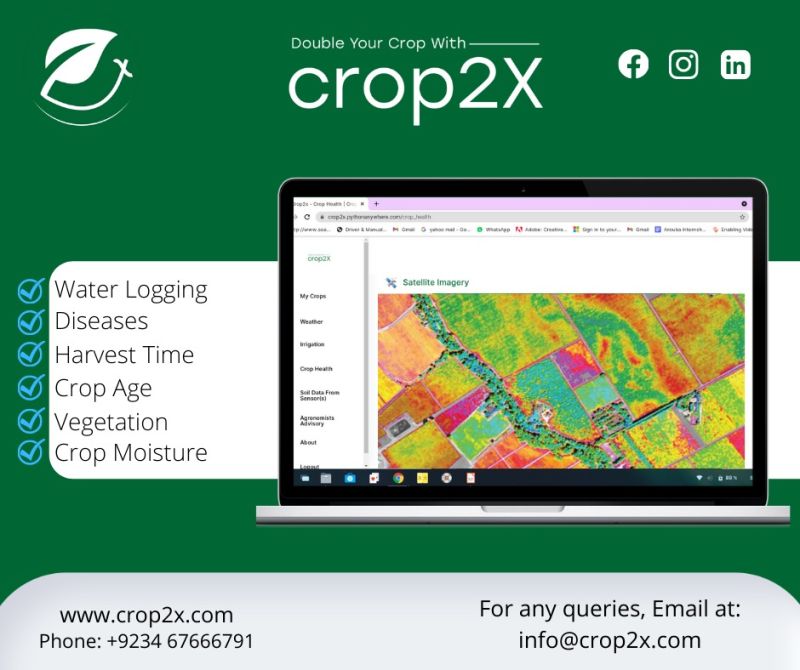
Crop2X Private Limited (Pakistan) is a precision agritech startup that provides weather forecast and
water information
that can help farmers increase production while minimizing inputs. This enables farmers to adapt to changing climatic conditions due to climate change. Builds resilience to: extreme weather events and weather volatility that affect crop yields and farmer incomes. (Agriculture, Risk Analytics/Management)

EF Polymer Private Limited (India) Since opening in 2018, EF Polymer has successfully developed, tested, and piloted 100% Organic Super Absorbent Polymer. EF Polymer is an organic Super Absorbent Polymer made by biowaste from juice shops. It is useful to reduce the irrigation water & fertilizer requirement and help to get more yield without affecting the soil and crop. The product can enhance soil health by providing micronutrients and maintain the moisture content along with helping the growth of microbe which is almost at zero level due to the high usage of chemical fertilizer. As a result, irrigation water requirement is reduced after 10-12 days with this water-retaining natural polymer which can absorb 100 times more water.

Hiraya Water (Philippines) provides AI-driven smart water management products and services for developing markets, helping water utilities optimize their operations – reducing water loss, reducing power consumption and improving service levels. Builds resilience to: increased drought and water scarcity that affect drinking water availability and price. (Water Management)

Komunidad Global Pte Ltd (Singapore, Philippines) is an environmental intelligence platform which helps businesses and governments use earth observation data and analytics to accurately assess physical risks and improve resilience. Their clients are in agriculture, insurance, ports and harbors, construction companies, schools, and government. Builds resilience to: extreme weather events, flooding, and other climate-related events that affect  governments and businesses in various sectors. (Risk Analytics and Management)

Ship60 (Vietnam) Ship60 is building a LogTec platform to provde the fulfillment solutions. Ship60 connects with logistics service providers such as warehousing and delivery services, applies technology platforms to create a unified ecosystem and digitizes logistics processes.

Africa

Agromyx (Ghana) helps smallholder farmers reduce food waste and generate additional income by turning non-marketable post-harvest crops into shelf-stable and nutritious food products. Reducing post-harvest food losses helps to build a more resilient agricultural system and global food supply chain. Builds resilience to: drought, heat stress, and extreme weather events that reduce crop yields, harm farmer incomes, and increase food insecurity. (Agriculture/Food Waste)

Cadel Consulting Ltd (Burkina Faso) produces phospho-compost, an organic fertilizer that helps in restoring degraded land, a problem faced by 85% of farmers in Burkina Faso. The company also distributes improved seed from other companies and trains farmers on smart farming practices. Builds resilience to: drought, heat stress, and extreme weather events that reduce crop yields and degrade arable land. (Agriculture)

Congretype (South Africa) Congretype is a Green Project Developer and Consulting Company in generating cleaner, more affordable energy, conserving it and contributing to a greener, more sustainable environment. These business activities have a particular focus on the following sub-sectors:Renewable energy and rural electrification; Cogeneration and decentralized energy systems; Biogas production and energy recovery from wastewater, landfill and MSW ; Energy efficiency; Biofuels; Climate Change, Greenhouse Gas (GHG) mitigation/adaptation, and, GHG Accounting.

Freezelink (Ghana) delivers cold chain logistics services to reduce food waste and enhance food security and to increase the availability of medicine in Africa. Builds resilience to: extreme heat and extreme weather events that reduce crop yields, worsen food waste, and increase food insecurity. (Cold Chain Logistics Services and Infrastructure)

Kitovu Technology (Nigeria) provides smallholder farmers with data about soil and crop health, storage and market links, through a digital farm productivity platform. Builds resilience to: drought, heat stress, and extreme weather events that reduce crop yields and harm farmer incomes. (Agriculture)

Rwanda Bio Solution (Rwanda) produces organic fertilizers using Effective Microorganism (EM) technology. The process recycles crop waste into organic fertilizer, helping farmers improve soil fertility, reduce disease, and increase their yields. Builds resilience to: drought, heat stress, and extreme weather events that reduce crop yields, degrade arable land, and harm farmer incomes. (Agriculture)

Worldtech Consult (Ghana) designs, manufactures and installs solar powered walk-in cold rooms to extend the shelf life of agricultural products and temperature-sensitive materials, enhancing food system resilience and minimizing losses. Builds resilience to: extreme heat and extreme weather events that reduce crop yields, worsen food waste, and increase food insecurity. (Agriculture, Supply Chain, Transportation, Logistics, and Infrastructure)

ZR3I (Egypt) is a precision agriculture platform-as-a-service that offers crop monitoring, management, and insurance services to the agriculture sector in Egypt and the Arab world, helping farmers to mitigate risks due to climate change. Builds resilience to: extreme weather events and weather volatility that reduce crop yields and harm farmer incomes. (Agriculture, Risk Management, Insurance)

For more information, reach out to Ben Wrobel at Village Capital or Brian Parham at Lightsmith.

About the Partners
  • Village Capital helps entrepreneurs bring big ideas from vision to scale. So far, VC has supported more than 1,400 early-stage startups and invested in more than 110 program graduates. 
  • The Lightsmith Group is an investment firm investing in companies that address critical societal needs. For more information, please see: www.lightsmithgp.com and for the ASAP project, please see: www.climateasap.org.
Related:
22 April 2022. Investor forum ASAP Accelerator - investor forum for these companies  in 2 slots.
  1. Slot 1 - Absolute Water, Agtuall, Congretype, Freezelink, Hiraya Water, Komunidad Global, Ship60, Worldtech Consult.
  2. Slot 2 - Agromyx, Aumsat, Cadel Consulting, Crop2X, EF Polymer, Kitovu Technology, Rwanda Bio Solution, Zr3i

Wednesday, February 16, 2022

7th EU-AFRICA Business Forum (EABF22) and agriculture

14-18 February 2022. The  7th EU-AFRICA Business Forum (EABF22) took place online (with limited on-site presence for speakers and moderators only). Co-organised by the European Commission, the African Union Commission, as well as EU and African business organisations.

Twelve high-level panels and numerous online workshops provided insights into the key themes of EU-Africa business, trade and investment relations. Below are the sessions related to agriculture and food systems.

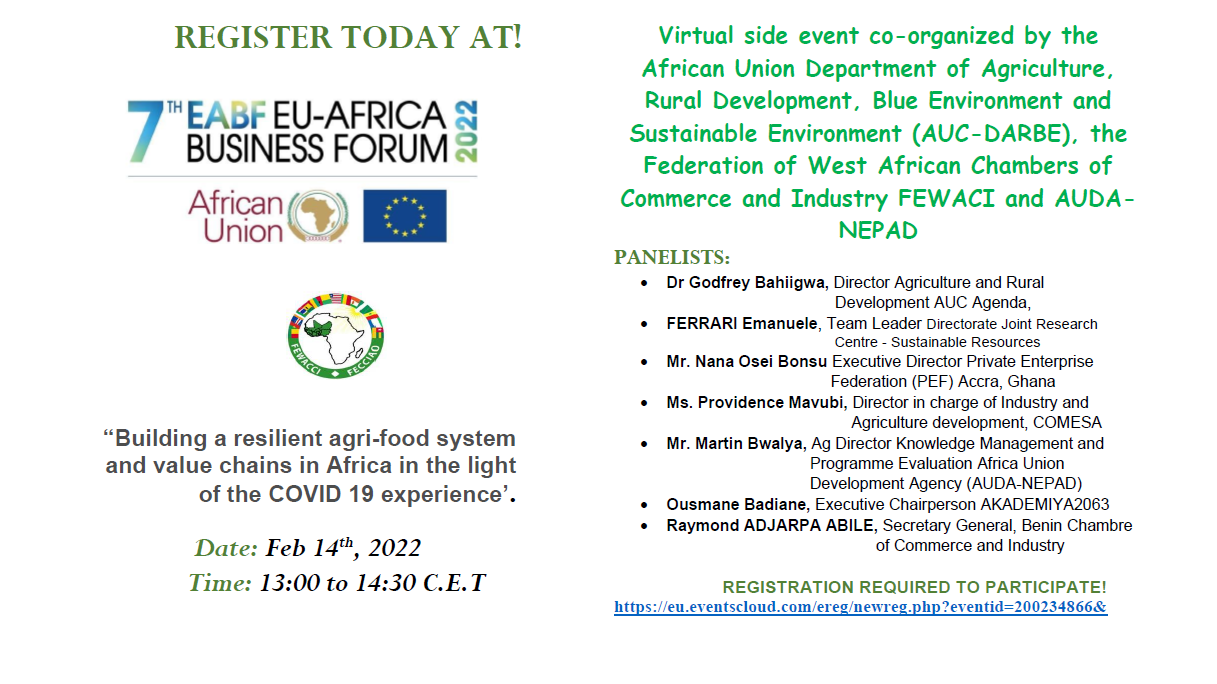
14/02 Building blocks of a resilient agri-food system and value chains in Africa, and possible collaborative arrangements between public and private sector in the light of the COVID 19 experience

Organised by the AUD-NEPAD and FEWACCI
  • Moderator: Dr Godfrey Bahiigwa, Director Agriculture and Rural Development AUC
  • Nana from Ghana
  • Ms. Providence Mavubi
  • Ousmane Badiane
  • Martin Bwalya
  • Raymond ADJARPA ABILE, Secretary General, Chambre de Commerce et d'Industrie du Benin

14/02 Investing in resilience: The future of regenerative agriculture in Africa

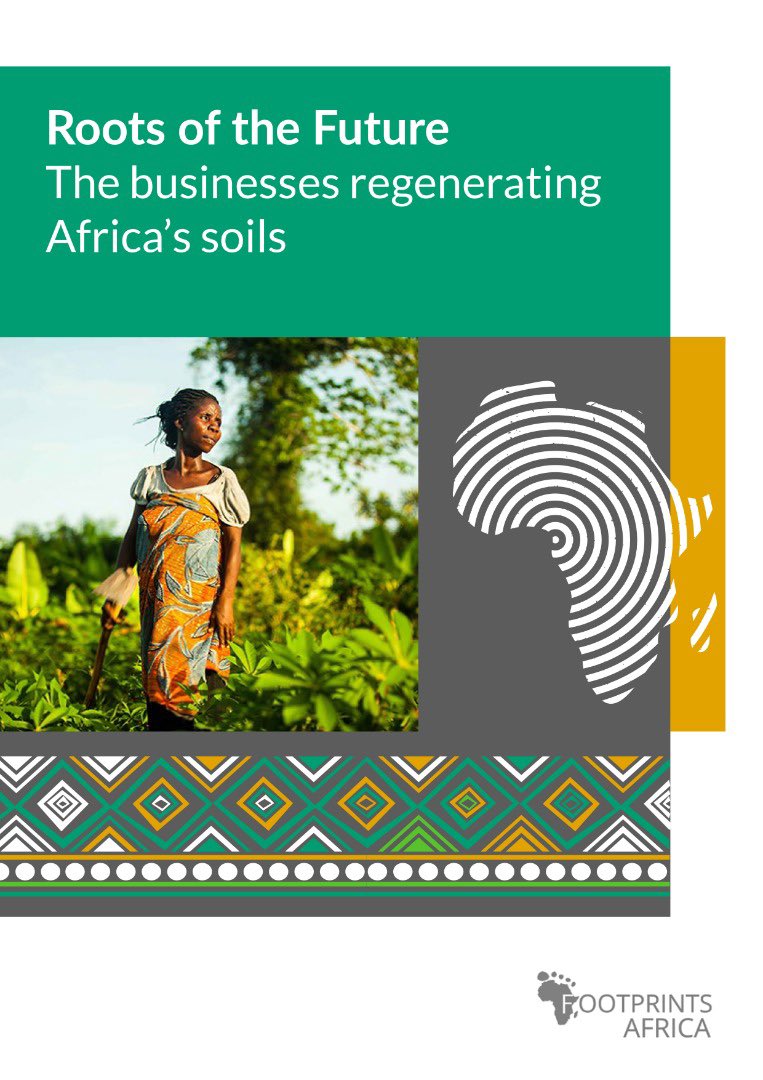
Organised by Footprints Africa. The objective was to hold a session that outlines the pathway to scaled-up investments in African regenerative agriculture: how investors can get better-positioned and how governments can work differently to accelerate the shift. Regenerative agriculture is a huge business opportunity for Africa. Estimates suggest that $1 invested in land restoration can create $7 to $30 in economic benefits, while protecting biodiversity and fighting climate change.  It also makes sense as a risk mitigation strategy; approximately half of the world’s total GDP - some $44 trillion - is dependent on ecosystem services.

Regenerative agriculture at its core is about working with – and not fighting against – nature, more specifically to work in a way that soil can renew itself. We shouldn’t underestimate the implications of this. It requires changing food systems, and by extension, business models. What does this mean for businesses? Globally, companies with significant value chains on the continent such as Cargill, Danone, Nestlé, Olam, Pepsi,  Unilever, and Walmart have all made ambitious public commitments toward regenerative agriculture in their value chains. How far will those commitments reach? 

This session brought leaders in regenerative agriculture value chains and shared insights from
Footprints Africa's work to map the circular economy in food systems on the continent
. It drew on selected extracts from Footprints Africa’s recent report on regenerative agriculture during the session

Footprints (2021) Roots of the FutureThe businesses regeneratingAfrica’s soils #34 p.

At the heart of regenerative agriculture is a recognition that mobilising the complexity of natural systems is more important than adopting a tech-driven approach. But, critically, new technologies have the potential to increase the power of smallholder farmers. Technology will also have a fundamental role in making the job of regenerative farming less labour intensive and more profitable, which are two of the major drivers of Africa’s inter-generational decline in farmers.
  • Joanna Bingham, CEO, Footprints Africa (chair)
  • Christopher Zaw, Partner, Warc group, Sierra Leone, christopher.zaw@warcgroup.com
  • Kofi Debra, CEO, OKO Forests, Ghana, kofi@okoforests.com
  • Joseph Lentunyoi, Director, Laikipia Permaculture Centre, info@lpct.or.ke

14/02 Agri-food systems in the Sahel: the need for investment in local value chains

Organised by MEDEF International + UPAS (union of G5 Sahel business federations)
The development of the economy represents a response to the multiple crises experienced by the countries of the Sahel. However, in the Sahel, the food economy represents 27% of GDP and 80% of total employment. Agriculture remains the main segment. The agricultural sector is dominated by subsistence production systems, characterized by small farms, with low productivity, high levels of self consumption, and weak integration of value chains. Because of their capacity for innovation and investment, private operators are seen as key players in the transformation of African agriculture, which must simultaneously increase agricultural production, provide healthy and nutritious food to a rapidly growing population, sustainably preserve natural resources, and provide jobs and decent incomes to tens of millions of young people entering the labor market each year. 

Partnerships between companies and producers are put forward as a model for structuring sectors to integrate small producers more equitably and sustainably. Thus, dynamic agro-food processing SMEs are developing in various sub-sectors. Nevertheless, the potential for production and agro-food processing is still under-exploited. The objectives of this sessions were:
  • Highlight the challenges of developing agri-food chains in the Sahel
  • Underline the obstacles to the development of agri-food in the Sahel
  • Highlight the role of the private sector and promote co-investment models for sustainable place-based agri-food systems in the Sahel
  • Feed reflections on good support practices for private operators involved in the agri-food sectors in the Sahel
Speakers
  • Moderator Mr. Henri de VILLENEUVE, President COBASA
  • Mr. Franck VIAULT, Head of Sector Sahel, DG INTPA
  • Mrs. Zeinabou MAIDAH, CEO Niger-lait and President Organisation Professionnelle des Industriels du Niger (OPIN)
  • Mrs. Sophie MÉNAGER, Managing Director I&P Accélération au Sahel
  • Mr. Bastien BALLOUHEY, CEO Grands Moulins de Mauritanie

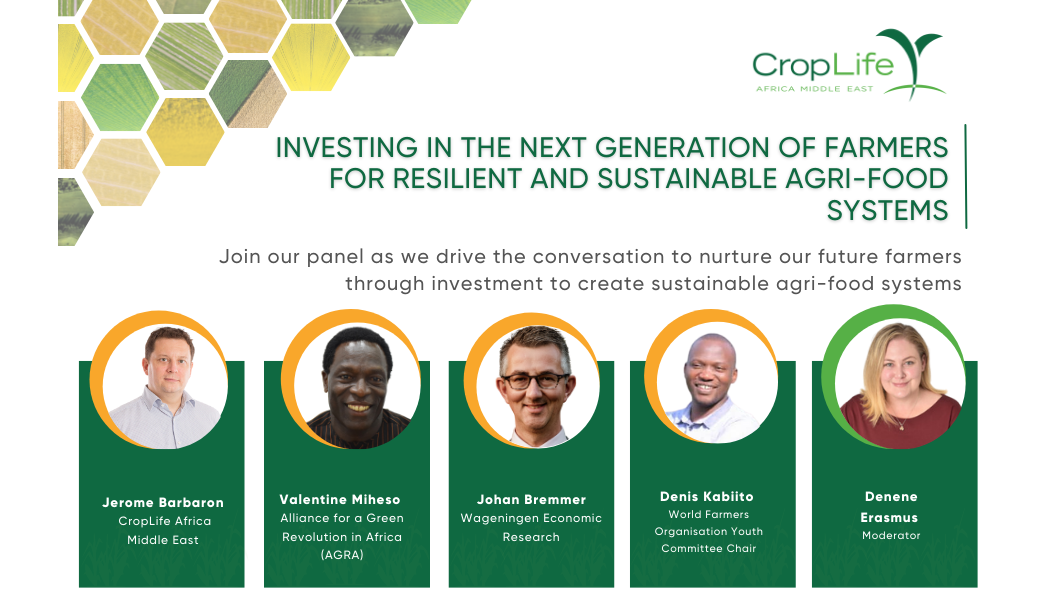
14/02 Investing in the Next Generation of Farmers for Resilient and Sustainable Agri-Food Systems

Organised by CropLife Africa Middle East

Objectives: Enhance the EU Africa Dialogue on youth entry and sustenance into Agriculture as a career and business option backed by a facilitative business and investment environment. Create incentives for PPPs in agrifood systems that benefit both continents
  • Dr. Agnes Kalibata - Alliance for a Green Revolution in Africa (AGRA)
  • Jerome Barbaron, President CropLife Africa Middle East - CropLife Africa Middle East
  • Dr Bart de Steenhuijsen Piters, Senior Scientist Food Systems - Wageningen Economic Research
  • Denis Kabiito. World Farmers Organisation Youth Committee Chair
  • Moderator: Denene Erasmus Business Day

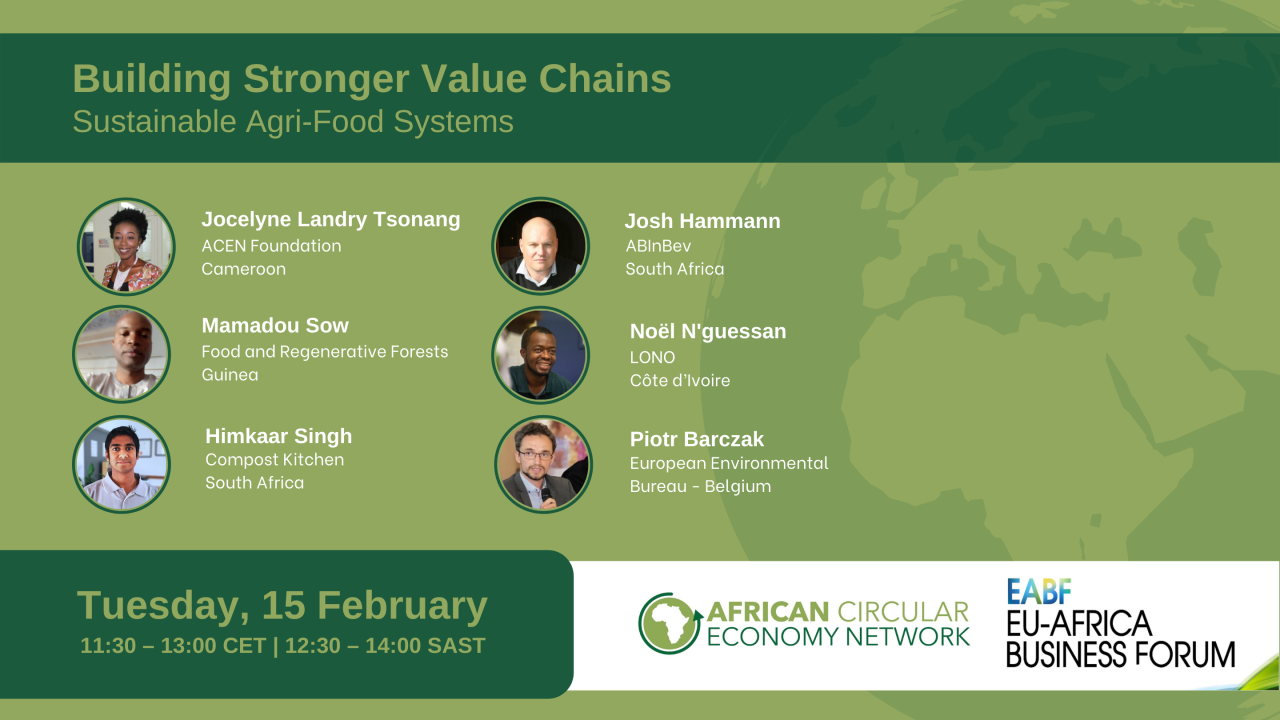
15/02 Circular Food Systems in Africa – opportunities and challenges for EU / African Cooperation

Organised by African Circular Economy Network
Objectives: To present and discuss the role of the circular economy in creating resilient, regenerative and climate-positive solutions in African food value chains from the farm to consumer. The opportunities and challenges for developing circular African food systems will be presented and discussed, particularly in the context of EU / Africa cooperation. African case studies were presented as a panel with reflections from a European perspective. 
  • Moderator Jocelyne Landry Tsonang, African Circular Economy Network / ACEN Foundation, Cameroon
  • Piotr Barczak, European Environmental Bureau, Belgium
  • Ndidi Okonkwo Nwuneli, Global Alliance for Improved Nutrition (GAIN), Nigeria
  • Himkaar Singh, The Compost Kitchen, South Africa
  • Alyssa Jooste, ABInBev, South Africa
  • Elke Nijman, African Leadership University / Circular Africa / African Circular Economy Network, Rwanda
  • Noël N'guessan, LONO Côte d’Ivoire

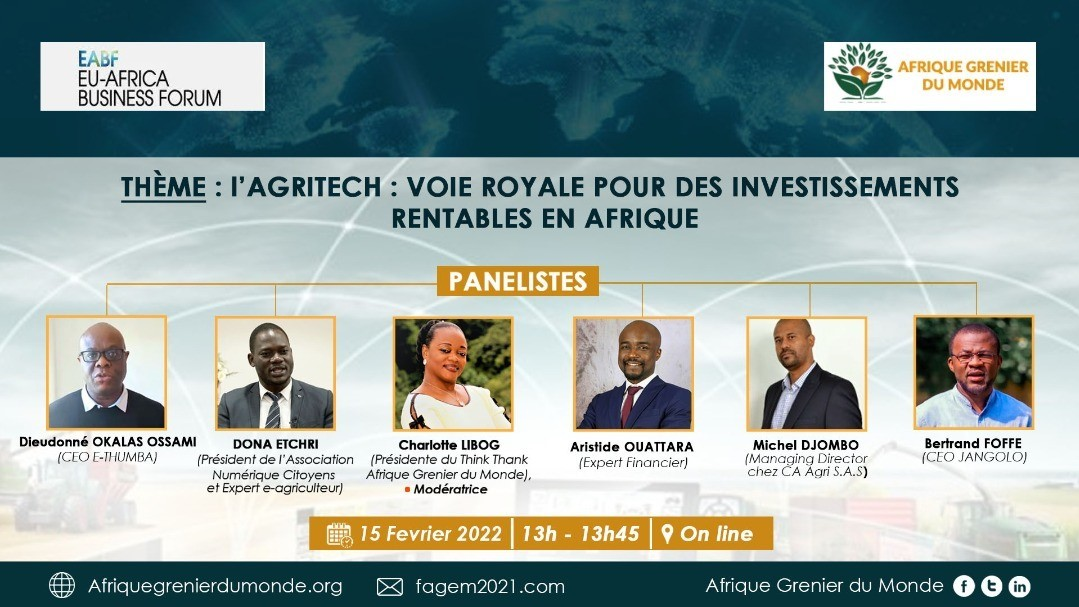
15/02 L'Agritech : Voie Royale pour des Investissements Rentables en Afrique

Organised by Afrique Grenier du Monde
  • Madame Charlotte LIBOG / Présidente du Think Thank Afrique Grenier du Monde, Modératrice.
  • Monsieur DIEUDONE OKALAS OSSAMI / CEO E-THUMBA
  • Monsieur DONA ETCHRI /Président de l'association Numérique Citoyen et Expert e-agriculteur
  • Monsieur ARISTIDE OUATTARA / Associé en charge du métier Risk Advisory de Deloitte
  • Monsieur BERTRAND FOFFE / CEO JANGOLO
  • Monsieur MICHEL DJOMBO / Managing Director chez CA Agri S.A.S

16/02 Launch event and signing ceremony of the new AgriFI & ElectriFI country and regional windows


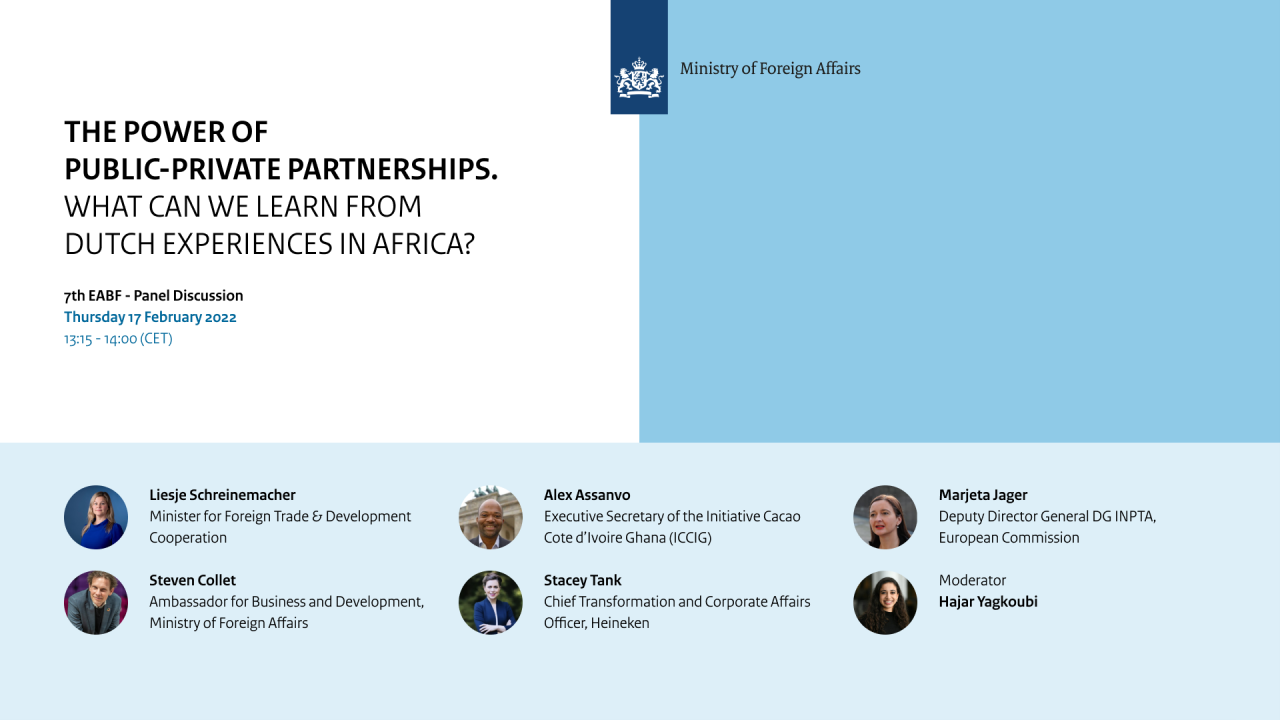
17/02 The power of public-private partnerships. What can we learn from Dutch experiences in Africa?

13:15 Organised by the Ministry of Foreign Affairs of the Netherlands. This high level event will look at the potential of public-private partnerships for sustainable development in Africa on the basis of best practice. It will also clarifying what Public Private Partnerships (PPPs) can bring Africa and what is required for successful PPPs.
  • Moderator: Ms. Hajar Yagkoubi
  • Ms. Liesje Schreinemacher, Minister for Foreign Trade & Development Cooperation
  • Ms. Marjeta Jager, Deputy Director General, DG for International Partnerships, European Commission
  • Steven Collet, Ambassador for Business and Development, Ministry of Foreign Affairs of the Netherlands
  • Stacey Tank, Chief Transformation and Corporate Affairs Officer, Heineken
  • Mr. Alex Assanvo, Executive Secretary of the Initiative Cacao Côte d'Ivoire Ghana (ICCIG)

18/02 Women agri-food business in Africa and Europe: benefits in the economy and the sustainable development by promoting the geographical indications as best practices

10:00 am Organised by the Hellenic Ministry of Foreign Affairs and Enterprise Greece National Chamber Network of Women Entrepreneurs in Greece (NCNWEG)
  • Ms. Valia Kaimaki, journalist, Director, Greek edition of "Le Monde diplomatique", Greece and Cyprus, Vice Chairwoman of the European Journalism Centre
  • Mr. Georges Georgandas, Minister of Rural Development and Food, Greece
  • Dr. Yulita Chebotip Mitei Cheruiyot, Deputy Governor of Nandi County, Kenya
  • Ms. Sofia Kounenaki-Efraimoglou, President, National Chamber Network of Women Entrepreneurs of Greece
  • Mr. Sotiris Mousouris, President, Hellenic-African Chamber of Commerce
  • Ms. Vicky Pantazopoulou, Honorary Consul of the Republic of Kenya, Honorary Presidentof the Hellenic-Kenyan Chamber of Industry, Trade, Development, Tourism & Culture
  • Mrs. Josephine Francis, Vice President, ROPPA, West African Farmers Organisation for ECOWAS, Liberia
  • Mr. Gregor Schneider, Deputy Team Leader of the AfrIPI project
  • Ms. Dorsaf Benhamed, Directorate General for the Agricultural Production, Ministry of Agriculture, Water Resources and Fishing Resources of Tunisia
  • Ms. Mary Koliou, Member of Board, KOLIOS SA GREEK DAIRY, Kilkis, Greece - “feta cheese”
  • Ms. Vicky Onderi, CEO, GREEN FARM COULD LTD, Kenya - “tissue culture bananas”
  • Ms. Helen Bozineki, Marketing Manager, XILOFOURNISTA FANOURAKIS, Heraklion Greece - “cretan rusk”
  • Ms. Sara Yirga, Founder and General Manager, YA COFFEE ROASTERS, Addis Abeba, Ethiopia - “coffee”
  • Ms. Vassiliki Karoumbali, Export Manager, AENA0N, Kalamata, Greece - “olives”, “olive oil”
  • Ms. Eleni Kyrou, Head of Representation to Ethiopia and the African Union, European Investment Bank
  • Ms. Athina Chatzipetrou, CEO and President, Hellenic Development Bank

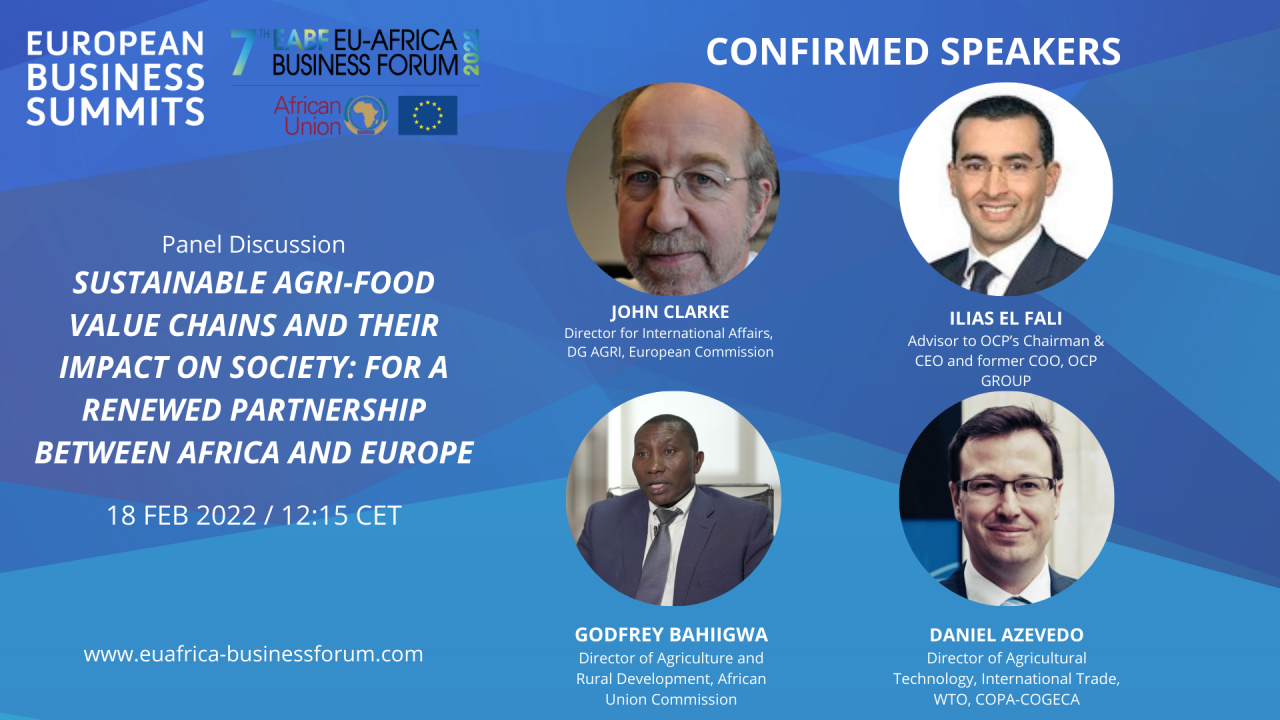
18/02 Sustainable Agri-food value chains and their impact on society: For a
renewed partnership between Africa and Europe

12:15 Organised by European Business Summits
  • John Clarke, Director for International Affairs, DG AGRI, European Commission
  • Ilias El Fali, Advisor to OCP's Chairman & CEO and former COO, OCP GROUP
  • Godfrey Bahiigwaw, Director of Agriculture and Rural Development, African Union Commission
  • Daniel Azevedo, Director of Agricultural Technology, International Trade, WTO, COPA-COGECA

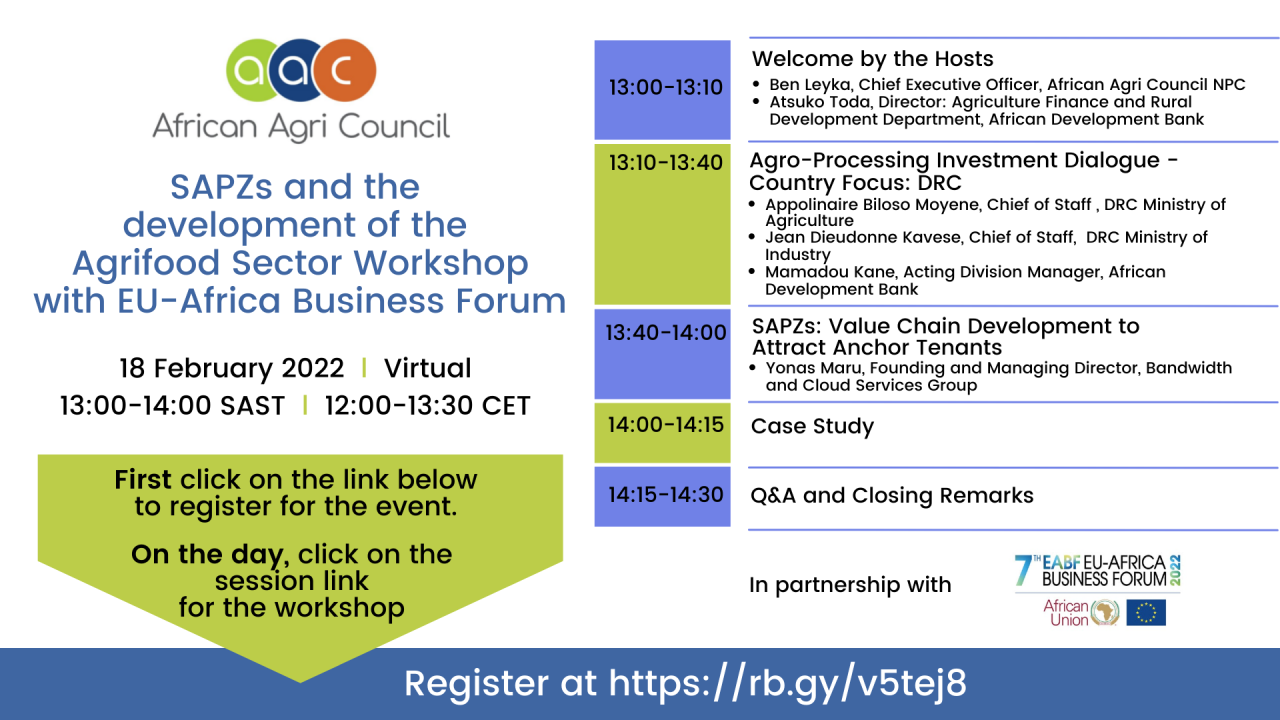
18/02 SAPZs and the development of the Agrifood sector virtual workshop

1:00 pm Organised by African Agri Council NPC
  • Ben Leyka, Chief Executive Officer, African Agri Council NPC
  • Atsuko Toda, Director, Agriculture Finance and Rural Development Department, African Development Bank
  • Appolinaire Biloso Moyene, Chief of Staff, DRC Ministry of Agriculture
  • Jean Dieudonne Kavese, Acting Division Manager, African Development Bank
  • Mamadou Kane, Acting Division Manager, African Development Bank
  • Yonas Maru, Founding and Managing Director, Bandwidth and Cloud Services Group

18/02 Renewable Energy for African Agriculture and Access to clean water

2:30 PM Organised by Africa Energy Services Group. The event will highlight challenges and opportunities available in Africa to harness clean energy to support agriculture and provide access to clean water .
  • Sylvester Richard Chikabvumbwa, Researcher, AgriMetsoft Research Laboratory
  • Abdel Aziz GADO, Hydraulic Engineer,ESSOR INGENIERIE
  • Mugwaneza Ishimwe Bénigne, Executive secretary, Water Patnership
  • Bamundekere Giselle, Project Engineer, Munyaxeco
  • Isaac Kiunga, CEO, Gogreen energy
  • Barahira Dominique Savio, Energy Projects Development Engineer, Africa Energy Services Group Ltd

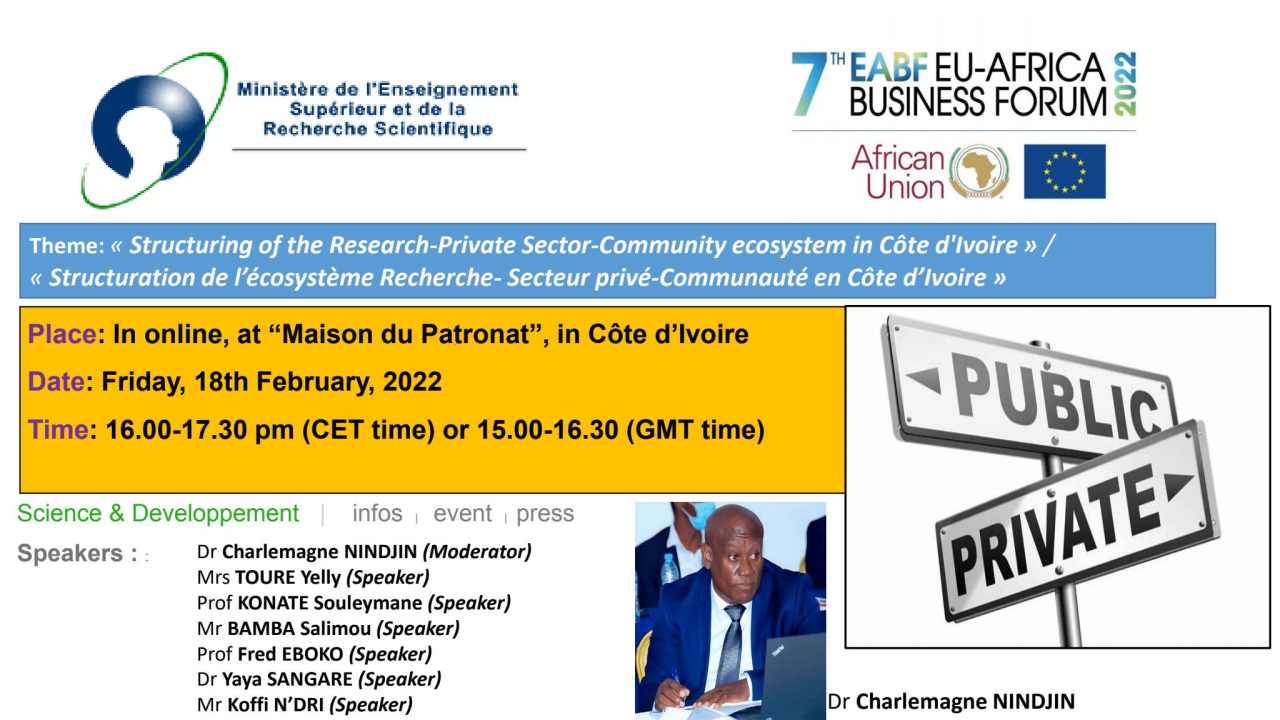
18/02 Structuring of the Research-Private Sector-Community ecosystem in Côte d'Ivoire

4:00 pm Organised by the Office of Valorization and Relation with the industry at the Ministry of High School and Scientific Research
  • Moderator: Charlemagne NINDJIN, PhD, Deputy Director of Valorization and Relationship with the industries, Ministry of Higher Education and Scientific Research in Côte d’Ivoire
  • Mrs. TOURE Yelly, Director of Communication, Cabinet of the MESRS, Ministry of Higher Education and Scientific Research in Côte d’Ivoire
  • Prof. KONATE Souleymane, Professor, General Director of Research and Innovation (DGRI), Ministry of Higher Education and Scientific Research in Côte d’Ivoire
  • Mr. BAMBA Salimou, General Director of Agence Côte d’Ivoire-PME (CI-PME), Ministry for the Promotion of SMEs, Handicrafts and the Transformation of the Informal Sector
  • Prof. Fred EBOKO, Professor, IRD representative in Côte d'Ivoire, IRD Côte d'Ivoire
  • Dr. Yaya SANGARE, Doctor, Secretary General, Funds for science, technology, and innovation in Côte d’Ivoire (FONSTI)
  • Mr. Koffi N’DRI, President of the Professional Training and Research Commission, The General Confederation of Private Industries of Côte d'Ivoire (CGECI)

18/02 Championing private-public blended policy and investment choices to accelerate Africa’s food systems transformation – the role of digital

12:00 Organised by Vodafone/Vodacom and African Union Development Agency (AUDA-NEPAD). Foster exchange and networking among interest constituencies and stakeholders on Africa-Europe and Public-Private collaborative alliances in harnessing digital innovations in boosting collective capacities towards resilient, inclusive and viable agro- and food-industries Digital technologies have the potential to deliver impact across food value chains by reducing costs, helping farmers make sustainable decisions, improving access to information and markets, and empowering women and youth in particular.