Platform for African – European Partnership in Agricultural Research for Development
Showing posts with label the Netherlands. Show all posts

Friday, September 11, 2026

The Netherlands Food Partnership at AFSF 2026: Connecting Dutch Expertise with Africa’s Food Systems Transformation

31 August to 4 September 2026. AFS Kigali. For the Netherlands Food Partnership (NFP), the Forum was an opportunity to demonstrate that Dutch engagement in African food systems is not about a single technology, sector or organisation. Rather, it is about building partnerships across agriculture, nutrition, energy, research, entrepreneurship, finance and policy.

NFP brought together Dutch organisations and partners around a shared presence at the Forum, while also supporting several partnerships and sessions addressing some of the most pressing challenges facing Africa’s food systems.


A Dutch Pavilion built around partnership


One of the most visible elements of the Dutch presence was the Dutch Pavilion, hosted by the Netherlands Food Partnership. NFP brought together 17 members of its network at the booth, creating a shared space where organisations could present their work, meet African and international partners, exchange experiences and explore new collaborations.

The pavilion reflected the diversity of Dutch engagement in African food systems. Among those represented were organisations working on farmer livelihoods and value chains, climate resilience, nutrition, youth entrepreneurship, research and innovation.

  • Dorcas, for example, used the pavilion to showcase its work on climate-resilient agriculture, farmer field schools and value-chain development in East Africa. Its representatives highlighted experience from Tanzania and Kenya, including work around the PIP approach, farmer field schools and the honey value chain.
  • Access to Nutrition Initiative (ATNi) was also represented through the Dutch booth, with Katherine Pittore participating on behalf of the Netherlands Working Group on international
    Nutrition. ATNi's broader engagement at the Forum focused on healthy diets, consumer demand and the food environment.
  • ProVeg International was another partner present at the Dutch Pavilion, bringing perspectives on plant-rich diets and protein diversification and linking these issues to healthier and more resilient African food systems.

The pavilion therefore served as more than an exhibition stand. It became a meeting point for organisations that approach food-system transformation from different entry points but share an interest in practical, locally relevant solutions.


Putting youth entrepreneurship at the centre


A major NFP-supported event during the Forum was the session “Scaling the Youth Enterprises Ecosystem,” held on 2 September at the Youth Dome. The session was jointly organised by SNV, FAO, AGRA, Netherlands Food Partnership and Wageningen University & Research Student Challenges, with NFP's Bente Meindertsma helping to facilitate the discussion. The central question was : what does it take to help youth-led enterprises move from incubation to scale?

The discussion explored the importance of education, skills, networks, market opportunities and enabling ecosystems. Rather than treating young people simply as beneficiaries of food-system programmes, the session focused on young people as entrepreneurs, innovators and economic actors.

The involvement of East-West Seed Knowledge Transfer Foundation added a practical smallholder perspective. Elijah Mwashayenyi, Head of Knowledge Transfer for Africa, participated in the panel discussing how youth enterprises can scale across different country contexts.


Turning food-system plans into action


NFP joined FAO, GAIN, AGRA, AKADEMIYA2063, GIZ, Expertise France, the Scaling Up Nutrition Movement and the UN Food Systems Coordination Hub, among others, in a side event examining how national food-system plans can be translated into practical action. The discussion focused on the practical challenges governments face when moving from strategy to implementation, including the need for stronger coordination, partnerships and investment.

A session convened under the Accelerator framework brought together government representatives, development partners and international financial institutions to consider how implementation gaps can be addressed.


Connecting food systems with clean energy


Another major area of NFP engagement was the Agri-Energy Coalition, which brings together partners working at the intersection of energy, agriculture, water, nutrition, climate and finance. The Coalition had a dedicated exhibition booth, side events, deal-room activities, Innovation Hub sessions and networking events. NFP was among the Coalition partners. The Coalition brought together organisations including GOGLA, SNV, AGRA, GAIN, Wageningen University & Research, IWMI, Practical Action, REEEP, the Global Energy Alliance for People and Planet, Welthungerhilfe, IKEA Foundation, Acumen, BASE, Partners in Food Solutions, Helen Keller International and others.

Energy is not a peripheral issue for food systems. Reliable and affordable energy affects irrigation, cold storage, processing, transport, markets and the ability of rural enterprises to add value. Renewable energy can therefore be an enabler of both food-system resilience and rural economic development.


Investing in young innovators


NFP's partnership with Wageningen University & Research was also visible through the Food Systems Innovation Challenge. 

The Challenge connects students from universities in the Global South and elsewhere with real food-system challenges, creating opportunities for young people to develop practical solutions and entrepreneurial ideas. 

WUR and NFP jointly organise the Challenge, with a strong emphasis on partnerships with universities in the Global South and on connecting youth innovation with food-system transformation pathways. The 2026 edition involves student teams from 17 partner universities. 

Although the Grand Finals will take place Tuesday, 29 September 2026 in Wageningen, the initiative formed part of the wider NFP presence at AFSF: an example of how youth engagement, education, innovation and entrepreneurship can be connected rather than treated as separate agendas.

The 30 selected teams

1BangladeshBangladesh Agricultural UniversityThe Golden Loop
2BangladeshBangladesh Agricultural UniversityBiocircular
3BeninNational University of AgricultureGreenValor-Compost
4BeninNational University of AgricultureKetou FertiSoyaPlus
5BrazilESALQ-USPEcoPalm Nexus
6BrazilESALQ-USPKindred Ora
7EthiopiaWollo UniversityEureka
8EthiopiaWollo UniversityBiochar – The Black Diamond
9GhanaUniversity of GhanaSoilpulse AI
10GhanaUniversity of GhanaMacIsland
11IndonesiaUniversity of BrawijayaEkolestari
12IndonesiaUniversity of BrawijayaNgramut Wiji
13KenyaLukenya UniversityAgripro
14KenyaLukenya UniversitySolar Harvest Innovators
15KenyaUniversity of EldoretBreezBag
16KenyaUniversity of EldoretFermentaFuture
17NepalKathmandu UniversityGreen Miracle
18NepalKathmandu UniversityShell Alchemist
19NetherlandsWageningen University & ResearchIronTeam
20NetherlandsWageningen University & ResearchPaludifuture
21NigeriaUniversity of AbujaGreen Dessert
22NigeriaUniversity of AbujaSiam Bio-Store
23SenegalUSSEINGancax Pro
24SenegalUSSEINMBT's Infusana
25South KoreaSeoul National UniversityRegrain
26South KoreaSeoul National UniversityABEL
27UgandaMakerere UniversityGreen Organic Harvest Canopy
28UgandaMakerere UniversityBioCoat Solutions
29VietnamCan Tho UniversityEco-Aqua Alliance
30VietnamTra Vinh UniversityEverGreen


Thursday, May 21, 2026

What Dutch exports mean for African food systems

20 May 2026. Research into the possible structural impacts of Dutch agrifood exports to Africa

Do subsidised, highly efficient Dutch farmers push African farmers out of their markets? ECDPM and Wageningen University researched this question for the Dutch Foreign Ministry and the Dutch Parliament (Tweede Kamer). 

ECDPM analysed the trade data, selected two in-depth cases with the highest probability of structural negative impacts – and, based on econometric analysis and interviews, found that there were no such harmful impacts in these cases. This also indicates that impacts in other cases would likely be very limited.


No impact is surprising – why is that?

Why no impacts, then? Trade data shows that Dutch food exports to ‘vulnerable countries’ are declining, and there are few instances where they have a substantial market share and attribution of impact is possible. 

Two cases were selected: onion exports to Senegal and potato exports to Côte d'Ivoire ($ 33.3 million volume and 71% market share for onions to Senegal; $ 10.0 million and 84% for potatoes to Côte d'Ivoire).

Friday, June 20, 2025

Delivering the Kampala Strategy for Agricultural R&D in Africa

16 - 19 June 2025
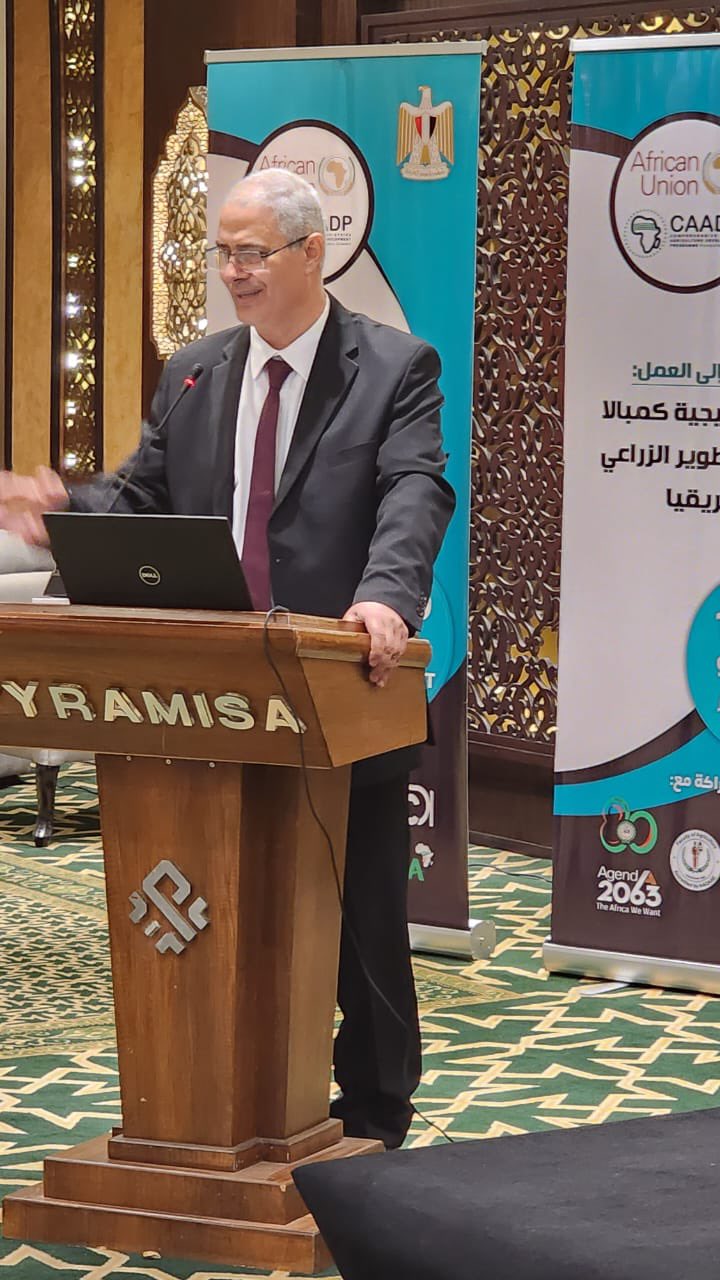
. Cairo, Egypt. From Commitment to Action: Delivering the Kampala Strategy for Agricultural R&D in Africa. 

This meeting was organized by AU‑SAFGRAD (the African Union’s Semi‑Arid Food Grains Research & Development office). It served as a key strategy session aimed at operationalizing the newly launched CAADP Kampala Strategy (covering 2026–2035), which is Africa's post‑Malabo framework for transforming agriculture through science and innovation.

It is important to strengthen joint African action to address the risks and challenges facing the region, as well as the optimal and effective exploitation of the vast and diverse economic and natural resources possessed by the African continent, to achieve intra-African economic integration and address the new global reality. Egypt develops agriculture through several axes, including: horizontal expansion through the reclamation of approximately 4 million acres to support the production of strategic crops and reduce the food gap therein, as well as vertical expansion through the development of new varieties with high productivity, early maturity, low water requirements, and tolerance to climate change.  
Egyptian state's efforts include adopting modern technologies to develop irrigation systems and increase the efficiency of water resource use by building giant agricultural wastewater treatment plants. This is in addition to supporting the transition to healthy and safe food systems, reducing loss and waste by expanding the scope of the National Silos Program and diversifying import sources for strategic grain commodities. This is in addition to strengthening and expanding the social protection network through the "Takaful and Karama" programs and launching the presidential "Decent Life" initiative, which aims to alleviate the burden on citizens in the most needy communities in rural areas and urban slums, representing more than 60% of the Egyptian population. 
The Ministry of Agriculture and its scientists from the Agricultural Research Center and the Desert Research Center are fully prepared to provide the necessary expertise and all means of support to cooperate with our brothers from the African continent, harnessing all capabilities to ensure the success of this cooperation and achieve food security. Alaa Farouk, Minister of Agriculture and Land Reclamation of Egypt
The workshop was attended by: the Director of the African Union Office for Research and Development at the African Union Commission; the Executive Secretary of the Forum for Agricultural Research in Africa; the Executive Secretary of the Arab Fund for Technical Support to African Countries; Dr. Adel Abdel Azim, Head of the Agricultural Research Center; Dr. Saad Moussa, Supervisor of External Agricultural Relations; and representatives of African Union bodies and organizations.

Objectives of the Meeting
  • Translate the Kampala Strategy into a concrete Action Plan: Participants focused on identifying R&D priorities, setting targets, defining implementation pathways, and establishing an M&E (monitoring & evaluation) framework .
  • Engage key stakeholders: A broad range of actors from national agricultural research centers, CGIAR institutes, regional bodies like FARA, and AU entities (e.g., SAFGRAD, AUC) were consulted to ensure ownership at all levels.
  • Mobilize support and funding mechanisms: The meeting also explored ways to build strong public–private partnerships, secure donor engagement, and tap into new financing instruments to support agricultural research in Africa.
Key Themes Covered
  • Strengthening R&D infrastructure up to 2035.
  • Enhancing tech transfer—including mechanization, digital agriculture, AI, climate-smart practices.
  • Establishing robust institutional frameworks and governance for implementation and monitoring.
  • Formulating resource mobilization strategies.
This event marked the first major consultative workshop aimed at driving the shift from high‑level commitment—to the Kampala Strategy—toward tangible, on‑the‑ground action across Africa. The ultimate goal: to build sustainable, resilient, and innovation-led agri-food systems across the continent.

Extracts of the programma

Panel 1: CAADP Kampala Strategy – From Vision to Action 

  • Moderator: Dr. Irene Annor Frempong (Facilitator) 
  • Kenao Lao (AUC/CAADP) 
  • Dr. Samuel Benin (IFPRI/CGIAR) 
  • Dr. Clement Adjorlolo (AU-NEPAD) 
  • Dr. Moses Odeke (ASARECA) 
  • Representative ARC Egypt 

Panel 2: Building Resilient Agricultural Research Systems 

  • Moderator: Dr. Niéyidouba Lamien (CORAF) 
  • Dr. Majola Lawrence Mabuza (CCARDESA) 
  • Dr. Wanjiru Kamau-Rutenberg (CGIAR) 
  • Dr. Sokona Dagnoko (RUFORUM) 
  • Dr. Charity Kagiso K-Kruger (NARDI, Botswana) 
  • Dr. Fredah Maina Wangui (KALRO, Kenya) 
  • Representative ARC Egypt 

Panel 3: Leveraging Technology and Innovation for Agri-Transformation 

  • Moderator: Dr. Charles Kleinermann (CGIAR/ ICARDA) 
  • Dr. Baboucarr Manneh (AfricaRice) 
  • Dr. Oladunjoye Michael Adeyinka (Pan African University) 
  • Kofi Kisiedu Acquaye (YPARD) 
  • Dr. Niéyidouba Lamien (CORAF) 
  • Dr. Hernán D. Muñoz, Food and Agriculture Organization (FAO) 
  • Representative ARC Egypt 

Panel 4: Bridging the Research-to-Practice Gap 

  • Moderator: Dr. Lilian Lihasi Kidula (AFAAS) 
  • Dr. Oyewole Babafemi (PAFO) 
  • Representative ROPPA/PROPAC 
  • Prof. Quirico Migheli, Director, Desertification Research Centre (EWA 
  • BELT) 
  • Dr. Uffelen, Gerrit-Jan van (WUR) 
  • Representative ARC/Cairo University 

Panel 5: Gender, Youth and Inclusive Research Systems 

  • Moderator: Fatma Bensadok (Algeria – Gender/Training) 
  • Lovin Kobusingye (Uganda National Women Fish Organization) 
  • Kofi Kisiedu Acquaye (YPARD) 
  • Jenniffer Wairimu Waruingi (Kenya Youth) 
  • Dr. Jennie Van der Mheen (WUR) University 
  • Dr. Laura Altea (EWA BELT ) 
  • Representative ARC Egypt 

Panel 6: Institutional Collaboration and Policy Engagement for Kampala Delivery 

  • Moderator: Dr. AKwesi Ntiamoah Atta-Krah, Senior advisor to the Regional Director for Africa   
  • Dr. Uffelen, Gerrit-Jan van (WUR) 
  • Dr. Aliou Faye (ISRA, Senegal) 
  • Representative ARC/Cairo University 
  • Dr. Moyo Siboniso, ILRI Deputy Director General 

Panel 7: Resource Mobilization and Public-Private Partnerships 

  • Moderator: Dr Kwaku Antwi (FARA) 
  • Dr. Oyewole Babafemi (PAFO – Farmer/PPP links) 
  • Dr. Tapsoba François (EWA Scientific Board) 
  • Peter Claver Anyeembey (Ministry of Agriculture, Ghana) 
  • Dr. Mohammed Ssemwanga (AGRENES-Private Sector) 
  • Representative Cairo University 
  • Representatives from AFTAAC 
  • Representative ARC Egypt 

Key Outcomes & Next Steps

  • Drafting of an AU-SAFGRAD Action Plan. Outlining thematic priorities, institutional roles, performance indicators, and implementation timelines.
  • Governance Frameworks Initiated. Draft TORs for coordinating bodies, partnership agreements, and M&E systems were proposed for adoption at continental and regional levels 
  • Resource Mobilization Framework Drafted. Including proposals for public–private funding, donor coordination, and engagement with “Team Africa” financing mechanisms 
  • Research Priorities Finalized. Soil health, digital/agri-tech, AI, mechanization, climate-smart practices and value-chain R&D were signed off as flagship areas 
  • Partnership Agreements Under Development. Including a roadmap for AARIEIs (Africa‑wide Agricultural Research & Innovation Excellence Institutions) aligned with Kampala goals 
  • RUFORUM-Led Capacity Support Planned. RUFORUM to roll out training programs aiding national implementation efforts

Monday, June 2, 2025

Netherlands Food Partnership about the upcoming UNFSS +4 Stocktake


2 June 2025. Online network briefing session from the Netherlands Food Partnership about the upcoming UNFSS +4 Stocktake for the Dutch partner network

The global UN FSS+4 Stocktaking Moment (July 27–29, 2025, in Addis Ababa, Ethiopia, co-hosted by Ethiopia and Italy) aims to discuss progress made since the UN Food Systems Summit of 2021. 


With just five years remaining until the 2030 Agenda for Sustainable Development horizon line, the UNFSS+4 will provide an opportunity to document progress, strengthen accountability, and unlock investments for transformative action. 

The event spotlighted:
  • successful country-level transformations, 
  • innovative practices, 
  • challenges faced in fragile and conflict-affected settings,
  • and be part of broader efforts to shape a coherent global narrative on sustainable development and accelerate synergies between key SDG transitions. 
Download the summary report from the meeting here. 

Below are the slides used by Mr. Khaled Eltaweel (see picture) of the Food Systems Coordination Hub.


Speakers

Setting the scene 
  • Mr Khaled Eltaweel (UN Food Systems Coordination Hub) 
  • Mr Oliver Camp (GAIN) 
Perspectives on the relevance of the UNFSS+4 Stocktake 
  • Ms Joyce Akpata (GAIN Nigeria) 
  • Ms Namukolo Covic (IFPRI Ethiopia) Dutch delegation update 
  • Ms Ingrid Flink (Ministry of Agriculture, Fisheries, Food Security and Nature) 
  • Ms Stineke Oenema (Ministry of Foreign Affairs)
Next Steps 
  • NFP Mailing list for Dutch organisations attending UNFSS+4, subscribe via: events@nlfoodpartnership.com 
  • Face-to-face expert meeting 18 June - Utrecht. Food Systems Transformation in LMICs: Opportunities to strengthen the Dutch contribution. With Corinna Hawkes, Director of the FAO Division of Agrifood Systems and Food Safety. On invitation, via events@nlfoodpartnership.com

Shared resources

Further Reading 

UNFSS+4 Independent Stakeholder Report Consultation

This open consultation is part of the development of the UNFSS+4 Independent Stakeholder Report, a critical submission to the upcoming UN Food Systems Summit +4 Stocktake, taking place in Ethiopia, 27–29 July 2025. Non-state actors are invited to provide their feedback and insights to refine and enhance the report, ensuring an inclusive, participatory approach to UNFSS+4 preparations and outcomes and strengthen knowledge sharing. Consultation period: 26 May to 6 June 2025

Access to Nutrition Initiative * ● Sanku, Ethiopia ● Tetra Pak ● WBCSD * ● World Benchmarking Alliance * ● Act 4 Food ● Amref Health Africa ● CARE Nederland ● Christ Soldiers Foundation ● Max Foundation ● SNV * ● True Animal Protein Price Coalition *● Ethiopian Agricultural Transformation Institute * ● National Department of Agriculture, South Africa ● NL Ministry of Foreign Affairs * ● NL Ministry of Agriculture, Fisheries, Food Security and Nature *● Clim-Eat * ● GFAIR - Global Forum Agricultural Research and Innovation ● The Institute for Social Accountability Kenya * ● Wageningen University & Research * ● Netherlands Food Partnership * 

Update 17/06


→ Registrations for the UNFSS+4 are now open. Follow this link
→ Check the draft programme overview of the UNFSS+4, here.
→ Check the additional programme information presented by the host country Ethiopia, a/o. an overview page, and further information about field visits and exhibition opportunities.
→ Subscribe to the UN Food Systems Coordination Hub Newsletter, using this form.

Monday, March 17, 2025

Biodiversity & Food Systems Community Call

17 March 2025.
 03:30 PM - 05:00 PM (Europe/Amsterdam). First Biodiversity & Food Systems Community Call of the  the Netherlands Food Partnership. 

Based on consultations and interactions with >70 organizations in the food systems and biodiversity space during 2024, the Netherlands Food Partnership developed a collective plan for 2025 with four main activities to further bridge biodiversity and food systems as a community.

There is a lot of energy to do more on biodiversity and food systems. Taking a systems approach surfaces biodiversity as a critical leverage point to build resilience and address multiple challenges of food systems (see figure below). Moreover, in the urgency of climate change, biodiversity management is promoted as a top agri-food system climate solution in the National Determined Contributions (NDCs)(COP29, November 2024).

You can also find more background information on the 2025 plans in two different formats (long read or slide deck) and longer term theory of change here.

Agenda:

Global Processes & Events 
  • At what events will you be present? 
  • How can this community support our collective impact at these events? 
Use Cases 
  • Selection criteria 
  • What insights must jump out from the use cases to make it useful for you and the community? 
Resources 
https://www.nfpconnects.com/communities/bridging-biodiversity-and-food-systems

Related:

20 - 23 May 2025. Kunming, Yunnan, China. International Agrobiodiversity Congress (IAC)

Friday, May 31, 2024

Seed sector development in the Global South

27 - 30 May 2024.
 Rotterdam. World Seed Congress
The Dutch seed sector organised the centennial celebration of the International Seed Federation (ISF) and the World Seed Congress 2024, providing a platform to meet ‘everybody’ relevant in the global seed sector. This Congress gathered seed professionals from all over 80 countries for business, trading, exhibition, panel discussions, and plenty of networking opportunities.

Extracts of the programme

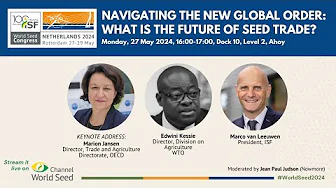
27/05 Navigating the new global order: What is the future of seed trade?"

The current shift in global trade dynamics, characterized by a move from multilateralism to a decentralized and fragmented structure, poses a challenge for seed trade given that seed interdependency is an ongoing reality. What, then, is the future of seed trade in this new context? What is the role of multilateral organizations like OECD and WTO in reshaping the landscape of international agricultural trade, including seeds? 
  • Marion Jansen, Director for Trade and Agriculture Directorate, OECD 
  • Edwini Kessie, Director, Agriculture and Commodity Division, WTO 
  • Marco van Leeuwen, ISF President; Managing Director, Rijk Zwaan

28/04 Unlocking the full potential of plant breeding innovation across frontiers

Genome editing in plant breeding shows promise in addressing global challenges in the food system transformation by enhancing seed resilience, productivity, and nutritional value. Despite its potential, the diverse regulatory approaches across frontiers create a complex and uncertain environment for researchers, farmers, and industry stakeholders, influencing the trajectory of innovation and the seed industry as a whole. This situation hinders international collaboration, potentially increasing compliance costs, and impeding the global trade of vital agricultural resources, affecting thereby food security and agricultural sustainability. Join speakers from the public and private sectors explore the multifaceted landscape surrounding genome-edited crops and food, addressing the scientific rationale and regulatory controversies that have influenced global discourse. How can we ensure that these innovations promote inclusivity, support farmers, and contribute to global food security without exacerbating existing inequalities and trade? 
  • Dan Jenkins, VP Regulatory Affairs, Pairwise - Klaus Berend, Director DG Health and Food Safety, EU commission 
  • Janet Talling, Head of Genetic Technology Policy, DEFRA, UK 
  • Alexandre Nepomuceno, General Head, EMPBRAPA Brazil 
  • Krista Thomas, VP Trade Policy, Seed Innovation, Canadian Grain Council 
  • Olalekan Akinbo, Technical Lead - Genome Editing Program, African Union Development Agency – NEPAD (AUDA-NEPAD) 
  • Moderator: Jean-Paul Judson, Nowmore

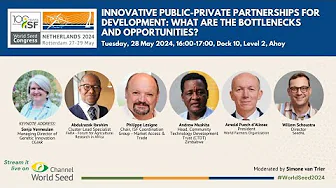
28/05 Innovative public-private partnerships for development

Seed sector development in the Global South has been on the agenda for decades, and several initiatives and programs have been put in place by a wide range of stakeholders from governments, private sector, and civil society. While there is improvement, the overall situation demands more attention in the face of challenges like a growing population, climate change, and the need for more sustainable solutions for agriculture. In all these efforts, the goal is clear: to improve the livelihoods of smallholder farmers by providing them with seed choice.

This panel analyzed what, among all the parallel initiatives in different parts of the world, has worked on the ground, what has not, and why. What more can be achieved together? 
  • Keynote Address: Sonja Vermeulen, Managing Director of Genetic Innovation, CGIAR 
  • Willem Schoustra, Director, Seed NL
  • Arnold Puech d'Alissac, President, World Farmers Organization -
  • Abdulrazak Ibrahim, Cluster Lead Specialist, FARA -
  • Andrew Mushita, Head, CTDT (Community Technology Development Trust) Zimbabwe 
  • Closing remarks: Philippe Lesigne, Chair ISF CG Market access and Trade 
  • Moderator: Simone van Trier


29/05 launch 'Science2Seed'! 

  • Johannes D. (J.D.) Rossouw, Bayer 
  • Ebunoluwa Ajobiewe, NGIN 
  •  Moderator: Gugulethu Mahlangu


29/05 Seeds4Food Coalition

 What is the Seeds for Food Coalition? How did it start and how has it grown into multi-stakeholder dialogues at national, regional and global levels? 
  • Andrew Mushita, Community Technology Development Trust Zimbabwe 
  • Morgan Nzwere, Seedco Zimbabwe 
  •  Moderator: Gigi Manicad


29/05 Seed Resilience project in Rwanda 

The ISF Seed Resilience project in Rwanda was launched in 2023 to establish local and more resilient food systems with quality seeds as the foundation. Find out what progress has been achieved so far, the lessons learned, and the next steps to look forward to in this project. 
  • Khaoula Belhaj Fragniere, International Seed Federation
  • Alon Haberfeld, Fair Planet 
  • Namuhoranye Innocent, National Seed Association of Rwanda - Jean Claude NIYOMUGABO, NGIN Moderator: Claire Taylor


Monday, March 25, 2024

Building food systems resilience for protracted food crises in the Horn of Africa

25 March 2024. Knowledge Agenda for building food systems resilience for protracted food crises in the
Horn of Africa
  • This Knowledge Agenda has been developed as part of the FNS-REPRO Learning Agenda by the Wageningen Centre for Development Innovation (WCDI) with knowledge partners across the Horn of Africa.
  • It is based on the framework provided by the Agenda Knowledge for Development which outlines the knowledge necessary to attain the Sustainable Development Goals with 12 Knowledge for Development Goals and 130 personal statements.
  • The proposed Knowledge Agenda for building food systems resilience for protracted food crises in the Horn of Africa is also based on academic and other literatures on knowledge management and food systems resilience in protracted crises.
  • This hybrid consultation is bringing together key stakeholders to further develop and validate this Knowledge Agenda.
  • Stakeholders: experts and community representatives from the Horn of Africa (Ethiopia, South Sudan, Sudan, Somalia/Somaliland), those interested in food systems transformation/resilience in protracted crisis, and experts in knowledge management for development.

Thursday, February 15, 2024

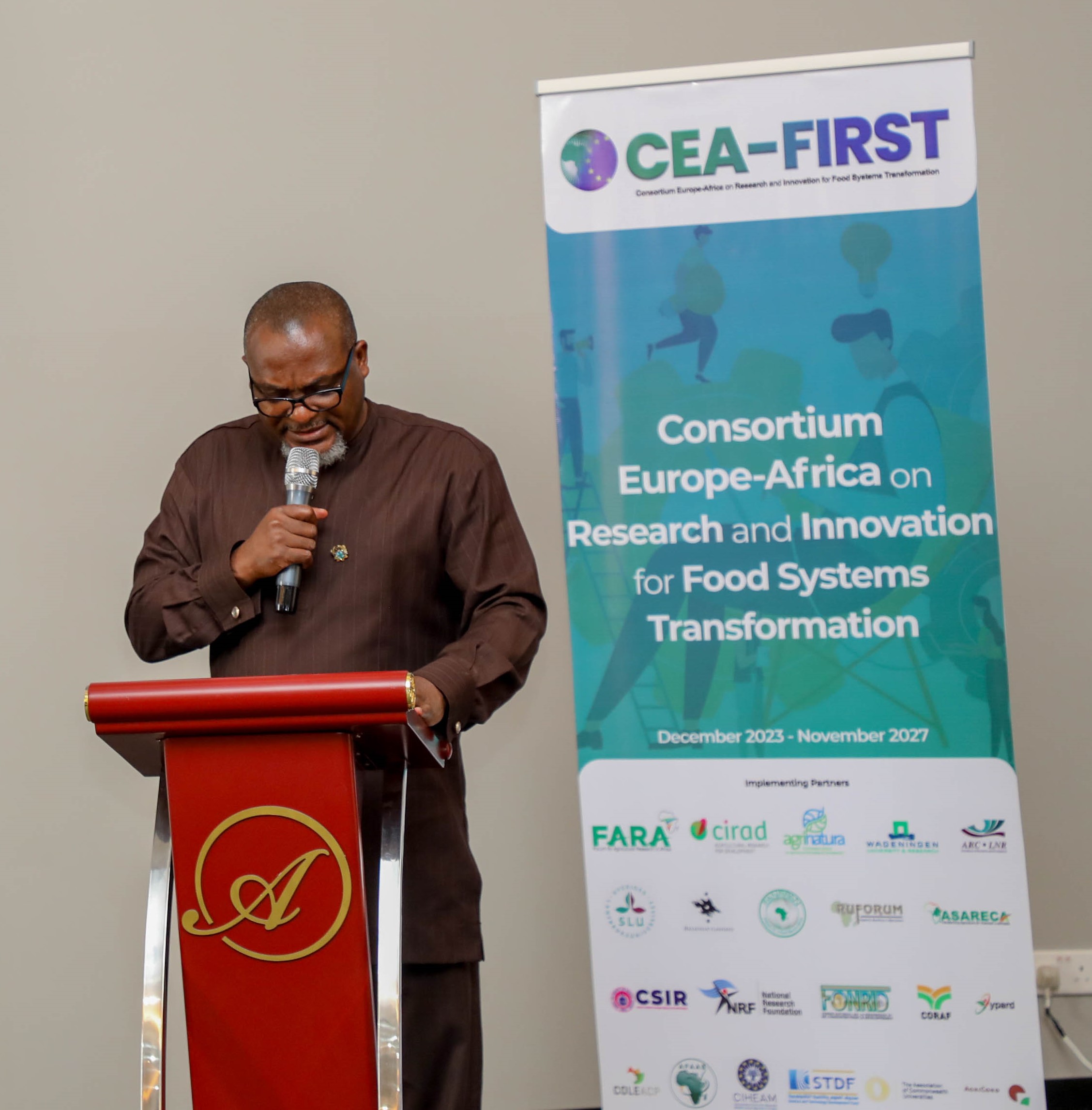
CEA-FIRST, the Consortium Europe Africa on Research and Innovation for Food Systems Transformation

12 - 14 February 2024.
 Accra, Ghana. 

The African Union and the European Union alongside a number of implementing partners have launched the Consortium Europe-Africa on Research and Innovation for Food Systems Transformation #CEA_FIRST Project.

  • CEA FIRST is funded by the European Union as part of the Green Deal’s “From Farm to Fork” strategy (Horizon Europe budget envelope). It forms a crucial part of the EU’s “Global Gateway” strategic vision, which aims to establish sustainable and reliable connections serving citizens and the planet. This vision addresses pressing global challenges, from combating climate change to enhancing the competitiveness and security of global supply chains, particularly in Africa.
  • The project brings together 22 partners from Europe and Africa covering a wide range of expertise and stakeholders (research, NGOs, donors, extension workers, etc.) involved in the field of food and nutritional security and sustainable agriculture. It consists partly from the former LEAP4FNSSA and PAEPARD, extended with new public and private network partners.

The main objectives of CEA-FIRST are as follows: 
  1. Providing public access to an extensive platform of knowledge in food and nutrition security and sustainable agriculture.
  2. Developing a robust methodology for analyzing Research and Innovation (R&I) activities and priorities.
  3. Supporting the update of the AU-EU R&I partnership roadmap.
  4. Establishing operational and thematic research working groups.

    * COLEAD leads the CEA-FIRST working group which focuses on fostering linkages and multi-stakeholder engagement in programmes and initiatives related to food and nutrition security and sustainable agriculture. Concurrently, COLEAD will co-lead efforts to strengthen the link between research, innovation, and their practical application
    .

  5. CEA-FIRST will facilitate connections between the IRC and the AU-EU high-level political dialogue.
  6. It will create a learning environment, including communication channels, to support multi stakeholder networks and to strengthen R&I coordination.
CEA-FIRST will operationalise the International Research Consortium (IRC) as a long-term platform on food and nutrition security and sustainable agriculture (FNSSA) in line with the FNSSA Roadmap of the AU-EU High-Level Policy Dialogue (HLPD).
  • The IRC is a member-based, multi-actor platform and will work towards increasing synergies andcoherence while reducing fragmentation and duplication of research efforts. Its aim is to promote higher returns on investments and impact on business development in Africa and Europe, by linking actors, research and innovation projects, initiatives, and funding programmes.
  • The final output will be a fully functional IRC. In the context of an essential transition in agri-food systems, compounded by the challenges of climate change and demographic shifts,
    the IRC is positioning itself as a vital tool for fostering an equitable and sustainable research and innovation partnership between Africa and Europe. This partnership focuses on bolstering agriculture as a key driver of economic development. 
  • The IRC will also serve related AU-EU policy priorities, such as the Climate Change and Sustainable Energy and the Innovation Agenda of the HLPD, as well as the European Green Deal priorities (and farm to fork strategy) and the AU priorities like the African Free Trade Area.

In his opening remarks to kick-off the International Research Consortium and the #CEA_FIRST Project, the Executive Director of FARA, Dr. Aggrey Agumya  recognized: "CEA-First represents a larger and far-reaching formation that promises to revolutionize the partnership and working arrangements between African and European institutions."


Participants

  1. Forum For Agricultural Research In Africa (FARA), Ghana (Coordinator)
  2. Centre For International Cooperation In Agronomic Research For DEVELOPMENT (CIRAD), France
  3. European Alliance On Agricultural Knowledge For Development (Agrinatura), France
  4. Stichting Wageningen Research (WUR), the Netherlands
  5. Agricultural Research Council Institute For Soil Climate And Water (ARC), South Africa
  6. Sveriges Lantbruksuniversitet (SLU), Sweden
  7. Helsingin Yliopisto (UH), Finland
  8. Food Agriculture And Natural Resources Policy Analysis Network (FANRPAN), South Africa
  9. Regional Universities Forum For Capacity Building In Agriculture (RUFORUM), Uganda
  10. Association Of Commonwealth Universities (ACU), United Kingdom
  11. The Registered Trustees of The Association for Strengthening Agricultural Research In Eastern
    And Central Africa (ASARECA), Uganda
  12. Council For Scientific And Industrial Research (CSIR), Ghana
  13. National Research Agency (ANR), France
  14. National Research Foundation (NRF), South Africa
  15. National Fund For Research And Innovation For Development (FONRID), Burkina Faso
  16. West And Central Africa Council For Agricultural Research And Development (CORAF), Senegal
  17. Young Professionals For Agricultural Development (YPARD), Germany
  18. Entrepreneurship-Agriculture-Development Liaison Committee (COLEAD), Switzerland
  19. African Forum For Agricultural Advisory Services (AFAAS), Uganda
  20. Agricord, Brussels Belgium
  21. Ciheam, Bari Italy
  22. Science, Technology And Innovation Funding Authority (STDF) Egypt

See also:

13/02 CNR Citinewsroom/Ghana Consortium Europe Africa on Research and Innovation for Food Systems Transformation project launched

The project brings together 22 partners from Europe and Africa covering a wide range of expertise and stakeholders (research, NGOs, donors, extension workers, etc.) involved in the field of food and nutritional security and sustainable agriculture. It consists partly on lessons from the former #PAEPARD initiative, to the LEAP4FNSSA and now extended with new public and private network partners.

Monday, February 12, 2024

Multi-Stakeholder Consultative Forum on COP28 Reflections and 2024 Strategy

12 - 13 February 2024. Multi-Stakeholder Consultative Forum on COP28 Reflections and 2024 Strategy - 37 TH AFRICA UNION SUMMIT SIDE-EVENT

The overall objective of the Multi-stakeholder Consultative Forum on COP28 Reflections and COP29 Strategy, held in conjunction with the thirty-seventh Assembly of the Heads of State and Government of the African Union, is to foster a unified and impactful African stance on climate action through the exchange of perspectives, the evaluation of progress and challenges faced in 2023,
and the formulation of strategic recommendations. This forum aims to enhance collaboration among African stakeholders, including delegates and political leaders, to effectively contribute to the global climate discourse and decision-making processes.

The Africa Adaptation Climate Justice (AACJ) program, supported by various partners and the Dutch Ministry of Foreign Affairs, aims to build strong, inclusive movements for climate justice across eight African countries.
 

Extracts of the programme

12/02 HIGH LEVEL OPENING STATEMENTS   

  • Dr. Mithika Mwenda, Executive Director, Pan African Climate Justice Alliance 
  • Dr. Kevin Kariuki, Vice President for Power, Energy, Climate and Green Growth, African Development Bank 
  • Dr. Nassim Oulmane, Director of the Technology, Climate Change and Natural Resources Management Division, UN Economic Commission for Africa 
  • H.E. Ambassador Josefa Sacko, Commissioner, Agriculture, Rural Development and Blue Economy, African Union Commission 

12/02 Session 3. a: Key outcomes on adaptation, Global Goal on Adaptation and Adaptation finance

  • + dedicated session of Health 

    For more details on the consultations in climate change and health, please visit ARIN Website www.arin-africa.org 
    The African Research and Impact Network (ARIN) is an impact platform that brings together a network of scholars and policymakers across Africa. Modeled as a network, ARIN seeks to leverage on the capabilities of African talented scholars in a flexible manner. ARIN’s core focus is to engage in peer learning and sharing good transformative research and impact practices. Areas of focus include natural resource management, climate change, agriculture, forestry, energy, water, and cities to leverage their knowledge and experiences in promoting research excellence and impact pathways.

12/02 Session 3.b: Key Outcomes on Loss and Damage  

  • Richard Sherman, Co-chair, Transitional committee on Loss and Damage 
  • Julius Ngoma, Coordinator, Civil Society Network on Climate Change, Malawi   
  • Mathewos Tulu, AU Liaison Office Coordination Officer (Head of Office) UNDRR  
  • Obed Koringo, Policy Advisor, Care International 
  • Yared Deme, World Resources Institute 
  • Mohapi Mpona Eusebia, Youth for Climate Justice ¡ Ayan Harare, Climate Justice Lead, Oxfam in Africa

13/02 Session 3.d: Key Outcomes on Mitigation and Just and orderly Transition (Energy, Transitioning away from fossil fuels)  

  • Caroline Tagwireyi, Senior Mitigation Officer, AUC-SEBE
  • Prof. Fadhel Kaboub, President, Global Institute of Sustainable Prosperity 
  • Thomas Opande, Energy Expert, WWF   
  • Eugene Nforngwa, Thematic Lead- Energy & Just Transition, African Coalition for Sustainable Energy and Access 
  • Elizabeth Chege, Energy Efficiency and Cooling Specialists, Sustainable Energy for All 
  • Dr. Dorsouma Alhamndou, Division Manager, Department of Climate Change and Green Growth, AfDB 

13/02 Session 3.e: Key Outcomes on Climate Finance 


13/02 Session 4.b: Critical Minerals - securing Africa’s interest in critical minerals sector


13/02 Session 4.b: Securing land and natural resource rights for climate resilient in the face of carbon markets 

  • Dr. Yemi Katerere, Independent Environmental and Policy Expert, African Civil Society Biodiversity Alliance 
  • Daisy Mukarakate, Regional Climate Policy Advisor, UNDP, Addis Ababa 
  • Emmanuel Siakilo, Senior Advisor; Climate Change-AUC ¡ Susan Otieno, Country Director, Action Aid International Kenya 
  • Grace Ananda, Policy and Advocacy Manager – Africa, Habitat for Humanity International ¡ Samante Anne, Programmes Manager, MPIDO


Wednesday, March 15, 2023

AgriFI and Team Europe Initiative ‘Investing in Young Businesses in Africa’

16 March 2023. The hybrid event ‘Effective partnerships between European implementers and Development Finance Institutions (DFIs): Bridging the financing gap in developing countries’
Join from the meeting link
https://ecconf.webex.com/ecconf/j.php?MTID=me7868c7159febf2dcb3bedfa46856040
Join by meeting number
Meeting number (access code): 2742 283 0089

This 1-day event aims to bring together different actors involved in technical and financial cooperation for an exchange of experience with a view of identifying important next steps towards effective partnerships between development cooperation agencies, DFIs and development banks in EUs contribution to the Addis-agenda and Agenda 2030.

During the event, opportunities will be given to have practical and honest discussions on how a relevant mix of technical and financial cooperation can best contribute to development impact in partner countries, in the frame of their efforts to design and develop their Integrated national financial frameworks (INFFs). 

Extract of the programme

13:45 – 15:30 Thematic session: Case nº5: AgriFI Country and Regional windows: A framework
to foster greater collaboration with technical assistance providers.

Presenting: Guillaume Simoes and Aude Sauvaget, EDFI MC. 

The AgriFI Country and Regional Windows which provides long term investment to SMEs and financial institutions with the aim to improve smallholders livelihoods will be presented. A focus on potential collaboration opportunities with technical assistance providers will be explored.

EDFI AgriFI is one of the EU development instruments aiming to invest in sustainable agriculture projects with high impact on smallholders. EDFI AgriFI is managed by EDFI MC, on behalf of the 15 bilateral development finance institutions.

The mission of EDFI AgriFI is to support smallholders on their path to commercial and sustainable farming, contributing to improve their livelihoods while aiming to unlock, accelerate and leverage investments in the agriculture sector. To achieve this, EDFI AgriFI supports SMEs, Financial Institutions and Impact Funds having a positive impact on smallholder farmers with long term investments (4 to 10 years) in the form of debt or equity participation (ticket size between EUR 1 million and EUR 5 million).

After the successful deployment of a global facility of EUR 40 million, through various long-term investments, EDFI AgriFI reinforced its partnership in 2022 with the European Union, including with some of its Delegations, closely working with partner countries and with the European DFIs. It will allow to provide additional long term financial offering to local agriculture value chains and smallholders in some specific geographies. 

The four dedicated new financing windows (Ghana, Sri Lanka, Tanzania and ACP) offer customised approaches designed to meet the needs of specific markets, in line with the strategy of the European Commission, the EU Green Deal and national programs in the targeted countries, to support development agenda and sustainable development goals, and stimulate inclusive growth, private sector and job creation.

In addition to provide access to long-term finance to private companies, EDFI AgriFI is now developing a technical assistance offer to leverage and enhance the impact of its investments. This TA offer provides a framework for collaboration opportunities with technical assistance providers in targeted geographies. 

Typically, EDFI AgriFI technical assistance will allow to provide partners with:
  • Specialist advisory services during due diligence and/or contractual phase;
  • Capacity building (training to farmers, support to certification, improvement of environmental and social standards, digitalisation, etc.);
  • Governance standards improvements;
  • Impact measurement studies.

13:45 – 15:30 Case no7: Team Europe Initiative ‘Investing in Young Businesses in Africa’ (TEI IYBA)


National coordination between implementing agencies, DFIs and PDBs, the example of The Agence Française de Développement (AFD) Group.

Presenting: Rima Le Coguic, Expertise France Deputy CEO, on behalf of AFD Group.

Presentation of the AFD Group, as an example of national coordination between implementing agencies, Development Finance Institutions (DFIs) and Public Development Banks (PDBs). The articulation between Proparco, Expertise France and AFD was presented, focusing on the challenges encountered and how to address them. (Expertise France joined the AFD Group on January 1, 2022)

The Invest in Young Businesses in Africa (IYBA) initiative was used as an example of such coordination between different actors. 
  • Read Team Europe Initiative Investing in Young Businesses in Africa: A quick overview # 5 p.
  • The Investing in Young Business in Africa (IYBA) initiative is a €4.6 billion fund to support young entrepreneurs, growing start-ups, and local and national entrepreneurial ecosystems in Africa. 
    • Value of programmes falling within the TEI IYBA EU: nine (9) EU Member States: Total €1.9 billion + EU: €2.7 billion. TOTAL: €4.6 billion
    • On the Team Europe side, nine (9) EU Member States: BE, DE, ES, FI, FR, IT, LU, NL, PT.
    • DG INTPA and several European development agencies are also putting together a new €20 million programme to strengthen the business ecosystem.
  • The Team Europe Initiative “Investing in Young Businesses in Africa” is made up of 3 building blocks:

    1) Increase the financial and technical support for pre-seed stage entrepreneurs and micro and small enterprises,
    2) Increase the finance for SMEs and entrepreneurs at seed and early stages, and
    3) Supporting the ecosystem, with a special emphasis on women and young people.


  • Aimed at extending financial and technical support at the early stages of those businesses’ development, it also tries to strengthen the ecosystem of organisations that support them, such as incubators and accelerators.
    • Senegal is the pilot country for this initiative: IYBA-SEED Senegal: Investing in Young Businesses in Africa - Supporting Entrepreneurship
      Ecosystem Development
       - Contributing to creating decent jobs and resilient economies by increasing access to financial resources and technical assistance of SEED beneficiaries through strengthened and sustainable entrepreneurial ecosystems. (Start date 30 December 2022 / End date 30 November 2026)
    • In December 2022 the Team Europe Initiative’s ‘Investing in Young Businesses in Africa’ (TEI IYBA) was launched in Nigeria. The Women Entrepreneurship for Africa (WE4A),  a constituent of the TEI IYBA, facilitated the session on the conditions where early-stage businesses and entrepreneurs in Sub-Saharan Africa could thrive, especially women and young people; also creating decent jobs for all. One example of a programme in Nigeria is a new €15 million agenda to improve the digital innovation ecosystem in Nigeria. While the EU and Germany are financing it, it will be implemented by GIZ.
    • Other countries are set to follow include Benin, Togo, Nigeria, Rwanda, Comoros, Kenya, and South Africa
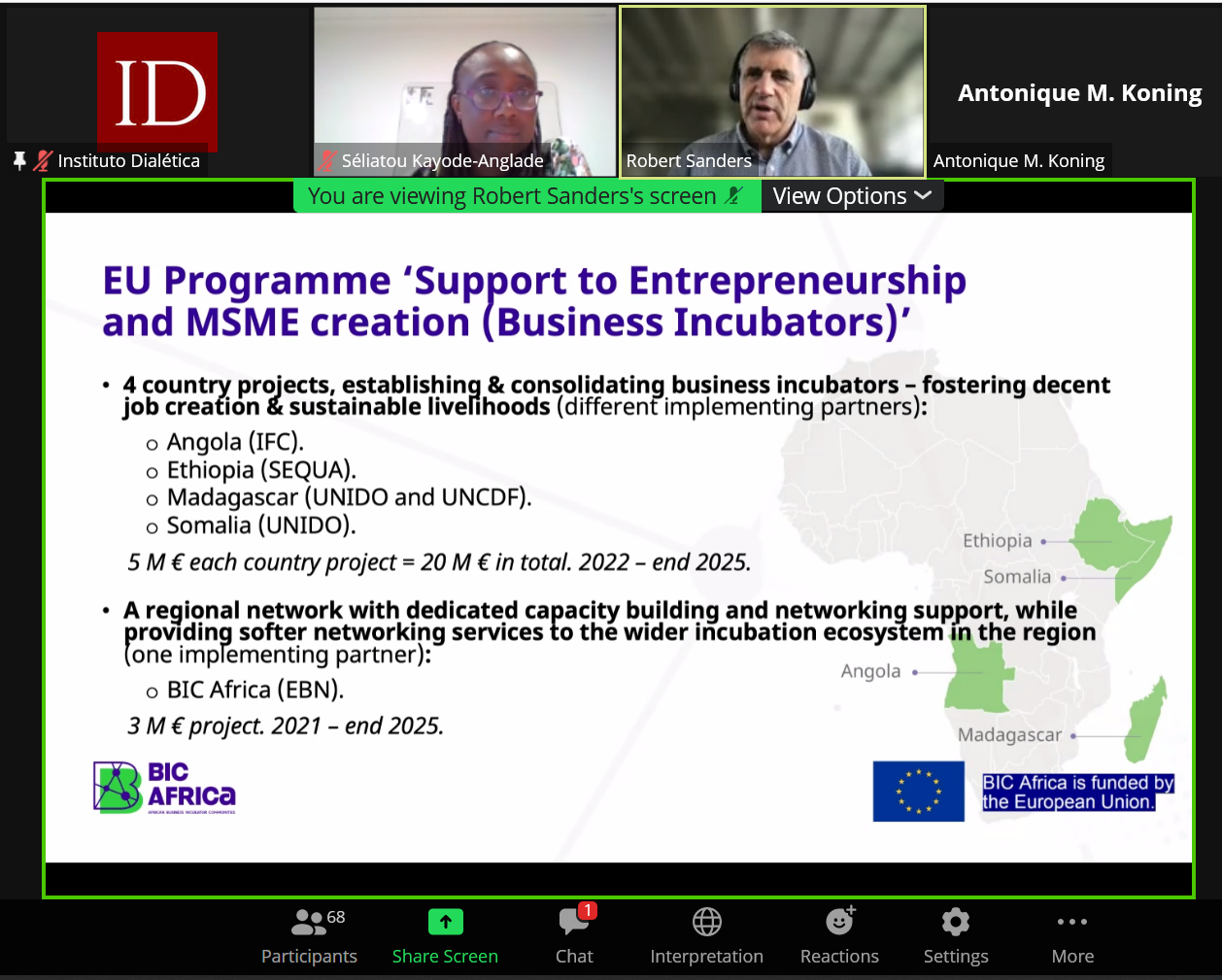
4th July 2022. Workshop Team Europe Initiative (TEI) Investing in Young Businesses in Africa (IYBA) Working Group on Ecosystem Development 

The event was chaired by Ms. Cécile Billaux Head of Unit E2 – Micro-economic Analysis, Investment Climate, Private Sector, Trade, Employment Directorate-General for International Partnerships (DG INTPA), European Commission

During the first part of the workshop, EU member state organisations (MSOs) (Expertise France, Enabel, GIZ, SlovakAid, SNV) presented the IYBA SEED components, with an emphasis on lessons learnt. The second part of the workshop focused on the regional perspective for ecosystem development where presentations from BIC Africa, UNCDF and the AfDB were made followed by an open discussion on how to connect different national ecosystems.


Tuesday, November 1, 2022

NL-CGIAR Conference Partnering for Global Food Security

2 - 3 November 2022. NL-CGIAR Conference Partnering for Global Food Security ‘Advancing knowledge and innovation for food system transformation’

NWO-WOTRO will celebrate the NL-CGIAR research programme and the partnerships within the programme with an online conference. 

The programme consists of three partnership instruments.
  1. Seed Systems Development (SSD) programme
  2. Senior Expert Programme (SEP)
  3. Public-Private Partnership-expert (PPP)

Two afternoons (from 12:00 CET) filled with a keynote speech by CGIAR’s global director of partnerships and advocacy Juan Lucas Restrepo, an interactive debate on the role of the private sector, a poster session and four thematic sessions will inform and inspire scientists, policy makers, and stakeholders from companies, public authorities and NGOs. With special attention to equality, partnerships, a systems approach and enabling & scaling, together we aim to understand, improve and transform food systems.

Wednesday 2 November

  • Wilma van Esch (Ministry of Foreign Affairs) 
  • Floor Boselie - Abbenhuis (Ministry of Agriculture, Nature and Food Quality);
  • Keynote speech by Juan Lucas Restrepo (CGIAR)
Panel conversation 
  • Namukolo Covic (CGIAR)

  • Elizabeth Swai (AKM Glitters ldt.) - Elizabeth Swai: A lesson in resilience

    Elizabeth Swai, 55, is a successful business woman and the managing director and majority shareholder of AKM Glitter Ltd, a major supplier of organic poultry and poultry products to over 20 regions in Tanzania. She founded the company in 2006 and has 70 full time employees. But life has not always been a bed of roses.

    Today, AKM Glitter is in the front seat of the poultry business in Tanzania and is one of few certified Kuroiler chicken breeders in the country. Kuroiler is a hybrid breed for both meat and eggs and can be reared in free range conditions since it is more resistant to diseases than the traditional free range breeds and has a yield of around 150 eggs per year.
    "We currently have in our service 20 veterinary doctors and 20 agriculture extension officers who provide training to farmers, and the vets also provide awareness to consumers who are small scale farmers,”
  • Jan Willem Nibbering (Dutch Embassy Burundi);
  • Emma Naluyima (One Acre Fund).
The synthesis study of the NL-CGIAR research programme brings together new knowledge and insights generated by the NL-CGIAR projects and experts. The study was conducted by Daniëlle de Winter and dr. Ellen Lammers in 2022. 

It addresses three key themes in food system thinking today:
  1. NWO (2022) The role of the public sector in food system transformation #29 p. + 1 page summary 
  2. NWO (2022) The diversity of smallholders in agri-food value chains, #25 p. + 1 page summary 
  3. NWO (2022) Public-private partnerships in international agricultural research.  #31 p. + 1 page summary 
The synthesis study resulted also in three short animations, highlighting key messages from the three synthesis papers
Three ‘Food Fight’ debates, in each of which two experts from the NL-CGIAR research programme act as the proponent and opponent of a provocative statement on global food security in relation to the three themes.


To be published soon: a reflection on the set up of the NL-CGIAR research programme and its instruments.

Panel: ‘Public Private Partnerships in agriculture for food security’ 
  • Sarah Cummings (WUR) 
  • Ken Giller (WUR);
  • Conny Almekinders (WUR) 
  • Erwin Bulte (WUR);

Thursday 3 November: Dialogue for global food security 

  1. Food systems for zero hunger
  2. Sustainable, inclusive and resilient agriculture
  3. Inclusive and resilient value chains and agribusiness
  4. Inclusive access to seed