

The events are particularly timely because they converge around the African Union's growing recognition of Farmer-Managed Seed Systems. They also reveal different perspectives on the future of African seed systems: while some initiatives emphasize integration between farmer-managed and formal seed sectors, civil-society movements increasingly stress farmers' rights to save, use, exchange and sell seed, the protection of indigenous knowledge and genetic resources, and farmers' participation in seed governance.
Latest AFS Kigali blogpost on seeds
3 September 2026. Interview with Isoulfou Kapran (Niger) Director of Seed Systems Group.
2 September 2026. AFS Kigali. Interview with Epaphras Milambwe KT Manager Tanzania.
2 September 2026. AFS Kigali. Interview with Dr. Taofeek Tope Adegboyega.
Scaling Opportunity Crops Through Policy, Partnerships, and Investment
2 September 2026. Scaling Opportunity Crops Through Policy, Partnerships, and Investment. Including Shorts of Dr. Wole Fatunbi, Ag. Director of Research and Innovation, FARA & Cristina Miranda Gozálvez, Head of Unit, European Commission – DG International Partnerships
2 September 2026. Scaling Opportunity Crops Through Policy, Partnerships, and Investment. Including Shorts of Dr. Wole Fatunbi, Ag. Director of Research and Innovation, FARA & Cristina Miranda Gozálvez, Head of Unit, European Commission – DG International Partnerships
1 September 2026. This session focused on how investment in diverse, underutilized and climate-resilient crops can strengthen Africa’s food systems. It moves beyond dependence on major staples such as maize, wheat and rice and examines opportunities around indigenous, nutritious and high-value crops.
1 September 2026. Organized by: Sight and Life, CIFF Sight and Life (SAL) work on fermentation
31 August 2026. “Power the Plate: Energy for Nutrition” . Affordable, reliable renewable energy is not simply an energy-sector issue but a prerequisite for productive, resilient and nutritious food systems.
AfricaVeg: Turning Africa’s Vegetable Diversity into a New Engine for Food, Nutrition and Investment
31 August 2026. AfricaVeg: African Seeds, African Solutions. Hosted by World Vegetable Center. AfricaVeg is a new public–private initiative led by the World Vegetable Center to strengthen Africa’s vegetable breeding and seed innovation ecosystem.
Main indigenous-seed and FMSS events in Africa in 2026
- January 2026 – Uganda–Kenya Community Seed Bank Learning Exchange, western Kenya
- 27 February–1 March – 6th Central African Farmers' Seed Fair (FOSPAC 6), Esse, Cameroon
- 2–4 June – 4th Pan-African Conference on Seed Governance and 4th Farmers' Seed Fair, N'Djamena, Chad
- June – Community Seed Banks in Humanitarian–Development–Peace Contexts Workshop, Addis Ababa, Ethiopia
- 21 June – Training on Production and Preservation of Farmer Seeds, Tizi-Ouzou, Algeria
- 9 July – Opening of the Mutiusinazita Community Seed Bank, Buhera, Zimbabwe
- 4–8 August – World Social Forum, Cotonou, Benin, including the Roundtable on Farmer-Managed Seed Systems in Africa
- 5–7 October – Inaugural African Union Africa Seed Summit, Mbabane, Eswatini
- 17–20 November – 1st Eastern Africa Indigenous Seed Conference, Nairobi, Kenya
- January – Farmers learning from community seed banks in Kenya
January 2026. The year began with a practical South-South learning exchange involving farmers from the Masindi and Hoima community seed banks in Uganda, who travelled to western Kenya to learn from the Kabudi-Agoro, Lower Nyando and Vihiga community seed banks.
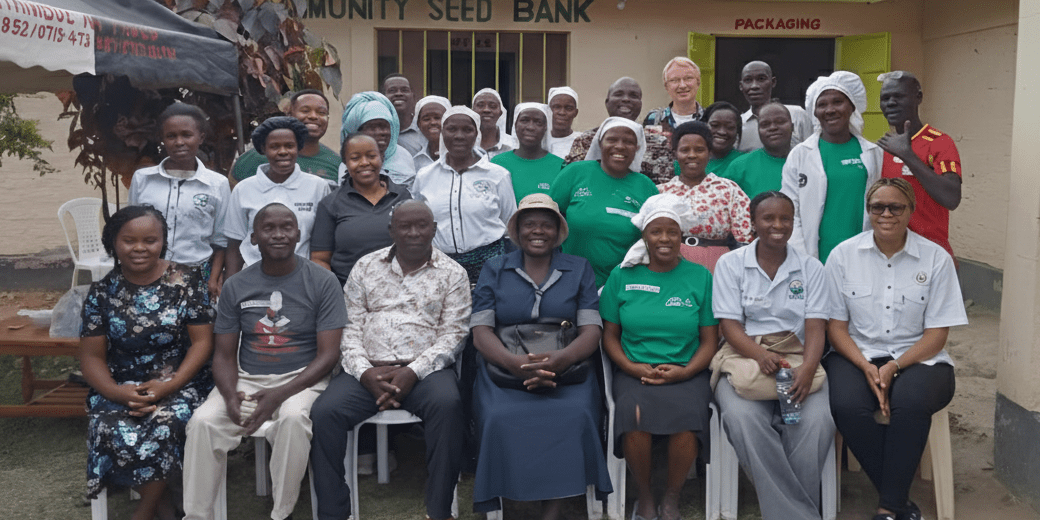
- The exchange formed part of the final workshop of a project on neglected and underutilized species (NUS), implemented with the Alliance of Bioversity International and CIAT and Seed Savers Network, with support from the Netherlands and the Benefit-Sharing Fund of the International Treaty on Plant Genetic Resources for Food and Agriculture.
- The exchange demonstrated that community seed banks can do considerably more than conserve seed. By connecting indigenous seed diversity with diversified farming, value addition, nutrition and cultural heritage, they can become local institutions supporting more resilient food systems.
- The experience is particularly relevant for neglected and underutilized crops, whose continued cultivation frequently depends on farmer-to-farmer seed exchange rather than commercial seed markets.
From 27 February to 1 March 2026, Esse in Cameroon hosted the 6th Central African Farmers' Seed Fair
(FOSPAC 6).
- Organized by the Network of Sustainable Development Actors (RADD), in partnership with the municipality of Esse and under the patronage of Cameroon's Ministry of Agriculture and Rural Development, the fair focused on community farmer-saved seed banks as instruments for safeguarding local genetic heritage.
- FOSPAC illustrates the importance of seed fairs as spaces where farmers are not merely recipients of improved varieties but seed producers, conservers and innovators.
- The 2026 edition also highlighted the potential role of municipalities in supporting community seed banks and linking local seed conservation with agroecology, food sovereignty and territorial development.

2–4 June 2026 in N'Djamena, Chad. A major milestone came with the 4th Pan-African Conference on Seed Governance, held alongside the fourth edition of the Farmers' Seed Fair.
- Convened by the Alliance for Food Sovereignty in Africa (AFSA), the conference brought together farmers' organizations, civil-society organizations, women and youth movements, academics, researchers, parliamentarians, local governments, regional institutions and development partners from across Africa.
- The meeting culminated in the N'Djamena Declaration – AFSA: “Africa's Seeds Belong to Its Peoples.” The Declaration calls for stronger recognition, protection and implementation of farmers' rights and seed sovereignty and places Farmer-Managed Seed Systems at the centre of Africa's food future. AFSA argues that FMSS remain the principal source of seed for millions of African farmers while facing pressure from restrictive seed legislation, corporate concentration and emerging digital technologies affecting genetic resources and associated knowledge.
- The N'Djamena meeting therefore represented an important shift from discussing indigenous seeds principally as genetic resources that need conserving towards addressing the political and governance dimensions of seed: who controls it, who establishes seed standards, whose varieties are recognized, and whether farmers retain the right to reproduce and exchange the seeds they have developed over generations.

- At a workshop in Addis Ababa, partners from Ethiopia, Somaliland, South Sudan and Uganda examined community seed banks through the Humanitarian–Development–Peace nexus.
- The experiences presented demonstrate that community seed banks can simultaneously conserve crop diversity, provide emergency seed following drought or conflict, support farmer seed enterprises and potentially strengthen cooperation between communities. Ethiopia, for example, was reported to have 43 community seed banks conserving more than 35 species and over 400 varieties.
- The discussion therefore broadened the role of FMSS: indigenous and farmer-managed seeds are not only biodiversity assets but can form part of local resilience and humanitarian seed-security strategies.
21 June 2026. Tizi-Ouzou Living Lab in Algeria. In North Africa, the Horizon Europe NATAE project organized a training session on “Production and Preservation of Farmer Seeds”
- The training covered production, selection, conservation and collective management of farmer
seeds, together with practical instruction on establishing and managing a community seed bank. - This event illustrates the connection between agroecological transition and seed diversity.
- Agroecology depends not only on farming practices but also on farmers having access to crop diversity adapted to local environments.
- Participants consequently expressed interest in creating a community seed bank to conserve the area's genetic heritage.
9 July 2026, Zimbabwe officially commissioned the Mutiusinazita Community Seed Bank in Buhera District. Supported by the Government of Zimbabwe and FAO through the Global Environment Facility-funded Dryland Sustainable Landscapes Impact Programme, the seed bank conserves locally adapted crops including sorghum, pearl millet, finger millet, bambara groundnut, cowpea and indigenous vegetables.
- The initiative demonstrates the close relationship between indigenous crops and climate resilience. Recurrent drought and erratic rainfall have threatened both harvests and farmers' capacity to retain sufficient locally adapted seed for subsequent seasons.
- The community seed bank consequently places farmers themselves at the centre of conserving agricultural biodiversity while connecting seed conservation with sustainable land management and climate-resilient agrifood systems.

- The World Social Forum in Cotonou, Benin provided a broader social-movement platform for the seed debate.
- The Roundtable on Farmer-Managed Seed Systems in Africa, co-organized by AFSA, Centre for Environmental Justice Togo, No REDD in Africa Network and Brot für die Welt, focused on safeguarding FMSS as a cornerstone of agroecology and food sovereignty.
- The roundtable connected seed quality and community seed systems with wider questions concerning GMOs, hybrid seeds, seed sovereignty and public policy. Its significance lies in taking the seed discussion beyond specialist agricultural institutions and placing it within wider debates about food sovereignty, agroecology, social justice and control over natural resources.
- See GFAiR interview with Omoniyi Françoise Agbodjo: "A new generation of researchers is emerging with a desire to promote agriculture in a different way. Farmers' seeds are an essential genetic, cultural, and nutritional heritage."
1 September 2026. AFS. Innovation Hub: Investing in Diverse Crops
- Different strands will converge at institutional level at the inaugural African Union Africa Seed Summit, scheduled for Under the theme “Resilient Seed Systems for a Food Secure Africa,” the Summit is especially significant because of the AU's work on a continental Farmer-Managed Seed Systems policy framework.
- The challenge will be to develop an African seed-sector vision capable of accommodating commercial and public breeding systems alongside farmer-managed systems, without undermining farmers' seed rights, local varieties, indigenous knowledge and the enormous diversity maintained outside formal seed markets.
19–30 October 2026 - Yerevan, Armenia. Seventeenth meeting of the Conference of the Parties to the Convention on Biological Diversity
- The year's indigenous-seed agenda will continue after the AU Summit with the 1st Eastern Africa Indigenous Seed Conference, scheduled for at the Catholic University of Eastern Africa in Nairobi, Kenya. Under the theme “Realizing the Right to Food through Seed Sovereignty,” the conference aims to establish and strengthen a regional Farmer-Managed Seed Systems Community of Practice.
- Its six thematic tracks demonstrate how much the seed agenda has expanded: Farmer-Managed Seed Systems in practice; seeds, climate change and resilience; gender equity and social inclusion; market innovations around FMSS; data sovereignty; and policy solutions for FMSS and seed sovereignty. Neglected and underutilized species and indigenous foods are explicitly included in discussions of markets and value addition.
Policy challenge for Africa
Taken together, the 2026 events reveal a remarkable progression. At community level, farmers are conserving, multiplying and exchanging indigenous seeds through community seed banks and seed fairs. At regional level, networks are exchanging experience and building Communities of Practice. At continental level, AFSA and other civil-society actors are advocating farmers' rights and seed sovereignty, while the African Union is bringing different actors together around the future of Africa's seed systems.
The sequence from Esse → N'Djamena → Cotonou → Mbabane → Nairobi is particularly significant.
- It connects community seed conservation with civil-society advocacy, continental policy and regional implementation.
- The N'Djamena Declaration provides a strong civil-society position before the AU Seed Summit; Cotonou places the debate within a wider food-sovereignty movement;
- the AU Summit provides an opportunity for institutional recognition;
- and the Nairobi conference can help translate continental debates into stronger farmer-managed networks and practices in Eastern Africa.
The policy challenge for Africa is therefore not simply how to supply farmers with more seed, but how to build a pluralistic seed system that recognizes farmers as seed producers, breeders, custodians of biodiversity and legitimate participants in seed governance.


No comments:
Post a Comment