
[see also 6 August: Roundtable on Farmer Managed Seed Systems in Africa]

From farmers’ organizations to a regional seed movement
The thesis places today's seed movement within the much longer history of West African farmers’ organizations. Successive droughts, structural adjustment, agricultural liberalization and regional integration contributed to the emergence and strengthening of farmer organizations and regional platforms. These organizations progressively acquired roles not only in agricultural production and services but also in negotiating prices, defending farmers’ interests and participating in agricultural policy processes. At the same time, new networks emerged around biodiversity, agroecology and food sovereignty, emphasizing farmers’ knowledge and locally managed crop diversity.
The farmers’ seed movement began taking shape before biodiversity became a central element of the agroecological transition debate. From around 2004, local farmers’ organizations and international associations were already advocating political recognition of farmers’ seeds as a strategic component of sustainable agriculture. These efforts eventually contributed to the establishment of the COASP in 2011. Since 2014, climate-change adaptation and growing interest in agricultural biodiversity have brought scientists, NGOs, policymakers and farmers into the debate, considerably expanding the network of actors concerned with farmers’ seed systems.
An important milestone identified in the thesis was the

became more than places for exchanging seeds: they helped connect farmers and organizations across national borders and stimulated the creation of national networks. Following the 2009 fair, participants were encouraged to organize in their respective countries and report back on the situation of farmers’ seeds. These connections also generated farmer-led research initiatives and political mobilization, illustrating how a seed fair could evolve into an instrument for regional collective action.
Seeds are more than agricultural inputs
One of the central messages emerging from the thesis is that farmers’ seeds occupy a fundamentally different position in the discourse of the movement than conventional agricultural inputs. COASP was established partly to defend farmers' freedom to produce, conserve and circulate their own seeds. Its founders associated farmers’ seeds with autonomy, food sovereignty and agricultural heritage. The emergence of COASP therefore represented a shift in the political framing of seeds: farmers’ seeds became simultaneously an agricultural resource, a heritage asset and an object around which rights could be claimed.
Yet the thesis highlights a striking paradox. Farmers’ seeds are considered crucial to West African food production, but they largely remain within what policy and legislation classify as the informal seed system, without the same legal status accorded to certified seed. This “legal invisibility” has important consequences, including reduced access to public support, and has itself become a major driver of farmer mobilization. The struggle therefore concerns not only conserving crop diversity but also who has the right to produce, reproduce, exchange and govern seed.
Many organizations, one cause—but different strategies
Since 2014, the political landscape around farmers’ seeds has become increasingly crowded. The thesis examines a network that includes

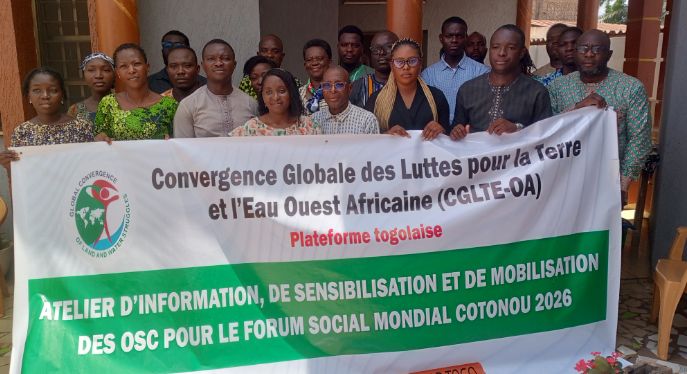
These organizations do not play identical roles. COASP is particularly rooted in farmers’ practices and the promotion and preservation of farmers’ seeds but has limited direct access to formal political arenas. COPAGEN and AFSA bring legal, scientific and policy expertise to advocacy. ROPPA has developed substantial institutional recognition and access to regional and international policymaking, while LVC-AO and CGLTE-AO mobilize farmers across borders and connect seeds to wider struggles over food sovereignty, land and natural resources.
This diversity is simultaneously a strength and a weakness. It creates an unusually rich combination of farmer knowledge, mobilization capacity, scientific expertise, legal advocacy and political connections. But organizations use different terminology, methods and approaches to in-situ seed management and sometimes pursue different political strategies. Consequently, alliances can strengthen the movement while disagreements and fragmented advocacy can slow collective progress towards formal recognition.
The thesis identifies an additional challenge: when farmers’ demands move from local movements into institutional policy arenas, they are frequently translated into broader policy languages such as biodiversity, agroecological transition or food security. This translation can facilitate access to policymakers, but it can also dilute the explicit demand for recognition of farmers’ seed systems and farmers’ rights over seeds.
The unresolved question: how should COASP organize its political voice?
The research therefore moves beyond documenting the movement and asks a practical question: how can COASP consolidate its leadership while obtaining greater political and institutional recognition? Within COASP itself, the thesis identifies tension between a more radical position that prioritizes local legitimacy and independence from institutions and a more pragmatic position that considers engagement and negotiation with research organizations and political institutions essential. The latter approach appears to be gaining ground, reflected in growing cooperation with research organizations, participation in agroecology platforms and engagement with other farmer organizations.
Rather than prescribing a single institutional solution, Agbodjo develops three scenarios for stronger collective action.
- The first scenario would establish a coalition between COASP, COPAGEN, CGLTE-AO, AFSA and LVC-AO, with COASP recognized as the principal voice on farmers’ seeds. Such a coalition could combine COASP's farmer-based technical expertise with AFSA's international advocacy, COPAGEN's legal and scientific expertise and the mobilizing capacity of LVC-AO and CGLTE-AO. It could
also allow participating organizations to pool technical and financial resources for advocacy. - The second scenario would build a more formal relationship between COASP and ROPPA, using ROPPA's established institutional position while allowing COASP to lead specialized advocacy on farmers’ seeds. The thesis stresses, however, that COASP would need to retain its identity and freedom of expression. Otherwise, institutional integration could result in co-optation or dilution of its farmer-based position. At its most ambitious, however, such cooperation could constitute an institutional innovation capable of advancing recognition of farmers’ seeds alongside conventional seed systems.
- The third scenario explores COASP seeking direct official recognition within West African political institutions, rather than relying primarily on another farmer platform to carry its voice. Together, the scenarios illustrate the central dilemma identified throughout the research: how can a farmer movement acquire greater institutional influence without losing the grassroots legitimacy that made it influential in the first place?
From seed diversity to the governance of food systems
The significance of this thesis extends beyond seed policy. The author connects farmers’ access to locally adapted seeds with food autonomy, resilience to international market disruption and climate change, and the rehabilitation of local resources, knowledge and foods. This makes the debate particularly relevant to current efforts to promote agroecology, indigenous and neglected crops, local food value chains and more diverse and resilient food systems.
The study ultimately shows that conserving agricultural biodiversity cannot be separated from the institutions and people who maintain that diversity. Seed diversity survives not simply because varieties are conserved, but because farmers continue to select, reproduce, exchange, experiment with and attach cultural and economic value to them. Recognition of farmers’ seeds is therefore also recognition of farmers as knowledge holders, innovators and actors in the governance of agricultural biodiversity.
The challenge ahead is consequently not merely to demonstrate the agronomic value of farmers’ varieties. It is to create governance arrangements through which farmer organizations, researchers, civil society and regional institutions can translate the considerable diversity of existing initiatives into a stronger collective political voice. As Agbodjo's thesis demonstrates, the future of farmers’ seeds in West Africa will depend as much on the governance of alliances as on the conservation of the seeds themselves.
Note Q & A session @34:22

Related:
Organizers: Switzerland SWISSAID European Union (European Commission – DG INTPA) International Fund for Agricultural Development (IFAD) Italian Agency for Development Cooperation (AICS) Alliance for Food Sovereignty in Africa (AFSA) Research Institute of Organic Agriculture (FiBL) Mediterranean Agronomic Institute of Bari (CIHEAM-Bari)


No comments:
Post a Comment