

Africa’s indigenous and neglected foods are increasingly being recognized not as relics of the past, but as strategic resources for the future. They can contribute simultaneously to healthier diets, biodiversity conservation, climate resilience, stronger local economies and culturally grounded food systems. Yet many of these foods continue to disappear from farms, markets, kitchens, schools and diets, taking with them traditional knowledge about how they are cultivated, prepared and used.
The GFAiR Collective Action on Forgotten Foods (CAFF) is responding by placing young people at the centre of efforts to rediscover, innovate around and create new opportunities from Africa’s food biodiversity.

A youth message from the World Social Forum 2026
This ambition gained momentum during the World Social Forum 2026, where GFAiR and The Food
Bridge vzw convened the side event “Growing the Food Future: Youth, Innovation and Indigenous Food Systems.”
Participants from from Benin, Gabon, Canada, Congo, France, Cameroon, Benin, Ghana, Nigeria, and other countries and several generations explored one central question: “How can young people transform forgotten foods into the foods of the future?”
The discussion showed that this transformation is already underway. Recipients of the 2025 CAFF grants presented concrete youth-led initiatives:
The discussion showed that this transformation is already underway. Recipients of the 2025 CAFF grants presented concrete youth-led initiatives:
- Chimezie Marvellous, Federal University of Technology, Owerri, described efforts connecting elders and young people to preserve Igbo food heritage in Imo State, Nigeria. The project "Connecting elders and young people to preserve Igbo food heritage" responds to the risk that indigenous foods may disappear together with the knowledge of how they are grown, prepared and valued: elders and other community knowledge holders serve as custodians of traditional food knowledge, while young people help carry this heritage forward and make it relevant to contemporary food systems.


- Israel Oyeyemi presented the youth-led Campus Food Heritage Hub helping young people rediscover forgotten vegetables. The initiative "CFF Agroschooling Project – Rediscovering Forgotten Vegetables" conducted awareness activities at the University of Ibadan, where students learned about the nutritional, cultural and environmental importance of indigenous vegetables and participated in documenting local species. Young people also received indigenous vegetable seeds and hands-on cultivation training, while a Campus Indigenous Food Festival and Cooking Competition, themed “Preserving Our Indigenous Food Heritage,” brought food knowledge into a more creative and experiential setting. Digital campaigns further promoted traditional vegetables, their recipes and nutritional value. The project covered species including amaranth (Efo Tètè), Corchorus (Ewedu), Malabar spinach (Amunututu), African wild lettuce (Yanrin), bitter leaf, fluted pumpkin (Ugu), waterleaf and several other underutilized vegetables. According to the project’s own reporting, it reached more than 100 students, strengthened youth skills through seed distribution and cultivation, encouraged student-led documentation of food knowledge, and fostered intergenerational learning. In this way, Oyeyemi’s initiative illustrates the CAFF approach of making forgotten foods relevant to a new generation by combining education, cultivation, food culture, documentation and digital communication rather than treating their conservation as a purely agricultural activity.
- Emmanuella Akumtu Cesar highlighted the nutritional potential of Bambara groundnut for young people’s diets. Her project, "Aboboe Revival: A School Farm for Nutrition, Skills and Indigenous Crop Heritage" is located in Korm M/A Basic School, a highly underserved school in Ghana's Eastern Region. This initiative showcases the transformative potential of school farms. Beyond producing food, the project promotes better nutrition, preserves indigenous crops and equips young people with valuable agricultural knowledge and practical skills. Many children depend on school meals as their primary source of daily nutrition, yet the budget allocated for school feeding is only about 2 cedis per child per meal—less than €0.20. Providing nutritious meals under such constraints is incredibly challenging. (see also: From Ghana to Benin: The Journey Begins)
- Joel Teye shared work around indigenous bean species and their reintroduction to consumers in Ghana’s Krobo area. Farming organically within a biodiversity-rich ecosystem presents unique challenges, including adjusting planting schedules to accommodate wildlife migration patterns. To sustain his farms, Joel has also adopted an innovative approach. Alongside the indigenous beans, he cultivates Chinese vegetables for Chinese shops and consumers in the Tema area, creating a reliable income stream. According to him, with the challenge of youth unemployment and a large family, farming offers him the income he needs. His work demonstrates how entrepreneurship and cultural preservation can successfully go hand in hand. (see also: Collective Action on Forgotten Foods (CAFF) mission to Ghana)
- Oluwaferanmi Olatilo presented her wider work on agrobiodiversity and Slow Food Nigeria’s Ark of Taste. Her activities reconnect Nigerian schoolchildren with indigenous foods, food traditions and agricultural biodiversity, responding to the disappearance of nutritious traditional foods and young people’s growing disconnection from food heritage.


Turning the declaration into action
The declaration identifies a practical agenda for governments, research and educational institutions,
development partners, civil society, businesses and food movements.
- It calls for indigenous foods to be integrated into education, school gardens and nutrition and culinary learning; for mentorship linking youth with elders, farmers, Indigenous and local communities, researchers, chefs and entrepreneurs; and for greater investment in community seed systems and neglected crop cultivation. It also emphasizes moving beyond conservation towards value creation, through processing technologies, food safety, packaging, certification and quality standards.
- Markets and entrepreneurship are equally important. Public procurement, schools, restaurants and food businesses can create demand for forgotten foods, while young entrepreneurs need grants, finance, incubation, equipment, technical training and market connections. Festivals, digital storytelling and culinary events can make indigenous foods visible and desirable to younger consumers. At policy level, the declaration calls for food sovereignty, agroecology and indigenous foods to be incorporated across agriculture, nutrition, education, biodiversity, climate, trade and rural-development policies.


Cultivating Africa’s next generation of biodiversity leaders
Building on these priorities, CAFF is developing
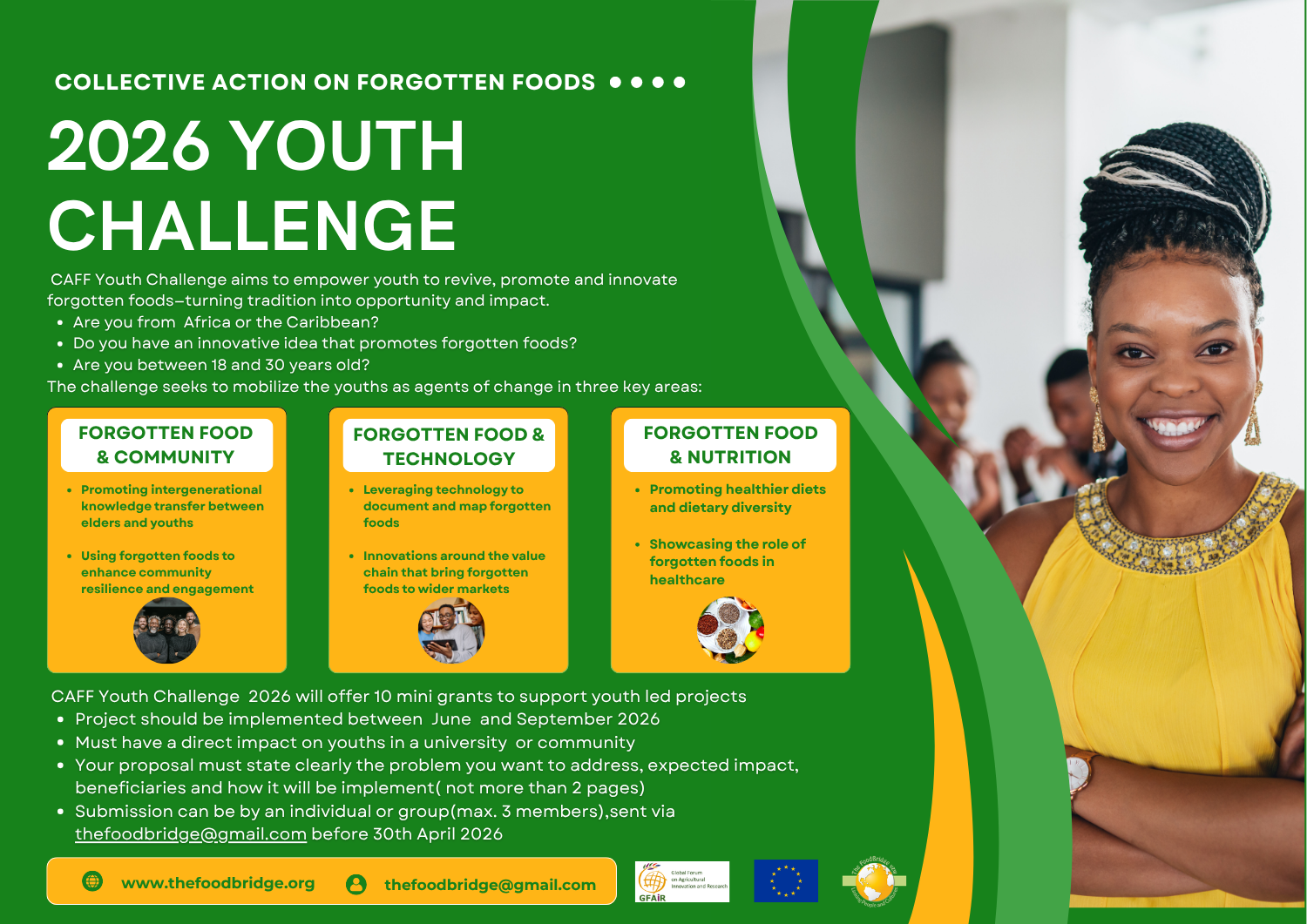
The initiative is conceived as a leadership and innovation academy for young entrepreneurs, researchers, students, farmers and community advocates working to restore indigenous foods, biodiversity and food sovereignty. Its premise is that young people and women are already innovating around indigenous foods but need stronger access to mentorship, research partnerships, finance and leadership opportunities.
The 2026 CAFF Youth Challenge targeted young people aged 18–30 from Africa and the Caribbean, with projects to be implemented on university campuses or in semi-urban communities; selected participants receive mentorship, capacity building and a project grant.
The first five selected projects (for 2026) are:
- Dalis Favour Apollos, Gwomshar Initiative. ROOTS & REVIVAL: A Youth-Led Forgotten Foods Initiative in Plateau State, North-Central Nigeria
- Wisdom Kofi, with Philomena Blankson (Nutritionist, GIMPA) and Kwame Asante (Food Technologist). From Farm to Feast: Reviving Ghana's Forgotten Grains and Leafy Foods Among Urban Youths
- Damaris Adhiambo Adoyo & Quinter Aoko Ogwonyo, School of Environmental Sciences, Department of Community Development, Pwani University. Revitalizing Seaweed as a Nutritional Powerhouse in Kwale County, Kenya
- Enongene Beltin Epie, Youth Environmental & Community Development Advocate, Cameroon. ROOTS REVIVAL: Youth-Elder Action for Forgotten Foods and Community Resilience
- Suzan Amoit, Makerere University, Uganda. Reviving Forgotten Foods: A Youth-Led Innovation for Orphan Crops

The the side events was structured around five complementary pillars:
- Rediscover Africa’s biodiversity and indigenous knowledge;
- Innovate through new products and value chains;
- Lead through advocacy and leadership;
- Collaborate across sectors;
- Transform food systems through collective action on green entrepreneurship and indigenous-food business innovation to branding Africa’s biodiversity, linking research with community innovation, financing nature-based enterprises, accessing diaspora markets and building collective action for Africa’s food future.
From biodiversity conservation to economic opportunity

A particularly important dimension is connecting conservation with livelihoods. CAFF envisages young entrepreneurs learning how to develop sustainable enterprises from indigenous crops, improve processing and competitiveness, build compelling brands around Africa’s food heritage and connect with researchers and investors. Diaspora markets and international opportunities are also part of this approach, alongside financing through grants, investment, crowdfunding and other business-support mechanisms.
This reflects one of the strongest messages emerging from the youth declaration:
Food heritage must create opportunity. Conservation is unlikely to be sustainable if young people cannot see viable futures and decent livelihoods within it. Indigenous foods therefore need to connect biodiversity conservation with education, research, nutrition, entrepreneurship and markets.
A vision for 2030
The youth declaration ultimately looks towards 2030, envisioning indigenous African foods becoming integral to diets, economies and food systems rather than remaining at their margins. It imagines schools, farms, markets and restaurants where these foods are grown, taught, consumed and valued; young people leading enterprises and innovation; and research and policy recognizing their nutritional, ecological, cultural and economic potential. It also envisages Africa developing the capacity to process, certify and export safe, high-quality indigenous food products, generating livelihoods and economic opportunities for communities and young people.
The CAFF youth challenge provides a pathway for translating that vision into a longer-term movement.

- Participants at the side event discussed practical entrepreneurial and leadership skills, stronger biodiversity stewardship, research and investment partnerships, improved value-addition and advocacy capabilities, business growth plans and membership in a regional Forgotten Foods Youth Network.
- The longer-term ambition is a continental movement of young biodiversity champions capable of turning forgotten foods into engines of nutrition, biodiversity conservation, climate resilience, decent employment and food sovereignty.

is about repositioning indigenous foods as part of Africa’s future and equipping a generation capable of doing so. As the Youth Declaration concludes, the challenge is to move from remembering forgotten foods to rebuilding their place in food systems—allowing the knowledge of the past to inform the innovations of the future and enabling young people not merely to inherit food systems, but to transform them.


No comments:
Post a Comment