
.png)
This webinar organised under the Farmer-led Research and Innovation (FO-led R&I or FO-RI) programme promoted a shared understanding and practical exchanges on agroecology to support the agroecological transition led by farmers’ organisations.
- From EU Policy to field action: The EU Operational Guide on Agroecology. Key principles and guidance from the EU Operational Guide and its relevance for farmer-led research and innovation.
- Farmers’ Organisations as drivers of agroecological transition: PAFO’s advocacy strategy on agroecology and the strategic role of continental and national farmers’ organisations.
- Enabling agroecology in practice: Constraints to organic input production. Technical and systemic barriers to producing organic inputs and implications for scaling agroecological practices.
Speakers:
- Katja Vuori - CEO, AgriCord
- Marion Michaud - Policy Officer, DG-INTPA
- Schadrack Seneza - M&E officer Pan African Farmers’ Organization (PAFO)
- Sheila Chebichii Kosgei - Agribusiness Coordinator, Cereal Growers Association (CGA)
- Dr. Babafemi Oyewole, CEO of PAFO
- Moderated by Martin Agboton, FORI Program Manager, AgriCord
Resource
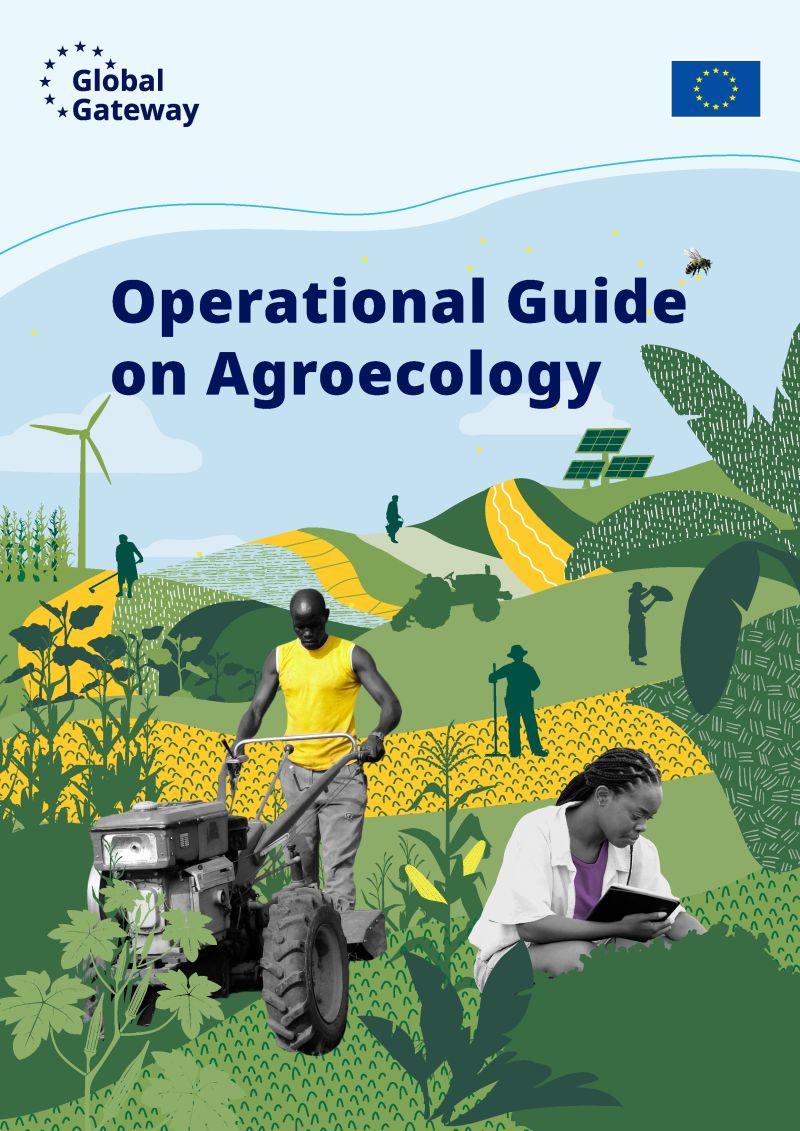
Chapter 1 – Agroecology: Definitions and Guidance.
This chapter introduces agroecology as a concept that has evolved from a scientific discipline into a holistic approach to food systems. It recounts the origins of agroecology, its broadened scope encompassing ecological, social, and cultural dimensions, and the current positions of key actors - research institutions, civil society, governments, and international organisations. The chapter highlights that agroecology aims to transform food systems by grounding agricultural practices in ecological processes, local knowledge, and equity. It also emphasises growing institutional recognition, including within EU development policy frameworks.
Chapter 2 – Reference Framework on Agroecology.
The guide then presents a structured conceptual foundation for agroecology, describing it as a paradigm shift towards systemic thinking. Central to this framework are the 13 HLPE principles, aligned with the 10 FAO elements, which together define the ecological, economic, social, and governance dimensions of agroecology. The chapter details each principle—such as diversity, synergies, recycling, responsible governance, and co-creation of knowledge—and identifies practices not compatible with agroecology, including input-intensive monocultures and measures undermining farmer-managed seed systems. It also analyses related approaches (e.g., climate-smart agriculture, conservation agriculture), showing their points of convergence and divergence with agroecological principles.
Chapter 3 – Agroecology and Major Global Challenges.
This chapter explains how agroecology provides practical, evidence-based responses to global challenges such as climate change, food insecurity, low farmer incomes, gender inequality, biodiversity loss, nutrition and health issues, water crises, and territorial management. For climate, agroecology increases vegetation cover, restores degraded land, strengthens water and nutrient cycles, and promotes carbon sequestration through agroforestry and organic fertilisation. For food security and income, it supports diversified production systems and reduces dependence on external inputs. Agroecology also advances gender equality, protects biodiversity through diversified landscapes and reduced synthetic inputs, improves nutrition through diversified diets, and supports sustainable water management. The chapter also underscores the role of territorial approaches, such as shared resource management, local governance, and inclusive participation.
Chapter 4 – Integration of Agroecology in Programming.
This section provides guidance for incorporating agroecology into EU multiannual programming processes, especially under the NDICI (Neighbourhood, Development and International Cooperation Instrument. Certain quantified objectives of the NDICI are aligned with some key principles of the agroecological approach. In the current Multiannual Financial Framework (2021-2027).
Chapter 5 – Political Dialogue and Building a Case for Agroecology.
Here, the guide emphasises the importance of multi-stakeholder political dialogue with national, regional, and local authorities to advance agroecological transitions. It provides arguments demonstrating agroecology’s advantages: economic resilience, climate adaptation, biodiversity restoration, improved nutrition, and reduced input dependency. The chapter also recommends developing incentive mechanisms, including repurposing subsidies away from synthetic-input agriculture, creating financial incentives for agroecological innovation, and using public procurement to support agroecological production.
Chapter 6 – Possible Interventions by Type of Actor.
This chapter outlines concrete actions for different stakeholders: strengthening farmers’ capacity for innovation, improving advisory services through participatory and co-creation-based approaches, supporting value chain actors to enhance access to inclusive markets, promoting action-research, updating academic and vocational training curricula to incorporate agroecology, and assisting ministries in developing public policies that enable agroecological transitions.
Chapter 7 – Topics of Intervention.
Building on Chapter 3, this section proposes practical activities to operationalise agroecology in areas such as climate change, food security, gender, biodiversity, value chains, nutrition, water, and territorial approaches. Examples include crop diversification, support for seed systems, soil carbon sequestration practices, water-efficient irrigation technologies, anti-erosion measures, and co-created advisory services. These activities illustrate how agroecological principles can be translated into concrete interventions.
Chapter 8 – Examples of Contextualised Interventions.
This chapter provides examples demonstrating how agroecological initiatives have been adapted to specific regional and socio-economic contexts, showing the diversity of pathways and the importance of local relevance in successful transitions.
Chapter 9 – Evaluation Methodologies.
The guide reviews a suite of evaluation tools, including TAPE, the Agroecology Criteria Tool (ACT), Business Agroecology Criteria Tool (B-ACT), the AE Assessment Framework, and EFA+—used to assess agroecology at farm, project, enterprise, policy, or territorial level. These tools measure environmental, social, economic, nutritional, and governance dimensions and support evidence-based decision-making throughout project cycles.
Chapter 10 – Developing a Logical Framework.
The final chapter offers guidance for designing logical frameworks compatible with agroecology, including indicators and examples that reflect the multi-dimensional nature of agroecological transitions. It stresses ensuring coherence between objectives, results, and monitoring systems while respecting agroecological principles.


No comments:
Post a Comment