A G R I C U L T U R E
Agropolis Foundation (France) and CAPES (Brazil)
Agropolis and CAPES invite French/Brazilian research related to agricultural crops and food systems. Themes include plant genetics, pests and diseases, agri-environmental innovations, and others. Proposals that involve African participation will be considered. Proposals should be submitted in English before 17 September 2010.
U.S. National Science Foundation and Gates Foundation -- BREAD
The National Science Foundation, in partnership with the Bill and Melinda Gates Foundation, invites proposals under BREAD (Basic Research to Enable Agricultural Development). Proposals should address major constraints that limit the productivity of crops important to smallholder farmers in developing countries. International collaboration with the developing countries is encouraged, but the principal investigator must hold an appointment in the USA. Letters of intent are due 16 September 2010.
InnoCentive -- Access and Affordability of Fertilizers in Africa
InnoCentive offers cash prizes for solutions to worldwide challenges, including how to make NPK fertilizer more affordable for small-hold farmers in Sub-Saharan Africa. The award is US$20 thousand, and the closing date is 26 September 2010.
Rothamsted International -- October 2010
Rothamsted International offers one-year grants for senior researchers in developing countries to work with British researchers at Rothamsted in agricultural sciences. Next deadline for applications is 22 October 2010.
Orskov Foundation -- Small Grants for Agriculture
Orskov makes grants of up to £2,500 to support agriculture in developing countries. One category of grants supports university students in agricultural studies related to poverty alleviation and environmental sustainabilty. The second category of grants is for community-based agriculture on a revolving-fund basis. Application deadline is 31 January of each year.
Scholarship for plant breeders
The African Centre for Crop Improvement (ACCI) in Durban, South Africa, is inviting applications for its PhD scholarship in plant breeding. The programme is reserved for students from Ethiopia, Rwanda, Uganda, Kenya, Tanzania, Zambia, Mozambique, Namibia, Malawi and South Africa, whose research interests include cereals, roots and tubers, and legumes. Applicants must have a master's in plant breeding, plant genetics, plant pathology, crop science or horticultural science, be below the age of 40 and be employed as an agricultural research scientist in a national agricultural research institution or a non-governmental organisation, or as a university lecturer.
The future of agriculture in the Nile Basin
Scientists have until 31 October 2010 to submit their abstracts for a conference on agriculture in the Nile Basin, which will be held in Egypt next year.
B I O D I V E R S I T Y
French Foundation for Research on Biodiversity (FRB) -- Global Change and Biodiversity
FRB invites proposals to model scenarios of global change, biodiversity, ecosystem services, and public policy. Provided that some French territories are included, proposals may cover large regional and continental scales. Projects that focus on developing and emerging countries are particularly encouraged. Proposals (full projects, pre-projects, and expressions of interest) are due 13 October 2010.
Bioversity International -- Agricultural Genetic Resources 2011
Bioversity International announces the Vavilov-Frankel fellowships for 2011. Up to two grants of US$20 thousand each will support young researchers in themes of conserving and using genetic resources in agriculture. Proposals are invited from researchers in low and middle-income countries who are under age 35. Closing date is 07 November 2010.
World Wide Fund For Nature (WWF) -- Prince Bernhard Study Grants 2011
WWF announces the 2011 Prince Bernhard Scholarships to fund mid-career training of individuals working in conservation or disciplines directly relevant to conservation. Eligibility extends to nationals from Africa (including Madagascar); Asia and Pacific; Latin America and Caribbean; Eastern Europe; and the Middle East. WWF gives preference to applicants seeking support for studies in their own country or region. Maximum grant amount is CHF 10 thousand. Applications (English, French, Spanish) are due be 11 January 2011.
Global Biodiversity Information Network (GBIF) -- Young Researchers Award 2010
The GBIF invites university graduate students to apply for its Young Researcher awards in biodiversity informatics. GBIF comprises 54 countries and 44 international organizations. Two awards of €4 thousand each are available in 2010, the first year of the awards. Application deadline is 15 September 2010.
Fellowships for researchers who want to protect the environment
Germany's state-run Alexander von Humboldt Foundation has announced the start of its 2010 international climate protection fellowships. The programme, which targets future leaders from developing countries, allows applicants to conduct a research-related project of their own choice during a one-year stay in Germany. Applicants must have completed their first university degree (a bachelor's degree or its equivalent) less than 12 years ago. They must also hold further academic or professional qualifications (such as a master's degree, PhD, LLM or MBA) or have extensive professional experience in a leadership role.
First Peoples Worldwide -- Keepers of the Earth Fund
First Peoples offers grants for the support of indigenous organizations worldwide. Grants frequently include aspects of protecting and managing natural resources and environment (including climate change). Grants through the Keepers of the Earth Fund range from US$250 to US$20 thousand. Application information is in English, French, and Spanish. Annual application deadline is 30 September.
Whitley Fund for Nature -- 2011 Awards are Open
The Whitley Fund makes grants for grass-roots conservation projects in developing countries. The grants are to nationals in eligible countries who lead pragmatic projects that combine conservation and long-term sustainability. Whitley Awards are £30,000 each; the Whitley Gold Award is £60,000. Application deadline is 31 October 2010.
Royal Geographical Society -- Application Deadlines January 2011
The RGS funds British students and researchers for international studies and projects, including many in ecology and environment in the developing world. The RGS-IBG fieldwork grants, and several categories of research grants, have deadlines on 21 January and 28 January 2011.
Birdfair/RSPB Research on Endangered Birds
The British Birdwatching Fair (Birdfair) and the Royal Society for the Protection of Birds (RSPB) jointly provide grants of up to US$2 thousand for research on endangered birds (IUCN's red list). Priority is for researchers working in their own countries, particularly in collaboration with BirdLife partners. Closing date is 30 November 2010.
World Conservation Union (IUCN) -- Central African Regional Program for the Environment
IUCN-CARPE makes small grants to civil society for sustainable forest conservation in Central Africa. Application deadlines are 31 January and 30 June 2011.
International Osprey Foundation -- Small Grants for Research
The International Osprey Foundation makes grants of US$1,000 to individuals engaged in research of ospreys, other raptors, or environmental research on wildlife and birds in general. Many past grants have been awarded for projects in the developing countries. Closing date for applications is 31 January each year.
Garden Club of America -- Grants for Students
The GCA offers grants, prizes, and fellowships for students enrolled at U.S. universities, including some awards that have a tropical focus. Most grants do not have nationality restrictions. The Awards in Tropical Botany are offered in partnership with WWF (application deadline is 15 January). The Chatham Fellowship in Medicinal Botany is in partnership with the Missouri Botanical Garden (deadline is 15 January). GCA also offers the Lou McCandless Marks Scholarship in Tropical Horticulture (deadline is 01 February 2011).
African Bird Club -- Small Grants
The ABC Conservation Awards (up to £1,000) support small and medium-sized bird conservation projects in Africa. Applicants should be resident in Africa. The ABC Expedition Awards (up to £1,500) take place within continental Africa or adjacent islands, with a strong base in conservation and birds. Applications for both programs are due before the end of February 2011, June 2011, and October 2011.
U.S. Agency for International Development (USAID) -- Energy
USAID will make two grants of up to US$2.5 million each in support of its Energy Efficiency and Renewable Energy Program (EEREP). Themes are reducing greenhouse gas emissions, and increasing renewable energies, in developing countries. Unrestricted eligibility. Funding Opportunity RFA-OAA-10-000009. Application deadline is 10 September 2010.
C L I M A T E C H A N G E
German Education Ministry -- Climate Change and Developing Countries
The German Education Ministry (BMBF) funds CLIENT -- “International Partnerships for Sustainable Technologies and Services for Climate Protection and the Environment." CLIENT makes grants for German research in collaboration with partners in Brazil, Russia, India, China, South Africa, and Vietnam. Priorities in CLIENT are climate protection, resource efficiency, land management, and water management. In the first phase of applications, the German partner sends a detailed project outline to BMBF before 31 August 2010.
International Development Research Center -- Graduate Research on Climate Change and Water
Canada's IDRC invites applications for research grants on climate change and water in 2010-2011. Applicants must be citizens of developing countries enrolled for masters or PhD studies at universities in Canada or developing countries. Applications are accepted in English or French before 15 October 2010.
A Q U A C U L T U R E
U.S. Fish and Wildlife Service -- African Wildlife Conservation
Grants for wildlife conservation and management in Africa. Open to government agencies, nonprofit organizations, educational institutions, private-sector entities, and individuals. Proposal deadline is 01 March each year.
PADI Foundation -- Grants for Marine Conservation
The PADI Foundation invites applications for its worldwide grants in underwater science, environmental projects, and education. Most grants are US$5 thousand to US$10 thousand. Applicants include many for projects in tropical regions. Applications will be accepted from 11 December 2010 through 31 January 2011.
Intergovernmental Oceanographic Commission (IOC) -- Support for African Marine Science
The IOC (of UNESCO) will support 12 young African marine scientists to address ocean and coastal adaptation to climate change. Information about the opportunity is available in English, French, and Portuguese. Closing date is 14 September 2010.
Scholarships available for hydrological and energy scientists
The African Union (AU) is inviting postgraduate students to apply for a variety of water and energy scholarships. The Mwalimu Nyerere African Union scholarship scheme is reserved for students wishing to pursue a master's or PhD in water or energy sciences, climate change and education planning. The application deadline is 30 September 2010.

Thursday, August 19, 2010


Thursday, August 12, 2010
Japan Sponsors Rice Research Hub in East Africa
6 August 2010 | EN SciDev Net

Japan's initiative aims to develop superior strains of rice in Uganda
Flickr/IRRI Images
Uganda hopes to become the region's leader in rice research with the opening later this year of a US$6 million centre at its crop research institute.
The National Crop Resources Research Institute (NACRRI) received the money from Japan in September last year for the construction of a training and research centre for rice farmers and scientists, which is now nearing completion.
The centre will promote North-South collaboration in research and technology transfer, said Geoffrey Asea, head of the cereal department at NACRRI, and "will be fully operational by December".
The investment is part of Japan's attempt to position itself as a strategic business partner to East African countries by investing in a range of infrastructure, food production and trade projects under the Tokyo International Conference on African Development (TICAD IV) initiative.
On the TICAD IV platform Japan launched the Coalition for African Rice Development initiative whose goal was to double rice production between 2008 and 2018.
Funding Aquaculture Research for Africa

Funding Aquaculture Research for Africa
Sustainable Aquaculture Research Networks for Sub Saharan Africa - A new era for strengthening African aquaculture development.
This FP7/EC funded SARNISSA project aims to link like minded individuals throughout Sub Saharan Africa and beyond for their mutual benefit. Language differences present a particular challenge. English speakers may be unaware of key contacts or unable to access the wealth of information from French-speaking countries and vice versa for French speakers

The project team has a balance of considerable experience and expertise in the aquaculture research and commercial sectors, development and policy, and information technology, as well as an ability to work in different linguistic areas, and a track record in the implementation of activities at local to international level.
The consortium consists of 8 partners from Africa and Europe and beyond:
- University of Stirling (co-ordinator UK)
- CIRAD
- WorldFish Center
- CABI
- Asian Institute of Technology
- Bunda College Univ of Malawi
- IRAD Cameroon
- ETC Netherlands
- Moi University Kenya
Through the further development of the Aquaculture Compendium the project aims to deliver a comprehensive interdisciplinary knowledge base required for Sub Saharan African aquaculture to develop in a sustainable way and so fulfil its potential to help increase farmers’ incomes and increase food security.
Related blog post: FARA blog 19August 2008
Sarnissa is also on Facebook: Get regularly updated about SARNISSA through the Facebook site which you can join by just clicking on the "Like this site" link - once registered in Facebook you can then post messages or share information to the site yourself
Wednesday, August 11, 2010
Early findings for funders and policy makers on getting research into use

20th July 2010. RIUs Central Research Team has produced an initial synthesis of some of the findings from the RIU Africa Country Programmes. These findings make a case for appropriately-funded rural development brokering agencies that can bring together a wide range of partners and find the best ways to remove bottlenecks that stop research getting into use.
Jeroen Dijkman writes: "The policy implications from the preliminary findings by the RIU Africa Country Programmes are:
- that agricultural innovation, rather than simple investment in research and technology initiatives, may also require the establishment of appropriately-funded rural development brokering agencies
- that whilst the private sector may be ideally placed in some sectors, local circumstances may currently limit their role in many areas. In light of this, coalitions of private, public and civil society sector actors are important for developing, accessing and using knowledge and technology for agricultural and rural system innovation
- that rural development interventions and investment should not be solely about solving problems but also about pursuing exciting new options
- that investment in research capacity alone will do little to enhance innovation and rural development, unless that capacity is relevant to rural sector innovation and growth.
These findings raise important questions about how global public research and development efforts could or should reorient themselves to be able to respond."
RIU will be doing more work and analysis to test these early findings including reviewing the skills, competencies and other factors that need to be in place for the brokering agencies to be successful.
 | Africa matters: some policy relevant lessons emerging from the RIU country programmes Author: Jeroen Dijkman June 2010 (PDF 80KB) |
A survey of business models that provide opportunities for smallholders
Making the most of agricultural investment: A survey of business models that provide opportunities for smallholders

By Sonja Vermeulen and Lorenzo Cotula
Published by IIED and FAO
Website: www.iied.org/pubs
2010, 106pp, ISBN 978 1 84369 774 9(Pb), free to download
Published by IIED and FAO
Website: www.iied.org/pubs
2010, 106pp, ISBN 978 1 84369 774 9(Pb), free to download
Renewed interest in agricultural investment has led to a rise in large-scale acquisition of farmland and subsequently to heated debates over 'land-grabbing'. But little attention has been paid to alternative, and more inclusive, business models, such as contract farming schemes, joint ventures, management contracts, and new supply chain relationships. To address this gap, Making the most of agricultural investments examines a variety of business models and considers their opportunities and constraints, and options for scaling up.
According to the authors, none of the business models reviewed emerged as the best option in all circumstances for smallholder farmers, but the extent to which an investment shared value with local smallholders was usually more important. "Depending on its specific terms, contract farming may be a vehicle for providing support and improving market access for smallholders - or an exploitative relationship where smallholders are effectively providers of cheap labour, and expected to carry production risks," the authors explain.
IMPLEMENTING AGRICULTURAL INNOVATION FUNDS: Lessons from Competitive Research and Matching Grant Projects

Authors: © 2010 The International Bank for Reconstruction and Development/The World Bank
Many countries are using innovation funds in the agricultural sector to support innovators and their links to public institutions, private entrepreneurs, and other actors, such as groups of rural producers. These funds create platforms for innovative activity by providing incentives for quality and collaboration.
This report (94 pages) synthesizes experience with the two main innovation funds that the World Bank has used to fund agricultural innovation—competitive research grants and matching grants—and offers lessons and guidelines for designing and implementing them.
Although the report draws extensively on experience with World Bank investments, the lessons are relevant in other contexts. The practical aspects of designing and implementing successful grant schemes are emphasized throughout.
Monday, August 9, 2010
Announcement ‘Financing agriculture´: 20th Brussels Development Briefing
The 20th Brussels Development Briefing will be on ‘Financing agriculture´ and will take place on the 15th of September 2010. As an input to the UN Summit on MDGs to be held in New York on 22-26 September 2010, CTA will discuss issues related to financing development in the context of agriculture and rural development. This will include issue such as:
Related: 13/09/2010 Information Day and Brokerage Event on Call FP7-KBBE-5-2011
- Aid and ODA, taxation (Domestic tax revenues),
- private investment (new donors),
- revenue generation.
Related: 13/09/2010 Information Day and Brokerage Event on Call FP7-KBBE-5-2011
Sixty outstanding women agricultural scientists receive 2010 AWARD fellowships
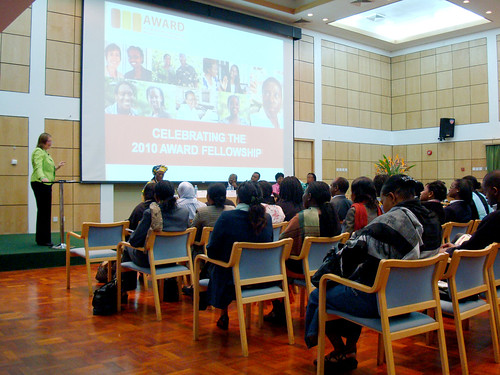
Over 780 women scientists from 54 institutions competed for this year’s fellowships. Sixty outstanding women agricultural scientists from 10 African countries this week received 2010 fellowships from African Women in Agricultural Research and Development (AWARD), an initiative of the Gender and Diversity program of the Consultative Group on International Agricultural Research (CGIAR).
“We have proven that top-notch female scientists do exist in significant numbers" says Vicki Wilde, Director CGIAR Gender and Diversity Program and AWARD, "and equally important, they are conducting critical food security research that is desperately needed to feed future generations.”
Akinwumi Adesina, Vice President Policy and Partnerships for the Alliance for a Green Revolution in Africa (AGRA), speaks as a scientist, a father and a strong political advocate about the need for better recognition and support for women in agricultural science.
2008 AWARD Fellow, Waceke Wanjohi, uses examples from her own life to show the possibilities offered through AWARD to African women who wish to succeed in the competitive area of agricultural science.
Ruth Amata, new AWARD Fellow, shares her commitment to the program. She describes the challenges and sacrifices facing Africa’s female agricultural scientists who are trying to forward the economic growth of Africa, and the vital help that the AWARD program is giving to make that process possible.
Stella Williams, AWARD Chair, describes the AWARD scheme, its unique nature and why it is necessary to the future of African agriculture.
Ephraim Mukisira, Director Kenya Agricultural Research Institute (KARI), talks about the vital role of African women scientists in the struggle to achieve food security for Africa. He starts with giving his impression on the FARA GA2010 which he attended the week before in Ouagadougou
Sustainable intensification has become the priority of many agricultural research agencies
July 28th edition of the journal Nature . The Nature reports explore the vital role of advancing and disseminating useful agricultural practices and technologies, including but hardly limited to genetically modified crops, but also the simple reality that poverty is the main source of hunger now, not a lack of food. A central theme is efficiency, getting higher yields on small plots with fewer inputs of water and fertilizer. There’s a nice downloadable summary poster of some of the main findings.
The journal also points out the glaring lack of government investment in basic research and development on agriculture, a remarkable parallel to the other area of science that sees scant government investment despite its importance in the next few decades — energy. This Nature graph says it all:

Here are just a few of the bullet points:
1. Where the hungry people areIn 2009, more than 1 billion people went undernourished — their food intake regularly providing less than minimum energy requirements — not because there isn’t enough food, but because people are too poor to buy it. At least 30 percent of food goes to waste. Although the highest rates of hunger are in sub-Saharan Africa — tracking closely with poverty — most of the world’s undernourished people are in Asia.2. Hunger isn’t going awayThe percentage of hungry people in the developing world had been dropping for decades even though the number of hungry worldwide barely dipped. But the food price crisis in 2008 reversed these decades of gains.3. It’s not about the bombScientists long feared a great population boom that would stress food production, but population growth is slowing and should plateau by 2050 as family size in almost all poorer countries falls to roughly 2.2 children per family. Even as population has risen, the overall availability of calories per person has increased, not decreased. Producing enough food in the future is possible, but doing so without drastically sapping other resources, particularly water, will be difficult.4. And it’s not about landAn outlook published in 2009 by the Food and Agriculture Organization of the United Nations and the Organization for Economic Cooperation and Development (http://go.nature.com/DdNYvk) says that current cropland could be more than doubled by adding 1.6 billion hectares — mostly from Latin America and Africa — without impinging on land needed for forests, protected areas or urbanization. But Britain’s Royal Society has advised against substantially increasing cultivated land, arguing that this would damage ecosystems and biodiversity (http://go.nature.com/YJ2jsB). Instead, it backs “sustainable intensification,” which has become the priority of many agricultural research agencies.


Over 300 agricultural research projects in Africa are mapped
Over 300 agricultural research projects in Africa are mapped
Posted 6th August 2010 by Paul Karaimu

An initiative has now mapped over 300 of the world’s ongoing agricultural research projects in Africa. Evelyn Katingi, the map coordinator, says this represents ‘an 86 per cent coverage of information from all 15 centres of the Consultative Group on International Agricultural Research (CGIAR), the world’s pre-eminent group of agricultural research-for-development specialists.’ Katingi leads this initiative at the Nairobi campus of the International Livestock Research Institute (ILRI).
‘CGMap Ongoing Research in Africa’ is the result of a collaborative effort between two CGIAR programs: Collective Action in Eastern and Southern Africa and ICT-KM (Information and Communication Technologies—Knowledge Management). The map makes information about research projects across Africa and the CGIAR consortium accessible to staff, partners and other key stakeholders in African agricultural research.
Information in the map is contributed by CGIAR scientists, who provide details of their projects, including time frame, location, key players and partners involved and contact information.
Started in 2007, this project provides an interactive way of viewing all projects that the 15 CGIAR partners are involved in, allows one to search and find out more about on-going projects and provides links to key players in agricultural research in Africa and beyond.
According to information collected from the map, 21 per cent of reported projects focus on crops, 14 per cent on policy and institutions, 10 per cent on livestock, 5 per cent on land management, 4 per cent on soils and 2 per cent on fisheries.
Most of the projects currently mapped are being conducted in East Africa, with 120 projects in Kenya, 91 in Uganda and 87 in Tanzania. But coverage of other countries, especially Ghana, Nigeria and Zambia, is growing.
A new version of the map launched earlier in the year is attracting increasing numbers of visitors, and thus generating concomitant increasing opportunities for greater collaboration.
The CGIAR demonstrated the use and utility of the CGMap to participants of a Science Week and General Assembly of the Forum for Agricultural Research in Africa (FARA) held 19-24 July 2010 in Ouagadougou, Burkina Faso.
Visit http://ongoing-research.cgiar.org/ for more information or to learn how you can contribute to the research map.
Ninth AGOA Forum Embraces African Agribusiness


In attendance were cabinet ministers and senior officials from the 38 sub-Saharan African countries that benefit from the African Growth and Opportunity (AGOA) trade preference program, as well as representatives of African regional economic communities, the American and African private sector, and civil society. The ministerial portion of the event was held in Washington, D.C. from August 2-3.

"We can produce enough for our needs and for the rest of the world as long as challenges facing the farmers are dealt with" he said. Ngwenya said in 20 years, Africa's collective GDP would be US$2.6 trillion, its consumer spending US$1.4 trillion, the number of Africans of working age would be 1.1 billion, with 50% of Africans living in cities by 2030. He further said regional integration through the tripartite COMESA, East African Community (EAC) and the Southern Africa Development Cooperation (SADC) agreement had created a bigger market which should be exploited. The Secretary General said COMESA was addressing the challenges to agricultural development like infrastructure, technology and market related constraints through the Comprehensive Africa Agriculture Development Programme (CAADP. Ngwenya said Africa has potential to produce enough food for internal needs and international trade.
During the meeting the main African agents were presented that are trying to increase their productivity by using USA Technologies, equipments and other agriculture elements, such as seed, fertilizers and others.
A feature added this year was a trade fair where about 25 American and African businesses, large and small, displayed their goods, networked and looked for potential partners and investors. Ismail Aderogba, the head of product quality assurance and research at Multi-Trex Integrated Foods in Lagos, Nigeria, displayed his company’s products and looking for ways to export to the U.S. market. Multi-Trex processes cocoa butter, cocoa cake and cocoa beans. His company is exporting to Europe but wants to bring its products to the United States, he said.
Thirty-four African women entrepreneurs also participated in the 2010 U.S.–Sub-Saharan Africa Trade and Economic Cooperation Forum. Four of these women — entrepreneurs from Uganda, Cameroon, Ethiopia and Botswana — talked to America.gov .


 Zambian's Commerce Minister Felix Mutati cited as an example Ghana’s CEO of Homefoods Processing and Cannery Limited, Felicia Twumwasi (photo left) and Zambia’s Sylvia Banda (photo right), the CEO of Sylva Food Solutions as being among the most dynamic women on the continent.
Background: Homefoods employs 23 people and ships 6-8, 20 ft containers per month, worth an average $140,000. Sylvia Food Solutions is a food company whose products include Solar dryers and Solar Dried foods.
BACKGROUND of AGOA
The US Congress passed the African Growth and Opportunity Act legislation in 2000. President Clinton subsequently signed the AGOA bill into law on May 18, 2000. Since then, three successive administrations, including the Obama Administration, have actively implemented AGOA, working closely with African partners and other stakeholders to help them make the most of the program.
AGOA institutionalized an annual, high-level dialogue between officials of the United States and AGOA beneficiary countries: the AGOA Forum. This year’s AGOA Forum is the ninth. In 2009, the AGOA Forum was held in Nairobi, Kenya. The AGOA Forum brings together Cabinet-level officials from the United States and AGOA beneficiary countries, along with representatives of the African and American private sector and non-governmental organizations, to discuss issues related to U.S.-sub-Saharan African trade and economic cooperation.
U.S. imports from sub-Saharan Africa increased by 78 percent to $26.6 billion in the first five months of 2010. Imports under AGOA increased 74 percent to $18.8 billion during this period. AGOA non-oil products included vehicles and parts, apparel, jewelry, fruits and vegetables, wines, nuts, spices, baskets, cocoa powder, cocoa paste and seafood.
AGOA Fosters Growth for African Farmers, Fine Dining in U.S.
In addition to increased commercial exchanges between the United States and various African nations, AGOA has also allowed American consumers to discover an array of exotic, healthy and high-end agricultural products.
Saturday, August 7, 2010
The production of cheap rural energy to support post harvest technologies
25th of july 2010. Ouagadougou, Burkina Faso. FARA GA 2010. Interview with William Ilboudo, engineer, "Innovation en solaire et metallique"
The production of cheap rural energy to support post harvest technologies
Transcript of the interview:
Take another example like mangos. Gaz is presently used to produce hot air to dry them. But you can also use the nuts. You burn them, you produce steam and with a temperature converter you produce hot air to dry the mango. This also prevents possible contamination of the mangos with gas. You can adjust the temperature according to the influx of hot water in the converter.
The production of cheap rural energy to support post harvest technologies
Transcript of the interview:
Your project was selected for the World Bank Agricultural Market place?
We have worked on the idea of a rural food processing production unit. We use solar energy and waste of agricultural production like the nuts of mangos. We can also use the residue of manioc to produce “akieke “. Unfortunately this installation was not yet put into service because of lack of funding.
What was the basic technology?
Parabolic metallic dishes transform solar energy into steam and the steam is used directly for food processing or to produce hot air. We used both solar energy and the agricultural waste.
Why did the project not get a prize?
The reaction was very positive in Washington but because of my poor English I could not defend the project as I wished.
How to transform agricultural waste into rural energy?
Let me give an example. You make Shea butter with a press. The remaining shelves have 3 times more energy than wood. You burn them to operate your whole Shea butter process. If you combine this with solar energy you become autonomous. You produce steam to filter your oil. You remain autonomous far from Ouagadougou: in Bura or in Leo…
Why is it important to diversify sources of energy in post-harvest production?
When you think of renewable energy for post harvest production you cannot rely on only one source of energy. The sun shines when it wants to shine. And accumulating or conserving energy is very expensive. Therefore, the mix of solar energy and bio mass energy is highly recommended. In Burkina we have a lot of re-usable bio mass. Take f.i cotton: 1 ton and a half of residu remains after harvest. When you combine this bio mass with solar energy you can process food even in remote areas in Burkina Faso.
Which European partners do you have?
We collaborate a lot with Solar Food which wants to create a certificate on solar food. Buts also other small organizations. But our major concern is to be considered by African institutions.
Why do African researchers rarely collaborate with innovators from the private sector?
The African researcher often works in isolation. It’s collaboration between institutions and meetings among researchers in order to find funds for their research. Often and their research findings are far too expensive when they want to make it available to the African private enterprises. We need a research which is affordable according to our means.
What are your expectations towards African research institutions?
The African institutions tend to do what has already worked. The AFRICAN SHORT CUT is ONLY POSSIBLE when you accept to innovate and take risks. Institutions have therefore to support people who innovate and they must be willing to take risks. It is not the figures at the end of the year which count but the impact they have.
The role of incubators from an SME’s perspective
25th of july 2010. Ouagadougou, Burkina Faso. FARA GA 2010. Interview with William Ilboudo, engineer, "Innovation en solaire et metallique"
Why should entrepreneurship be part of the training of students in agriculture?
I think it is very important for students to make a business plan, to study a specific enterprise case. Because this allows them to see the reality and to see if their initiative fits in the economic landscape of their country. A business plan is very important in this perspective: it gives you beforehand the life of your enterprise. It informs us about the economic viability of our idea. Whether you like it or not, all depends on the economic viability.
What are the prerequisites of a good business plan?
It first depends on how well you know your field. For example: what is the cost of the transport, of this material, etc. It is also essential to know if it will be possible to work as planned: f.i. if five day in the months are public holidays, then you have only twenty five days. One missed day has a significant impact on your business.
Are African universities ready to listen to the expertise of private enterprises?
I don't have the impression right now. As an outsider I may have a wrong judgment. But trainers/scientists already struggle for their job at the university whereby they are not taking the private expertise into account and they protect their jobs against those who have experiences on the ground
Is the youth ready to make a business out of agriculture?
Yes, I think everybody wants either to do research and express himself intellectually, or wants to express himself as an entrepreneur . But the question is whether this is easy? I would advise them to thing this twice of trice over.
How can they be supported?
To be supported they first have to make a business plan to first check if their idea can survive. The second thing they need is training, training to start their idea. Africa should start to create incubators. Through an incubator and as a start-up you don't need to make huge investments to buy your basic equipment. You work for 2 or 3 years with a partner. You use equipment which already exists and which is shared. And after making some profit, putting some money aside and HAVING SOME EXPERIENCE, then you can fly on your own wings. I was not so lucky. I made wrong investments and I could have worked in a different way. But that’s how it is!
Exclusive interview at FARA GA2010 (2): His Excellency Sam Sesay, Minister of Agriculture Sierra Leone
24th of July 2010. FARA GA 2010. Interview with His Excellency Sam Sesay, Minister of Agriculture of Sierra Leone
The importance of incentives for SME involvement in agricultural innovation platforms
Transcript of the interview:
The importance of incentives for SME involvement in agricultural innovation platforms
Transcript of the interview:
Are researchers development oriented?
Researchers are far behind the development oriented aspirations. They used to be mainly production only oriented. Today the agriculture production mode has move to the agricultural value chain mode, which is looking at the whole spectrum that will enhance agricultural development. The researchers have to move likely: to look at the agro processing, to look at the marketing. And even inside the production mode they need to look at what kinds of local manure can be promoted, what kind of appropriate technology can they develop which are labor saving? Not much has been done on those areas within the production research mode. Within the agricultural value chain mode there is far more that research needs to do in the current situation.
What are innovation platforms?
We have to promote innovation platforms. In the innovation platform we ask how can we put all stakeholders together: the farmers, the researchers, the policy makers, the business people. How can we engender a dialogue to make sure “we put orders towards the researchers”? To tell them “this is exactly what we need”. All the stakeholders should identify what they want to be able to take active part in the agricultural value chain. And this is the source of development and agricultural research delivery products. And research should be transparent: accountable for the resources that were invested in the form of the products they promised to deliver to the stakeholders.
How should research be organized?
In Sierra Leone we decided to take the commodity chain. Because we want to take those commodities where Sierra Leone has a comparative advantage as a country. The territorial approach make us less efficient and less effective. Therefore rice has been identified as a comparative advantage, cassava, oil palm, fisheries and non-timber products.
Besides rice, around which commodities do stakeholders collaborate?
Already we are doing something in cassava. Cassava processing has gained momentum in Sierra Leone along the value chain. We now package “gari” which is one of the products of cassava. And our “gari” is finding its way to Guinea, to Liberia and to many other places, and they are packaged in different sizes, even in small sizes of 1 kg that every ordinary person can buy.
What are the incentives for private sector involvement?
First and foremost, we used to see agricultural development as the task of the government. Since the seventies and the early eighties, when the public sector was told to move away from the market and allow the private sector to compete, that has been a very sluggish process. Governments still feel they have the responsibility to feed the people, to educate the people. If that does not happen because the private sector is not there, they have the temptation to move in. In Sierra Leone we try to restrain ourselves by creating an enabling environment. And this is what we have done with agriculture in Sierra Leone by having an incentive package for private sector promotion. We give waivers; we give tax holidays depending on the investment from five to ten years. Even for the land tenure issue the government steps in as a middle person. There are many incentives for the private sector so that they can take over economies. All booming sectors in Europe, America, etc are private sector driven. Government has only a regulatory and monitoring function.
For innovative partnerships to last you need a conducive environment?
Definitely!
Subscribe to:
Posts (Atom)