Platform for African – European Partnership in Agricultural Research for Development

Saturday, March 14, 2015

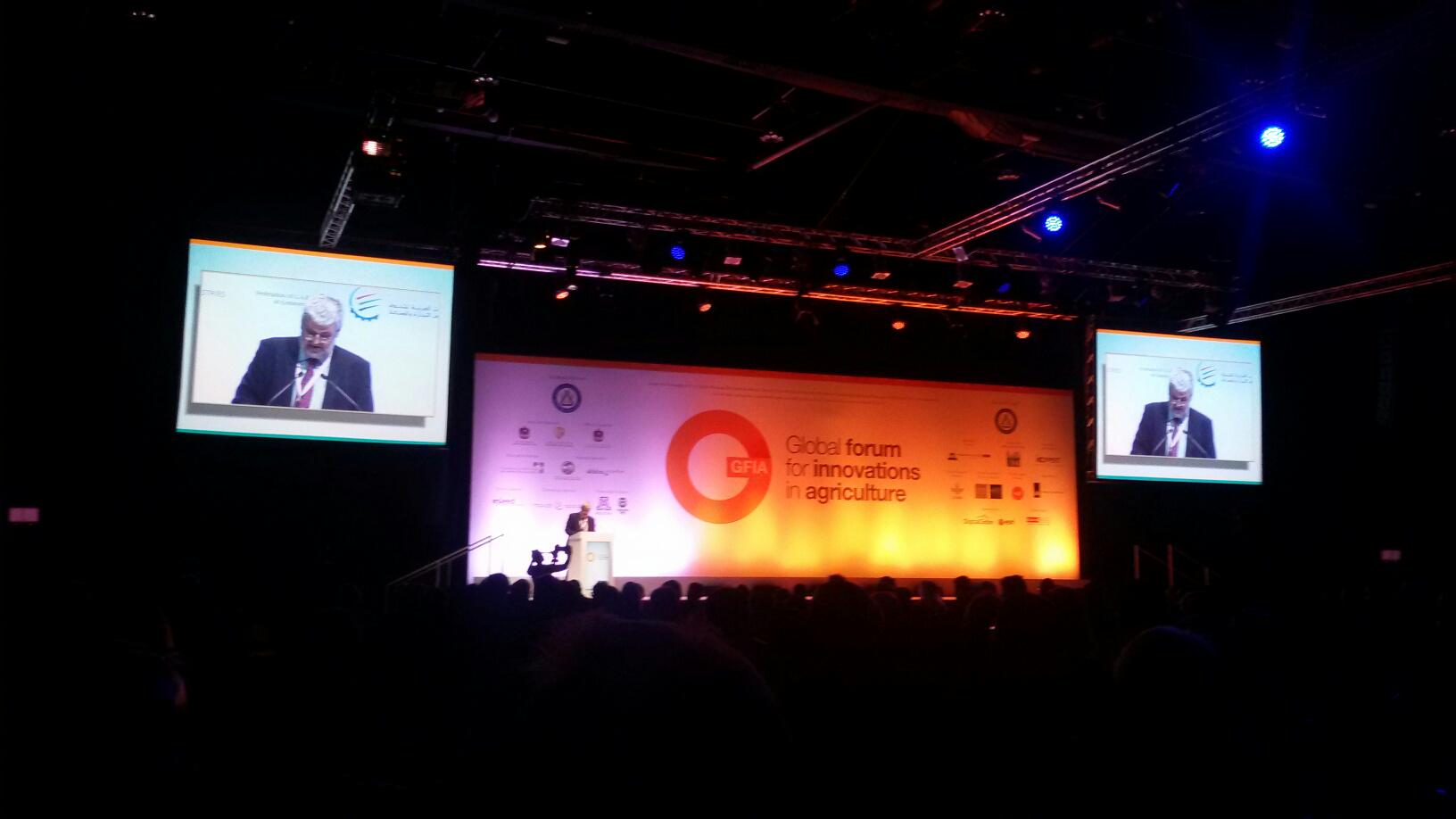
Global Forum for Innovation in Agriculture 2015

9 - 11 March 2015. Abu Dhabi - Abu Dhabi - United Arab Emirates. Global Forum for Innovation in Agriculture 2015.

300 scientists and experts from across 71 countries take park in the programAbu Dhabi - H.E. Rashid Mohammed Al Shariqi, Director General of Abu Dhabi Food Control Authority opened the Hosted Scientist Program which brought together some 300 scientists and experts from across 71 countries of the world to explore solutions to tackle the world hunger and under-nutrition caused by the scarcity of resources and climate change.

The Hosted Scientist Program was held on the sidelines of the second edition of Global Forum for Innovations in Agriculture. Focusing on critical issues such as food security, nutrition, climate change, women in agriculture and agri-biodiversity, the Global Forum is a unique platform for agricultural knowledge, innovation and enterprise communities, to work together to share information and ideas, to dialogue, and to build partnerships for action.

The Forum comprised six conferences:
  1. Global Climate-Smart Agriculture Summit (CSA) - The inaugural Global CSA Summit will be launched under the theme “Promoting sustainability & agricultural resilience” and it represent the core of GFIA 2015.
  2. Post harvest waste initiative: from prevention to valorisation - As the reduction of food waste must be part of a portfolio of solutions needed to feed the world more sustainably, GFIA 2015 will include a major focus on the important issues
  3. ICT for sustainable agriculture - This two day conference will focus on how ICT can promote sustainable, climate resilient agriculture and promises exciting solutions for food producers in terms of increasing productivity, improving market access, financing and training. Companies already confirmed to exhibit within the ICT Pavilion include Progis Software,Top-Con, PA Source, TAHA (Mascar, Crushing Tech, Bellon, Ortolon, GIL, SIP), FarmApps,Expressweather, Aeroterrascan, Fieldeye and Dalsem
  4. Edible cities: building resilience with urban agriculture - This conference will focus on the critical need for cities to develop their own sources of food to avoid severe food insecurity associated with water shortages, land degradation and climate change
  5. Forum on non-conventional water use in arid climates - This forum will seek to showcase research and innovations to tackle the issues posed by water scarcity and explore strategies to promoting sustainable solutions in the region and globally.
  6. Aquaculture and indoor agriculture discovery days - A series of workshops aimed at providing farmers and businesspeople in the MENA region with all the information they need about setting up a new food production business
Download the GFIA 2015 show catalogue including the event timetable, conference programmes, innovation and speaker profiles, exhibitor listings and product guide.
GFIA 2015: The Agricultural Revolution Continues from nadine cottman on Vimeo.

Agro-industry Development for Food and Nutritional Security in Southern Africa

9th to 10th March 2015. Victoria Falls, Zimbabwe. Ad-hoc Expert Group Meeting. Over 60 experts from southern Africa including agro-industry and agribusiness experts from government institutions, the private sector, SADC institutions, civil society, academia and others development partners participated in this meeting.

This Ad-hoc Expert Group Meeting discussed emerging issues and challenges in strengthening agro-industry for food and nutritional security in the SADC region. An issues paper on Agro-industry development for food and nutritional security in Southern Africa was the major discussion paper.

Other papers addressing specific issues in agro-industry development were presented by other stakeholders. These include,

  • “Agro-industry development in East and Southern Africa: Exploring Regional Value Chains (COMESA)”, 
  • “Agro-industry development: capacity and operational needs for take-off”(UNIDO), 
  • “Agro-industry development: The Experience of the Milling Industry in Zambia” (Zambia Millers Association), 
  • Agribusiness development and participation in regional value chains in Southern Africa and 
  • “Financing agroindustry for food and nutritional security in Southern Africa” (DBSA). 

The two day meeting provided concrete recommendations on how to strengthen the agro-industry sector through among others partnerships, best practices and lessons from other regions.

Objectives: 

  • Map the structure and conduct of the sector including performance trends in the SADC sub region; 
  • Identify investment opportunities for the benefit of existing as well as emerging actors within the industry; 
  • Identify constraints that limit agro-processing development in the sub region and analyze short and long term issues that influence the effective establishment and development of agro-processing industries and affect their ability to promote food and nutrition security; 
  • Audit the current policy support mechanisms and their ability to promote an efficient, profitable, competitive, sustainable and inclusive agro-industry which sustains food security and nutrition in the SADC sub region, draw lessons and highlight success stories; 
  • Discuss alternative business models and approaches to agro-industrial development and innovative institutions to support the development of agro-industries with a clear focus on the possible role of governments, the private sector and civil society in the process; and 
  • Recommend strategic directions for strengthening agro-industry development and linkages with food and nutrition security in southern Africa. 

The small and inchoate private sector in many African countries and struggling medium and small scale industries required for the state’s involvement which is key in creating an agricultural entrepreneurial class that would invest in the agri-business.

Wednesday, March 11, 2015

Combating Poverty through Better Use of Natural Resources

10 March 2015. Joint research project carried out by the IASS and the International Fund for Agricultural Development (IFAD) in 2012 and 2013

Responsible and pro-poor governance of natural resources is essential. This is particularly true in the context of climate change, because access to and the management of natural resources play a key role in adaptation strategies to climate change. IASS researchers Judith Rosendahl, Matheus Alves Zanella and Jes Weigelt stress this in their new study on Pro-poor Resource Governance under Changing Climates.
  • In close collaboration with local civil society organisations, case studies were prepared in six countries: Bangladesch, Bolivia, Brazil, Burkina Faso, Ecuador and India. 
  • The case studies document and analyse examples of pro-poor governance of natural resources, paying particular attention to the impact of institutional change on livelihoods and the way in which climate change and other change processes increase the vulnerability of smallholders.
  • One of the core results of the study is that climate change makes smallholders more vulnerable. While social factors also play a role here, climate change reinforces vulnerability. Securing community land rights is one crucial element of adaptation strategies. But this must be accompanied by other measures if poverty is to be reduced. All of the case studies underline the importance of political processes for increasing the capacity of smallholder populations to adapt. However, all too often the needs of these populations are ignored in such processes. 
In addition to the English-language version of the study, French- and Spanish-language versions will soon be available. Link: Study „Pro-poor Resource Governments under Changing Climates“.

Tuesday, March 10, 2015

Grow Markets, Fight Hunger: A Food Security Framework for US-Africa Trade Relations

Grow Markets, Fight Hunger:A Food Security Framework forUS-Africa Trade Relations
By Andrea Durkin March 2015
Copyright © 2015 by The Chicago Council on Global Affairs
22 pages

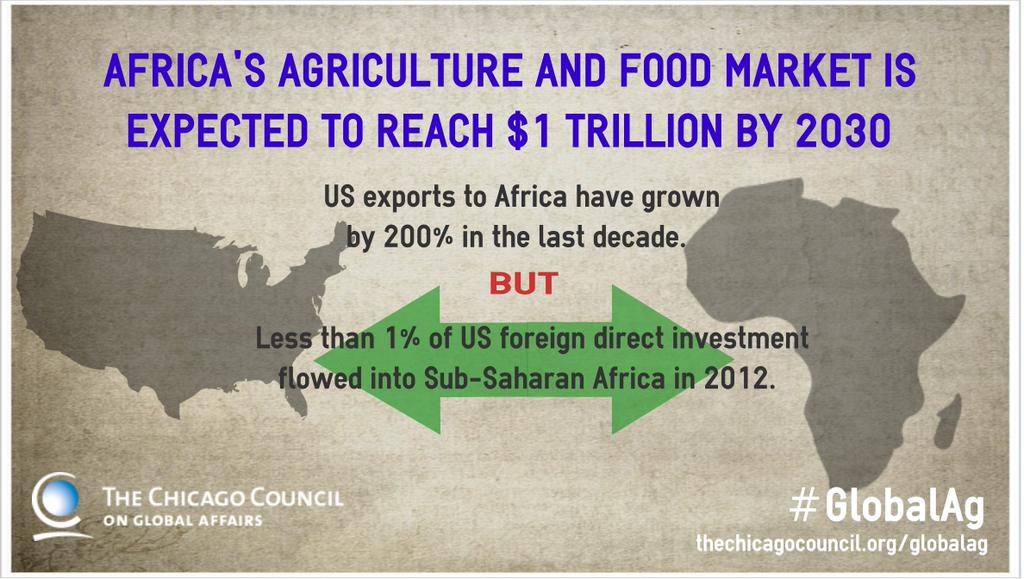
3 March 2015. A new framework for US-Africa trade relations focused on agriculture and food can advance African food security while positioning US businesses to benefit from Africa’s growing food market, which is expected to reach $1 trillion by 2030.

This report presents evidence that an effort by the United States focused on bolstering regional trade and harmonizing food standards and regulations across countries would drive economic growth while improving the availability and affordability of nutritious foods throughout Africa.

The Council recommends that the U.S. government will build on the African Growth and Opportunity Act (AGOA) Forum by creating a U.S.-Africa Food Dialogue to advance regional economic integration; reduce technical regulations and standards barriers to agriculture and food trade; and implement trade facilitation measures.
"African and American farmers and agrifood businesses stand to make big gains if we can increase regional trade in Africa through tackling some of the inconsistencies in standards and regulatory frameworks," said Dan Glickman, former U.S. secretary of agriculture and co chair of the Council's project on global food security. "We need to make more headway in reducing the cost of moving agricultural products and food within and between countries."

Summary of Report Recommendations


New $13.8 million project aims to boost banana production in Uganda and Tanzania

The researchers expect their hybrid 

banana varieties to have a 
30% higher yield and a 
50% higher resistance. 
© Rony Swennen
6 March 2015scidev.net. A five-year project that aims to improve banana farming in Tanzania and Uganda by creating high-yielding and disease-resistant banana hybrids is set to begin trials in June 2015.

The project, which received US$13.8 million funding from the Bill and Melinda Gates Foundation in October last year, aims to develop banana varieties for smallholder farmers in the two countries where banana is a staple food for millions of people.

The IITA, Bioversity International and the CGIAR Research Program on Roots, Tubers and Bananas are also providing substantial co-financing.

Uganda and Tanzania produce more than 50 per cent of all bananas cultivated in Africa, but achieve only nine per cent of the crop’s potential yield because of pests and diseases, according to the Nigeria-headquartered International Institute of Tropical Agriculture (IITA). The project will be implemented by IITA, with five doctoral and eight master’s students expected to receive research grants.
“Beneficiaries will come from Uganda’s National Agricultural Research Organisation (NARO) and IITA, and most master’s and doctoral students will be selected on a competitive basis,” says Rony Swennen, project leader and head of banana breeding at IITA. The research projects will include pest and disease control, and genetics.
The venture, says Swennen, hopes to boost resistance to common banana pests including banana weevil and nematodes; and diseases such as Black sigatoka also called black leaf streak — and Fusarial wilt disease by up to 50 per cent, while raising yields by 30 per cent higher than the current potential. Swennen adds that in June the plants will be introduced in five field sites for trials and evaluation. The venture will build on 26 already existing hybrid varieties developed earlier jointly by NARO and IITA.

Related:
Video Emission du 13 janvier 2014. Dans l’histoire d’ABE, c’est la première fois qu’une émission est consacrée à la banane et c’est aussi la première fois que l’éthique des entreprises est soumise à un véritable test.

Forum international sur l’agro-écologie

24 to 27 February 2015. Mali. Nyeleni Center. A ce forum international sur l’agro-écologie au Mali, ils étaient plus de 300 délégués et principaux investisseurs dans l’agriculture venant de 45 pays pour représenter diverses organisations et mouvements internationaux de petits producteurs produisant environ 70% de l’alimentation consommée par l’humanité.

The International Forum on Agroecology was by the following organisations:
  • Coordination Nationale des Organisations Paysannes du Mali (CNOP Mali) as chair; 
  • La Via Campesina (LVC), 
  • Movimiento Agroecológico de América Latina y el Caribe (MAELA), 
  • Réseau des organisations paysannes et de producteurs de l’Afrique de l’Ouest (ROPPA) , 
  • World Forum of Fish Harvesters and Fishworkers (WFF), 
  • World Forum of Fisher Peoples (WFFP), 
  • World Alliance of Mobile Indigenous Peoples (WAMIP), 
  • More and Better (MaB)
Objectives:
  • to come to a common understanding of agroecology as a key element in the construction of Food Sovereignty, 
  • to develop joint strategies to promote Agroecology and defend it from co-optation.
See the final declaration
Download declaration Agroecology Nyeleni 2015
  • Popular pressure has caused many multilateral institutions, governments, universities and research centers, some NGOs, corporations and others, to finally recognize “agroecology”. However, they have tried to redefine it as a narrow set of technologies, to offer some tools that appear to ease the sustainability crisis of industrial food production, while the existing structures of power remain unchallenged. This co-optation of agroecology to fine-tune the industrial food system, while paying lip service to the environmental discourse, has various names, including “climate smart agriculture”, “sustainable-” or “ecological-intensification”, industrial monoculture production of “organic” food, etc. These are not agroecology.
  • The production practices of agroecology (such as intercropping, traditional fishing and mobile pastoralism, integrating crops, trees, livestock and fish, manuring, compost, local seeds and animal breeds, etc.) are based on ecological principles like building life in the soil, recycling nutrients, the dynamic management of biodiversity and energy conservation at all scales. Agroecology drastically reduces our use of externally-purchased inputs that must be bought from industry. There is no use of agrotoxics, artificial hormones, GMOs or other dangerous new technologies in agroecology.
Dans l’après-midi de la première journée du Forum international sur l’agroécologie se tenant du 24 au 27 février à Sélingué, Mali, plus de 60 femmes d’Afrique, d’Asie, des Amériques et d’Europe ont décidé de tenir une réunion parallèle afin de pouvoir avoir une compréhension commune de la signification de leur travail en tant que paysannes, artisanes de la pêche ou pastoralistes. Nandini Jairam, une paysanne du Karnataka, en Inde, a déclaré “il est donc essentiel que les femmes débattent, échangent leurs expériences et parlent de leurs défis entre elles afin de pouvoir bien comprendre la valeur de leur précieux travail ”.

Quelles perspectives pour l’agriculture et l’alimentation en Afrique subsaharienne ?

3 mars 2015. Communiqué de FARM. Quelles perspectives pour l’agriculture et l’alimentation en Afrique subsaharienne ?
« Dynamiques agricoles en Afrique subsaharienne : une perspective à 2050 des défis de la transformation structurelle »
Bruno Dorin, Cirad, Centre de Sciences Humaines (CSH). 
Octobre 2014, pp.52
For the English abstract click here
Une étude sur les défis de la transformation structurelle : sécurité alimentaire, pauvreté, emploi.

La Fondation pour l’agriculture et la ruralité dans le monde (FARM) a commandé à Bruno Dorin, chercheur du Cirad détaché au Centre de Sciences Humaines de New Delhi, en Inde, une étude visant à éclairer les enjeux agricoles et alimentaires de la transformation structurelle des économies africaines, désormais engagées dans une croissance soutenue.

L’étude fait ressortir notamment les trois points suivants :
  1. pour asseoir sa sécurité alimentaire, l’Afrique subsaharienne augmenterait fortement sa production agricole et importerait davantage de denrées ;
  2. malgré les progrès de la productivité du travail, les inégalités de revenu risquent de se creuser entre l’agriculture et les autres secteurs ;
  3. la capacité de l’agriculture à offrir des emplois décents et en nombre croissant est limitée par plusieurs facteurs, dont les incertitudes sur la création d’emplois dans les autres secteurs et l’expansion démographique dans les zones rurales.

Monday, March 9, 2015

Highlight: management of indigenous livestock to foster agricultural innovation

Grant FED/2013/330-246 
Project duration 36 months 1/1/2014 – 31/12/2016 
EU grant EUR 999,736.74, ACP S and T program

Co-ordinator Egerton University, Kenya 

Partners: Lilongwe University of Agriculture and Natural Resources (LUANAR), Malawi and Obafemi Awolowo University (OAU), Nigeria 

This project improves the management of indigenous livestock (IL) through building capacity in the creation, update and use of innovative livestock technologies. The state-of-the-art on IL innovation potentials, state and levels of research and development (R and D) investments, and relationships between research and industry will be analysed, while needs and measures to improve IL management will be discussed with stakeholders along the IL product value chain. IL management capacity is strengthened through summer camps and linkages between research, industry and the civil society. Finally, a Livestock Innovation and Business Centre will be established that builds on existing capacity, and fosters innovation and agribusiness development.

Expected Results
  • Capacity of scientific staff and students at the participating institutions, as well as of enterprises (smallholder farmers, processors, traders, cooperatives, extension services….), policy makers and CSOs in Kenya, Malawi and Nigeria strengthened to create, update and use knowledge on IL management.
  • The culture and importance of ILT promoted among the general public and policy makers in governments.
  • Contributions made to local and international policies on IL management, and related scientific goals and priorities formulated.
  • Knowledge on innovative practices related to IL management developed to promote further innovations. 
Download iLINOVA Fact Sheet

Artificial insemination is an innovative reproductive technology for the enhanced productivity of indigenous chickens. Participants during training on artificial insemination in indigenous chickens at Egerton University, Kenya (February 2014) and actual semen extraction.


Related:
Within the purview of this project, iLINOVA-OAU team is compiling a compendium of appropriate science, technology and innovation (STI) in the management of indigenous livestock (MIL), with a focus on low-input, alternative livestock production systems.

  • In particular, the  iLINOVA-OAU team is interested in the application of STI related to animal breeding and stock selection, nutrition,general animal management, including innovations in processing, value addition and marketing of indigenous livestock. 
  • Responses should have some scientific basis, not just simply anecdotal reports. 
  • Ultimately, contributions will be included in the compilation of a compendium of appropriate STI for the MIL. 
  • All sources and contributors will be duly acknowledged. 
  • Contact:  S O Oseni, PhD Research Partner, iLINOVA-OAU, Animal Breeding Unit, Department of Animal Sciences, Obafemi AwolowoUniversity, Ile-Ife, Nigeria| Mobile: + 234 (0)806 658 1894 Alternate e-mail addresses: (a) soseni@ugaalum.uga.edu| | (b) soseni2@yahoo.com|

Conference on policies for competitive smallholder livestock production


4-6 March 2015.
Gaborone, Botswana. The Botswana Institute for Development Policy Analysis (BIDPA) in collaboration with the International Livestock Research Institute (ILRI) and the Australian Centre for International Agricultural Research (ACIAR) held a conference on  with the theme Policies for competitive smallholder livestock production.

The conference provided an opportunity for African and international scientists and the broader stakeholder groups in the livestock production sector to discuss competitiveness in livestock production systems and improving the livelihoods of livestock farmers, especially smallholders, with emphasis on southern Africa.

The broader objectives of the conference were to gather researchers, policymakers and development partners working in the area of assessing competitiveness in agricultural food production and marketing, and to provide answers to various questions rotating around four thematic areas.

The various development issues related to competitiveness of smallholder livestock farming in southern Africa  were grouped under the following sub-themes:
  • Measures of competitiveness in smallholder livestock production and policy advocacy
  • Market access and utilization
  • The role of collective action in enhancing competitiveness of smallholder livestock farmers
  • The role of governments in the provision of livestock support services
  • Economics of animal health and trade in the competitiveness of smallholder livestock production systems

Africa Seed Trade Association (AFTSA) congress

3 - 5 March 2015. Victoria Falls, Zimbabwe. Africa Seed Trade Association (AFTSA) congress. The conference covered areas like seed legislation, seed certification, variety release, plant property rights, biosafety, seed production, crop protection, seed marketing, packaging, labelling, harmonisation and institutional arrangements

Several representatives from the regional and international organisations attended the congress including the International Seed Federation, Asia Pacific Seed Association, the International Seed Testing Association, Organisation for Economic Co-operation and Development, Union for the Protection of New Plant Variety, Food and Agriculture Organisation, Common Market for East and Southern Africa, West and Central African Council for Agricultural Research and Development and United States Agency for International Development.

See: Congress Programme

Background: 
The African Seed Trade Association vice president 
Mr Denias Zaranyika (left)
AFSTA was created out of the need to have a regional representative body for the seed industry, which also serves to promote the development of private seed enterprises. This was also borne out of the realisation that quality seed is the most important agricultural input without which use of fertiliser, irrigation, crop-chemicals or improved management practices were unlikely to produce the crop yield increase needed to enhance food security in Africa.

AFSTA aims to promote trade in quality seeds, strengthen communication between the African seed sector with the rest of the world, interacting with regional governments and non-governmental organisations involved in seed activities in order to promote the interests of the private seed industry and facilitate establishment of national seed trade associations in Africa. This is the first time that Zimbabwe has hosted the regional function which brings together stakeholders in the seed industry in Africa, with over 500 delegates expected to attend the congress. Next year the congress will be hosted by Kenya.

Hidden Hunger conference

3-6 March 2015. Stuttgart, Germany. The 2nd International Congress Hidden Hunger was a global meeting of scientists, field workers, members of NGOs and representatives from the government, public, private and civil sector. It focused on causes and consequences of Hidden Hunger during early development as well as on counter-strategies.

The program offered the approximately 360 participants from around the globe
  • 66 lectures,
  • 35 poster presentations,
  • 2 panel discussions and
  • 1 film
by experts from numerous disciplines, such as nutrition, gynecology, pediatrics, agricultural sciences, and economics.

Topics included:
  1. Impact of malnutrition on intrauterine development and its consequences on long-term health,
  2. Impact of Hidden Hunger on physical and cognitive development,
  3. Consequences of Hidden Hunger for future society and economy,
  4. Early detection of Hidden Hunger and options to intervene before and during pregnancy, lactation, complementary feeding, weaning and post-weaning period.
Panel discussions with participants from high- and low-income countries focused on the links and gaps between science and reality in all parts of the world. The conference also brought together various disciplines to discuss Hidden Hunger under the perspectives of nutrition, gynecology/obstetrics, pediatrics from neonatology to adolescent medicine, social sciences, politics, economics, and agricultural sciences.


The scientific program was complemented by a “Science Meets Culture” stream , with 6 artists and 3 students from the Transdisciplinarity Master’s Program of the Zürich University of the Arts.

Wednesday, March 4, 2015

New fish drying technology launched in West Africa

Women in Abobodoumé, Côte d’Ivoire, huddle around 
the FAO-Thiaroye Processing Technique (FTT-Thiaroye) 
to smoke fish. (Photo Credit: FAO)
25 February 2015. A new and easy-to-assemble fish drying technology pioneered by FAO is helping to reduce health hazards, improve food safety and quality, improve working conditions and cut down food losses in West African fishing villages.

Smoked fish is a vital source of food and income for many African coastal communities. In Côte d'Ivoire, for example, an estimated 20-30 percent of local marine and freshwater catch is consumed in smoked form, according to FAO.

A popular protein alternative, smoked fish is preferred by locals because of its taste, its nutritional benefits, its competitive prices compared to other protein sources such as milk, meat and eggs, and its long shelf-life which ranges from 3-6 months. However, traditional kilns widely used to prepare this popular food item do pose some concerns.
"Traditional smoking techniques often involve a massive burning of wood which leads to a variety of problems. For one, an exorbitant amount of CO2 is produced, so the kilns produce more greenhouse gas pollution than they should. Also, traditional smoking releases contaminants known as polycyclic aromatic hydrocarbons (PAHs), which are carcinogenic and hazardous to the human respiratory system," says Yvette Diei-Ouadi, a fishery industry expert at FAO.
In the following interview she explains what these problems are how a new project has revolutionized the process of fish smoking in this community. Detail Audio | FAO | Food and Agriculture Organization of the United Nations

Traditional techniques also leave higher amounts of tar particles on the final product, affecting taste and quality - making it much more difficult to sell. The new FTT technology - consisting of a dual functioning oven and mechanical drier, which also can act as storage unit - is especially designed to help small-scale fish processors like those in Abobodoumé prepared and market safe, high-quality food.

A result of five years of design improvements, FTT, makes it easy to upgrade traditional ovens and is capable of significantly slashing the carcinogenic contaminants produced during smoking. At the same time, the technology reduces the amount of fuel needed and provides a load capacity five times greater than traditional barrel ovens or twice the Chorkor kiln.

Farmers' voice project' impacts policy on Strategic Food Reserves (SFR) and Post-Harvest Losses (PHL)

27 February 2015. The farmers’ Voice project that was co- funded by European Union and the Dutch agri-agency Agriterra is partnered by Eastern African Farmers Federation (EAFF) , Uganda National Farmers Federation(UNFFE), Mtandao Wa Wakulima Tanzania (MVIWATA), Uganda Coperative Alliance(UCA), Kenya National Farmers Federation (KENAFF) and Agriterra. 

The project on ‘Improving Food Security Governance in East Africa’ focuses on participatory generation of food security related policy Issues.

The project unites 14 farmers’ organisations in a strategic partnership at regional, national and district levels, representing a total of over five million farmers. It uses a new approach developed by Agriterra, the Farmers’ Advocacy Consultation Tool (FACT).
According to EAFF Policy and Advocacy Mainza Mugoya EAFF contributed by sharing data of farm-gate prices and marketing costs, improving the quality of analysis. The valuable participation of EAFF in policy dialogue was greatly enhanced by evidence, supporting their voice in key policy decisions.
Member of organisations were thus fully involved in the analysis and dialogue in their respective countries, while EAFF engage at regional level with the East African Community (EAC) and the East African Legislative Assembly (EALA).

The project achieved increased capacities of FO’s in preparing policy proposals and influencing policy processes, based on the views, needs and concerns of their grassroots members, accountable, feasible and well-informed policy proposals on Strategic Food Reserves (SFR) and Post-Harvest Losses (PHL) generated through piloting of the FACT method and increased consultation and networking amongst the participating FO's on relevant policy issues at different levels.

Myth-busting for African agriculture

25 February 2015. According to the project “Agriculture in Africa – Telling Facts from Myths,” the evidence upon which we base our decisions and views about agriculture and farming systems in sub-Saharan Africa is often inadequate or out of date.

The project seeks to tell facts from myths about African agriculture using the Living Standards Measurement Study - Integrated Surveys on Agriculture, or LSMS-ISA, a household survey project working to collect up to date agricultural data. It tests the validity of 15 commonly believed statements; statements that, although commonly accepted, may no longer be valid given Africa’s rapid economic growth and the new era of high food prices, amongst other driving forces of change. To date, surveys have been conducted in six countries — Ethiopia, Malawi, Niger, Nigeria, Tanzania and Uganda — representing 40 percent of the population in sub-Saharan Africa.

This research project identified some new facts about African agriculture that you may not know.
  1. FACT #1: Inorganic fertilizer in Africa is being used on staple crops, not only export crops.
  2. FACT #2: Uptake of improved seed varieties is already high, but mechanisation and irrigation is low.
  3. FACT #3: Men take on more farming responsibilities than previously thought.

28 February 2015. By Agnes Kalibata. Agnes Kalibata is the President of the Alliance for the Green Revolution in Africa (AGRA) and former Rwandan Minister of Agriculture and Animal Resources.
  1. Double down on creating the conditions for smallholder farmers to adopt new inputs and practices through raising awareness and access to finance.
  2. Think outside the bank to consider new ways to deliver financing to farmers.‎
  3. Develop structured and efficient grain markets that are accessible for smallholder farmers
  4. Support efforts to match smallholder farmers with large-scale buyers.
  5. Support women in agriculture to reap a large dividend.

Tuesday, March 3, 2015

Integrated Systems Research for Sustainable Intensification in Smallholder Agriculture


3-6 March 2015. Ibadan Nigeria. IITA headquarters.

This 4-day conference organized by CGIAR Research Program on Humidtropics opens in Nigeria today 03/03/2015.

Humidtropics, in collaboration with Dryland Systems and Aquatic Agricultural Systems (AAS), is organizing an international conference on integrated systems research. Entitled Integrated Systems Research for Sustainable Intensification in Smallholder Agriculture, the conference will deal with major components within systems research in agriculture. The purpose of the conference is to learn from research undertakings on integrated systems, with an emphasis on results: data, methods and lessons learned.

Conference outcomes:
  • Demonstrate and share experiences and evidence to the effect that Systems Approaches in agriculture research are effective and contribute to livelihoods and natural resource management;
  • Share methods, tools and research approaches used in Systems Research;
  • Explore opportunities for new partnerships in Systems Research for development;
  • Identify opportunities for cross-system learning, and methods to do this effectively;
  • Special peer-reviewed publication.
Core questions to be addressed include:
  • How to move systems concepts into practice?
  • How do we move to scale and impact with systems research and development?
  • What is the value added of that approach? Why is Systems Research needed to achieve this?
See the full programme here
See Conference Program &Book of Abstracts 66 pages

The first day included a webcast with the following speakers (live stream):
  • Dr. Nteranya Sanginga, Director General, International Institute of Tropical Agriculture (IITA) 
  • Dr. Kwesi Atta-Krah, Director, CGIAR Research Program on Integrated Systems for the Humid Tropics (Humidtropics) 
  • Dr. Yemi Akinbamijo, Executive Director, Forum for Agricultural Research in Africa (FARA) 
  • Dr. Frank Rijsberman, Chief Executive Officer, CGIAR Consortium 
  • Ann Tutwiler, Director General, Bioversity International 
  • Prof. David W. Norman, Professor Emeritus, Kansas State University: Historical Trajectory of Farming Systems Research: Past, Present and Future 
  • Dr. Bernard Hubert, President, Agropolis International: Systems Thinking toward Institutional Innovation and Change 
  • Cynthia McDougall, Senior Scientist, Gender & Equity Theme Leader, WorldFish and Aquatic Agricultural Systems (AAS): Gender in Integrated Systems Research 
  • Dr. Marie de Lattre-Gasquet, Senior Foresight Scientist, CGIAR Consortium: Facilitating Changes in Complex Humid Systems: Role of Foresight in Agricultural Research for Development
Videos of Key note speakers:


Integrated Systems Conference Keynote Marie de Lattre-Gasquet from Humidtropics on Vimeo.


During her visit to Nigeria, M. Ann Tutwiler also featured on a TV programme, Earth File: Increasing Food Production Through Systemic Farming, shown on Nigeria's Channels TV. The programme featured comments given at a press briefing as part of the conference, where Tutwiler also stressed the importance of agricultural biodiversity as part of integrated system research approaches:
"We at Bioversity International believe that agricultural biodiversity - at the genetic level, the species level and the landscape level - is very important to helping us improve productivity over the long-term by providing genetic resources, helping to manage agricultural pests and diseases, by using diversity within species and ensuring landscapes can provide nutrition and improve our environmental quality. This systems thinking is, I think, really important to helping us resolve the very complex challenges of our time."
Watch the speech here

Watch the TV programme (in total 25 mins)
Part 1 (M. Ann Tutwiler at 5.50-7:15 mins)
Part 2

Read the press release from the Integrated Systems Research for Sustainable Intensification in Smallholder Agriculture Conference - 'Scientists call for systems research in agriculture to realize the sustainable goals

Can Public-Private Partnerships Actually Benefit the Poor?

Can Public-Private Partnerships Actually Benefit the Poor?
Ajmal Abdulsamad, Shawn Stokes and Gary Gereffi of Duke University’s Center on Globalization, Governance and Competitiveness for ACDI/VOCA
Funding from USAID/E3’s Leveraging Economic Opportunity (LEO) project.
February 2015. 41 pages

While private sector development is not new to the development community, the focus on development PPPs has important implications for development policy and practice. Little is known about the impact these partnerships have on smallholders in developing countries. Most studies on the impact of PPPs rely on information about the delivery of outputs, rather than an understanding of the industry context in which the PPPs take place. None of the available studies has systematically examined development PPPs against the interconnected context of local, regional and global industries, or market systems.

Thus this report does not evaluate partnerships according to the traditional format and criteria (efficiency, effectiveness, impact, relevance and sustainability). Rather, drawing on the available Global value chains (GVC) literature, as well as information and reports related to three cases in the export-oriented agricultural sectors (Cocoa in India, Coffee in Rwanda and Horticulture in Kenya out of 135 PPP cases initially reviewed), this research examines the main concerns over the potential of PPPs to truly bring about inclusive development: 
  • The alignment of business and pro-poor development interests; 
  • The actors and institutions that determine how the system works; and 
  • The outcomes that can be achieved.
The report concludes at the following:
  • There are a number of roadblocks in global value chain PPPs that prevent the poor from benefitting, even when the project itself leads to growth and increased outputs.
  • While the three cases analysed are not representative of the diverse range of partnership programs, there are some lessons that may provide insight for new and ongoing partnerships. 
  • Industry gains through PPPs — be they increased exports, investment or production — do not automatically translate to smallholder, producer or household level economic benefits.
  • If the partnership isn’t designed properly, it may end up merely reinforcing existing power dynamics in the value chain, which could result in some actors profiting more than others.
  • Certification costs often fall to the producer, which can increase a smallholder’s production costs. Certifications are often touted as a way for smallholders to gain access to greater markets or earn premiums on their product, but in reality, their costs can outweigh potential benefits. 
  • PPPs that subsidize certification costs can increase farmer income, but only when farmers are paid price premiums, which are often not guaranteed. As a result, such programs are not the most sustainable
Uploaded on 19 Feb 2015


Contextual changes characterized by the globalization of agricultural value chains not only influence patterns of production, competition, and trade; they also offer potential for public-private partnerships (PPPs) to achieve development objectives. These PPPs often result in economic growth. However, they have not always brought about significant and sustained benefits for the poor.

Drawing on the concepts of global value chains, representatives from Duke University’s Center on Globalization, Governance and Competitiveness (CGGC) examined evidence contributing to three main debates surrounding the potential of PPPs to truly bring about inclusive development:
  1. The alignment of business and pro-poor development interests; 
  2. The actors and institutions that determine how the system works; and, 
  3. The outcomes that can be achieved.
This panel presented research findings on USAID-supported partnerships and upgrading trajectories experienced in the cocoa sector in Indonesia, the coffee sector in Rwanda, and the horticulture sector in Kenya. This research examines what historical PPPs can teach us about how to use this approach to actually benefit the poor.

Pastoralismand the Green Economy – a natural nexus?

McGahey, D., Davies, J., Hagelberg, N., and Ouedraogo, R., 2014. Nairobi: IUCN and UNEP. 72 pages.

As economies and populations grow, so does the demand for animal products,` including milk, meat and fibre. Pastoralism can play a significant role in fulfilling this demand whilst continuing to protect rangeland biodiversity and ecosystem services.

This study focuses on pastoralism’s current and future potential for securing sustainable management and green economy outcomes from the world’s rangelands. The book explores

  1. the contribution of pastoralism to the maintenance of natural capital; 
  2. pastoralism’s resource efficiency and sustainable production in highly variable dryland environments; and 
  3. the conditions that enable pastoralism to deliver on its green economy potential.

It synthesises existing evidence and uses practical examples from mobile pastoralism in Europe, Latin America, North America, Central, Western and Southern Asia, Australia and throughout Africa to both demonstrate the system’s inherent characteristics for adaptive sustainability and some of the key opportunities and challenges for promoting development in rangelands. Finally, the study identifies the key enabling conditions required for pastoralism to deliver on its potential role in a Green Economy.

The “Green Economy” is a vision of the future wherein material wealth is not generated at the cost of increasing environmental risk, ecological scarcity or social disparity. Considerations over “green” development for the global livestock sector are at an all-time high and whilst countries grapple with what this entails, many of them possess large areas of rangelands that are managed through pastoralism and which already make a major contribution to environmental sustainability and the economy.

This report is financed by UNEP and is part of the efforts of UNEP, IUCN and the World Initiative for Sustainable Pastoralism (WISP), to provide the social, economic and environmental arguments for increased recognition of sustainable pastoralism as a viable land management option for the world’s rangelands.

Related:
9-12 March 2015. Cancun Mexico. The global Drylands Initiative in Collaboration with UNEP will be launching a publication they produced together at the 3rd UNCCD scientific conference in Mexico.

Monday, March 2, 2015

Pan-Africa Project to Focus on Potential of Fish Trade

Mr. Felix Kosgey, Cabinet Secretary for Agriculture, 
Livestock and Fisheries, Kenya, officially addresses 
participants at the launch of the 
FishTrade for a Better Future programme
2 March 2015. Nairobi, Kenya. A new pan-African project has been launched to strengthen the continent’s great potential for increased trade in fish. Africa, a continent that is endowed with plentiful fish resources in oceans, rivers, lakes, floodplains and fish farms accounts for just 4.9% of global fish trade. 

More efficient trade could significantly improve income and nutrition for millions of Africans, particularly those 12.3 million that are directly employed in the fisheries and aquaculture sectors.
'FishTrade for a Better Future', a European Commission funded project implemented by WorldFish, the New Partnership for Africa’s Development (NEPAD) and the African Union Inter-African Bureau for Animal Resources (AU-IBAR) will strengthen value chains and, with a focus on sustainability, give better access to intra-regional markets and subsequently improve food and nutritional security and income in sub-Saharan Africa.

FishTrade will work in four ‘corridors’ to generate information on the structure, products and value of intra-regional fish trade and its contribution to food security in sub-Saharan Africa. Recommendations will be prepared on policies, fish certification guidelines and quality and safety standards, as well as regulations. A second stage will focus on strengthening the trade capacities of private sector associations, in particular of women fish processors, women traders and all aquaculture producers, in order for them to make better use of expanding trade opportunities through competitive small- and medium-scale enterprises.

Fund for Agricultural Financing in Nigeria (FAFIN)

24 February, 2014. Abuja, NIGERIA. The Federal Minister of Agriculture and Rural Development of Nigeria, Dr. Akinwumi Adesina, met with the new Nigeria Agribusiness Group Executive Leadership, a select group of CEOs from Nigeria’s top agribusiness and financing institutions to lead the engagement of the broader agribusiness community through the Nigeria Agribusiness Group (NABG) in Nigeria’s Agricultural Transformation Agenda (ATA).

In partnership with FMARD, the NABG will catalyse sustainable growth of the country’s agricultural sector by continuing to treat agriculture as a business, not as government funded development project. The Fund for Agricultural Financing (FAFIN) and the Nigerian Incentive Based-Risk Sharing for Agricultural Lending (NIRSAL) are to contribute to cheap financing and access to financing issues

Related
16 December 2014. Officially Launch Agriculture of the Nigerian Funding and Youth Empowerment Programme and the Fund for Agricultural Finance in Nigeria (FAFIN) is an innovative agriculture-focused investment fund that provides tailored capital and technical assistance solutions to commercially-viable small and medium-sized enterprises (SMEs) and Intermediaries across the agricultural sector in Nigeria.
  • One of the funders is KfW. KfW Development Bank carries out Germany’s Financial Cooperation with developing and emerging countries on behalf of the German Federal Government.
  • FAFIN has an initial 10 year life extendable for three additional 1 year periods.
  • FAFIN’s target fund size is US $100 million currently with $34 million committed capital from its first close.
  • Average investment size is US$ 3-5 million.
  • Small and medium sized enterprises across the agricultural value chain; and intermediaries for on-lending to agricultural SMEs and small holder farmers.
  • FAFIN has an independently funded technical assistance facility that supports investee companies and mitigates investment risks. The target size of the facility is 10% of the fund and it is currently funded with US$ 2 million.
  • FAFIN has a preference for investment opportunities that enable import substitution, increase food security, or bridge gaps and fix inefficiencies along supply chains.
27 Nagropreneurs that received the initial grant from the presidency through the Federal Ministry of Agriculture (FMARD) and Rural Development under the Youth Employment in Agriculture Programme (YEAP).

One among them is Barrister Nkiru Nnaemego. She is the chief executive officer of Fresh and Young Brains Development Initiative. 
This initiative will invest in the Youth Farm (YFarm) Incubation (One Stop) Centre for African Youth in Agribusiness.

  • This centre will provide online and onsite certificate courses in agribusiness, host a culinary school, agro-processing/packaging plant and an integrated farm for livestock, aqua-culture and crop production. 
  • The project was launched as a national campaign under the “YFarm: My Farm, My Swag Campaign,” during the 1st National Stakeholders Meeting on the YFarm Project by the FMARD, Oxfam, UNWomen, and other stakeholders in 2014. The project enjoys endorsement and support from the African Union Commission, ministries of agriculture and rural development,youth development, UNDP, UNWomen, UN Volunteers, among several others.

Samuel Terhungwa Ayede, a young graduate of Geography from Benue State is ex-banker that dumped the corporate boardroom for the farm. He is the Chief Executive Officer (CEO), Terjimi Farms, located at Masaka, Nasarawa State. The farm, which sits on a seven hectares land, where high yielding, high quality fresh vegetables are produced. For Terhungwa, there is no reason for regrets, as he is a major supplier to many departmental stores like Shoprite, hotels, restaurants and individuals.

Mariam Sanda, 27, a native of Maiduguri in the insurgency ravaged Borno State, is the Managing Director/Chief Executive Officer, Treasure Land Global farms, located in Kuje, Abuja, which employs not
less than nine people.

Adeniyi Adenuga, a graduate of Animal Production and Health, and Masters degree holder in Agricultural
Biochmeistry, owns a 30-tonne Catfish farm in Ijebu-Ode, Ogun State. The farm has, in its employ, 10 permanent staff and five others on temporary placement. Adenuga is angling to bring the farm to a 900-1000-tonne expert-based fish farm within the next five years.

Muniru Umaru, who was once unemployed, now has 70-tonnes of fish farm that employs many people.


Enhancing the resilience of African landscapes, lives, and livelihoods

18-19 February 2015. Addis Abeba. The twelve country project teams that form the World Bank/Global Environment Facility Sahel and West Africa Program (SAWAP) in support of the Great Green Wall met at the Africa Union to share knowledge and best practices to enhance the resilience of African landscapes, lives, and livelihoods – especially the poorest who deeply depend on natural resources for environmental and food security.

SAWAP, a $1.1 billion flexible investment umbrella with 12 country-led investment operations, is theWorld Bank and GEF’s contribution to the African initiative to help transform the region into a stable, sustainable, resilient region. The program was developed in 2011 under the TerrAfrica partnership, and is reinforced by a regional hub project Building Resilience through Innovation, Communication and Knowledge Services (BRICKS). With the support of Connect4Climate BRICKS facilitates cooperation among the country projects and Great Green Wall partners on operational problems and solutions facing country project teams.

The World Bank partnered with 12 countries and the Global Environment Facility (GEF). These countries include Benin, Burkina Faso, Chad, Ethiopia, Ghana, Mali, Mauritania, Niger, Nigeria, Senegal, Sudan and Togo.