7-8 June 2017. Brussels. Organised by the European Commission, the European Development Days (EDD) brought the development community together to share ideas and experiences in ways that inspire new partnerships and innovative solutions to the world’s most pressing challenges.
Following sessions and stands were related to agriculture:
7 June 2017:

Organised by: CBA, TBT, CTA
This lab presented intra-ACP initiatives aimed at spurring investment opportunities to support trade expansion and sustainable development. Regimes for intra-regional investment flows and facilitation need to be enhanced. The session started with a video contribution of Dr. Ameenah Gurib-Fakim, President of the Republic of Mauritius.
This lab presented intra-ACP initiatives aimed at spurring investment opportunities to support trade expansion and sustainable development. Regimes for intra-regional investment flows and facilitation need to be enhanced. The session started with a video contribution of Dr. Ameenah Gurib-Fakim, President of the Republic of Mauritius.
- Moderator: Viwanou Gnassounou, Assistant Secretary General African, Caribbean and Pacific Secretariat
- Bibi Ameenah Firdaus Gurib-Fakim President Republic of Mauritius (video contribution)
- Pamela Coke-Hamilton Executive Director Caribbean Export Development Agency
- Steve Kayizzi-Mugerwa Independent Evaluation Office International Monetary Fund
- Masego Marobela Managing Director Botswana Bureau of Standards
- Roberto Ridolfi Director for Sustainable Growth and Development European Commission - DG for International Cooperation and Development
"Research should be applied to sustainable investment to promote descent jobs"
 Organised by: UNIDO, DW, The Consumers Good Forum, Danish Technological Institute, FAO, IIF/IIR, RIOGO
This session brought together entrepreneurs and experts in food systems, refrigeration, agricultural supply chains, and climate change to discuss food loss and how refrigeration could mitigate it. Participants discussed the role that refrigeration and the cold chain have in reducing this loss, the downsides of increasing energy consumption and emissions through additional cooling and transport, and the barriers that exist to extend cold chains in countries. Possible solutions and existing technologies and ideas were presented, such as off-grid refrigeration, where investments should be made and policy changes to facilitate such technologies.
- Graciela Alvarez International Institute of Refrigeration

- Ignacio Gavilán (picture) Director of Environmental Sustainability The Consumer Goods Forum
- Manuela Kasper-Claridge Head of Business and Science and Environment Deutsche Welle
- Yvonne Lokko Industrial Development Officer United Nations Industrial Development Organization
- Antoine Skayem CEO RIEGO
Resources:

Organised by: CIRAD, EC, UNDP
The territorial approach aims to bring together different regions and local communities to enhance the potential for development. The challenge is to connect the work of the national government to the local level to ensure inclusive development. The territorial approach is only part of a solution that focuses on a bottom-up approach and increasingly on decentralisation. Involving small and medium-sized enterprises in the implementation of the SDGs and the political process guiding it are of outmost importance.
The territorial approach aims to bring together different regions and local communities to enhance the potential for development. The challenge is to connect the work of the national government to the local level to ensure inclusive development. The territorial approach is only part of a solution that focuses on a bottom-up approach and increasingly on decentralisation. Involving small and medium-sized enterprises in the implementation of the SDGs and the political process guiding it are of outmost importance.
- Moderator Johannes Krassnitzer International Coordinator UNDP
- Roberta Dall’Olio Vice President European Association of Development Agencies
- Franco Iacop Rapporteur on SDGs European Committee of the Regions
- Stefano Marta Economist, Policy Research and Advice OECD
- Marie-Cécile Thirion Agronomist and project coordinator Agence Française de Développement
- Elodie Valette Researcher Centre de Coopération Internationale en Recherche Agronomique pour le Développement (CIRAD)

Organised by: AFDB, AAIN, PAFO, CTA, CEMA, ACP
An earlier conference on boosting youth employment in Africa revealed that around 80 % of people in the continent work in agriculture, hence the need for investment in the sector. The majority of farmers are small holders and so the focus needs to be particularly on access to finance and skill enhancement. Most vocational programmes are not very effective because they assume people have at least primary education, which is not always the case. On-the-job training needs greater focus in these vocational programmes.
In Botswana, an entrepreneur with information technology skills has created an application (mAgri) that farmers can access through their mobile phones. Since the Internet is currently too expensive for most people, the application uses Short Message Service (SMS) and Unstructured Supplementary Service Data (USSD) technology. Users pay a small fee, and state their name, location and type of crop they are producing and then receive local advice about weather and soil conditions.
The entrepreneur has increased the number of users from 2,000 to 250,000, with about 500 new ones signing up each day. A major factor in this success is that his application has a social element, allowing users to “chat” with each other, and access Wikipedia and their emails. The target is 500,000 users and to add more services, including insurance, crop protection and weather updates, to make the application available on the internet as data processing costs decline, and to expand the service to other countries.
AgriHack Talent is a programme of the Technical Centre for Agricultural and Rural Cooperation (CTA). It supports ICT innovations and entrepreneurship in Agriculture led by young entrepreneurs. Pitch AgriHack is an e-agriculture start-up competition, a component of the program. The pilot edition of Pitch AgriHack was held in 2016 in collaboration with the African Development Bank; its final was in Kenya.
An earlier conference on boosting youth employment in Africa revealed that around 80 % of people in the continent work in agriculture, hence the need for investment in the sector. The majority of farmers are small holders and so the focus needs to be particularly on access to finance and skill enhancement. Most vocational programmes are not very effective because they assume people have at least primary education, which is not always the case. On-the-job training needs greater focus in these vocational programmes.
- Moderator Leonard Mizzi Head of Unit C.1 - Rural development, food security and nutrition European Commission - DG for International Cooperation and Development
- Alieu Jallow EDD Young Leader, Gambia
- Dalitso Luke Mbewe Director Tapera Industries
- Thato Mojaboswa Stimela Managing Director Brastorne Enterprises
- Christiaan Rebergen Director General for International Cooperation Ministry of Foreign Affairs, Netherlands
- Mara Walz Board Member German National Young Farmer Association
 |
| Thato Mojaboswa Stimela mAgri/Botswana Managing Director Brastorne Enterprises |
The entrepreneur has increased the number of users from 2,000 to 250,000, with about 500 new ones signing up each day. A major factor in this success is that his application has a social element, allowing users to “chat” with each other, and access Wikipedia and their emails. The target is 500,000 users and to add more services, including insurance, crop protection and weather updates, to make the application available on the internet as data processing costs decline, and to expand the service to other countries.

Organised by: ColeACP, YPARD, ACP
The Food and Agriculture Organization of the United Nations (FAO) estimates that the world will need to produce some 60 % more food to feed a hungry world by 2050. A way to meet this challenge is to transform agriculture by involving youth and the private sector. This brainstorming session was driven by young dynamic entrepreneurs from the South and the North. From production to consumption, developing sustainable and inclusive agri-food value chains will be possible if young people are involved, if their perception of agriculture can change. Concretely, what does it mean for the different stakeholders involved in developing an inclusive and sustainable agriculture? This brainstorming session, driven by young and innovative people, supplied new and concrete ideas that can be forwarded to decision makers.

 How to create decent jobs in the global supply chains?
Organised by: EC, ILO, UNIDO, ACP
DG DEVCO shared its experience in promoting decent work in global value chains, particularly in the garment sector. A dialogue unfolded involving the African, Caribbean and Pacific Secretariat and the participants.
Moderator
- Francoise Millecam Deputy Head of Unit, Human Development and Migration European Commission - DG for International Cooperation and Development
- Valérie Berset Bircher Deputy Head International Labour Affairs Swiss State Secretariat of Economic Affairs
- Michael Elkin Chief Technical Adviser of the SCORE programme International Labour Organization
- Dan Rees Director of the Better Work Programme International Labour Organization
- Christophe Yvetot Director of UNIDO Liaison Office to the European Union United Nations Industrial Development Organization

 How to make agriculture attractive for youth?
Organised by: ColeACP, YPARD, Gembloux Agro Bio-Tech, Global Vert, ACP Young Professionals Network
From production to consumption, developing sustainable and inclusive agri-food value chains will be possible if young people are involved, if their perception of agriculture can change. Concretely, what does it mean for the different stakeholders involved in developing an inclusive and sustainable agriculture? This brainstorming session, driven by young and innovative people, supplied new and concrete ideas that can be forwarded to decision makers.
 Innovative agriculture for next generation farms
Organised by: OCP, EU-Africa Business Forum
Participants heard about two examples of how high technology can be used to boost the productivity of African agriculture. The Nigerian company Zenvus has developed technology that allows farmers to monitor their crops and land more efficiently, registering the state of the soil or the threat from pests, telling them when to irrigate or when to use fertiliser. The technology can make it easier for farmers to raise credit with banks, something that can be difficult because credit institutions have an independent means of verifying the information that farmers provide.
- Viwanou Gnassounou Assistant Secretary General African, Caribbean and Pacific Secretariat
- Carolin Kawira Agronomist
- Regis Meritan Head of Sector for Agricultural Growth European Commission
- Stephen Mintah Chairman Comité de liaison Europe-Afrique-Caraibes-Pacifique
- Khadija Niang Crop Manager
- Calvin Picker General Manager Africa Bio
Organised by: OCP, EU-Africa Business Forum
Participants heard about two examples of how high technology can be used to boost the productivity of African agriculture. The Nigerian company Zenvus has developed technology that allows farmers to monitor their crops and land more efficiently, registering the state of the soil or the threat from pests, telling them when to irrigate or when to use fertiliser. The technology can make it easier for farmers to raise credit with banks, something that can be difficult because credit institutions have an independent means of verifying the information that farmers provide.
The Geneva-based International Trade Centre, a joint venture of the United Nations and the World Trade Organization, presented its soon-to-be launched Sustainability Network, through which users can share their business and sustainability profiles with buyers, traders, standards organizations, certification bodies, financiers and others.
- Karim Lotfi Senhadji OCP Africa CEO OCP Group
- Moderator Lanre Akinola Editor African Business
- Ndubuisi Ekekwe Founder and Chairman First Atlantic Semiconductors and Microelectronics
- Maira Dzelzkalēja Vice President Copa
- Michael Hailu Director Technical Centre for Agricultural and Rural Cooperation
- Kanayo F. Nwanze Member of the Global Agenda Council on Food Security World Economic Forum
- Joseph Wozniak International Trade Centre

Young people are attracted by technology and technological innovation could be a means to draw young people to agriculture, or to keep them from leaving the farm, which would help ease Africa’s unemployment problem.

 The central role of water for inclusive and sustainable growth and the creation of decent jobs
Organised by: UNESCO, World Water Assessment Programme, EC
The potential employment effects of investment in water are considerable. Water treatment plants, for example, directly employ engineers, administrative staff, security guards and indirectly, many more. Crucially are the induced and growth-related jobs in the wider economy that are made possible by investment in water. In Kinshasa, small water systems operated by local communities have created 400 local sustainable jobs.
In Africa, it is estimated that women and girls spend the equivalent of one year’s worth of work by France’s entire workforce on collecting water every year. However, in the current programming cycle and following the end of the EU’s Water Facility, fewer than 10 countries in Africa have designated water as a focal sector, which reduces opportunities for obtaining funds for blending under the African Investment Facility.
- Moderator Eric Beaume Deputy Head of Unit Water, DG for infrastructures and cities European Commission - DG for International Cooperation and Development
- Paolo Ciccarelli Head of Unit European Commission - DG for International Cooperation and Development
- Céline Gilquin Head of Water Unit Agence Française de Développement
- Lucilla Minelli Programme Officer United Nations World Water Assessment Programme of UNESCO
- Stefan Uhlenbrook Coordinator United Nations World Water Assessment Programme of UNESCO
Organised by: UNEP, UNIDO, SwithAfrica, Regional Activity Centre for Sustainable Consumption and Production
The session addressed the transition to an inclusive green economy as a new model of development, that can be based on the circular economy paradigm. It builds on the experience of the SWITCH programmes in Asia, Africa and the Mediterranean region, in developing partnerships with the private sector to shift SME’s behaviour and practice, towards Sustainable Production and Consumption patterns. The lab generated a debate on private sector collaboration approaches – ranging from enabling eco-entrepreneurship to providing MSMEs with technical assistance on SCP and to enhancing sustainable value chains – and how these can become more effective in the context of the inclusive green economy transition.
Moderator
- Alexander Charalambous Team Leader SWITCH to Green Facility
- Nour Kays Founder NK by Nour Kays
- Chantal Marijnissen Head of Unit C2 Environment, Ecosystems, Biodiversity and Wildlife European Commission - DG for International Cooperation and Development
- Vivekanand Mishra Director Gayatri Pashmina Inc.
- James Mwaura Muiruri Managing Director Champion Shoes LTD
 |
| Prof De Decker, KULeuven |
Organised by: EC, KULeuven, WAC, FAO,
Soil is at the heart of agriculture. Africa's fertile soils are under threat, especially due to climate change and poor land management. Nutrient and soil organic matter depletion, together with soil erosion, worsen the effect of climate change and decrease the resilience of the land. The answer lies in the large-scale adoption, both at policy and practical levels, of guidelines for sustainable soil management, including integrated soil fertility management, in conjunction with climate-safe agriculture, for example, intercropping and agroforestry. The session assessed systematic challenges and obstacles for ensuring food security and rural development, and providing increased resilience to climate change.

8 June 2017:

There is no sustainable development without shared science
Organised by: CIRAD
According to SDG 17, a successful sustainable development agenda requires inclusive, multi-stakeholder partnerships. In the agricultural sector, structured knowledge platforms gathering political players, the private sector, civil society and research actors exist. Co-ownership, co-decision on the societal challenges to tackle, shared values and visions, and jointly committed resources are key characteristics. They cover a wide range of expertise, approaches and backgrounds and the impact of their activities stretches from the local to the national and regional scale. During the brainstorming session, participants reflected on the expansion potential and sustainability of global knowledge partnerships for sustainable development in agriculture.
 Soils and agriculture in the face of climate change: Challenges of the 4P1000 initiative
Organised by: IRD (Mathieu Savadogo was excused (Director Association for research and training in agroecology)
4P1000 has two objectives: improving carbon sequestration in soil will enrich the soil and improve agriculture; storing carbon produced by industrial emissions will reduce the level of carbon in the atmosphere and potentially slow climate change. The programme is run by a partnership of government and non-state actors and is based on a research and scientific programme of 11 countries.

The programme helps farmers to experiment in comparing costs and benefits in relation to other practices, as well as offering technical training sessions in agro-ecology innovation. It also has a social aspect: boosting gender and economic equity by setting up women’s savings and credit groups; encouraging dry-season vegetable gardening for consumption and sale at local markets; improving practices for raising livestock; and building agricultural capacity.
- Moderator Dorothée Fischer Journalist
- Jean-Luc Chotte Head of research and Deputy Director of ECOBIO Institut de Recherche pour le Développement (CIRAD)
- Bernard Rey Deputy Head of Unit, Rural development, food security, nutrition European Commission - DG for International Cooperation and Development
- Emmanuel Torquebiau Senior researcher and Climate Change Officer Centre de Coopération Internationale en Recherche Agronomique pour le Développement

Organised by EC
The systemic inclusion of CSOs in climate policy-making is a step towards inclusive risk governance, the area where climate resilience, disaster resilience, and conflict resilience overlap. This interconnectedness is especially salient at local level, where communities are faced with interlocking resilience challenges. CSOs have a crucial role to play in integrating disaster risk reduction and resilience-building in climate adaptation strategies. Local communities become even more vulnerable when they are excluded from the policy process.
Moderator
- Guido Corno Climate Change Policy Expert Global Climate Change Alliance +
- Rosario Bento Pais Head of Unit Civil Society, Local Authorities European Commission - DG for International Cooperation and Development
- Buh Wung Gaston Coordinator Geotechnology, Environmental Assessment and Disaster Risk Reduction
- Maria Theresa Nera-Lauron CSO Partnership for Development Effectiveness
- Marcus Oxley Executive Director GNDR Global Network of Civil Society Organisations for Disaster Reduction
- Felice Zaccheo Head of Unit C.6 - Sustainable Energy and Climate Change European Commission - DG for International Cooperation and Development

Today, women in Africa are largely restricted to the type of microfinance that is typical of development programmes. The experience of Ugandan entrepreneur Lovin Kobusingye has shown that with persistence and drive, African women’s agri-businesses can thrive. When Kobusingye was refused bank credit – despite a surge in orders following her appearances in the Ugandan press and on national TV – she received the fresh fish she needed for her processed fish ‘sausages’ on credit from her poor farmers’ suppliers and paid them out of the proceeds of the sales. Her company now exports products across Africa, trades with Lebanon and is exploring ways to enter European and US markets.
The European Investment Bank is among the international financial institutions that are trying to
 strengthen the business environment for women like Kobusingye, with new credit structures that will allow entrepreneurs to get enough large-scale loans for them to launch small and medium-sized enterprises or grow bigger corporations.
Two Kenyan women, for example, have developed a phone-based credit score and lending system. The She Trades initiative focuses on seven areas critical to the expansion of women-owned enterprises in Africa, helping women farmers to escape from their traditional roles in low-paid primary production. Comprehensive data collection on agri-businesses is seen as a first step to bring government and scientific partners together to diversify crops, increase output and promote value-adding activities such as food processing and exporting.

The European Investment Bank is among the international financial institutions that are trying to
Two Kenyan women, for example, have developed a phone-based credit score and lending system. The She Trades initiative focuses on seven areas critical to the expansion of women-owned enterprises in Africa, helping women farmers to escape from their traditional roles in low-paid primary production. Comprehensive data collection on agri-businesses is seen as a first step to bring government and scientific partners together to diversify crops, increase output and promote value-adding activities such as food processing and exporting.
Moderator
- Michael Hailu, Director CTA
- Vanessa Erogbogbo, Head of Women and Trade Programme, International Trade Centre (see below video)
- Heike Ruettgers, Head of Mandates Management, European Investment Bank
In her presentation Heike refers to FarmDrive (Kenya) which is transforming how smallholder farmers access financial services and to Boost Africa: empowering young African entrepreneurs (see below video) - Lovin Kobusingye, Managing Director, Kati Farms Ltd
- Marie-Joseph Medzeme Engama, Chargée de Programmes de Développement des Chaînes de Valeur agricole, Plateforme Régionale des Organisations Paysannes d'Afrique Centrale
- Fatma Ben Rejeb, CEO PAFO (Organisation panafricaine des agriculteurs)
AUDIO STARTS @ 6:30
Related: ‘Africa Tech Ventures’ – a venture fund focussed on investing in and accelerating the growth of disruptive tech-enabled startups and businesses in Sub-Saharan Africa.
Global partnerships supporting smallholder farmers
Organised by: CABI, EC, East-West Seed
 Companies can provide tropical vegetable seeds, which cost about 5 % of farm costs, but can more than double or treble income. Alternatively, with the growth of smartphones and tablets, farmers can send pictures of diseased crops to remote “plant doctors”, with a 92 % success rate in diagnosis. Early warning of a particular banana pest, for example, can be transmitted to 50 million smallholder farmers at the touch of a button.
 But just as donors are not just cash machines, farmers are not just guinea pigs for trial experiments. It is a dignified role – the foundation of all human life – but remote rural farmers often need education to help articulate their needs and eradicate pockets of ignorance. For example, in some developing countries, a farmer is not considered ‘a man’ unless he grows maize – even though it requires heavy rainfall and maize is often not as profitable as other crops, such as cashew nuts.
 For any PPP to be successful, its entry point must be the local village and its success must start at the farm gate. That means increasing productivity and access to markets, which in turn build up income and resilience – a virtuous circle where a farmer can then afford more seeds or technology. There is no one-size-fits-all solution for PPPs – different regional fruits, vegetables, tastes and specialities – but farmer cooperatives can help smallholders when dealing with the private sector. Farmer cooperatives can also help to scale up enterprises in what will always be a largely private sector activity, whether large or small.
- Moderator Nick Ishmael Perkins Lead Technical Advisor - Development Communication and Extension CABI
- Maaike Groot Company Representative Europe East-West Seed
- Henry Msatilomo Chief Agriculture Extension Officer Ministry of Agriculture, Irrigation and Water Development
- Washington Otieno Plantwise Programme Executive Director CABI
- Roberto Ridolfi Director for Sustainable Growth and Development European Commission - DG for International Cooperation and Development
 A Territorial Approach to Food Security and Nutrition Policy
Organised by: EC, OECD, German Cooperation
Gathering knowledge, with governments in Cambodia, Colombia, Côte d’Ivoire, Mali, Niger, Morocco, and Peru, a joint study by the FAO, the OECD, and the United Nations Capital Development Fund, has confirmed the value added that traditional approaches have when complemented with a territorial approach to address food insecurity. This approach promotes bottom-up, place-based and multisectoral development initiatives, which can break through dependency relationships and improve the enabling factors for development, capitalising on the benefits of urban-rural linkages. This session presented the findings from the joint study and outline the next steps of the project.
- Moderator Mark Cropper Senior expert European Commission - DG for Agricultural and Rural Development
- Vito Cistulli Senior Economist Food and Agriculture Organization of the United Nations
- Leonard Mizzi Head of Unit C.1 - Rural development, food security and nutrition European Commission - DG for International Cooperation and Development
- Joaquim Oliveira Martins Special Advisor to the Director - Centre for Entrepreneurship, SMEs, Local Development and Tourism Organisation for Economic Development and Cooperation


 |
| Roberto Ridolfi Director for Sustainable Growth and Development European Commission - DG for International Cooperation and Development |
- Moderator: Nanno Kleiterp Chairman of the Board of Directors of EDFI European Development Finance InstitutionsZsuzsanna Hargitai irector of EU Funds Co-Financing and Financial Instruments EBRD
- Hakim Marrakchi CEO Maghreb Industries
- Amaury Mulliez Deputy Chief Executive Officer, Operations in Africa and the Middle East PROPARCO
- Roberto Ridolfi Director for Sustainable Growth and Development European Commission - DG for International Cooperation and Development
Stands/boots related to agriculture:
 |
| Michael Hailu (CTA), Patrice Sewade (Sojagnon), Dr Kanayo F. Nwanze (former IFAD president), Yemi Aknibamijo (FARA ED) |
Stand 3: Compagnie Fruitiere
Stand 4: Global Shea Alliance
Stand 12: a.o. SwitchAfricaGreen
Stand 14: Fair Trade
Stand 16: Joint FAO/IAEA Programme
Stand 20: EC
Stand 23: EC, FAO
 |
| Bernard Rey (DevCo) said innovation is key for agriculture to fulfill the development objectives, like climate change and nutrition |
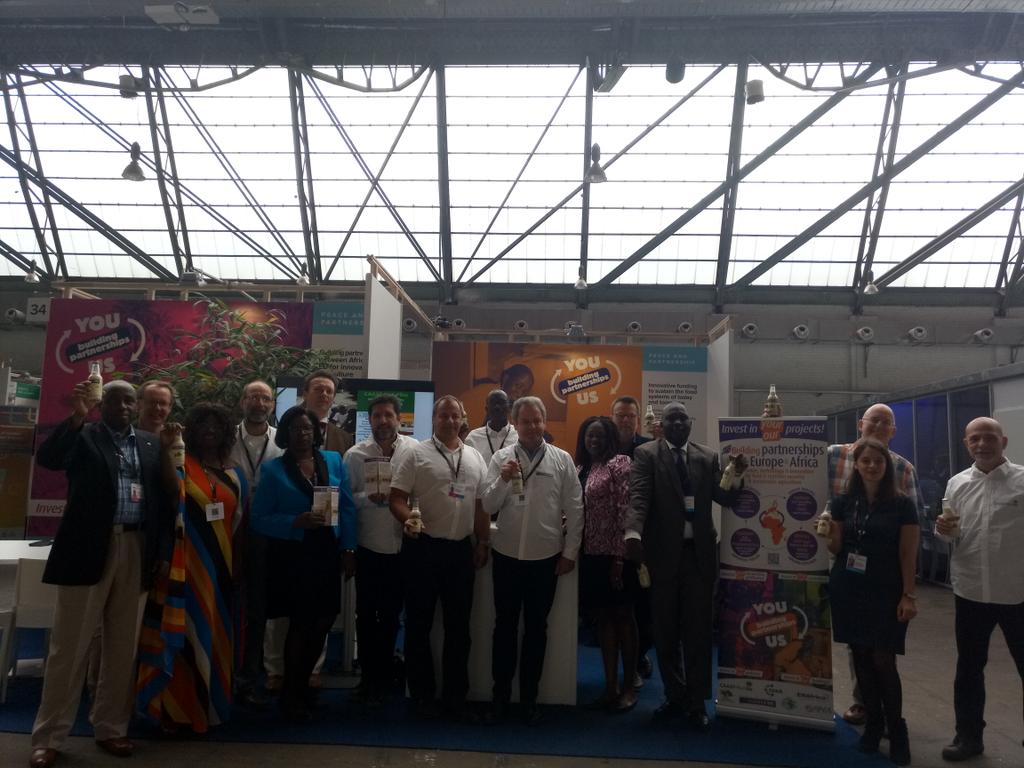
Stand 34: PAEPARD, FARA, Agrinatura, EFARD, CDAIS, Caast-net+, RINEA, Leap-Agri, FAO, PronIntensAfrica
See blogposts
See blogposts
- PAEPARD @ EDD2017: MAKE ARD FUNDING WORK 4 FARMERS 8 June 2017. DOWNLOAD THE NEWSLETTER HERE
- PAEPARD @ EDD2017: Processing food is the future of African jobs and innovation 7 June 2017. In a boot at the European Development Days(EDD 2017) PAEPARD is show casing the successful project: Re-engineered Soybean “Afitin” and Soybean Milk processing technologies in South and Central Benin (ProSAM).
 |
| Executive Director, FARA said: Showcasing PAEPARD, the best ship in Africa-EU research and innovation partnerships |
Stand 39: CABI
Stand 56: EC, CONCORD, etc
Stand 68: AESA, ACP
Stand 72: AECOM, ECORYS, CARDNO, DMI
Stand 73: ColeACP, YPARD, Gembloux Agro Bio-Tech, CEJA, Global Vert, ACP Young Professionals Network