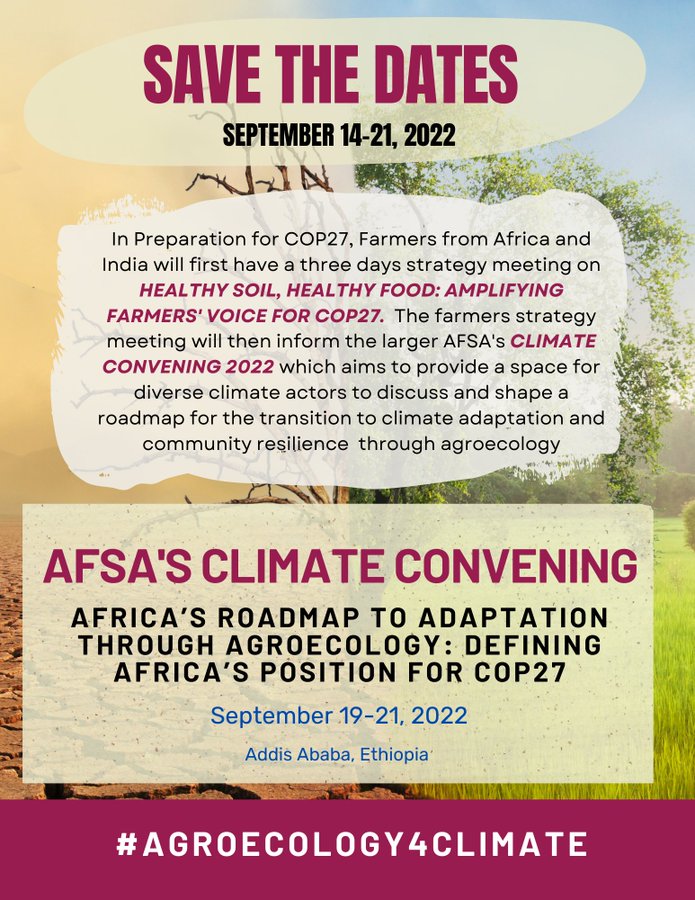
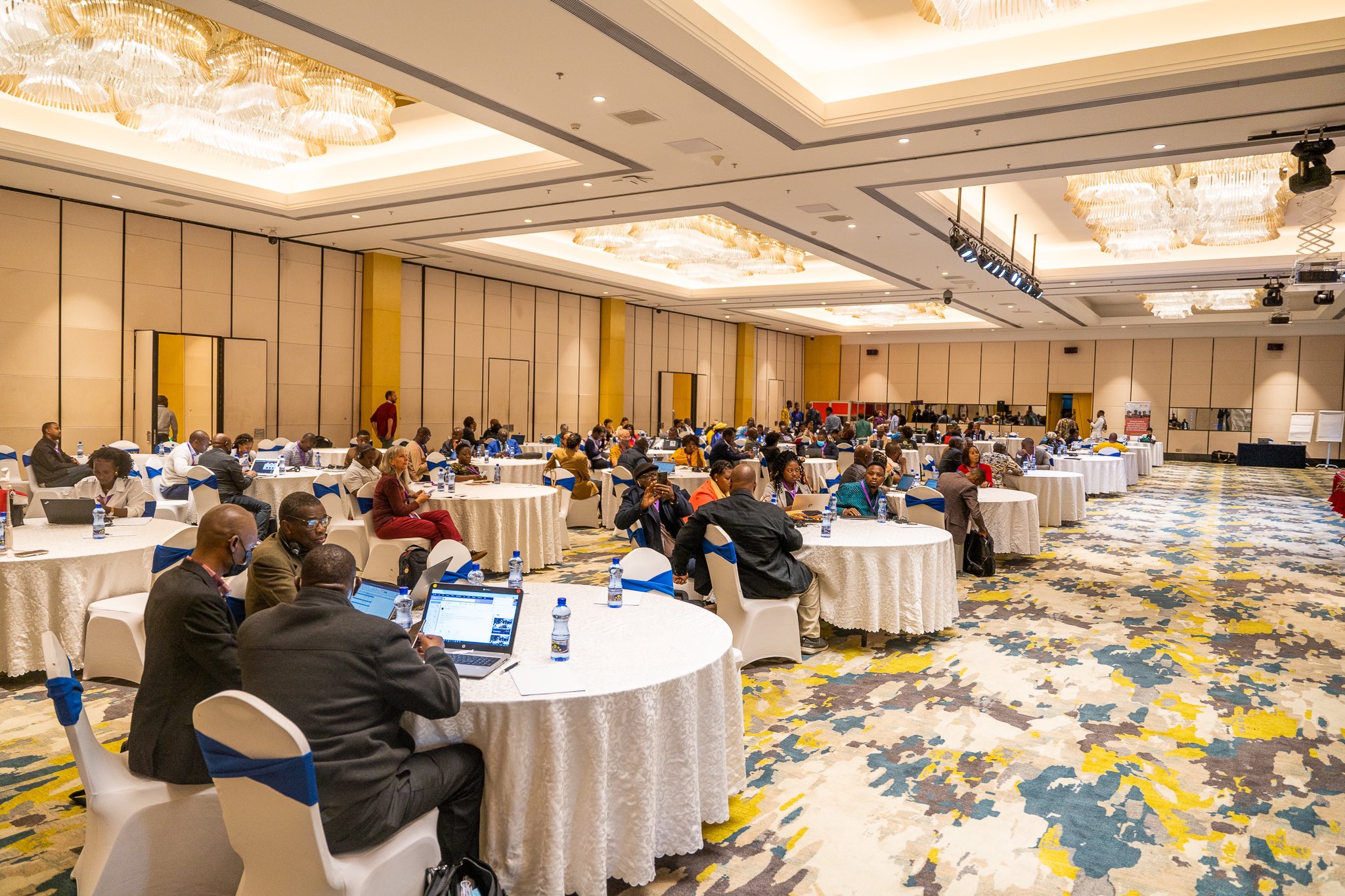
19 - 21 September 2022. AFSA’S CLIMATE CONVENING 2022 in Addis Ababa under the theme, AFRICA’S ROADMAP TO ADAPTATION THROUGH AGROECOLOGY and DEFINING AFRICA’S POSITION FOR COP27.
AFSA, the Alliance for Food Sovereignty in Africa, promotes agroecology and food sovereignty as an urgent 21st-century climate change solution and works to make the African food system more resilient.
In 2011, AFSA first appeared at COP17, the UN Climate Change Conference held in South Africa. As a civil society collaboration of 40 member networks of farmers, pastoralists, Indigenous people, citizens, and environmentalists from 50 African countries, the AFSA is a powerful uniting force that bolsters an agenda centered on small farmer-led agriculture. It is determined to amplify agroecological practices and resist initiatives that seek to privilege agribusiness and techno-fixes over justice and sustainability.
Focusing on areas such as land, seed sovereignty, and pastoralism, ASFA has published 33 case studies of agroecological practices across Africa, producing a “Know Agroecology” media guide for journalists, communicators, and practitioners. It has also amplified its ambitious “Agroecology for Climate Resilience” campaign to demonstrate that only agroecological practices will cool the planet, feed the world, and regenerate ecosystems. This project aims to reach 7 million African citizens and make agroecology a key climate mitigation and adaptation strategy in the official climate plans of 10 African countries.
This paper questions whether the Green Deal and Global Europe, the EU’s instrument for neighbourhood,
development and international cooperation, have led to increased political support for climate change adaptation
for agriculture to the benefit of smallholder farmers in sub-Saharan Africa. Or is the EU repackaging what already
existed?
Answering this complex question means looking at potential shifts in four areas related to EU development,
cooperation and finance: (1) narrative as expressed in recent policies and strategies towards Africa and the new
programming documents; (2) financing modalities and instruments; (3) partnerships with EU members states, the
private sector and development finance institutes; and, (4) implementation of projects in the period 2021-2022.
This paper ends with ten recommendations on how
to increase the much-needed support for adaptation in Africa’s agricultural sector and facilitate a change of direction
from finance, policy and practical perspective, ahead of the mid-term review of EU projects in 2024.
Agroforestry: A primer Design and management principles for people and the environment
Conventional agriculture comes at a cost: soil that is depleted or eroded, watercourses that are polluted or drying up, and a food system that produces 20–40% of greenhouse gas emissions. Many people now agree that we urgently need to transform the food system, including agriculture.
Agroforestry, as a nature-based approach to production and land use, will play an important role in this transformation. Agroforestry is not new; farmers have practised it for thousands of years, and scientists have recognized it since the 1970s as a productive and ecologically sustainable form of agriculture and land use. However, agroforestry is not just a matter of adding trees to farms. To realize its potential, practitioners need to understand its principles. Agroforestry: A primer is a guide to agroforestry principles and concepts – and how to use them effectively.
Contents • Introduction • Components of agroforestry systems • Agroforestry systems as circular systems • Principles of agroforestry design • Co-design and establishment of agroforestry systems • Planting material in agroforestry • Management of trees in agroforestry systems • From principles to practice: Key systems • Stories from the front line
14 - 16 September 2022. Accra Ghana. Science and Partnerships for Agriculture Conference. The Science and Partnerships for Agriculture Conference is crafted to encapsulate broad-based partnerships at different levels to address key issues in Africa’s agricultural research and innovation space.
The 2022 edition of the Biennial Africa Climate Smart Agriculture Stakeholders Conference
This edition provided opportunities for researchers, academicians and students to share their research findings.
To discuss agroecological approaches and practices which contribute to climate resilience and concrete ways in which agroecology can support adaptation and mitigation strategies
To make recommendations to mainstream agroecological principles into the Climate Change and Climate-Smart Agriculture debate and call for investments.
DeSIRA-LIFT supports FARA and its members in two main areas:
Organising two complementary sessions: (i) a Thematic Paper Presentation on
“Compatibility assessment of agroecology and CSA practices”, and (ii) a Side event
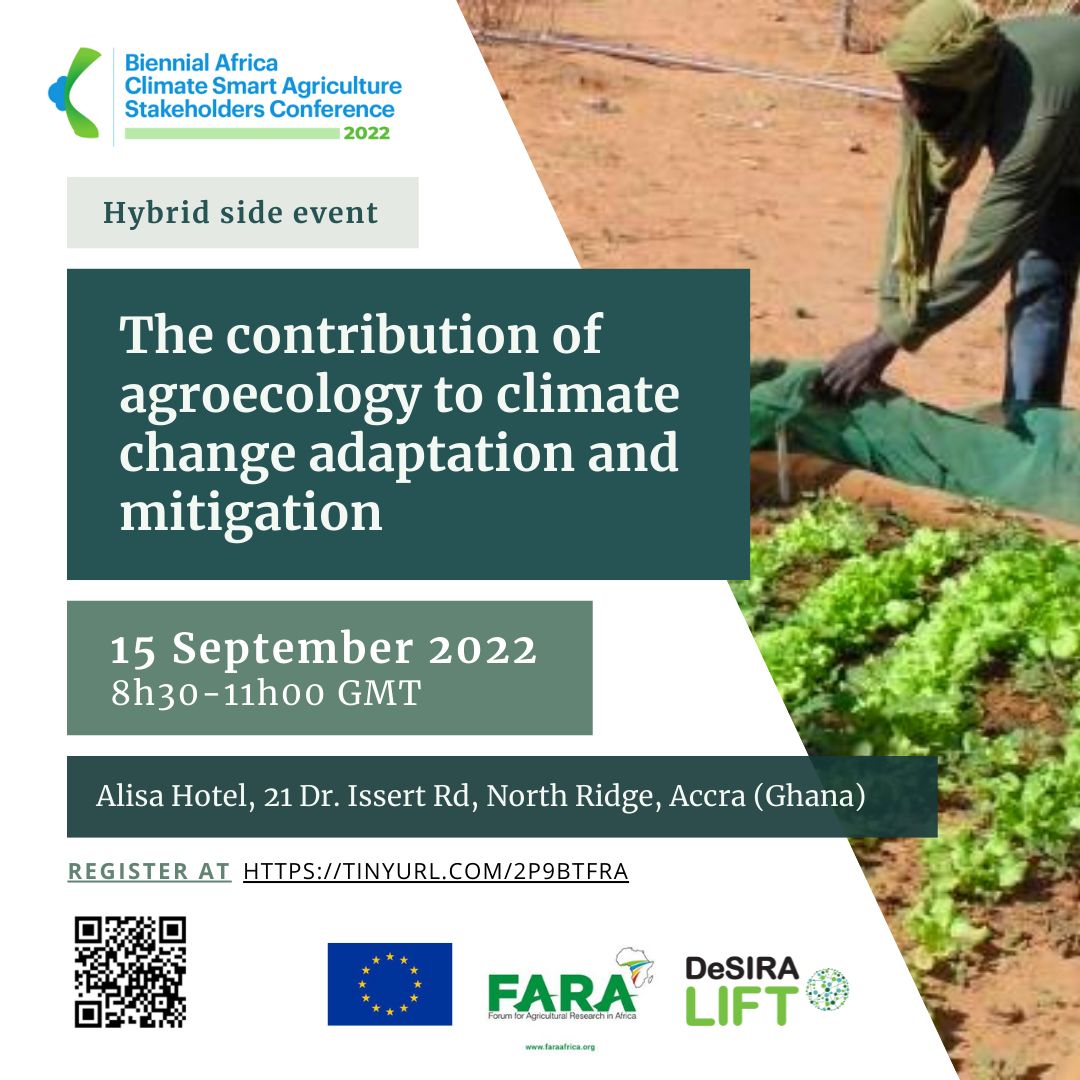
on “The contribution of agroecology to climate change adaptation and
mitigation” showcasing successes from smallholders, private sector operators
and CSOs in the field to showcase some sustainable innovations and solutions
adopted in Africa.
Supporting: (i) a review of ten years of African involvement and action in COPs
(between CoP 17 and CoP 27) detailing lessons learned and plausible future actions
and efforts to achieve the foreseen actions in relation to African agriculture; (ii) the
development of a Decadal Plan to implement the African Climate Change Strategy
on agriculture. Both reports will be presented at the Biennial CSA Conference. Main
preliminary findings will be presented at the Conference.
14/09 Compatibility assessment of agroecology and CSA practices
A literature review on agroecology, Maria Luisa Paracchini, JRC, Italy
Agroecological transformation in support of climate change adaptation and mitigation
in Africa, Pablo Tittonell, CONICET/University of Groningen, the Netherlands
The contribution of agroecology to CSA, Suwilanji Sinyangwe, FANRPAN, South
Africa
Ecological Organic Agriculture: A mitigating alternative for climate change, Oluyinka
Adewoyin, Department of Crop Science and Horticulture, Federal University, Oye,
Nigeria
14/09 Panel: Analysis of framework CSA/Agroecology
Smallholder Farmers and The Need for Climate-Smart Agriculture in Nigeria, Adebola
Adedugbe, Farmideas, Nigeria
Agronomy-driven climate-smart agriculture: Agronomy and climate adaptation and
mitigation, Bernard Vanlauwe, R4D Director at the International Institute of Tropical
Agriculture (IITA), Kenya
Climate-Smart Agricultural Practices for the sustainable food system in Nigeria: An
Agroecology-specific Analysis, Iredele Ogunbayo, Innovation Lab for Policy
Leadership in Agriculture and Food Security (PiLAF), Nigeria
Examining the strengths, weaknesses, opportunities and treats of agroecology in
ensuring food security and environmental sustainability, Never Mujere, Department of
Geography Geospatial Sciences and Earth Observation, University of Zimbabwe,
Zimbabwe
Biodiversity Conservation of Neglected and Underutilized Nigerian Horticultural Crops,
Funmilayo Mary Oloyede, Department of Crop Production and Protection, Obafemi
Awolowo University, Ile-Ife, Nigeria
Agronomic Evaluation of Soybeans (Glycine Max (L.) Merrill) Under Crop Rotation
System in The Forest-Savanna Transitory Location in The Humid Tropics, Victor Olowe, Institute of Food Security, Environmental Resources and Agricultural Research
(IFSERAR), Nigeria
Agroecological Cropping Systems Management: Impact of Conservation Agriculture in
Maize-Based Cropping Systems, Anthony Imoudu Oyeogbe, University of Ibadan,
Nigeria
Agroecological Differentials in Crop Production: Evidence from Smallholder Rice
Producers in Nigeria, Tenitayo Adeyemo, Nigerian Institute of Social and Economic
Research, Nigeria
Panel: Nature based solutions/Agroecology
Analysis of Agroforestry Practices Among Small-Scale Farmers in Southern Guinea
Savannah Zone of Nigeria, Adeola Oloyede, Dept of Agricultural Economics,
University of Ilorin, Nigeria
Mangrove Forest Restoration Nature-Based Solution to Climate Change: An Agroecological Contribution to Climate Sensitive Agriculture in Coastal Communities,
Ogunnaike Gbemisola, Dept of Agricultural Economics and Farm Management,
Olabisi Onabanjo University, Nigeria
Assessment of stakeholders’ satisfaction for Sustainable ecological agricultural
practices that promote climate-smart agriculture in Nigeria, Taofeeq Yekinni,
Agricultural Extension and Rural Development, University of Ibadan, Nigeria
Enhancing agroecology as an effective Climate Smart Agriculture approach to reduce
wildfires vulnerability in the savannah ecological zone of Ghana, Aline Mwintome
Naawa, WASCAL Doctoral Program, Université de Lomé, Togo
GIZ, the World Bank and the International Livestock Research Institute (ILRI) organised a virtual closing event of the Programme for Climate-Smart Livestock Systems. After almost five years of implementation, the programme shared key findings and lessons learned on supporting the development of climate-smart livestock systems in Africa. Experts in the field showcased selected adaptation and mitigation measures and discussed with key stakeholder the role of policies and finance to bring climate-smart livestock practices and measures to scale.
The Programme for Climate-Smart Livestock Systems (PCSL) is implemented by Deutsche Gesellschaft für Internationale Zusammenarbeit (GIZ) together with the International Livestock Research Institute (ILRI) and the World Bank on behalf of the German Federal Ministry for Economic Cooperation and Development (BMZ).
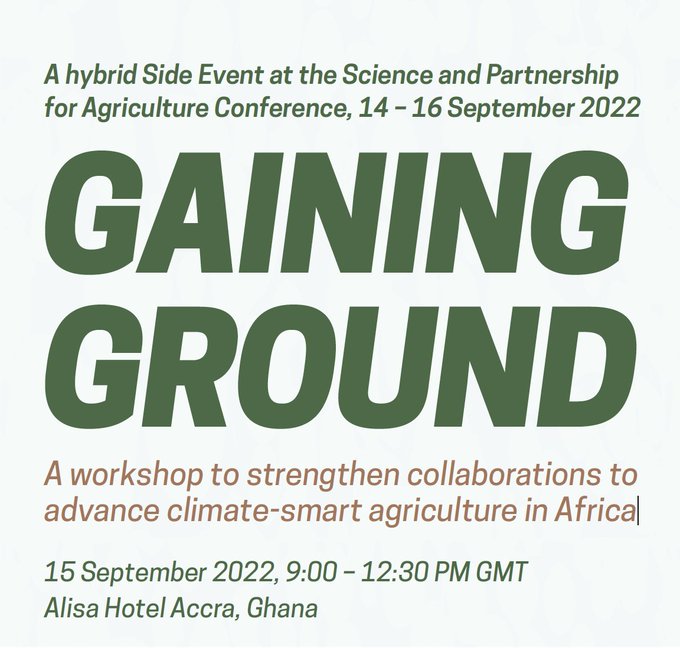
As part of the GRA’s continuing commitment to strengthening countries’ scientific capability and institutional capacity to increase productivity, enhance resilience and reduce greenhouse gas emissions, we are pleased to present “Gaining ground” – a workshop to strengthen collaborations to advance climate-smart agriculture (CSA).
The workshop/side event showcased science-based practices that illustrate pathways to climate-smart, low-emission agricultural development. The event also offered an open platform to discuss how to connect the various emerging opportunities and different actors engaged in CSA to help advance long-term CSA change (See details in flyer below). Expert facilitators shared their personal experiences in working with different stakeholders from both developed and developing countries, answer questions, and highlighted further opportunities for research collaboration provided by the GRA and other related science networks.
Introduction
Dr. Sega Ndao, NZAGRC
Keynote address
State of knowledge and policy
efforts to improve inventory
estimates and mitigate livestock
GHG emissions in Africa.
Dr. Claudia Arndt, ILRI
Scaling up CSA: What are the
missing links?
The context for scaling up CSA,
practical elements to guide
thinking and planning around
scaling up and pathways for taking
CSA to scale in Sub-Saharan Africa.
Dr. Ackim Mwape, NZAGRC
Demonstrating CSA
Two invited papers demonstrating (i)
how effective low-carbon, climateresilient technologies and systems
can facilitate scale up and
replication; and (ii) how linking
government and university sectors
in CSA research programmes can
have a strong policy context.
Dr. Edward Yeboah, CSIR
Panel discussion on how collaborative relations in
CSA can enhance food system
resilience and climate protection.
The Agroecology Dialogue Series is an initiative of FAO and the Biovision Foundation in support of the Coalition for food systems transformation through Agroecology (Agroecology Coalition).
The Science and Partnerships for Agriculture Conference is crafted to encapsulate broad-based partnerships at different levels to address key issues in Africa’s agricultural research and innovation space.
14 September 2022. 2022 scientific meeting of the Pan-African Network for Economic Analysis of Policies (PANAP)
The Pan-African Network for Economic Analysis of Policies (PANAP) is a network for researchers, data producers and analysts from governmental bodies and other research institutions in various partner countries. These countries collaborate with the European Commission and the African Union Commission in developing research on agricultural economics and policy issues with the focus on Africa. The objective of the PANAP network is to strengthen the liaison between researchers/scientists and policymakers in Africa and to stimulate their cooperation on selected topics linked to policy priorities that reinforce the agricultural sector’s stability in Africa.
Panel discussion 1: A changing world: Implications and policy challenges for Africa
Co-chaired by A. Agumya (FARA) and Genovese G. (EC-JRC)
Charles Peter Mgeni, Sokoine University of Agriculture (SUA)
Souleymane Diallo, Centre Ivoirien de Recherches Economiques et Sociales (CIRES)
Astou Camara Diao, Senegalese Institute of Agricultural Research (ISRA)
Endeshaw Habte, Ethiopian Institute of Agricultural Research (EIAR)
Dr. R. Ngugi, Kenya Institute for Public Policy Research and Analysis (KIPPRA)
Mamadou Adam, Institut National de la Recherche Agronomique du Niger (INRAN)
Dr. Fred Dzanku, Institute of Statistical, Social and Economic Research (ISSER)
Panel discussion 2: European Union policies and possible impacts on the African
agricultural sector.
Co-Chaired by Dr. G. Bahiigwa (AUC-ARBE) and J. Clarke (EC - AGRI)
Panel discussion 3: Policy impact analysis and role of PANAP to promote the use
of science-based policies.
Co-Chaired by TBC Dr. S. Nouala (AUC-ARBE) and TBC (EC-INTPA)
Dr. A. Agumya, Forum for Agricultural Research in Africa (FARA)
E. Ferrari, European Commission – JRC (EC - JRC)
TBC, Common Market for Eastern and Southern Africa (COMESA)
TBC, Economic Community of West African States (ECOWAS)
D.S.D. Amany, Banque ouest-africaine de développement (BOAD)
TBC, Akademya2063
15/09 PANAP governance meeting: Memberships of PANAP, Terms of Reference,
Functioning and governance of PANAP
Impact of AfCFTA: a collaborative example of policy impact analysis
Co-Chaired by E. Ferrari (EC - JRC) and TBC (AUC-ARBE)
TBC, African Continental Free Trade Area (AfCFTA) Secretariat
A. Simola (remote) and V. Nechifor, European Commission – JRC
J. Laichena, Kenya Institute for Public Policy Research and Analysis (KIPPRA)
A. Agyei-Holmes, Institute of Statistical, Social and Economic Research (ISSER)
TBC, Sokoine University of Agriculture (SUA)
O. E. Omoju, National Institute for Legislative and Democratic Studies (NILDS)
S.A. Sangaré, Cellule d'analyse des politiques publiques et évaluation de l'action
gouvernementale (CAPEG)
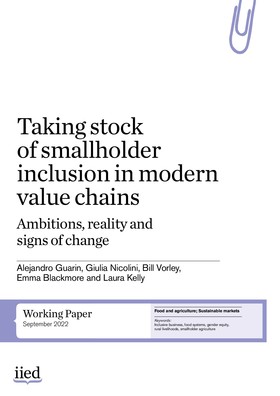
This report examines the promise and reality of including smallholders from developing countries in modern value chains as a path to sustainable development. Drawing on an extensive literature review and interviews with diverse stakeholders, we lay out the ambitions, expectations and assumptions hanging on smallholder inclusion with regard to income, gender equity and environmental sustainability. We describe the gaps between expectation and reality, suggesting that inclusion — as conceptualised and implemented — is poorly suited to the complex challenges faced by farmers.
The report identifies five signs of change in the discussion about smallholder inclusion, and reflect on what these might mean for its future.
The Science and Partnerships for Agriculture Conference is crafted to encapsulate broad-based partnerships at different levels to address key issues in Africa’s agricultural research and innovation space.
15 September 2022. Soil Initiative for Africa Stakeholders Consultation
The Soil Initiative for Africa (SIA) is an initiative of the Africa Union Commission (AUC) to respond to the
need for sustainable use of African soil. Anecdotal data on arable soil in the world suggest that 60% of
the world’s available arable land is in Africa.
The SIA is currently being developed by a broad stakeholder group in African agriculture under the
leadership of FARA. The initial task team comprised representatives of the Sub-regional Organizations
(SROs) (CORAF, CCADERSA, ASARECA) and AFAAS. Further key stakeholders include the African Soil
Partnership (AfSP) (African chapter of the FAO Global Soil Partnership [GSP]) and enthusiasts in soil
development that are also drawn from other African organizations.
Legumes are important in crop rotations, because they reduce weeds and enrich the soil by partnering with nitrogen-fixing bacteria in the soil. To be sure your soil has the right bacteria, you can buy an inoculant of Rhizobium bacteria. Rhizobium bacteria can survive several years in your soil, so you do not need to inoculate your legume crop every time.
Science and Partnerships for Agriculture Conference.
The Science and Partnerships for Agriculture Conference is crafted to encapsulate broad-based partnerships at different levels to address key issues in Africa’s agricultural research and innovation space.
The CAADP-XP4 partners initiated and rolled out the Knowledge
Management for Agricultural Development (KM4AgD) agenda in 2021, which involves
a three-month certification training (the Challenge) and an annual Conference. The
KM4AgD agenda set out to build appropriate capacities of relevant stakeholders,
establish communities of practice for Knowledge Management (Artificial Intelligence)
and strengthen the knowledge ecosystem to accelerate the achievement of the CAADP
Malabo goals by 2025, the AU agenda2063 and the SDGs by 2030. The KM4AgD agenda
is implemented through an integrated, strategic, educational and transformational
approach.
Keynote Presentation
Topic: How Knowledge influences
economies and helps them achieve
sustainable development - Prof. Albert Ahenkan
Professor of SD & Head of
Department, Public Admin &
Health Services, University of
Ghana Business School
15/09 KM Strategies in
Agricultural Research Organizations
in Africa
Presentation by KALRO - Dr Boniface Akuku
Director of Knowledge
Management & ICT, KALRO,
Kenya
15/09 ICIPE Session: Accelerating Inclusive
Green Growth through Agri-based
Digital Innovation in West Africa
(AGriDI)
Moderator: Dr Jonas Mugabe
Programme Manager, AGriDI
Scaling AgroCenta Platform and Adoption for Effective
Market Linkages in Ghana (SAPA) by AGROCENTA
Digital Tools to Drive Market Access and Manage
Ag-Value Chains (DigiMakt) by ESOKO.
Enhancing farmers’ uptake of digital technologies
through empirical research, innovation, and policy intervention
(EFUDTRIP) by STEPRI
16/09 Km4AgD Communities of Practice
Presentations and Discussion on the
Recommended KM Framework for a
CAADP-XP4 – One CGIAR Collaboration from the KM4AgD Challenge - Mr Micheal Victor & Ms Bridget
Kakuwa
Advancing knowledge diversity and inclusion; promoting indigenous knowledge and decolonizing knowledge - Dr. Sarah Cummings (Director at K4DP and Lecturer, Waageningen University
Demonstration of Outreach and
Extension equipment for promoting
Indigenous Knowledge - Mr Kouadio Amavi
Digisoft Africa
14 - 16 September 2022. Accra Ghana. Science and Partnerships for Agriculture Conference. The Science and Partnerships for Agriculture Conference is crafted to encapsulate broad-based partnerships at different levels to address key issues in Africa’s agricultural research and innovation space.
A final write-shop involved all institutions that have declared their interest to be members of the IRC. This write-shop culminate in the ‘Founding Launch of the IRC’. The final General Assembly brought together the 35 beneficiary institutions of the LEAP4FNSSA project for a final ratification of key actions and decisions for the project and on the IRC.
Functions and services Introduction WG leader: Emanuel Okalany, Petronella Chaminuka Discussant: on the IRC functions and services - Prof. Theresa Nkuo-Akenji, Vice Chancellor of University of Bamenda, Cameroon, and RUFORUM Board Chair
Governance & coordination: Introduction & clustering WG leader: Stephanie TruilléBaurrens, Jackie Kado Discussant: : Ensuring an inclusive approach in the IRC Governance and Coordination - Dr. Abdou Tenkouano, Executive Director, CORAF
Membership criteria & growth strategy Introduction WG leader: Patricia Wagenmakers, Thato Morokong Discussant: Dr Cliff Dlamini Executive Director CCARDESA
Funding Strategy - Introduction WG leader: Henning Knipschild, Jacob Kamwaria Njagih Discussant: Hamidou Tamboura, General Director of FONRID
Knowledge Management, Communication and dissemination Introduction WG leader: Jannis Dimitriou, Carlo Sansivieri Discussant: Dr Silim Nahdi, Executive Director AFAAS
Impact Pathway Introduction: WG leader: Tim Fry, Stefan Haffner Discussant: Dr. Enock Warinda, Executive Director ASARECA
Available recording
Presentations
Opportunity
HORIZON-CL6-2023-FARM2FORK: Long-term sustainable platform for the EU-AU cooperation under the FNSSA partnership.
The GLF Africa Digital Conference will highlight leading change-makers, voices and thinkers from Africa and the world to show the power of community-led action for food security, drought management and healthy ecosystems.
The day will feature inspiring speakers, the latest science, virtual speakers, concerts, job opportunities and the chance to network with those shaping the future of the world.
Many of us face concerns or anxieties over news of fires, floods, and other looming environmental problems in the world. In this webinar, we will discuss how thriving soil ecosystems can help alleviate future disruptions and heal the damage done to our precious biosphere.
Dr. Adam Cobb will explore our ‘tiny allies’ in the soil, using the example of arbuscular mycorrhizal fungi to highlight how soil food webs create the conditions for life to flourish.
Didi Pershouse will discuss how landscapes function as wholes, and how the soil sponge is the vital infrastructure that regulates local climate and makes life on land possible. She will present how soil biology, plants, and other forms of life are the essential workforce of our biosphere. For example, fungi entangle soil particles to improve aggregation, enhancing healthy soil’s sponge-like ability to soak up water and provide resilience to flooding and drought. The biosphere contains wonderous organisms, such as mycorrhizal fungi in soil. If we learn to work with these tiny allies, rather than against them, there is hope for a future where life is protected, ecosystem health is restored, and human needs are provided for, without degradation of our planet.
The Science and Partnerships for Agriculture Conference is crafted to encapsulate broad-based
partnerships at different levels to address key issues in Africa’s agricultural research and innovation
space.
The conference hosts four continental and bi-continental initiatives supported by different
European Union funding portfolios, International Fund Agricultural Development, Catholic Relief Services,
GCA, GRA, etc. The four key conferences will run simultaneously but independently.
The 2022 Biennial
Africa CSA stakeholders conference;
The LEAP4FNSSA final writeshop to develop the EU/AU International
Research Consortium on Food and Nutrition Security and Sustainable Agriculture and closing General
Assembly;
the2022 scientific meeting of the Pan-African Network for Economic Analysis of Policies
(PANAP)
and the Knowledge Management for Agriculture Conference (KM4AGD). Lead Paper Presentation: “Introspection on CSA Action to Strengthen - Accountability, Resource Use and Impact in Africa” by Dr. Bruce Campbell (ClimEAT)
The joint conference provided the opportunity to leverage the participation of high-level individuals in Africa and European
agriculture to jointly address pertinent emerging issues affecting the continent. The four conferences and
their constituents will provide important technical and policy information from different engagements.
Goodwill message
Dr. Hans
Hoogeveen
GACSA co-chair
Goodwill
message
ADG- FAO Dr Abebe
Haile Gabriel
Video
message
Stephen
Quest DG
JRC European
Union
Commission
Mariya Gabriel,
European
Commissioner for
Innovation,
Research, Culture,
Education and Youth
Goodwill
message
Massimo
Mina, Head of
Cooperation,
Delegation of the
European Union to
Ghana
Goodwill Video
message
HE Nardos
Bekele Thomas
CEO of AUDA-NEPAD
Video message
HE Josefa
Sacko
Commissioner of
DERBE, AUC
Video message
Dr. Akin
Adesina President
of Africa Development
Bank
Welcome Address
Dr. Owusu Afriyie
Akoto
Minister of Food and
Agriculture, Ghana
Keynote Address
HE. Jeanine Milly Cooper
Minister of Agriculture, Liberia
Lead Paper
“Introspection on CSA Action to Strengthen Accountability, Resource Use and Impact in Africa”Dr. Bruce Campbell (ClimEAT)
14/09 CSA Biennial Conference Thematic Paper Presentation
The role of digitalization in advancing CSA in the smallholders’ systems Facilitator: Dr. Vincent Aduramigba [GCA]
The nexus of CSA and the mechanization of the smallholder system in Africa. Facilitator: Dr Mkomwa [ACTN]
Bottom-up and systemwide capacity development approaches; to enhance CSA practices Facilitator: Prof. Babalola
Strengthening the support of extension and advisory services to ensure CSA compliance among smallholder farmers in Africa Facilitator: Max Olupot [AFAAS]
Advances in CSA technology generation and use in the crop, livestock, fisheries, and aquaculture. Facilitator: Dr Alcade Segnon [AICCRA]
Compatibility assessment of agroecology and CSA practices Facilitator: Dr. Cliff Dlamini [DeSIRA-Lift ]
15/09 Side Events
Climate
information
services in
climate-smart
agriculture:
enhancing
resilient
agrifood
The
contributions
of agroecology
to climate
change
Annual Meeting
of the
Continental
Think-Tank for
responding to
Emerging issues
in African
agriculture
Gaining
Grounds…a
workshop to
strengthen
collaborations to
advance climate smart
agriculture in
Africa
Soil Initiative
for Africa
(SIA)
Stakeholders
Consultation (see available recordings)
The AGRF, Africa’s premier forum for food and agriculture, has launched its 12th annual summit under the theme ‘Grow, Nourish and Reward – Bold Actions for Resilient Food systems’
09/09 Food Innovation Hubs: Taking Innovation to Scale
Innovation is critical to food systems transformation: Innovations in technology, climate mitigation and adaptation, inputs, alternative proteins and business models across the agricultural value chain
abound. Yet many fail to go to scale, reflecting the systemic nature of agricultural value chains and
food systems. This session looked at some of the common barriers to scale and discussed the role of
innovation incubators, hubs and other models for knowledge sharing and scaling of innovation.
Moderator: Mr. Sean de Cleene, Member of the Executive Committee, Head of the Future of Food, World Economic Forum
Opening Remarks: Hon. Mariam Almheiri, Minister of Climate Change and Environment, United Arab Emirates and Co-Lead, Food Innovation Hubs
Firestarter remarks: Challenges to scale
Mr. Kees Aarts, Founder and CEO, Protix
Mr. Claude Munyangabo, CEO, BK Techouse
Ms. Anna Marie Silvester, Innovation Team Lead, Microsoft
Mr. Akintunde Akinwande, Head of Digital and Business Development Nigeria, Middle Africa, OCP Africa
Mr. Kunal Prasad, Co-Founder, Cropin Technology
Panel Discussion: Building Eco-systems for Scale
Mr. Eugene Kandel, CEO, Start Up Nation Central
Ms. Tesi Rusagara, Managing Director, Kigali Innovation City, Rwanda
Mr. Mehrdad Ehsani, Vice President for the Food Initiative in Africa, The Rockefeller Foundation
Mr. Jonathan First, Consultant, Climate Policy Initiative
Mr. Jeremie Pige, Head of IGNITE – WFP Innovation Hub for Eastern Africa
Ms. Amandla Ooko-Ombaka, Economist and Associate Partner, McKinsey
Mr. Parmesh Shah, Global Lead for Rural Livelihoods and Agricultural Jobs, World Bank
Closing Remarks and Special Announcement
Hon. Gerardine Mukeshimana, Minister of Agriculture & Animal Resources Rwanda
H.E. Amb. Ertharin Cousin, Founder and CEO, Food Systems for the Future and Former Executive Director, WFP
Hon. Pudence Rubingisa, Mayor, City of Kigali, Rwanda
09/09 The role milk, meat, and eggs play in sustainable food systems transformation
This session looked at specific cases of livestock contributions to food systems transformation and drew out lessons learned in transforming the sector.
Moderator: Ms. Shirley Tarawali, Assistant DG, ILRI and Global Agenda for Sustainable Livestock (GASL)
Ms. Adesuwa Ifedi, Vice President, Africa Heifer International
Dr. Iain Wright, Deputy DG, International Livestock Research Institute (ILRI) - Keynote Remarks
Four ‘rapid-fire’ case presentations with a focus on different aspects of food systems transformation: environment/climate, gender/youth, region, and value chain diversity
Panel Discussion:
Hon. Minister of Agriculture, Chad
Ms. Emma Naluyima, Smallholder Farmer, Uganda
Mr. Ishmael Sunga, CEO, Southern African Confederation of Agricultural Unions (SACAU)
Mr. Faustin Mbundu Kananura, Executive Chairman, MFK Group Rwanda
Mr. Ekko Oosterhuis, Managing Director, Silverlands Tanzania ltd.
Mr. Gbola Adesogan, Director, Food Systems Institute, Feed the Future Innovation Lab for Livestock Systems
Mr. Geoffrey Kirenga, CEO, SAGCOT Centre
Ms. Elizabeth Swai, CEO and Founder, AKM Glitters Company Limited
09/09 Accelerating Youth Employment in Food Systems and Agriculture
Generation Africa has designed a youth in Ag Ecosystem development framework through Generation Africa. The tool will ensure that Governments are able to coordinate collaborative actions from different actors to focus on creating an enabling environment that will ensure the youth are accounted for in the development and inclusion.
Moderator: Mr. Simon Winter, Executive Director, Syngenta Foundation
Mr. Dickson Naftali, Head, Generation Africa
Hon. Rosemary Mbabazi, Minister of Youth and Culture, Rwanda - Keynote remarks – Rwanda’s Perspective
Mr. Henry Lagat, Associate Partnership Officer, Generation Africa - Presentation of Youth Employment Development Framework
Panel Discussion:
Hon. Moussa Baldé, Minister of Agriculture and Rural Equipment, Senegal
Dr. Donal Brown, Associate Vice President, Programme Management, IFAD
Ms. Subhashini Chandran, Head of Social Impact, Africa & Asia, YARA
Ms. Betty Kiplagat, Government Affairs Leader, Africa & the Middle East, Corteva
Ms. Almas Jiwani, President of Emeritus UN Women Canada NC and CEO of Almas Jiwani Foundation
09/09 True Value of Food
This session unpacked the critical role of food in development, highlighting new ways to think about food and food markets, the impact of subsidies and buying cartels, alongside strategies for resilience, sustainability, access, inclusion and organisation in food systems.
Moderator: Mr. Roy Steiner, Senior Vice President, Rockefeller Foundation
Mr. Peter Bakker, CEO, World Business Council for Sustainable Development - Keynote Remarks – The True Value of Food in Africa
Panel Discussion:
Mr. Biendi Maganga-Moussavou, Former Minister of Agriculture, Livestock, Fisheries and Food, Gabon
Hon. Dr Jeanne d'Arc Mujawamariya, Minister of Environment, Rwanda
Dr. Lawrence Haddad, Executive Director, GAIN
Prof. Sheryl Hendricks, Head of Department and Professor in the Department of Agricultural Economics, Extension, and Rural Development, University of Pretoria, South Africa
Mr. Tabi Joda, Expert in Local Communities' Ecosystems Resilience
Mr. Ben Valk, Global Head Food and Agri Partnerships, Rabobank
Ms. Helena Leurent, Director General, Consumers International
Ms. Cynthia Samuel-Olonjuwon, Assistant Director-General and Regional Director for Africa, International Labour Organization (ILO)
Ms. Belinda Bwiza, Rwanda Deputy Country Director, One Acre Fund
Mr. Francois Nsengiyumva, Managing Director and CEO, Kilimo General Business Ltd
Mr. Omid Kassiri, Managing Partner, East Africa, McKinsey
Mr. Amar Ali, President, Africa Region, Royal DSM
09/09 Finance Risk-Return Trade Off
The overall objective of the session was to discuss the risk – return trade off that informs the decision to invest, the cost of finance and sector allocation.
Ms. Diane Karusisi, CEO, Bank of Kigali
Ms. Hong Thuy-Patterson, Chief Financial Officer and Chief Operations Officer, Green Climate Fund
Mr. Jules Ngankam, CEO, Africa Guarantee Fund
Mr. Ibrahima Cheikh-Diong, UN-ASG and Director-General, Africa Risk Capacity Group
Mr. Yosuke Kotsuji, Acting Manager of Agribusiness and Forestry, IFC Africa
This workshop guided attendees through numerous functionalities of the GLFx platform on which the CoP is hosted, shed light on the scope and purpose of our vibrant and growing community of agroecology enthusiasts, provided a wealth of real-life examples of the CoP features, and explained how to join the CoP to all new members.
Welcome remarks from the Agroecology TPP team
Fergus Sinclair, Chief Scientist, CIFOR-ICRAF; Co-convenor of the Agroecology
TPP
Philippe Vaast, Chief Scientist, CIRAD; Co-convenor of the Agroecology TPP
The Agroecology TPP’s story, projects, objectives, and modes of engagement
Fergus Sinclair, Chief Scientist, CIFOR-ICRAF; Co-convenor of the Agroecology
TPP
Lisa Fuchs, Social Systems and Engagement Scientist, CIFOR-ICRAF, AE-TPP
Scientific Coordinator
The Agroecology TPP Community of Practice
- Purpose, features, and how to join
Fabio Ricci, Communications Specialist, CIFOR-ICRAF and Agroecology TPP
Background:
The Transformative Partnership Platform (TPP) on agroecological approaches to building resilience of livelihoods and landscapes aims to foster transitions to more sustainable agricultural and food systems. It seeks to do so by accelerating and co-ordinating the actions of a range of institutions that are already working on agroecology across various scales, contexts and locations.
6 - 10 June 2022. (video uploaded 13/09/2002) The 2022 CIFOR-ICRAF Science Week Annual Meeting (SW2022 in short) took place during the week of 6-10 June 2022 as a hybrid meeting, connecting 500+ scientists across the world. The event was jointly run with staff gathered in hubs in Nairobi, Kenya and Bogor, Indonesia supplemented as well as connecting remotely across the 30 or so countries where CIFOR-ICRAF has offices and worldwide to our scientific staff connecting via Zoom.
Stewardship economy (like nature-based solutions) has an environmental pedigree, focusing on the need to conserve but recognizing that farmers and foresters are key actors that need to be part of the solution – looking at how they can become stewards of the environment. Agroecology on the other hand, starts with farming and food production but tries to do it equitably and in harmony with nature. While on the surface we might expect these two stands to meet in the middle, in reality the mindsets associated with initiatives coming from the conservation and agricultural traditions respectively are often fundamentally different. At the end of the session, we hope to have clarity on the similarities and differences offered by these approaches and how CIFOR-ICRAF should embrace them as either complementary or competing paradigms.
The AGRF, Africa’s premier forum for food and agriculture, has launched its 12th annual summit under the theme ‘Grow, Nourish and Reward – Bold Actions for Resilient Food systems’
This "Council of the Wise" encouraged African leaders to increase funding to the agriculture sector, meeting CAADP, SDGs and Food Systems targets by 2030 and to solicit stronger accountability of the AGRF partners in delivering on commitments.
Moderator: Ms. Aggie Konde, Vice President, AGRA
Ms. Jennifer Baarn, Managing Director, AGRF
Mr. Maximo Torero, Chief Economist, FAO - Framing Keynote Remarks: Our Future with Business as Usual
H.E. Hailemariam Dessalegn, Chair, AGRF Partners Group and Former Prime Minister, Ethiopia
H.E. Chief Olusegun Obasanjo, Former President, Nigeria and Outgoing Chair of the Africa Food Prize Committee
H.E. Jakaya Kikwete, Former President, Tanzania and Incoming Chair of the Africa Food Prize Committee
H.E. John Kufuor, Former President, Ghana
H.E. Ellen Johnson-Sirleaf, Former President, Liberia
H.E. Joyce Banda, Former President, Malawi
H.E. Lionel Zinsou, Former Prime Minister, Benin
H.E. Ibrahim Hassane Mayaki, Former Prime Minister, Niger
Rt. Hon. Tony Blair, Executive Chairman, Tony Blair Institute for Global Change
H.E. Mary Therese Winifred Robinson, Former President of Ireland, and chair of the Women Leaders Network
Tidjiane Thiam, Former CEO, Credit Suisse
Mr. Donald Kaberuka, Former President, African Development Bank (AfDB)
08/09 AGRA Strategy Launch
This session highlighted AGRA’s results and journey since 2006 as well as the new strategy for 2023-
2027. This platform provided an opportunity to reengage existing participants and potential partners to
showcase AGRA’s continuous effort in leveraging its learnings to deliver stronger, more resilient food
systems on the continent.
08/09 AGRA New Strategy Launch press briefing
08/09 Building Diverse and Nutritious Food Markets in Africa
Perhaps the most critical component of Food Systems in Africa, certainly the most visible to the majority of Households, is the Food Market.Households across the continent depend on food markets to provide them with access to nutrition. However, with recent disruptions caused by COVID-19 and the Russia-Ukraine war, how can we build diverse food markets that will secure our most vulnerable communities against malnutrition and undernutrition?
Moderator: Ms. Lindiwe Sibanda, Director, Centre of Excellence in Food Security, University of Pretoria
Mr. Nico Janssen, Programme Manager, Agricultural Livelihoods, IKEA Foundation
Mr. Michael Ojo, Nigeria Country Director, GAIN
Ms. Lynn Brown, Director of Alliances and Policy, HarvestPlus
Ms. Fannie Gondwe, Founder and Executive Director, Perisha Agro and Packaging Enterprise
Dr. Gabriel Rugalema, Regional Director, World Vegetable Centre
08/09 Leveraging Data to Improve Intra-Africa Food Trade
The intended outcome of this session was to gather commitments and encourage governments to align national and regional strategies and policies to support the successful implementation of the African Continental Free Trade Area.
Mr. Daniel Njiwa, Head of Regional Food Trade and Secretariat, Regional Food Trade Coalition
Presentation of the Key Findings of the Africa Trade Status Monitor (ASTM) Dr. Ousmane Badiane, Founder and Executive Chairperson, Akademiya 2063
Panel Discussion:
Hon. Chipoka Mulenga, Minister of Commerce, Trade and Industry, Zambia
Hon. Dr. Ashatu K. Kijaji, Minister of Investment, Industry and Trade, Tanzania
Hon. Masuku Phelela, Minister of Lands, Agriculture and Rural Resettlement, Zimbabwe
Hon. Wamkele Mene, Secreatary General, African Continental Free Trade Area Secretariat
Hon. Dr Omar Touray, President, ECOWAS Commission
Mr. Peter Mathuki, Secretary General, East African Community
Hon. Chileshe Kapwepwe, General Secretary of the Common Market for Eastern and Southern Africa
Ms. Maura Barry Boyle, Senior Deputy Assistant Administrator, Bureau for Resilience & Food Security, USAID
Mr. Mansoor Ahmad MBE, Group Head, Africa Economic Development, FCDO UK’s Foreign, Commonwealth & Development Office
Mr. Johan Swinnen, Director General, International Food Policy Research Institute (IFPRI)
Mr. David Phiri, FAO Sub-Regional Coordinator for Eastern Africa
08/09 South-South Cooperation: Leadership from the Americas and Asia
In this session, leaders from Africa, Asia and the Americas shared experiences, lessons and ambitions for the next phase of development.
Moderator: Mr. Juan Lucas Restrepo, Global Director of Partnerships and Advocacy, CGIAR and Director-General of the Alliance of Bioversity International and the International Center for Tropical Agriculture (CIAT)
Dr. Agnes Kalibata, President, AGRA
Dr. Manuel Otero, Director General, Inter-American Institute for Cooperation on Agriculture (IICA)
Prof. Jean Jacques Muhinda, Regional Head, East Africa, AGRA
Mr. Jorge Werthein, Senior Adviser to the Director General, IICA
Fireside Chat: South-South Cooperation
Prof. Shenggen Fan, Professor Chair, China Agricultural University
Dr. Godfrey Bahiigwa, Director of Agriculture and Rural Development, African Union Commission
Dr. Naoko Ishii, Executive Vice President, Director for Center for Global Commons, University of Tokyo, Japan
Roundtable Discussion
Hon. Olegario dos Anjos Banze, Deputy Minister of Agriculture and Rural Development, Mozambique
Hon. Antoine Lekpa Antoine Gbegbeni, Minister of Agriculture, Livestock and Rural Development, Republic of Togo
Hon. Minister of Agriculture, Republic of Costa Rica
Hon. Minister of Agriculture, Suriname
Hon. Minister of Agriculture, Bahamas
Mr. Chandrajit Banerjee, Director General, Confederation of Indian Industries
Ms. Bev Postma, Executive Director, Grow Asia
Amb. Asghar Ali Golo, Pakistani Ambassador to the African Union
Amb. Xuekun Wang, Chinese Ambassador to Rwanda
Dr. Jacqueline d'Arros Hughes, Director-General, ICRISAT
Mr. Simon Winter, Executive Director, Syngenta Foundation
08/09 VALUE4HER
This session unpacked opportunities for directing investments to women led ag businesses. Using an evidence-based approach, the session will create a platform for establishing scalable mechanisms that build resilience in agriculture and food systems while demonstrating the impact of access to resources for this group.
Panel Discussion - Women-Led Businesses
Ms. Sakina Usengimana, CEO and Founder Rwanda AFRI foods Fresh food export
Ms. Adanne Uche, CEO, Ady’s Food Mart
Ms. Sipamandla Manqele, Founder, Local Village Foods
Mr. Santiago Alba-Corral, Director, Climate Resilient Food Programs, IDRC
Ms. Christine Campeau, Global Advocacy Director, Food Systems, CARE
Ms. Vicki Wilde, Senior Program Officer, Bill & Melinda Gates Foundation
Mr. Mehrdad Ehsani, Vice President for the Food Initiative in Africa, The Rockefeller Foundation
Ms. Victoria Sabula, CEO, Africa Enterprise Challenge Fund (AECF)
08/09 Interactive Dialogue with African Food Systems National Convenors
In a global, regional and national context drastically impacted by the triple food, energy and finance crisis, the interactive dialogue provided a unique space for National Convenors from the Africa region, to engage in a strategic exchange with the leadership of the African Union, the UN Food Systems Coordination Hub, the Global Crisis Response Group and AGRA.
Moderator: Mr. Boaz Keizire, Head, Policy & Advocacy, AGRA
Opening Remarks: Dr. Stefanos Fotiou, Director, Office of Sustainable Development Goals, FAO
Mr. Martin Bwalya, Director for Agriculture, Knowledge Management and Programme Evaluation (KMPE), AUDA-NEPAD
High-Impact Panel
Dr. David Nabarro, UN Response Group and Strategic Director, 4SD
Dr. Agnes Kalibata, President, AGRA and Host of the AGRF Secretariat
Mr. Martin Bwalya, Director for Agriculture, Knowledge Management and Programme Evaluation (KMPE), AUDA-NEPAD
Nigeria PE Finance and Food Systems Convenor
Interactive dialogue with National Convenors Deep-Dive on Implementing and Financing Food Systems Transformation in Africa
Ms. Sylvia Lopez-Ekra, Deputy, UN Food Systems Coordination Hub
Ms. Nadine Gbossa, Chief, Means of Implementation, UN Food Systems Coordination Hub
Ms. Geeta Sethi, Advisor and Global Lead for Food Systems, World Bank
08/09 Stopping crises by seizing opportunities to build resilient food system
Leading individuals from trade, development, health, finance and international civil society discussed how to safeguard local, regional, national and international food systems, highlighting the opportunities that must be grasped and changes that must be made to build resilience for a more dynamic, more uncertain world in the midst of geopolitical and economic tumult.