Platform for African – European Partnership in Agricultural Research for Development

Wednesday, October 23, 2013

Fostering Partnerships for an Improved Banana Subsector in Kenya

October 23, 2013. NAIROBI, Kenya. More than 300 experts including top leaders from the Ministry of Agriculture, agricultural research institutes, non-governmental organizations, regional bilateral institutions, development partners, financial institutions and farmer organizations convened at the Kenya Agricultural Research Institute (KARI) Headquarters, in Nairobi to discuss key issues affecting the banana sector. 

The conference was themed: “Fostering Partnerships for an Improved Banana Subsector in Kenya” and is jointly convened by the Kenya National Federation of Agricultural Producers (KENFAP), the Banana Growers Association of Kenya (BGAK) and the Alliance for a Green Revolution in Africa (AGRA). This one day conference has the objective of bringing all actors/stakeholders in the banana value chain to discuss issues affecting the industry and find solutions.

Activities:
Related:

The Banana Growers Association of Kenya (BGAK) Project (02/08/2012)

Through its Farmer Organizations Support Center in Africa (FOSCA) and Market Access Programs, AGRA is supporting 23 produce aggregation centers across Kenya, owned and managed by farmer groups where they come together to learn about the need to start with quality planting materials and good soil fertility, effective postharvest management and collective marketing. These groups have been connected to the mobile money network and this has greatly increased their access to real-time price information and convenience in transacting with buyers. This initiative has seen both the productivity and profitability of banana farmers rise.


“The BGAK aspires to grow from strength to strength as the voice of the banana smallholder farmer in Kenya. This conference is just the beginning in encouraging networking and collaboration among all stakeholders to improve the banana value chain for the growers and various consumers, including processors,” says Thomas Mwangi, Chair, BGAK.

Tuesday, October 22, 2013

The Food Security through Commercialization of Agriculture programme

16 October 2013. At a side event on the first day of World Food Week, FAO showcased the success of Italy-funded projects in East Africa, West Africa, Central America and the Caribbean that are transforming smallholder and family farms into small businesses.

The Food Security through Commercialization of Agriculture programme has been ongoing in 34 countries since 2006, under the technical guidance of FAO's Rural Infrastructure and Agro-Industries Division. To date, countries have benefitted from nearly $50 million in support focusing mainly on policy guidance, capacity development and transfer of modern technologies and best practices.

Through the Italian contribution to the FAO Global Trust Fund for Food Security and Food Safety, 36 projects have been implemented in different areas of the world, covering 85 countries, with the aim of addressing poverty and improving food security by enhancing agricultural productivity. The target is to transform agriculture into a modern, vibrant and commercially competitive sector.
Bright Rwamirama, Uganda's Minister of Agriculture, noted that a key to the success of FSCA is the fact that it closely integrates the aims of the country's own policies and strategies for development.

The areas of action and the objectives mirror national policies. Rwamirama noted that the project resulted in a 30-35 percent increase in transactions for farmers' organizations and an increase of 30 percent in household incomes.

3rd Africa Rice Congress

credit: AfricaRice
21-25 October 2013, Yaoundé, Cameroon. 3rd Africa Rice Congress:  Rice Science for Food Security and Agri-business Development in Africa.  This congres is bringing together more than 650 participants from 60 countries – including 36 countries from Africa and 24 countries from outside Africa – to discuss recent developments in science and technology, policies, agri-business issues and investment opportunities relating to Africa’s rice sector.

The 3rd Africa Rice Congress is being co-organized by the Africa Rice Center(AfricaRice) and the Food and Agriculture Organization of the United Nations(FAO) in partnership with the Institute of Agricultural Research for Development of Cameroon (IRAD).

The objectives of the Congress are to:
  • Provide a platform to discuss rice science and technology aimed at improving rice production, processing and marketing along the value chain whilst preserving environmental services and coping with climate change.
  • Provide a platform for development organizations, farmer associations, civil society, private sector and research organizations to communicate and interact for greater and equitable impact on food security and value chain development.
  • Discuss effective policy instruments and investments at national, regional and continental levels for sustainable smallholder and agri-business development to boost Africa’s rice sector.
credit: AfricaRice
As part of the special events of the Congress, a new book, “Realizing Africa’s Rice Promise,” jointly published by AfricaRice-CABI, will be released. The book provides a comprehensive overview of Africa’s rice sector and ongoing rice research and development activities, indicating priorities for action on how to realize the rice promise in a sustainable and equitable manner.

24 October 2013.
ROPPA, CRCOPR, Oxfam, Agricord, SNV and VECO sponsored a session on "Increasing synergy between actors in the West African Rice sector and increasing future supplies to cities".


See programme of the conference:
Presentations around innovation and multi stakeholder rice platforms

  • A multi-stakeholder network to plan sustainable development of rice in Chad: page 49
  • Les plates-formes multi-acteurs, un processus d’apprentissage pour orienter les activités de recherche : cas des bas-fonds du Mali-Sud, page 69
  • Innovation systems: Making science work for farmers. Bridging the gap between science and farmers. 
  •  (Ton Dufour ICRA) page 85.
  • Multi-stakeholder platforms as a process of innovation and learning: An experiment on integral and sustainable farming in inland valleys page 101
  • Do current ICTs fill the gender gap in agricultural knowledge transfer? Evidence from five African countries. p. 145
  • Effectiveness of an innovation platform in managing rice disease in Togo, p. 160
  • Commercialization of the rice value chain by linking smallholders to downstream agri-businesses in Mozambique, p. 175
  • Improving rice stakeholders’ ability to articulate agricultural research for-development needs: The Users-Led Process (ULP) of the Platform for African-European Partnerships in Agricultural Research for Development, J. Mugabe (PAEPARD), p.187
  • Actors in the rice value chain: from seeds to produce, p.202
  • Making science work for farmers: The role of farmer groups, p.204
  • Farmer-to-farmer training videos strengthen institutional relationships, p.213 
  • Rice value chain analysis: The case of Western Province, Kenya, p.215
  • Assessing impact of video and rural radio on building capital assets with smallholder rice processors in Benin among radio stations, extension services and farmers, p.280

Interviews:

Dr Marco Wopereis, Deputy Director General and Director for R&D, AfricaRice, Benin speaks about his expectations for the 3rd Africa Rice Congress, 21-24 October 2013, in Yaoundé, Cameroon.


Prof. Eric Tollens, AfricaRice Board Member, and Professor Emeritus of Katholieke Universiteit Leuven, Belgium speaks about his expectations for the 3rd Africa Rice Congress, 21-24 October 2013, in Yaoundé, Cameroon

Dr Yo Tiemoko, Board Member of AfricaRice, Former Director General, CNRA, Côte d'Ivoire, speaks about his expectations for the 3rd Africa Rice Congress, 21-24 October 2013, in Yaoundé, Cameroon.


11th African Crop Science Society conference

14 - 17 October 2013. Entebbe, Uganda. 11th African Crop Science Society Conference. The African Crop Science Society (ACSS), established in 1993 to encourage crop production and food security in the Africa continent, is a society for researchers, producers, business people and technicians around the world. The ACSS organizes one international conference in every odd year in one of the African countries. 

The overall goal of the conference was to promote the active exchange of crop sciences information, innovation, and new ideas. It was attended by experts and distinguished keynote speakers and eminent scientists from Africa and of the entire globe.
  1. Workshop #1 - Advances in the research, utilization and commercialization of neglected and underutilized species: a new push to bring them to the center stage
  2. Workshop #2 - Women in Agriculture: strategies for promoting the empowerment of rural women
  3. Workshop #3 - Management of invasive pests: lessons from the recent accidental introduction of fruit flies in Africa
  4. Workshop #4 - Advancing research on weed science in Africa
  5. Workshop #5 - Responding to the demand for high value perishable commodities in fast growing urban areas in Africa: opportunities and challenges for urban and peri-urban agriculture
  6. Workshop #6 - Biomass and agriculture energy: opportunities and challenges for African agricultural
  7. Workshop #7 - Positioning Nematology in Africa - Now and the Future
  8. Workshop #8 - Pesticidal plants as alternatives to synthetic pesticides for crop, storage and livestock protection in Africa: optimization, conservation and commercialization

World Food Prize Ceremony Honors Biotech

WORLD FOOD PRIZE 2013: Guests and spectators watch the 2013 World Food Prize Laureate award ceremony held at the Iowa Capitol in Des Moines. This years winners are Marc Van Montagu of Belgium, Mary-Dell Chilton of the United States and Robert Fraley of the United States. The three researchers played prominent roles in developing biotech crops.
Guests and spectators watch the 2013 World Food Prize
Laureate award ceremony held at the Iowa Capitol in Des Moines 

17 October 2013. The World Food Prize for 2013 was presented at the Iowa State Capitol in Des Moines to three researchers who've played key roles in developing genetically modified crops. The music and history-filled ceremony highlighted the biggest and most controversial week in the 27-year history of the annual prize.

The three people who share the $250,000 prize this year are Marc Van Montagu of Belgium, Mary-Dell Chilton of the United States and Robert Fraley of the United States. Van Montagu is founder and chairman of the Institute for Plant Biotechnology Outreach in Ghent, Belgium. Chilton is a distinguished science fellow and founder of Syngenta Biotechnology. Fraley is executive vice president and chief technology officer at Monsanto in St. Louis, Mo.

Speech of Dr. Yemi Akinbamijo starting at 1:56 min (up to 2:06). Borlaug Dialogue Livestream Broadcast. @ 2:31 he answers the question: What will you do to the fact that Africa is trailing in terms of food security... from a research point of view.


Related:
A research scientist at the International Institute of Tropical Agriculture (IITA) – a member of the CGIAR Consortium – is this year’s winner of the prestigious Norman Borlaug Award for Field Research and Application, endowed by the Rockefeller Foundation. Dr. Charity Kawira Mutegi, 38, was named as the prize winner by the World Food Prize Foundation, which administers the award. The Kenyan scientist won the prize for her efforts in different facets of aflatoxin management in Kenya, spanning a decade. Aflatoxin is a natural toxin produced by a mold which causes death and disease in consumers and massive economic damage to farmers, especially in developing countries.

Related:
16 October 2013. CRDF Global and The Association of African Agricultural Professionals in the Diaspora (AAAPD) organised side event on:  Partnering for Africa's next decade of agricultural development: listening to farmers, supporting scientists
  • Welcome and Overview, Andrew Manu, President – Association of African Agricultural Professionals in the Diaspora (AAAPD); Professor & Washington Carver Chair, Iowa State University, Event Co-Chair & Moderator 
  • AAAPD/CRDF Global Fellowship in African Agricultural Science & Technology (FAAST) Announcement, Marilyn Pifer, Director of Capacity Building Programs, CRDF Global, Event Co-Chair 
New Opportunities for Making Substantial Gains in African Agriculture
  • Mandivamba Rukuni, former Dean of Agriculture, University of Zimbabwe: AAAPD/CRDF Global Fellowship in African Agricultural Science & Technology (FAAST) : Mobilizing Africa’s Latent Diaspora Resources through Science, Technology and Capacity Building 
  • Focus on African Farmers: “We Are Speaking But No One is Listening”, Dyborn Chibonga, CEO of NASFAM, Malawi 
  • Harnessing Africa’s Secondary Agriculture: New Products & Technology Opportunities, Desh Verma, Professor of Plant Molecular Biology, Ohio State University 
Practical Considerations: A Quest for Real Capacity
Following speakers addressed the opportunities to engage the African diaspora to help smallholder farmers reap the benefit of technological improvements:
  • Building for African Agriculture & Food Security, Meaza Demissie, Program Manager, CRDF Global, Moderator 
  • Africa’s Appropriate Technology Development, the Role of Industry, Mark Edge, Director of Water Efficient Maize for Africa Partnerships, Monsanto Corporation 
  • Partnerships to Enhance Skills Development, the Role of Private Foundations, Jacob Mignouna, Senior Program Officer, Gates Foundation 
  • Building Agricultural Human Capacity, the Role of U.S. Universities, Kendall Lamkey, Professor & Chair of Agronomy, Iowa State University

Start-Up Promises to Revolutionise Shrimp Farming

14 September 2013. A UK start-up says it has developed a low-cost, ecological alternative to traditional shrimp farming by using bacteria as both a water filter and food for its shrimp.

IKEA-like portable units using microbes and solar power to cheaply grow shrimp indoors could transform the booming aquaculture sector and prevent further environmental degradation, according to its inventors.

If made available to farmers in developing countries, the technology could help tackle malnourishment while reducing environmental degradation, and all at a lower cost than current shrimp production, they say.

Founded by biochemical engineering students from University College London, the start-up Marizca is producing whiteleg shrimp in central London in its first trial operations.

With Marizca's system, the shrimp are grown in layered trays with about 300 animals per square metre. One unit can produce roughly 10,000 shrimp every three months - fairly standard figures for an intensive shrimp operation, but with much lower operational costs, according to Rios.

Nonetheless, the technology's broader relevance to small-scale shrimp farmers, who constitute the majority of the industry in many developing countries, is not guaranteed.

Saturday, October 19, 2013

33rd CTA Brussels' Briefing: Agricultural transformation in Africa

2 October 2013. Brussels. More than 100 participants discussed successes and shared lessons from the agricultural transformation in Africa at the last Brussels Development Briefing on the ‘Drivers of success for agricultural transformation in Africa.

They emphasized its impact on the livelihood of the people and its key role for the growth of the economies of the continent. The event consisted of two different parts. 
  1. The first provided an overview of the potential of agriculture in Africa as an engine for growth and sustainable development. It showed the positive trends and the needed drivers for sustained growth and inclusiveness. 
  2. The second panel presented proven actions in African agriculture and best PPPs practices based on the successes of CAADP in the last 10 years. It highlighted successes which can be upscaled and/or replicated.
Panel 1: Agriculture: a driving force for economic and social transformation in Africa

Chair: H.E. Mary M. Muchada, Ambassador of Zimbabwe [Video]

Panellists:
- African agriculture in a changing global context: lessons learned[Video|Presentation|Summary]
Steve Wiggins, Researcher, Agricultural Development and Policy Programme, ODI

- Catalyzing Agricultural performance as a force for economic and social transformation [Video|Presentation]
Martin Bwalya, Head of the NEPAD Comprehensive Africa Agriculture Development Programme

- Job creation and entrepreneurship development in rural/farming communities [Video|Presentation|Summary]
Ms Charity Mariene, Agricultural Counsellor, Embassy of Kenya

- Financing African agriculture: perspective from the private sector financing institutions [Video|Presentation|Summary]
Hans Balyamujura, Co-Founder/CEO, Zed Group Limited – Africa, Absa

Debate for the first panel [Video]

Panel 2: Proven successes, best practices in African Agriculture

Chair: Bernard Rey, Deputy Head of Unit/Food security, DG DEVCO, European Commission [Video]

Panellists:
- Successes in agriculture and structural transformation in Africa[Video|Presentation|Summary]
Ousmane Badiane, Director for Africa, International Food Policy Research Institute

- Monitoring the progress of Maputo commitments towards agriculture in West Africa [Video|Presentation]
Kalilou Sylla, Executive Secretary, ROPPA, West Africa

- Domestic private sector engaging in agricultural-based PPPs: success factors [Video|Presentation|Summary]
Nana Osei-Bonsu, CEO, Private Enterprise Federation, Ghana

- Leveraging private investments in African agriculture [Video|Summary]
Ruth Rawling, Vice President of Public Affairs for Cargill Europe

Debate for the second panel [Video]

Concluding remarks [Video]

Thursday, October 17, 2013

Publication: Make Agriculture Truly Sustainable

18 September 2013. The Trade and Environment Review 2013 is entitled Wake up Before it is Too Late: Make Agriculture Truly Sustainable Now for Food Security in a Changing Climate.
UNCTAD 2013, 321 pages.

More than 60 international experts have contributed their views to a comprehensive analysis of the most suitable strategic approaches for dealing holistically with the inter-related problems of hunger and poverty, climate change, rural livelihoods and overcoming the severe environmental crisis of agriculture.

The report noted that despite the warning, vulnerability to increased frequency and intensity of droughts and floods in East Africa continue to suffocate the region's economic growth.

The report added that with a population of approximately 130 million people, the East African Community (EAC) remains vulnerable to the imbalance between climate change, food security and trade.

Climate, food and trade experts said that while trade is critical for food stability in the grossly deficient regions, correcting existing imbalances between where food is produced and where it is needed will reduce irregularities that exist in agricultural output, food-processing and markets.

Lessons and Impact of Partnerships

Lessons and Impact of Partnerships: Experiences from FARA’s Initiatives in Africa 
FARA 2013, 147 pages.
Adewale Adekunle, Ajuruchukwu Obi, Tunde Ajayi, Josaphat Mugabo and Oluwole Fatunbi

The Forum for Agricultural Research in Africa (FARA) in the last ten years has been supporting
the organization of partnerships between all concerned stakeholders in agriculture in order
to foster a transformation process towards more productive, more remunerative and more
sustainable farming.

This publication presents an assessment of outputs from FARA in cooperation with many
partners to support the transformation process in agriculture in Africa. It reviews the outputs
and outcome from ongoing and recently concluded projects, programs and corresponding
partnerships. The material is packaged to inform FARA stakeholders’ viz., farmers, entrepreneurs,
financing institutions, agro-based industries, academic and research institutions, policy makers
in agriculture and extension agents of case studies, lessons learnt and models for effective
partnerships and strategic alliances. This material will contribute to strengthening on-going
initiatives and will provide a guide to structure new ones to yield good transformation outcomes
for African agriculture.

Round Table on Innovation and Competitiveness in African Agriculture

8 October 2013. Thon Hotel EU in Brussels from 09.00 - 13.00h. Mazungumzo The African Forum in Brussels. Round Table on Innovation and Competitiveness in African Agriculture

The objective of the Round Table was to discuss how research and innovation in technology and market organisation can make significant contributions in Africa’s fight against poverty and food insecurity. To unleash their full potential, research and innovation require enabling framework conditions, both for companies and smallholder farmers, which most African countries have not yet developed. 

Programme: Innovation and Competitiveness in African Agriculture

Key note speeches
Leonard Mizzi
John Purchase

Tuesday, October 15, 2013

Promoting innovation, linkages and technology adaptation: Achievements of the South-South Cooperation in African Agriculture

26 and 28 September 2013. Abuja . Nigeria. The forum with the theme: Promoting innovation, linkages and technology adaptation: Achievements of the South-South Cooperation in African Agriculture, drew about 50 participants from SSC host countries and attracted participants from Benin Republic, Democratic Republic of Congo, Ethiopia, Kenya, Liberia, Malawi, Namibia, Senegal, Sierra Leone, Guinea and Uganda, as well as development partners. 

In his address, Nigeria's Minister of Agriculture and Rural Development, Dr. Akinwumi Adesina noted that "China's agricultural growth is impressive and offers lessons for African countries.

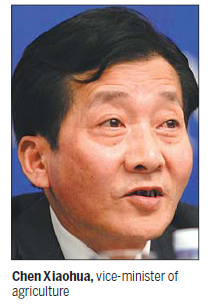
Also speaking, China's Vice-Minister for Agriculture, Mr. Chen Xiaohua noted that China has sent altogether 998 agricultural experts and technicians to 24 countries in Africa, Asia, South Pacific and the Caribbean. The biggest, longest and most productive SSC project by China is with Nigeria,"

Adesina commended FAO for its vision in developing, promoting and nurturing SSC to boost agricultural production in developing countries, noting that out of a total of 998 Chinese experts that have been in the SSC programme across Asia, Africa, South Pacific and Caribbean, 686 have been in Nigeria. He also praised Chinese Government's vision to set up a $30m Trust Fund to support the SSC, noting that the SSC has helped Nigeria in many areas especially in rice production, apiculture, aquaculture, poultry, bamboo production, development of small scale equipment, vegetable production and drip irrigation.

"The impact of the SSC is evident in the lives of farmers, communities and private sector firms that have taken advantage of the programme," he enthused. He appealed for a closer cooperation among participating countries and development partners saying: "Because we now treat agriculture as a business, the SSC should be modified to South-South Agricultural Investment Cooperation."

Backgound:
In 2003, Nigeria signed a Tripartite Project Agreement (TPA) in support of the NPFS.National Programme for Food Security (NPFS) under the Federal Ministry of Agriculture, in conjunction with the People's Republic of China and the Food and Agriculture Organisation of the United Nations (FAO).
  • The Nigeria-China SSC Programme, fis currently in its second phase of implementation.
  • The first phase was implemented between 2003 and 2007, and involved the deployment of 496 Chinese experts and technicians across the 36 states and the Federal Capital Territory.
  • Due to the impressive achievements recorded during the first phase, the Federal Government approved the continuation of the programme under a second phase for another five-year term.
As part of its efforts to eliminate hunger from countries of the south through technological advancement, economic growth and home-grown capacity development, the South-South cooperation (SSC) has many objectives.
  • The South-South cooperation (SSC) in Nigeria is to assist the country to identify, design and implement SSC activities in water control and management, apiculture, horticulture, and vegetable production.
  • Other areas of assistance include fisheries production, crop intensification, agro-processing, livestock production and fabrication of simple farm equipment and tools.
  • They include food and nutrition security for improved livelihood; improved agricultural production and productivity.
  • Others are, building capacity of all those involved in agricultural production and promoting partnership and cooperation between Nigeria and China.

Monday, October 14, 2013

Agribusiness Education Fair of ANAFE

Participants of the Agribusiness Education Fair being held at the World Agroforestry Centre, Nairobi, Kenya

10th – 12th October 2013. Nairobi, Kenya. An Agribusiness Education Fair was held at the World Agroforestry Centre,  The three-day Fair, whose objective to improve Agribusiness teaching, research and practice through stronger linkages between training/research institutions and the private sector brings together academicians, private sector players, Non-Governmental Organizations, policy makers, students and entrepreneurs drawn from across Africa.

The Fair has been organized by the African Network for Agriculture, Agroforestry and Natural Resources Education (ANAFE) and its partners: Forum for Agricultural Research in Africa (FARA) and its UniBRAIN (Linking Universities with Business and Research in Agricultural Innovations) programme, the Pan African Agribusiness Consortium (PanAAC), the Centre for Rural Development Cooperation (CTA), the Association of African Business Schools (AABS) and the World Agroforestry Centre (ICRAF).

ANAFE’s Executive Secretary, Dr Aissetou Yaye, said the Network has invested heavily in forging stronger and effective links between universities/colleges and business enterprises within the context of agribusiness. This has been done through ANAFE’s tin programs of Strengthening Africa’s Agricultural Capacity for Impact on development (SASACID) and Universities, Business and Research in Agricultural Innovation (UniBRAIN).

The first day of the Fair was graced by ICRAF’s Director General, Dr. Tony Simons; Executive Director of the Forum for Agricultural Research in Africa (FARA), Dr. Yemi Akinbamijo; The CEO of the Pan African Agribusiness Consortium (PanAAC), Ms Lucy Muchoki; Senegalese Ambassador to Kenya, His Excellency Mr. Momar Gueye and Prof. Andre Louw, a prominent agribusiness expert from the University of Pretoria, South Africa among others.

AgriBusiness Forum in Rwanda


6 - 10 October. The AgriBusiness Forum is the largest pan-African AgriBusiness Forum held on African soil annually which aims at strengthening the Agri-Food sector in Africa, by encouraging partnerships, exchanging best practices and attracting investments. It is the right platform to discuss and present successful projects and business models. This year, the Forum focused on  "The Agri-Food Sector: A Catalyst for Sustainable and Inclusive Growth in Africa”.

Agnes Kalibata, Minister of Agriculture and animal resources qualified the Agribusiness Forum as "an opportunity for us to unlock the potential of agriculture in Africa and Rwanda". She called Rwanda's private sector to join hands with international partners in this venture. Among the speakers were  Monty Jones (Special Adviser to Sierra Leone President & Former ED of FARA recipient of
the World Food Prize, Sierra Leone) and Yemi Akinbamijo, Executive Secretary – Forum for Agricultural Research in Africa (FARA), Ghana

The governor of the State of Osun, Ogbeni Rauf Aregbesola was presented with an award for “Innovative Agricultural Policy and Practice for Inclusive AgriBusiness Development in Africa”. He started the Osun Rural Enterprise and Agriculture Programme (O’REAP) to train youth in farming. The administration is providing the necessary infrastructure and support for farmers with inputs, which requires supplying them with inputs such as improved seedlings, fertiliser and fumigants among others; giving them hundreds of thousand of already prepared hectares of land.

A total of 610 O’YES Cadets were trained last year at the O’REAP Youth Academy Farm Centres located across the nine Federal Constituencies in the state, with selected participants at 20 per Local Government and 10 from Ife East Area Office.

This year’s edition of the O’REAP Youth Academy, witnessed a significant rise in the number of youth participants, each of the 332 wards in the state is fairly represented with three O’YES Cadets per ward, accounting for 996 Cadets to be trained in modern agriculture at the nine training centres of the O’REAP Youth Academy.

The commitment of the governor to raise agriculture from subsistence to mechanised farming is one of the major reasons for sending 40 youths to Saxony-Anhalt, Germany.

Extracts from the presentations:

Workshop B – Agribusiness incubation, an instrumental tool to unleash the potential of African agriculture and economic transformation
Alex Ariho
Facility Coordinator
UniBRAIN
Ghana

DOWNLOAD PRESENTATION
Henry Bwisa
Professor of Entrepreneurship - JKUAT
Chairman, Investment Promotion Centre
Kenya

DOWNLOAD PRESENTATION


Somasundararam SM. Karuppanchetty
Chief Executive Officer
ABI-ICRISAT
India

DOWNLOAD PRESENTATION

Session II – How to prepare smallholder farmers for commercial partnerships: strategies to enhance smallholders farmer incomes and market access
Raf Somers
Co-Manager of Seeds & Agricultural Development Program
Belgian Development Agency
Rwanda

DOWNLOAD PRESENTATION

Session III – Agro-industries development  promotion in the East AfricaCommunity: a pathway for inclusive market access
Fiona Lukwago
Assistant Director
Kilimo Trust E. Africa
Uganda

DOWNLOAD PRESENTATION
Moses Marwa
Principal Agricultural Economist
East African Community
Tanzania

DOWNLOAD PRESENTATION

Session IV – Facilitating access to Finance in the agribusinessPART I: The role of commercial financing
Sylvia Ngare
Advisor to the CEO
Centum
Kenya

DOWNLOAD PRESENTATION
Eric Kaleja
Resident Representative
KfW/DEG
Kenya

DOWNLOAD PRESENTATION


Daniel Muhimuzi
Country Manager
Oikocredit
Rwanda

DOWNLOAD PRESENTATION
Special Session - EMRC-Rabobank Project Incubator Award
Bukola Adeshina
A & Shine International Ltd
Nigeria
DOWNLOAD PRESENTATION


Cathy Mbuyi Tshiswaka
Optifood Production
Congo - DRC
DOWNLOAD PRESENTATION


Peace Byandusya
Mushroom Training & Resource Centre
Uganda
DOWNLOAD PRESENTATION


Jean Claude Ruzibiza - Award winner
Rwanda Best
Rwanda
Please contact pmm@emrc.be to receive presentation by email

5th African Grain Summit

1st 3rd October 2013.  Mombasa, Kenya. 5th Africa Grain Trade Summit. Over 250 top leaders from Africa including business executives from the private sector, including farmers, traders and millers, non-governmental organizations, development partners, financial institutions, researcher government representatives, regional bilateral institutions, and policymakers convened to discuss key issues affecting the African grain sector. This event was hosted by the Eastern Africa Grain Council (EAGC) and had as theme Africa: The Emerging Frontier for Global Investments in Grain Trade.

“We have seen in the recent past increased investment being channeled to Africa, specifically to the grain sector. There is a need to get more investments in agriculture and agribusiness so as to increase production and productivity of the African agriculture, because we need to increase the food production levels in Africa for the simple reason that Africa has become a net importer of foods, and the food import bill in Africa has already hit the 50-billion U-S dollar mark per year, and this is projected to continue increasing. And more importantly we can reverse the trends and get Africa becoming a net exporter of food and agricultural products”.

The East African Community secretariat has said aflatoxin control in grains and nuts in the region has
been ignored in the past. They said this has had serious consequences on people's health and nutrition.

The EAC deputy secretary general in charge of productive and social sectors Jesca Eriyo yesterday said a number of people have died from ingestion of aflatoxincontaminated food, especially maize. She was speaking during the ongoing 5th African Grain Trade Summit in Mombasa.

Eriyo said the region lacks enhanced grain specific interventions such as construction of modern silos, warehouses, processing plants, and data and information exchange systems to address the problem. "The EAC is working with partners to deal with aflatoxin control," she said.

NTV
;

KTN

SNV

Wednesday, October 2, 2013

First international symposium on Building Capacity for Agricultural Training and Education in Developing Countries

18-20, 2013 September 2013. Fairfax, VA near Washington. InnovATE hosted its first international symposium on Building Capacity for Agricultural Training and Education in Developing Countries
The event explored successful agricultural training and education interventions and identified strategies to meet capacity-building challenges. This year's focus topics were: gender issues and gender curriculum in agricultural education, implementing interventions in post-conflict environments, and rural youth workforce development.

Practitioners and development professionals working in agricultural education and training in primary and secondary education, youth workforce development, vocational education, and higher education were invited to contribute to leadership groups and produce strategy documents which will influence agricultural training and education discourse. World Bank/Team Africa Regional Networks Session - Using Team-Africa as an example, this session helped participants learn how regional networks can be used to collaborate on AET capacity building

Tuesday, October 1, 2013

Opinion: Can value chains and innovation platforms boost African agriculture?

Future Agricultures. 11 reasons to be sceptical

Toni Darbas (CSIRO, Australia) and Jim Sumberg (IDS, UK) express their scepticism about the recent ‘value chains’ narrative in agricultural development discourse that sees agriculture as a ‘business’ that must be ‘professionalised’. The authors believe that there are good reasons to be sceptical about their ability to deliver on the high expectations that are being laid at their door.

Some of the reasons for scepticism they list are: 
  • unknown feedback across administrative scales; 
  • unknown evolution of transaction costs; 
  • private sector interests vs. public ones; inclusion issues; 
  • innovation blueprints insensitive to context; 
  • little direct evidence of positive impact of innovation platforms and value chains to poor farmers. 
They believe there is the constant danger of slipping into uncritical, formulaic and context insensitive responses. A much more critical and realistic approach to the potential contribution and applicability of both value chain approaches and innovation platforms would likely pay large dividends, they conclude.

Results of public consultation on future of organic farming

19 September 2013. Consumers' trust in organic products together with a demand for stricter rules at EU level, are among the main elements coming out of the report on the public consultation on the future of organic farming published today by the European Commission.


The on-line consultation, which took place in the first half of 2013, has attracted major interest with close to 45,000 responses.
  • The report highlights that consumers trust organic products (71 %), that they buy them mainly out of concern about the environment (83%), and because they are free from GMOs and pesticide residues (81%).
  • The vast majority (78%) also indicated that they were prepared to pay more for organic goods.
  • The report also shows a very strong demand for harmonized rules at EU level, with 74 % of all respondents requesting European organic standard to be strengthened and 86% wishing organic rules to be uniform across the EU.
  • More than half of the interviewees also strongly required to improve the European control system for organic products.
  • The results of the public consultation will feed the ongoing review of the political and legal framework for organic agriculture in Europe, with an overall strategy to be put forward in early 2014.

Read the report on the results of the public consultation
Read the executive summary
Read the press release

Now online: an educational series on family farming

October 2013: Have you always looked for ways to learn more about the principles of sustainable agriculture? Are you curious about the values that underlay agro-ecological practices around the world? Have you been searching exercises and games to teach students about all of this? If so, Learning AgriCultures may be just what you are looking for.
Family farmers have much to offer in terms of food production and sustainability. And yet, conventional agricultural education gives little importance to sustainable family farming and the way it works. There is a huge gap between the daily realities of hundreds of millions of family farmers on the one hand, and what is being taught to agricultural students around the world on the other.
Now online: an educational series on family farmingILEIA decided jump into this gap and developed a series of teaching modules that help teachers explore the logic of family farming together with their students. This series, called Learning Agricultures, has become a rich educational resource, inspiring educators to present a fresh and hope giving perspective on the values and principles of family farming in today’s world.

Learning AgriCultures is now accessible online

Banana Hybrids in Uganda

Published on 23 September 2013. For three years now, locals in six districts in northern Uganda have gradually shifted from growing traditional cash crops like simsim and sorghum.

Syngenta to invest $500m in African agriculture

27 September 2013. SWITZERLAND-based agribusiness Syngenta is planning to invest $500m in African agriculture over the next decade as it targets more than $1bn in sales of its seed and crop-protection products.

Mike Mack, CEO of Syngenta International, said in an interview that the "cumulative investments" in Africa would include recruitment and training of more than "700 employees with a high level of agronomic specialisation".

Productivity rises are expected from a modern technological revolution in Africa and genetic modification (GM) of seeds that enable greater crop yields. GM crops have been slow to gain acceptance in Africa but an increasing number of countries are conducting trials and growing limited amounts of crops. South Africa is the continent’s leader in GM technology, cultivating by far the greatest amount of crops.

Syngenta’s move follows that of multinational agribusiness DuPont Pioneer that earlier this year bought 80% of South African seed company Pannar in what it described as its "biggest investment in Africa". Agricultural leaders then predicted that more investments by multinationals in Africa would follow.

Mr Mack said further:
There are many millions of "pre-commercial" smallholder farmers in Africa, but Syngenta does not view the consolidation of small farms into bigger entities as "either desirable or necessary". Countries like India, Vietnam. Indonesia and Bangladesh have shown that agriculture need not be scale dependent. I disagree that there is a need to be big.The argument that only big commercial farms could employ economies of scale does not take into account the role that business could play in providing services for small farmers.Private enterprise must respond to the needs of small farmers. Yes, a small farmer cannot buy an expensive tractor, for example, but businesses or co-ops can provide tractor services, as well as planters and harvesters. It’s done all over the world.