
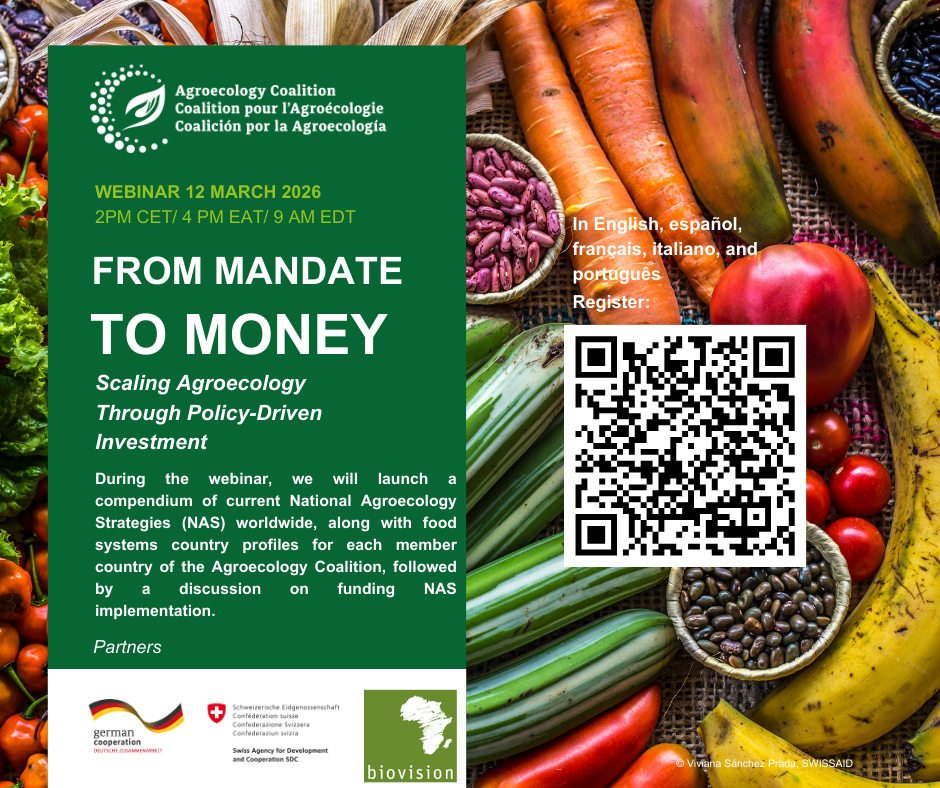
Despite the challenging global context affecting food systems, agroecology continues to advance as a pathway towards food system transformation. This is evidenced by the emergence of national and regional policies and strategies around the world. In 2025, several countries introduced or strengthened their policy frameworks supporting agroecological transitions.
During the webinar the Agroecology Coalition launched a compendium of current National Agroecology Strategies (NAS) worldwide, along with food systems country profiles for each member country of the Agroecology Coalition, followed by a discussion on funding NAS implementation.
- Opening address: Ronnie Brathwaite, Food and Agriculture Organization of the United Nations (FAO)
- Presentation of the Compendium of National Agroecology Strategies and Country Briefs: Oliver Oliveros, Agroecology Coalition
- Moderation: Amelie Steu
Roundtable discussion with country representatives and donors
- Thatheva Saphangthong, Lao PDR
- Fernanda Machiaveli, Ministry of Agrarian Development, Brazil
- Valentina Palmeri and Guido Bissanti, Coordinamento Agroecologia Sicilia
- Stephanie Piers De Ravenschoot, Swiss Agency for Development and Cooperation
- Lauren Baker, Global Alliance for the Future of Food
- Morest Agossadou, Caisse des Dépôts et Consignations du Bénin (CDC Bénin)
- Liesa Nieskens, Deutsche Gesellschaft für Internationale Zusammenarbeit (GIZ)
- John Garcia Ulloa, Biovision Foundation
- Moderation: Oliver Oliveros, Agroecology Coalition
- Moderation: Marion Michaud, European Commission
Resources:

On this page you will find National Agroecology Strategies and Laws in Benin, Bolivia, Brazil, Burkina Faso, Colombia, Cuba, Dominican Republic, Ethiopia, Kenya, Tanzania, Tunisia, and Uruguay
On this page, you will find 53 country briefs—one for each member government of the Agroecology Coalition.
Each country brief provides information on:
- National agricultural context
- Main food and agriculture policies, strategies, and laws currently in force, including key highlights
- Ongoing agroecology programs and projects
- International development cooperation initiatives related to agroecology
- Recent news and innovations linked to food systems and agroecology
- Agroecology Coalition member organizations in the country
- Additional resources for further reference
- These briefs offer an overview of how each country is advancing food systems transformation through agroecology, reflecting its specific social, economic, environmental, and political context.


No comments:
Post a Comment