

The webinar emphasized that the rapid growth of livestock production, agro-processing, and municipal organic waste streams creates significant opportunities for developing profitable circular bioeconomy businesses based on compost, manure, biofertilizers, and other organic soil amendments.
The presentations examined the commercial dimensions of the sector, including the current and projected market size for organic fertilizers, emerging business models adopted by producers and distributors, investment requirements, access to finance, and the importance of quality assurance and certification.
Speakers highlighted that while demand for sustainable soil fertility solutions is increasing across Africa, investors continue to face constraints such as fragmented supply chains, inconsistent product standards, limited technical capacity, and insufficient policy support. The discussion therefore proposed recommendations to strengthen enabling policies, improve regulatory frameworks, expand financing mechanisms, and encourage private-sector participation in scaling locally produced organic fertilizers.
- A practical policy perspective was provided by Moses Abukari, IFAD Regional Programme Manager, who presented European Union-funded initiatives that promote farmers' access to fertilizers through electronic voucher (e-voucher) systems while progressively encouraging a shift toward organic and integrated nutrient management.
The webinar concluded that investment in organic fertilizers is not only an environmental opportunity but also an economic one, capable of creating rural enterprises, improving soil fertility, strengthening food system resilience, and advancing agroecological food systems across Africa. By linking public investment, private entrepreneurship, and farmer incentives, the session illustrated how organic fertilizer markets can contribute simultaneously to agricultural productivity, climate adaptation, and sustainable rural development.
 Highlight: OFIMAK the association of organic farm inputs manufacturers in Kenya.
The Organic Fertilizers and Input Manufacturers Association of Kenya (OFIMAK) is the national association representing manufacturers of organic fertilizers, bio-inputs, and other sustainable agricultural inputs in Kenya.
- Established in 2023, the association seeks to accelerate the adoption of organic farm inputs by creating awareness among farmers, advocating for supportive policies, strengthening quality standards, and building partnerships with government, research organizations, development agencies, and the private sector.
- OFIMAK's vision is to empower farmers and manufacturers to champion sustainable plant and soil health solutions, while its mission is to lead Kenya's soil health agenda through increased use of locally produced organic inputs that contribute to food security, climate resilience, and environmental sustainability. The association also promotes research and innovation, provides training and networking opportunities for its members, and aims to increase the share of organic farm inputs in Kenya's fertilizer market from approximately 2% to 30% within five years.
- OFIMAK has become an important platform for advancing Kenya's agroecological transition by bringing together manufacturers, researchers, regulators, and farmers around sustainable soil fertility management. The association works closely with organizations such as the Kenya Agricultural and Livestock Research Organization (KALRO), the African Fertilizer and Agribusiness Partnership (AFAP), and government agencies to integrate organic fertilizers into national soil health strategies and extension services.
- Its members promote circular economy approaches by converting agricultural and organic waste into high-quality composts, biofertilizers, soil conditioners, and biostimulants, thereby reducing waste, lowering agriculture's carbon footprint, and improving long-term soil productivity. Through advocacy, capacity building, and public-private collaboration, OFIMAK is positioning Kenya's organic input industry as a key contributor to resilient, low-emission, and commercially viable agrifood systems.
Transforming Agricultural Practices: In Kenya's highlands, farmers sought sustainable solutions; OFIMAK transformed practices with organic inputs, fostering environmental resilience.
Shared resources:
Ellssel, Pierre & Freyer, Bernhard & Posthumus, Helena & Hobart, Marius & Nyakanda, Fortunate & Amizero, Nadege & Abubakari, Fatimah & Saussure, Stéphanie. (2026). Exploring the state of ex situ organic fertilizer and soil amendment production: an innovation systems analysis across eleven African countries. Frontiers in Sustainable Food Systems. 10. 10.3389/fsufs.2026.1656284.
- Many farming systems across Africa suffer from insufficient recirculation and replenishment of nutrients and organic matter, contributing to soil degradation.
- At the same time the scant management of municipal organic waste, agro-processing residues, and human excreta creates substantial externalities. Valorizing organic waste and recycling it back to farmland could create a win-win situation.
- South Africa stands out, with multiple functions institutionalizing and reinforcing one another, characterized by pronounced private sector R&D, established entrepreneur networks and professional associations as well as recycling targets and public support of knowledge brokers.
- Across all countries, disruptions in national and international value chains are acting as pull factors for increased experimentation, raising demand, and enhancing legitimacy.
De Marinis, P., Ceriani, R., Rega, C., Schievano, A., Callenius, C., Alali, S., Mouratiadou, I., Rembold, F. Yield and economic performance of agroecological transitions in the Global South - A geospatially-augmented meta-analysis
- The findings show an average 14.3% increase in crop yields, a 44.5% increase in gross income, and a 36.5% reduction in production costs when applying agroecological practices.
- This study has been financially supported by DG INTPA under the Administrative Agreement on "Scientific and Technological Support to Regional Centres of Excellence related to Green Transition”.
- This meta-analysis evaluates the multi-dimensional impacts of agroecological transitions on farm
economic performance across the Global South, covering Sub-Saharan Africa, South/Southeast Asia, Latin America and Australia. - By drawing from a database of over 350 primary studies, the research quantifies the effect of transitioning from more conventional, input-intensive farming to more integrated agroecological systems.
Freyer, Bernhard & Ellssel, Pierre & Nyakanda, Fortunate & Saussure, Stéphanie. (2024). Exploring the off-farm production, marketing and use of organic and biofertilisers in Africa - A scoping study. 10.13140/RG.2.2.14042.56004.
- This comprehensive scoping study on the off-farm production, marketing, and use of organic and biofertilisers (OFBF) in 12 African countries reveals significant potential for improving soil health and food security.
- It highlights the urgent need for robust regulatory frameworks, quality control, and expanded circular-economy waste recycling.
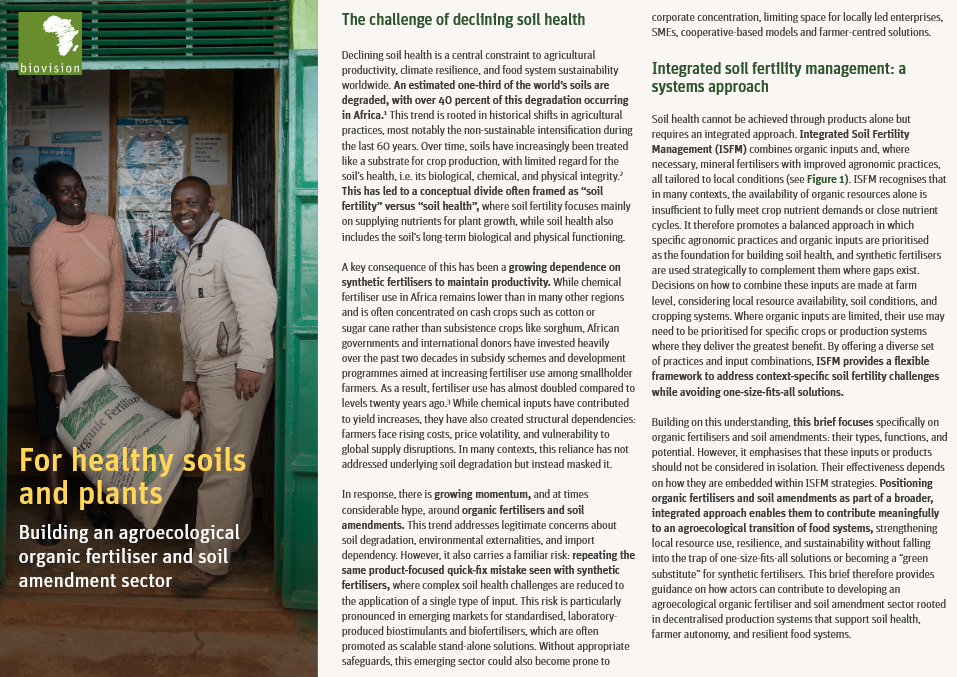
- Poor soil health is making it harder to grow food, adapt to climate change, and build sustainable food systems around the world.
- From compost tea, worm tea, plant extracts, bioslurry, and animal manure to insect frass, vermicompost, bokashi, compost, biochar, and more—these locally produced soil amendments can play a key role in restoring soil health and reducing dependence on synthetic inputs.
- But to support a transition to more sustainable and agroecological food systems, they need to be part of a broader approach that values local resources, builds resilience, and avoids one-size-fits-all solutions.


No comments:
Post a Comment